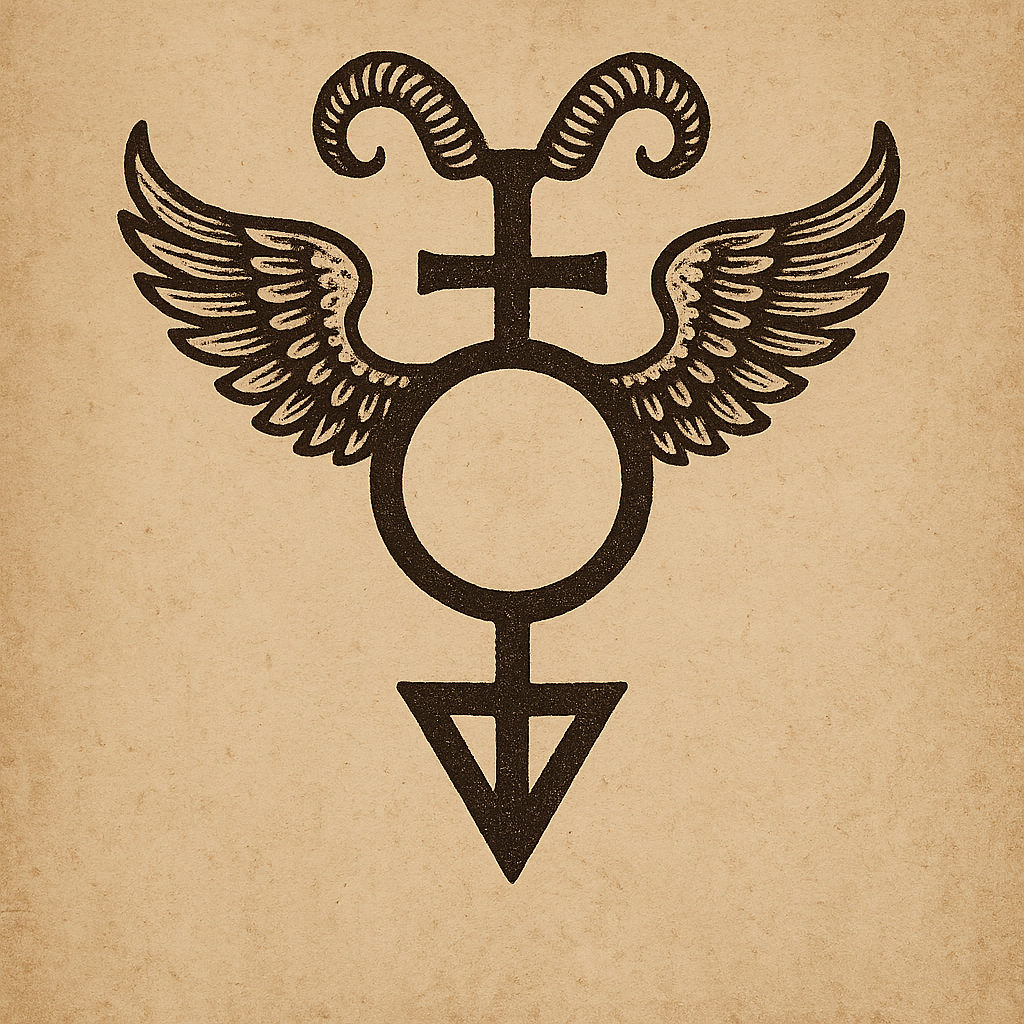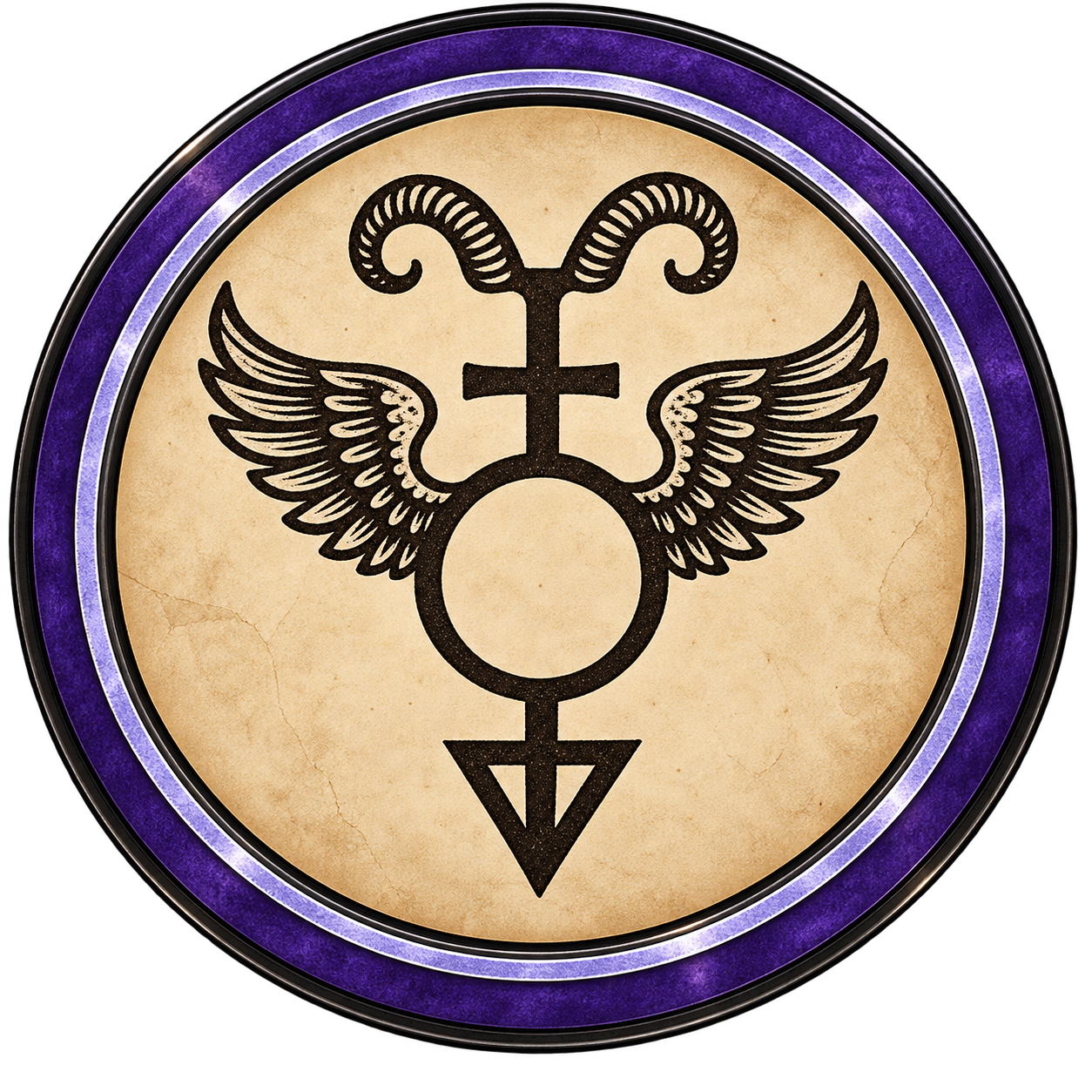
Hermes
The Light That Travels Between Worlds
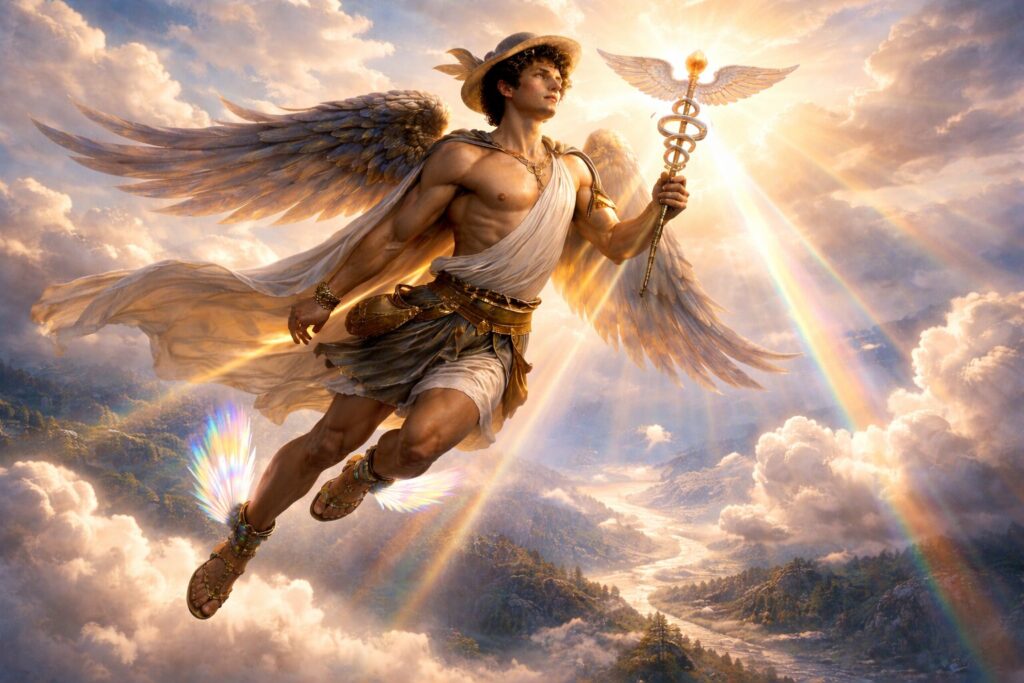
At the meeting of worlds there must be a way for messages to travel.
When the first thresholds of creation opened and the realms of existence began to touch one another, something new became necessary: communication. Ideas had to move. Knowledge had to travel. Signals had to pass between the living, the dead, the divine, and the unseen currents of the world.
In the ancient traditions of the Mediterranean and beyond, that living intelligence of communication took form as Hermes.
Hermes is not simply a messenger in the narrow sense. He is the great communicator between realms — the one who carries knowledge across boundaries, moves ideas between cultures, and keeps the roads of understanding open. Wherever there are travelers, traders, translators, writers, magicians, and seekers of knowledge, the presence of Hermes can often be felt nearby.
If the Earth Mother grounds the world in living substance, and if Hekate stands watch at the thresholds where realms meet, Hermes is the one who walks the roads between them.
Hekate guards the crossroads.
Hermes walks the roads that meet there.
For this reason Hermes appears wherever exchange is taking place. He presides over the movement of goods in markets, the sharing of stories between cultures, the discovery of new ideas, and the transmission of knowledge across generations. Trade routes, libraries, crossroads shrines, and places of learning have long been considered part of his domain.
He is youthful but ancient, playful yet wise. The myths often portray him as clever and mischievous, but beneath that playful energy lies something deeper: the restless intelligence that drives discovery and connection. Hermes represents curiosity itself — the impulse that pushes humanity to explore, to communicate, and to understand.
In the traditions of magic and spiritual practice he also serves another role. Hermes interprets signs, translates symbols, and guides communication between worlds. Where Hekate governs the threshold, Hermes helps meaning travel across it.
For those who seek knowledge, inspiration, insight, or the courage to follow a road that has not yet been walked, Hermes remains a powerful and living presence.
The Name of Hermes and the Herm Pillars
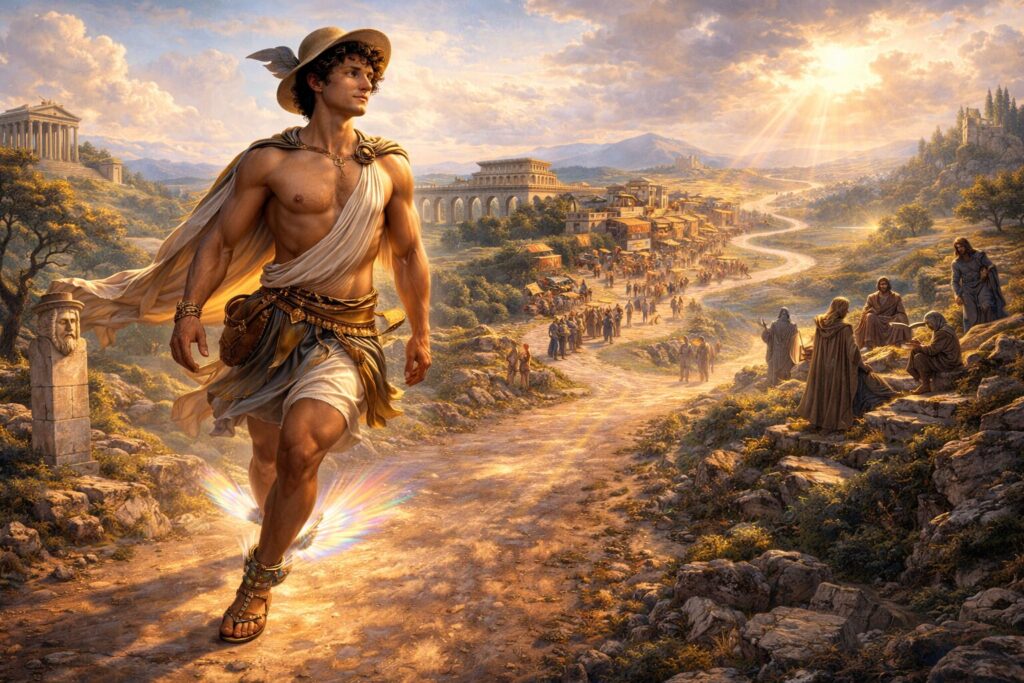
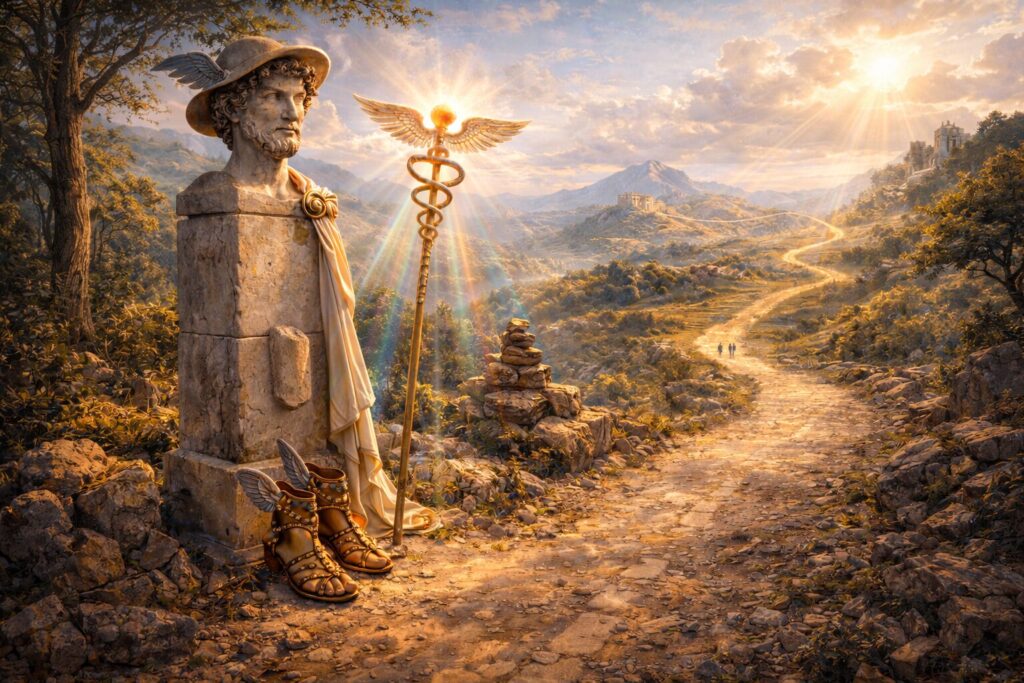
The name Hermes is closely connected to the ancient Greek word herma, which referred to a stone marker placed along roads, boundaries, and crossroads. These markers eventually developed into what were known as herm pillars — upright stone columns often topped with the head of Hermes.
Throughout the ancient Greek world these pillars stood along roads, at city gates, in marketplaces, and at important boundaries. Travelers would pass them, merchants would make offerings beside them, and communities believed they provided protection and guidance along the journey ahead.
Because of this connection, Hermes became strongly associated with the movement of people and ideas across the landscape. Roads, trade routes, and places of exchange naturally fell under his influence, and the herm pillar itself became a symbol of the god’s presence wherever paths converged and communication flowed.
Even today the image of the herm pillar reminds us that Hermes is not a distant figure locked within temples. His presence is found along the roads between places — wherever travelers meet, cultures exchange knowledge, and new discoveries begin their journey into the world.
Hermes Through Time
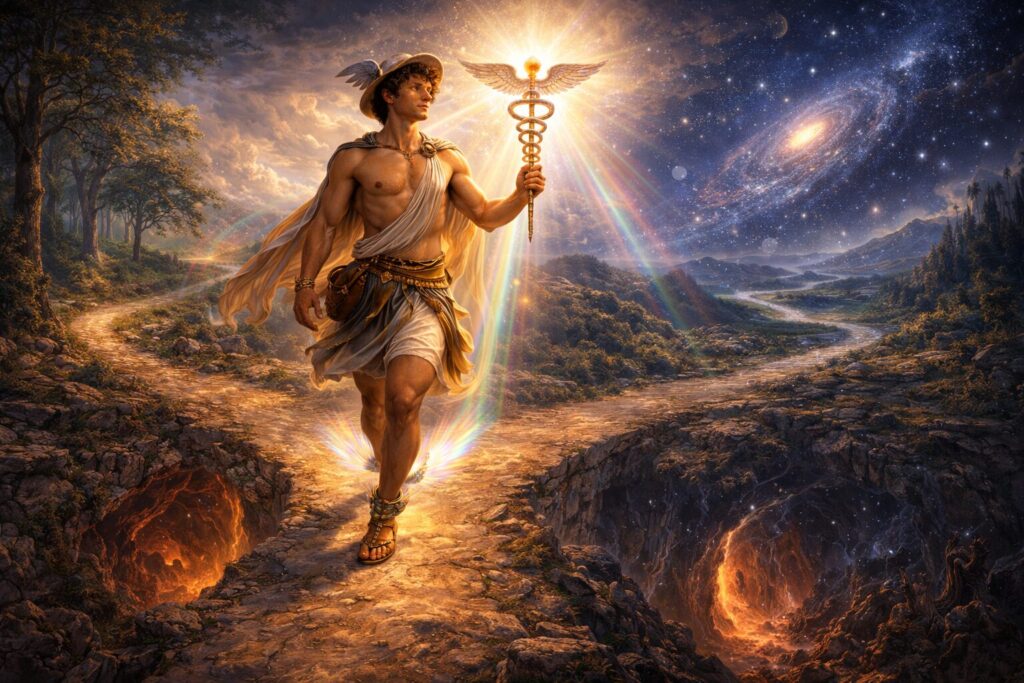
Hermes does not remain confined to one era, one city, or even one culture. As roads widened, trade increased, and ideas moved more freely between peoples, Hermes traveled with them. His expression changed across time, but the current beneath those changes remained recognizable: movement, communication, exchange, and the illumination that comes when worlds begin to speak to one another.
There is a moment in every living system when boundaries begin to interact.
In the earliest layers of myth and philosophy, the world first becomes stable through foundational forces — the earth itself, the great structures of existence, and the thresholds that divide one realm from another. But once those thresholds exist, something new inevitably follows: the need for communication.
Worlds begin to speak.
Messages must pass between the living and the dead, between human beings and the divine, between cultures, languages, and ideas. Knowledge must travel. Meaning must be carried from one place to another. Without that movement, even the most perfectly structured world would remain silent.
This is where Hermes appears.
Hermes is not merely a figure who carries messages; he represents the living intelligence that allows communication to occur at all. He governs translation, interpretation, exchange, and the movement of understanding across boundaries. Where one realm meets another, Hermes provides the path by which meaning travels between them.
In this way his role naturally complements that of Hekate. The two are often associated with crossroads and transitions, but their functions differ in a subtle and powerful way.
Hekate guards the thresholds themselves. She stands at the places where worlds meet and holds open the gates between them.
Hermes walks the roads that connect those gates.
Because of this, Hermes becomes the patron of communication in every form. Trade routes, languages, diplomacy, storytelling, writing, philosophy, and magical symbolism all fall within his sphere. Whenever ideas move from one mind to another, from one culture to another, or from one realm of existence to another, the current of Hermes is at work.
This is also why he is frequently portrayed as youthful and playful. Discovery requires curiosity, and communication requires flexibility. Hermes introduces motion into creation — the restless intelligence that refuses to let knowledge remain stagnant.
Through him, information becomes inspiration. Exchange becomes creativity. And the silent spaces between worlds begin to speak.
Symbols of Hermes
Hermes is recognized through symbols of movement, exchange, protection, and inspired communication. These are not decorative details added to an already complete god. They are part of the language through which his presence has long been understood: roads, wings, staffs, markers, and signs that reveal a deity always in motion between worlds.
Hermes is rarely encountered without symbols. Roads, wings, staffs, stones, and signs appear wherever his current is active. These symbols are not decorative additions but part of the language through which Hermes has long been recognized.
Exchange is one of the great engines of human civilization.
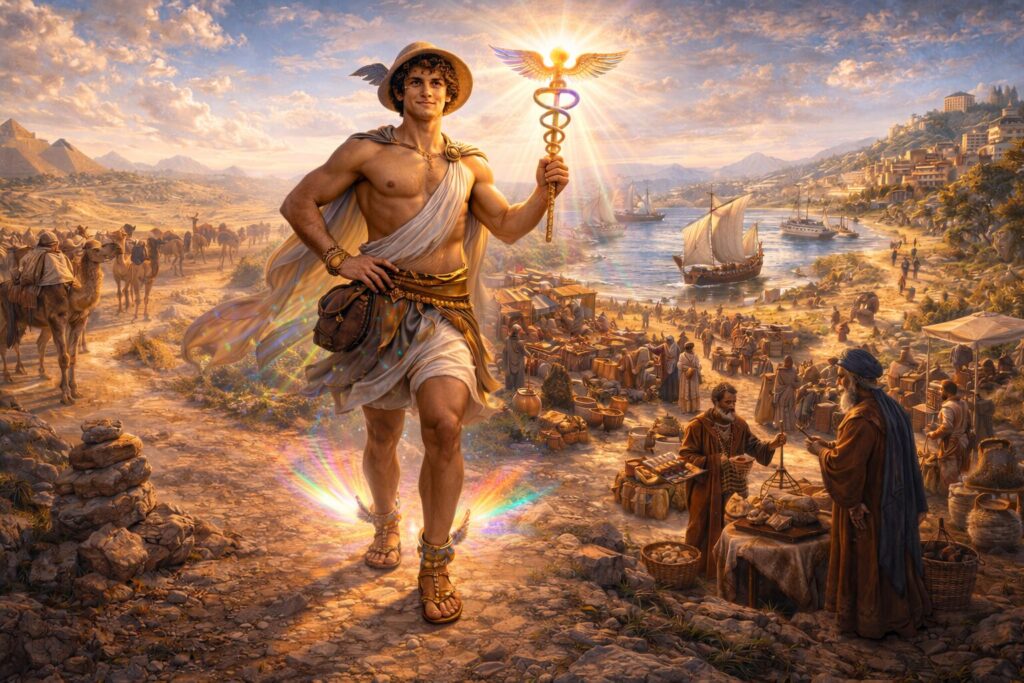
Whenever goods change hands, whenever stories move from one culture to another, whenever knowledge travels across generations, something more than simple transfer is taking place. Exchange allows ideas to grow, evolve, and transform. Through it, discoveries spread beyond their place of origin and become part of the shared inheritance of humanity.
In mythic language, this living current of exchange belongs to Hermes.
Hermes governs far more than roads and travel. He presides over the movement of meaning itself. Communication, trade, translation, diplomacy, invention, and intellectual discovery all fall within his sphere because each of them requires the ability to carry something valuable from one mind or culture to another.
Commerce in this sense becomes more than the buying and selling of goods. It represents the circulation of value. A marketplace is not only a place where objects are traded; it is a meeting ground of ideas, languages, customs, and possibilities. Hermes thrives wherever such circulation is active, because his nature is expressed through movement and exchange.
This is also why Hermes becomes closely associated with language and symbolic systems. Writing, alphabets, and coded forms of communication allow knowledge to travel across time as well as space. A written sign can cross centuries in the same way a traveler crosses a mountain pass. Through symbols, the voice of one age can reach another.
Magical traditions have long recognized this connection. Systems of sacred writing, symbolic alphabets, sigils, and encoded forms of knowledge all reflect Hermes’ domain of communication across boundaries. These systems allow meaning to travel between the visible and invisible layers of the world.
For those interested in magical writing systems and sacred alphabets, Hermes’ influence can often be seen in the way symbols carry intention and knowledge between practitioner and cosmos.
Hermes’ connection to illumination through knowledge also becomes especially visible in the Hermetic philosophical tradition. In those teachings, communication itself becomes a sacred act: the transmission of insight from divine intelligence into human understanding. Here Hermes appears not only as traveler and negotiator, but as revealer of hidden wisdom.
Because of this, Hermes is often honored by writers, translators, students, scholars, inventors, merchants, and magicians alike. All of them participate in the same underlying current: the movement of ideas from one place of awareness to another.
Wherever knowledge is shared, interpreted, or transformed into new understanding, the work of Hermes continues.
Hermes Across Cultures
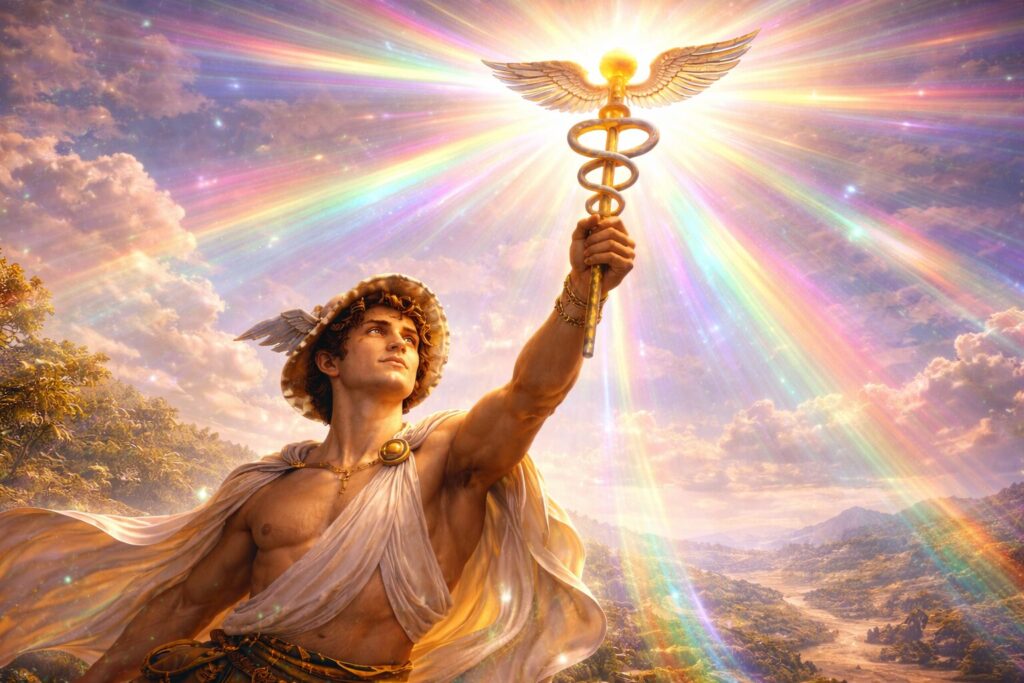
Hermes does not feel culturally isolated. As trade expands, ideas circulate, and languages meet, figures with similar functions begin appearing again and again: gods of roads, wisdom, exchange, speech, sacred knowledge, mediation, and inspired cunning. This does not mean all such beings are identical, but it does suggest that Hermes expresses a current widespread in human religious imagination.
Many practitioners experience Hermes through moments of synchronicity — unexpected messages, coincidences, or discoveries that seem to arrive precisely when needed.
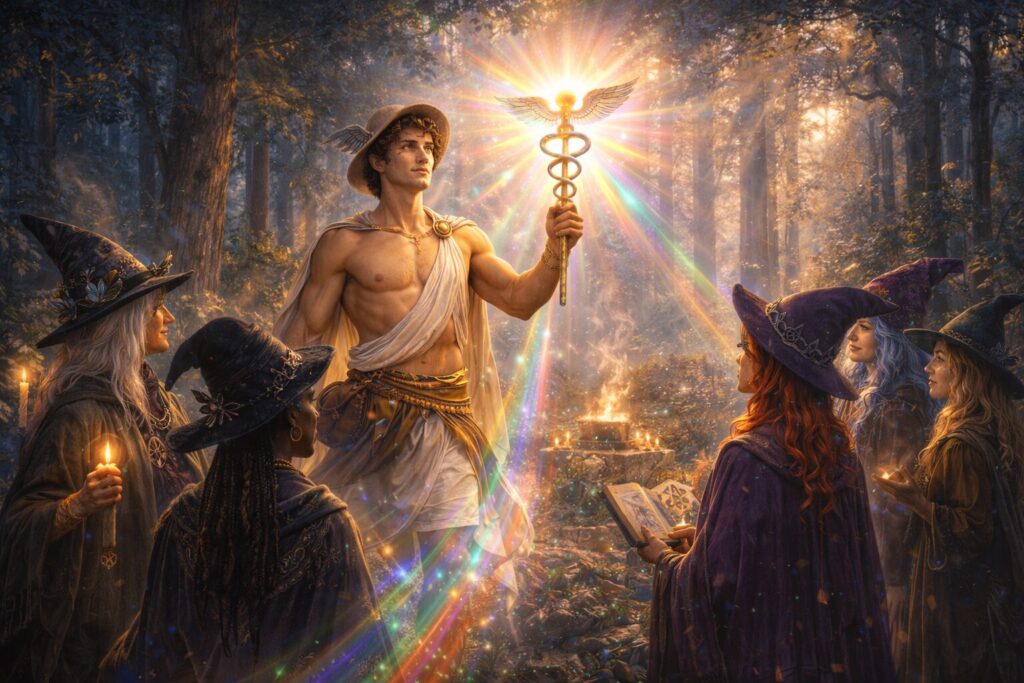
Long before the modern world, the ancient world was already connected by movement.
Caravans crossed deserts carrying spices, textiles, metals, and stories. Ships moved between ports bearing goods and ideas. Roads stretched across mountains and valleys, linking cities that might otherwise have remained strangers to one another. At every stage of this movement, cultures encountered difference and learned to negotiate it.
In mythic language, this living circulation belongs to Hermes.
Hermes presides over roads because roads allow worlds to meet. A road is never merely a strip of earth connecting two places. It is a channel through which knowledge travels, trade develops, alliances form, and cultures influence one another. When a road opens, isolation ends. Communication begins.
Trade itself carries this same meaning. At first glance commerce appears concerned only with material exchange, but beneath that practical surface something deeper occurs. Merchants bring languages into contact. They introduce new techniques, foods, symbols, and beliefs. Markets become places where strangers learn how to understand one another.
In this way commerce becomes a form of cultural conversation.
Hermes thrives wherever such exchange takes place. He governs negotiation, persuasion, clever strategy, and the ability to recognize value where others might overlook it. His presence can be felt wherever people learn to translate difference into opportunity rather than conflict.
This is also why Hermes has long been honored by travelers, merchants, diplomats, and interpreters. Each of these roles requires an ability to move between systems of meaning. One must listen carefully, adapt quickly, and speak with precision. The successful traveler and the successful negotiator both share a Hermes-like quality: the ability to move fluidly between worlds.
When this exchange functions well, something remarkable happens. Knowledge multiplies. Innovation spreads. Culture becomes more dynamic. New ideas are born at the meeting point between traditions.
In this sense Hermes does not merely govern travel or commerce. He governs the movement of civilization itself.
Where people meet, trade, translate, invent, negotiate, and learn from one another, the current of Hermes continues to move.
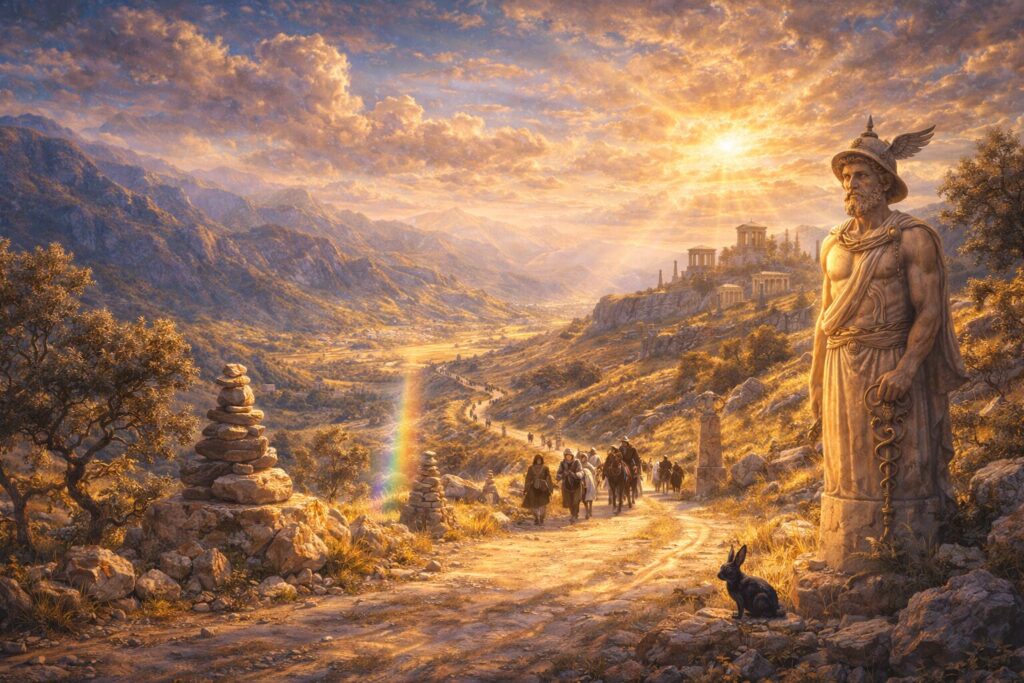
Magic, at its deepest level, depends on communication.
Symbols must carry intention. Words must shape meaning. Signs must be interpreted correctly. Messages must travel between visible and invisible layers of reality. In this sense, magic is not only about power — it is about understanding how meaning moves through the world.
For this reason Hermes has long been associated with magical knowledge.
Unlike forms of magic rooted primarily in deep ritual or the guardianship of thresholds, Hermes represents the intelligence that allows magical systems to function. He governs interpretation, symbolism, translation, and the moment when a pattern suddenly becomes clear. Insight, inspiration, and sudden understanding often arrive with a distinctly Hermetic quality.
In magical practice Hermes is therefore often connected to systems of symbolic communication. Sacred alphabets, coded writing systems, sigils, and magical scripts all depend on the idea that meaning can travel through symbols across time and space. Through these systems, the practitioner sends intention outward and receives insight in return.
Those interested in sacred writing traditions can explore this current further through magical alphabets, where symbols themselves become vehicles for intention and knowledge.
Divination also belongs naturally within Hermes’ sphere. Reading signs, interpreting omens, translating patterns, and recognizing the subtle language of the world all require a mind capable of moving quickly between possible meanings. Hermes assists in this interpretive process, helping the practitioner perceive connections that might otherwise remain hidden. This makes him a natural ally in practices such as divination.
Hermes’ connection to illumination through knowledge also reaches its most philosophical expression in the Hermetic tradition. In these teachings, communication between divine intelligence and human understanding becomes a sacred act. Insight is not merely discovered; it is revealed through symbolic language, contemplation, and inspired interpretation.
Those drawn to this current may wish to explore Hermeticism, where the movement of knowledge between realms becomes a path of spiritual awakening.
In this way Hermes supports magic not through solemn authority, but through illumination. He helps the practitioner recognize patterns, understand symbols, and communicate intention clearly. Where confusion dissolves into understanding, where signs begin to speak, and where knowledge moves freely between mind and cosmos, the presence of Hermes can often be felt.
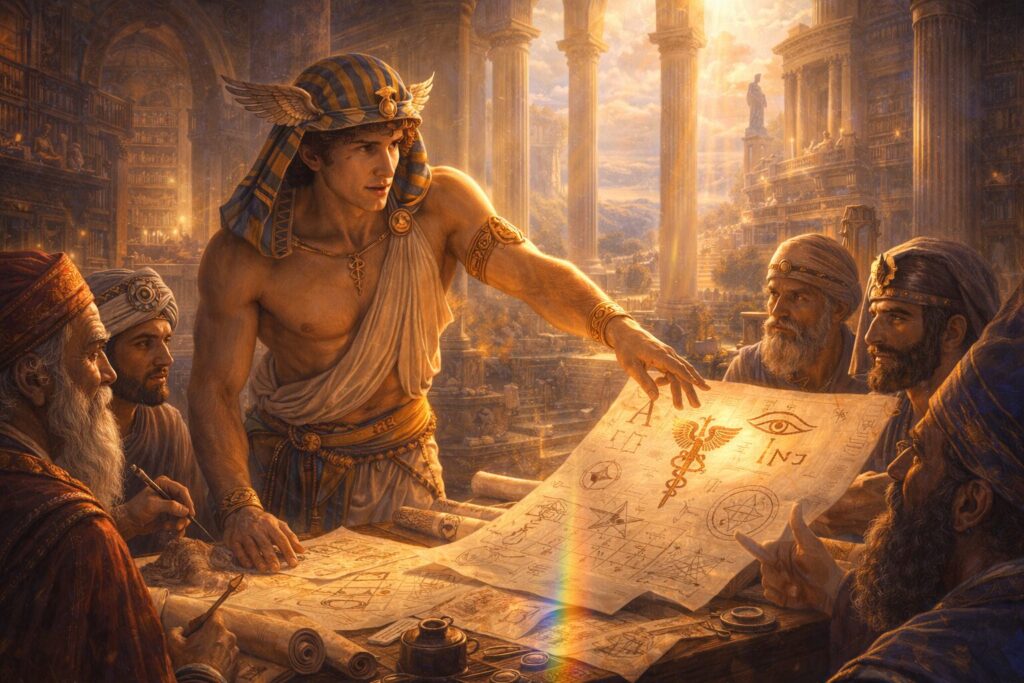
Hermes in Modern Pagan Practice
Hermes continues to attract practitioners whose lives revolve around movement, knowledge, and communication. Wherever ideas travel quickly and understanding must bridge different worlds, his presence is often recognized.
Writers and Communicators
Hermes governs language, storytelling, translation, and the transmission of ideas. Writers, journalists, speakers, and teachers often find inspiration in his current.
Students and Seekers of Knowledge
Hermes encourages curiosity, intellectual exploration, and discovery. Students and scholars often turn to him for insight and clarity when learning new systems of knowledge.
Travelers and Explorers
As a god of roads and movement, Hermes has long been honored by travelers, wanderers, and those whose lives involve crossing borders both literal and symbolic.
Entrepreneurs and Traders
Hermes presides over commerce, negotiation, and the movement of value. Entrepreneurs, merchants, and innovators often recognize his presence in successful exchanges.
Magicians and Diviners
Hermes assists in interpreting symbols, reading signs, and communicating meaning between visible and invisible worlds. This makes him a natural ally for magical practitioners.
Translators and Bridge Builders
Whenever people work to connect cultures, languages, disciplines, or communities, they participate in the same current Hermes has long represented: communication across difference.
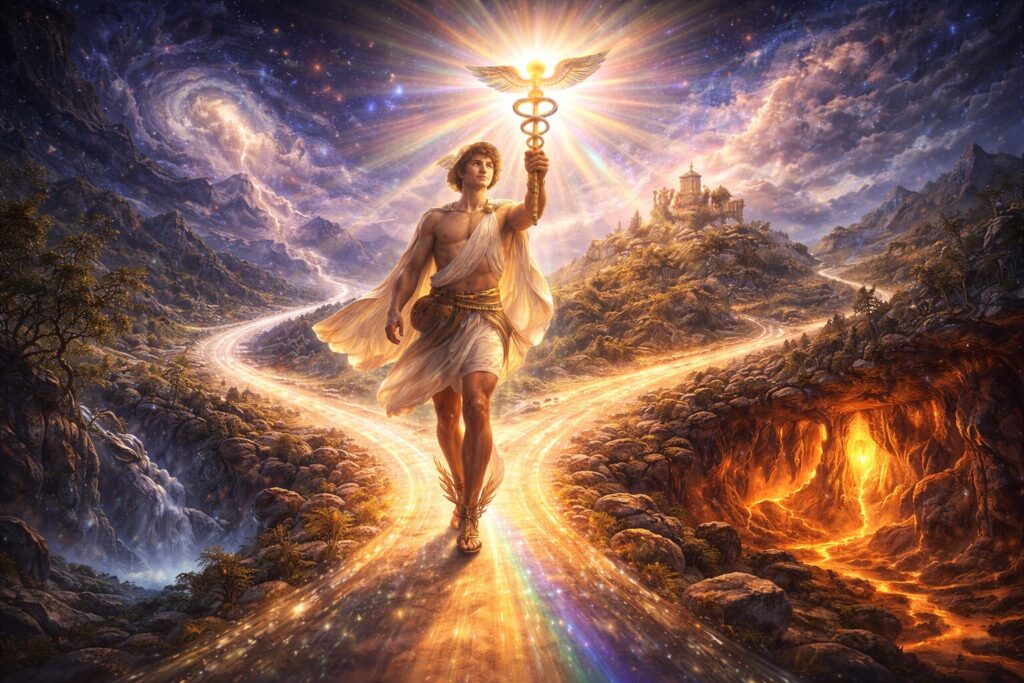
The world is held together not only by structure, but by movement.
Mountains may anchor the land, and thresholds may divide one realm from another, but without the ability for meaning to travel across those boundaries, creation would remain silent. Knowledge would remain isolated. Cultures would never meet. Insight would never pass from one mind to another.
Hermes ensures that this silence never takes hold.
He represents the living current through which connection becomes possible. Through him, messages cross distances, ideas circulate through civilizations, and understanding begins where once there was only separation. His presence is felt wherever translation occurs, wherever strangers learn to speak to one another, and wherever curiosity leads someone to follow a road they have never walked before.
This is why Hermes appears both playful and profound at the same time. The trickster element in his nature is not mere mischief. It reminds creation that intelligence must remain flexible. Systems that become too rigid eventually lose their ability to communicate. Hermes loosens what has become stuck so that movement and discovery can begin again.
In the same way, he continues to guide seekers of knowledge today. Writers, travelers, students, negotiators, translators, magicians, and innovators all participate in the same ancient current: the movement of meaning between worlds.
Even the symbols associated with Hermes — the winged sandals, the traveler’s hat, the staff of mediation, the markers along the road — remind us that the journey of understanding never truly ends. There is always another horizon, another idea waiting to be discovered, another conversation that can change the direction of a life.
For those who walk with curiosity, courage, and a willingness to listen across difference, Hermes remains close.
The roads between worlds are still open, and the great communicator continues to travel them.
A Blessing of the Open Road
May Hermes guide your steps where roads divide and new paths begin. May his light fall across your way like the first gold of morning, revealing not every answer at once, but enough for you to move forward with courage and curiosity.
May the great communicator between realms open your mind to knowledge, your voice to truth, and your spirit to the living exchange of wisdom. May language serve you well, and may understanding travel freely where confusion once stood.
May your journeys be protected, your conversations meaningful, and your discoveries timely. May you recognize signs when they appear, opportunities when they open, and unexpected roads when they call your name.
And when the distance between worlds feels wide, may Hermes remind you that the road is never truly closed. Meaning can still travel. Insight can still arrive. The way can still open.
May Hermes bless the road before you.