More Elements for Spellwork
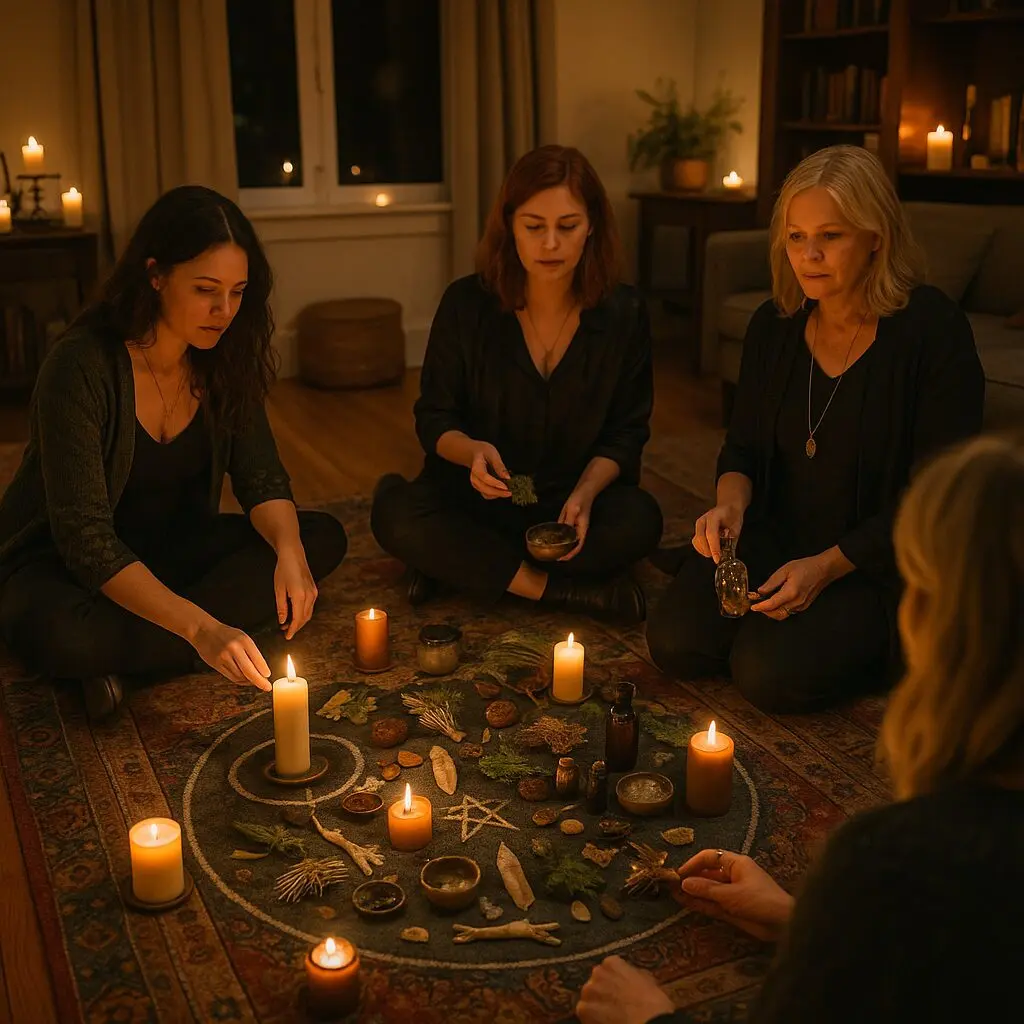
Spellwork is often discussed in terms of tools, yet tools alone do not create a working. Magic emerges from conditions: the shaping of space, the ordering of attention, the use of material symbols, the presence of memory, and the quality of relationship between practitioner, act, and outcome. These elements exist whether an altar is present or not.
What is gathered here are not primary instruments of power, but the supporting structures through which spellwork becomes coherent and repeatable. Atmosphere, timing, physical materials, the body itself, record-keeping, offerings, and shared practice all contribute to how intention takes form. They influence clarity, stability, and resonance — not by adding force, but by reducing distortion.
None of these elements are mandatory, nor do they signify advancement. Many effective workings rely on only one or two. Others develop organically over years of practice. Their value lies not in accumulation, but in appropriateness: knowing when a condition strengthens a working, and when it merely decorates it.
This page does not present a checklist or a hierarchy. It outlines a field of practice — the often overlooked structures that support spellwork before, during, and after it is performed. Approach these elements as you would any craft tradition: experimentally, ethically, and with attention to what actually changes when they are introduced.
The Shaping of Space

Space is not a neutral container for spellwork. It participates. Whether a working is performed in a dedicated room, a habitual working area, or a deliberately chosen liminal setting, the conditions of that space influence attention, perception, and continuity. Before intention is shaped, the environment in which it arises has already begun to structure the outcome.
The shaping of space is not decoration. It is a preparatory act—one that establishes boundaries, reduces interference, and signals transition from ordinary awareness into deliberate practice. This may be accomplished through scent, light, sound, physical arrangement, or silence itself. The specific methods matter less than their consistency and appropriateness to the working at hand.
Environmental elements commonly used
Incense, smoke, or scent marks transition, clears residual attention, and helps establish continuity across repeated workings. Smoke functions less as a “cleanser” in a literal sense than as a visible carrier of change—something that moves, permeates, and dissipates.
Light and illumination (candles, lamps, controlled darkness) alters focus and depth of perception. Used here, light is not a spell component so much as a means of narrowing attention and reducing visual noise.
Sound and silence regulate rhythm and internal pacing. Silence, when chosen deliberately, is an active condition rather than an absence.
Physical arrangement shapes posture and movement. Repeated layouts allow the body to recognize a working space before conscious intention is engaged.
Dedicated and liminal spaces
Permanent or dedicated spaces tend to function more efficiently over time. Through repeated use, they accumulate stable correspondences: patterns of movement, habitual gestures, symbolic arrangements, and expectations that reduce the effort required to enter a working state. Intention, focus, and meaning are partially pre-loaded.
Liminal spaces—thresholds, temporary locations, outdoor sites, borrowed environments—can be equally effective when deliberately chosen. However, they demand greater precision. Correspondences must be established actively rather than assumed, and focus must be maintained with fewer environmental supports. Such spaces are often selected not for convenience, but because the nature of the working calls for transition, ambiguity, or movement between states.
Neither approach is inherently superior. The distinction lies in cost: dedicated spaces trade flexibility for efficiency, while liminal spaces trade stability for specificity.
Containment and threshold
More important than atmosphere is containment. A shaped space distinguishes inside from outside—not symbolically, but functionally. This distinction allows a working to begin and end cleanly, preventing diffusion of attention and reducing the sense of incompletion that often follows poorly bounded practice.
Pro tip: ending a working as deliberately as it begins prevents both energetic bleed and unnecessary rumination.
Space as memory
Spaces remember through repetition—not mystically, but behaviorally and neurologically. A location used consistently for focused work begins to elicit the same internal state with less effort. This effect is strongest in dedicated spaces, but it can be cultivated even in temporary environments through consistent preparatory actions.
In advanced practice, the shaping of space becomes increasingly economical. Fewer tools are required, not because they were unnecessary, but because their functions have been internalized. What remains essential is clarity: knowing when a space is open to work, and when it has been returned to rest.
Material Symbols and Sympathetic Forms

Material elements in spellwork do not function because they are inherently powerful, but because they give intention a stable language. Matter slows thought. It resists abstraction. When a working is anchored in physical form, it becomes less prone to drift, reinterpretation, or internal contradiction.
Symbols used in this way are not decorative metaphors. They are operational. A candle, herb, stone, vessel, or written mark serves as a point of convergence—a place where intention, attention, and action agree on what is being done. The value of material symbols lies in their capacity to hold meaning steady long enough for change to occur.
Symbolic versus sympathetic use
Symbolic materials rely on shared language—color correspondences, planetary metals, traditional herbs, ritual forms. Their effectiveness increases with familiarity and repetition, both personal and communal.
Sympathetic materials rely on relationship—names, photographs, soil, locations, personal items, crafted representations. These are often more precise but less forgiving: ambiguity in the link tends to produce ambiguity in the outcome.
Most effective workings combine both modes: symbol to give shape, sympathy to give direction.
Common material forms
Candles and controlled flame structure duration, focus, and transformation. Here, the candle is also a temporal engine: it marks beginning, sustains attention, and provides a natural conclusion.
Herbs, resins, oils, and powders encode layered meaning—historical, sensory, associative. Physical properties (scent, texture, volatility) matter as much as attributions.
Containers and vessels (jars, bowls, boxes, poppets, bindings) function as limits: they define where a working resides and how it persists.
Written forms and marks externalize intention—names, sigils, petitions, inscriptions—fixing language in time so it becomes examinable and repeatable.
Economy of materials
More material does not equal more effect. Excess often introduces contradiction: too many symbols pointing in slightly different directions, too many correspondences competing for emphasis. Skilled practice tends toward economy—clarity over density.
Pro tip: if a material cannot be clearly explained, it is often better omitted.
Material lifecycles
Materials have beginnings, durations, and endings. Some are consumed, some dismantled, some buried, returned, cleansed, or retained. Knowing how a working concludes materially is as important as knowing how it begins. Neglect—especially with containers or sympathetic links—is a common source of lingering effects and practitioner fatigue.
Over time, practitioners develop personal grammars of material use. What remains consistent is not the object, but the relationship between intention and form. Materials are not the work itself—they are the means by which the work becomes intelligible.
Time, Rhythm, and Alignment

Spellwork does not occur in isolation from time. Every working unfolds within a larger rhythm—biological, environmental, and cultural—whether that rhythm is acknowledged or ignored. Alignment is not obedience to cosmic schedules; it is coherence: choosing moments that support rather than resist the nature of the work.
Time influences spellwork in two primary ways: through external cycles (lunar phases, seasonal shifts, planetary symbolism) and through internal rhythm (repetition, pacing, duration, return). Skilled practice attends to both.
Cycles and correspondence
Lunar, planetary, and seasonal systems function as shared symbolic languages. Their usefulness lies not only in precision, but in predictability: they allow a practitioner to anticipate how a working may feel, unfold, or resolve. These systems sharpen intention when used deliberately and consistently; followed mechanically, they add complexity without clarity.
Duration and pacing
Every working has a natural duration. Problems arise when pace does not match aim—when long-term change is pursued through momentary effort, or simple acts are burdened with unnecessary extension. Candles that burn down, repeated refrains, timed returns, or short multi-day sequences regulate duration and prevent the work from remaining indefinitely open.
Pro tip: impatience disrupts timing more reliably than ignorance.
Repetition and rhythm
Repetition is not redundancy. It is how spellwork trains expectation—in the practitioner and, symbolically, in the field the working addresses. A rhythm maintained imperfectly but consciously will usually outperform one followed precisely without engagement.
Alignment versus control
Alignment differs from control. Control forces a result into an unfavorable moment; alignment chooses or creates conditions in which the work proceeds with less resistance. Advanced practice often narrows to fewer, well-understood rhythms. What is lost in breadth is gained in accuracy: knowing not only when to work, but when not to.
Time does not grant power to spellwork. It grants proportion. When rhythm is respected, effort decreases and clarity increases—the work moves with the current rather than against it.
The Body as Instrument

Spellwork is conducted by the body. Attention, intention, and action are mediated through posture, breath, movement, and voice long before they are interpreted symbolically. The body is not an accessory to practice—it is the primary interface through which work is enacted.
Because of this, bodily conditions often determine the effectiveness of a working more reliably than tools or timing. Fatigue, tension, distraction, or dissociation introduce noise that no amount of correspondence can fully compensate for. A settled, oriented body can sustain work with minimal material support.
Posture and orientation
Standing, seated, kneeling, stillness, movement—each emphasizes a different mode of engagement. Orientation (direction, stance, consistent transitions) becomes a physical grammar the body learns over time, reducing cognitive load and increasing repeatability.
Breath and internal rhythm
Breath regulates pacing. Slow, deliberate breathing consolidates attention; shallow, irregular breathing fragments it. Traditions use breath not as mystical ornament, but as synchronization—internal rhythm matched to the duration of the work.
Pro tip: breath stabilizes a working more reliably than visualization.
Gesture, movement, action
Gesture translates intention into motion. Tracing, binding, opening, releasing—small, deliberate actions often outperform theatrical ones. Repeated gestures build muscle memory; the body begins to anticipate openings, sustainment, and closure.
Dress, adornment, sensory structure
Ritual dress is not mere costuming. It structures attention through sensation: posture, temperature, tactile feedback. Robes or designated garments create separation from ordinary activity and reduce decision-making during work.
Adornment can function as tactile anchor or symbolic structure. A sigil worked into fabric or worn consistently is carried through movement and breath—reinforcing continuity as the work unfolds.
Skyclad practice
Some practitioners work skyclad for practical reasons: minimizing sensory interference, removing symbolic mediation, emphasizing vulnerability or equality in group settings. Functionally, skyclad reduces layers between intention and embodiment—nothing constricts or distracts, and bodily feedback is fully available.
However, skyclad also increases demands on focus and containment. Without the structuring effect of dress, boundaries must be supplied internally. It is not inherently more advanced or “truer”—it is a different configuration of the instrument, appropriate to some workings and counterproductive to others.
Voice, speech, silence
Words engage breath, timing, and cognition simultaneously. Clear phrasing supports clear outcomes; ambiguity in language often mirrors ambiguity in aim. Silence, used deliberately, is a condition with weight—marking transitions and allowing the work to settle.
As practice deepens, the body becomes a reliable point of reference. Less is required to enter a working state—not transcendence of the body, but familiarity with it.
Memory, Record, and Continuity

Spellwork that is not remembered cannot mature. Even successful workings fade into impression unless they are recorded, revisited, and refined. Memory is not merely archival; it is methodological—the difference between repeating a practice and developing a craft.
Continuity does not require a formal tradition, but it does require return. Patterns emerge only when attention is given time to compare, correct, and learn. Journals and Books of Shadows are not accessories to magic; they are instruments of calibration.
Records as method
A record makes experience examinable. It externalizes memory so it can be evaluated rather than romanticized. A functional record tends to include: what was attempted, how it was performed, what was noticed (including state), and what followed (results, lag time, side effects).
Pro tip: note your state as carefully as your ingredients—mood and fatigue are variables.
Mistakes, revisions, honesty
Errors are not removed from a working record; they are retained. A crossed-out line, marginal note, or brief correction preserves the history of a decision and the reason it was abandoned. Records that erase mistakes teach nothing; records that preserve them reveal how understanding changes over time.
Many practitioners avoid sanitizing early entries. Draw a single line through what you revise, annotate what you learned, and continue. A clean page can be vanity; a legible history becomes method.
Book of Shadows and working journal
A Book of Shadows often becomes curated practice—forms, correspondences, structures that proved reliable. A working journal is messier: attempts, doubts, revisions, partial successes, failures. Together they form a living method: experiment, then integrate.
Iteration and refinement
Craft develops through iteration. Refinement does not mean adding complexity; it often means subtracting what did not matter and strengthening what did. Records reveal what actually changed between attempts, rather than what is merely believed to have changed.
Records are not the opposite of intuition. They are how intuition becomes trustworthy over time.
Exchange, Offering, and Relationship

Magic does not operate in a vacuum. Even solitary practice is articulated toward forces, patterns, or conditions that are not entirely internal. Relationship implies exchange—whether explicit or implicit. In this context, reciprocity is not payment; it is a structural recognition that agency and influence are not unilateral.
Directional distinctions
Deities are often approached as enduring loci of agency or pattern. Relationship is framed through mythic correspondence and sustained attention. Offerings here function as acknowledgment and respect for a relational field that is not merely momentary.
Spirits are often encountered as contexts or presences as much as agents. Engagement emphasizes observation, listening, and response. Offerings communicate intent but must be calibrated to the nature of the spirit rather than imposed upon it.
Ancestors are marked by continuity across time. Offerings tend to be quiet and sustaining—less evocative, more enduring—woven into memory and lineage.
Land / place is not inert on many paths. A site’s history, ecology, and topology condition how work feels or resolves. Offerings to land recognize that place has contextual demands that are neither personal nor arbitrary.
What exchange is—and is not
Exchange is not transaction. Offerings are signals: attention made tangible. A bowl of water, a burned herb, a moment of silence—these are less about material loss than about patterned recognition of relationship. Reciprocity discourages unilateral wish-fulfillment and encourages responsive interaction with the field in which the work is undertaken.
Viewed this way, offerings are not superfluous. They are structural signals that align intention with context, increasing coherence without assuming dominion.
Shared Work and Collective Fields

When spellwork is undertaken collectively, the nature of the work changes. Shared practice does not simply multiply individual intention; it introduces a field shaped by coordination, variance, and relationship. Group work can amplify outcomes, but only when structure and coherence are maintained.
Collective fields are less stable than solitary ones. They require alignment not only of intention, but of timing, expectation, pacing, and trust. Effective group work is rarely spontaneous. It is structured, rehearsed, and bounded.
Coherence and interference
Coherence matters more than intensity. Interference arises from mismatched assumptions, uneven preparation, unspoken disagreement, or differing interpretations of outcome. These are structural realities of shared work. Naming roles, timing, and closure procedures in advance reduces noise.
Pro tip: clarity of role often matters more than equality of role.
Shared tools and anchors
Groups often rely on shared anchors—common symbols, focal objects, repeated phrases, designated implements. These do not centralize power; they centralize reference. They provide a point of return when focus drifts and allow re-synchronization without interruption.
Timing, distance, coordination
Shared work need not be co-located, but distance increases demands on coordination. Distributed workings require explicit timing and shared correspondences to compensate for the absence of physical co-presence. In-person work benefits from proximity but adds logistical complexity: arrangement, movement, and sightlines influence how attention circulates.
Outcome and amplification
When collective work is coherent, the outcome is often more substantial than comparable solitary efforts. This amplification arises from distributed attention held within a unified frame—sustaining longer efforts, broader intentions, and momentum beyond what an individual can maintain. The same mechanics that make group work difficult are what make it powerful when done well.
Authority, consent, boundaries
Every collective field implies authority structures. When these remain implicit, they assert themselves unpredictably. Clear consent and boundary-setting protect both the work and participants—including clarity around participation, withdrawal, and aftercare.
Collective spellwork is not inherently superior to solitary practice. It is conditional. When coherence is achieved, shared work can produce outcomes of greater scope and persistence. When it is not, restraint is often the wiser choice.
Practicalities, Closure, and Grounding

Spellwork does not end when intention is released. How a working is concluded determines how cleanly it integrates, how much residue remains, and how the practitioner returns to ordinary awareness. Practicalities are not an afterthought; they are the final structural element of effective practice.
Failure to attend to closure often produces lingering effects—fatigue, distraction, emotional bleed, or a vague sense of incompletion. These are not signs of depth; they are signs of insufficient resolution.
Physical safety and care
Fire, sharp tools, strong scents, prolonged focus—these require care. Safety is not mundane interruption; it is prerequisite for sustainable practice: extinguish flame fully, ventilate, restore hydration and nutrition, and tend the body before returning to ordinary tasks. Neglect erodes practice over time through cumulative strain.
Closing the working
A working benefits from a clear end: extinguishing light, reversing opening gestures, spoken closure, or deliberate dismantling. Closure signals that focused conditions have ended, allowing attention to release rather than remain partially engaged.
Pro tip: ending deliberately prevents both bleed and fixation.
Grounding and return
Grounding is re-orientation, not suppression. The aim is to restore proportion—body, environment, time. Movement, eating, washing hands, contact with familiar objects, stepping outside: these actions re-anchor attention and prevent over-extension.
Aftereffects and integration
Not all effects are immediate. Some unfold gradually; others appear only in retrospect. Integration requires patience and observation rather than continual interference. This is where records return: noting aftereffects completes the cycle and informs future refinement.
Practicalities, closure, and grounding are what make spellwork repeatable. A practice that cannot be closed cleanly cannot be sustained, and a working that cannot be integrated cannot teach. Completion is not an ending—it is how practice remains intact.
The Craft works through attention, care, and reciprocity, and the origins of our tools matter because they carry the imprint of how they were made. Ethical sourcing is not about purity tests or rigid rules—it is about relationship. While many things can work, items that are crafted, given, gathered with permission, or shaped by hand tend to hold greater potency because they already bear intention, time, and respect. To make something—whether a tool, a charm, or a working itself—is to enter into right relationship with the forces involved. In this way, The Craft is not only practiced, but participated in, and it responds best when we do more than consume it—we help create it.
On Misalignment and Unintended Effects
Misalignment in spellwork is not evidence of incompetence, hostility, or cosmic “punishment.” It is usually evidence of incomplete agreement between intention, method, and context. Because spellwork is conditional, drift and error are not anomalies—they are part of how the craft teaches.
Misalignment, Misfire, Misdirection
Misalignment is the simplest form of error: the stated aim and the chosen means do not fully match. The practitioner may be attempting long-term change through momentary effort, choosing correspondences that conflict, or working in conditions that resist the desired outcome. Misalignment often produces vague results—movement without clarity.
Misfire occurs when the working functions, but inefficiently or incompletely. The structure holds, yet the duration, pacing, or containment is insufficient for the scale of the aim. Misfires commonly show up as short-lived effects, partial manifestation, or outcomes that require repeated reinforcement.
Misdirection is subtler: the work resolves, but not where the practitioner expected. Energy may translate into mood, attention, conversation, or circumstance rather than the explicit target. This is not necessarily failure. It is often a diagnostic signal that the working’s “path of least resistance” differed from the practitioner’s preferred route.
Residue, Drift, and “Bleed”
Some unintended effects are not the result of flawed intent, but of incomplete closure. When a working is left open—materially or psychologically—it may linger as low-level background noise. The result can feel like fatigue, agitation, fixation, or an odd persistence of the working’s emotional tone. In most cases this is not danger. It is unfinished structure asking to be finished.
Warding as Definition
Warding is often spoken of as defense. Functionally, it is better understood as definition. A ward clarifies scope: what the working is allowed to touch, where its effects may resolve, what is excluded, and what must remain undisturbed. This is why warding relates so closely to misdirection and bleed. Without clear boundaries, a working may disperse, attach to unintended associations, or remain partially active.
The most effective wards are rarely elaborate. They are consistent. They are maintained. They reflect an honest understanding of the practitioner’s space, temperament, and habits—rather than an idealized self-image.
Correction and Continuity
The craft does not mature by avoiding errors; it matures by reading them well. When a working misses its mark, the first question is rarely “what went wrong?” and more often “what was this actually structured to accomplish?” The answer is usually visible in timing, pacing, language, and closure.
This is where records become indispensable. Preserve mistakes. Cross out what you revise, annotate what you learn, and continue. A clean page can be vanity; a legible history becomes method. Over time, the practitioner learns which variables matter most, and which are merely aesthetic.
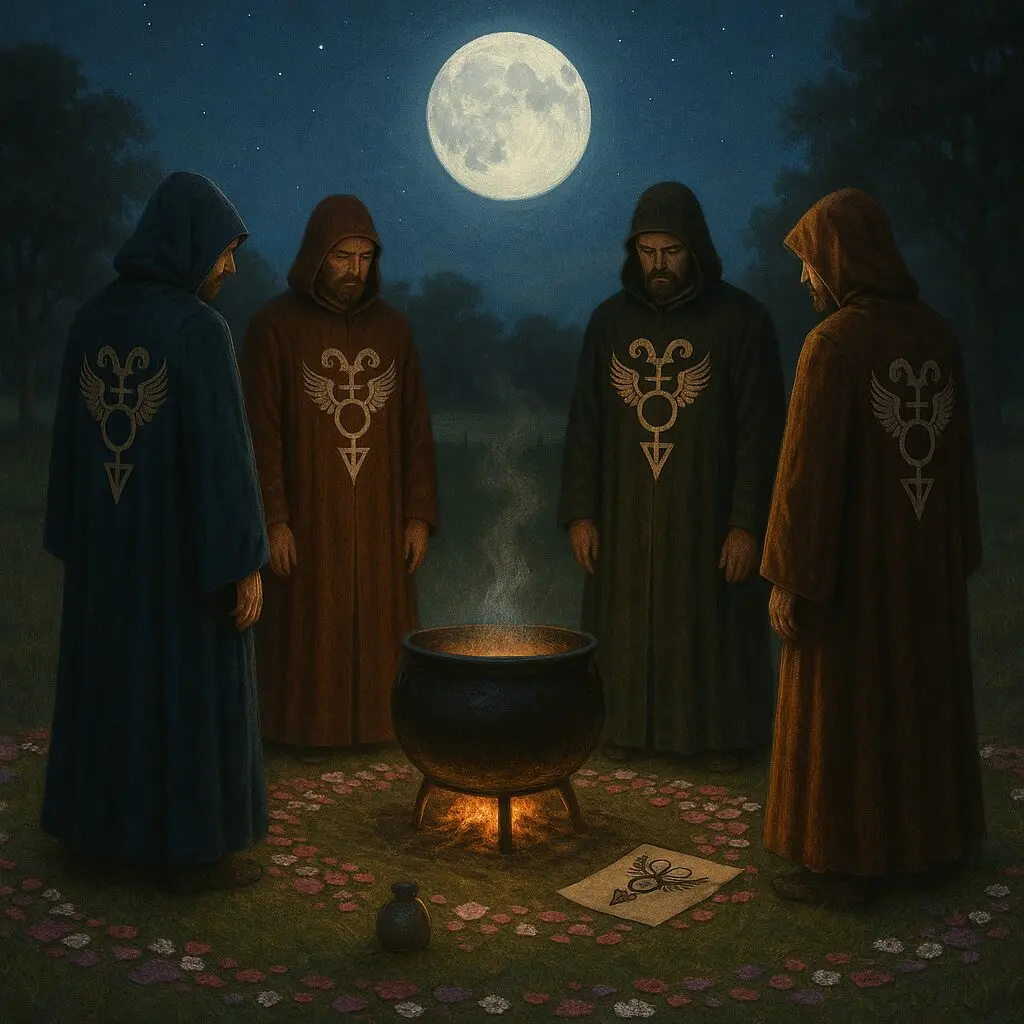
Spellwork matures when it stops being a collection of objects and becomes a discipline of conditions. Space is prepared, time is aligned, materials are chosen for coherence rather than novelty, and the body is treated as the instrument through which the work is conducted. Records preserve what was learned. Relationship—whether with spirits, ancestors, deities, land, or a group—keeps the practitioner attentive to context, consequence, and reciprocity.
The movement is always toward refinement. Not more complexity, but fewer contradictions. Not louder ritual, but clearer structure: containment, closure, and honest integration. The craft remains sustainable when it can be ended cleanly, reviewed without vanity, and repeated without strain.
Over time, the most potent elements are not those that impress, but those that hold: the practices that clarify intention, respect boundaries, and remain teachable. Between tradition and adaptation, spirit and matter, the work becomes less about display and more about precision—and the magic holds its shape.