Scrying
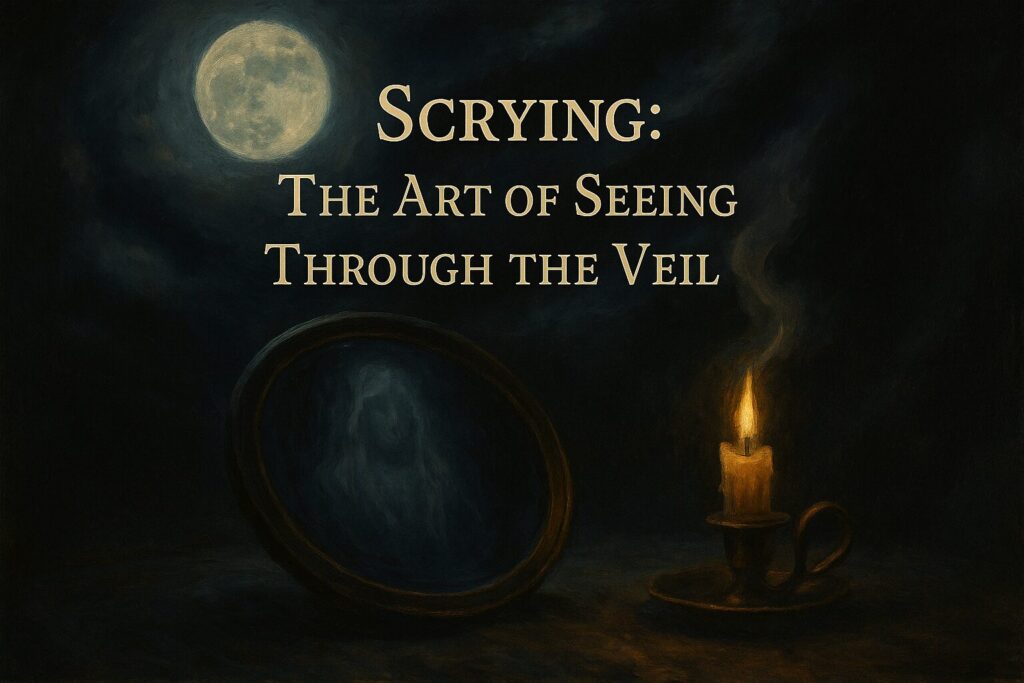
To scry is to gaze beyond surface — to look not at a thing, but through it. Where Tarot speaks in symbols and runes in carved lines, scrying speaks in light and shadow, in shimmer and reflection. It is the art of perceiving spirit through form, the act of opening the inner eye until the world reveals its hidden dimension. To scry is to court vision, to invite the unseen to make itself seen.
The practice is older than recorded magic. Ancient priests and priestesses watched the ripples of sacred pools, the gleam of obsidian, the dance of flames. The Egyptians peered into bowls of ink and water to summon the images of gods. The Persians read revelations in polished metal. In the temples of Greece, oracles looked into oil or crystal, entering trance as the mind yielded to the mirror’s depth. Across the world, from the Celtic druids to the seers of the Andes, reflective surfaces became portals — not of illusion, but of communion.
The word scry itself derives from the Old English descryan — to reveal, to make known. It is kin to “describe,” for to scry is to translate vision into language. The mirror does not tell, it shows; and the seer becomes interpreter. The true work of scrying is not passive witnessing but active witnessing — not drifting into fantasy, but perceiving what is real beneath appearances. The surface becomes a medium through which energy, thought, and spirit take visible shape.
The classic tools of scrying are as diverse as its practitioners. Water scrying uses still bowls or black mirrors, allowing light to drift across the surface until imagery forms. Flame scrying watches the behavior of fire — the color of its heart, the tilt of its smoke, the rhythm of its crackle — to read the element’s voice. Crystal scrying, perhaps the most iconic, employs quartz spheres or polished stones whose inclusions and refractions serve as catalysts for vision. Smoke, embers, clouds, mirrors, and even ink can all become gateways, for it is not the medium that holds power but the gaze that consecrates it.
To scry well requires preparation of both tool and self. The surface must be cleansed and anointed, the space dim and still, the mind emptied yet alert. The gaze softens, unfocusing until shapes emerge at the edge of sight. These forms may appear as colors, faces, symbols, or motion — or they may arrive as knowing rather than image, a felt impression rather than a seen one. What begins as random reflection becomes revelation.
Historically, scrying was central to ceremonial magic. The Renaissance magus John Dee and his scryer Edward Kelley used a polished obsidian mirror and crystal ball to communicate with angelic intelligences, recording the Enochian language from their visions. In the medieval grimoires, the speculum magnum — the great mirror — was said to reveal spirits, provided the operator was purified and protected by invocation. In folk witchcraft, a simpler version endured: a bowl of water, a candle, a question, and patience. The tool changed; the essence remained — to see what ordinary sight cannot.
Within Wicca and modern witchcraft, scrying continues as both divinatory and meditative practice. It may precede ritual, revealing the currents at play before casting a spell. It may be used after, to read the spell’s unfolding in image and sign. In coven settings, multiple witches may gaze together into a single mirror or cauldron, sharing visions that intertwine and confirm. The process is not merely predictive but revelatory — a dialogue between the conscious and the deep intuitive self, between the witch and the unseen world that mirrors her intention.
The mechanism of scrying is both mystical and psychological. The mind, relaxed yet attentive, enters a liminal state — a trance between waking and dreaming. In this threshold, imagination and intuition fuse, creating a field in which meaning can manifest symbolically. The reflections on the surface act as a focus for projection: patterns and forms arise from within the seer but resonate with energies beyond. Thus, scrying is not hallucination but harmonization — a conversation between inner and outer worlds.
A simple act may illustrate the process. A witch seeking guidance on her path fills a black bowl with water, placing it between two candles. She breathes slowly, watching the twin flames reflect. Gradually, her focus deepens. The reflections shift; an image forms — a serpent coiling around a tree, then fading. She understands: transformation through wisdom, shedding what no longer serves. The vision dissolves, but the meaning remains. The water has spoken, but it is her spirit that heard.
Scrying’s power lies in its refusal to confine meaning to the material. It affirms that knowledge can arise through intuition as surely as through reason, that the universe speaks not only in words but in images, rhythm, and resonance. To scry is to trust that revelation will come not through seeking control, but through surrender — the same surrender Odin made to glimpse the runes, or the same stillness the moon casts upon a quiet pond.
Ethically, scrying demands humility and discernment. The mirror amplifies the seer’s state of mind; fear distorts as surely as clarity reveals. Visions are symbolic, not literal — guides, not decrees. The seer must anchor vision with reflection, balancing intuition with reason. As in all forms of divination, the goal is not prediction but understanding — not to command the future, but to align oneself with its unfolding.
Ultimately, scrying teaches that the act of seeing is itself sacred. Every surface, every shadow, is a potential mirror; every moment of stillness, a threshold. The witch who learns to see with both eyes — one outward, one inward — discovers that divination and vision are not separate gifts but one motion of awareness.
To scry is to remember that the world itself is a reflection — a living mirror of the divine mind. When we gaze into its depths, it gazes back, and between the two lights — human and cosmic — the veil grows thin.