The Elements

“Magic is the art of causing changes in consciousness in accordance with will; the Elements are the alphabet through which this art first speaks.” -Dion Fortune
Long before witches spoke of correspondences, before circles were cast or gods invoked, the Elements offered the first and most enduring framework for understanding how magic moves. Every craft tradition—whether folk, ceremonial, Wiccan, animist, or occult—draws upon Fire, Water, Air, Earth, and Spirit not merely as symbols, but as living patterns of behavior woven through the world.
The Elements form a kind of cosmic grammar: they teach us how things change, how intention takes shape, how energy flows from thought into action, and how the subtle becomes tangible. Even witches who do not work formally with quartered circles or classical elemental systems still find themselves relying on these forces through the choices they make—where to anchor a spell, how to cleanse a space, when to kindle and when to rest, what to offer and what to release.
In everyday, “low” magic—kitchen witchery, herb craft, candle work, divination, and household practice—the Elements show up as simple, embodied gestures.
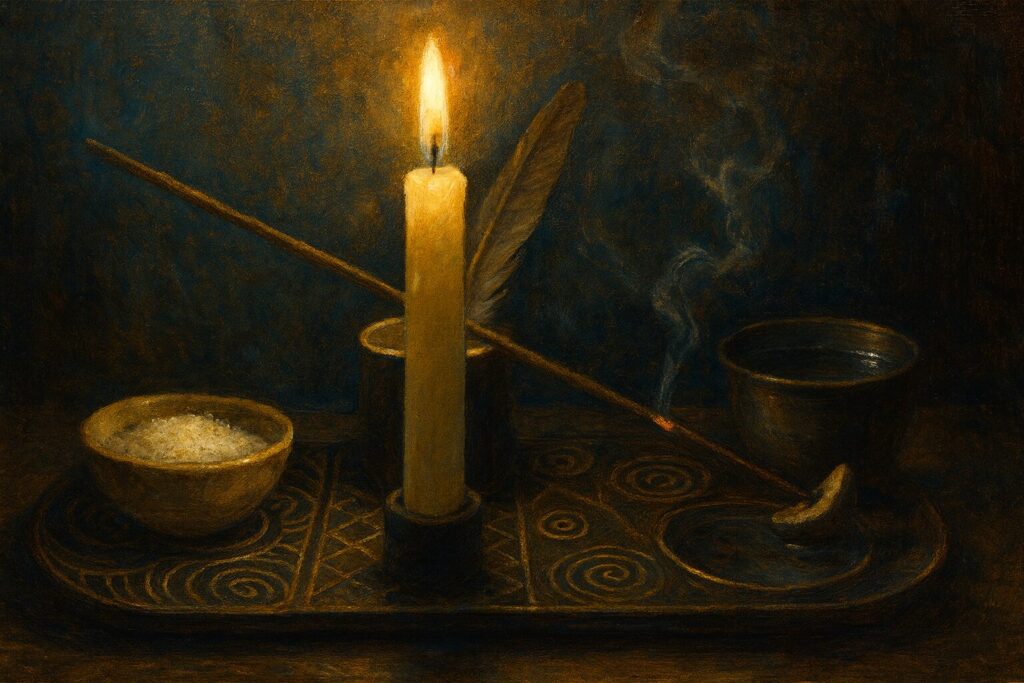
A flame to set intention.
A bowl of salt to ground and purify.
A feather or incense to clarify thought.
A cup of water to soften grief or welcome intuition.
These are small acts, but they teach the witch to feel how the world’s forces respond to touch.
In “high” ritual—formal circles, sabbat rites, initiatory workings, spirit-contact, and ceremonial spellcraft—the Elements become structural pillars.
They define the boundaries of sacred space, hold the directions open, mediate between the living and the unseen, and help shape the ritual body into alignment with the forces being called. Through them, witches learn to build and sustain containers for power, to listen for presence, and to weave themselves into relationships that extend beyond the visible world.
Elemental correspondences—herbs, stones, colors, animals, planetary hours, tools—are not arbitrary lists. They are mnemonic maps: ways of remembering how the world behaves and how to collaborate with it. A witch who knows why rosemary belongs to both Fire and Air, or why iron anchors Earth yet bleeds with Mars’ heat, has already learned something about the nature of transformation.
This page unfolds these themes in depth, tracing the Elements from prehistory through mythology, ritual structure, ecological wisdom, psychological insight, and divine contact. It is not a closed system or a dogmatic primer, but a living exploration of how witches understand and engage with the forces that sustain the world.
“Fire gives life, Earth sustains it, Air moves it, Water shapes it.”
Enter the circle.
Walk with the Elements as teachers, companions, and mirrors.
Here begins the deeper work.
“Before me, the powers of Air; behind me, the powers of Water; on my right hand, Fire; on my left hand, Earth.” -Doreen Valiente
𓇼 Before the Gods Had Names: The Elements as Humanity’s First Sacred Language
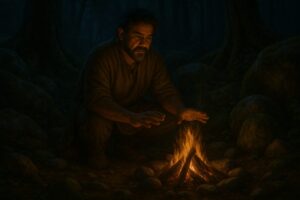
Long before anyone whispered the names of Zeus or Brigid, before priests inscribed hymns to Inanna or Ra, human beings were already in conversation with fire, water, stone, and wind. In the deep night of early human prehistory, the glow of a shared fire was not only warmth and safety; it was a revelation. The Elements were not abstractions. They were the first presences that shaped, constrained, and sustained human life, and so they became the first “sacred language” our ancestors learned to read.
Fire carved a circle of visibility out of the dark and taught our kin about transformation: flesh becoming smoke, wood becoming ember, fear becoming courage at the edge of predator-haunted night. Water gathered in rivers and pools, reflecting back the sky and the human face, teaching flow, depth, and the peril of crossing boundaries. Earth, in the form of cliff, cave, and soil, sheltered the body and received the dead; Air carried not only weather, but also the cries of the tribe, the scent of danger, and the first ritual songs.
In this sense, elemental awareness precedes theology. Before the gods had genealogies, before they were arranged into pantheons, there was already an intuitive recognition that reality comes to us through patterned forces. Modern witchcraft inherits this older stratum of spiritual language. To work with the Elements is to return to that primordial literacy: learning once again to listen to the way stone, flame, gust, and tide speak.
𓆝 Elemental Foundations in Prehistory: How Early Humans Engaged Forces
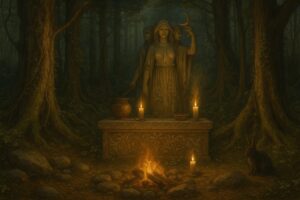
Archaeology does not uncover fully articulated elemental systems in the Paleolithic world, but it does reveal patterned relationships between early humans and the more-than-human environment. Hearths recur in the archaeological record as carefully tended spaces, their ash and charcoal accumulated over generations. Caves bear evidence of pigment, engraving, and offerings placed in crevices where water seeps and echoes carry. The shaping of stone tools required an intimate knowledge of the behavior of different rocks under pressure and heat.
These practices suggest an animist horizon in which landscapes and forces were experienced as responsive partners rather than inert backdrops. A spring might become the source of dreams or healing; a particular rock face might be recognized as a presence that “receives” markings and gifts. Fire itself could be coaxed, fed, and offended. It is not difficult to imagine that such repeated, embodied encounters laid the groundwork for later ritualized relationships with the Elements in magical practice.
For contemporary witches, this prehistory is not merely of antiquarian interest. It reminds us that every elaborate ritual script ultimately rests on such simple acts: tending a flame, listening to water, tracing a hand along stone, feeling the pressure of the wind. Elemental work is not an escape from the material world but a deepening of attention to it.
✧ The Elemental Families of the Ancient Gods
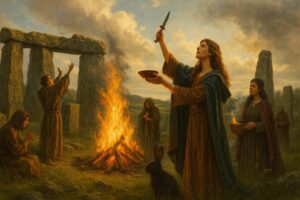
As complex civilizations emerged, the raw forces of prehistory grew faces and names. Storm, sea, sun, and fertile earth became the domains of particular deities—often arranged into extended families whose stories carried subtle elemental metaphors. In the Hellenic world, for example, Olympian genealogies link Olympian sky-gods with chthonic powers below, while river gods, nymphs, and winds occupy intermediary spaces. In other cultures, triads or pairs of deities embody complimentary polarities such as sky and earth, fire and water, order and wildness.
These divine “families” are not strictly equivalent to the modern four- or five-element schema, but they do cluster around recognizable elemental themes. The cult of a hearth goddess centers Fire as domestic continuity and sacrificial medium. Sea gods govern both danger and abundance, while land deities oversee agriculture and the stability of borders. The gods, in other words, are not separate from the Elements; they are narrative ways of thinking through how elemental forces behave in relation to human communities.
Modern Pagan and witchcraft traditions frequently re-map these ancient pantheons into consciously elemental terms. A devotee might experience Brigid as a synthesis of Fire (forge, inspiration), Water (wells, healing), and Earth (the land itself). Others align particular gods and spirits with the quarters of a circle, not as rigid assignments, but as devotional pathways: approaching deity through the doorways of flame, tide, stone, and wind.
𓋹 Elemental Spirits: Persons of Substance and Motion (Aether / Spirit)
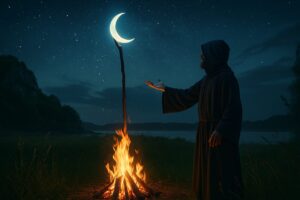
Between the grand narratives of the gods and the quiet presences of place, many traditions recognize a third stratum: spirits of fire, wind, river, and stone who are neither fully divine nor merely metaphorical. Folklore across cultures preserves accounts of beings who arise where the Elements are most intense—at storm-wracked crossroads, at lonely springs, in the depths of the forest, or within the hearth itself. Some are guardians and teachers; others are indifferent or ambivalent toward human concerns.
Within contemporary magical practice, these entities are often approached as “elemental spirits” or, in ceremonial vocabulary, as the inhabitants of the watchtowers and quarters. They are treated as persons: invited, greeted, thanked, and dismissed. The witch does not simply manipulate an abstract quality called Air; they address the airy spirits of a place, the currents and intelligences that ride on wind and breath. Spirit or Aether, in this framework, is not a fifth substance so much as the relational field within which such meetings become possible.
For practitioners who experience mediumship, trance, or spirit-contact, Elemental beings can become important allies and mirrors. They teach about boundary and flow, about the difference between invitation and intrusion. They remind the witch that magic is never purely psychological or purely external, but a conversation unfolding in a world already full of others.
🜂 Elemental Dynamics in Witchcraft & Magic (Fire-forward Section)
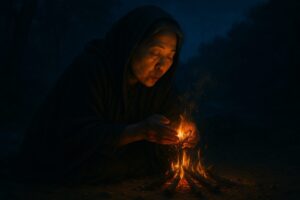
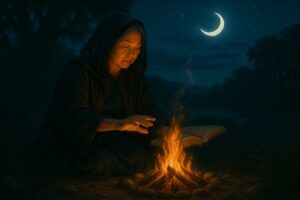
In active spellcraft, the Elements are not merely symbolic correspondences on a chart; they are participating forces. Fire, in particular, dramatizes magical dynamics. It consumes offerings, accelerates change, and signals commitment—once the match is struck, the working is underway. A witch leaning close to coax embers into flame embodies the interplay of Air and Fire, breath and will, intention and ignition.
Most traditions weave the Elements together in patterned ways. Earth provides the material basis: ingredients, tools, and the physical body of the practitioner. Water carries emotion, memory, and the subtle currents of affinity. Air structures the work through words, names, and the patterning of thought. Fire drives transformation, turning possibility into actuality. To design a working is to decide how these four (and the connective presence of Spirit) will move, combine, and release.
Different streams of witchcraft emphasize different dynamics. Some systems are Fire-forward, favoring bold acts of will and rapid change. Others lean into slow, Earth-heavy workings of protection and stability, or Water-centered rites of healing and emotional realignment. Learning elemental dynamics is therefore less about memorizing tables and more about noticing, over time, how each force behaves in one’s own practice.
🜁 Elemental Ritual Structure: The Circle as an Ecology of Forces (Air / Direction)
Many forms of modern witchcraft employ a ritual structure in which the Elements are invited to stand at the edges of sacred space. Calling the quarters, casting a circle, or walking the compass are all ways of acknowledging that magic unfolds within an ecology of forces rather than in a vacuum. Air, associated with direction, speech, and pattern, often governs the articulation of this structure: the words spoken to open the rite, the sequence of movements, the careful naming of what is being done and why.
In a typical Wiccan-influenced rite, a circle is cast as both boundary and conduit. Within its perimeter, the Elements are invoked at their cardinal points. The witch might face east to welcome Air as clarity and inspiration, south for Fire, west for Water, north for Earth, and center for Spirit. This choreography teaches the body that magic has orientation; one literally turns toward different qualities of the world when seeking different kinds of aid.
Tools reinforce this structure. The wand traces pathways of will through space. The athame or blade defines and separates. The chalice and cauldron receive and mingle. The altar stone anchors the work. All of these are, in a sense, instruments of Air, shaping the language and grammar of ritual. When they are used well, the witch does not feel constrained by form; instead, structure becomes the vessel through which elemental presence can move freely.
🜃 The Elements as Ecological Teachers (Earth / Land Wisdom)
Elemental symbolism is ultimately rooted in ecology. The stories we tell about Earth as stable, patient, and enduring arise because mountains outlast empires and soil quietly turns death into the possibility of new growth. For land-based witchcraft, Earth is not an abstract square on a quartered circle but the specific terrain under one’s feet: the local hills, rivers, weather patterns, plants, and animals that co-create the conditions of life.
When witches speak of “listening to the land,” they are engaging Earth as a teacher. Land wisdom includes practical knowledge—understanding seasons, migrations, and the impacts of human activity—but it also includes subtle, relational learning. How does a forest feel after logging versus after careful stewardship? How does a river respond when it is regularly offered care versus when it is treated as waste channel? These are empirical questions as much as spiritual ones.
Spirit or Aether, in this context, can be understood as the web of relationship tying beings together. To honor Earth is to honor the network of dependencies that make one’s own magic possible: soil microbes, ancestral seeds, weather systems, and the labor of countless others. Elemental practice then becomes not only a way of casting spells, but also a framework for ethical decision-making about how to live on and with the land.
🜄 Elemental Psychology: Balance, Imbalance, and Magical Identity (Water)
Many practitioners find that the Elements provide a rich language for thinking about inner life. Rather than diagnosing oneself in purely clinical or abstract terms, a witch might notice that they are “running hot” with Fire—quick to act, quick to anger—or that they feel bogged down in Earth, heavy and resistant to change. Water becomes the metaphor for emotional tone and movement: the difference between turbulent flood, stagnant pool, gentle rain, and deep, clear lake.
Elemental psychology does not replace mental health care, nor does it reduce complex experiences to simplistic labels. Instead, it offers an imaginal framework for noticing patterns and experimenting with shifts. A practitioner who feels brittle and over-aerated—stuck in thought and anxiety—might deliberately seek more Earth and Water in their days: time in the garden, long baths, slower rituals, and grounded conversation. Someone drowning in Water may need the courage and boundaries of Fire.
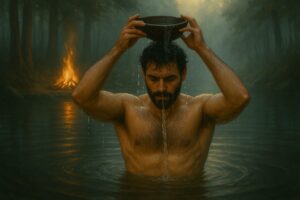
Ritual cleansing in Water, whether in a bath, river, or forest pool, dramatizes this work. The act of pouring water over one’s head, of letting old stories and emotional residues wash away, can mark a turning point in how the self is understood. The witch steps out of the pool with a renewed sense of elemental identity: not fixed as “a Fire person” or “a Water person,” but as a being who can move among the Elements with increasing skill and care.
✧ The Elements as Divine Pathways (Spirit as Connector)
In many polytheist and witchcraft traditions, the Elements are not merely psychological metaphors or components of spellcraft; they are pathways by which humans approach the gods. A devotee of a storm deity may first come to know them through the raw experience of wind and thunder. A lover of a sea goddess may feel her most vividly in the rhythm of waves and the taste of salt on the tongue. Elemental work, in this view, is preparation for encounter: learning the “accent” of a god’s preferred mediums.
Wiccan theology often frames the God and Goddess as immanent within, and expressed through, the Elements. The Horned One moves in wild Earth and dancing Fire; the Moon-Rider moves in tides and winds. Calling the quarters becomes not only a way of balancing a circle, but a way of opening multiple doors for divine presence to enter. Each Element offers a slightly different angle of approach, a different facet of relationship.
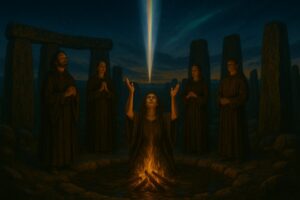
Spirit—the “Finger of Light” that some practitioners experience as a prism cutting down through the worlds—is what links these doorways together. It is the recognition that Fire, Water, Air, and Earth are not separate compartments but interpenetrating expressions of a deeper mystery. When a coven stands beneath that descending beam, real or imaginal, they stand at the crossing point where the ordinary Elements of their lives become transparent to the sacred.
𓇼 The Circle of Elements
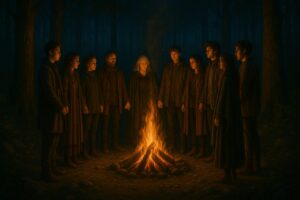
In the end, the Elements are less a set of separate topics than a pattern of relationship. A modern coven gathered around a fire in the forest is not re-enacting prehistory, nor are they frozen in a fantasy of the ancient world. They are participating in an ongoing conversation: with the land beneath their feet, with the weather around them, with the lineages of gods and spirits that have traveled through many cultures, and with their own bodies, breath, and feelings.
Every flame lit in ritual is kin to the first hearths of our ancestors. Every bowl of water placed on an altar participates in the hydrological cycles of the Earth. Every stone used to mark a quarter is part of geological timescales that dwarf human history. Every word of invocation rides on Air that has passed through the lungs of countless beings. To work magically with the Elements is to remember that we are always already inside the circle, whether we notice it or not.
When witches speak of “casting” a circle, then, they may simply be choosing to become conscious of a reality that is continually present. The circle is the lived pattern of elemental interdependence; Spirit is the awareness that lights it from within. From that perspective, each practitioner, solitary or in coven, walks through the world as a moving point on that circle, carrying the memory of firelight, river-song, stone wisdom, and wind’s invisible touch into the ordinary tasks of the day.