A Consecrated Microcosm

In witchcraft, tools are not accessories, nor are they requirements imposed from outside the practitioner. They exist because humans have always worked magic through relationship — between hand and object, space and intention, repetition and meaning. A tool is anything deliberately chosen to help shape attention, direct will, and mark the boundary between the ordinary and the sacred. Tools do not create power on their own; they help power become deliberate, intelligible, and repeatable.
Our coven leans on older teachings, not because age alone grants authority, but because many tools and practices have been tested through long use. Generations of practitioners have returned to the same forms — bowls, blades, flames, symbols — because they work. Over time, these objects gathered not only symbolism, but familiarity and focus, becoming reliable points of contact between intention and action. That accumulated experience matters. At the same time, we do not treat ancient practices as inherently superior, immutable, or beyond question. Tradition, for us, is a foundation — not a ceiling.
Historically, magical tools emerged from ordinary life long before they were formalized by modern traditions. A bowl was first a bowl, a knife first a knife, a candle first a source of light. What transformed them into tools of the craft was not ceremony alone, but use: the same object returned to again and again, in the same place, for the same kinds of work. Through repetition, tools became extensions of practice itself, teaching the hands what the mind already intended and giving structure to acts of will.
In contemporary witchcraft, tools often carry layered meaning drawn from elemental systems, folklore, ceremonial forms, and lived experience. A single tool may serve several roles at once — practical, symbolic, and psychological. We approach these tools with modern sensibility: adapting methods, materials, and interpretations to the realities of present life while retaining what has proven effective. Innovation is welcome here, but it is most powerful when it builds on what is already known to function.
It is also important to say plainly: meaningful work does not require abundance. Many witches begin — and continue — with only a few carefully chosen items. Others accumulate tools slowly over years, each one earned through necessity and use. Both approaches are valid. What gives a tool its weight is not how impressive it appears, but how well it serves the work it is asked to do. Care, intention, and familiarity matter far more than completeness.
The sections below explore tools not as a checklist to be fulfilled, but as ways of engaging with space, elements, and practice itself. Some are foundational, some optional, and some deeply personal. Taken together, they form a living language — one shaped by tradition, refined through experience, and continually adapted to the needs of the present.

The altar is not simply a surface on which tools are placed; it is the first tool of the craft itself. Before any object is lifted, before any word is spoken, the altar establishes where the work happens. It marks a deliberate shift from ordinary space into intentional space, creating a physical and psychological boundary in which attention can settle and ritual action can unfold. In this sense, the altar is less about display and more about orientation.
For many practitioners, the altar functions as a working table — a place to light candles, prepare materials, trace symbols, and focus spellwork. For others, it also carries a devotional or reverential quality, holding images, offerings, or objects connected to spirits, ancestors, or deities. These approaches are not mutually exclusive. An altar may move fluidly between work and reverence depending on the moment, the season, or the needs of the practitioner. What matters is not the label, but the relationship formed with the space over time.
Historically, altars were rarely elaborate or permanent. In folk practice especially, they were often temporary: a cleared table, a hearth edge, a cloth laid out and later folded away. The power of the altar did not come from its permanence, but from its consistency. Returning to the same place — or recreating the same space — teaches the body and mind to recognize when ritual has begun. Over time, the altar becomes familiar in a way that supports focus, steadiness, and presence.
In modern practice, altars adapt to contemporary life. Some are permanent fixtures; others are portable or discreet, assembled and disassembled as needed. Some are minimal by necessity, others layered with meaning through years of use. All of these forms are valid. An altar does not need to be large, ornate, or publicly visible to be effective. It needs to be intentional. When a space is chosen, prepared, and returned to with care, it begins to function as a tool in its own right — holding memory, reinforcing habit, and quietly supporting the work done upon it.
Everything that follows — candles, bowls, symbols, and tools — depends on the altar first. It is the place that receives them, orders them, and gives them context. Before learning what to use, it is worth understanding where you stand.
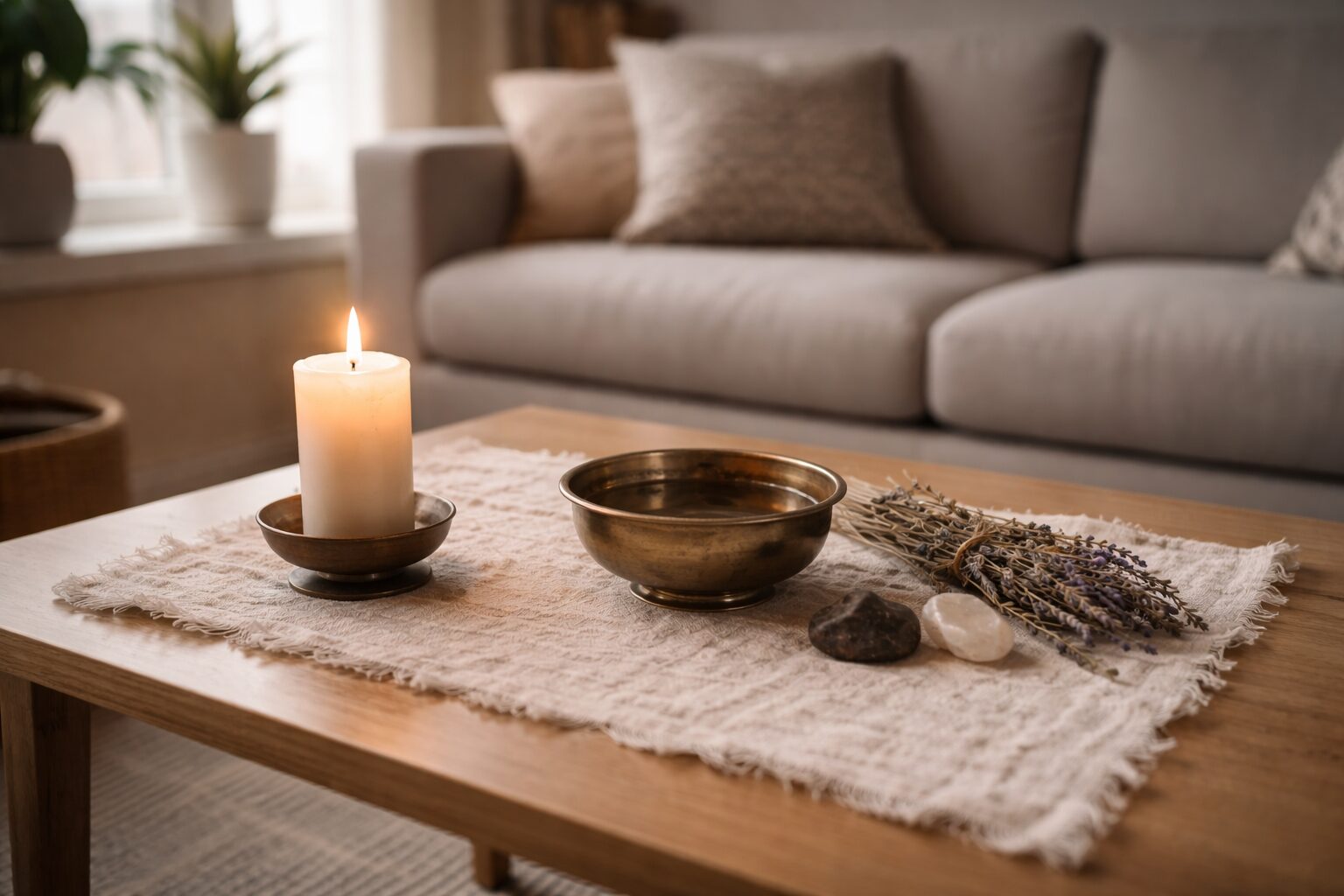
At its most fundamental, an altar does not require complexity. A single candle and a simple bowl are enough to establish a working space capable of real, meaningful practice. This level of simplicity is not a compromise or a beginner’s shortcut; it is a form that has appeared again and again across cultures and eras because it works. Light and container, presence and reception — with these two elements alone, the craft can begin.
A candle serves several roles at once. It provides light, marks time, and gives the practitioner a steady focal point. Flame draws attention naturally, helping the mind settle and remain present. In ritual and spellwork, a candle can hold intention over duration, allowing a working to unfold rather than be forced. Even when no words are spoken, the act of lighting a candle signals that something has begun. It is one of the oldest and most reliable ways humans have marked moments of transition, devotion, and will.
The bowl acts as counterpart and balance. It receives rather than projects, holds rather than directs. In practice, a bowl may contain water, offerings, herbs, stones, or nothing at all. Its presence establishes containment — a place for intention to rest, for offerings to be given, or for symbolic work to take shape. Like the candle, the bowl does not need to be ornate or specialized. What matters is that it is chosen deliberately and returned to with consistency.
Together, candle and bowl form a complete working pair. They introduce polarity without complication and create a quiet dialogue between action and receptivity. Many practitioners find that returning to the same simple setup again and again builds familiarity and focus more effectively than frequently changing arrangements. Over time, even the most modest altar begins to carry a sense of recognition — a subtle shift that signals the mind and body that ritual space has been entered.
Additional elements may be added if they feel appropriate — a small dish of water, a pinch of salt, a stone or token that carries personal meaning — but none of these are required. The purpose of a very basic altar is not to impress or perform completeness. It is to provide a stable place to work, to practice attention, and to begin forming a relationship with ritual itself. From this foundation, everything else can grow.
How Tools Work — Method, Correspondence, and Coherent Practice
Tools are best understood in relationship rather than isolation. They are not a checklist, and they are not a substitute for skill; rather, they are focal technologies—methods of stabilizing attention, clarifying will, and giving ritual action a repeatable structure.
In modern discussions, spellwork is often reduced to intention alone. Intention is essential, but it is not sufficient. Effective work emerges from the alignment of will with method: tools, timing, correspondences, personal grounding and strength, and the ethical discipline that keeps a working coherent. The altar is where those elements meet, reinforce one another, and become capable of producing real change.
These establish ritual space, stabilize attention, and make spellwork repeatable. A practitioner can do excellent work with only these, and many do.
The Altar Cloth — Defining Sacred Space
The altar cloth is one of the oldest “portable altar” solutions: a way to claim space without needing a permanent shrine. Most practitioners, in most eras, have worked in shared homes and ordinary rooms, so the cloth becomes boundary and continuity made material. It marks a surface as “for work,” helping the mind and body cross the threshold into ritual without requiring a dedicated temple space. Over time, a cloth becomes a quiet record of practice—wax flecks, faint stains, and the feel of repeated use—not a failure of cleanliness.
In spellwork, the cloth is not merely decorative. It defines the working field, reduces visual noise, and gives your altar a repeatable grammar of placement so the working stays coherent. In smaller rites, it can function as the primary boundary; in fuller circle work, it supports the structure by keeping the center stable while energy rises, shifts, and seals.
MCC leans toward grounded tools that cooperate with real craft. Natural fibers (cotton, linen, wool) tend to behave better over time and tolerate wax and cleaning more gracefully than synthetics. Pre-printed cloth can still serve if that is what you have, but the ethic is simple: do the best you can with what is real, and keep the tool dedicated when possible. Many practitioners find that one cloth is enough for excellent work, but a second cloth (or a small overlay runner) can be a practical upgrade: one for general devotion and blessing, and one reserved for protective, banishing, or boundary-heavy work. This isn’t about collecting—it’s about reducing mixed signals and keeping method clean.
Best practice: lay the cloth first and fold it last. That consistency quietly teaches the body when the work is open and when it is closed.
Candles — Flame, Will, and the Most Basic Proven Altar
If you strip witchcraft down to its simplest reliable form, you are left with this: a lit candle, a focused will, and time. Across folk magic, devotional practice, and modern Craft, flame remains central because it gathers attention, marks threshold, and sustains intention long enough to become a coherent act of will. Lighting a candle is not only symbolic—it is practical method. It turns “a thought” into a sustained working that has duration, structure, and a clear beginning and end.
On many altars, a candle is the first true tool because it creates a center even when you have very little else. A single white candle is widely used as the universal foundation: blessing, cleansing, clarity, peace, devotion, protection—white can stand in when you don’t have a specific color or when the working calls for simplicity. Black is the next workhorse in many traditions, not because it is “evil,” but because it excels at containment: protection, uncrossing, banishing, binding harmful influence, grief and ending rites, and closing what must be closed. From there, other colors become a form of precision—not required, but often effective—because widely shared correspondences help align the mind, the symbol, and the material act so the working carries fewer contradictions within it.
In practice, a candle can serve as a timed container, a spell engine, or a ritual witness. The goal is coherence rather than complexity: a plainly dedicated candle, set with clear will and ethical alignment, often outperforms an elaborate candle dressed from anxiety or scattered focus. Keep your method clean, keep your intention honest, and let the flame do what flame does—steady, visible, undeniable.
Safety belongs inside competent practice. Use stable holders and heat-safe surfaces, dress lightly, keep herbs away from open flame, and never leave a burning candle unattended. If open flame isn’t possible, an LED candle can preserve structure and symbolism—yet when real flame is safely available, it remains the most proven “minimum viable altar.”
Best practice: one purpose, one flame, clean closure—let the work be simple enough to stay true.
The Bowl / Chalice — Water, Offering, and Containment
The bowl is one of the oldest ritual technologies because it solves a basic spiritual problem: if blessing is meant to be more than a mood, it needs containment. A vessel receives, holds, and concentrates. In older domestic devotion, bowls and cups carried washing, libations, anointing, offerings, and purification—simple acts made repeatable by a tool that could reliably “hold the work.”
On the altar, the bowl can be element and function at once: a witness of water, a receiver of offerings, a place for cleansing or blessing mixtures, or a calm center for reflective work. In spellcraft it often becomes the point where scattered parts become one prepared medium—herbs in water, salt dissolved, petitions anointed, offerings placed with intention. The method matters: when the vessel’s purpose is clear, the working tends to feel integrated rather than scattered.
Because MCC leans toward good tools, choose a bowl that fits real use and real care. Some materials handle saltwater or oils better than others; porous surfaces may need to be reserved for dry work. Offerings also carry an ethic: do not leave them to rot in neglect. Treat the vessel as part of the relationship—clean, respectful, and consistent.
Best practice: let the bowl mean one thing at a time—receiving, cleansing, or mixing—so the tool stays clear in purpose.
Pentacle (and Other Focal Symbols) — Grounding the Work
A focal symbol is where attention lands and where the altar teaches the mind what “center” means. Many use the pentacle because it gathers the elements in a familiar pattern, but the deeper principle is older than any one sign: you need a stable place where intention can collect, be blessed, and be grounded without scattering. In older household practice this might have been a plate, a marked board, a hearth-stone, or a carved disk—forms change, function endures.
In spellwork, the focal surface becomes the staging ground: you place components there to unify them before beginning, return to it after raising energy to ground, and use it as the stable “charging place” for petitions, talismans, sigils, and blessing work. Widely shared correspondences become stronger when the center is consistent—this is where method prevents a working from contradicting itself, which is often where intention alone fails.
Keep the focal point clear enough to do its job. A cluttered center stops being a center and becomes a distraction. The point is not maximal decoration; it is a stable landing place for will.
Best practice: protect the center from clutter—clarity at the core keeps the whole working coherent.
Elemental Anchors — Feather, Stone, Salt, Herb
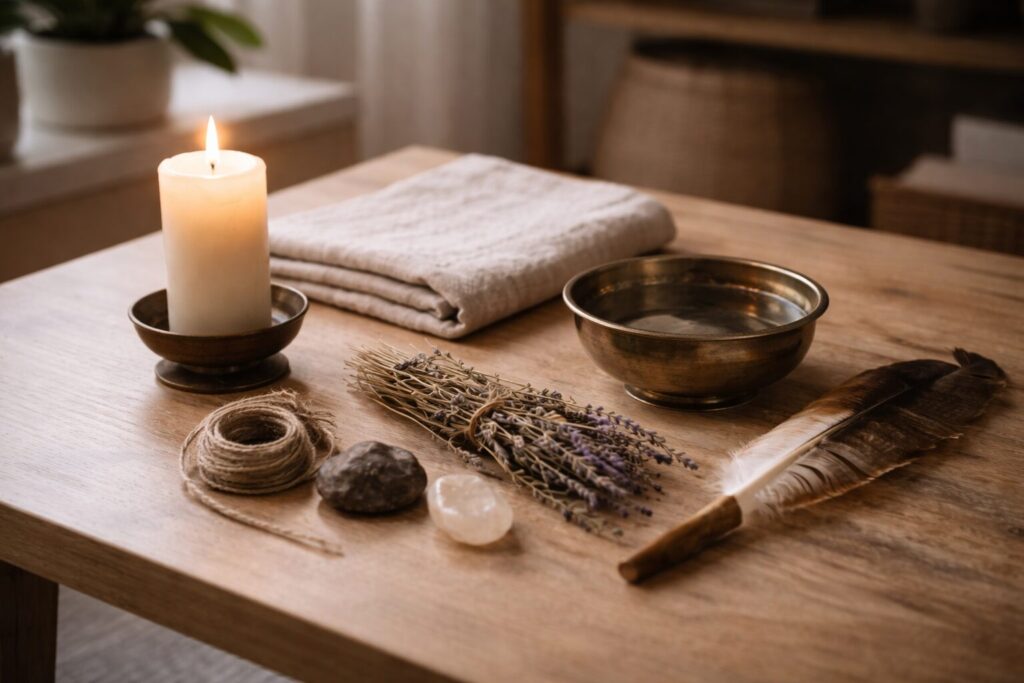
Elemental anchors are often the most honest tools on the altar: simple objects that carry the world directly into the working space. A feather speaks to breath and movement; stone steadies and grounds; salt purifies, preserves, and defines boundary; herbs carry scent, memory, and widely shared correspondence through the lived behavior of plants. The strength of anchors is that they do not require you to pretend—salt preserves, stone endures, herbs heal and scent the air. Symbol and reality cooperate.
In spellwork, anchors help establish balance, strengthen correspondence, and return the body to center at the end. When you are unsure what something “means,” begin with how it behaves in the real world and let the material teach you. That approach keeps symbolism grounded and makes your correspondences less arbitrary and more dependable.
Keep the altar from becoming crowded. A few anchors you know deeply often carry more weight than a scattered collection. Refresh herbs as they fade, keep salt dry, clean stones gently, and treat any natural materials with respect and awareness of local rules and ethics.
Best practice: choose fewer anchors, learn them well, and let repetition build strength.
These tend to appear as a practitioner’s work narrows, intensifies, or becomes more technical. They are powerful, but never mandatory.
The Wand — Direction, Invitation, and Subtle Movement
The wand appears wherever ritual involves blessing, pointing, tracing, or calling—because the body already understands the language of direction. Where blades often define boundary through sharpness, the wand tends to work through invitation: guiding, gathering, and shaping without harshness. That makes it especially suited to rites of blessing, threshold work, devotional practice, and steady guidance rather than force.
In spellwork, use it to trace a circle, “write” a sigil into the air, bless tools and offerings, or gather a current into the altar’s center. The wand is often strongest when it is precise rather than theatrical: clear gesture, steady breath, consistent method. Many practitioners also find that a handmade wand carries unusual depth—not because it is expensive, but because attention is laid into it through carving, smoothing, and repeated use.
Store it dry, check bindings and adornments, and keep it functional. Let it be a tool first and an ornament second.
Best practice: small, deliberate motion builds more authority than dramatic gesture done inconsistently.
The Athame — Boundary, Definition, and Precision
The athame is a tool of clarity: inside and outside, open and closed, now and not yet. In modern Craft it is often treated as iconic, but its deeper function is older than the name—ritual separation, definition, and boundary. Its value is not aggression but precision. In practice, the athame stands for the discipline of making clean edges so the working remains contained and ethically coherent.
In spellwork, use it to cast or reinforce a circle, to mark an opening when needed, and to direct a current toward a candle, sigil, or focal surface. Many practitioners keep athame motion minimal: less flourish, more definition. And it matters to say plainly—if blades are not welcome in your life or home, a wand or gesture can do excellent boundary work. The function is what matters; the tool is a means.
Keep it stored safely, prevent rust, and keep its use dedicated. Boundary work is moral work; treat the tool accordingly.
Best practice: use it to define, not to intimidate—clarity is the power here.
Mirrors — Reflection, Protection, and Perception
Mirrors can unsettle people because reflection is psychologically intense: it turns the gaze back on itself. That intensity is exactly why mirrors have long been used for protection, perception, and divination. A mirror reflects attention. In practice it can serve warding (returning unwanted focus), boundary work, or scrying—methods that respond best to steadiness rather than fear.
On the altar, a mirror can face outward as a ward, inward as a tool of self-knowledge, or be reserved for scrying. The key is deliberate opening and clean closure. Some practitioners cover a dedicated mirror when not in use—not from superstition, but as a clear signal that the tool is closed and resting, the same way a blade is sheathed or a candle is extinguished.
Keep mirror work bounded: open with intention, close cleanly, and ground afterward. If mirror work destabilizes you, choose another method—the point is clarity, not intensity.
Best practice: cover the mirror and take one grounding breath when you finish—closure keeps the tool clear.
These tools are never required. They become valuable when they solve a real problem in your practice or support a specific kind of work. Add them slowly, and let function—not aesthetics—justify their place on your altar. Flexibility allows practice to adapt; method allows it to endure.
Cauldron (or Heat-Safe Vessel) — Containment, Burning, and Transformation
The cauldron carries a lot of romance, but in modern practice its real virtue is practical: it is heat-safe containment. Historically, hearth vessels already held transformation— raw becomes edible, cold becomes warm, herbs become medicine. The cauldron continues that lineage as a safe place for burning petitions, receiving ash, or holding fire-adjacent work without turning your altar into a hazard.
In spellwork, use it to burn petitions safely, receive ash, hold charcoal disks where appropriate, contain sand or salt beneath a candle, or serve as a central working bowl when a rite involves combining materials. Because it is heavy and stable, it also functions well as an earth anchor that keeps the working grounded.
Treat it as real equipment: place it on a heat-safe surface, add sand or salt when burning is involved, allow it to cool fully before moving, and clean ash residue regularly. If cast iron, dry thoroughly and lightly oil to prevent rust.
Best practice: competence is part of ethics—safe containment keeps the working clean.
Bell — Timing, Clearing, and Ritual “Punctuation”
Bells are about structure. Sound changes atmosphere quickly, gathers attention, and provides ritual punctuation—opening, closing, and shifting phases. A bell can do in seconds what the mind might otherwise struggle to do gradually. In shared homes or smoke-restricted spaces, bells are especially valuable because they can “clear” without smoke.
In spellwork, ring to open, ring to mark transitions, and ring to close. Consistency matters: simple patterns used repeatedly become strong cues that teach the body what is happening in the rite, which strengthens the working over time.
Keep it stored where it won’t be dented. What matters is that it remains clear-toned and dedicated to purpose.
Best practice: repeat the same simple cues until your body recognizes them as ritual on contact.
Incense — Atmosphere, Offering, and Cleansing (When Safe)
Incense sits at the crossroads of devotion and spellwork. Scent changes the mind’s state, smoke makes prayer visible in motion, and burning offerings create a visceral sense of release. In many traditions incense is quite literally an offering—beauty given in a form that rises and disperses.
In practice, incense can cleanse, bless tools, carry prayer, or help set ritual mood. But good craft also respects the reality of the home: pets, allergies, roommates, tenancy rules, ventilation. If smoke is not permitted or not healthy, do not force it—sound, salt, water, and intentional cleaning can do similar work. Safety is not a limitation; it is part of competent practice.
Use stable burners, keep ash contained, ventilate, and never leave burning incense unattended.
Best practice: let the method fit the home—ethical craft adapts without losing coherence.
Boline (Working Knife) — Cutting Materials, Not the Circle
The boline is the practical counterpart to the athame: a tool for physically cutting herbs, cords, paper, and materials. Keeping a dedicated working knife helps separate practical action from boundary gesture, which many practitioners find clarifies both. This is also where craftsmanship shows—preparation is often where the “spell” begins.
In spellwork, use it to cut cord lengths, trim herbs, shape wax, or prepare petitions. Because it touches materials directly, it becomes a tool of making—quiet, domestic, and powerful precisely because it is repeatable.
Keep it sharp enough for clean cuts, store safely, and clean after plant work. A blade is only useful when it is treated responsibly.
Best practice: preparation is part of the working—make with attention, not haste.
Cords & Knots — Binding, Timing, and Structured Will
Cords are “slow magic” tools: they bind intention to sequence—measured, repeatable, and disciplined. Knotwork appears in many folk traditions because it is reliable: each knot can carry a phrase, vow, condition, or step in a working. Structure helps will remain coherent beyond the moment of ritual.
In spellwork, cords bind charm bags, mark phases, tie petitions, or build knot spells where each knot holds a line of will. Because cords persist, they also demand closure: decide deliberately whether you keep a completed cord as a talisman, dismantle it, bury it, or burn it safely. Endings are part of ethics.
Natural fibers are often easiest to work with and age well. Store cords clean and untangled. Writing down what the knots mean preserves the spell’s structure and keeps the practice grounded.
Best practice: record the meaning of the knots—method is what makes the work repeatable.
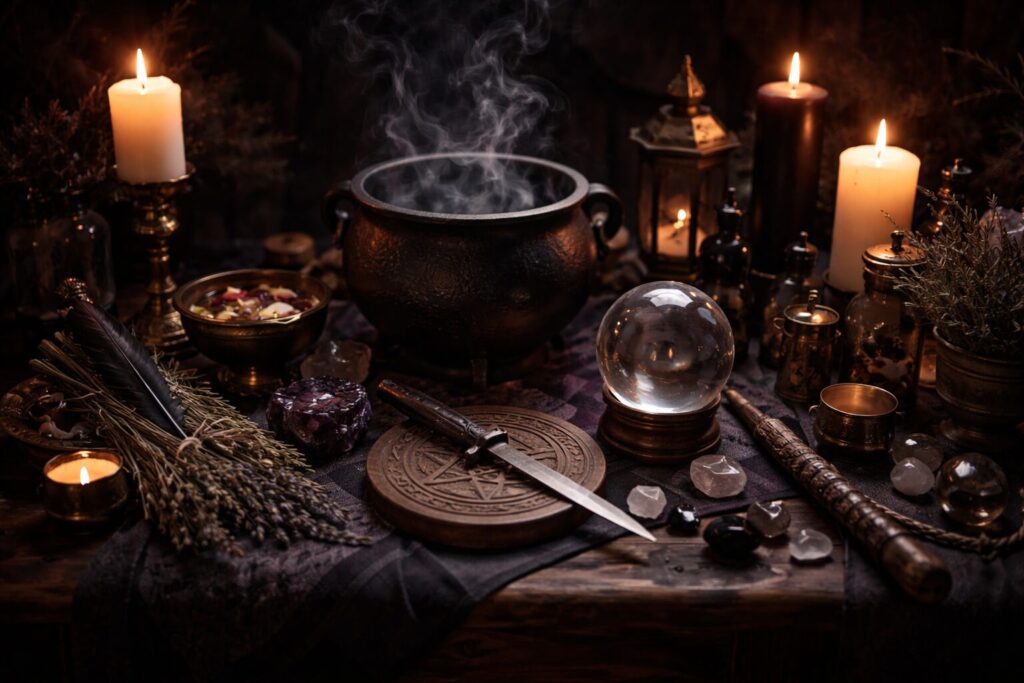
Choosing tools ethically means paying attention not just to what a tool symbolizes, but how it comes into your hands. Whenever possible, prioritize materials that are responsibly sourced, durable, and honestly represented. Handmade tools can carry a particular steadiness because time and care are already woven into them, but cost itself is not a moral measure. What matters is clarity of purpose, respect for the living world, and an honest assessment of need. If a tool is made from an animal, a rare wood, or a culturally specific form, it’s worth pausing to ask whether it is truly necessary for your work, whether it was obtained with integrity, and whether a simpler alternative might honor the same principle just as well.
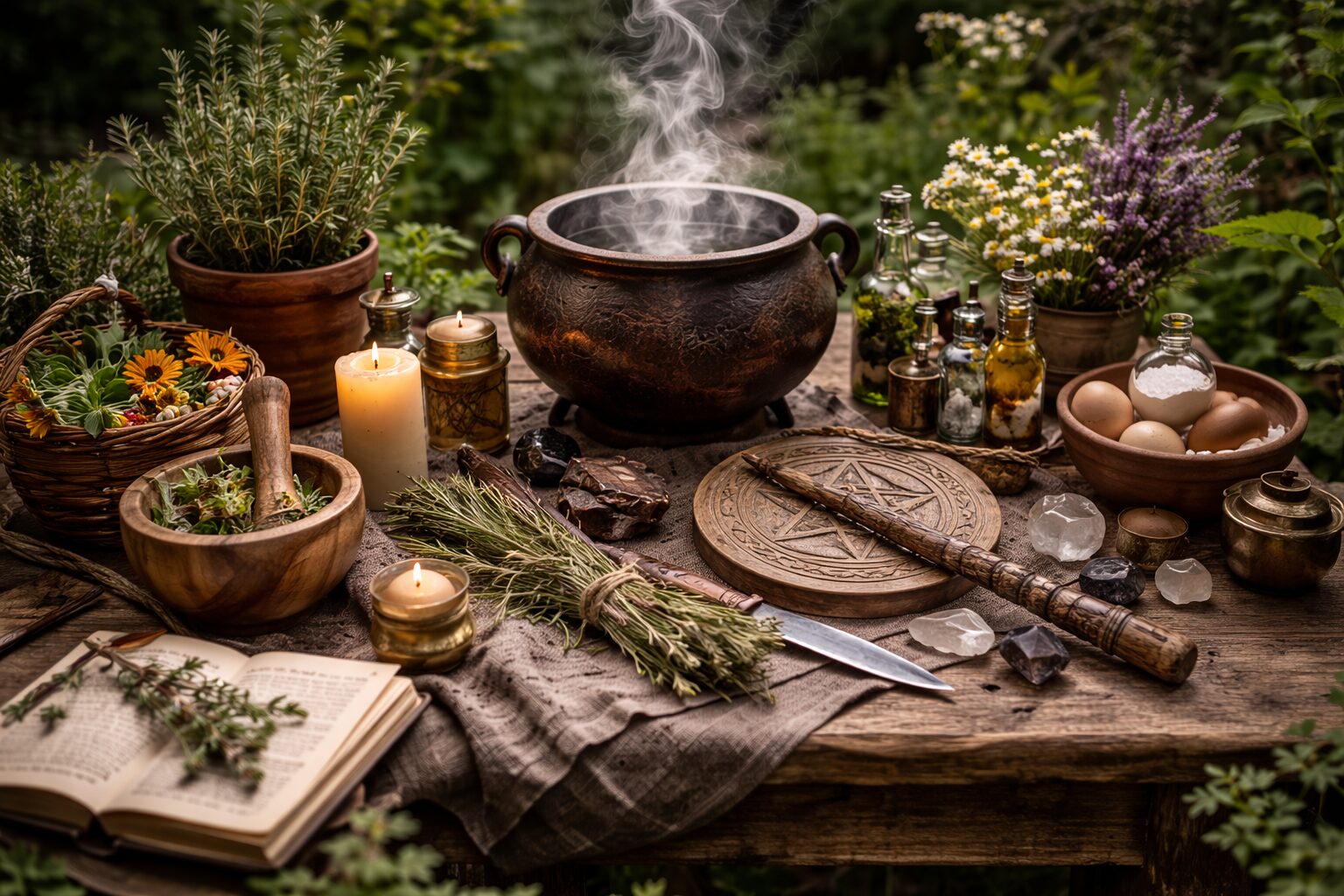
Common Mistakes When Working with Tools
Collecting before practicing. One of the most common missteps is acquiring tools faster than one learns how to use them. Tools gain meaning through repetition and familiarity, not accumulation. A small set used consistently will almost always outperform an elaborate altar that is rarely worked.
Overloading the work. More ingredients, more symbols, and more correspondences do not automatically produce stronger results. In fact, they often scatter attention. Effective spellcraft tends to be economical: each tool should have a clear role, and anything that does not serve the working should be left aside.
Treating cleansing as anxiety management. Regular care and cleansing are healthy parts of practice, but compulsive cleansing is often a sign of insecurity rather than necessity. Tools do not become “corrupted” through normal use. Gentle, consistent maintenance is usually sufficient, and over-cleansing can disrupt the sense of continuity that makes a tool effective.
Confusing symbolism with function. Symbols matter, but they are not the whole story. A tool works because of how it is used, not because it is theoretically perfect. If a particular correspondence helps you focus, use it. If it distracts or feels forced, it may be getting in the way rather than helping.
Ignoring practical reality. Fire safety, shared living spaces, pets, health concerns, and legal or tenancy rules are not obstacles to real practice. They are part of it. The craft adapts to the practitioner’s life, not the other way around. A practice that cannot be done safely and sustainably will not endure.
Assuming there is a “correct” altar. There is no universal template. Traditions provide frameworks, not uniforms. What matters is that your tools form a coherent system that you understand, trust, and can return to with confidence. A tool that fits your hand and your life is almost always more powerful than one chosen to meet an external ideal.
In the end, tools are not what make a practitioner legitimate — practice does. A well-used candle, a familiar cloth, or a single bowl returned to again and again will often carry more weight than a carefully curated altar assembled all at once. Over time, tools become effective not because they are ancient, expensive, or aesthetically perfect, but because they have been present for real work. Let your altar grow at the pace of your practice, allow tools to earn their place through use, and remember that clarity, consistency, and care are the quiet foundations on which lasting craft is built.
“Magic is the art of changing consciousness at will.”
— Dion Fortune
Common Mistakes When Working with Tools
Collecting before practicing. One of the most common missteps is acquiring tools faster than one learns how to use them. Tools gain meaning through repetition and familiarity, not accumulation. A small set used consistently will almost always outperform an elaborate altar that is rarely worked.
Overloading the work. More ingredients, more symbols, and more correspondences do not automatically produce stronger results. In fact, they often scatter attention. Effective spellcraft tends to be economical: each tool should have a clear role, and anything that does not serve the working should be left aside.
Letting correspondences contradict each other. Correspondences are meant to support coherence, not create mixed signals. A common mistake is combining symbols, colors, herbs, and timing that point in different directions—asking for calm and closure while loading the altar with heat and acceleration, for example. When correspondences are widely shared and used consistently, they strengthen a working; when they conflict, they can dilute focus, muddy the “instruction,” and leave the outcome feeling unstable. When in doubt, simplify until the whole altar is saying one thing.
Treating cleansing as anxiety management. Regular care and cleansing are healthy parts of practice, but compulsive cleansing is often a sign of insecurity rather than necessity. Tools do not become “corrupted” through normal use. Gentle, consistent maintenance is usually sufficient, and over-cleansing can disrupt the sense of continuity that makes a tool effective.
Confusing symbolism with function. Symbols matter, but they are not the whole story. A tool works because of how it is used, not because it is theoretically perfect. If a particular correspondence helps you focus, use it. If it distracts or feels forced, it may be getting in the way rather than helping.
Borrowing chaos without building continuity. Some modern approaches emphasize experimentation: improvising symbols on the spot, treating meaning as highly personal, and leaning into quick, portable, “in-a-pinch” methods. There’s creativity and flexibility there, and for some people it can be a useful way to work under constraints. The tradeoff is that highly experimental work is often less grounded and less durable over time, because it doesn’t always build the continuity that makes tools and correspondences reliably reinforce one another. If you do work experimentally, treat it as a conscious mode—then return to a stable framework for your core practice so your tools can deepen rather than reset every time.
Ignoring practical reality. Fire safety, shared living spaces, pets, health concerns, and legal or tenancy rules are not obstacles to real practice. They are part of it. The craft adapts to the practitioner’s life, not the other way around. A practice that cannot be done safely and sustainably will not endure.
Assuming there is a “correct” altar. There is no universal template. Traditions provide frameworks, not uniforms. What matters is that your tools form a coherent system that you understand, trust, and can return to with confidence. A tool that fits your hand and your life is almost always more powerful than one chosen to meet an external ideal.