
Salt in Practice
“Nothing is more useful or more necessary than salt and sunshine.” – Pliny the Elder, Natural History

Salt is one of the humblest tools in a witch’s cupboard, and one of the most profound. It is the memory of oceans turned to crystal, the taste of tears, the ash of ancient seas resting in the palm of your hand. A few grains can bless a home, guard a doorway, seal a spell, or carry away what no longer belongs. In witchcraft and Wicca, salt is less a “spice” and more a threshold: a place where one thing turns into another. Water becomes stone. Emotion becomes pattern. Intention becomes boundary.
Unlike some tools that must be hunted in specialty shops, salt is everywhere. It rides in from the sea in sacks and blocks. It is mined from ancient beds beneath mountains. It sits on kitchen tables and in bath jars, in road grit and ritual bowls. This ubiquity is part of its magic. Salt is the everyday body of something very old and very patient. When a witch works with salt, they are working with what remains when the tides recede.
Because of that, salt is deeply associated with protection, purification, and preservation. It slows decay, draws out excess moisture, and can carry away what is no longer needed. It can hold a boundary or bless a crossing. In many traditions, salt is used to anchor the edge of the circle, to cleanse tools before use, or to bar harmful influences from a space. Yet salt is not only about defense. It can also be used to seal blessings, to ground heightened states, and to stabilize energy in workings that might otherwise scatter.
This page is a deep dive into salt as a magical ally: where it comes from, how witches work with it, and how you might begin to build your own relationship with this crystalline familiar.
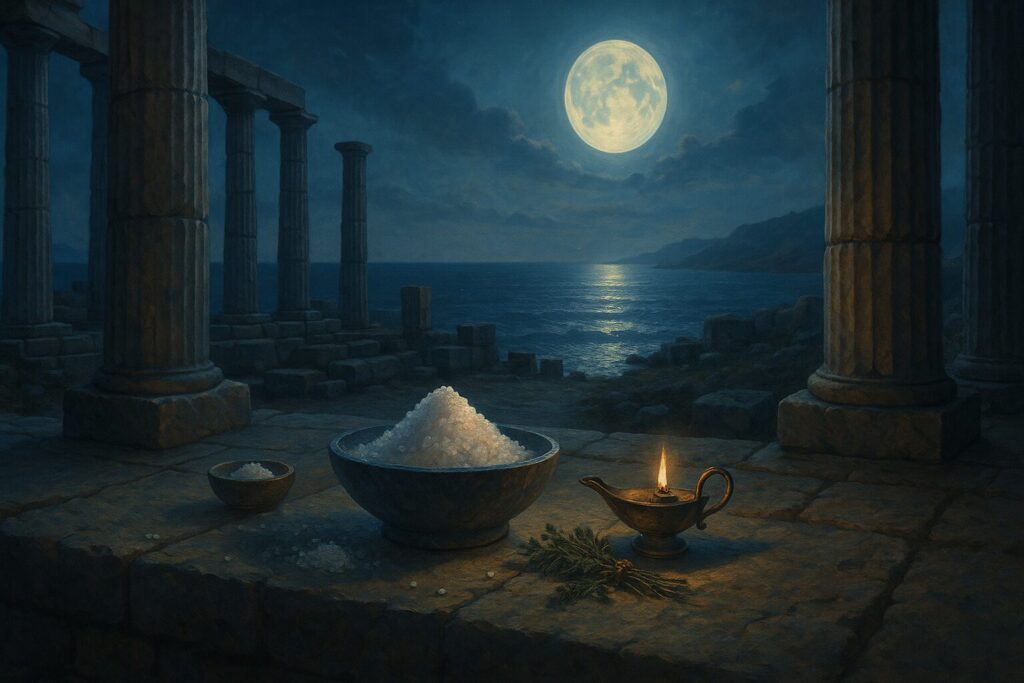
“Salt, like fire, is a source of life and a means of purification; it cleanses the unclean and banishes the uncanny.” – James Frazer, The Golden Bough
Long before modern witchcraft, salt had a reputation for being precious and powerful. It preserved food through winter, kept sailors alive at sea, and acted as a form of currency and covenant. To share salt with someone at table was to bind a temporary peace or hospitality. To waste salt, in many cultures, was to court misfortune.
In ritual life, salt shows up everywhere once you begin to look for it. Temples used it to purify offerings and altars. Folk healers dusted thresholds and bedframes with it. Householders poured salt into the corners of new homes or into the foundation trench to bless the ground. Travelers cast a pinch over their shoulders to avert ill luck or unwanted spirits. Farmers mixed salt into cattle feed or scattered it across fields in careful amounts to protect herds and crops.
Salt’s mythic and magical roles often mirror its physical ones. The substance that protects food from spoilage becomes the spell component that protects a spirit or a home from decay. The mineral that dries out and neutralizes becomes the magical tool that dries up gossip, weakens a hex, or neutralizes an unwanted influence. The same salt that marks the boundary between land and sea is invited to mark the boundary between sacred and mundane.
Modern witchcraft inherits this tangle of temple, kitchen, and crossroads. Whether you identify as Wiccan, eclectic, witch or hedge – or something else entirely – salt is likely somewhere in your practice, even if only in the kitchen jar you instinctively reach for when the house feels “off.”
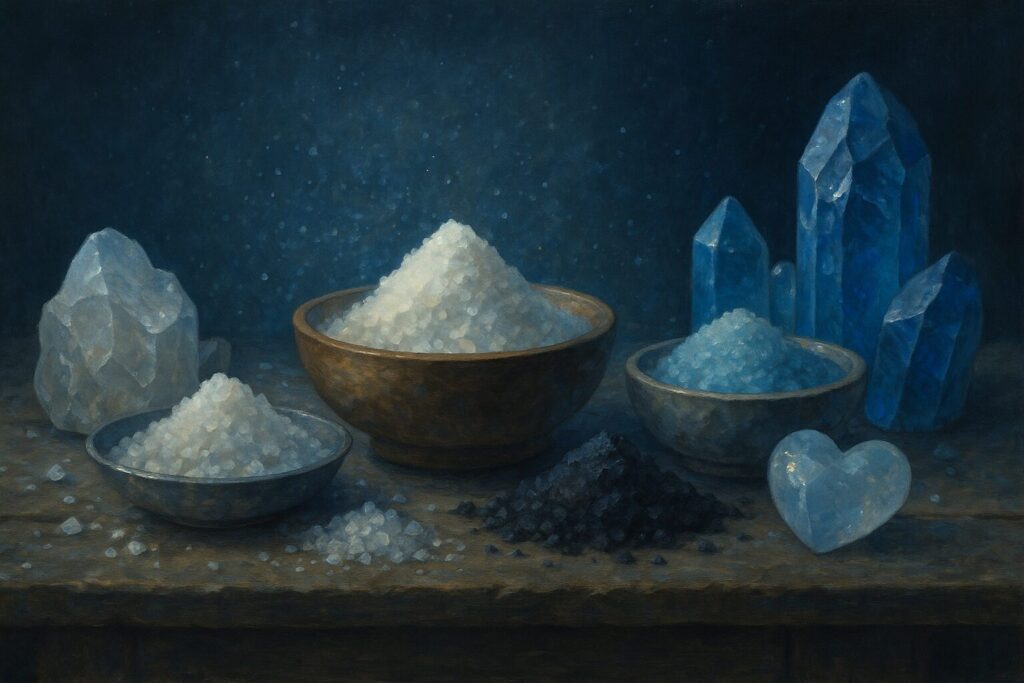
“They sprinkled the barley and the holy salt, marking the boundary of the sacred.” -Homer, The Iliad
From a magical perspective, salt sits where Water and Earth meet. It is born of water but holds the stillness and solidity of stone. This is part of why witches experience it as both fluid and stable. It carries the memory of motion but offers firmness and structure.
The crystalline structure of salt lends itself to absorbing, storing, and redirecting energy. Many witches experience salt as an energetic sponge: it draws out what is stagnant, heavy, or discordant. A bowl of salt in a sickroom, near a front door, or by a troubled altar is not just symbol; it functions as a tiny energetic filter, catching what you ask it to catch.
Because salt is so absorbent, purity matters in magical use. Table salt with anti-caking agents and additives will still “work” on a basic level, but many witches prefer sea salt, rock salt, or minimally processed salts for ritual. These tend to feel “cleaner” and easier to dedicate. Epsom salt and Dead Sea salt, while not chemically identical to kitchen salt, also have long histories in cleansing baths and body work.
Before using any salt in magic, many witches dedicate or ask it to be blessed. This might be as simple as placing both hands over the jar and saying, “I cleanse and bless you to purify and protect in my work,” or as formal as a full elemental consecration. The point is to acknowledge that this is no longer just seasoning; it is now a participant in your craft.
As with any tool, intent and relationship matter as much as the substance itself. The same handful of salt can be used to protect a home, bind a harmful pattern, or gently carry away grief, depending on how it is prepared, spoken to, and placed.
“The world cannot endure without salt.” -Talmudic
Types of Salt in Witchcraft & Wicca
Sea salt is the crystallised memory of moving water. It carries the feel of tides, currents, and the slow breathing of the ocean. Many witches experience sea salt as lively and flowing, even when it sits still in a bowl. It is especially suited to purification, emotional healing, lunar rites, and any working that needs to wash something through rather than lock it down.
In practice, sea salt is a go-to for cleansing baths, purification bowls, and threshold lines where you want to filter energy without hardening the space too rigidly. It pairs well with moon water, shells, seaweed, and lunar herbs like mugwort or jasmine. Used around the home, it encourages a sense of freshness and circulation rather than static heaviness.
Rock salt is mined from ancient beds laid down by seas that vanished long ago. It feels older and heavier than sea salt, with a deep, steady quality that lends itself to long-term protections and ancestral work. Where sea salt moves, rock salt anchors.
Use rock salt when you want a ward that will hold: at property boundaries, inside protective jars, or in charms buried near foundations. It is excellent for stabilising spaces that see a lot of emotional traffic—doorways, family rooms, healing rooms. Paired with iron, bones, or sturdy roots, it creates a “stone circle” effect in miniature.
“Black salt” in witchcraft is not one single recipe but a family of blends that combine salt with dark, absorbent materials. Common additions include charcoal ash, soot from protective incense, iron scrapings, finely ground eggshell, or even dirt from protective places such as a threshold or grave of a trusted ancestor (depending on your tradition and ethics).
This salt is usually used when you need a sharper edge: to absorb baneful energy, disrupt harmful patterns, or mark a boundary that clearly says “No further.” It can be sprinkled along doorways and window sills, used to encircle a candle in banishing work, or added in tiny amounts to jars intended to bind and cool a situation.
To make your own black salt, begin with clean sea or rock salt. Add a small amount of very fine charcoal or ash—the ash from your own protective incense or herbs can be particularly potent. Work slowly, grinding until the mix is even and dark. As you blend, speak your intention clearly: that this salt will absorb, repel, and carry away that which does not belong in your life or home.
Keep in mind that some forms of black salt, particularly in hoodoo and other rooted folk traditions, have specific cultural context. If you are borrowing from those practices, study them respectfully and acknowledge your sources rather than treating black salt as a generic “curse eater.”
Pink or Himalayan salt is mineral-rich and visually softer than bright white crystals. Many witches experience it as tender, heart-oriented, and well suited to workings that need both protection and kindness. Instead of a sharp banishment, pink salt often supports boundaries rooted in self-worth and compassion.
It works beautifully in self-love baths, gentle home blessings, and rituals focused on emotional recovery. Candle holders and lamps carved from pink salt can be dedicated as quiet guardians of bedrooms, healing rooms, or altars, with the understanding that the glow is more about ambiance and intent than scientific ionisation.
Epsom salt and Dead Sea salt are not the same compound as kitchen salt, but they behave similarly in magical baths: they draw out tension, relax muscles, and invite the energy field to loosen its grip on what it is holding. Blends that mix these salts with sea salt, herbs, and a little oil can be powerful tools for cleansing and healing.
Because they engage both physical and subtle bodies, bath salts are excellent for ritual resets after heavy days, intense readings, or difficult conversations. A simple soak with clear intention can be every bit as effective as an elaborate ceremony on the floor.
The salt in your shaker is still salt. Even with anti-caking agents, it will respond to intention. For many kitchen witches, it is the most important salt in the house, because it moves directly into meals, broths, and preserved foods—the places where magic joins daily life without fanfare.
You might dedicate a small jar of kitchen salt as your “spell salt,” blessing it specifically for protective soups, prosperity stews, or comfort food enchanted for healing. A pinch of this salt stirred clockwise into a pot with a whispered charm can turn dinner into a quiet working.
Beyond the physical type, many witches work with salts that have been ritually charged: dedicated under the full moon, empowered at a sabbat, or offered to a particular deity or spirit ally. These “lunar” or consecrated salts are secondary tools—meant for specific tasks rather than general use.
You might lay out a tray of sea or rock salt under the moon, with water, shells, and silver coins, dedicating it to work with intuition and dream. Or you might consecrate a jar of salt to a protective deity and reserve it for wards and emergency shielding.
Protective blends combine salt with herbs, resins, and occasionally ground crystals to create specific effects. A home ward blend might use rock salt, rosemary, bay, and eggshell; a travel blend might rely more on sea salt, juniper, and tiny chips of tiger’s eye. These mixtures let you tailor salt’s boundaries to real-world needs.
Blends can be kept in jars, laid in subtle lines, incorporated into sachets, or sprinkled sparingly into cleaning water. It is easy to over-collect, so build a few blends you will genuinely use, rather than dozens that gather dust.
Because salt absorbs and holds what you ask it to, it benefits from thoughtful handling. Keep your working salts in closed, clearly labelled containers, away from moisture and household grime. A cool cupboard, altar shelf, or dedicated box works well. Avoid leaving open bowls of “working” salt where they endlessly absorb whatever drifts by; focus its service on intentional tasks.
Once a salt has been used for heavy cleansing—such as in a sickroom, during grief work, or in banishing spells—it is usually best to dispose of it rather than “recharge” it. The point was to take something on and carry it away. For gentler uses, you can occasionally refresh a jar by placing it briefly in sunlight or moonlight, blessing it again, or mixing in a small amount of new salt.
Think of your salts as co-workers. Every so often, check which jars feel stale, overburdened, or forgotten. Retire them with thanks, and make fresh companions.
Practices with Salt in the Craft
A simple bowl or jar of salt can quietly transform the feel of a space. Place sea or rock salt in a clean, heat-safe bowl and set it where the room feels thick or unsettled—on a shelf, under a chair, near a doorway. As you pour the salt, speak to it as an ally: invite it to absorb and soften what is tense, stagnant, or unkind.
You can keep these bowls dry, or add a little blessed water to create a denser “energetic sponge.” Pink salt works well in bedrooms where you want gentle clearing; black salt is better reserved for corners that feel spiky, angry, or truly unpleasant, and should be disposed of more carefully afterwards.
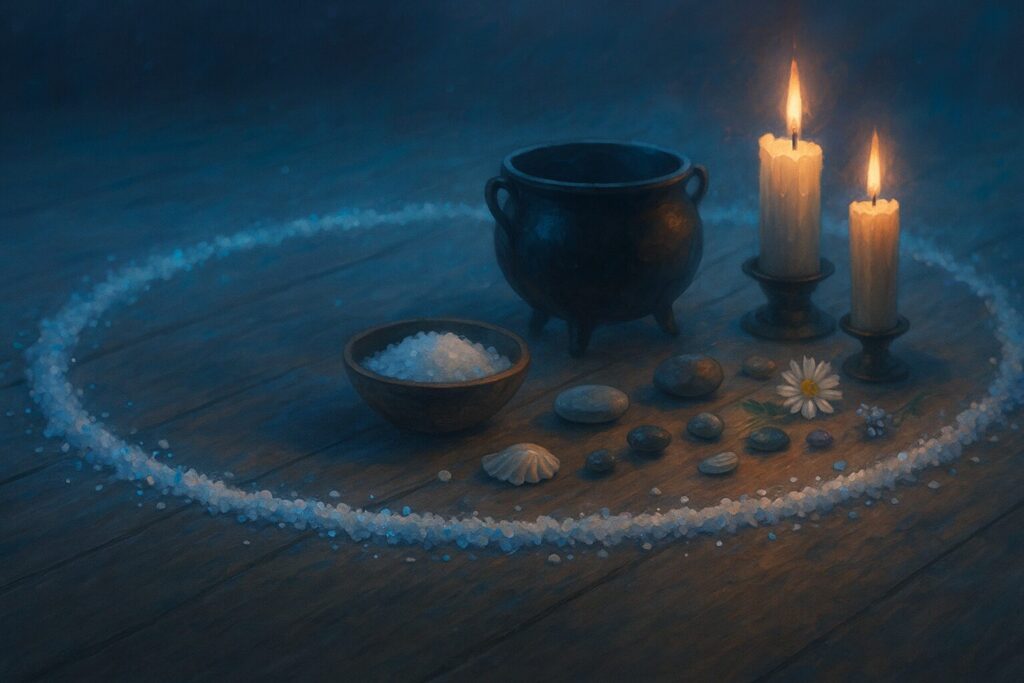
Laying a line of salt across a threshold or around a working space is one of the simplest forms of protection magic. Sea salt at doors can keep emotional turbulence from clinging to the home. Rock salt at property edges reinforces physical wards. Black salt, used sparingly, is for the places where you need a firm “no.”
In formal circles, some witches combine a visualised boundary with a physical one: an unbroken ring of salt on the floor, or a ring of small dishes of salt marking the quarters. The salt gives your intent a body. When the working is complete, the circle is broken consciously and the salt is gathered up and removed.
When a tool feels “off”—a deck that has seen too many readings, a charm that has carried you through a rough patch—salt can help reset it. Some witches bury tools in a bowl of rock or sea salt for a full day or lunar cycle. Others prefer a gentler approach, setting the tool beside the bowl so it can offload without direct contact.
Softer salts like pink or lunar-consecrated blends are ideal for items tied to the heart and intuition. Stronger salts, or a little black salt mixed in, are better for heavy protection pieces, provided the materials are not corroded or damaged by contact.
Salt baths bring the work directly to the body. Sea salt stirs oceanic cleansing; Epsom and Dead Sea salts relax muscles and help the aura release what it has been gripping. Black salt is rarely used in baths, but a trace of water that has stood briefly with a black-salt jar beside it can add a subtle banishing tone.
As you soak, you might imagine the salt gently unhooking clinging emotions, sending them down the drain. For self-love or healing, pink salt combined with rose petals or a few drops of your favourite oil creates a bath that protects without numbing. You step out not just cleaner, but re-calibrated.
Adding a pinch of salt to floor washes, window sprays, or dusting water turns housework into spellwork. Sea salt lifts emotional residue; rock salt lends sturdiness to long-term home protections. A tiny amount of black salt can be used on threshold washes when you are clearing out especially stubborn vibes, but it should be used sparingly and wiped away thoroughly.
As you move through the home, work from back to front, or from top to bottom, consciously sweeping what you release toward the door. Herbs like rosemary, hyssop, or lemon peel combine well with salt for this kind of work. When you pour away the dirty water, do so with awareness that you are sending the old on its way.
In more focused spellwork, salt helps to bind, cool, or carry away what can no longer remain. Black salt is the classic ally here, especially when mixed with ashes from written petitions or remains of cords that have been cut. Rock salt lends solidity to bindings meant to hold firm but not harm, such as jars to contain gossip or cool down conflict.
A common pattern is: name the situation, raise energy, enact the symbolic act (cutting, burning, knotting), and then cover the remains with salt. The salt seals the act, absorbing any lingering charge so it does not drift back into your life. Used respectfully, this is housekeeping, not vengeance.
Salt has followed humanity through every age — from temple floors to kitchen hearths, from the shores of vanished seas to the small bowls on our altars. It is both artifact and ally, a mineral that remembers water and a boundary that remembers fire. In the Craft, we return to it not because it is rare, but because it is honest: it preserves what must be kept, banishes what must be released, and marks the thin places where the sacred leans close. To work with salt is to join a lineage older than written spellbooks, woven through folklore, ritual, covenant, and the daily work of keeping a life whole. It is simple, steadfast magic — the kind that endures.
“Salt shaped civilization: it preserved, it purified, it protected.” -Mark Kurlansky, Salt: A World History