The Zodiac

The zodiac is not a set of personality costumes, handed out at birth like party hats. It is older and stranger than that: a symbolic calendar written in the language of sky and season, a wheel of recurring powers that describe how life tends to move when it moves through time. Signs are not verdicts. They are archetypes—patterns that help the mind name what the world is already doing.
Astrology can be used poorly: as shorthand for judgment, an excuse for bad behavior, or a substitute for knowing someone. But used correctly, it becomes a disciplined art of attention. A sign can illuminate temperament, motives, and certain repeating habits—the way a shoreline predicts how waves will break—without ever claiming to explain the whole sea. A person is never only one thing. We are inheritance and environment, memory and choice, wounds and wisdom, and yes: a measurable imprint of timing.
For witches and other practitioners of the esoteric arts, the zodiac matters because it describes the texture of a moment. It does not merely describe people—it describes conditions. The same working cast under different signs can feel like the same melody played on different instruments: the intention remains, but the tone changes. Fire sharpens; Water deepens; Air clarifies; Earth stabilizes. The wheel teaches not fate, but rhythm.
This page is built as an archetypal library: an atlas of symbols you can consult for study, for ritual timing, and for understanding the mythic grammar that so many magical systems quietly assume. If astrology is the gateway many people stumble through on the way to deeper craft, the zodiac is the threshold itself—twelve doors in a circular hallway, each opening into a different kind of knowing.
What a zodiac sign actually is
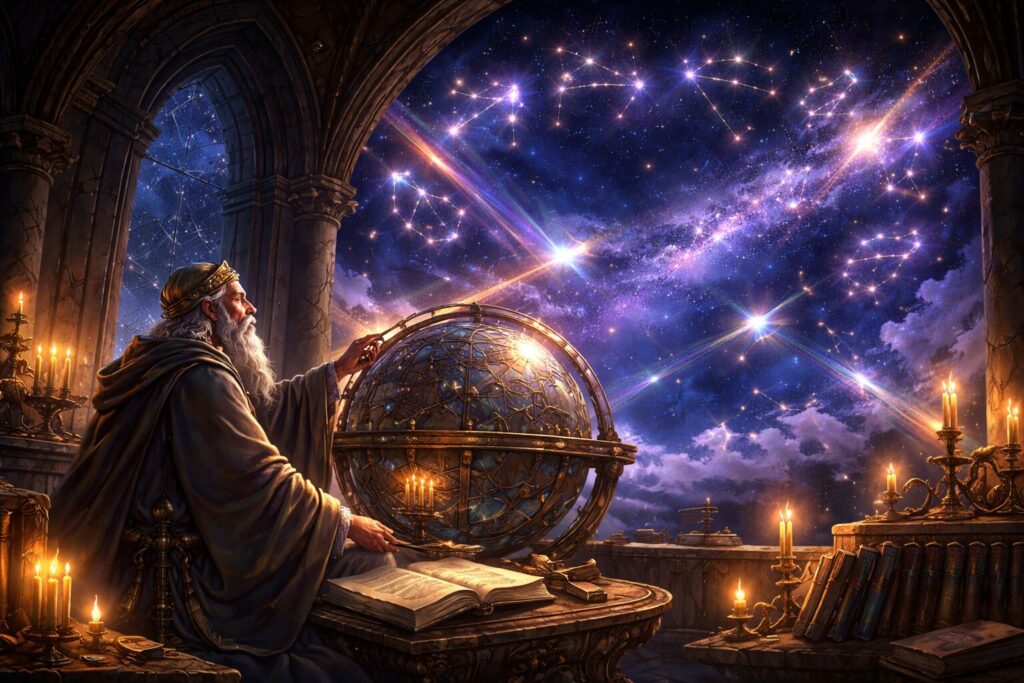
A zodiac sign is not a label meant to finish the sentence of a human being. It is a symbolic climate—a recurring pattern in the architecture of time. The signs are twelve lenses through which life is sorted into recognizable motions: impulse and patience, hunger and harmony, ascent and dissolution.
In practice, the zodiac works best as a disciplined language for pattern-recognition. It can illuminate tendencies—how a person may press forward, retreat, guard, charm, test, or transform— without ever claiming to contain them. People are lived history: nature and nurture, choice and circumstance, memory and meaning… and (sometimes startlingly) a trace of timing.
For magical work, the signs describe tone. The same intention cast beneath different signs can land differently: one hour sharpens, another steadies; one opens the heart, another demands a boundary. The wheel does not replace will—rather, it teaches rhythm.
- The 12 classical signs as an archetypal library (with magical correspondences)
- How zodiac timing changes the “flavor” of spellwork and ritual
- Alternative and esoteric zodiac systems—treated as side paths, not replacements
- A brief historical thread connecting ancient roots to later occult practice
When I trace the windings of the heavenly bodies, I no longer touch the earth with my feet. — Ptolemy
Ruler: Mars
Initiation, courage, sharp beginnings.
Road-opening, bold protections, first-step magic.
Ruler: Venus
Stability, pleasure, endurance.
Prosperity, hearth blessings, grounding rites.
Ruler: Mercury
Curiosity, language, shifting viewpoints.
Divination study, sigils, communication magic.
Ruler: Moon
Home, protection, memory.
Warding the threshold, ancestral soothing work.
Ruler: Sun
Radiance, artistry, sovereignty.
Confidence spells, visibility, vitality blessings.
Ruler: Mercury
Discernment, craft, refinement.
Cleansing, herbal craft, practical magic.
Ruler: Venus
Balance, beauty, agreement.
Harmony spells, restorative workings, mediation.
Ruler: Mars (Pluto)
Depth, taboo, transformation.
Uncrossing, shadow work, cord cutting with care.
Ruler: Jupiter
Vision, truth-seeking, widening horizons.
Road blessings, big-picture luck, sacred direction.
Ruler: Saturn
Structure, discipline, legacy.
Consecrated effort, boundaries, long workings.
Ruler: Saturn (Uranus)
Innovation, distance, reform.
Pattern-breaking, community magic, future craft.
Ruler: Jupiter (Neptune)
Mysticism, empathy, dissolution.
Dreamwork, blessing rites, veil-thin intuition.
The Zodiac as a Magical Engine
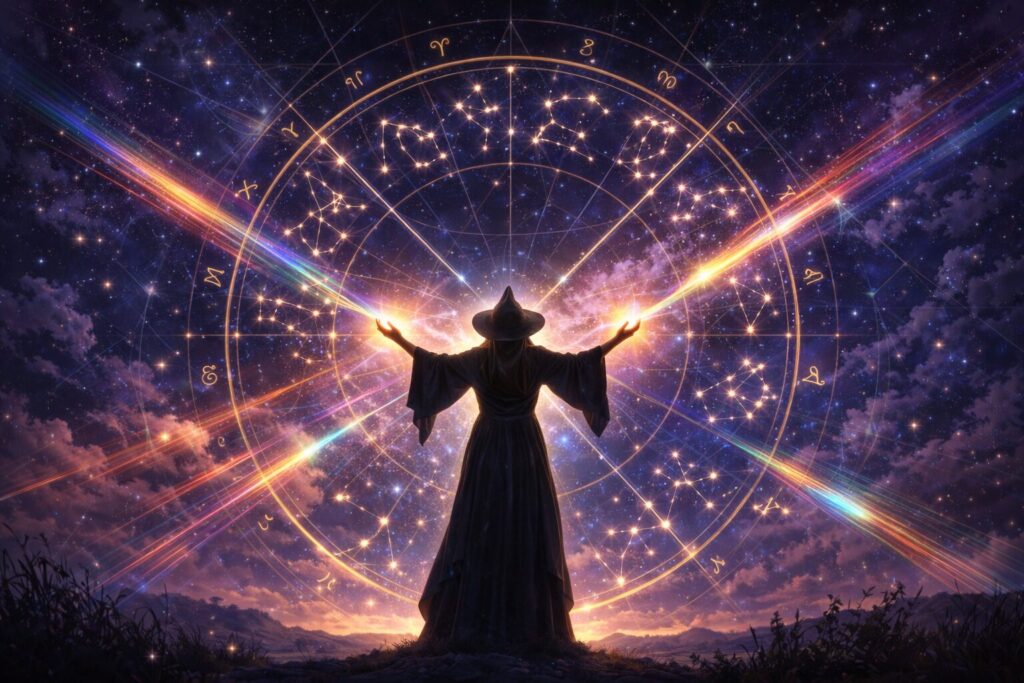
Astrology becomes most convincing when it is treated less like a personality label and more like a timing language. The zodiac describes the texture of a moment: what kind of energy is available, what kind of work it favors, and what kind of results it tends to produce when a working is pushed through it.
Why the Moon in a sign matters (even when you “don’t live by astrology”)
The Moon is the fastest moving “clock hand” in practical magic—tone, mood, and response.
Why the Moon in a sign matters (even when you “don’t live by astrology”)
The Moon is the fastest moving “clock hand” in practical magic—tone, mood, and response.
The Moon changes signs roughly every couple of days, which makes it the most immediately usable timing factor for many practitioners. Even when a working is simple, the Moon’s sign can shift the way the spell behaves: what it emphasizes, what it stirs up, and what it asks of you in return.
This is why experienced practice tends to sound less like “I am this sign” and more like “the Moon is in this sign, so the air tastes like this.” It’s not about handing your agency to the sky—it’s about choosing a current that supports the kind of change you intend to make.
| Moon in… | Favored magical tone | What to watch for |
|---|---|---|
| Aries | Quick ignition; courage; “first move” spells; cutting hesitation. | Impatience, impulsive wording, scorched-earth choices. |
| Taurus | Stability; prosperity; body-based magic; making outcomes durable. | Stubbornness; over-attachment; slow starts that never start. |
| Gemini | Communication; divination; research; clever reversals and re-framing. | Scatter; overthinking; “too many options” paralysis. |
| Cancer | Home, protection, ancestors; emotional repair; blessing the hearth. | Over-merging; nostalgia loops; heightened sensitivity. |
Working principle: timing doesn’t replace skill—it amplifies it. A well-built spell usually works anyway; timing changes how smoothly it runs and what kind of lessons it drags behind it.
Electional magic: choosing a moment on purpose
When the “when” is part of the spell.
Electional magic: choosing a moment on purpose
When the “when” is part of the spell.
Electional magic is the craft of selecting a time that supports your intention. Instead of asking whether astrology is “true,” electional work asks a different question: Which conditions make this kind of change easier?
A simple electional hierarchy (practical, not obsessive)
You don’t need perfect charts. You need good-enough alignment and clean execution. Many practitioners prioritize timing in layers:
Layer 1: Moon phase (growth vs release)
Layer 2: Moon sign (spell “tone”)
Layer 3: Planetary day/hour (optional amplifier)
Layer 4: Avoid obvious snarls (severe stress aspects, personal chaos, exhaustion)
The trick is to keep timing in service of the working, not the other way around. A moment can be auspicious and still require real-world follow-through. Astrology can open a gate; it will not walk through it for you.
Element + modality: the “physics” of a sign
Why two signs can share an element and still feel completely different.
Element + modality: the “physics” of a sign
Why two signs can share an element and still feel completely different.
In magical practice, the element tells you what kind of energy is emphasized—heat, flow, structure, or air. Modality tells you how that energy behaves: does it begin, stabilize, or adapt? Together they form a practical shorthand for spell design.
Element (what the power is made of)
Fire ignites and purifies. Earth stabilizes and manifests. Air clarifies and connects. Water binds, heals, and dissolves.
Modality (how the power moves)
Cardinal initiates. Fixed sustains. Mutable adapts and transforms. This is why a “Fire” working in Aries can feel like a spark, while “Fire” in Leo feels like a hearth, and “Fire” in Sagittarius feels like a torch on the road.
Spellcraft tip: If you need momentum, choose Cardinal. If you need staying power, choose Fixed. If you need change, release, or negotiation with complexity, choose Mutable.
Planetary rulership: the “sponsor” behind the sign
Rulers add motive, method, and consequences.
Planetary rulership: the “sponsor” behind the sign
Rulers add motive, method, and consequences.
The sign is the style; the ruler is the agenda. In practice, rulership tells you what kind of “fuel” a sign runs on and how it tends to seek results. This is especially useful when you’re deciding what offerings, tools, or ritual structure will harmonize with the working.
Example: Venus-ruled signs (Taurus, Libra) often favor enchantment, attraction, and restoration of value; Mars-ruled signs (Aries, traditionally Scorpio) tend toward decisive action, cutting, and protective force; Saturn-ruled signs (Capricorn, traditionally Aquarius) are excellent for boundaries, commitments, and long-term outcomes.
Practical rule: If the ruler is “well-fed” (supported by your methods and offerings), the working tends to feel cleaner. If the ruler is ignored, the spell may still work—but with more friction.
Using the zodiac to understand people—without reducing them
Archetypes illuminate patterns; they do not define a soul.
Using the zodiac to understand people—without reducing them
Archetypes illuminate patterns; they do not define a soul.
The zodiac is at its worst when it becomes a verdict. It’s at its best when it becomes a language for compassion: “Ah—this is how that person tries to protect themselves,” or “This is the kind of pressure that makes them reactive.” Even then, a sign is not the person. It’s a single symbol in a larger chart; and a chart is still only a map.
Three healthy uses
1) Pattern awareness: noticing repetition without moralizing it.
2) Translation: naming differences in needs, pace, and communication style.
3) Timing empathy: understanding why certain periods hit certain people harder.
Quiet discipline: treat astrology like a powerful mirror—use it to see more clearly, not to punish yourself or dismiss others.
Alternative & Esoteric Zodiacs
The twelve-sign zodiac is the classical backbone used across much of Western astrology and modern occult practice. But symbolic calendars evolve. Some systems track different boundaries, different star logic, or entirely different archetypal “wheels.” These are best treated as side paths: meaningful to study, sometimes useful in practice, and rarely interchangeable without changing what you’re actually doing.
Sidereal Zodiac
A star-anchored zodiac (commonly used in Vedic astrology).
Sidereal Zodiac
A star-anchored zodiac (commonly used in Vedic astrology).
The sidereal zodiac aligns sign boundaries to the fixed stars rather than the seasonal equinox framework used by the tropical zodiac. Because of the precession of the equinoxes, the two systems gradually drift apart over centuries, which is why someone may “shift signs” when calculated sidereally.
For magical work, the important point isn’t which one “wins,” but that they describe different reference frames: one is primarily seasonal-symbolic; the other is star-referential. Mixing them casually can create confusion in timing work.
Ophiuchus (the “13th sign” story)
An astronomical constellation often misframed as a lost classical sign.
Ophiuchus (the “13th sign” story)
An astronomical constellation often misframed as a lost classical sign.
Ophiuchus is a real constellation that the ecliptic passes through. The modern “13th sign” meme usually confuses constellations (unequal sky areas) with the zodiac signs (a symbolic division). Classical Western astrology standardizes twelve signs for symmetry and coherence; it’s not a mistake so much as a design choice.
That said, Ophiuchus can be studied as an additional mythic figure—useful for creative, experimental work—so long as you’re clear you’ve stepped outside the classical twelve-sign framework.
Decans (the 36 “faces”)
A finer zodiac: each sign has three 10° segments with distinct flavor.
Decans (the 36 “faces”)
A finer zodiac: each sign has three 10° segments with distinct flavor.
Decans divide the zodiac into thirty-six segments (three per sign). They appear in older astrological and magical traditions, and later become especially useful in Renaissance and talismanic magic as a way to refine timing and imagery. Think of them as the difference between “spring” and “late spring”: same season, different atmosphere.
If the twelve signs are the alphabet, decans are handwriting. They can add precision to spell timing, image selection, and the “felt sense” of an election—without requiring a brand-new zodiac.
Celtic Tree Zodiac (modern)
A neo-traditional symbolic calendar using trees as archetypes.
Celtic Tree Zodiac (modern)
A neo-traditional symbolic calendar using trees as archetypes.
The “tree zodiac” is a modern esoteric system that maps periods of the year to trees and their mythic associations. It often draws inspiration from Ogham-adjacent symbolism and romantic-era ideas about Celtic lore.
In witchcraft, it can work beautifully as a seasonal devotion practice—especially for plant spirit relationships— but it should be treated as a distinct wheel rather than a direct substitute for the classical zodiac.
Witchcraft Symbol Wheels (modern)
Thematic cycles built for practice: tools, animals, rites, and thresholds.
Witchcraft Symbol Wheels (modern)
Thematic cycles built for practice: tools, animals, rites, and thresholds.
Many witches build alternative “zodiacs” that function more like an initiatory curriculum than an astronomical model: a year-wheel of archetypes (the cauldron, the raven, the key, the candle, the crossroads), each teaching a mode of work. These systems are often deliberately poetic: a way to make practice memorable and coherent.
They can be potent—especially for training and devotion—because they are designed for the psyche and the altar, not the observatory. The trade-off is that they are usually personal, local, or community-specific rather than universal.
Fixed Stars (advanced)
A stellar layer that can override “sign-only” interpretations.
Fixed Stars (advanced)
A stellar layer that can override “sign-only” interpretations.
Fixed-star work treats certain stars as having distinct mythic reputations and effects, especially when they closely align with key points in a chart (or a moment chosen for a working). Historically, this is one of the places astrology and talismanic magic most clearly interlock.
This is not beginner material—yet it’s worth knowing it exists, because it explains why purely “sign-based” readings can feel too blunt for lived reality.
Practice note: alternative wheels are most useful when you treat them as coherent systems—each with its own rules— rather than grabbing pieces from many models at once. Mixing can be powerful, but only after you can feel what each framework is doing.
Historical Roots of the Zodiac
The zodiac is not a modern invention layered onto ancient sky-watching. It is the result of thousands of years of refinement, translation, and magical experimentation. Each era added new meanings without erasing what came before.
Babylonian foundations
The earliest recognizable zodiac emerges in Mesopotamia, where sky observation was not curiosity but governance. Babylonian astronomer-priests recorded planetary motion with obsessive precision because celestial cycles were believed to encode the rhythms of kingship, agriculture, and divine favor. The heavens were not distant—they were administrative. The sky was a ledger.
Over centuries, recurring star patterns stabilized into a twelve-fold band along the ecliptic. This was not yet personality astrology; it was a calendar of cosmic weather. Certain celestial configurations were interpreted as warnings, permissions, or openings. Timing itself became sacred technology.
What survives into modern astrology is not superstition but methodology: the conviction that cycles matter, that recurrence creates meaning, and that observation is a magical discipline. The Babylonian inheritance is the root of astrological seriousness—astrology as structured knowledge, not free invention.
In a witchcraft context, this era establishes the central principle still used today: right action depends on right timing. The zodiac begins as a clock before it becomes a mirror.
Egyptian decans and stellar magic
Egyptian stellar religion adds a different layer: astrology as afterlife architecture. The decans—thirty-six star-groups rising sequentially through the night—functioned as cosmic markers of ritual hours. These were embedded in funerary texts, temple ceilings, and initiation symbolism. The sky was a map of passage.
Unlike Babylonian omen-reading, Egyptian astronomy leans toward metaphysical orientation. Stars were gates. The decans tracked the soul’s movement through invisible territories. Astrology here becomes spatial rather than predictive: a navigation system for consciousness.
When Hellenistic astrologers absorb Egyptian stellar lore, the zodiac inherits this mystical geometry. The signs are no longer only calendar divisions; they become thresholds within a cosmic architecture. Each segment of the sky acquires mythic texture.
For modern magical practice, this legacy survives in the idea that astrology describes states of being, not just events. A sign is a mode of experience. A witch working with zodiacal timing is aligning with atmospheres, not just dates.
Greek synthesis and philosophical astrology
Greek philosophy transforms astrology from omen science into symbolic cosmology. Thinkers such as Ptolemy articulate a universe governed by proportion, sympathy, and intelligible structure. The zodiac becomes a grammar for describing temperament, causation, and relational harmony.
This period marks the birth of astrology as a psychological and metaphysical language. The heavens are not dictating fate; they are expressing pattern. Human character is read as resonance within a larger system. The sky becomes a mirror capable of reflection without tyranny.
Crucially, Greek astrology introduces the concept of cosmic sympathy: the belief that all levels of reality echo one another. This idea becomes foundational for Western magic. Talismans, correspondences, and planetary rites depend on the assumption that alignment amplifies intention.
The zodiac in this framework is neither destiny nor decoration. It is a symbolic interface through which the human mind can study the architecture of experience itself.
Renaissance talismanic revival
The Renaissance does not invent magical astrology—it professionalizes it. Scholars such as Marsilio Ficino and Agrippa treat celestial influence as a branch of natural philosophy. Astrology becomes medicine, psychology, music theory, and ritual engineering at once.
Renaissance magicians believed the universe was saturated with hidden harmonies. By crafting images, chants, and talismans timed to zodiacal configurations, a practitioner could tune themselves to those harmonies. Magic was understood as participation, not coercion.
This era reframes astrology as an applied science of resonance. The zodiac becomes a toolkit. Signs are no longer abstract archetypes but operational forces that can be invited, strengthened, or moderated through ritual art.
Modern witchcraft inherits more from Renaissance astrology than from any other period: the idea that celestial symbolism is actionable. Timing is craft. Alignment is technique. The sky is usable.
Modern occult reinterpretation
The 19th and 20th century occult revival internalizes astrology. Influenced by psychology, mysticism, and comparative religion, practitioners reinterpret the zodiac as a map of inner development rather than external fate. Astrology becomes literacy in symbolic pattern.
This shift does not abandon traditional cosmology—it translates it. The signs become lenses through which personality, wounds, potential, and transformation can be studied. Astrology becomes dialogic: a conversation between sky and psyche.
Contemporary witchcraft inherits this hybrid worldview. Ancient timing systems merge with modern self-awareness. A birth chart becomes not a sentence but a curriculum. The zodiac becomes a tool for reflection, alignment, and deliberate change.
What persists across all eras is the same core thesis: the cosmos is structured, and structure can be read. Astrology survives because it is a language capable of evolving without losing its grammar.
Continuity, not contradiction. Across its history, astrology has repeatedly reinvented itself without losing its core assumption: that pattern is meaningful. The zodiac is not frozen doctrine but a durable symbolic technology. Each era reframes it, but none replaces it.
Modern witchcraft stands inside that continuity—studying the sky not as superstition, but as an evolving conversation with structure itself. We believe the heavens are not a cage; they are a language. And language can be learned.
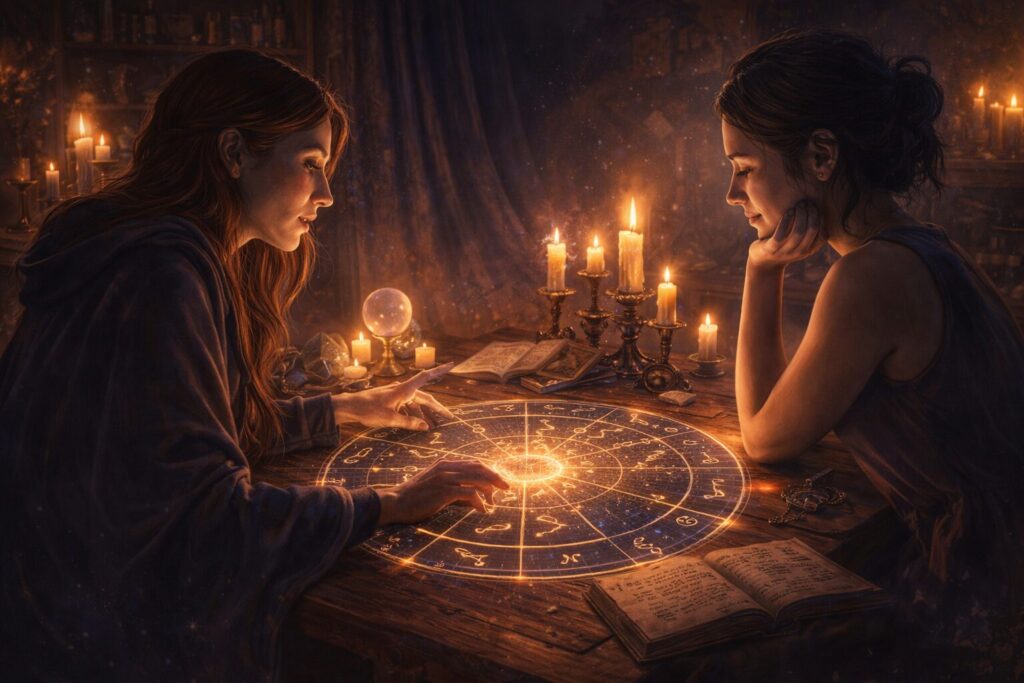
The zodiac is best approached the way one approaches any living symbol: with respect, curiosity, and restraint. It is not a courtroom where a person’s character is sentenced by a birth moment. It is a wheel of repeating climates—an old map of how energy tends to behave as it moves through time. The signs describe tendencies, not inevitabilities; patterns, not prisons.
This is why astrology can feel both “basic” and bottomless. Almost everyone encounters it early, and many dismiss it early—usually because it’s been offered to them in its thinnest form. But under the surface, the zodiac is a serious symbolic instrument: a vocabulary for temperament and timing, for the way desire and fear shape decisions, for the way seasons seep into psychology, and for the way moments themselves have texture. Used well, it does not reduce a person. It makes you a better observer of what’s already there.
For magical practice, the zodiac is less about identity than condition. It helps answer practical questions: What kind of work does this moment favor? What wants to grow here, and what wants to be released? What is likely to move smoothly, and what will require more negotiation? When aligned with clear intention and skillful execution, timing becomes an ally. Not a substitute for will—an amplifier of it.
If you take anything from this library, let it be this: the zodiac is a language of cycles. It can illuminate people without defining them, and it can guide spellwork without ruling it. A person is always more than their sign—and a good practitioner is never less than their choices.