Correspondences
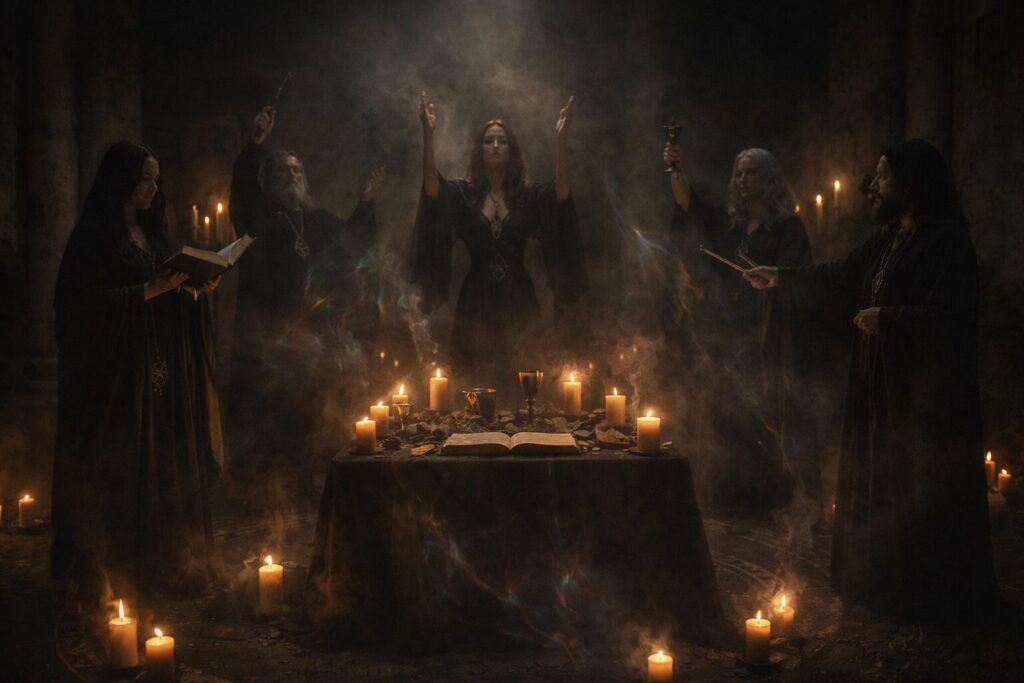
Correspondences are the hidden grammar of magic — the system by which symbols, forces, times, elements, and meanings align into working structure. At the simplest level, every practitioner already uses them. A candle chosen for color, an altar arranged by element, a ritual timed to a moon phase: these are correspondences in their most accessible form. In low or domestic magic they function as intuitive anchors, helping intention take shape through familiar symbolic language.
In advanced practice, however, correspondences stop behaving like decorative associations and begin acting more like a calculus of meaning. They form interlocking systems where a change in one variable ripples through the entire working. A planetary alignment alters the tone of a rite; a mythic symbol shifts the psychological field; a geometric structure redirects energetic flow. At this level, correspondences are not aesthetic choices but architectural decisions. They determine coherence, amplification, and stability.
Because of this, high-level correspondence work carries greater consequence. When systems are layered incorrectly or pushed beyond the practitioner’s grounding, the result is not simply a weak spell — it can produce symbolic overload, emotional destabilization, or unintended energetic feedback. The risk is not supernatural punishment but misalignment: too much force passing through structures that are not yet integrated. Advanced work magnifies both success and error.
This is why correspondence study is considered an adult discipline in the craft. It requires patience, symbolic literacy, and the ability to step back from intensity when a structure becomes unstable. Yet it is also one of the most rewarding domains of magical practice. When understood well, correspondences allow workings to become elegant, efficient, and precise. They transform ritual from improvisation into composition — a deliberate architecture of meaning that can be tuned rather than guessed.
The sections that follow explore correspondences as language, rhythm, engineering, and psychological mapping. They are not meant to replace simple practice but to deepen it. Even the most complex symbolic equations rest on the same foundations as a candle lit with intention. The difference is scale, not essence. Correspondences are present in all magic; advanced study simply reveals how vast the system truly is.
Core Structures
FoundationsThe elemental, planetary, numeric, and geometric frameworks that form the skeleton of correspondence systems.
Mythic Systems
Symbol & NarrativeArchetypes, deities, and symbolic narratives that organize correspondences into living mythic language.
Temporal Rhythms
Timing & CyclesPlanetary tides, seasonal currents, and rhythmic timing structures that align workings with cosmic flow.
Energetic Engineering
Operational LogicThe mechanics of polarity, resonance, layering, and symbolic circuitry that shape functional outcomes.
Psychological Mapping
Inner TerrainCorrespondences as cognitive architecture — archetypes, identity, dream symbolism, and inner pattern.

Correspondences are not a catalog to memorize but a way of seeing. They reveal that magic is structured — that symbols do not float randomly, but exist in relationships that can be studied, tuned, and composed. At the advanced level, working with correspondences is less about collecting associations and more about learning how systems breathe together. A ritual succeeds not because it is ornate, but because its parts agree with one another.
This is why correspondence work is considered a higher discipline. The study can be slow, exacting, and at times maddening in its detail. Misalignment is easy; a single misplaced emphasis can ripple through an entire structure. Yet the very precision that frustrates is also what makes the practice worthwhile. Time spent learning correspondences builds fluency — and fluency replaces guesswork with intentional design. The practitioner begins to feel when a system locks into coherence, when a working hums instead of strains.
Correspondences also act as a focusing lens for will. When symbols align cleanly, intention stops scattering and begins to concentrate. The working becomes less about pushing harder and more about directing accurately. This amplification is one of the great strengths of high correspondence work: it allows subtle effort to produce disproportionate effect. But amplification cuts both ways. If the structure is unstable, confusion is amplified alongside intention. Mastery therefore comes from restraint as much as invention — knowing when to simplify, when to layer, and when to step back and let the system resolve itself.
None of this removes correspondences from ordinary practice. The same principles that govern elaborate ceremonial structures are present in a candle lit with intention or an altar arranged by element. Advanced study does not replace simple magic; it reveals the mathematics hidden inside it. Every working, no matter how humble, participates in a vast symbolic architecture.
To study correspondences is to study the grammar of reality as experienced through symbol. The goal is not control, but fluency — the ability to compose meaning with care, balance, and coherence. From that fluency arises a craft that is elegant rather than forceful, deliberate rather than chaotic, and powerful precisely because it is aligned.