
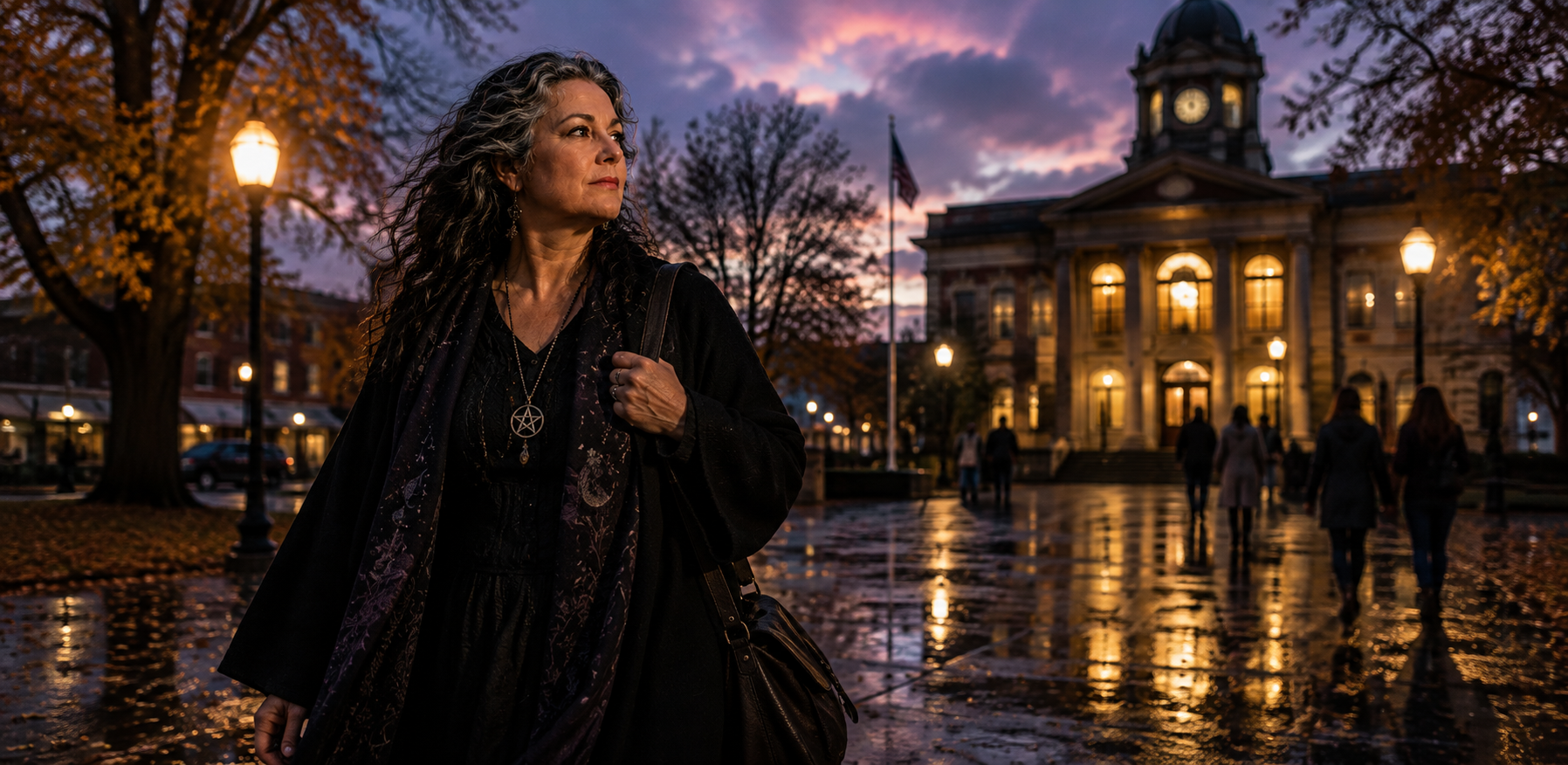
Pagan Ethics, Religious Freedom & the Cost of Staying Quiet
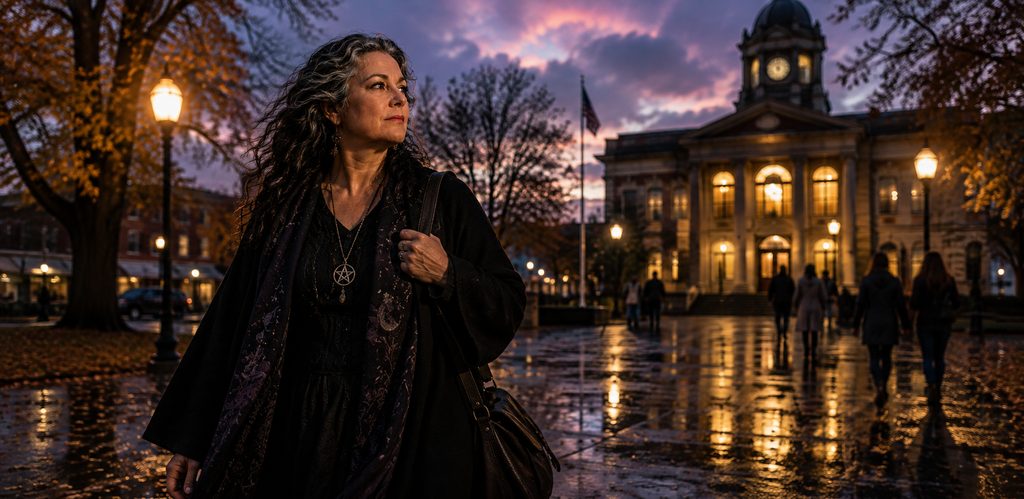
Every few months, somewhere in the witchy corners of the internet, somebody announces that they are tired of politics being dragged into witchcraft. “I came here for spells, not politics.” “Why does everything have to be political?” “Can’t we just practice our religion and leave politics out of it?”
I understand part of the complaint. Politics can become exhausting, performative, tribal and almost deliberately unpleasant. Not every Sabbat needs a campaign speech attached to it, your altar does not have to endorse a candidate, and casting a circle does not somehow generate a party platform. There are times when I want politics out of my spiritual life too.
But there is another version of “keep politics out of witchcraft” that I have considerably less patience for. It is the version that really means: I would like to enjoy the religious freedom other people fought to secure for me without having to pay attention to whether that freedom remains secure. That is not really apolitical. It is simply politics happening while you look the other way.
Witchcraft is not inherently Democratic or Republican, and Paganism certainly is not. Our traditions are far too varied for that, and anyone attempting to reduce Pagan ethics to a modern American party platform is flattening both religion and politics. But witches still live under laws. Pagans work for employers, raise children who attend schools, use libraries, serve in the military, bury our dead, rent buildings, create organizations, ask for religious accommodations, wear religious symbols and occasionally have to explain to someone with authority over us that, yes, this really is our life.
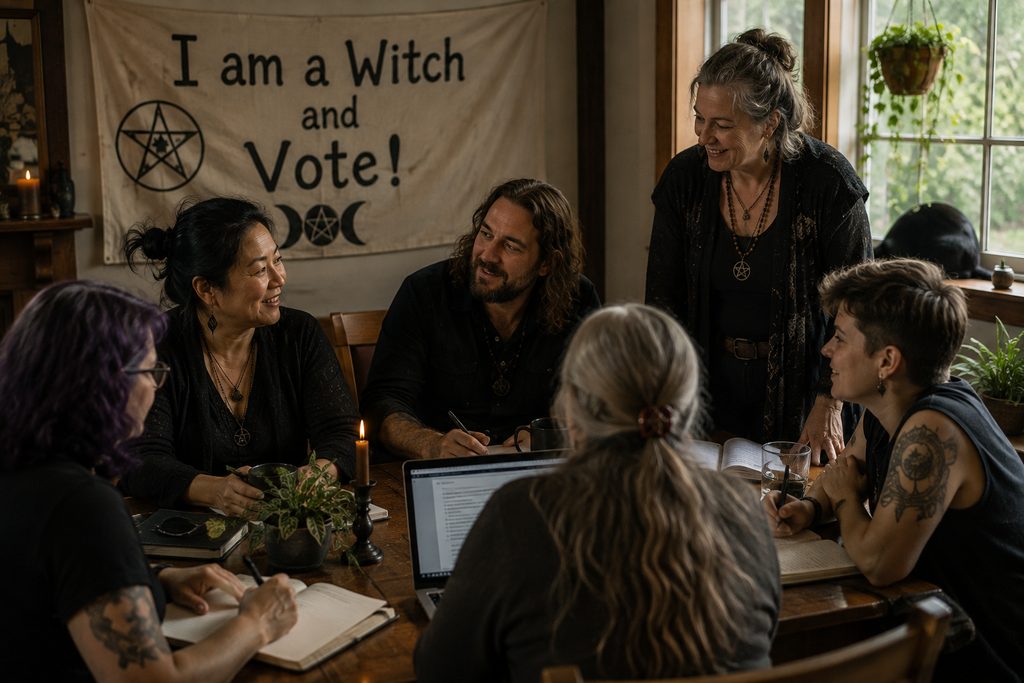
Politics already entered the circle. The question is whether we noticed.
Pagan Ethics Are Not a Party Platform
There is no universal Pagan catechism. Not every witch follows the Wiccan Rede, not every Pagan believes in the Threefold Law, and Heathen, Hellenic, reconstructionist, animist, ceremonial, folk-magical, Wiccan and eclectic traditions can approach morality very differently.
That does not mean we have no ethics. Across these traditions we continually encounter questions about sovereignty, consent, reciprocity, hospitality, responsibility, stewardship, harm, obligation, truth and the relationship between personal power and community. Those sound wonderfully philosophical until somebody writes a law about them.
Who controls your body? Whose religion gets accommodated? Who gets to define family? What books may children read? Can a public institution privilege one theology over another? Does freedom of religion mean freedom for minority religions too? What happens when someone else’s religious convictions become rules you are expected to live under?
Those are ethical questions, but they are also political questions. Politics is often nothing more mysterious than what happens when our values encounter other people and institutions with power.
Witches Did Not Simply Wake Up One Morning With Religious Rights
It is surprisingly easy to forget how recent some of our victories are.
In 1986, the Fourth Circuit Court of Appeals decided Dettmer v. Landon, a case involving a Virginia prisoner who practiced Wicca. The state challenged whether Wicca should even be treated as a religion for constitutional purposes. The court concluded that Wicca occupied a place in the lives of its adherents comparable to more conventional religions and therefore qualified for First Amendment protection. The court still allowed certain prison restrictions on ritual objects for security reasons, so it was not an unlimited victory, but the recognition itself mattered enormously.
Think about the date. 1986 is not ancient history. Many of us were already alive.
That case is a useful reminder that the legal legitimacy Pagan practitioners now casually assume was not always casually granted. Somebody had to insist that our religions counted.
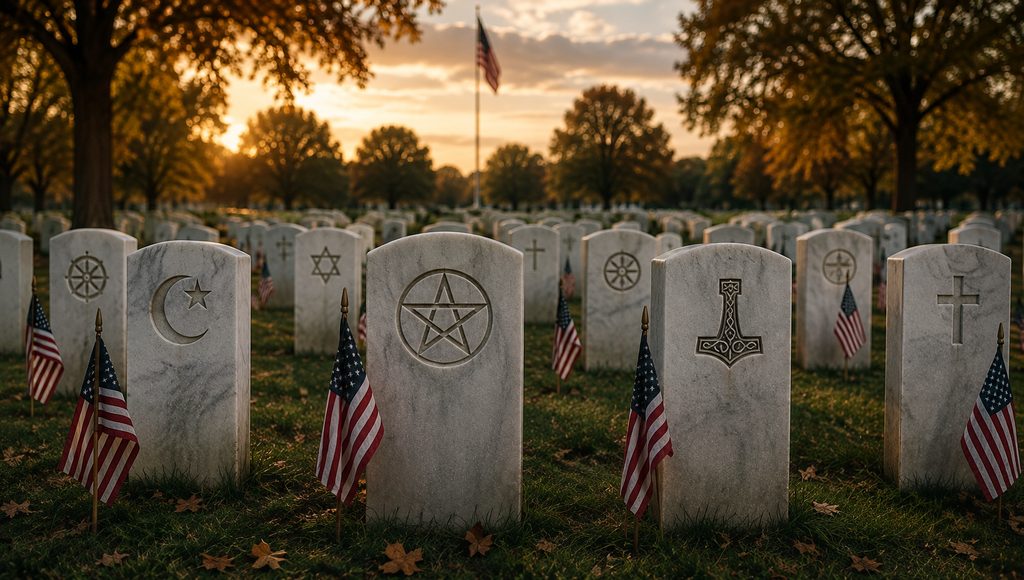
A Wiccan Veteran Had to Fight for a Pentacle
Here is another date worth remembering: 2007.
For years, Wiccan veterans and their families fought to have the pentacle recognized as an approved religious emblem for government-issued grave markers. Only after litigation and sustained pressure did the Department of Veterans Affairs approve it.
That was less than twenty years ago.
A Wiccan could serve this country, wear its uniform, accept its risks and even die in its service, while the government still had to be pushed before the symbol of that veteran’s religion received treatment comparable to the symbols of majority faiths.
So when someone tells me Pagan religious liberty is settled history and witches should stop making everything political, forgive me if I remain unconvinced. Someone made it political because somebody had to.
We Won Recognition. That Did Not End the Problem.
Religious discrimination involving Wicca is real enough that the Equal Employment Opportunity Commission has used Wicca in official guidance explaining religious discrimination and accommodation. One example describes a Wiccan employee requesting time off for Samhain and a supervisor dismissing Wicca as irrational or not a “real” religion. The lesson is straightforward: employers do not get to decide that a sincerely held religion is too unfamiliar or strange to deserve consideration.
There is an obvious point hiding in that guidance. If nobody ever needed reminding that Wicca could qualify as religion, the federal government would not need to explain it.
Modern allegations of discrimination continue as well. Recent lawsuits have included Wiccan employees alleging mistreatment after declining Christian prayer or disclosing their religion, and prisoners have continued litigating access to Wiccan books, ritual materials and religious practice. Allegations in lawsuits should not be confused with proven findings, but their continued existence tells us something important: these conflicts did not disappear when society became somewhat more comfortable with Paganism.
Even administrative decisions deserve our attention. In 2026, the Pentagon dramatically reduced the number of religious-affiliation codes used in military records, with Pagan, Wiccan and many other minority-faith identities absorbed into broader categories. The Pentagon described the change as administrative streamlining rather than a judgment about the legitimacy of those religions, and that distinction matters. At the same time, critics reasonably asked what happens when minority religions become harder to count individually, because bureaucratic visibility can affect whether institutions understand who needs particular religious resources.
Not every institutional decision involving Pagans is persecution. Not every institutional decision involving Pagans is harmless either. We should be capable of enough discernment to tell the difference.
Then There Is the Republican Problem
The modern Republican Party is, as a practical matter, less religiously comfortable terrain for Pagans and witches than the Democratic coalition. That does not mean every Republican hates witches, nor does it mean every Democrat respects Paganism. It certainly does not mean a Republican Pagan somehow stops being Pagan.
It does mean we should stop pretending the religious composition of American conservatism is irrelevant.
Conservative evangelical Protestants overwhelmingly align with the Republican Party, and the alliance extends beyond evangelicals into other conservative Protestant traditions. Those communities are not simply incidental voters. They are an important part of the modern Republican coalition, its activist networks and its political infrastructure.
That matters because many conservative Protestant traditions begin with theological assumptions that are difficult to reconcile comfortably with Pagan religion. Their God is not generally understood as one deity among many. The biblical tradition explicitly prohibits the worship of other gods and contains language describing God as jealous of competing worship. In many conservative churches, our gods are not regarded as alternate expressions of the sacred. They may be regarded as nonexistent, idolatrous, deceptive spirits or, in some cases, demons. Witchcraft itself is frequently described as forbidden or spiritually dangerous.
That creates a genuine tension.
It does not automatically require political intolerance. A Christian can believe every god I worship is false while defending my absolute civil right to worship them. Many Christians do exactly that, and a pluralistic society depends on the ability to make that distinction.
The problem begins when theology moves from “my religion teaches that your religion is wrong” to “government and public institutions should be organized according to the truth of my religion.”
At that point, I become very concerned.
Christian Nationalism Is Not Christianity, but It Is a Christian Political Project
Christian nationalism deserves to be named directly because it has become a major part of the conversation.
Christian nationalism is not simply Christianity, and criticizing it should not be treated as an attack on every Christian. Broadly speaking, it seeks a privileged relationship between American national identity and Christianity. Its advocates vary in how far they want that privilege to extend, but the underlying idea is that Christianity should occupy a special cultural or governmental position that other religions do not occupy equally.
For Pagans, that should raise an obvious question: where exactly are we supposed to fit in that arrangement?
This is not an abstract concern when Christian-nationalist language repeatedly appears around education, government, law, public morality and national identity. If somebody tells me America needs to “return to God,” I want to know which God. If they tell me schools need more religion, I want to know whether they mean my religion too. If they want government to acknowledge divine authority, I want to know whether Hekate, Hermes, Odin, Brigid, Isis and the thousands of other gods worshipped by Americans are invited to that ceremony.
Usually, we know the answer.
And yes, Christian nationalism today has a particularly strong relationship with Republican politics. We can debate definitions, polls and labels, but pretending that relationship does not exist requires ignoring a considerable amount of political reality.
Pagans should pay attention when influential people tell us they want a more explicitly Christian public sphere. We should believe them enough to ask what they mean.
You Can Be a Republican Pagan. You Still Have Something to Reconcile.
Let me be blunter.
You can be a Pagan Republican. You can be a conservative witch. No coven police are coming to confiscate your athame.
But calling yourself Pagan does not exempt you from examining the coalition you help put into power.
If a major constituency within that coalition believes your gods are false, your practices are spiritually dangerous and American public life ought to reflect Christianity more explicitly, then at some point you should be willing to explain how you reconcile those things.
Maybe you have an answer. Perhaps racism, taxation, abortion, gun rights, foreign policy, immigration, economic policy or another issue outweighs your religious concerns. Adults make political tradeoffs constantly, and political coalitions are complicated. But pretending the conflict does not exist is not an answer.
“I don’t like discussing politics” does not make policies disappear, and “both parties are the same” does not magically make both parties equally influenced by people who regard your gods as demonic.
I am not particularly interested in surrendering my civic power to people who openly tell me that my gods are false and then assure me their politics have nothing to do with their theology. If you reach a different conclusion, that is your decision, but at least own the decision rather than pretending there is nothing there to examine.
Christian Witches Complicate the Story, and That Is Useful
Christianity and witchcraft are not nearly as cleanly divided in lived practice as either side sometimes pretends.
Christian magic is old. Folk Christianity, cunning traditions, Biblical charms, saint work, magical prayer and other forms of Christian magical practice existed long before anyone discovered the phrase “Christian witch” on social media. There are Christians today who openly identify as witches, and probably many more who practice quietly.
There is a reason for some of that quiet.
A Christian witch practicing within a liberal, mystical or folk-Christian framework occupies a very different religious environment from someone attending an American evangelical or fundamentalist church that teaches witchcraft is demonic. Disclosure in the latter environment may mean family rejection, exclusion from a church community, professional consequences or simply having to defend one’s spirituality constantly.
That is one reason the broom closet still exists. Many witches remain quiet not because they are ashamed of what they practice, but because religious difference can still carry social, familial and professional costs.
Christian witches actually strengthen the argument for pluralism because they demonstrate why the government should not be in the business of resolving theological disputes. A fundamentalist pastor may say the Christian witch is not truly Christian. The Christian witch may strongly disagree. Neither one needs the state to settle the argument.
That is precisely what religious freedom is for.
“But I Just Want Politics Out of My Spirituality”
There is a version of this request I respect.
Some people are exhausted. They spend all day hearing about presidents, Congress, courts, elections, wars, scandals and outrage, and they come to their altar because they desperately need fifteen minutes during which Donald Trump, Democrats, Republicans and cable news are not invited.
Fine. I understand that completely.
Your ritual does not owe anybody a civics lesson. Your coven does not have to endorse candidates. Your deity practice does not need campaign merchandise. Wanting respite from politics is not the same thing as refusing civic responsibility.
The version I object to is different. It appears whenever somebody raises an issue affecting actual witches, religious minorities, libraries, schools or civil liberties and is immediately told to “keep politics out of witchcraft.”
Sometimes “no politics” means, Please give me one peaceful place in my life. I understand that request.
Sometimes it means, Please stop asking me to examine what the people I support intend to do to people unlike me.
Those are not the same request.
Politics, Like Witchcraft, Is Local
National politics gets most of the attention, but some of the decisions most likely to affect your everyday life happen much closer to home.
School boards decide curriculum and library policy. Library boards determine how challenges are handled. City councils and county commissions make decisions about public facilities, zoning and community resources. State legislatures shape civil-rights protections. Local officials influence schools, jails, hospitals and public institutions. Judges, prosecutors and sheriffs exercise enormous power, often with much less public attention than a presidential election receives.
The people who want to change public culture understand this remarkably well.
They show up.
They run for school boards.
They challenge books.
They attend library meetings.
They organize around city councils.
They learn obscure administrative procedures that most people do not even know exist.
Then everyone else discovers what happened after the vote.
Witchcraft-related books have been challenged in American libraries along with books involving LGBTQ lives, race, sexuality, religion and other controversial subjects. A book challenge is not automatically a ban and not every objection is religiously motivated, but the broader pattern should matter to anyone who values intellectual and religious freedom.
This is why I keep coming back to a simple idea:
Politics, like witchcraft, is often most powerful when it is local.
We understand this principle magically. We worry about correspondences, timing, appropriate tools and directing intention toward the place where it can actually have an effect. Then we enter civic life and scream at the President about something controlled by a five-person local board whose election we skipped.
We can do better.
Know Your Rights
This may be some of the least glamorous magical advice I will ever give: learn how your government works.
Know who represents you. Understand what your school board actually controls. Learn how your library handles challenges. Know what religious protections your state provides in addition to federal law. Understand how workplace religious accommodation works and how discrimination can be documented. Know the difference between private religious expression and government endorsement of religion.
Know what the First Amendment does—and what it does not do.
You do not have to become a lawyer, policy analyst or political obsessive. You do need enough civic literacy to recognize when something that affects you is happening and enough confidence to know which door to knock on.
There is power in knowing where power actually lives.
Magic Is Not a Replacement for Citizenship
I believe in magic. That should be reasonably obvious by now.
I also believe magic becomes an excuse when we use it to avoid mundane action.
If a school board is considering a policy you oppose, perform a working for wisdom, courage or justice if that is your practice. Then go to the meeting.
If a politician is advocating something harmful, light your candle. Then find out when the election is.
If someone experiences religious discrimination, protect them magically if that is part of your Craft. Then write down what happened, preserve the evidence and find out which civil-rights office handles the complaint.
I do not believe casting for justice substitutes for voting about it.
Magic and mundane action are not enemies. They are partners. Most experienced witches understand that perfectly well in every other area of practice. You can perform a prosperity working and still submit the job application. You can cast for healing and still call the doctor. You can work for protection and still lock the door.
Politics should not suddenly become the exception.
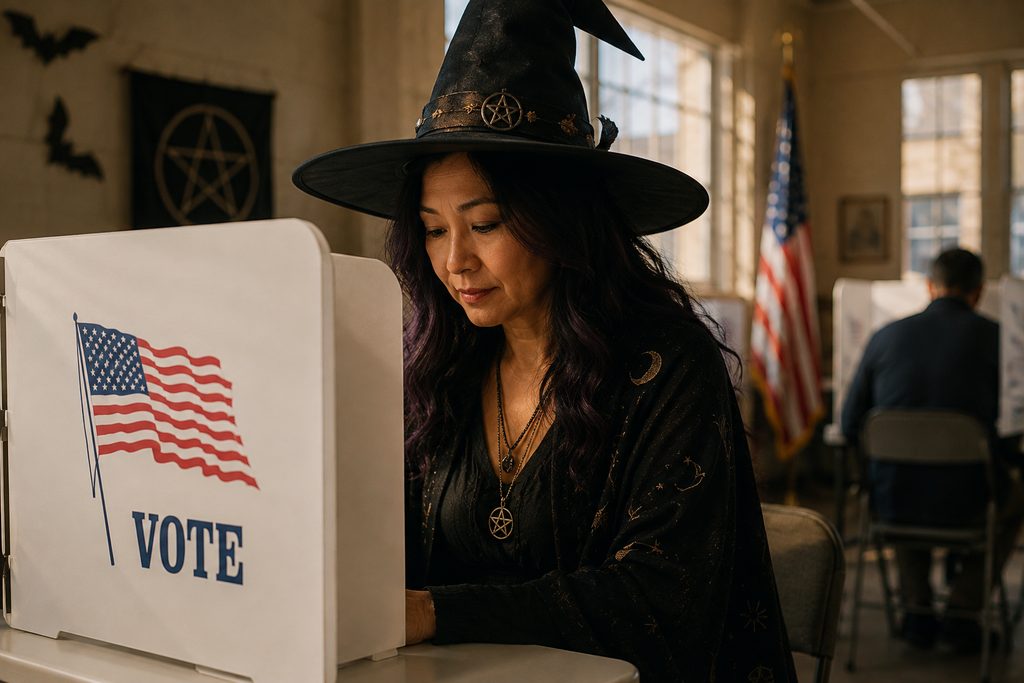
If You Can Vote, I Think You Should
If you have meaningful access to the ballot, I think deliberately refusing to vote while constantly complaining about politics is difficult to defend.
No candidate will perfectly reflect your ethics. Mine certainly do not. Voting is not a declaration that a politician is your spiritual teacher or moral superior. It is choosing among available political outcomes.
And the presidential contest is only one line on a ballot. Judges, legislators, prosecutors, sheriffs, school boards, city councils and local measures can affect your life far more directly.
You do not have to vote the way I vote. I would much rather have an informed Pagan examine the issues carefully and disagree with me than have a politically disengaged Pagan insist none of it matters.
It matters because people before us demonstrated that it mattered. Someone went to court so Wicca would be treated as religion. Families fought so a Wiccan veteran could have a pentacle on a grave marker. Employees insist that Samhain deserves the same serious consideration as somebody else’s holy day.
Rights do not maintain themselves because we once won them.
Religious Freedom Means Their Religion Too
There is an ethical test here that I think matters enormously.
If I demand religious liberty only for Pagans, then I do not really believe in religious liberty. I believe in Pagan privilege.
Those are not the same thing.
If government cannot privilege Christianity over Paganism, then it cannot privilege Paganism over Christianity. A Muslim employee deserves accommodation. A Jewish student deserves protection. A Sikh deserves to wear the articles of their faith. An atheist deserves freedom from compulsory worship. A conservative Christian deserves protection against genuine religious discrimination just as I expect protection for a witch.
A religion being unpopular, strange to me or even offensive to me does not erase its civil rights.
That is pluralism, and pluralism is messy. It sometimes requires us to defend the freedom of people whose theology explicitly says ours is wrong.
But that is the bargain.
My gods do not need the government to declare your God false before I can worship them. I expect the same courtesy in return.
Other People Pushed the Door Open for Us
One of the easiest mistakes modern witches can make is assuming our current visibility happened naturally.
It did not.
Somebody challenged the employer. Somebody challenged the prison. Someone filed the lawsuit. Someone called the lawyer. Someone attended the meeting. Someone wrote the letter, organized the group, collected the evidence and kept showing up after everyone else became tired.
Someone made enough noise that a Wiccan veteran can now be buried beneath a pentacle.
Someone insisted that we counted.
Because they did, many of us can now openly build altars, publish websites, create communities, wear religious symbols, ask for accommodations and casually complain on Facebook that Paganism has become “too political.”
There is an irony there that should not be missed.
Religious freedom is not something Pagans inherited untouched. Other people pushed doors open for us. I think we have some obligation not to let those doors quietly swing shut behind us.
So Stand Up a Little
I am not asking every witch to become an activist, every coven to become a political organization or every ritual to become a protest. I am asking for something smaller, and perhaps harder: pay attention.
Vote when you can. Know your local politics. Learn your rights and the rights of people unlike you. Watch the school board. Support your library. Read the proposed policy instead of relying entirely on somebody’s Facebook summary. Document discrimination. Contact representatives occasionally. Show up when something important is happening.
Defend religious freedom before the threatened religion happens to be yours.
And when somebody proposes that American government ought to become more explicitly Christian, do not politely assume that the word “Christian” somehow includes your gods too. Ask what they actually mean. Ask who belongs in the country they are describing and who does not. Ask which religions receive legitimacy and which merely receive tolerance.
Most importantly, ask what happens to the witch when the state begins deciding which theology deserves special treatment.
Those are not paranoid questions. History has already answered some of them.
The Witch Still Lives in the World
I understand the temptation to retreat. The circle feels clean. Politics rarely does.
Inside ritual we can choose our correspondences, establish our boundaries and decide who enters. Democracy is much messier because we share it with people who profoundly disagree with us.
That is precisely why participation matters.
Your altar may be private. Your relationship with the gods may belong only to you. Your ethics may begin in the quietest parts of your conscience. But the freedom to practice those things openly—or secretly, if secrecy is what keeps you safe—has always depended partly on what happens outside the circle.
So no, I do not think witchcraft comes with a party-registration card, and I do not think Paganism requires everyone to vote the same way.
But I also do not believe witches have the luxury of pretending politics cannot reach us.
It already has.
The only question is whether we intend to have a voice when it does.
—Kael
Coven of the Veiled Moon
My Cousin’s Coven
Leave a Reply