When Part of Our Sacred Life Remains in Shadow
The broom closet is the affectionate name many witches use for the place between knowing who we are and deciding how much of that life the wider world is allowed to see.
This page is written primarily for witches, but the door is wider than that. Pagans, polytheists, occultists, and others may also find themselves keeping part of their spiritual lives private. Privacy can be a choice, secrecy can be sacred, and sometimes concealment is simply the safest option available.
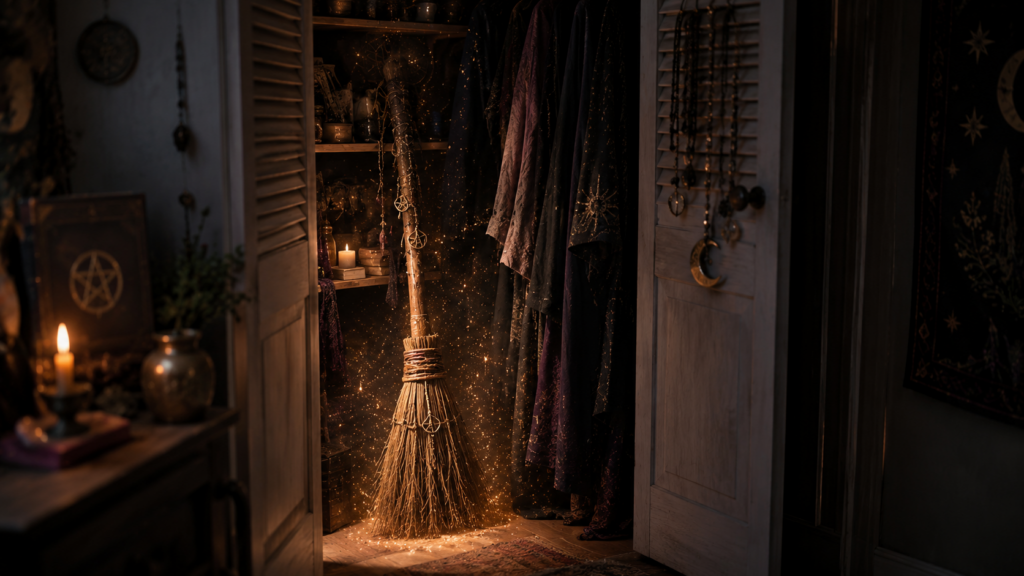
The broom closet is a playful name for something that can be very real: the space between knowing ourselves as witches and deciding how much of that identity or practice we allow the wider world to see. For some people the closet is almost complete. Their family, coworkers, neighbors, or friends may know nothing about their spiritual life. For others it is only one part of life that remains private.
Being “out” as a witch is rarely an all-or-nothing condition. Someone may be openly Pagan while keeping witchcraft private, or speak comfortably about meditation, divination, herbal practice, or nature spirituality without using the word witch. A person may be completely open with close friends and a coven but private at work, public online under a magical name but unknown under a legal one, or comfortable discussing religion while keeping actual magical practice to themselves. Visibility exists on a spectrum, and people may occupy different places on that spectrum in different parts of their lives.
Some witches also soften the language around their practice because other words are easier for the people around them to hear. Witchcraft may be presented as spirituality, energy work, folk practice, meditation, manifestation, herbalism, or New Age practice. Others find a home within newer religious movements or broader Pagan communities where much of what they do remains recognizably witchcraft even if they rarely use the word. Sometimes those labels are sincere descriptions of a blended path. Sometimes they provide a socially safer vocabulary for practices a person already understands in essentially witchcraft terms.
There is nothing inherently dishonest about choosing which language belongs in which setting. Words carry histories, stereotypes, religious assumptions, and consequences. Calling oneself a witch may feel joyful and liberating in one room and unnecessarily risky in another. A person can know exactly who they are without believing that everyone around them is automatically entitled to that knowledge.
At the same time, we do believe visibility matters. The more people encounter witches and Pagans as ordinary neighbors, relatives, professionals, artists, parents, friends, and community members, the harder it becomes for old caricatures to survive unquestioned. Those who are able to live openly can help make greater openness possible for others. But that communal good does not turn disclosure into a test of courage. Housing, employment, financial dependence, family circumstances, age, community pressure, and personal safety are real considerations.
The broom closet is therefore not a measure of how serious someone’s practice is. A quiet witch is still a witch. A private altar is still an altar. A ritual performed behind a closed bedroom door is not less meaningful than one performed publicly beneath the moon. Privacy may be temporary, selective, practical, sacred, or simply preferred.
And a person may move along that spectrum over time. What feels impossible today may become safe later; what someone once shared freely may later become something they choose to protect more carefully. The goal is not to force every witch toward identical visibility. It is to create a world in which being known is genuinely possible—and being private remains a choice rather than a necessity.
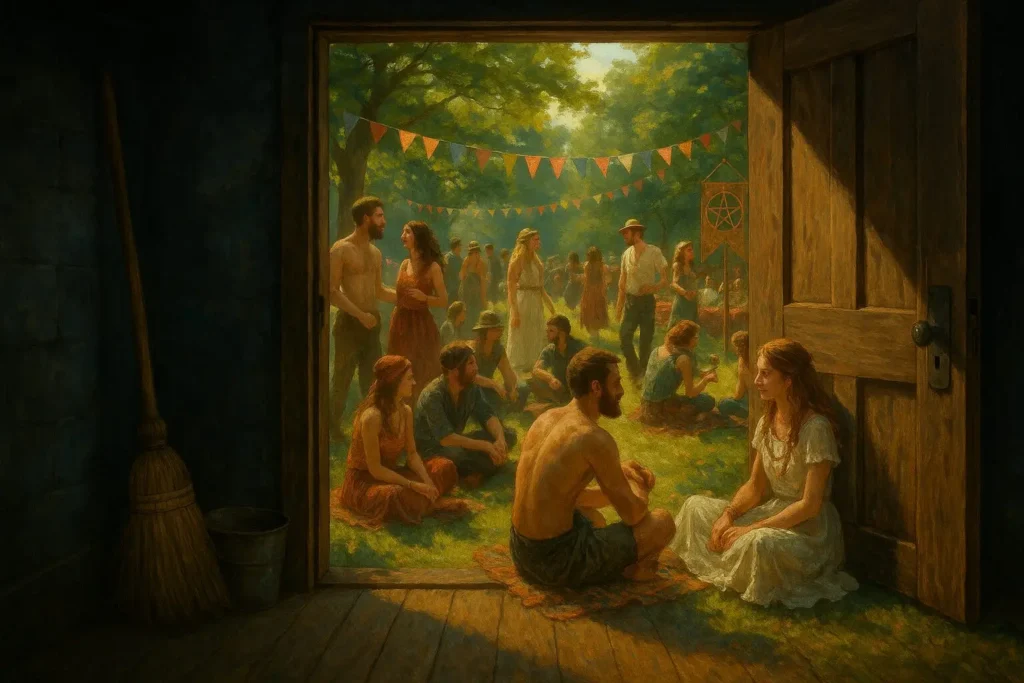
Privacy, Sacred Secrecy & the Closet
Not everything kept from public view is being hidden for the same reason. Witchcraft has always contained private, sacred, and protective forms of concealment, and it helps to distinguish them.
Privacy
Privacy is the simple recognition that not everyone is entitled to every part of our spiritual life. A person may be completely comfortable as a witch and still keep an altar, devotional practice, divination, magical journal, or relationship with spirits private.
Privacy is not shame. It can be an ordinary expression of personal sovereignty and healthy boundaries, principles that also sit at the center of our ethics .
Sacred Secrecy
Some things are kept secret because secrecy itself belongs to the practice. Magical names, initiatory teachings, oathbound material, private rites, coven mysteries, spirit relationships, and personal workings may be deliberately protected from casual exposure.
This is not the broom closet. It is the older magical idea that some knowledge gains meaning through context, trust, preparation, and responsibility. Many initiatory traditions preserve this distinction intentionally.
The Broom Closet
The broom closet is different because concealment is shaped by the possible consequences of being known. A witch may avoid disclosure because of family, employment, housing, school, religious pressure, community attitudes, financial dependence, or personal safety.
Sometimes that concealment is temporary. Sometimes it is selective. Sometimes it lasts for years. Its purpose is protection, not proof that the practice matters less.
Witches have learned to be careful about visibility for reasons that are both historical and very modern. The word witch has carried fear, accusation, ridicule, fascination, and power through different periods and cultures, and those histories still shape the way people respond to it. The history of witchcraft is more complicated than the simple story that “witches were always persecuted”—many people accused during historical witch trials would not have understood themselves as witches at all—but the cultural association between witchcraft, danger, heresy, secrecy, and social suspicion became deeply established.
At other times, magical and Pagan practices survived not by announcing themselves but by adapting. Folk customs could remain embedded in household practice, healing, divination, seasonal observance, charms, prayer, local lore, or religious forms that were more socially acceptable. Esoteric traditions developed their own languages of secrecy and initiation. Later occult movements often worked behind private doors, under pseudonyms, within lodges, or through carefully controlled publications. Being hidden has sometimes been imposed on magical practitioners, and sometimes it has been a strategy chosen to preserve the work.
That history still echoes in modern witchcraft, even though the circumstances have changed dramatically. Today, many witches and Pagans can live openly, find one another easily, publish books, form organizations, gather publicly, and maintain visible online communities. That openness matters. It allows people to discover that witchcraft is not merely the frightening caricature found in some religious polemics or the theatrical version offered by popular culture. Ordinary visibility can do a great deal to replace stereotype with familiarity.
But greater acceptance is not evenly distributed. A person may live in a welcoming city while belonging to a deeply conservative family. A workplace may be tolerant in principle while an individual supervisor is not. Someone may be legally free to identify as Pagan and still know that disclosure could complicate housing, schooling, family support, relationships, or community life. Younger people and anyone financially dependent upon others may have especially little control over the consequences of being known.
This is why we do not treat coming out of the broom closet as a test of bravery. Courage and good judgment are not opposites. We believe greater openness can be good for individual witches and for the wider community when it is realistically possible, but nobody strengthens witchcraft by placing themselves unnecessarily in danger.
There is also a subtler kind of concealment. Some people do not deny their practice so much as translate it. Witchcraft becomes “spirituality.” Divination becomes “intuition.” Spellwork becomes “manifestation.” Magical herbal practice becomes “natural wellness.” Pagan ideas may be expressed through post-religious or New Age language, or folded into a newer religious movement that feels easier to explain. Sometimes these are genuinely the person’s preferred beliefs; modern spiritual paths overlap in complicated ways. At other times, the vocabulary provides a socially comfortable cloak for a practice that still follows much of the path of a witch.
That does not make someone fraudulent. Human beings have always adjusted language to audience and circumstance. What matters is whether the person is making that choice freely or feels compelled to erase something important about themselves in order to remain acceptable.
For us, the hope is not that every witch becomes publicly identifiable in exactly the same way. The hope is that fewer people have to hide. Every person who can safely be visible helps make witchcraft, Paganism, and other minority spiritual paths a little more ordinary to the people around them. But until that freedom is equally available, safety deserves to come before symbolism.
Before Disclosure, Consider the Real Consequences
Being open can be freeing, but disclosure is difficult to take back. A thoughtful decision considers the life surrounding the decision, not only the desire to be known.
Visibility is not a switch that is either fully on or fully off. Most people live somewhere between complete secrecy and complete public disclosure, and witches are no different. Someone may be openly Pagan but private about spellwork, comfortable discussing astrology but not spirit work, known as a witch among friends while using different language at work, or publicly visible online under a magical name while keeping their legal identity separate.
That does not make their identity inconsistent. It reflects the simple reality that different relationships carry different levels of trust, risk, intimacy, and relevance. We already do this in ordinary life. We do not tell every coworker what we tell a close friend, and we do not owe strangers the same access we give family or coven members. Spiritual identity can work the same way.
For some people, selective visibility is temporary. They may be waiting for greater independence, a safer living situation, a different workplace, or simply enough confidence to decide what they want others to know. For others, selective visibility is a permanent and comfortable way of living. A person can be completely at peace with being a witch while choosing that only certain people need to know the details.
This is also why we resist treating “coming out” as a single dramatic event. Disclosure can happen in layers. A person may first tell one trusted friend, later become more open within a Pagan community, eventually use the word witch publicly, yet still keep particular magical practices, names, spirits, or rites private. Visibility can expand without privacy disappearing.
What matters is agency. The healthiest position is not necessarily maximum openness; it is having enough freedom and safety to decide where openness serves us and where privacy still belongs.
There Is More Than One Way to Be Known
These are not ranks or stages. A person may move between them, occupy several at once, or remain comfortably in one place.
Private
Practice and identity are kept mostly to oneself.
Trusted Few
A small circle knows, while the wider world does not.
Selectively Open
Visibility changes according to setting and relationship.
Publicly Open
Identity is generally visible, while private practice remains private.
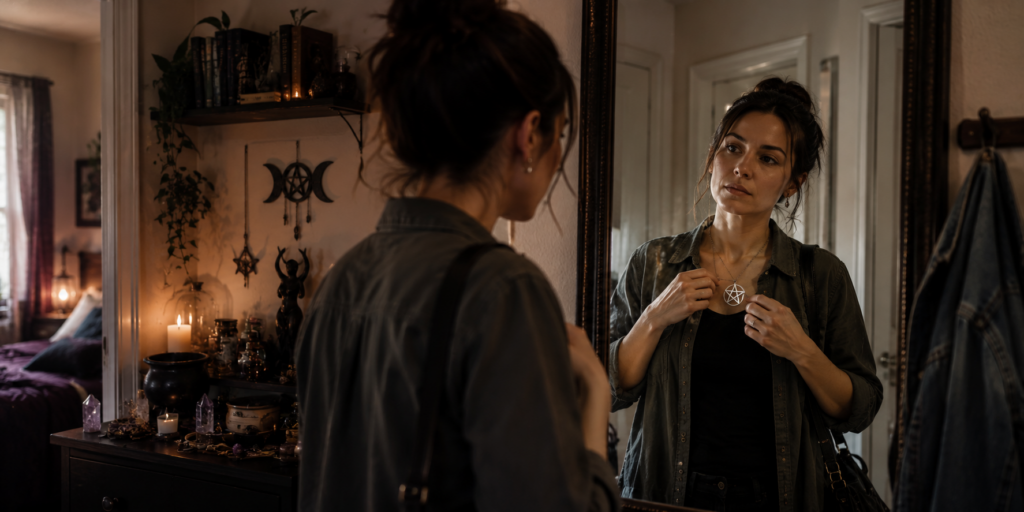
Names have always carried power in witchcraft. Sometimes that power is mystical, sometimes social, and sometimes very practical. A magical name may mark initiation, devotion, transformation, belonging, or a particular relationship with one’s practice. It may also create a boundary between the witch’s ordinary public life and a spiritual life that is shared only with trusted people.
For someone in the broom closet, that boundary can be especially useful. A magical name or pseudonym may allow a person to participate in Pagan communities, study openly online, publish writing, attend gatherings, or form meaningful relationships without immediately connecting every part of that activity to a legal name, employer, family member, or public social-media profile. Used thoughtfully, a second name does not have to mean pretending to be someone else. It can simply define which part of ourselves is being invited into a particular space.
Witches have used many kinds of masks besides names. Some describe themselves broadly as spiritual rather than Pagan, speak of intuition rather than divination, call a working manifestation rather than spellcraft, or talk about herbalism and meditation without explaining the magical framework surrounding them. Others use the language of New Age spirituality, folk practice, mysticism, alternative religion, or another tradition that overlaps enough with their actual practice to provide a safer public vocabulary.
Sometimes this reflects a genuinely blended path. Modern witchcraft is extraordinarily porous, and a person may sincerely belong to several spiritual worlds at once. But sometimes the softer label is also a cloak. Someone may understand themselves privately as a witch while knowing that meditation, energy work, nature spirituality, or manifestation will be received far more easily in the environment where they live.
There is nothing automatically wrong with that. Language has consequences, and choosing language according to audience can be an ordinary form of discernment. We do it in many parts of life. A complicated spiritual practice may be described differently to a close covenmate, a curious friend, a coworker, and a stranger because those relationships do not require the same amount of explanation or trust.
At the same time, it is worth noticing when a useful boundary begins to feel like erasure. There is a difference between saying, “This person does not need access to that part of me,” and feeling that the word witch itself must always be translated into something more acceptable. One protects a boundary. The other can begin allowing other people’s discomfort to define the language we use for ourselves.
This is one reason reclaiming the word witch has mattered so much to many modern practitioners. The word carries centuries of folklore, accusation, fear, fantasy, resistance, and reinvention. Choosing it openly can therefore be more than a description of magical practice; it can be a refusal to let hostile interpretations have permanent ownership of the name. Our Lore of the Witch material explores some of the cultural history surrounding that image, while our Witchcraft Traditions material looks more closely at the many different practices and identities now gathered beneath the broader term.
But reclamation remains meaningful only when it is chosen. A person does not become a better witch by using the word publicly before it is safe or appropriate to do so. Nor does everyone who practices magic need to adopt it. Names should help us describe, protect, and understand ourselves—not become another set of rules about who we are required to be.
The same is true of magical names themselves. Some are deeply sacred and may be known only within a coven or ritual setting. Some become public Pagan names. Some are playful, temporary, inherited, bestowed, discovered, or gradually outgrown. A practitioner may have more than one name for different parts of their spiritual life. A name can reveal us, protect us, or do both at once.
What matters is that the mask remains something we choose to wear rather than something we forget how to remove.
A private practice does not have to be a diminished one. Witchcraft has never depended upon owning an obvious altar, displaying shelves of occult books, wearing visible symbols, or being able to explain our spiritual life to everyone around us. Those things can be meaningful, but they are expressions of practice rather than the source of it.
Much of witchcraft can be remarkably quiet. Prayer can be spoken inwardly. Meditation leaves nothing behind. Divination can be done with a deck that returns to a drawer. Herbs can live in an ordinary kitchen. A candle can simply look like a candle. A walk can become devotional, a bath cleansing, a meal an offering, and a familiar room sacred for an hour before returning to ordinary use. Discretion changes the presentation of practice; it does not necessarily change its depth.
This can even sharpen a witch’s understanding of what is essential. When elaborate tools or permanent ritual spaces are unavailable, intention, knowledge, relationship, repetition, timing, memory, and skill become more visible. A practitioner learns what truly supports the work and what is merely convenient decoration. There is nothing wrong with beautiful magical objects—we enjoy them too—but witchcraft should not become dependent upon looking unmistakably like witchcraft.
A temporary sacred space can be established and released. A few meaningful objects can be stored together and brought out only when needed. Everyday items may serve perfectly well when their purpose is understood. A bowl, cup, knife, key, stone, plant, piece of jewelry, notebook, or candle can carry magical significance that is invisible to anyone who does not know what it means.
Privacy also extends beyond the physical room. Today the broom closet may have a digital door as well. Search histories, social-media follows, photographs, notifications, shared devices, cloud accounts, online purchases, and public usernames can reveal far more than a candle on a shelf. Anyone whose circumstances require discretion should think about digital visibility as deliberately as physical visibility—not out of paranoia, but because online information can travel beyond the audience for which it was intended.
And private does not have to mean isolated. Trusted friends, covens, Pagan groups, carefully chosen online communities, books, classes, correspondence, and gatherings can provide connection even when a person cannot be fully open in everyday life. A witch may be hidden from one community while completely known within another. The goal is not to practice alone. It is to find the forms of connection that are safe enough to be real.
The Practical Broom Closet
A magical life can remain rich, disciplined, and connected even when much of it must remain discreet.
Sacred Space Without an Obvious Altar
Sacred space does not require a permanent altar. A cloth, candle, bowl, stone, image, plant, or piece of jewelry can be brought out for practice and returned afterward without reducing the meaning of the rite.
Some practitioners maintain an altar inside a drawer, box, cabinet, travel case, or other private space. Others work almost entirely through gesture, visualization, prayer, invocation, or temporary arrangements of ordinary objects.
Our Sacred Space material explores the principle more deeply: sacredness can be established through relationship and deliberate practice rather than permanent display.
Tools That Do Not Need to Look Magical
Many ordinary objects can carry magical purpose without attracting attention. A kitchen knife may have ritual significance, a cup may serve in offerings, a key may become protective, jewelry may carry consecration, and herbs or spices may belong simultaneously to cooking and spellcraft.
Some tools can also remain entirely internal: memorized words, breath, visualization, prayer, energy work, meditation, gestures, and carefully developed mental correspondences leave little physical trace.
Practicing While Living With Other People
Shared homes require both discretion and respect. A practitioner can maintain meaningful practice without expecting everyone in the household to participate in it or understand it.
Temporary ritual space, contained storage, discreet devotional objects, quiet meditation, baths, kitchen practice, gardening, journaling, and outdoor work can all allow magical life to continue without turning a shared household into contested territory.
This is also where Spiritual Hygiene becomes especially useful: many cleansing, grounding, centering, and boundary practices are subtle enough to become part of ordinary daily life.
The Digital Broom Closet
Digital life deserves the same awareness as physical space. Search histories, notifications, shared browsers, photographs, purchases, social-media follows, usernames, cloud storage, and location information can reveal connections a person intended to keep separate.
A magical or community identity can sometimes be kept distinct from a legal or professional one. Separate usernames, thoughtful privacy settings, careful photo sharing, and awareness of what information is publicly searchable can help preserve that boundary.
Finding Community Without Becoming Public
Privacy does not require spiritual isolation. Trusted friends, covens, carefully chosen Pagan or witchcraft groups, classes, books, correspondence, and moderated online communities can all provide connection.
It is reasonable to learn how a community handles confidentiality before sharing personal information. A healthy group should understand that members may have different levels of public visibility and should not expose someone else’s identity for them.
A witch may be completely unknown in one part of life and fully known in another. Being safely witnessed somewhere can matter enormously, even when being visible everywhere is not yet possible or desired.

There is value in being seen.
For generations, witches and Pagans have been described largely by people who were not witches or Pagans themselves. Religious polemic, folklore, sensationalism, entertainment, and fear have all contributed to the public image of the witch. One of the quiet powers of greater visibility is that it allows ordinary practitioners to complicate those stories simply by existing openly.
A visible witch may be anyone. Pagan practice may exist beside an entirely ordinary working life. Magical practice can be serious without being theatrical, devotional without being irrational, and unconventional without making someone incapable of participating fully in the world around them. Every time someone encounters a real practitioner instead of only a stereotype, the cultural picture becomes a little more accurate.
That matters for people still finding their way as well. Someone discovering witchcraft or Paganism for the first time may have no idea whether there are others nearby, whether a spiritual life like theirs can be sustained into adulthood, or whether the things they are beginning to believe will always have to remain hidden. Visible practitioners demonstrate something very simple but powerful: there are people living this life already.
Openness can also make community easier to build. We find one another because somebody uses the word witch, wears a symbol, mentions a Pagan gathering, recommends a book, speaks openly about a deity, or creates a space where others recognize that they are welcome. Coven life, public ritual, Pagan organizations, teaching, publishing, advocacy, and community events all become more possible when at least some people are willing and able to be known.
This is one reason we believe coming out of the broom closet can be good—not only for the person who no longer has to constantly translate or conceal part of their life, but for the wider community. Cultural acceptance rarely appears by itself. It grows partly through familiarity, and familiarity requires some degree of visibility.
But visibility is valuable only when the person carrying its consequences has a meaningful choice.
No individual witch owes the rest of us their job, housing, family stability, financial support, education, or physical safety in exchange for greater public acceptance. Community visibility is a shared project, not a debt imposed upon whoever happens to be most vulnerable. Those who are in circumstances where openness is relatively safe can carry more of that public work while others remain protected.
And being visible does not require becoming a spokesperson. A person can simply stop hiding. They do not have to debate hostile relatives, answer every question from coworkers, explain every practice, defend every Pagan tradition, or become responsible for correcting every misconception someone else has ever heard about witchcraft. Being known does not mean becoming public property.
It is also possible to become more open gradually. Someone may begin by using the word Pagan, later become comfortable saying witch, attend public events, or allow magical symbols to become more visible. Another person may decide that friends and family can know while work remains private. There is no single correct sequence.
What matters to us is movement toward a world in which secrecy is increasingly a choice rather than a requirement. Sacred things may remain secret because they are sacred. Private things may remain private because they are personal. But nobody should have to conceal an entire spiritual identity merely to be treated with dignity.
Those who can safely live openly help create that possibility. Those who cannot yet do so are no less part of the community they are helping to preserve.
Visibility can open the door. Safety determines when we walk through it.
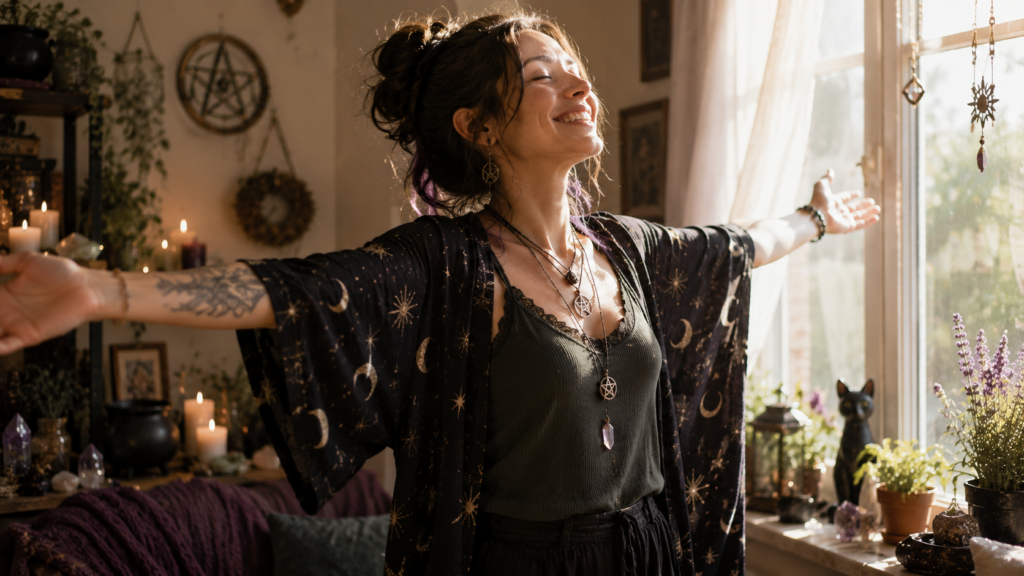
Coming out of the broom closet can feel wonderfully ordinary. Sometimes the great revelation is simply discovering that the world does not end when someone knows we are a witch. A friend asks a few questions. A pendant no longer has to be tucked beneath a shirt. Books can remain on the shelf. We stop editing every sentence before we speak. For many people, openness brings a sense of relief because different parts of life no longer have to be kept quite so separate.
But disclosure is still a choice, and choices are best made with the actual circumstances of our lives in view. The right question is not simply, “Am I brave enough to come out?” It is also, “What is likely to happen if I do?” A person who controls their own housing, finances, employment, and daily life occupies a very different position from someone dependent upon parents, relatives, a religious community, an employer, or another person who may react badly.
This is why we favor thoughtful openness rather than pressured disclosure. If being known is reasonably safe, we think there is real value in allowing the people closest to us to know something authentic about our spiritual lives. But we also believe strongly in personal sovereignty. Our own ethics place consent, boundaries, and individual agency at the center of practice; deciding when and how to disclose something as personal as religion or witchcraft belongs within that same principle.
Coming out does not have to mean announcing everything at once. Often the easiest beginning is one person who has already shown themselves to be trustworthy. Someone might say they have become interested in Pagan spirituality before discussing witchcraft specifically, or explain what witchcraft actually means to them before applying the label. Others prefer simply to use the word plainly and allow questions to follow. There is no ritual script that everyone must perform.
It can help to know what we want another person to understand. Perhaps the important point is simply, “This is part of my spiritual life.” Perhaps we want them to know that witchcraft is not what their religious upbringing taught them it was. Perhaps we practice devotionally, magically, religiously, or all three. We do not need to give someone a complete education in Pagan history or defend every witch who has ever lived in order to explain ourselves.
And we are allowed to establish limits. Someone learning that we are a witch has not been granted unrestricted access to our altar, spells, gods, coven, magical name, private rituals, or beliefs. We can answer sincere questions and decline invasive ones. We can say, “That part is private.” We can refuse arguments disguised as curiosity. Disclosure removes secrecy; it does not remove boundaries.
Sometimes openness unfolds gradually because trust grows gradually. A friend knows first, then a sibling. A Pagan identity becomes public before magical practice does. A person may eventually attend gatherings openly while still keeping their workplace separate. Coming out of the broom closet does not require throwing every door open at once. It can simply mean that the door is now ours to open.
When the circumstances are right, there can be something deeply affirming about no longer automatically concealing the language, symbols, relationships, and practices that matter to us. That is the future we would like to see more witches have: not compulsory visibility, but the freedom to be visible without fear.
And if that freedom is not available yet, waiting is not failure. Protect what needs protecting, strengthen the life around you, find people with whom you can safely be known, and remember that circumstances change.
Coming out should expand your freedom, not take it away.
Choose the Kind of Openness You Want
There is no prize for moving faster than your circumstances allow. A good decision leaves room for both authenticity and safety.
There is no single correct way to be visible as a witch and witchcraft is interdisciplinary.
Some people live openly and comfortably, with no meaningful separation between their spiritual life and the rest of who they are. Others remain selective: known to friends, community, or coven while keeping work, family, or public identity separate. Some stay almost entirely private. Most people move among these positions over time.
What matters is not whether everyone knows. What matters is whether you have enough freedom to decide who does.
That distinction is important. Privacy chosen freely is different from concealment required by fear or dependency. Sacred secrecy is different from shame. A magical name can be a boundary rather than a disguise. A private altar can be an intimate space rather than evidence that someone is afraid of being seen. Even a witch who is completely public may still keep rites, names, spirits, relationships, or experiences that belong only to themselves or to trusted people.
We hope for greater openness because visibility changes culture. It becomes harder to imagine witches and Pagans only through stereotype when real practitioners are neighbors, coworkers, family members, artists, teachers, tradespeople, parents, students, elders, and friends. Being known can make it easier for the next person to recognize that there is a place for them too.
But visibility is most meaningful when it is chosen.
No one needs to prove commitment to witchcraft by accepting consequences they are not prepared to carry. If circumstances require discretion, practice quietly. If only a few people can safely know, let those relationships be enough for now. If openness becomes possible later, the door can open then.
And if you are already able to live openly, there is value in doing so without apologizing for it. You do not have to soften every word, translate every belief into something more socially acceptable, or make your practice smaller simply to reassure people who have never tried to understand it. You can be thoughtful without being ashamed, private without disappearing, and visible without surrendering every boundary.
The broom closet can therefore be more than a place we either occupy or escape. Sometimes it is a shelter. Sometimes it is a threshold. Sometimes it is simply the name we give to that complicated space between private identity and public life.
We would like fewer people to need that shelter.
We would like more witches and Pagans to be able to say what they are without fear of losing something essential. We would like magical and minority spiritual paths to become ordinary enough that disclosure no longer feels like a declaration of war against someone else’s worldview.
But until that world exists everywhere, safety still matters.
So be open when you can. Be selective when you need to. Keep sacred what deserves to remain sacred. Let trusted people know you fully. Find community where you can be recognized without explanation. And do not confuse someone else’s demand for access with your obligation to provide it.
The goal is not to live without a veil. The goal is to be the one who decides when the veil is lifted.
And wherever you are on that spectrum, your practice remains yours.
Explore the Path Beyond the Broom Closet
Whether you are private, selective, or fully open, these pages offer deeper context for identity, practice, history, ethics, and finding your place within the wider witchcraft and Pagan world.