Literacy, Structure, and the Architecture of Meaning
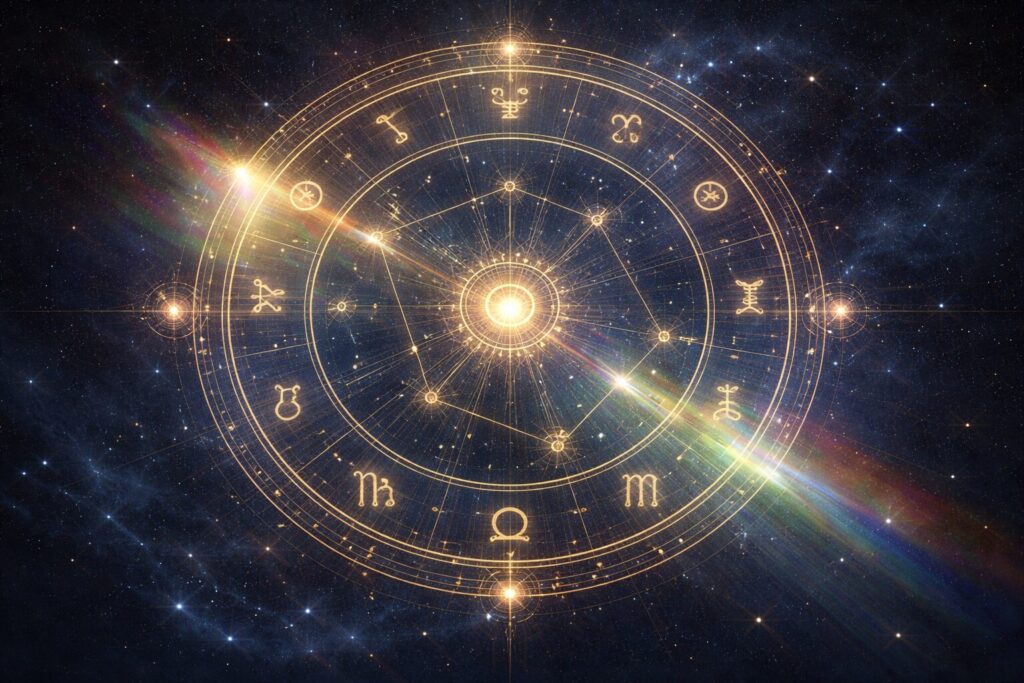
Astrology charts are not fortune machines. They are maps — disciplined symbolic diagrams humans invented to describe how time feels as it unfolds through a life. A chart is a grammar, a coordinate system, a way of turning the sky into language.
Ancient astrologers did not understand the physics of the heavens the way modern astronomy does. They did not know about nuclear fusion, orbital mechanics, or relativistic space. But humans have often tracked reliable patterns long before they understood the engine behind them. Farmers predicted seasons without climate science. Sailors navigated by stars without astrophysics. Medicine catalogued herbs long before chemistry named their compounds. The explanation came later; the pattern recognition came first.
Astrology belongs to that lineage of early pattern sciences. It is a long experiment in noticing recurrence: cycles of light and darkness, seasonal shifts, planetary rhythms, and the strange way human moods and events seem to echo those rhythms. Whether the causal mechanism is physical, psychological, cultural, or something not yet named, astrology persists as a symbolic calendar — a structured attempt to map experience onto time.
Modern astronomy changed our cosmology, but it did not erase our experience of cycles. The sky stopped being a crystal sphere and became a field of stellar plasma; the symbolic language built around it did not vanish. Astrology survives because it is less a rival to science than a parallel domain: astronomy describes what the heavens are made of, while astrology describes how humans experience the heavens as meaning. One is physics. The other is phenomenology.
This page is about literacy. It explains how charts are built, how their parts relate, and how the system holds internal coherence. It is not a tutorial for prediction, nor a promise of certainty. It is a framework — the architecture beneath interpretation. Understanding that architecture is what separates astrology as craft from astrology as superstition. A chart becomes useful not because it is magical, but because it is structured. Structure is what allows symbols to carry consistent meaning.
To read a chart well is to understand its grammar: planets as actors, signs as styles, houses as arenas, and aspects as relationships. These components do not float randomly. They form a patterned language developed over centuries of observation, refinement, and philosophical debate. Learning that language does not require rejecting modern science, nor does it require blind belief. It asks only that we take seriously the human impulse to organize time into stories — and to examine the tools we inherited for doing so.
The sections that follow describe the mechanics of the chart itself: what it is, how it is constructed, and how its pieces interact. This is the engine under the hood. Interpretation, magic, and ritual application belong elsewhere. Here we are concerned with structure — the blueprint that allows astrology to function as a coherent symbolic system.
The Chart’s Grammar at a Glance
Almost every chart statement is built from four parts. Keep these roles distinct, and interpretation stays clean: you’re not mixing “what it is” with “where it shows up,” or mistaking relationship tension for personality.
The core drive or faculty: desire, thinking, bonding, discipline, imagination, etc.
The style, tone, and strategy: direct or diplomatic, fixed or adaptable, earthy or airy.
The life arena: relationships, work, home, learning, visibility, inner life, community, etc.
How energies interact: harmony, friction, amplification, challenge, integration, and growth edges.
A clean chart statement often looks like:
[Planet] in [Sign] in the [House], in aspect to [Planet].
Example (conceptual, not predictive):
Mars in Libra in the 7th square Saturn can describe
a life-long craft of learning how to assert desire and boundaries in partnership — first through friction, then through skill.
Keep the grammar clean and the chart becomes readable: what is acting, how it acts, where it acts, and what it has to work with.
Astrology Charts
Astrology charts are not fortune machines. They are maps — disciplined symbolic diagrams humans invented to describe how time feels as it unfolds through a life. A chart is a grammar, a coordinate system, a way of turning the sky into language.
Ancient astrologers did not understand the physics of the heavens the way modern astronomy does. They did not know about nuclear fusion, orbital mechanics, or relativistic space. But humans have often tracked reliable patterns long before they understood the engine behind them. Farmers predicted seasons without climate science. Sailors navigated by stars without astrophysics. Medicine catalogued herbs long before chemistry named their compounds. The explanation came later; the pattern recognition came first.
Astrology belongs to that lineage of early pattern sciences. It is a long experiment in noticing recurrence: cycles of light and darkness, seasonal shifts, planetary rhythms, and the strange way human moods and events seem to echo those rhythms. Whether the causal mechanism is physical, psychological, cultural, or something not yet named, astrology persists as a symbolic calendar — a structured attempt to map experience onto time.
Modern astronomy changed our cosmology, but it did not erase our experience of cycles. The sky stopped being a crystal sphere and became a field of stellar plasma; the symbolic language built around it did not vanish. Astrology survives because it is less a rival to science than a parallel domain: astronomy describes what the heavens are made of, while astrology describes how humans experience the heavens as meaning. One is physics. The other is phenomenology.
This page is about literacy. It explains how charts are built, how their parts relate, and how the system holds internal coherence. It is not a tutorial for prediction, nor a promise of certainty. It is a framework — the architecture beneath interpretation. Understanding that architecture is what separates astrology as craft from astrology as superstition. A chart becomes useful not because it is magical, but because it is structured. Structure is what allows symbols to carry consistent meaning.
To read a chart well is to understand its grammar: planets as actors, signs as styles, houses as arenas, and aspects as relationships. These components do not float randomly. They form a patterned language developed over centuries of observation, refinement, and philosophical debate. Learning that language does not require rejecting modern science, nor does it require blind belief. It asks only that we take seriously the human impulse to organize time into stories — and to examine the tools we inherited for doing so.
The sections that follow describe the mechanics of the chart itself: what it is, how it is constructed, and how its pieces interact. This is the engine under the hood. Interpretation, magic, and ritual application belong elsewhere. Here we are concerned with structure — the blueprint that allows astrology to function as a coherent symbolic system.
Astrology Charts
A structural deep dive into how charts work — not prediction, not superstition, but the grammar and architecture that make astrology a coherent symbolic system.
Astrology charts are not fortune machines. They are maps — disciplined symbolic diagrams humans invented to describe how time feels as it unfolds through a life. A chart is a grammar, a coordinate system, a way of turning the sky into language.
Ancient astrologers did not understand the physics of the heavens the way modern astronomy does. They did not know about nuclear fusion, orbital mechanics, or relativistic space. But humans have often tracked reliable patterns long before they understood the engine behind them. Farmers predicted seasons without climate science. Sailors navigated by stars without astrophysics. Medicine catalogued herbs long before chemistry named their compounds. The explanation came later; the pattern recognition came first.
Astrology belongs to that lineage of early pattern sciences. It is a long experiment in noticing recurrence: cycles of light and darkness, seasonal shifts, planetary rhythms, and the strange way human moods and events seem to echo those rhythms. Whether the causal mechanism is physical, psychological, cultural, or something not yet named, astrology persists as a symbolic calendar — a structured attempt to map experience onto time.
Modern astronomy changed our cosmology, but it did not erase our experience of cycles. The sky stopped being a crystal sphere and became a field of stellar plasma; the symbolic language built around it did not vanish. Astrology survives because it is less a rival to science than a parallel domain: astronomy describes what the heavens are made of, while astrology describes how humans experience the heavens as meaning. One is physics. The other is phenomenology.
This page is about literacy. It explains how charts are built, how their parts relate, and how the system holds internal coherence. It is not a tutorial for prediction, nor a promise of certainty. It is a framework — the architecture beneath interpretation. Understanding that architecture is what separates astrology as craft from astrology as superstition. A chart becomes useful not because it is magical, but because it is structured.
The Limits of Astrology
A mature astrology is not defensive. It knows what it is good for — and what it is not. This is where the system stops feeling like superstition and starts reading like a disciplined framework: strong enough to use, honest enough to restrain.
Astrology describes tendencies, climates, recurring themes, and likely points of emphasis. It does not write a person’s future in ink. Even the most “intense” placement can manifest across a range — from unskillful expression to refined mastery. A chart describes the terrain; it does not force your footsteps.
Determinism is tempting because it feels certain, and certainty can feel like safety. But deterministic astrology tends to produce fear, dependency, and fatalism. That is not wisdom. A responsible reading holds the chart as a map of potentials and pressures — and then places human agency back at the center.
Astrology is a symbolic system — not a substitute for medical care, legal counsel, or evidence-based decision making. A chart can describe stress cycles, emotional climates, and meaning patterns, but it cannot responsibly diagnose illness or replace professional expertise. Treating astrology as a replacement for care is not spiritual. It is risky.
This matters for credibility: a system becomes superstition when it tries to do everything. Astrology stays coherent when it remains in its domain — meaning, pattern, timing, self-knowledge — and respects the boundaries of other domains.
A chart is structured, but it is still interpreted. That means bias is always a factor. Two readers can look at the same chart and emphasize different themes. This is not proof that astrology is empty — it is proof that chart reading is a craft with ethics, discipline, and accountability.
Bias shows up when readers project their fears, stereotypes, or personal ideology onto symbols. It also shows up when readers flatten nuance into pop-astrology clichés. The antidote is method: prioritize repeated patterns, keep the grammar distinct (planet/sign/house/aspect), and avoid absolute claims that exceed what the chart can responsibly support.
Many modern objections to astrology assume the system must work through a single physical mechanism to be meaningful. But human history is full of reliable pattern-tracking that preceded correct explanation. People mapped tides before they understood gravity. They used calendars before they understood axial tilt. In those cases, the mechanism was unknown, but the cycle was still real in experience.
Astrology’s strongest philosophical claim is not “planets force you.” It is: cycles correlate with lived patterns, and humans built a structured language to describe those correlations. Some practitioners interpret the cause spiritually. Others interpret it psychologically. Others see it as a symbolic mirror that organizes attention. This page does not demand a single mechanism. It demands only honest boundaries and disciplined interpretation.
Used responsibly, astrology excels at three things: pattern recognition, timing, and meaning-making. It can highlight recurring themes in relationship dynamics, motivation cycles, creative seasons, and periods of maturation. It can provide a structured language for what people already sense but cannot name.
Astrology is particularly useful as a reflective mirror: it helps you notice how you respond to pressure, what you repeat, where you avoid, where you overcompensate, and where you are called into growth. In this sense, astrology can function as an ethical discipline — not a prediction addiction.
Signs, Planets, and Houses
If astrology is a language, these are its primary parts of speech. Most confusion — and most “superstition-feel” — comes from mixing them together. Literacy begins when you can reliably separate what is acting, how it acts, and where it shows up in lived experience.
Forces, Functions, and “Actors”
In chart language, a planet is not just a physical body in space. It is a symbolic function: a recurring kind of motion within the human life — desire, duty, growth, change, attachment, imagination, appetite, boundaries, and so on. This is one of the reasons astrology survives changes in cosmology: even when we revise the physics story, the human story the planets point to remains legible.
Think of planets as the actors in a play — not because they “force” a script, but because they name the kinds of roles that reliably appear. The Sun gathers identity and vitality. The Moon gathers memory and instinct. Venus gathers attraction, values, and bonding. Mars gathers assertion and conflict. Saturn gathers limits and maturation. Whether you interpret these as spiritual currents, psychological patterns, or sacred correspondences, the chart uses planets to say: this is the type of force involved.
- Planets are verbs (or verb-like functions): they describe action, impulse, appetite, pressure, growth.
- They answer: What is operating here? Which “voice” is speaking?
- They are the primary carriers of agency in the chart — what initiates motion or demands response.
In mature astrology, planets are also contextual: a “Mars” is not automatically “bad,” just as a storm is not automatically evil. Mars can be courage, heat, defense, libido, and motivation — or it can be rashness, harm, and avoidable conflict. The planet names a power. The chart explains how that power is expressed.
Style, Temperament, and Expression
Signs are not “personality boxes.” In chart grammar, a sign is the mode of expression through which a planet speaks — like accent, temperament, or musical key. Aries is not “an Aries person.” Aries is an archetypal style: direct, initiating, heat-forward. Pisces is not “a Pisces person.” Pisces is a style: porous, imaginal, boundary-soft. When signs are treated as total identity, astrology becomes shallow. When signs are treated as expression patterns, astrology becomes coherent.
Signs are built from a deep internal logic: elements (fire/earth/air/water) and modalities (cardinal/fixed/mutable). This logic is one of astrology’s strongest defenses against “random superstition.” You can disagree with an interpretation — but the interpretive language is not arbitrary. It is structured.
- Element tells you what the energy is made of: inspiration (fire), materiality (earth), thought/connection (air), feeling/merging (water).
- Modality tells you how it moves: starts (cardinal), sustains (fixed), adapts (mutable).
- Signs answer: How does this planet go about its business? With what tone, rhythm, strategy, and reflex?
The simplest sign question is not “Who am I?” but: How do I do this? How do I desire (Venus)? How do I fight (Mars)? How do I learn (Mercury)? How do I mature (Saturn)? The sign is the “style guide” for that planetary function.
Arenas of Life and Manifestation
Houses are the most “earthbound” part of the chart. While signs and planets are tied to the zodiac, houses are tied to time and place — to the horizon and the turning of the Earth. This is why two people born on the same day can share similar planetary placements but have different house patterns: houses are anchored to location and orientation. In chart literacy, houses are the answer to: where does this show up?
Each house is an arena of experience — not a guarantee of event. A planet in a house suggests that the planet’s function tends to gather its lessons, opportunities, conflicts, and meanings in that domain. The 2nd house gathers resources and values; the 7th gathers partnership and mirroring; the 10th gathers public role, authority, and visibility. This is not prophecy. It is a map of where attention and growth concentrate.
- Houses answer: Where does this energy play out? In what arena does it demand engagement?
- They connect astrology to lived reality — relationships, work, body, home, belief, community, grief, vocation.
- They are one reason chart interpretation must be contextual: the “same” planet/sign can land very differently depending on house placement.
A note for the academically curious: house systems vary (Equal, Whole Sign, Placidus, Porphyry, and more). This page is not arguing one “true” system — that becomes a specialized debate. For literacy, what matters is the conceptual function: houses localize meaning. They make the sky personal by tying it to the horizon of a particular place.
Planet (what / which function) + Sign (how / what style) + House (where / what arena) = a readable, coherent statement.
When astrology feels vague, it’s usually because the parts are being collapsed into one. When the parts are kept distinct, interpretation becomes more precise — and the system stops feeling like guesswork.
Aspects
Aspects are the relationship lines of a chart: the angles planets make to one another. In practice, aspects are how astrology becomes a conversation instead of a list. They describe harmony, friction, polarity, and integration — not as moral judgments, but as patterns of interaction that shape how different parts of life “talk” inside the same person.
One voice
Helpful link
Growth pressure
Easy exchange
Recalibration
Mirroring
The fastest way to misunderstand aspects is to sort them into “positive” and “negative.” That habit turns astrology into a moral scoreboard. A better model is relational: aspects describe how two functions interact. Sometimes the interaction is smooth. Sometimes it is demanding. Sometimes it is contradictory. None of those are inherently “bad.” They are simply different kinds of conversation.
When a chart is treated as a list of placements, it can feel like trivia. Aspects are what make the chart behave like a system. They show where energies reinforce one another, where they compete, and where they must be integrated. In psychological terms, aspects often mirror internal dynamics: hunger and restraint, longing and fear, expansion and caution, imagination and skepticism.
A conjunction happens when two planets occupy the same region of the sky. Symbolically, conjunctions indicate fusion: the two functions blend and intensify one another. This can feel powerful, obvious, and defining — but it can also feel complicated, because fusion reduces separation. You don’t get two clean “voices.” You get a single, louder voice.
Conjunctions are not automatically harmonious. If you combine a desire planet with a boundary planet, you may feel a life-long need to negotiate what you want versus what you can responsibly sustain. If you combine a mind planet with a dream planet, you may think poetically — or struggle with clarity. A conjunction is like two metals melted into one alloy: it creates strength, but it also changes both originals.
Oppositions form across the wheel, creating a line of tension and reflection. Symbolically, opposition is polarity: two functions that need each other, but do not naturally agree on methods. Oppositions often show up as relationships, comparisons, projection, or a feeling of being pulled between two equally real truths.
The gift of an opposition is awareness. It forces you to see what you might otherwise ignore. The challenge is integration: the person learns to hold two truths without splitting into extremes. Oppositions can feel like a pendulum until they become a bridge.
Squares are the classic “hard” aspect — not because they are curses, but because they generate pressure. Two functions want different outcomes or use incompatible strategies. The result is friction, and friction produces heat: motivation, urgency, sometimes stress.
Many people fear squares because they are uncomfortable early in life. But squares are also among the strongest indicators of development. They demand skill. They demand choice. They are where the person becomes capable rather than merely gifted. A trine can describe ease; a square often describes mastery earned.
Trines connect planets through element compatibility, creating a sense of natural flow. Trines often describe talent, ease, and internal cooperation. They can feel like a gift: things that “just work” without constant friction. Trines can also feel invisible to the person, precisely because they are easy — like breathing.
The shadow of trines is complacency. What comes easily may not be developed intentionally. In deep reading, trines are not merely “lucky.” They indicate that two functions can exchange resources smoothly. When consciously used, trines become reliable strengths that support other more difficult aspects.
Sextiles are supportive and connective, but they usually require engagement. Unlike trines, sextiles often behave like potential — opportunities that become real when the person chooses them. They can show latent skills, helpful relationships, and “green lights” that appear when initiative is applied.
Sextiles often correlate with learning, networking, and constructive problem-solving. They can be particularly relevant for timing work later (transits activating sextiles often feel like a moment when small effort yields unusually large results).
The quincunx (or inconjunct) is often overlooked, but it describes a very real experience: two functions that do not naturally understand one another. There is no easy harmony, but also no clean conflict — instead there is mismatch. The person senses that something needs to be adjusted, refined, translated.
Quincunxes can show up as chronic “fine-tuning”: lifestyle shifts, boundary renegotiations, reframing beliefs, learning how to make two incompatible needs coexist without resentment. Over time, quincunxes can become sophisticated wisdom because they force the person to practice calibration.
In most astrological schools, aspects are strongest when they are tight — close to the exact angle. The logic is simple: the closer the geometry, the louder the relationship. Wider aspects can still matter, but they tend to behave like background themes rather than central storylines.
This is also where astrology becomes more technically disciplined. If every angle “counts,” the system becomes vague. Tight aspects give a chart sharper structure. They help a reader prioritize: which conversations are the loudest, which are subtle, which are occasional, which are foundational.

Reading a chart is not the same thing as assembling a checklist. The temptation — especially in beginner astrology — is to isolate placements and stack them like ingredients: Sun in this, Moon in that, Mars here, Venus there. But a chart is not a shopping list. It is a system. Meaning emerges from relationships, emphasis, repetition, and contrast. The task of reading is not to collect facts; it is to recognize patterns.
A useful way to think about interpretation is synthesis. No single placement explains a life. A chart becomes legible when you look for clusters of meaning: themes that echo across multiple placements, elements that repeat, tensions that appear in more than one form. Repetition is one of astrology’s strongest signals. When a pattern shows up in several places, it is rarely accidental within the language of the chart. It marks an area where attention, development, or identity tends to concentrate.
Context always modifies meaning. A planet never acts alone. A sign never operates in isolation. A house placement shifts emphasis. An aspect reframes intention. The same Mars can describe disciplined courage in one context and impulsive conflict in another. Interpretation is therefore less about memorizing definitions and more about understanding interaction. Charts behave more like ecosystems than machines: each part influences the whole.
Contradiction is not an error in astrology — it is information. People are not internally consistent, and a chart that contains tension is not broken. It is describing complexity. A person can crave freedom and security at the same time. They can be socially warm and emotionally guarded. They can be visionary and cautious. Mature chart reading allows for paradox instead of trying to flatten it into a single label.
Another crucial principle is proportion. Not everything in a chart carries equal weight. Tight aspects, angular placements, repeated elements, and dominant planets tend to speak louder than minor details. Good reading is an act of prioritization. Without hierarchy, interpretation becomes noise. With hierarchy, the chart reveals a center of gravity — a few themes that organize many smaller ones.
Ethically, chart reading requires humility. Astrology describes tendencies and symbolic weather, not fixed destiny. A chart is not a verdict about worth, success, or limitation. It is a language for describing potential pathways and recurring dynamics. The reader’s responsibility is not to predict a life from above, but to engage with the chart as a dialogue — a collaborative exploration of pattern, choice, and timing.
The strongest astrology is neither fatalistic nor dismissive. It recognizes structure without denying agency. A chart suggests terrain, but a person still chooses how to walk it. Framework comes first. Technique comes later. Without framework, astrology feels arbitrary. With framework, it becomes a disciplined way of thinking about time, personality, and development.
Glossary & Quick Reference
Charts come with their own vocabulary. This reference keeps the language precise so interpretation doesn’t drift into vague “vibes.” Use it as a reminder of what each term actually means in the structure of the chart.
| Term | Meaning | Why it matters |
|---|---|---|
| Ascendant (ASC) | The sign rising on the eastern horizon at birth; the chart’s “front door.” | Anchors house layout; describes approach, instinctive presentation, and how life “meets you.” |
| Midheaven (MC) | The highest point of the chart near the meridian; a public-facing axis point. | Highlights visibility, vocation themes, reputation, and what you build over time. |
| Cusp | A boundary line where a house or sign segment begins (system-dependent). | Clarifies what “belongs” to which house; helps prioritize transitions and emphasis. |
| Angles | ASC, DSC, MC, IC — the four power points of the wheel. | Angular planets speak loudly; angles define major life axes (self/other, private/public). |
| Orb | How close an aspect is to exact; the “tightness” of the geometry. | Tight aspects shape the core architecture; wide orbs often behave as background tone. |
| Retrograde | An apparent backward motion from Earth’s viewpoint; a perspective effect. | Often read as internalization, review, re-patterning — how a function cycles through revision. |
| Dignity / Debility | Traditional “fit” between planet and sign (domicile/exaltation vs detriment/fall). | Adds nuance: not good/bad, but how comfortably a function can express its strengths. |
| House Ruler | The planet that rules the sign on a house cusp (by tradition). | Links arenas: where the ruler sits becomes a “pathway” for that house’s themes. |
| Transit | Current planetary positions interacting with the natal chart. | Core timing tool; shows when certain natal themes are activated or emphasized. |
| Progressions | Symbolic “day-for-a-year” development technique (one common approach). | Describes inner maturation cycles; often tracks shifts in identity and emotional climate. |
| Synastry | Comparing two charts to see relational dynamics and resonance patterns. | Highlights friction/flow themes in relationships without reducing anyone to “compatibility scores.” |
| Composite Chart | A chart constructed from two charts’ midpoints to describe the relationship-as-entity. | Useful for understanding the “third presence” created between two people. |
| Chart Pattern | Overall distribution shapes (bundle, bowl, locomotive, etc.). | A quick read of how energy concentrates or disperses; helps establish the chart’s overall style. |
Technically, retrograde motion is an appearance created by relative orbital speeds and vantage point. Astrology has long treated that appearance as meaningful in practice: a reversal in the sky becomes a symbol of reversal in process. Many readers interpret natal retrogrades as a function that turns inward first, requiring revision, reflection, or re-patterning before it becomes fluent.
The key is restraint: retrograde is not a “curse.” It is a different style of learning. It often produces depth, self-awareness, and unusual competence — sometimes after frustration or delay.
Traditional dignity systems describe how easily a planet can express its function through a sign. This is not moral judgment. It is closer to the idea of environmental fit. A planet in domicile often expresses with confidence; a planet in detriment may still be powerful, but it must work differently — sometimes producing distinctive gifts through friction.
A useful modern translation: dignity describes comfort, not “goodness.” And discomfort can produce skill.
Transits are often experienced as the “weather” coming toward you: events, pressures, opportunities, and cycles arriving in real time. Progressions are often experienced as the “season” inside you: shifts in readiness, identity, emotional climate, and inner focus.
Used together, these techniques describe why timing can feel meaningful: an outer trigger tends to land differently depending on the inner season. This is one of the ways astrology becomes sophisticated rather than superstitious.

One of the quiet strengths of astrology is its flexibility of scale. It can be read in broad strokes or in fine detail, and it remains useful either way. A simple awareness of cycles can help someone notice patterns in mood, motivation, or timing. A deeply technical chart can map nuance, contradiction, and long arcs of development. The system does not collapse when you zoom in, and it does not become meaningless when you zoom out. It holds at multiple levels.
This is part of why astrology has survived for so long. It functions both as a general language of rhythm and as a precision instrument for those who study it closely. A beginner can benefit from noticing seasons of growth and rest. A seasoned practitioner can trace intricate relationships between symbols without losing sight of the human being at the center. The chart expands with the reader’s skill.
You do not need to master every technique to gain value from astrology. Even a light literacy can sharpen awareness of timing and temperament. At the same time, the depth is there for those who want to go further. The system rewards patience without demanding perfection. It is a discipline you can grow into rather than a test you must pass.
In that sense, astrology is less about prediction than about orientation. It offers a way to stand inside time and notice its texture. Whether used simply or elaborately, it remains a tool for reflection, pattern recognition, and dialogue with one’s own life. The chart does not replace experience — it gives experience a language. And language, when used carefully, is one of the oldest ways humans learn to see more clearly.
From Structure to Craft
This page teaches the grammar of charts — the machine under the hood. When you’re ready to apply that grammar to ritual timing, correspondence, and spellcraft, step into the Witchcraft hub.
Charts Hub is for literacy: how the symbols relate, how the wheel is organized, and how interpretation stays disciplined instead of drifting into superstition.
Witchcraft Hub is for application: lunar timing, planetary days and hours, electional choices, and the living practice of using astrology as a correspondence system in spellwork and devotion.