Familiars
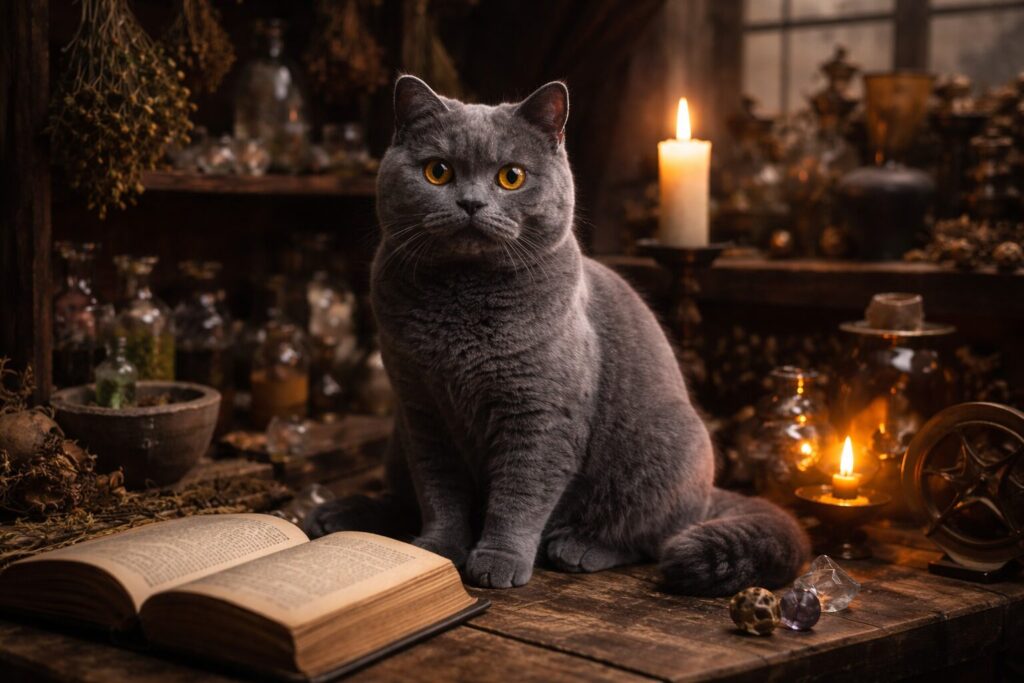
Across folklore, witchcraft, and spirit practice, animals have long been understood as more than companions. They appear as guardians, messengers, reflections of the soul, and sometimes as working partners in magic. The word familiar carries layers of meaning — shaped by myth, misunderstood by outsiders, romanticized by modern culture — yet at its core it describes a relationship: a meeting point between human and animal awareness that deepens both.
In popular imagination, familiars are often reduced to Halloween imagery or old demonological stories. Historical witch-trial narratives portrayed them as devils in animal form, a framing rooted more in religious propaganda than in the lived experiences of practitioners. At Coven of the Veiled Moon, we reject the idea that a familiar is something sinister or owned. A familiar is not a tool, not a servant, and not a symbol to decorate an identity. It is a bond — one that forms through recognition, trust, and mutual presence.
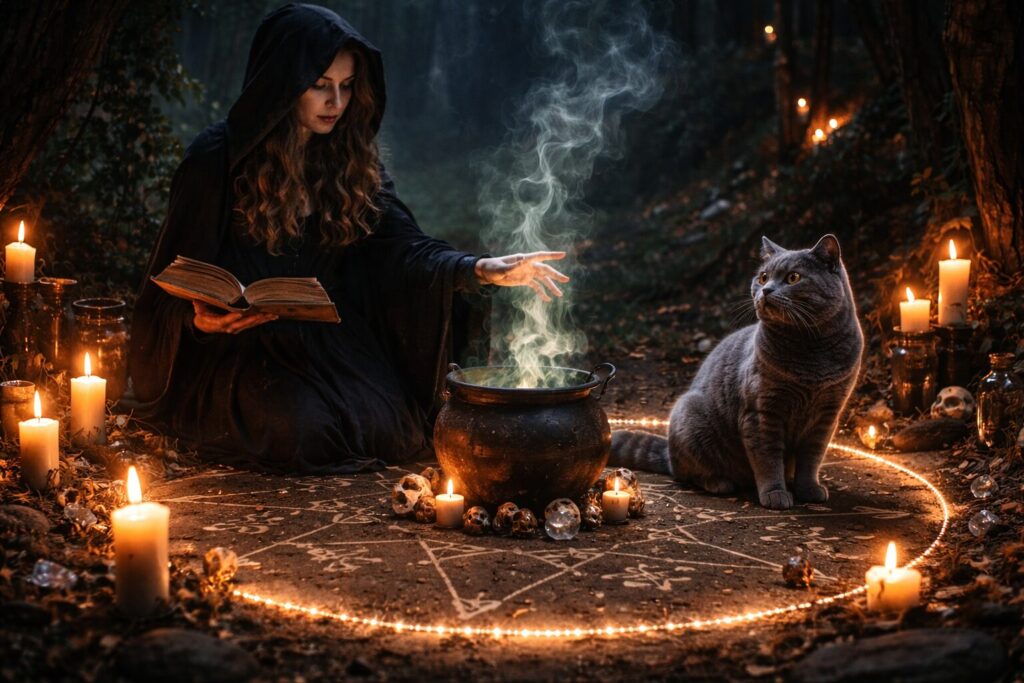
Many people lovingly call a pet a familiar when the relationship feels especially strong. There is nothing wrong with honoring that closeness. Yet in working craft, a familiar tends to reveal itself in more specific ways. Real familiars are usually not claimed — they choose. They arrive through alignment rather than effort: persistent attention, uncanny timing, shared emotional rhythm, or an animal that repeatedly places itself at the edge of ritual and awareness. When the connection is authentic, it enhances work not by force but by resonance. The animal steadies the witch; the witch steadies the animal; the current becomes clearer.
Cultures around the world describe related experiences using different languages. Norse lore speaks of the fylgja, an animal spirit tied to a person’s fate. Celtic traditions preserve animal patrons and clan emblems. Many Indigenous cultures maintain living systems of clan animals or spirit kinship that carry ceremonial meaning and ancestral identity. These parallels show that humans have long recognized animal intelligences as spiritual mirrors — but they are not interchangeable systems. Each arises from its own cultural ecology. Our work is not to collapse them into one label, but to learn respectfully from the shared human intuition that animals see the world differently than we do, often standing closer to the threshold between realms.
This page explores familiars, spirit animals, and animal allies through a coven lens that values ethics, consent, and relationship over spectacle. Animals are not batteries, symbols to be claimed, or proof of spiritual status. They are beings with agency. When a familiar bond forms, it is extraordinary not because it is dramatic, but because it is reciprocal.
| Term | What it is | How it shows up | What it isn’t | Use it for |
|---|---|---|---|---|
| Animal Companion (Pet) relational | A beloved animal you live with (or care for) whose bond with you can be deeply spiritual. | Daily closeness, comfort, routines, protection-by-presence, emotional grounding. | Not automatically a “familiar” in the working sense, and not a status symbol. | Grounding, household blessing, devotion expressed through care. |
| Familiar working ally | An animal (or animal-attuned presence) that actively aligns with your practice over time — a bond marked by repeatable pattern and mutual consent. | Chooses proximity during workings, guards thresholds, interrupts/redirects, recurring dream-contact, steady resonance. | Not a servant, not a “battery,” not something you can demand or prove on command. | Space-keeping, protection, steadiness, deepened attention and relationship. |
| Animal Messenger / Spirit Animal symbolic | A symbolic or spirit-level contact that appears as an animal form to carry meaning, warning, or guidance. | Dreams, meditation, synchronicity, repeated sightings at key moments, a “strange coincidence” that keeps repeating. | Not necessarily an ongoing partner; not proof of a permanent identity. | Discernment, reflection, omen-reading, decision support. |
| Animal Guide / Guardian protective | A longer-term protective intelligence that teaches, warns, or shields — sometimes experienced as an “animal lord” or guardian presence. | Recurring in trance/dream, felt at boundaries, protective sensations, consistent “teaching themes.” | Not a pet; not a license to claim cultural titles you haven’t earned or inherited. | Protection work, spiritual discipline, boundary strengthening, mentoring symbolism. |
| Totem (Culture-Specific) kinship | In some living traditions, a ceremonial/kinship concept tied to community identity, ancestry, and obligation (not a personal aesthetic label). | Belongs to a people’s system: clan structure, rites, teachings, and responsibilities. | Not interchangeable with “spirit animal,” and not a casual self-appointed title. | Use the concept with care; when in doubt, use “animal ally,” “messenger,” or “guide.” |
☽ How a Familiar Appears — relationship, not possession
In older witch-lore, the word familiar has worn many coats: servant-spirit, household ally, suspected “imp,” and—later— an accusation shaped by fear. Modern practitioners inherit that vocabulary, but not the panic that once surrounded it. In a practice-forward coven lens, a familiar is best understood as a relational phenomenon—a durable bond in which an animal (or animal-presence) becomes a consistent companion to the witch’s spiritual life, not as property, but as participant.
This distinction matters, because titles are easy and relationships are not. A familiar is not something a witch claims by declaration. It is a pattern of mutual recognition that forms through attention, trust, and time. You can invite the possibility—by becoming steadier, quieter, more ethically coherent—but the bond is chosen, not taken.
Most genuine familiar connections do not begin with spectacle. They begin with repetition: an animal that lingers at thresholds, arrives in the working space without being “summoned,” or settles into your orbit with unusual steadiness. In practice, real alignment often reduces spiritual noise. It makes the room feel more coherent, the witch more grounded, the work less performative and more precise.
Because witches are meaning-makers, discernment is essential. Projection can mimic connection: we want a sign, so we interpret a coincidence. We crave mystery, so we mythologize a pet. Yet beloved companions do not need to become “familiar” in order to be sacred. Sometimes the lesson is companionship itself; sometimes it is restraint; sometimes it is learning to let an animal be fully itself without recruiting it into our symbolism.
steadiness • repeated presence • shared rhythm • calming coherence
consent • safety • patience • observation • clear boundaries
forcing • projection • draining • “proof” seeking • spectacle
Ethics sits at the center. Animals are not batteries, scapegoats, or instruments for “intensifying” a working through strain. Any practice that burdens, frightens, restrains, or manipulates an animal for magical effect is not craft—it is harm dressed as mysticism. The proper posture is reciprocal care: offerings in the form of safety, gentleness, enrichment, and respect for the animal’s autonomy. If spiritual work is happening, it should leave the animal no worse—and ideally better—for being near you.
Time is part of the initiation. Familiar bonds mature slowly, and they often appear at hinge moments: grief, beginning, relocation, deepening study, major boundary work. Some companions stay for a lifetime. Others arrive for a season, long enough to stabilize a threshold, then fade back into ordinary life. That does not make the bond “less real.” It may simply mean the work has moved on.
Finally—no witch is incomplete without a familiar. Not everyone needs one, wants one, or is met that way. The craft is measured by relationship, not by possession or aesthetic. Animals remain mysteries. We never fully “know” them. We learn their habits, their preferences, their fear and comfort signals—but their interior world remains their own. And yet, it is precisely because they are other-than-human that their presence can teach: patience, humility, and a softer way of listening.
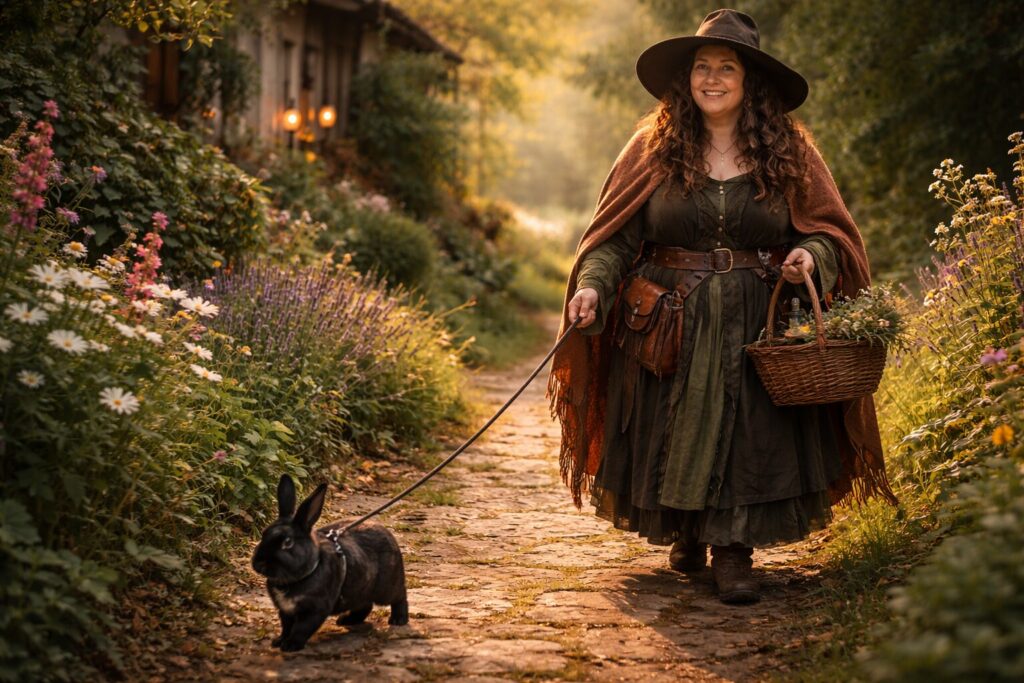
Animals remain, in the deepest sense, unknowable. We live beside them, love them, learn their moods and rhythms — yet their inner world is not ours to claim. That distance is not a failure of connection; it is part of the dignity of other life. A familiar bond does not erase the animal’s spirit. If anything, it asks us to respect it more.
Some witches are chosen into close animal companionship. Others walk their entire path without a familiar in the traditional sense. Neither condition marks greater power, worth, or spiritual maturity. A familiar appears — when it appears — because a particular alignment is needed. It strengthens a portion of the work, steadies a threshold, or reflects a lesson the witch is ready to carry. When that work is complete, the bond may change shape, soften, or become memory rather than daily presence.
There is no failure in walking without one. The craft does not require an animal counterpart to be real. Relationship is invitation, not obligation. When it arrives, receive it with tenderness. When it does not, cultivate the same tenderness toward the land, the spirits, and the human circle that surrounds you. Witchcraft is not measured by what accompanies you, but by how carefully you walk.
At the Coven of the Veiled Moon, we treat animal bonds as gifts — welcome, honored, and protected — never demanded. The work is to remain loving, observant, and ethical enough that if such a companion chooses you, it finds a steady home.