Folk & Low Magic
The Magic of Everyday Life
Folk magic—often called “low magic”—is the magic of the everyday world, woven through kitchens, crossroads, gardens, and doorways. It concerns itself less with elaborate ceremonial structures or cosmic hierarchies than with the immediacy of life itself: protection for the home, healing for a fever, blessing for a newborn, luck for a traveler.
Where high magic often looks toward the heavens, folk magic keeps its feet firmly in the soil. Yet both arise from the same current—the human desire to shape, protect, and remain in relationship with the unseen forces moving through the world.
The word low in this context does not mean inferior. Historically it simply referred to magic practiced close to the ground: in households, farms, villages, and marketplaces rather than temples or courts. It is the magic of hearths rather than towers, of gardens rather than observatories. Grounded, intimate, and practical, it is the craft practiced where life actually happens.
Because of this, folk magic has endured through centuries when other magical traditions were suppressed or lost. Passed from hand to hand, whispered in kitchens, or hidden in plain sight as “superstition,” it adapts easily to each generation. A sprig of rosemary above a doorway, a coin buried beneath a threshold, bread broken with blessing—these small acts transform the ordinary into vessels of intention. When books were burned or temples closed, magic survived in households, in grandmothers’ stories, and in the gestures no one thought to question.
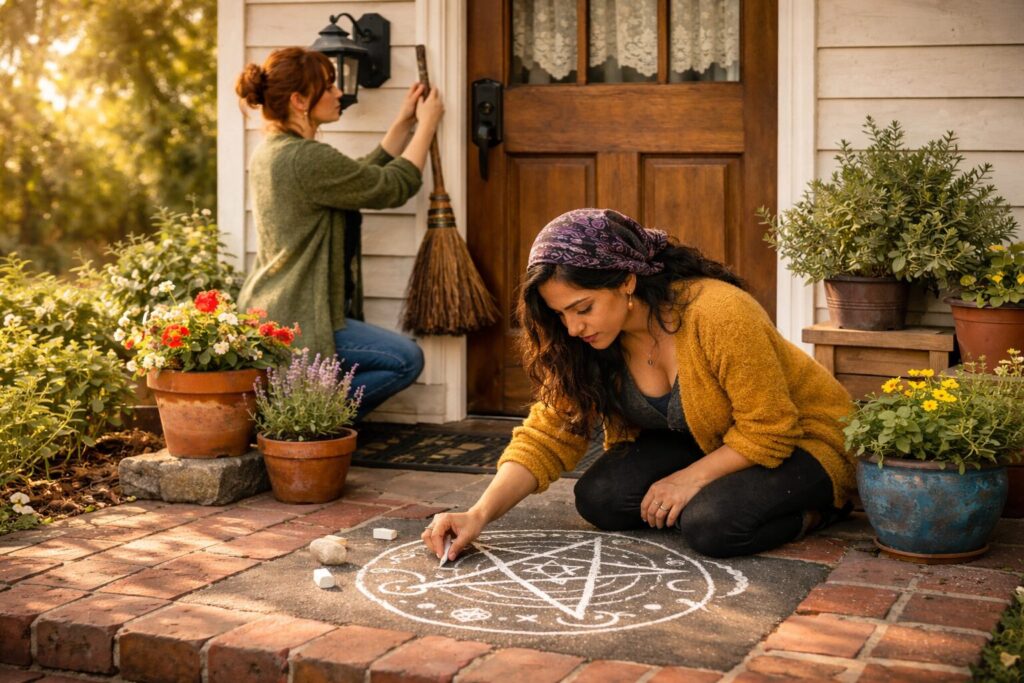
Within the Coven of the Veiled Moon, folk magic is ever-present though often personal. Members keep their own charms, kitchen rites, protective habits, and household blessings—sometimes shared, sometimes private. Yet when the coven’s work calls for it, these humble arts often appear inside the circle as well. A chalk sigil at a doorway may guard as strongly as any pentacle; a jar of herbs may protect a home as surely as an elaborate ritual.
Folk magic also forms the root of many healing traditions. Long before the rise of modern medicine, herbal knowledge, protective charms, and household remedies formed the backbone of community care. Even today, many witches find that their craft begins with herbs, teas, salves, and the quiet knowledge of how plants, fire, water, and intention move together.
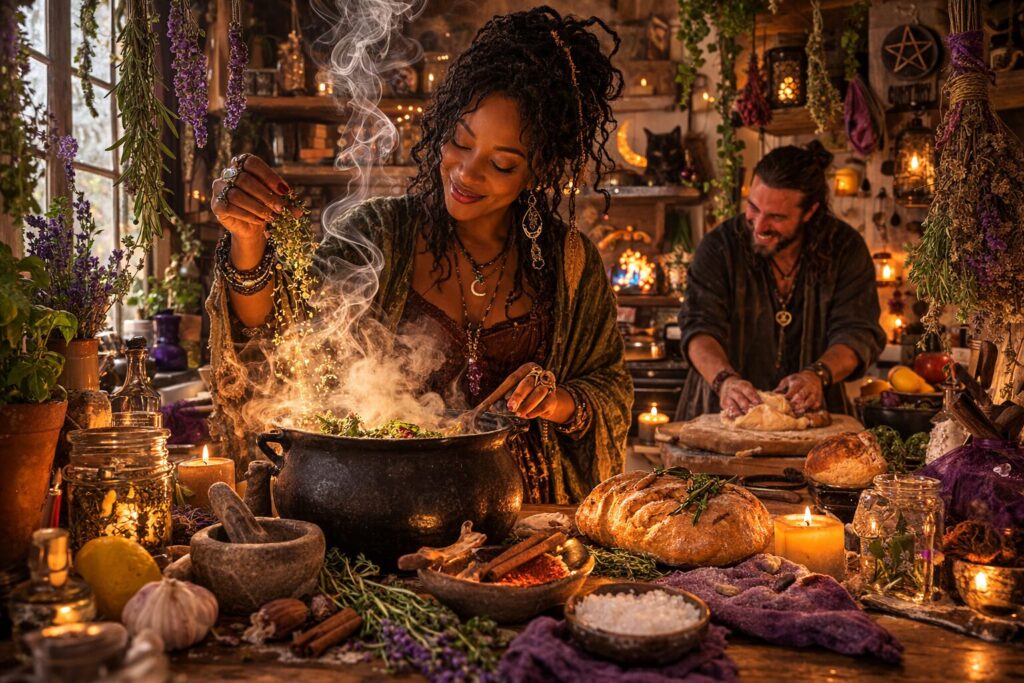
Nowhere does folk magic reveal its intimacy more clearly than in the kitchen. Fire and water meet there daily; herbs and grains transform under hand and heat. To cook with intention is to practice the alchemy of the hearth. A pinch of basil stirred in for love, salt scattered to purify, bread scored with symbols before baking—each act nourishes the body while weaving quiet enchantments into the fabric of living.
For many witches, kitchen craft becomes the gateway to deeper practice. It requires no rare tools or arcane libraries, only attention to what is already present. Yet it can also remain a lifelong path of its own, where every recipe becomes spellwork and every shared meal becomes communion. (You can explore this current further in our work on Hearth and Hedge Magic.)
Though distinct in tone, folk magic rarely exists in isolation. It overlaps with many other magical arts, grounding them in tangible action. Herbs used for healing become protective charms; everyday objects become vessels for enchantment; omens appear in candle flames, birds in flight, or the pattern left by spilled salt. Even the most formal ceremonial traditions often rely on tools—herbs, oils, talismans—that were first shaped within folk practice.
Thus what some call low magic is in truth foundational: the ground from which more elaborate magical traditions rise. Folk practice does not compete with ceremonial art; it roots it, ensuring that magic remains not only lofty, but lived.
The Character of Folk Magic
Folk magic is the craft of daily life: practical, adaptable, and rooted in the materials at hand. Rather than relying on elaborate ritual structures, it grows from observation, tradition, and the quiet relationship between people, place, and the unseen.
Domestic
Practiced in kitchens, gardens, and homes, folk magic protects households, blesses food, and maintains harmony within daily life.
Practical
Its goals are immediate and grounded: healing, protection, luck, fertility, safe travel, and the quiet well-being of family and community.
Accessible
Tools are simple and familiar—herbs, salt, thread, coins, bread, candles, and water. Magic arises from intention and relationship rather than rare instruments.
Inherited
Knowledge passes through stories, habits, and observation. Many practices survive because they were embedded within everyday life.
Healing
Folk magic often overlaps with traditional medicine. Herbal knowledge, teas, salves, and protective charms historically formed the foundation of community healing.
Foundational
Many ceremonial traditions rely on materials and techniques that first developed within folk practice—herbs, talismans, oils, and protective charms.
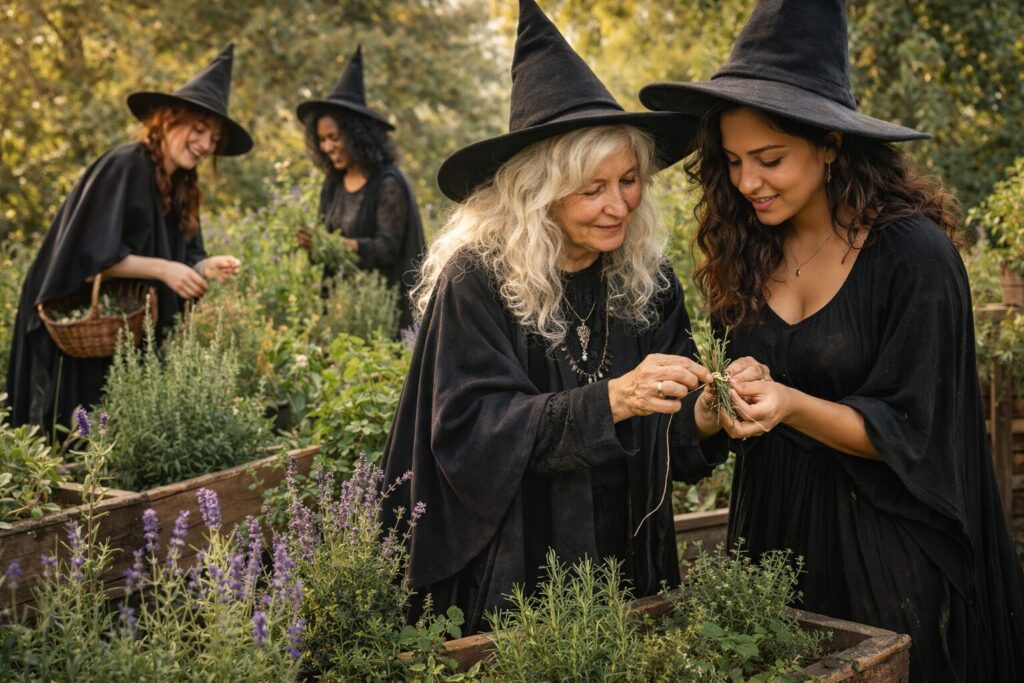
Folk magic lives where daily life unfolds. It appears not in grand temples or elaborate ceremonies but in kitchens, gardens, doorways, pockets, and small gestures repeated over years. These workings grow out of practical life and therefore remain grounded, accessible, and deeply woven into the rhythm of ordinary living.
Because of this closeness to daily life, folk magic often looks deceptively simple. A line of salt across a threshold, herbs hanging in a doorway, a charm tucked into a pocket, bread blessed before baking—each of these actions can carry symbolic and energetic meaning shaped by generations of experience.
Household Protection
Protection of the home is one of the oldest purposes of folk magic. Across cultures people have marked entrances, windows, hearths, and gates with symbols, herbs, or charms designed to guard the household.
Salt at the doorway, iron near the threshold, garlic in the kitchen, protective sigils drawn in chalk, or a broom placed beside the door all function as boundary markers. They signal that the home is spiritually tended and not left unguarded.
Garden & Herb Magic
Herb gardens have long served as living magical allies. Lavender for peace, rosemary for cleansing and remembrance, thyme for courage, basil for luck—such plants are cultivated not only for flavor or medicine but for their symbolic and energetic qualities.
Growing, harvesting, drying, and bundling herbs becomes a kind of relationship with the land. The garden becomes both apothecary and sanctuary.
Kitchen Blessings
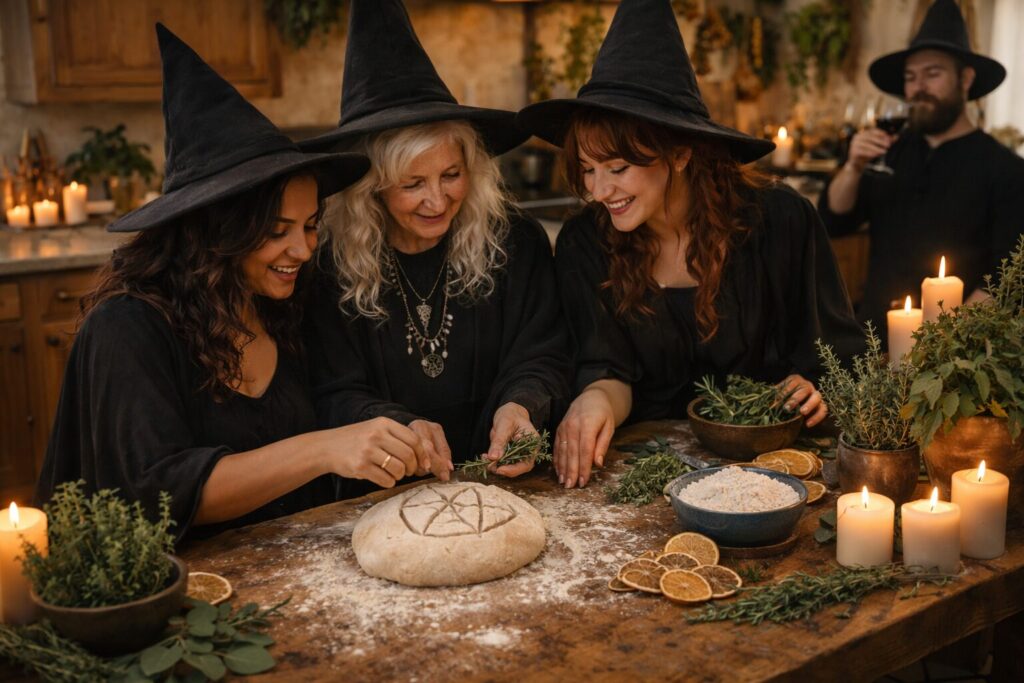
The kitchen is one of the oldest centers of folk magic. Bread, tea, soup, and shared meals carry intention into the body itself. A loaf may be scored with a protective mark before baking, herbs may be chosen with blessing in mind, or a pot may be stirred with focused intention.
Through repeated acts of nourishment, the kitchen becomes a place where care, protection, and community are continually renewed.
Everyday Charm Work
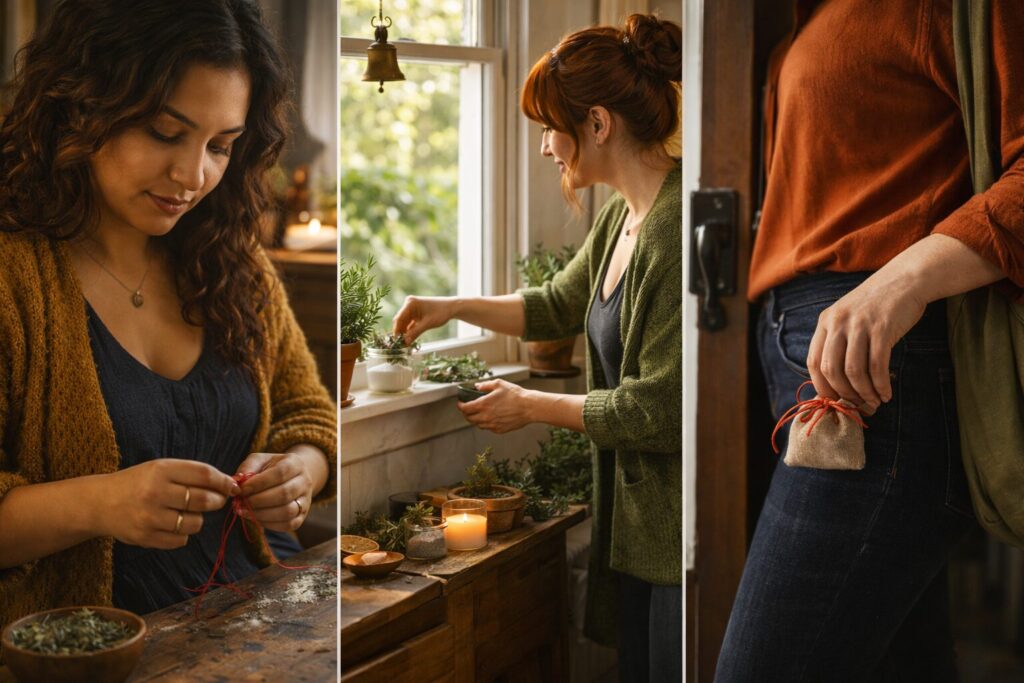
Many folk workings are small gestures woven into ordinary routines: tying red thread for protection, carrying a charm, whispering a blessing before leaving the house, or placing herbs near a window. These acts require little ceremony yet can accumulate meaning through repetition.
Over time, such practices shape the atmosphere of a home and the inner life of the practitioner. Folk magic therefore thrives not through spectacle but through quiet consistency.
Folk magic has often been dismissed under the label of superstition, yet the relationship between the two is far more complex than that word usually allows. Across history, the small protective and practical customs of ordinary people were often treated as irrational by outsiders, even when those customs carried symbolic depth, ancestral memory, and real magical purpose.
Part of the confusion comes from the fact that folk practice lives close to daily life. Because it uses salt, thread, bread, herbs, thresholds, gestures, sayings, and repeated household customs, it can look unremarkable to those who do not understand what is being done. What one person calls superstition, another may recognize as the surviving fragment of a once-living magical worldview.
Yet not everything called superstition is truly magic, and not every inherited custom carries spiritual force in the same way. A mature practitioner eventually learns that part of folk craft is not only preserving tradition, but discerning what is vital, what is symbolic, what is cultural habit, and what is merely fear wearing an old mask.
Why Folk Magic Is So Often Called “Superstition”
Many of the customs now dismissed as superstition were once part of the practical spiritual life of homes and villages. Hanging herbs above a doorway, blessing bread, speaking words over water, marking a threshold, carrying a charm, or avoiding certain actions on certain days were not always seen as eccentric. They were woven into the normal understanding of how life, luck, illness, danger, and blessing moved through the world.
When dominant religious or intellectual systems began to separate acceptable belief from forbidden practice, many of these customs were pushed downward into the category of the irrational. What could not be easily controlled, codified, or explained was often mocked, feared, or condemned. In this way, the word superstition became a flattening label placed over a wide range of things: ancestral custom, magical technique, regional belief, practical caution, symbolic habit, and fear-based folklore all became blurred together.
That flattening still affects modern conversations. Folk magic is sometimes treated as though it were only quaint nonsense or uneducated fear, when in truth it often preserves subtle forms of domestic and land-based spiritual knowledge. Even where the older cosmology has faded, the gesture may remain. The body remembers what official language forgets.
Some Superstitions Preserve Magical Fragments
Not every old custom is empty. Some superstitions preserve fragments of earlier magical understanding, even when the person performing them no longer knows the full story behind them. A family might keep a protective object near the door without remembering why. Someone may instinctively avoid sweeping certain things out after dark, cover mirrors in grief, bless a child before travel, or throw salt in a prescribed way without being able to explain the original metaphysics. Yet the custom may still carry symbolic logic, ritual force, or ancestral charge.
This is one reason folk practitioners often approach inherited customs with curiosity rather than immediate dismissal. Beneath an apparently odd habit there may lie an old concern with boundaries, contamination, fortune, mourning, hospitality, or protection. The surface form may seem simple, but the deeper pattern may reveal a worldview in which actions matter because the world is relational, porous, and spiritually responsive.
Still, preservation alone is not proof. Some customs endure because they continue to resonate; others survive merely because they were repeated often enough to become habit. Discernment means not romanticizing everything old simply because it is old.
Belief and Magic Are Not the Same
One of the most important distinctions a witch may learn is that belief and magic are not identical things. Superstition often depends primarily on belief or fear: a person feels compelled to repeat an action because they have been told something bad will happen otherwise. The emotional center of superstition is often anxiety, compulsion, or inherited nervousness.
Magic can include belief, but it is not reducible to belief. Magic works through intention, symbolism, trained attention, relationship, repeated pattern, and alignment with subtle forces. A witch may perform a working while uncertain, tired, or intellectually questioning, and the working may still have integrity because it is grounded not only in emotion but in method, pattern, and practiced correspondence.
This is why many practitioners eventually say that magic does not depend upon belief in the same way superstition does. Confidence can strengthen a working. Trust can steady the will. Relationship with spirits, land, herbs, tools, or ritual forms can deepen effectiveness. But magic is not merely positive thinking decorated with candles. Nor is it the same thing as anxious repetition. The two may overlap at times, but they are not the same species of act.
Fear, Habit, and Real Practice
It is also true that superstition and magic can become entangled. A person may begin with a meaningful protective custom and slowly turn it into fear-based compulsion. Another may inherit a family warning that sounds irrational, then discover it encodes a real protective pattern. The same outward act can arise from very different inward states.
For this reason, mature practice asks more than Is this old? or Did someone tell me this works? It asks: what is this action doing? What pattern does it establish? What symbolism does it carry? Does it create steadiness, clarity, protection, blessing, alignment, or relationship? Or does it merely inflame fear and dependency?
Folk craft is healthiest when it remains rooted in usefulness, reverence, coherence, and lived experience rather than panic. A practice that strengthens the home, calms the spirit, marks a boundary, or deepens relationship may be simple without being superstitious. A practice that feeds obsession without meaning may be superstitious without being magical.
Discernment Is Part of the Craft
A discerning witch does not throw away all old customs, nor swallow every claim untested. Discernment means learning to listen carefully: to tradition, to symbolism, to experience, to results, to inner sense, and to the larger pattern in which a custom lives. Over time, one begins to feel the difference between an act that is spiritually coherent and one that is merely repeated out of dread.
This kind of discernment rarely arrives all at once. It develops through practice, observation, mistakes, reflection, and honest attention. A person may keep some customs because they are beautiful and connective, discard others because they are rooted in fear, and deepen still others because experience reveals that they carry real force. This is not betrayal of tradition. It is one of the ways tradition stays alive rather than becoming hollow theater.
To grow in folk magic is therefore not only to gather charms, recipes, signs, and sayings. It is also to grow in judgment. One learns when a custom carries wisdom, when it carries symbolism, when it carries magic, and when it carries nothing but inherited anxiety. That discernment is not separate from the craft. It is one of its marks of maturity.
Examples of Folk Practice
Folk magic reveals itself in the small acts that shape ordinary life: what is hung above the door, stirred into a cup, tucked into a pocket, traced across a threshold, or spoken softly over bread, flame, and water. These workings are often humble in form, yet powerful in their intimacy.
Rosemary & Salt at the Window
Sprinkling rosemary and salt along a windowsill to discourage intrusion, cleanse stagnant energy, and establish a simple protective boundary around the home.
Chalk Marks at the Threshold
Drawing protective symbols or luck signs in chalk across a doorstep, gate, or stoop so that blessing and boundary are renewed each time the mark is refreshed.
Hanging a Broom by the Door
Hanging a broom near the entrance to sweep away ill will, disorder, and spiritual residue before it settles into the household.
Blowing Cinnamon at the Doorway
Blowing cinnamon through the front doorway with intention for prosperity, opportunity, and movement, inviting abundance into the home through a simple household gesture.
Morning Coffee Enchantment
Stirring cinnamon for courage, cardamom for success, or honey for sweetness into morning coffee, turning an ordinary routine into a daily act of charm and focus.
Bread Blessed Before Baking
Scoring symbols into dough or whispering blessing words over bread before it bakes, so the household shares not only food, but protection, stability, and care.
Pocket Stone or Crystal
Carrying an enchanted stone, coin, or crystal in a pocket before a difficult day, using a small personal talisman to steady emotion and anchor intention.
Red Thread or Knotted Charm
Tying knots into red thread for protection, luck, or focus, then wearing or carrying it as a quiet piece of portable folk spellcraft.
Garlic, Iron, or Herbs in the Home
Placing garlic in the kitchen, iron near entryways, or bundles of protective herbs around the house to establish layers of practical apotropaic defense.
Dressed Household Candle
Taking a plain white candle and dressing it with oil, herbs, or intention so that an ordinary household flame becomes a focused light of cleansing or protection.
Water Set Out for Blessing
Leaving a bowl or jar of water in a meaningful place—near an altar, by the hearth, beneath rain, or under moonlight—so it may be used later in blessing, cleansing, or house rites.
Herb Sachet in a Drawer or Pillow
Tucking a small herb charm into a drawer, wardrobe, or pillow to encourage restful sleep, household peace, love, or subtle protection through daily contact.
Many of these workings overlap with Herbalism, domestic spellcraft, and the practical rites collected in Common Workings. Kitchen-centered forms of folk craft may also be explored more deeply in Hearth and Hedge Magic.
Folk magic endures because it remains close to the pulse of life. It does not wait for rare alignments or distant sanctuaries, but works through the places people already inhabit: the doorway, the cupboard, the garden, the cooking fire, the pocket, the path home. In this way it reminds us that magic is not confined to temples, books, or elaborate rites. It lives wherever intention, relationship, and care are brought into the ordinary.
This is why so many witches begin here, and why so many never truly leave it behind. Even those who later study ceremonial practice, complex spellcraft, or formal devotional systems often continue to rely on the small protections, household blessings, herbal remedies, and quiet charms that shaped the craft in its earliest and most intimate forms. Folk magic is not the lesser branch of witchcraft, but one of its oldest roots.
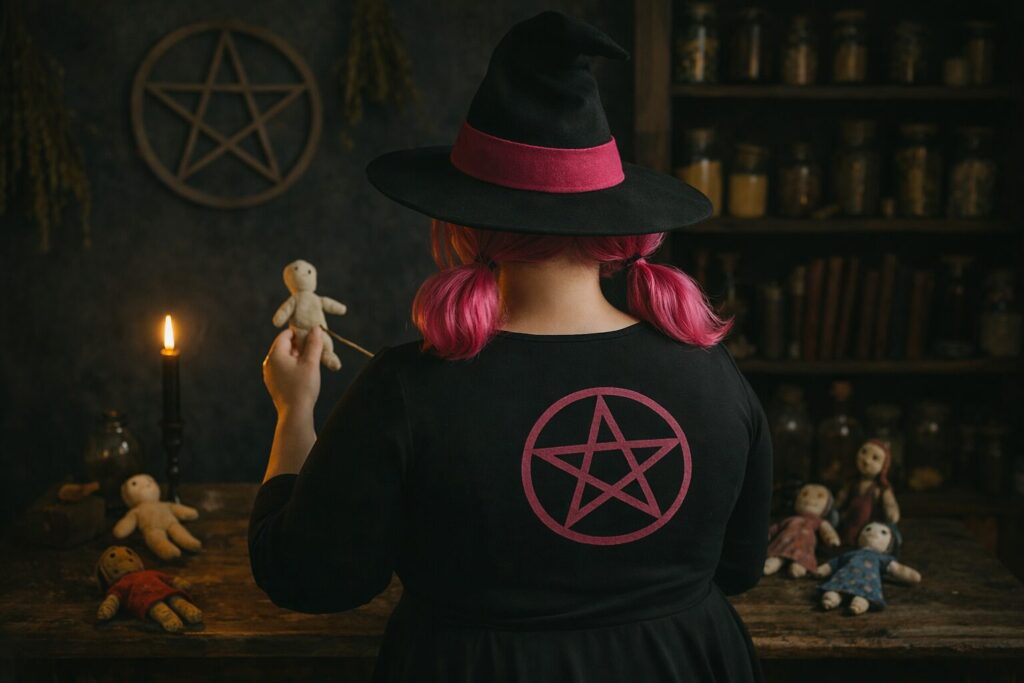
To practice it well is to learn attentiveness: to know which herbs soothe, which symbols protect, which gestures invite blessing, and which customs are merely habit clothed in mystery. Over time the witch learns discernment, and with discernment comes confidence. What once seemed like simple domestic action reveals itself as a living conversation between body, home, land, and spirit.
In the Coven of the Veiled Moon, we honor folk magic as the craft of lived enchantment: practical, enduring, and quietly profound. It is the magic that survives hardship, adapts across generations, and remains available even when all else has been stripped away. A whispered blessing over bread, a chalk mark at the threshold, a sprig of rosemary at the window—such acts may appear humble, yet they carry the ancient truth that the world is always listening, and that even the smallest working can make a home, a life, and a soul more whole.
For this page, the best next piece is the standard bottom navigation button set themed to Folk / Low Magic, matching the Magic Types pages you’ve been standardizing.