Kael’s Corner / Samhain 2026
Samhain: When the Dead Return and the Year Begins
An Irish mystery, the Witches’ New Year, and the War on Halloween
“The winds awaken, the leaves whirl round”
I’ve always loved those words from William Butler Yeats. In his poem, the fairy host moves across the Irish countryside, inviting mortals to follow. These are not harmless storybook fairies. They are powerful and unpredictable, and accepting their invitation could be a serious mistake.
Yeats drew on an older Irish understanding of the Otherworld: a place close to ours but governed by different customs, beings, and perhaps even a different sense of time. Certain places and seasons brought those worlds especially near.
Samhain is one of those moments.
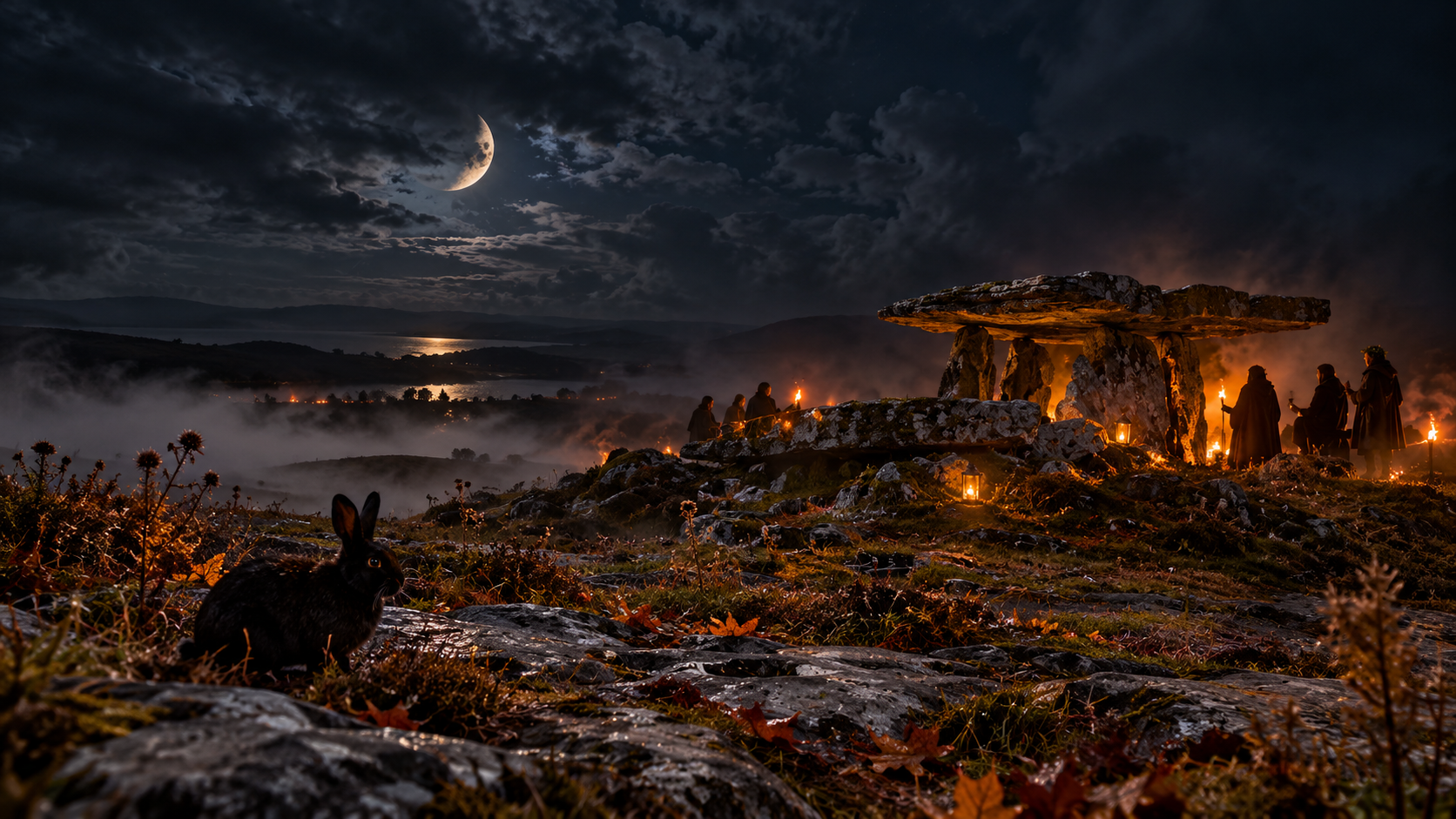
In the medieval Irish tale The Adventure of Nera, a warrior encounters a speaking corpse on Samhain night and journeys into the Otherworld. He returns with flowers and plants belonging to summer, though winter is approaching in his own world. Even time behaves differently across that boundary.
I like the story because it captures Samhain’s uncertainty. The dead speak, familiar rules fail, and another world intrudes upon this one. We should not mistake the tale for a record of ancient ritual, but it tells us plenty about the mysteries associated with the festival.
I rather like a holiday that begins by suggesting the world may be stranger than we think. -Roen, C.VM
When Summer Ends
Samhain, commonly understood as summer’s end, belongs to the old Gaelic seasonal calendar. The traditional festival falls on November 1, with festivities beginning the evening of October 31; it marked the beginning of winter and the completion of the agricultural year. Some modern witches prefer the astronomical cross-quarter, around November 6 or 7, marking the seasonal midpoint between the autumn equinox and winter solstice. I don’t see the need to declare one date more authentic than the other. Samhain is a seasonal threshold, not a specific date.
For people living close to the land, this was serious business. The harvest had been gathered, livestock brought down from summer pastures, and provisions prepared for the colder months. Animals that could not be maintained through winter might be slaughtered, while others were kept to sustain the household until spring. The abundance of autumn was real, but so was the uncertainty of what came next.
It was also a time of gathering, feasting, and community. Once the heaviest agricultural work was completed, people could attend to matters that had waited through the growing season. The festivities that developed around this period included games, storytelling, and forms of divination that attempted to discover what the coming year might bring.
Yet beneath the festivities lay an awareness of mortality. Winter could be dangerous, and the distinction between the living and the dead carried particular weight at the close of the growing year. Irish folklore also placed the Aos Sí, the mysterious people of the fairy mounds, close to human affairs during Samhain. Their presence was not necessarily welcome, and offerings, disguises, and household protections became part of the seasonal traditions.
It is easy to imagine why this time became associated with thresholds and uncertainty. The familiar world was changing, and people had to prepare themselves for whatever came next. The stories of wandering spirits and strange visitors gave supernatural form to anxieties already present in everyday life.
For witches, those associations have never entirely disappeared.
The Witches’ New Year
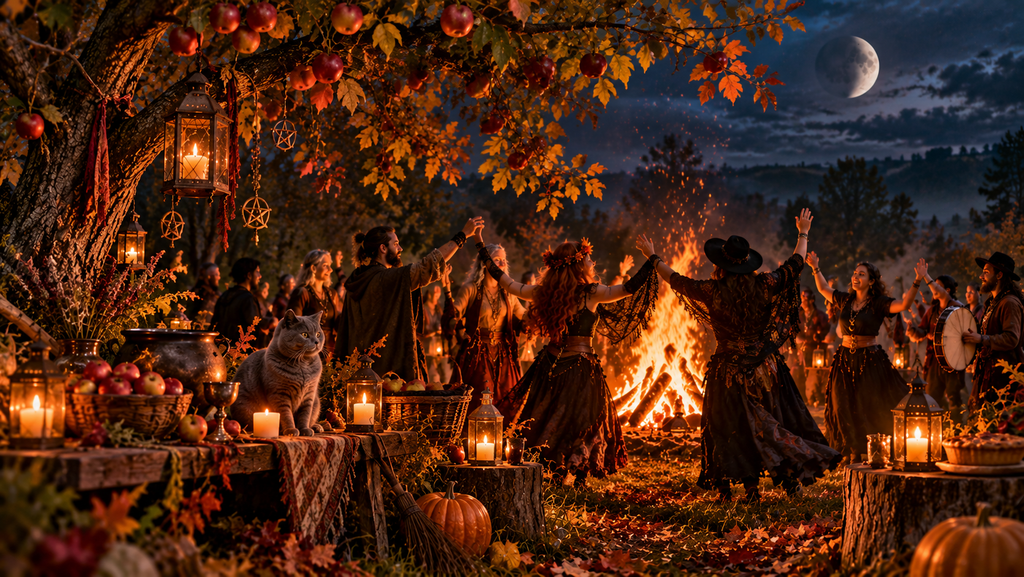
Samhain is frequently called the Witches’ New Year, and I’ve always appreciated that description. There is some debate about whether it functioned as a formal New Year throughout the ancient world, but there is little doubt about its importance as a seasonal turning point in Gaelic tradition.
For those of us who celebrate the Wheel of the Year, the symbolism is especially meaningful. The growing cycle has completed its work. What was planted has either flourished or failed, and what has been harvested must now sustain us through the darker months.
We begin another turn of the year in darkness, with much of what will eventually emerge still hidden from view.
There is something quite sensible about that. Nature rarely begins anything substantial with a big announcement. Much of its most important work takes place beyond our immediate perception, beneath the soil, within the seed, or inside the processes that prepare living things for their next season.
The Wheel of the Year that many modern witches and pagans observe today is itself a great example of traditions changing and continuing. The familiar eight-sabbat arrangement developed during the twentieth-century Pagan revival, particularly through Wicca and its relationship with modern Druidry. Older Gaelic festivals were brought together with celebrations of the solstices and equinoxes, forming a sacred calendar that has since become central to many different Pagan practices.
I think modern Wiccans deserve considerable credit for that achievement. They did not invent Samhain, nor did they create every custom associated with the eight festivals. What they helped accomplish was to bring these observances together into a framework that contemporary practitioners could celebrate, teach, and carry forward. Whatever differences we may have with particular Wiccan traditions, I believe we owe them genuine thanks for that contribution.
I have little patience for the notion that a tradition becomes less meaningful simply because some portion of it is relatively modern. Witchcraft has survived by learning, adapting, borrowing, preserving, and occasionally reinventing itself. A living tradition should be expected to grow.
Besides, I rather doubt our ancestors would be terribly impressed if we insisted upon preserving every old practice while refusing to make anything of our own.
The Crone and the Turning of the Gods
Samhain is one of the great rites of the year. It carries a weight that is difficult to explain to someone who has never participated in a substantial sabbat celebration. It is certainly a time for remembrance, but there is considerably more happening than a memorial service for the dead. The season reflects a movement in the divine world as well as the natural one.
The Crone comes into her authority. She is not simply an elderly woman representing the final stage of life. She embodies something far more substantial: the wisdom of experience, the consequences of what has gone before, and the authority to recognize when something has reached its proper ending. She is not always comfortable company. The Crone has little reason to flatter us about what we have accomplished, and I suspect she is even less interested in our excuses.
The Rising God has completed the generative work of the growing season. His influence has matured through the harvests, and now his seasonal journey carries him into the Otherworld. At Yule, the longest night, that passage reaches its turning point and the first promise of returning light emerges. This is not the destruction of the god himself, but the transformation of his expression within the sacred year. The divine endures even as the forms through which we encounter it change.
The Mother receives what returns to the earth, holding within herself the conditions from which future life will emerge. The Lady stands close to the thresholds, guarding the mysteries of passage and transformation, while the Wayfarer knows the roads between worlds and the journeys that every soul must eventually undertake.
There is a certain symmetry in this. What has lived returns to the conditions that made its life possible, and what appears to be finished may become part of something not yet imagined.
Death is not insignificant within that process. It is profound, and grief is real. But an ending does not necessarily mean that everything involved has ceased to matter.
The Rite
After many years of studying magic, I still look forward to Samhain. It remains one of my favorite celebrations, and the most important occasions in our coven’s ritual year. There is a particular pleasure in gathering with others at the close of the season, honoring the powers we work with, and deliberately bringing another cycle to its conclusion.
We come together to acknowledge the turning year and undertake the magical work appropriate to the occasion. The details vary among traditions and practitioners, but Samhain often includes purification, protection, divination, remembrance, and the release of things that should not be carried forward.
It is also an opportunity for personal accounting. What have we accomplished? What have we learned? What have we allowed to continue long after it should have ended? I think this last question is particularly important. Sometimes the most useful magical act is not obtaining something new, but recognizing what no longer deserves our energy.
The sky offers an interesting accompaniment this year. Samhain 2026 arrives beneath a waning Moon, approaching its Last Quarter on November 1. Mercury and Venus are also retrograde, while the Sun occupies Scorpio in the tropical zodiac. For those who work with these astrological correspondences, the combination lends itself rather nicely to reflection, release, and reconsidering relationships or unfinished matters. These are interpretive associations, of course, but they can help give a particular year’s observance its own character.
Among the customs I especially appreciate is the dumb supper, in which an additional place is set at the table for the beloved dead. The meal may be taken in silence or accompanied by remembrance and stories. A little food, a glass of cider, a candle, or a remembered name can become an offering of hospitality to someone whose physical presence has passed from our lives. There is no requirement that the dead be forgotten simply because they are no longer sitting beside us.
At the same time, I’ve never believed that every ancestor deserves an invitation. Lineage can carry wisdom, love, and remarkable accomplishments, but it can also carry cruelty, ignorance, and harm. We have the right to choose which legacies we honor and which we refuse to perpetuate. Family may be inherited – respect should still have some standards.
Nor does the thinning of the veil mean that every wandering spirit should be welcomed into our homes or ritual spaces. We approach the Otherworlds with respect, but also with discernment. We establish our boundaries and close our rites properly. An open door is not always an invitation. And although all this may sound rather solemn, I should emphasize something: Samhain is a celebration, and we love celebrating it.
There is food, companionship, laughter, and the pleasure of gathering with people who share our practices. We remember those who have gone before us while enjoying the company of those who are still here. I see no contradiction in that. In fact, I think the dead would find us tiresome if we spent every Samhain sitting around looking miserable.
A good celebration of life ought to contain some living.
The Shadow & the season
The War on Halloween
For decades, some Christians have warned us about a supposed “War on Christmas.” I find that hard to take seriously when Christmas displays start appearing in September and the holiday seems to claim more of the calendar every year. If that’s a war, Christmas appears to be winning. Meanwhile, Halloween is losing the very things that make it Halloween. Perhaps we’ve been talking about the wrong war.
Where have all the monsters gone?
I realize they haven’t disappeared entirely. There are still haunted houses, frightening costumes, and people who take genuine pride in turning their homes into miniature graveyards every October. But I sometimes get the impression that Halloween is being steadily cleaned up, softened, and made safe from its own traditions.
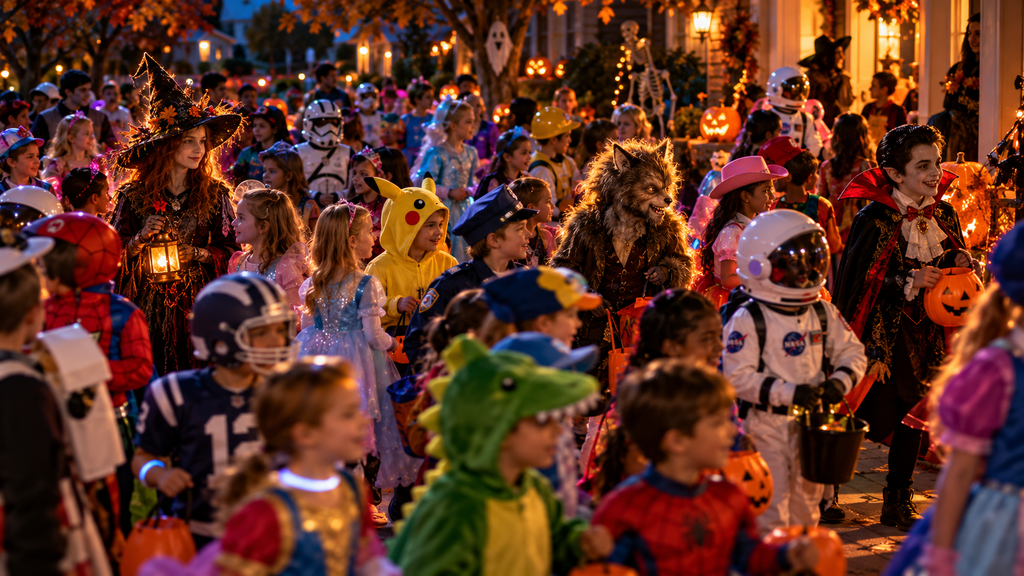
We have superheroes, princesses, cartoon characters, and every imaginable popular personality wandering around on Halloween night. There’s nothing inherently wrong with any of that. Children should wear whatever makes them happy, and adults ought to have some fun as well. But I do wonder whether we’ve become so determined to make everything cheerful and comfortable that we’re forgetting why we once filled this particular night with ghosts, skeletons, witches, and monsters.
Halloween is supposed to be a little frightening. That’s part of its purpose.
It matters that we have occasions to face fear without being overcome by it. Children play at danger, invent monsters, and tell frightening stories. Adults do the same, though we tend to charge admission.
Fear is part of being alive; pretending otherwise doesn’t help us understand it. A good ghost story, a frightening mask, and the laugh that follows a harmless scare all give us room to confront it.
The Shadow is not an enemy of life. It belongs to life.
In our magical understanding, the Shadow is not simply a collection of unpleasant qualities waiting to be eliminated. It is part of the deeper structure of existence, bound up with what is hidden, unknown, or not yet fully understood. Attempting to remove every trace of darkness from a celebration concerned with mortality and mystery seems to me a rather peculiar ambition.
And there is something else worth defending: silliness.
Tricksters frequently survive through wit, disguise, confusion, and laughter. The clever fool may succeed where the mighty warrior fails. A frightening spirit may be confounded by an unexpected response, and what appears dangerous sometimes loses its authority when treated with ridicule.
I think there is a useful magical principle here. When the veil is thin and unfamiliar things seem close, solemnity and protection certainly have their place. But laughter can be a defense as well. A little deliberate foolishness can interrupt fear, upset expectations, and prevent us from surrendering our confidence to whatever seems threatening. Confusion, properly employed, can be a surprisingly useful tool.
Sometimes the appropriate response to a mystery is reverence. Sometimes it is caution. And sometimes the best thing you can do is laugh at the damned thing and refuse to be frightened.
That is not disrespect for the sacred. It is recognition that life contains more than solemnity, and that joy has power of its own.
So yes, I want the monsters back. I want skeletons hanging from porches, ghosts floating in windows, vampires with long capes, and children who look as though they’ve recently escaped from a cemetery. I want haunted houses, ghost stories, strange noises in the darkness, and the occasional harmless prank.
I don’t want every celebration stripped of its shadows until nothing remains but another brightly decorated afternoon.
We don’t need Halloween to become safer from its monsters. We need a world in which we can safely meet them.
And if that means a few children occasionally scare the daylights out of one another, I suspect civilization will survive.
The Strange Little Visitors at Our Doors
Every October 31, little ghosts, witches, vampires, and assorted monsters come to our doors. They make their demands, receive our offerings, and head off to the next house.
We open our doors, hand over sweets, and wish them well. Most people probably don’t think about the resemblance to older traditions of disguise, hospitality, and offerings at the household threshold. I do, and I think it is great.
There is a stranger at the door. We offer hospitality. The stranger departs, hopefully satisfied, and the household remains in peace. That is a remarkably old idea, even if the visitor happens to be a six-year-old vampire with a plastic pumpkin.
Perhaps this is one reason I find it difficult to separate Halloween completely from Samhain. They are distinct celebrations, certainly, but they have been intertwined for centuries. The religious and magical observance remains important to those of us who practice it, while Halloween carries some of the same themes into the wider culture through play, folklore, and community.
Not everyone needs to understand the religious significance of Samhain to participate in something meaningful about the season. Sometimes a story, a costume, a small offering, or a good laugh is enough to keep an old idea alive.
The turning year
What Continues
The more years I spend studying magic, the more I appreciate Samhain’s particular understanding of endings. When I was younger, I think I was more inclined to regard the turning year in terms of what was beginning and what was finishing. Now I find myself paying more attention to what passes between those moments.
We inherit a great deal from those who came before us. Some of it deserves preservation, some needs changing, and some is best left behind. The same is true of our own lives and practices. Each turn of the Wheel gives us an opportunity to decide what we will carry forward and what we are finally ready to release.
I think that is one of the great gifts of Samhain. It asks us to consider our place in something larger than ourselves, without demanding that we surrender our individuality or our judgment. We remember the dead because their lives mattered, but we also remember that we are the living continuation of a world they helped shape.
Samhain is not only about what has been lost, but about what continues.
The harvest is finished, yet the seed remains. People die, but memory and relationship can continue. The gods’ seasonal expressions change, but their underlying powers endure. The coven closes one ritual year while preparing to enter another, carrying forward what deserves to survive and releasing what has completed its purpose.
We are not merely observers of that cycle. Through the sabbat, we participate in it.
So this Samhain, I hope you’ll remember someone worth remembering, offer a little friendship to the mysterious, and take some time to consider what you want to carry into the coming year. If you are a pagan or practice witchcraft, celebrate the sabbat in a way that honors your relationships, your traditions, and the work you have yet to do.
Pagan or not, I hope you make room for some mystery, a harmless scare, and a good laugh in the dark.
Happy Samhain! Let the children be monsters!
Leave a Reply