Writing Intention Into Form
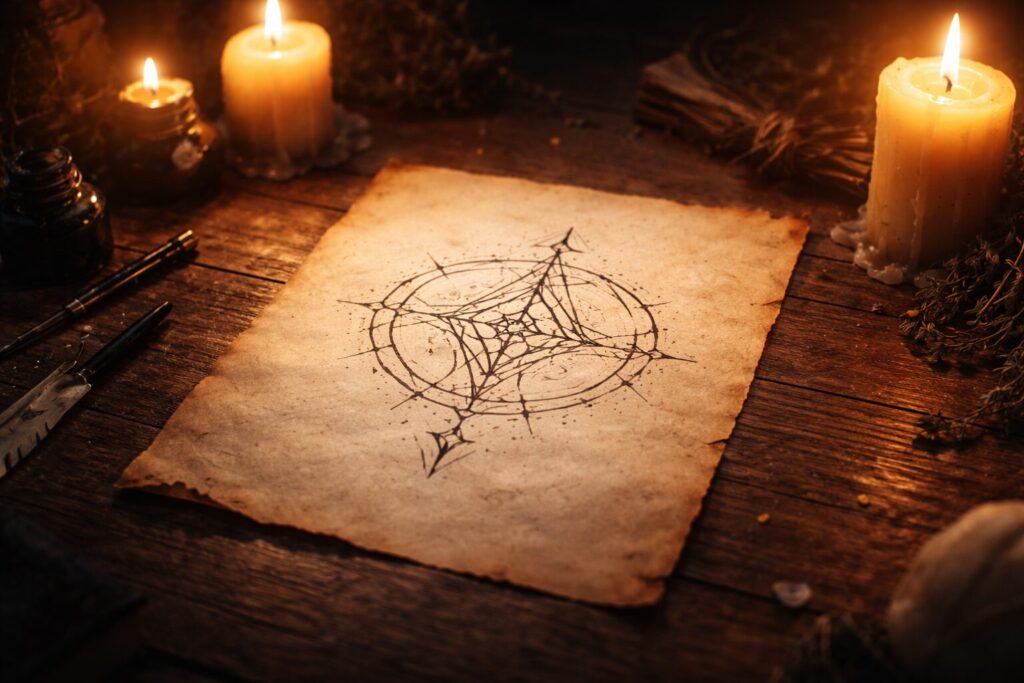
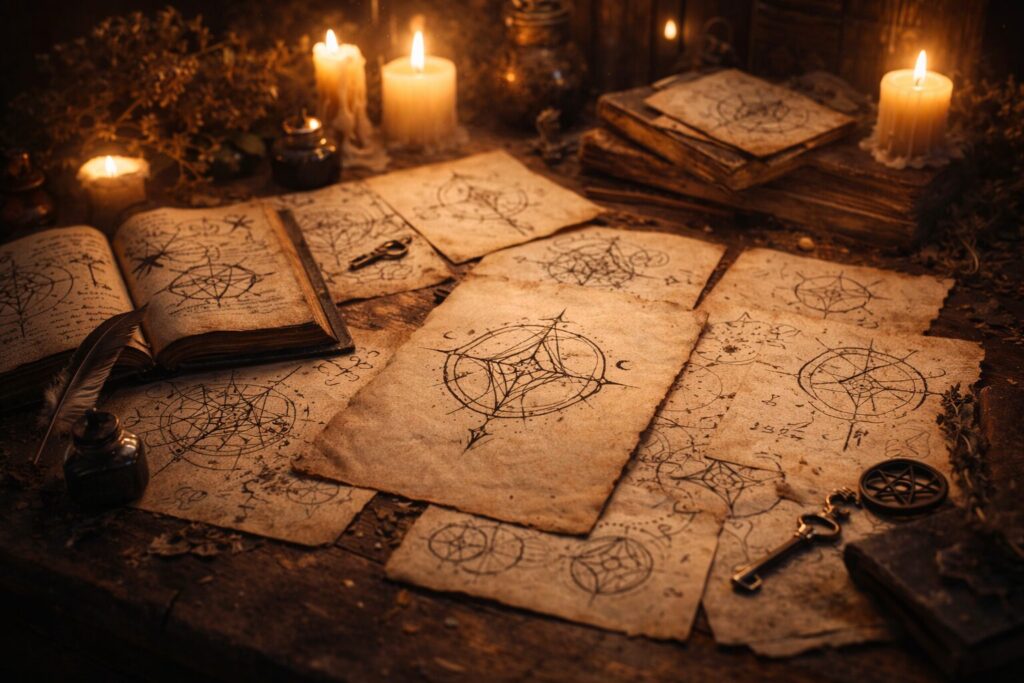
A sigil is a mark where intention becomes visible. It is the moment a thought condenses into shape, where will chooses a body and stands still long enough to be seen. Across cultures and centuries, humans have inscribed desire into matter — carving protection into doorways, sealing prayers into rings, tracing symbols into wax, bone, and skin. The sigil is not a modern invention, nor a novelty of occult fashion. It is one of the oldest gestures of magical consciousness: the instinct to bind meaning into form.
In the Western esoteric tradition, sigils occupy a curious threshold. They are simple enough to create with pencil and breath, yet profound enough to open into the architecture of ritual itself. A beginner can draw one in an afternoon. A lifetime practitioner can still uncover new layers in a single line. This is because sigil work is not merely about symbols — it is about training the relationship between imagination, intention, and focused awareness. It teaches the practitioner how to compress thought, how to hold desire without scattering it, and how to release it into action with precision.
For many witches and occult practitioners, sigils are the first true literacy of magic. Before complex ritual, before invocation, before elaborate correspondences, there is the ability to translate inner movement into outer sign. To craft a sigil is to practice the grammar of will. One learns how attention shapes experience, how symbols speak to the deeper mind, and how repetition carves pathways through psyche and world alike. These are not beginner tricks; they are the foundations upon which every later discipline rests.
This page approaches sigils through the lens of Western occult and witchcraft traditions — the stream from which MCC primarily speaks — while acknowledging that the human impulse to encode power into symbol is universal. We honor the many cultures that carry their own sacred systems of marks and glyphs without claiming them as interchangeable. Our focus here is the lineage that shaped modern witchcraft and esoteric practice, and the living methods that continue to evolve within it.
To begin sigil work is to step into a conversation between mind and mark. The symbol does not replace effort; it refines it. It does not force the world; it aligns the practitioner within it. Each sigil is a rehearsal of clarity, a small act of authorship over one’s own direction. Over time, these marks accumulate into fluency — and fluency becomes power not as domination, but as coordination. The witch learns to write intention the way a musician learns to shape sound: through repetition, care, and listening.
What follows is not a collection of tricks, but an introduction to a discipline. Sigils are approachable, but they are not trivial. They reward patience, curiosity, and honesty with oneself. Treated lightly, they fade. Treated with respect, they become mirrors, tools, and companions on the path — the first letters in a language the practitioner will spend a lifetime learning to speak.
Accordion I — What a Sigil Is
Sigils are approachable, but not trivial. They are the first literacy of magic: the practice of translating intention into form, then carrying that form through attention, activation, and release.
A Sigil Is Condensed Intention
A sigil is not merely a decorative symbol or an abstract design. It is intention compressed into form. Where ordinary writing communicates information outward, a sigil directs meaning inward—toward the subconscious, the emotional body, and the layers of perception that respond more readily to image than to language. It is a visual shorthand for desire: a way of binding a complex intention into a single, memorable mark.
This condensation matters. Human attention is diffuse by default. We want many things at once; our thoughts scatter and contradict each other. The act of crafting a sigil forces refinement. The practitioner must decide what is truly being asked, strip away excess phrasing, and hold the intention long enough to give it shape. In this sense, the power of a sigil begins before the symbol exists. It begins in the discipline of clarity.
Once formed, the sigil becomes a container. It holds the intention in a stable visual body that can be revisited, charged, and released. Each time the eye returns to it, the mind re-enters the intention with greater focus. Over time, the symbol accumulates emotional and psychological weight. It becomes a key that opens a specific state of consciousness—because repeated association has trained the mind to respond.
The Psychology of Symbol and the Subconscious
Symbols speak a language older than speech. Long before formal alphabets, humans organized meaning through image: marks carved into bone, protective signs cut into thresholds, geometric forms traced into ritual ground. The mind remains responsive to this mode of communication. Images often bypass certain layers of analytical filtering and move quickly into emotional and associative centers of awareness.
Sigil work deliberately engages this pathway. By translating intention into symbol, the practitioner communicates with the subconscious in its preferred dialect. The subconscious does not argue in sentences; it responds to pattern, repetition, and emotional charge. A sigil becomes effective not through belief alone, but through imprinting—each exposure reinforcing a pathway linking symbol and desire, gradually aligning attention and behavior toward the intended outcome.
This is why sigil practice can feel subtle rather than theatrical. Its influence often emerges as shifts in habit, perception, and opportunity recognition. The practitioner notices openings previously ignored, acts with slightly more steadiness, and holds focus where distraction once dominated. The magic is not separate from psychology; it operates through it—disciplined, intimate, and precise.
Sigils, Talismans, and Seals — Key Distinctions
It helps to distinguish a sigil from related symbolic forms. In everyday conversation the terms blur, but each carries a different emphasis. A sigil is typically a symbol created to encode a specific intention. It is personal, operational, and often temporary. Its power lies in the act of creation and activation rather than in inherited authority.
A talisman is an object invested with ongoing symbolic and energetic significance. It may incorporate a sigil, but it exists as a durable vessel meant to be carried, worn, or housed. A talisman sustains a relationship over time; it is less a message and more a companion.
A seal traditionally refers to a symbol representing an entity, force, or cosmic principle—planetary intelligences, angels, spirits, or archetypal powers. Seals belong to systems. They are part of a symbolic grammar developed across generations. Working with a seal is less about personal invention and more about entering an established current.
The Sigil as Conversation
To create a sigil is to enter dialogue with the self. The mark on the page is not a command issued to the universe from above; it is a negotiation between conscious desire and deeper motive. The process often reveals hidden contradictions—wanting change while fearing its consequences, seeking clarity while clinging to familiar confusion. The sigil becomes a mirror that exposes hesitation, ambivalence, or unspoken longing.
This reflective quality is part of its power. Sigil work encourages honesty. The symbol will only hold what is actually present. Vague intentions produce vague marks; conflicted desires generate unstable forms. Over time, practitioners learn to listen to the resistance that arises during creation and refine their intentions—not to please an external force, but to align internally.
Seen this way, the sigil is less a magical weapon and more a tuning instrument. It brings the practitioner into coherence. When thought, emotion, and action resonate, outcomes change because behavior changes, perception sharpens, and opportunity becomes visible. The sigil marks the moment that coherence is chosen—and from that choice, action follows.
Accordion II — Historical Lineage
Sigils did not appear fully formed in modern occultism. They emerge from older practices of sealing, marking, and encoding power in sign— from thresholds and rings to grimoires and planetary diagrams. This section traces the Western lineages most relevant to contemporary witchcraft and occult practice.
Ancient Seals and the Human Instinct to Mark Power
Long before the word sigil entered occult vocabulary, people used marks to bind meaning into matter. Seals impressed into clay, signet rings stamped into wax, protective symbols traced on doorposts—these were not simply identifiers but acts of authority and intention. A seal does something. It closes, claims, safeguards, authorizes, consecrates. It transforms an ordinary surface into a threshold where human will meets social, spiritual, or sacred force.
The Western magical imagination inherits this impulse: the belief that symbol is not mere representation but a channel through which power may be organized. Even where ancient practices served legal or administrative purposes, the symbolism of “impression” matters. A pressed sign is a choice made visible, and visibility is the beginning of magical consequence.
Medieval & Renaissance Grimoires: Seals, Names, and Spirit-Work
In medieval and Renaissance magical texts, we find a flowering of seals—symbols associated with spirits, angels, planetary forces, and divine names. Here the mark becomes part of a ritual technology. A seal is drawn at the right time, with the right materials, under the right conditions, and treated not as a doodle but as a keyed device within a larger operation.
This tradition often emphasizes correspondence and precision: inks, metals, days, hours, prayers, and ritual boundaries. Whether one interprets the metaphysics literally or symbolically, the underlying logic is consistent: symbols operate within systems. A seal is a coordinate—an address—within a cosmos that is assumed to be structured.
For modern practitioners, this grimoire lineage offers two gifts. First, it reminds us that sigil-like symbols were historically worked within ritual frames, not used as casual shortcuts. Second, it shows how symbols can function as interfaces between human intention and larger currents—planetary, archetypal, devotional, or numinous.
Folk Marks & Witchcraft Currents: Protection, Thresholds, and Everyday Magic
Alongside learned occultism runs another stream: vernacular, household, and folk magic—marks meant to protect homes, bless tools, safeguard livestock, or keep the boundary of a dwelling intact. These are not always called sigils, but they function in a sigilic way: symbol as action, mark as barrier, sign as prayer. You see this impulse in witch marks and protective carvings, in the use of runes as operative symbols, and in regional traditions where a simple sign carried an entire spell.
Folk practice tends to be pragmatic. It favors what is available: chalk, soot, salt, iron, thread, bread, herbs. The symbol is often embedded in the ordinary world—above a lintel, under a hearthstone, stitched into clothing. This “everyday placement” is part of the magic. The mark becomes an ongoing relationship with space, memory, and safety.
For contemporary witchcraft, this lineage is especially relevant because it emphasizes lived reality over theory. A sigil can be a private technology—quiet, practical, and integrated into daily life—rather than a dramatic display.
Modern Sigil Craft: Austin Osman Spare, Chaos Magic, and the Question of Precision
In the twentieth century, Austin Osman Spare reframed sigils as a direct method of communicating desire to the deeper mind. Rather than relying on inherited seals within elaborate ritual systems, Spare emphasized personal symbol creation, charging, and release—often with a deliberate “forgetting” meant to bypass conscious interference. Later currents of Chaos Magic popularized this approach, treating sigils as flexible tools that could be adapted to many belief structures.
This modern stream contributed something valuable: accessibility. It reminded practitioners that magical efficacy is not reserved for those with rare books or complex initiations. Yet it also generated a common pitfall: the idea that sigils require no discipline. In practice, sigils reward precision. Not necessarily precision of astrology charts or Latin conjurations—but precision of intention, of emotional alignment, of ethical clarity, and of follow-through.
In MCC terms, the best of modern sigil craft is a doorway, not a shortcut. It can be witchcraft-forward and practical while still honoring the older truth behind ceremonial magic: symbols work best inside a clear container. The more coherent the practitioner, the more coherent the mark.
How to Create a Sigil
The mechanics of sigil craft are simple. The discipline lies in clarity and attention. What follows is a foundational method used across modern witchcraft and occult practice. Variations exist, but the core structure—intention, condensation, formation, activation, release—remains consistent.
Step 1 — Clarify the Intention
Write a single sentence describing what you want. Use present-tense, affirmative language. Avoid vague phrasing. A sigil responds to precision.
“I am calm in difficult conversations” is stronger than “I want less anxiety.”
Step 2 — Reduce the Phrase
Remove repeating letters. Many practitioners also remove vowels, though this is optional. The goal is not aesthetic purity—it is symbolic compression.
You are distilling meaning until only the structural bones remain.
Step 3 — Merge Into Form
Combine the remaining letters into a single abstract glyph. Rotate them. Overlap them. Simplify lines. Let the symbol emerge rather than forcing it.
The final mark should feel balanced, memorable, and emotionally resonant. If it feels awkward, continue refining.
Step 4 — Charge the Sigil
Charging is the act of saturating the symbol with focused attention. Hold the sigil in view and enter a state of emotional intensity or deep concentration. Breath, rhythm, candle flame, movement, or meditation may be used.
You are imprinting the symbol into the subconscious.
Step 5 — Release
Once charged, let the sigil go. Burn it, bury it, fold it away, or simply stop focusing on it. The release is crucial. The intention moves from conscious control into deeper processing.
Obsessing over the outcome weakens the work. Trust the imprint.
Activation Methods (Examples)
- Candle meditation and breath work
- Rhythmic chanting or drumming
- Movement or dance
- Focused visualization
- Sexual energy (advanced, optional)
- Burning or water release rituals
Where Sigils Are Used
Sigils can live in almost any medium—paper, wax, metal, thread, skin—because the point is not the material itself, but the relationship between symbol, attention, and placement. Choose a location that matches the nature of your intention: a threshold for protection, a tool for skill, the body for embodied change, a hidden space for quiet workings.
On the Body (Temporary)
The body is the closest “altar” you have. Drawing a sigil on skin makes the intention intimate and immediate—useful for courage, calm, focus, protection, and behavioral change.
Examples: draw on wrist/ankle with eyeliner; trace over heart before a difficult talk; wash away after.
On Tools & Ritual Objects
Sigils on tools function like “built-in instructions.” They remind the mind what the tool is for, and they help the object accumulate a consistent magical association over time.
Examples: carve into a candle; inscribe on a wand/athame handle; place under a scrying mirror.
In Space & at Thresholds
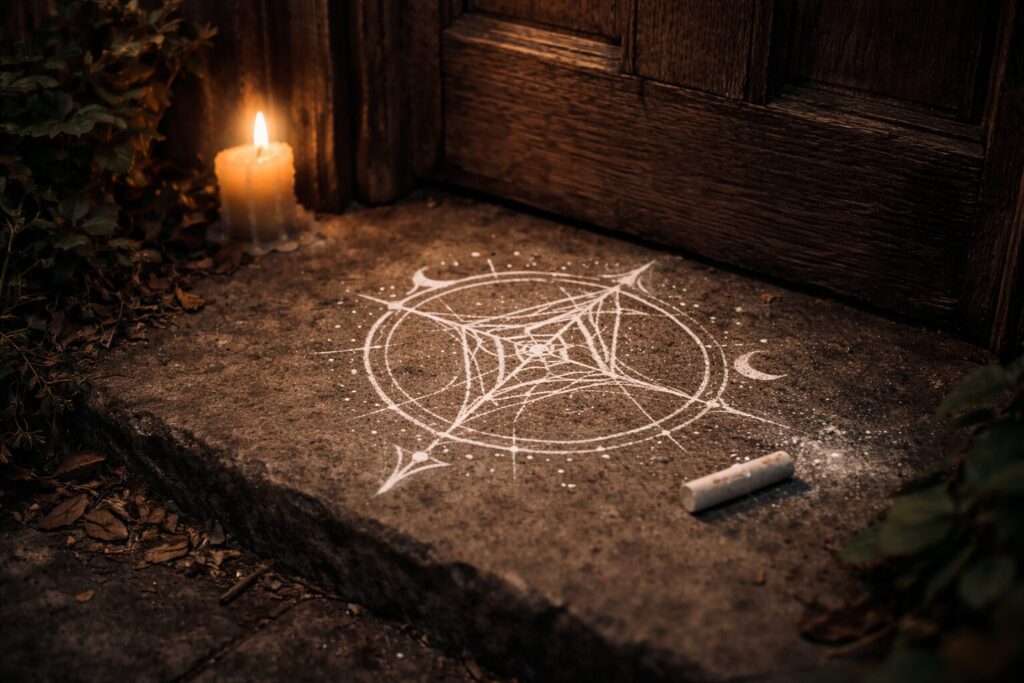
Homes, rooms, and doorways are energetic ecosystems. Sigils placed at thresholds act as boundary-keepers—quiet, constant, and deeply witchcraft-aligned.
Examples: chalk behind a door; hidden paper over a window frame; protective mark under a welcome mat.
Worn as Jewelry or Carried
When carried, a sigil becomes portable alignment. This is especially useful for intentions you want “with you” in multiple settings: confidence, discretion, grounding, safe travel, steady speech.
Examples: folded in a wallet; etched on a pendant; tucked into a phone case; stitched into a bag lining.
In Kitchen & Hearth Work
Witchcraft often works through the ordinary. A sigil can be placed where daily life repeats—turning routine into reinforcement. This is gentle magic: slow, steady, and surprisingly effective.
Examples: draw on a bay leaf and burn; trace under a mug; mark a bread bottom before baking.
Hidden in Art, Writing, and Design
Sigils can be embedded in drawings, paintings, poetry, or decorative patterns. This method is subtle and psychologically potent: the symbol becomes part of the world you repeatedly see.
Examples: weave into a border design; hide in a doodle; incorporate into a journal header.
Digital Placement (Modern Practice)
Screens are thresholds too: focus portals you look through dozens of times a day. Used thoughtfully, digital sigils can reinforce intentions through repetition without calling attention to themselves.
Examples: lock screen wallpaper; small symbol as a private icon; hidden layer in digital art.
Tattoos (Permanent Sigils)
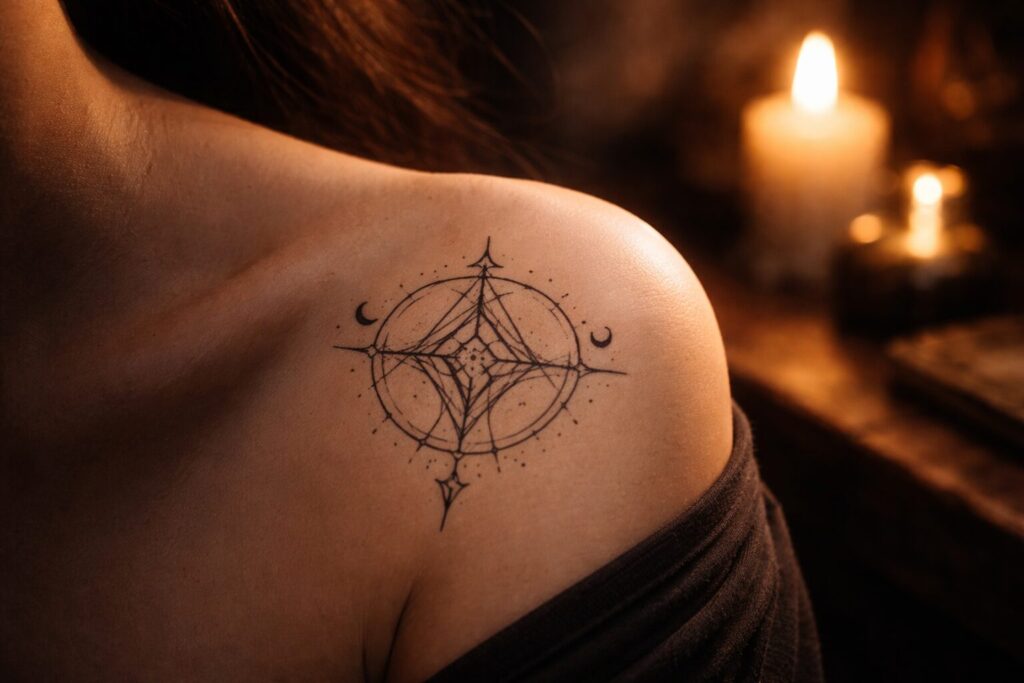
A tattooed sigil becomes a long-term relationship. It can be powerful, but it should be chosen with care. Permanent marks are best reserved for stable intentions: protection, core identity, devotion, oath-like commitments.
Examples: protective mark near shoulder/upper back; devotional sigil kept private; avoid “experiment” intentions.
Release Work (Burning, Burying, Water)
Some sigils are meant to be temporary: charged, released, and gone. Burning or water-release is especially suited for transformation, letting go, or clearing what no longer belongs.
Examples: burn safely in a bowl; bury in soil; dissolve ink in water; tear and scatter.
Working With Care
Sigils are approachable, but they are not toys. They function as a form of psychological imprinting and intentional rehearsal. Every symbol you charge is a pattern you are encouraging within yourself. For this reason, clarity and emotional honesty matter more than theatrical ritual.
Avoid writing sigils rooted in obsession, desperation, or self-harm. Symbols reinforce pathways. Repeatedly charging a destructive intention strengthens the very state you are trying to escape. Sigil work should move toward coherence, not fragmentation.
Equally important is consent. Sigils aimed at overriding another person’s will or manipulating their emotional autonomy tend to backfire psychologically. They entangle the practitioner in fixation rather than liberation. Witchcraft traditions across cultures repeatedly warn that magic which denies agency corrodes the one who performs it.
The safest rule is simple: craft sigils that strengthen your own clarity, resilience, and boundaries. Work on yourself first. When the practitioner stabilizes, the world rearranges more naturally around them.

Embodiment, Skin, and Permanent Marks
Writing a sigil on the body is one of the oldest gestures of magic. Skin remembers. The body is not separate from intention; it is the field through which intention moves. Temporary marks—drawn in ink, ash, or breath—allow the practitioner to rehearse change in an intimate register. A symbol placed on the body becomes rhythm, posture, and emotional tone.
Tattooed sigils intensify this relationship. A permanent mark is not a passing spell but an oath-like inscription. It declares that a certain alignment—protection, devotion, identity, transformation—is meant to endure. For this reason, tattoo sigils deserve time. Live with a symbol before making it permanent. Draw it daily. Carry it. Sleep with it. Let the relationship mature.
When chosen carefully, a tattooed sigil can act as a lifelong anchor. It becomes less a command and more a companion: a visual memory of the self you committed to becoming. The power lies not in the ink alone, but in the years of recognition that follow.
Sigils begin as marks on paper, but they do not remain there. Each one is a rehearsal of authorship: a moment in which the practitioner chooses direction instead of drift. Over time, these small acts accumulate. The hand learns steadiness. The mind learns precision. The will learns how to speak without shouting. What starts as symbol becomes habit, and what becomes habit becomes character.
This is the quiet promise inside sigil work. It is not about forcing reality into obedience. It is about learning how to participate in it with intention. The practitioner discovers that clarity is itself a form of power. To know what you are doing, to mark it deliberately, and to release it without panic is already a transformation.
Every sigil is therefore a conversation between present self and future self. It asks: What are you shaping? What pattern are you reinforcing? What version of yourself are you practicing into existence? The symbol holds the question long enough for an answer to emerge through action.
In this way, sigils are less like spells cast outward and more like doors opened inward. They train attention. They refine desire. They remind the witch that magic is not separate from daily life but braided through it — in breath, in posture, in decision, in repetition. A lifetime of practice is built from gestures this small and this deliberate.
Treat the mark with respect, and it will teach you how to move through the world with the same care.