
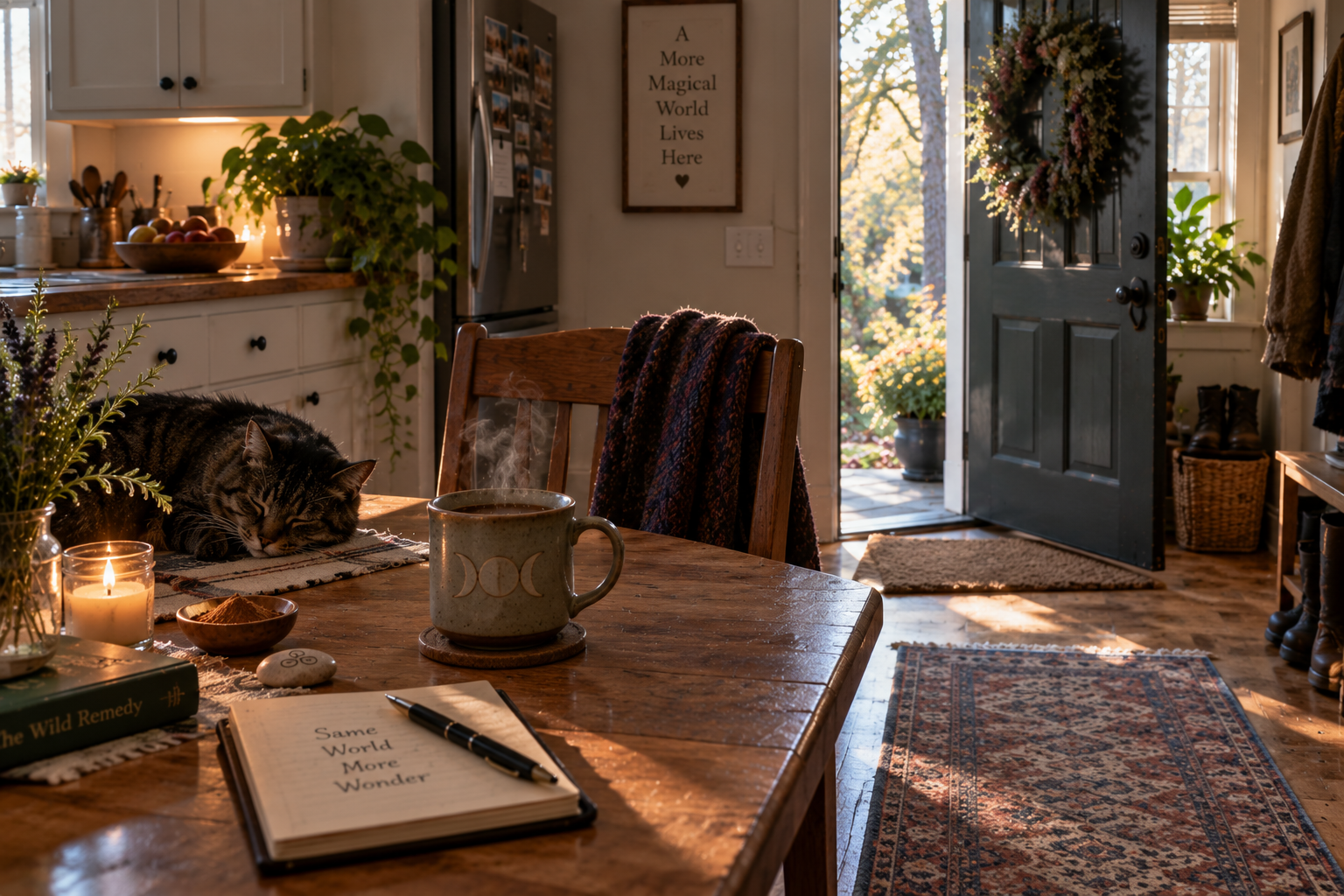
Living in a Magical World
Most of a witch’s life is not spent doing witchcraft. It is spent being a witch.
That may sound obvious, but I think there is something important in it. Formal practice has its place, but a magical life cannot exist only when we have deliberately stopped everything else to perform it. Eventually we return to the ordinary world—or, perhaps more accurately, we discover that we never really left the magical one.
For many witches, this is where practice becomes personal. A little attention given to the beginning of the day. A familiar gesture at the doorway. Something added to a meal with intention. Noticing the moon on the way to the car rather than consulting an app to be told it is there. These things are small, but they are also where a worldview begins to become a way of living.
There is an important distinction here between a magical worldview and magical thinking.
Magical thinking tends to confuse desire with causation. It can make every coincidence into a message, every setback into interference, or every successful outcome the direct result of whatever ritual came before it. A magical worldview can leave room for mystery without requiring the world to constantly prove that we are at its center.
You can believe that intention matters and still understand ordinary cause and effect. You can perform a prosperity working and then send the application, make the call, or change the budget. You can cleanse a home and still look for the source of the strange smell. You can work protection at the door and still lock it when you leave.
To me, the practical action is not something added afterward because magic failed. Very often it is part of the working.
That can begin first thing in the morning. Maybe you open the curtains before reaching for the phone and actually look at the day outside. Maybe you pause over coffee or tea for a moment and decide what you are carrying into the day. Jewelry can be chosen because of what it represents. A scent can remind you of someone, something sacred, or simply the person you intend to be that day. None of this requires a full ritual or even spoken words. It is simply attention with a little direction behind it.
Animals are especially good at pulling us into that kind of attention. Those of us who live closely with them gradually learn a language that is mostly not ours. We learn a look, a posture, the particular sound that means this rather than that, when company is welcome and when a boundary has been drawn. Another consciousness is sharing the house with us and having an experience of the place that is not identical to our own.
There is something deeply compatible with a magical worldview in that. We learn to notice without immediately needing everything to explain itself in human terms.
The same can happen with the home itself. You do not have to believe that every room contains a spirit in order to recognize that places develop character through relationship. A house becomes familiar. We know which room holds the afternoon light, which window gets cold first, which corner the animals prefer, which chair everyone eventually chooses. Objects acquire histories as well. An ordinary bowl stops being merely a bowl once it has belonged to someone for forty years.
Humans have been doing this for a very long time. Domestic religion is much older than modern witchcraft. Across cultures and periods, people have kept household shrines, blessed doors, tended hearths, remembered ancestors through food and objects, and marked the seasons from inside their homes. The sacred has never belonged exclusively to temples or ceremonial spaces. Much of it has always happened where people actually live.
Modern witchcraft inherits some of that instinct, whether consciously or not.
Cooking is an easy example because transformation is already taking place before we add anything magical to it. Heat changes things. Ingredients become something they were not separately. Recipes carry family, geography and memory. Adding an herb because of a correspondence can be meaningful, but the magic does not have to begin and end with the herb chart. Preparing something carefully for yourself or another person is already an act of relationship.
The same applies to cleaning and tending a home. There are plenty of magical customs involving sweeping, washes, smoke, salt and herbs, and they can be useful. But beneath them is a simpler idea: notice what has accumulated and decide what belongs.
A little intentionality can change the character of an ordinary action. Sweep outward when you are ready to be rid of something. Open the windows while clearing a difficult atmosphere. Clean the threshold while thinking about what you want welcomed through it and what you do not. None of this has to become elaborate.
That doorway is one of my favorite examples because a threshold is both completely practical and strangely symbolic. We cross it every day without thinking, yet it is literally the place where our private world meets everything outside it.
The first day of a month can work the same way. People have long created small customs around beginnings. Saying “rabbit rabbit” first thing on the first morning of the month for luck is an old folk custom rather than specifically witchcraft, but I like it for exactly that reason. People naturally mark thresholds.
A popular contemporary witch custom is blowing a little cinnamon inward through the front door on the first of the month for prosperity. It does not need to be ancient to be useful. Traditions have always begun somewhere. Blow the cinnamon if you like – then participate.
Look at the month ahead. Follow up on the opportunity. Deal with the money. Do whatever practical action corresponds to the thing you just asked to grow.
A prosperity ritual on the first of the month is lovely. Paying the electric bill on the second may also be part of the working.
That principle extends far beyond prosperity. If you perform a road-opening working, eventually you have to walk down one of the roads. If you ask for opportunity, you have to answer when it arrives. If you work toward reconciliation, someone will eventually have to speak. If you bless the garden, it still needs water.
Magic can change how we participate in the world. It should not become an excuse not to participate in it.
The ordinary can open into larger questions.
Everyday practice touches ideas that run throughout MCC: relationship, place, thresholds, attention and the kind of world we believe ourselves to inhabit.
There is another part of an everyday magical worldview that may be harder than adding cinnamon to a doorway: allowing things to remain themselves.
Not everything is a sign.
I think witches can occasionally become so interested in meaning that we begin interrogating the world rather than experiencing it. A crow lands nearby and immediately we want to know what it means. A strange dream has barely ended before we reach for an interpretation. Something breaks, someone calls unexpectedly, a number repeats and suddenly the universe has been asked to explain itself.
Usually the crow is a crow. That does not make the crow less remarkable.
A magical worldview can leave room for coincidence, ordinary causation and uncertainty. In fact, I think it needs to. Otherwise attention slowly becomes confirmation—we stop noticing what is actually happening and begin noticing only the things that support the story we already expect.
Wonder becomes interrogation. Discernment does not make the world less enchanted. It gives enchantment somewhere solid to stand.
That can be especially important in a home because our homes constantly teach us what repetition feels like. Morning comes again. Evening comes again. The animal asks for dinner at approximately the same impossible-to-ignore time. The moon changes. The season shifts almost unnoticed until one evening the light suddenly looks different. A witch does not have to turn every one of those moments into ritual. Sometimes simply noticing the transition is enough.
Evening can have its own little gestures. Lower the lights. Put something away deliberately. Step outside for a moment. Acknowledge the moon if it happens to be there. Close a door and understand for one second that you are closing the day with it.
The modern home has another doorway that our predecessors did not have: the phone. It brings an enormous amount of the outside world directly into our private space. News, arguments, strangers, work, entertainment and other people’s emotions can enter while we are sitting in bed.
If we are willing to think magically about thresholds, perhaps that one counts too. Sometimes boundary work is smoke, salt or a charm. Sometimes it is muting someone. Sometimes protection is deciding that another person does not get unlimited access to your attention.
That is another place where a magical worldview can become practical rather than decorative. The question is not always What spell should I perform? Sometimes the better question is What relationship am I participating in, and what can I actually do about it?
That may be the heart of everyday witchcraft – Pay attention to your life.
Notice where you are. Notice who and what shares the world with you. Mark beginnings when they matter. Cook with intention sometimes. Bless the doorway. Blow the cinnamon. Say “rabbit rabbit.” Watch the moon. Learn the habits of the animal sleeping nearby. Keep an object because its story matters. Make an offering when gratitude asks for one.
And then act.
A magical worldview does not require us to pretend the ordinary world is something other than ordinary. It asks us to recognize that ordinary things can participate in meaning. There is a difference.
Formal ritual still has an important place. Sometimes we need the circle, the cards, the candles, the carefully chosen hour and the deliberate working. Those moments allow us to concentrate attention and intention in ways ordinary life often does not. But ritual is punctuation. It is not the whole language.
The language is the life being lived between those moments -the relationships we maintain, the places we care for, the things we notice, the choices we make and the roads we are actually willing to walk.
Most of a witch’s life is not spent doing witchcraft.
It is spent being a witch.

Leave a Reply