Shadow Work
Walking the Line Between Light and Dark

Shadow work is the disciplined practice of meeting what we have denied, suppressed, or exiled within ourselves — psychologically, emotionally, and spiritually — so that our magic may move from integrity rather than distortion. It is not self-punishment. It is not indulgent excavation. It is the cultivation of clarity.
Every current of the Craft — whether prayer, spellwork, spirit alliance, divination, or ritual leadership — draws power from the whole of the practitioner. When parts of the self are disowned, that disowning does not disappear. It bleeds into intention. It bends interpretation. It seeks control where it feels insecure and certainty where it feels afraid.
Shadow work is therefore not an optional side practice. It is foundational. Without it, magic becomes projection. With it, magic becomes sovereignty.
To descend is not to collapse. Like Persephone, we do not descend to disappear, but to return altered. Like Inanna, we are stripped not to be humiliated, but to be made honest. Even Odin hung upon the tree to gain sight beyond illusion. The underworld in myth is rarely punishment — it is initiation.
Modern psychology, particularly the work of Carl Jung, uses the term “shadow” to describe the aspects of ourselves we reject or repress. Witchcraft recognizes something similar, but more embodied. The shadow is not merely unconscious content — it is energy held outside conscious authority. It is grief unprocessed, hunger unnamed, fear rationalized, pride disguised as purity.
If left unexamined, these forces do not remain dormant. They shape spellwork. They color divination. They distort spirit communication. They infiltrate leadership. They can even masquerade as enlightenment.
Shadow work trains the practitioner to recognize this subtle corruption — not with paranoia, but with discernment. It asks difficult questions before lighting the candle, before invoking the deity, before declaring revelation:
-
Reframe: I can name my desire clearly, without disguising it as destiny.
-
Reframe: I can tolerate uncertainty and correction without collapse.
-
Reframe: I can release the need to be confirmed and choose truth over reassurance.
-
Reframe: I can honor the fear of change and still step forward with integrity.
This is not cynicism. It is discipline.
The witch who has walked their own descent does not become darker. They become steadier. They do not lose light. They refine it. The light that survives descent is not blinding or theatrical — it is durable. It does not need to prove itself.
Shadow work is the art of becoming trustworthy to yourself.
And from that trust, true power grows.

What the Shadow Actually Is
Personal Shadow
The personal shadow consists of emotions, impulses, and identities we have disowned in order to survive, belong, or appear acceptable. It includes grief we minimized, anger we moralized away, pride we disguised as humility, and fear we renamed as logic.
These forces do not vanish when ignored. They operate beneath conscious will, influencing decisions, relationships, and magical intent.
Magical Shadow
The magical shadow appears when unresolved inner dynamics distort spiritual practice. Divination becomes confirmation-seeking. Protection becomes control. Devotion becomes dependency. Revelation becomes inflation.
When shadow is unexamined, power seeks to compensate for insecurity rather than express clarity.
Coven Shadow
Groups generate shadow just as individuals do. Unspoken hierarchies, spiritual competitiveness, avoidance of conflict, or collective bypassing can quietly shape the culture of a coven.
A healthy coven does not erase shadow. It creates containers where members are responsible for their own inner work while being witnessed without shame.
Archetypes of the Witch’s Shadow
Distortion: Control disguised as protection.
The Devourer seeks power not for clarity, but for security. Protection rituals become domination. Boundaries become walls. Leadership becomes possession.
Integration requires trust — learning that power is strongest when it does not need to grip.
Distortion: Identity built around suffering.
The Martyr unconsciously resists healing because pain has become proof of depth. Ritual becomes catharsis without resolution. Hardship becomes spiritual currency.
Integration asks: Who am I without my wounds?
Distortion: Spiritual superiority masked as certainty.
The False Sovereign believes their visions are beyond question. Disagreement feels like attack. Revelation becomes performance.
Integration requires humility — true sovereignty welcomes correction.
Distortion: Validation through divination.
The Oracle Addict pulls cards repeatedly, seeking reassurance rather than insight. Divination becomes dependency. Uncertainty becomes intolerable.
Integration restores silence. Sometimes the most powerful reading is restraint.
Distortion: Shame-driven self-erasure.
The Exile hides their gifts out of fear of rejection. Magic becomes small to remain safe. Power is minimized rather than embodied.
Integration invites the return of what was banished.
Distortion: Purity used to avoid embodiment.
The Ascetic Mask rejects anger, desire, and complexity in the name of “high vibration.” Humanity is denied in pursuit of transcendence.
Integration remembers that descent precedes ascension.
Distortion: Mystical experience without grounding.
The Uninitiated Seer mistakes intensity for truth. Visions are interpreted literally. Symbols are inflated into destiny.
Integration demands discernment — not every light is revelation.
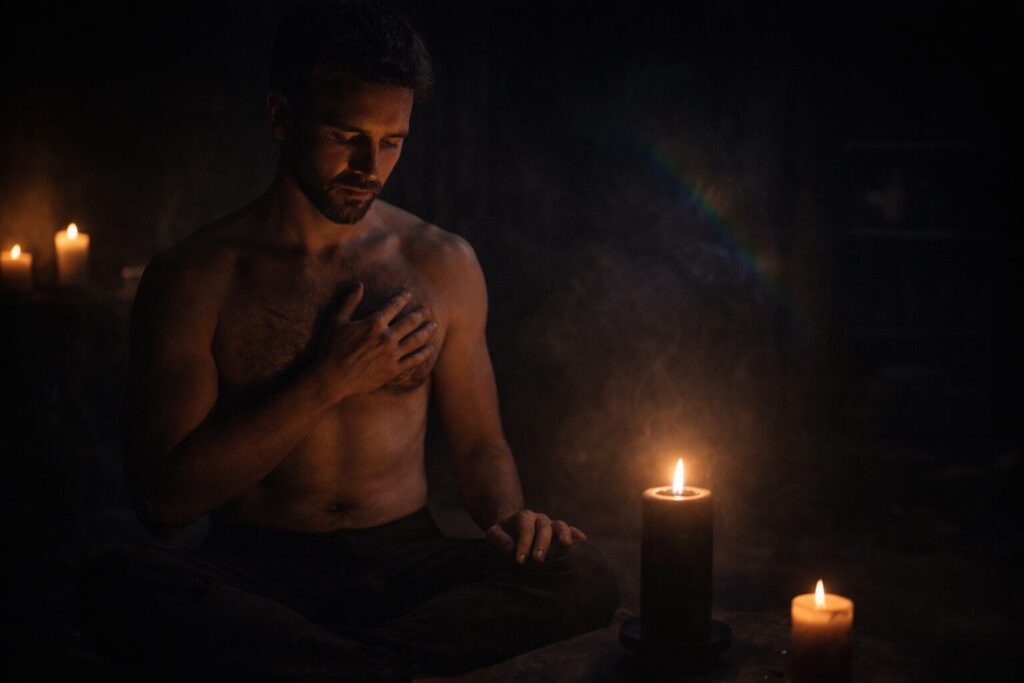
Shadow work does not unfold in a vacuum. It moves through the conditioning of culture, family, and identity — including gender.
Many men are taught, implicitly or explicitly, to avoid emotional excavation. Strength is defined as control. Stability is defined as stoicism. Vulnerability is framed as weakness. When such conditioning meets witchcraft, shadow avoidance often disguises itself as spiritual authority. Ritual becomes rigid. Emotion is intellectualized. Power is emphasized while grief is minimized.
This is not a flaw of masculinity. It is a distortion of it.
True spiritual strength is not the absence of feeling — it is the capacity to remain steady while feeling fully. When men avoid shadow work, they often over-identify with dominance, certainty, or esoteric knowledge. When they enter it honestly, their power refines. It becomes less brittle. More precise. Less reactive. More sovereign.
Likewise, many women and femmes are conditioned toward emotional labor — toward tending, absorbing, and managing the feelings of others. Their shadow may not be avoidance, but over-identification with healing, martyrdom, or relational responsibility. The danger here is not hardness, but depletion. Not denial, but diffusion.
Shadow work asks something different of everyone.
It asks the stoic to soften.
It asks the overextended to withdraw.
It asks the dominant to listen.
It asks the self-effacing to claim space.
These movements are not about abandoning identity. They are about removing armor mistaken for identity.
In myth, descent strips away titles and adornments. Inanna passed through seven gates and surrendered the emblems of her power before she reached the underworld. This is not humiliation — it is revelation. We discover what remains when our defenses fall away.
Shadow work refines expression. It does not erase it.
When approached honestly, it strengthens masculinity without hardening it. It deepens femininity without dissolving it. It clarifies the self beyond performance.
Power that has faced its own shadow does not need armor.
It stands.
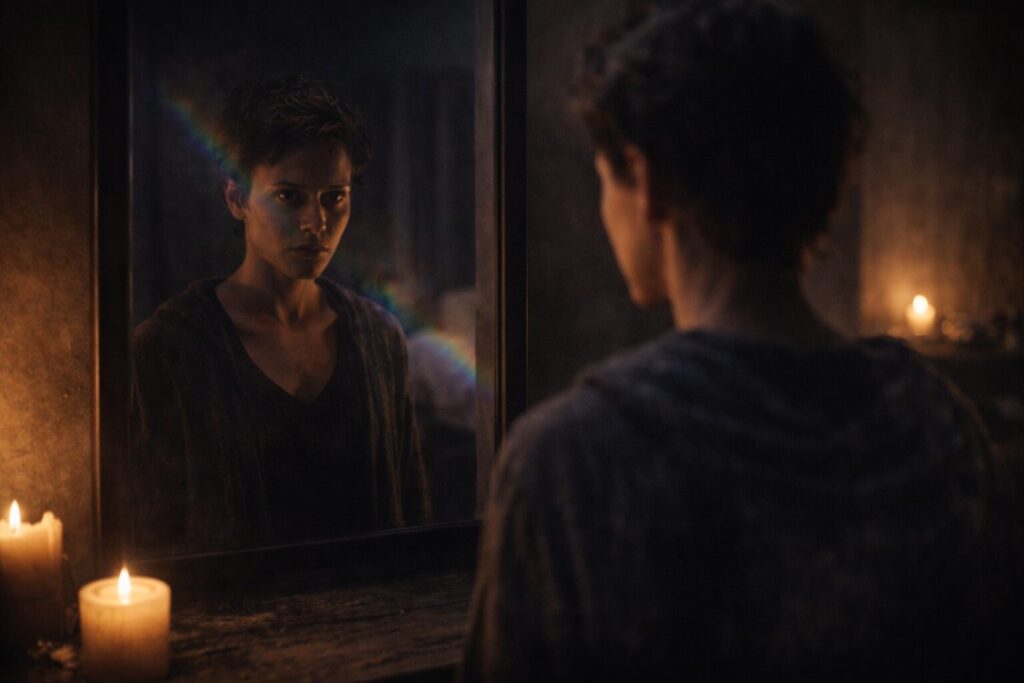
The Descent Cycle
Shadow work becomes stable when it is cyclical: revelation, containment, dialogue, integration, release. Treat this as a protocol you can repeat—especially at thresholds.
-
I
Revelation
Name what surfaced without dramatizing it. What emotion, pattern, memory, or fixation has arrived? The first act of power is accurate naming.
-
II
Containment
Choose a safe container: time limits, grounding, journaling boundaries, supportive witness, or professional care. Shadow work is not a free-fall. It is held.
-
III
Dialogue
Ask what function the shadow serves. What is it protecting? What need is it trying to meet? Most “darkness” is a defense that outlived its purpose.
-
IV
Integration
Translate insight into change. What boundary shifts? What behavior ends? What practice must evolve? Integration is where shadow work stops being theory.
-
V
Release
Close the cycle with ritual: cleansing, prayer, a bath, smoke, salt, water, or earth. End consciously, so the psyche learns completion rather than obsession.
Quiet advanced note: Many practitioners find descent work easier during the waning moon or during seasonal thresholds—when the psyche naturally loosens what no longer serves.

Discernment & the False Light
Spiritual bypassing occurs when practice is used to avoid unresolved emotional or psychological material. “High vibration” becomes a defense against grief. “Light” becomes a refusal to feel anger. “Ascension” becomes an escape from embodiment.
Toxic positivity is one of its most common masks. Pain is reframed prematurely. Boundaries are labeled “negativity.” Honest confrontation is dismissed as “low frequency.”
The result is not enlightenment — it is suppression wrapped in spiritual language. True descent work allows sorrow, rage, and doubt to surface without shame.
The psyche locates in others what it resists within itself. The person most insistent that “everyone else needs shadow work” is often standing at the edge of their own unentered descent.
Teaching shadow work is not the problem. Avoiding one’s own while prescribing it to others is. Authority emerges from lived descent, not rhetoric.
When shadow is unexamined, divination bends toward reassurance. Interpretations soothe the ego instead of revealing truth.
If your readings never contradict you, shadow may be speaking through the interpretation.
Intensity is not authority. Vision is not infallibility. The unintegrated shadow seeks uniqueness more than honesty.
The deeper the descent, the quieter the certainty.
- Your spiritual experiences always confirm your importance.
- You interpret disagreement as psychic attack.
- You avoid conflict in the name of “peace.”
- You diagnose others’ shadows but resist examining your own.
- Your practice feels grander while your relationships grow strained.
These are not accusations. They are mirrors.
Shadow work is ultimately personal. No coven can do it for you. No priestess, mentor, or partner can excavate what your psyche has hidden for your own survival. The descent must be chosen from within.
And yet — covens matter.
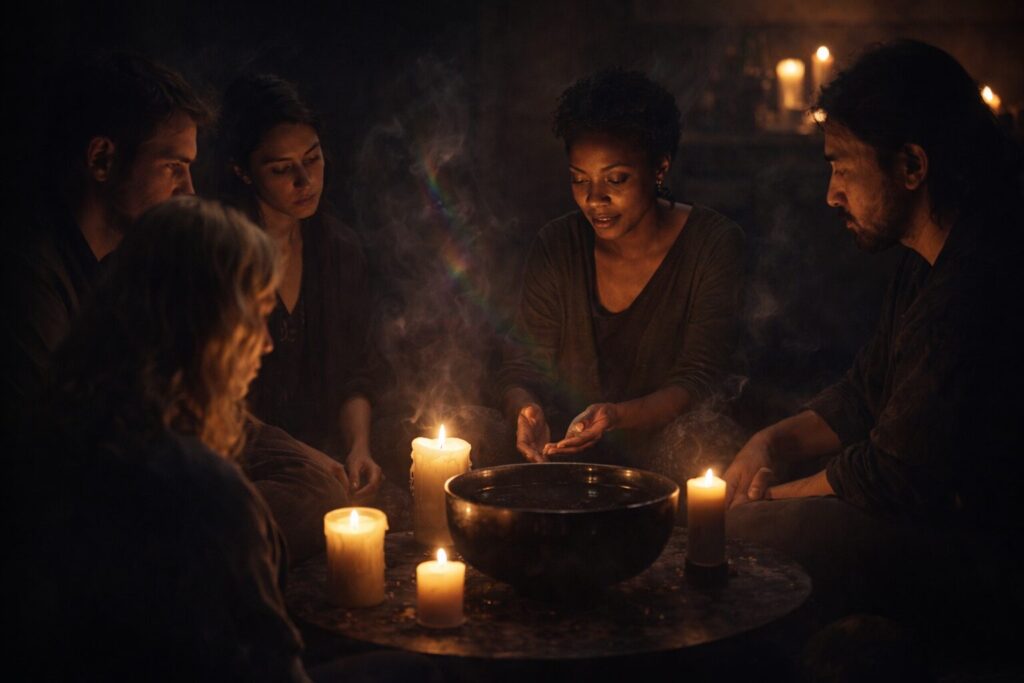
A healthy coven does not function as a court of judgment, nor as an echo chamber of comfort. It functions as a container: a place where truth can be spoken without theatrics, where accountability does not become humiliation, and where care does not become enabling. In such spaces, shadow tends to surface naturally — not because anyone is “calling it out,” but because closeness reveals pattern. Ritual reveals reflex. Community reveals the edges of the self.
This is where coven shadow dynamics become relevant. Groups can unconsciously reward bypassing (constant harmony, constant “love and light”), or they can unconsciously reward performance (who is the most psychic, the most devout, the most “advanced”). Both distort the work. A coven that fears conflict often breeds hidden resentment. A coven that worships certainty often breeds spiritual inflation.
The healthiest covens do something quieter: they normalize integrity.
They make space for members to name hard things without turning every moment into crisis. They encourage grounding after intense work. They respect privacy while also refusing manipulation. They understand that shadow work is not a spectacle — it is maintenance. Like cleaning a temple. Like tending a fire.
If you practice alone, you can still cultivate this container through trusted friendships, journaling, therapy, spiritual direction, or structured self-accountability. The key is the same in every case: shadow work requires witness — sometimes internal, sometimes relational — but always honest.
Community cannot replace the descent.
But it can keep you from mistaking isolation for enlightenment, or intensity for truth.
The Candle of Descent
Use this working when you feel yourself standing at the edge of a truth you have avoided. Keep it sober, grounded, and simple. Shadow work is not performance—it is honesty.
You will need
- One black candle (or dark violet)
- A small bowl of water with a pinch of salt
- Paper + pen
- A heat-safe dish
- Optional: a grounding stone (obsidian, smoky quartz, hematite)
Set the container
- Choose a time limit (20–40 minutes is plenty).
- Turn off distractions. Dim the room.
- Place the candle at center. Water at the left. Paper at the right.
- Take three slow breaths. Feel your weight in your body.
The Working
-
Speak the threshold aloud.
“I choose honesty. I choose integration. I descend to return whole.” -
Light the candle.
As the flame steadies, say: “Let what is hidden become visible—without harm, without distortion, without drama.” -
Write one truth.
On the paper, answer: What am I avoiding? Write plainly. No poetry. No justification. -
Ask the shadow its function.
Under the truth, write: What is this protecting? What does it fear would happen if I changed? -
Offer a corrective vow.
Write one small, concrete integration action you will take within 72 hours. (A boundary, a conversation, a habit ending, a practice beginning.) -
Seal and release.
Dip your fingers in the salted water and touch your forehead and chest. Say: “I release illusion. I keep the lesson.”
Close
Sit quietly for one minute. Feel your body. When ready, extinguish the candle (do not blow—snuff if you can). Fold the paper and place it somewhere private. If emotions remain stirred, do something grounding: water, food, a shower, bare feet on the floor, or a simple prayer.
Note: If you encounter overwhelming trauma or destabilizing emotion, pause this work and seek support. Descent is sacred—but it must be held.

Shadow work does not make you darker. It makes you accurate.
The practitioner who has descended does not emerge hardened or cynical. They emerge proportioned. They know the weight of their own hunger, so they do not confuse it with prophecy. They know the texture of their own fear, so they do not call it fate. They know the pull of ego, so they do not mistake it for destiny.
This is the true gift of descent: discernment without paranoia. Power without inflation. Devotion without dependency.
When shadow is faced honestly, something subtle shifts. Magic becomes less reactive. Ritual becomes less theatrical. Divination becomes quieter and more precise. Prayer becomes less about asking and more about aligning.
The shadow does not disappear. It becomes integrated — an advisor rather than a saboteur. It whispers warnings instead of hijacking behavior. It sharpens perception instead of distorting it.
Like Persephone, we do not remain below. We return — but altered. The light we carry back is not the bright glare of denial. It is the steady flame of someone who has seen themselves clearly and did not look away.
Shadow work is not a phase. It is maintenance.
It is the ongoing refinement of the self so that the Craft may move cleanly through you.
When you become trustworthy to yourself, your magic becomes trustworthy to others.
And that is initiation.