Post-Religious Spirituality

Many people describe themselves today with a phrase that would once have sounded contradictory: spiritual, but not religious.
For some, that identity begins with leaving a religious tradition that became restrictive, harmful, or simply impossible to believe. Others never belonged comfortably to organized religion in the first place. Some still believe deeply in gods, spirits, soul, synchronicity, sacred presence, magic, or a larger order to existence, but no longer want an institution to tell them exactly what those experiences must mean.
What remains is not an absence of spirituality. Often it is an attempt to build spirituality differently.
Post-religious spirituality is the broad territory that develops there. It is not one religion, one theology, or one organized movement. It is a loose and sometimes contradictory landscape in which meditation may sit beside manifestation, psychology beside astrology, yoga beside oracle cards, crystals beside journaling, and mystical experience beside the language of wellness and self-development.
New Age spirituality is part of that landscape, but it is not the whole of it. Some people in this world comfortably use the label New Age. Many others would never describe themselves that way at all.
What they often share is a shift in spiritual authority. Personal experience matters more than doctrine. Practices can be chosen, combined, adapted, or discarded. The sacred becomes portable enough to enter an apartment, yoga studio, therapy journal, garden, playlist, phone app, candle ritual, or quiet moment before bed.
There is genuine value in that freedom.
People who have been told what they must believe may discover that they are allowed to ask questions. Someone alienated from religious institutions may find that meaning, wonder, ritual, and spiritual experience did not disappear when formal religion did. Practices that are inexpensive, private, and easy to approach can give people a way to begin exploring without first accepting a creed or joining a community.
But freedom brings its own questions.
When personal resonance becomes the final measure of truth, how do we distinguish intuition from assumption? When every tradition becomes available for borrowing, what happens to context? When manifestation promises control over reality, who receives the blame when reality refuses to cooperate? When spirituality becomes content, products, influencers, and algorithms, who—or what—has quietly become the new authority?
Those questions do not make post-religious spirituality illegitimate.
They make it worth understanding well.
This page looks at both sides of that world: the permission it gives people to seek, the practices and ideas that have grown within it, the overlap with New Age spirituality and witchcraft, and the places where openness can deepen into discernment—or slide into wishful thinking, toxic positivity, consumerism, and what critics often dismiss simply as “woo-woo.”
Our interest is not in mocking people for seeking something meaningful.
It is in asking what happens after we give ourselves permission to seek.
What Do We Mean by Post-Religious Spirituality?
Post-religious spirituality is not a religion that came after religion, and it does not necessarily mean that someone has stopped believing. The term describes a broad spiritual landscape in which inherited institutions no longer hold the same authority they once did, while the desire for meaning, ritual, transcendence, healing, mystery, or relationship with something larger remains very much alive.
People arrive here by different routes. Some leave churches, temples, or other religious communities but retain a belief in gods, spirits, soul, sacred presence, or an underlying spiritual reality. Others keep very little traditional theology but continue to meditate, perform rituals, work with symbols, follow astrology, seek mystical experience, or simply understand nature and human life as possessing a depth that material explanation alone does not exhaust. Still others were never religious and begin their spiritual lives almost entirely outside established institutions.
What often joins these people is not a shared creed but a shared way of approaching spiritual authority. Experience becomes important. A practice may be adopted because it produces a meaningful change, helps someone make sense of life, creates a feeling of connection, or seems to open a door that previously felt closed. Teachings are more likely to be tested against intuition and personal experience than accepted because a religious body has declared them true.
This makes post-religious spirituality unusually flexible. Someone may meditate without becoming Buddhist, practice yoga without understanding it primarily as religion, use tarot without identifying as a witch, keep crystals beside a therapy journal, celebrate a solstice without becoming Pagan, or believe in synchronicity while remaining uncertain about gods. Practices that once arrived inside larger religious or esoteric systems can become portable, personal, and rearranged around the life of the individual.
That flexibility can be liberating, but it can also make this spiritual world difficult to define. Its boundaries overlap with New Age spirituality, wellness culture, modern mysticism, occultism, witchcraft, psychology, nature spirituality, and even forms of secular contemplation. None of those things is identical to post-religious spirituality, and a person may move among several of them without feeling any need to choose a permanent label.
For that reason, MCC uses post-religious spirituality here as a descriptive umbrella rather than the name of a single movement. It gives us a way to talk about a recognizable modern spiritual environment without pretending that everyone inside it believes the same things.
A Small Language Map
These terms often appear in the same conversations, but they do not mean the same thing.
Post-Religious Spirituality
The broad territory described on this page: spiritual practice and meaning pursued primarily outside the authority of formal religious institutions.
Spiritual but Not Religious
A common personal description rather than a single tradition. It usually signals spiritual interest or belief without formal religious identification.
New Age
An influential modern spiritual current with its own history, ideas, practices, aesthetics, and cultural legacy. It overlaps strongly with this landscape but does not define all of it.
Atheism
A question primarily about belief in gods. An atheist may be religious, spiritual, secular, contemplative, magical, or none of those things. It is a different category.
Monism & Omnism
Two related but different ways of thinking about unity and diversity. Monism asks whether reality is ultimately grounded in one underlying principle or reality. Omnism allows that many religions or worldviews may contain genuine insight without requiring them to be identical. Both appear in post-religious and eclectic spiritual spaces, where ideas about shared truth can be fruitful—but can also become flattening when meaningful differences among gods, traditions, and experiences are erased.
Why People Leave Religion Without Leaving the Sacred
Leaving a religion and losing interest in the sacred are not the same thing. For many people, the decision to step away from an institution does not resolve the spiritual questions that brought them there in the first place. Wonder remains. So does grief, awe, fear, longing, curiosity, and the sense that human life may contain dimensions that are difficult to reduce to ordinary language.
Sometimes people leave because a tradition genuinely harmed them. Authority may have been used to shame, control, exclude, frighten, or silence. A person may discover that their sexuality, gender, family, values, or understanding of the world cannot be reconciled with what they have been taught they must believe. Others leave for quieter reasons. The theology no longer convinces them. The institution feels remote from their lived experience. They may still value parts of a tradition while no longer being able to inhabit the whole of it.
And many people who now describe themselves as spiritual but not religious were never deeply religious at all. They may have grown up in nominally religious homes, secular families, mixed traditions, or environments where formal belief simply did not occupy much space. Their spiritual lives begin not with departure, but with discovery.
That distinction matters. Post-religious spirituality should not be understood simply as a recovery room for people wounded by religion, nor as a waiting area for people who will eventually choose another faith. It can emerge from religious disaffiliation, but it can also arise from curiosity, cultural change, philosophical uncertainty, or a desire to explore spiritual experience without first deciding exactly what one believes.

What often changes after institutional religion is not the desire for guidance, but the source from which guidance is expected to come. A priest, minister, scripture, creed, or inherited community may no longer occupy the center. In their place can appear intuition, meditation, personal experience, books, therapy, nature, divination, spiritual teachers, online communities, or a gradually assembled practice drawn from several sources.
That movement can be profoundly freeing. Someone who once experienced spiritual questions as a test with one permitted answer may begin to approach them as something that can be explored. Ritual can become chosen rather than required. Doubt can become part of spiritual life rather than evidence that spiritual life has failed. A person can revisit ideas about gods, spirits, magic, death, consciousness, or sacred place without having to accept an entire theological system at once.
But the loss of institutional authority does not eliminate the problem of authority. It relocates it.
A person may leave a church because they no longer want another human being telling them what is spiritually true, only to discover later that they have given extraordinary authority to an influencer, a spiritual coach, a tarot reader, a channeler, an algorithm, or the conviction that whatever feels right must therefore be true. One of the central questions of post-religious spirituality is not whether people should trust themselves. It is how personal experience can remain meaningful without becoming immune to reflection, evidence, disagreement, or correction.
There is also something worth remembering about what religious institutions sometimes provide when they function well. They can preserve stories and practices across generations, create shared ritual, maintain communities through grief and celebration, train teachers, support people in crisis, and give individuals a spiritual vocabulary they did not have to invent alone. Leaving institutional religion can remove harmful authority, but it can also remove structures of continuity and belonging. Post-religious spirituality often has to build new versions of those things for itself.
That does not make departure a mistake. It simply means that spiritual freedom is not the end of the story.
For some people, freedom itself is enough. They build thoughtful, ethical, sustaining spiritual lives without returning to organized religion or adopting a formal magical tradition. Others eventually discover that they want more structure, more history, more community, or a deeper relationship with particular gods, spirits, places, practices, or traditions. Both possibilities belong within the landscape we are describing.
Leaving a religious institution does not tell us what someone stopped believing. A person may reject a church while continuing to believe in God, leave formal religion while becoming more interested in spirits or magic, or abandon supernatural belief while retaining ritual, contemplation, ethics, and a profound sense of wonder. “Not religious” describes a relationship to religion; it does not, by itself, tell us what kind of inner world a person has.
Where New Age Fits
New Age spirituality belongs inside the post-religious landscape, but the two are not interchangeable. Post-religious spirituality is the broader condition we are describing: people building spiritual lives outside, between, or after traditional religious institutions. New Age, by contrast, refers to a recognizable family of modern spiritual ideas and practices with its own history.
That history is older and more complicated than the familiar image of crystals, affirmations, yoga studios, and inspirational social-media posts. Modern New Age spirituality inherited ideas from nineteenth-century esoteric and metaphysical movements, alternative approaches to healing, Spiritualism, comparative religion, and attempts to reconcile spiritual experience with a rapidly changing modern world. During the twentieth century, these currents increasingly mixed with psychology, self-development, holistic health, meditation, the Human Potential movement, and Western encounters—sometimes thoughtful and sometimes highly selective—with Asian religious and philosophical traditions.
What emerged was never a single church or creed. New Age culture has usually been decentralized, porous, and unusually willing to combine sources. A person might believe in reincarnation, astrology, spirit guides, energetic healing, meditation, synchronicity, crystals, personal transformation, and some form of universal consciousness without belonging to an organization that requires any particular combination of those beliefs.
That flexibility helps explain why New Age ideas traveled so easily beyond people who actually called themselves New Age. Much of the vocabulary now common in wellness and post-religious spirituality—alignment, vibration, manifestation, higher self, energy, spiritual growth, signs from the universe, holistic healing—has been shaped by currents that passed through or alongside New Age culture.
At the same time, not every meditation practice, yoga class, crystal user, astrologer, energy worker, mystic, Pagan, or spiritual-but-not-religious person belongs to the New Age movement. Similar practices can arise from very different traditions and carry very different meanings. Calling everything outside conventional religion “New Age” can obscure as much as it explains.
For MCC, the useful approach is neither to dismiss New Age spirituality as unserious nor to treat everything associated with it as ancient wisdom. It has given many people accessible ways to explore spiritual experience, experiment with practice, and imagine lives outside inherited religious categories. It has also developed habits and assumptions that deserve closer examination. Later on this page we will look at those more critically, particularly where personal resonance becomes unquestionable truth, positivity becomes avoidance, consumer products replace practice, or borrowed ideas lose the traditions that once gave them context.
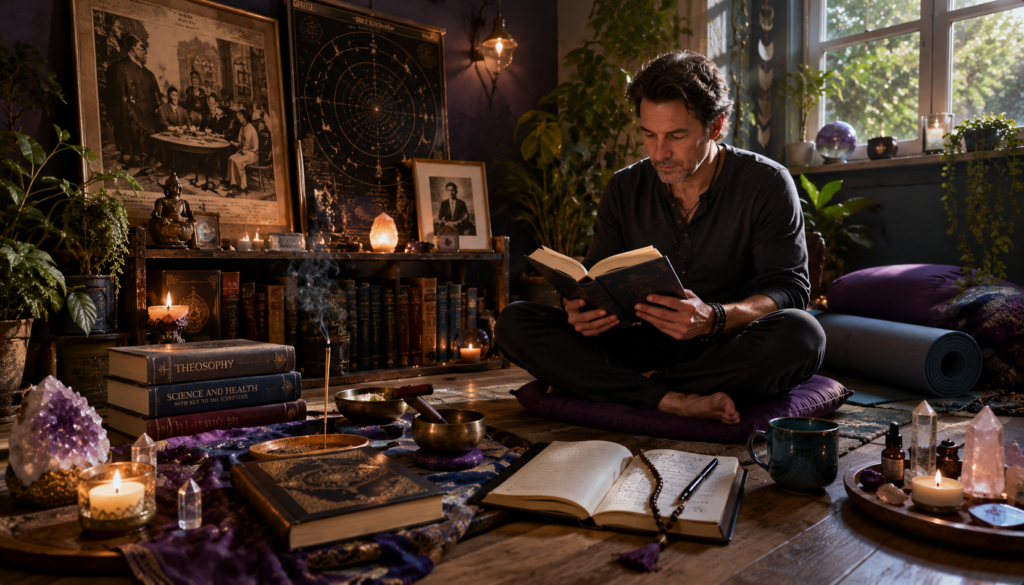
A Few Roots of the Modern New Age
New Age spirituality did not emerge from one founder or one tradition. It developed where several older currents met, changed, and entered modern popular culture.
Theosophy & Western Esotericism
Nineteenth-century esoteric movements helped popularize ideas about hidden spiritual realities, spiritual evolution, reincarnation, comparative religion, unseen teachers, and wisdom believed to lie beneath conventional religious divisions. These currents became important ancestors of later New Age thought.
New Thought & the Power of Mind
New Thought placed unusual emphasis on mind, belief, spiritual healing, prosperity, and the possibility that thought can influence lived reality. Modern affirmation, positive-thinking, and manifestation cultures did not simply appear with social media; they have recognizable predecessors in this older metaphysical landscape.
Spiritualism & the Unseen World
Modern Spiritualism helped normalize the idea that ordinary people might communicate with spirits and explore unseen dimensions outside the authority of established clergy. New Age spirituality later developed its own language of guides, channeling, messages, and nonphysical intelligences.
Human Potential & Self-Development
Twentieth-century Human Potential culture brought spirituality into conversation with personal growth, therapeutic experimentation, consciousness, creativity, and the idea that human beings possess capacities that ordinary life leaves underdeveloped. Spiritual transformation increasingly became something pursued through work on the self.
Holistic Health & the Wellness World
Holistic approaches encouraged people to think about mind, body, emotion, environment, and spiritual life as interconnected. This became one of the strongest bridges between recognizably New Age spirituality and today’s much broader wellness culture.
Asian Traditions in Western Spiritual Culture
Meditation, yoga, ideas about karma and reincarnation, and concepts drawn from Hindu, Buddhist, and other Asian traditions became increasingly visible in Western spiritual life. Some exchanges produced serious study and enduring practice; others removed ideas from their original religious and cultural settings. That tension between exchange and decontextualization remains important today.
What It Looks Like in Practice
Post-religious spirituality is often easier to recognize by what people do than by what they formally believe. Someone may have no settled theology at all and still maintain a regular spiritual life through meditation, journaling, yoga, divination, candle work, energy practices, or rituals built around intention and reflection.
That practice-first quality is one of the reasons this spiritual world is so accessible. A person does not necessarily need to join an organization, adopt a creed, or decide exactly what they believe about gods, spirits, consciousness, or the universe before beginning. They can try a meditation practice, light a candle before an important conversation, pull an oracle card when they need perspective, carry a stone that has personal significance, or create a quiet ritual for marking a transition in life.
Many of these practices are also found in witchcraft, occultism, Paganism, mysticism, folk religion, and established religious traditions. The practice itself therefore does not always tell us what path someone follows. A candle may be devotional, magical, meditative, aesthetic, or all of those things at once. A person may use tarot as divination, psychological reflection, spiritual guidance, or simply as a symbolic language for thinking through a problem.
What distinguishes post-religious practice is often its modularity. Practices can be combined around the needs and worldview of the individual rather than inherited as part of one complete religious system. That freedom can encourage experimentation and genuine discovery. It can also make context easier to lose, which is why learning where a practice comes from—and what it originally meant—still matters.
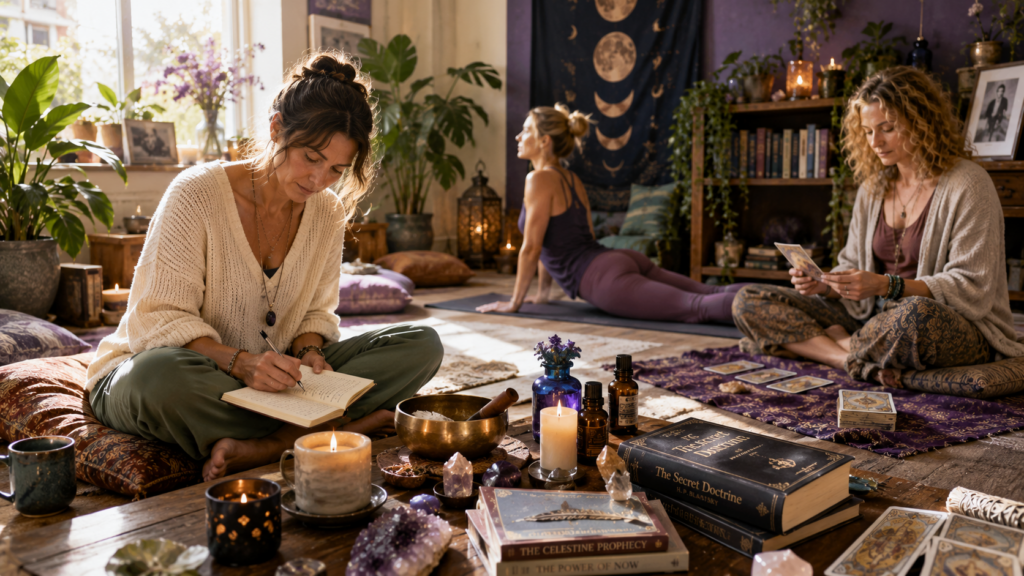
Common Forms of Practice
These practices often overlap, and none of them belongs exclusively to post-religious spirituality. Their meaning depends on the person, tradition, and context in which they are used.
Body & Presence
Meditation, breathwork, yoga, mindful movement, walking practices, time in nature, sound baths, and other techniques that use the body to slow attention and create a sense of presence. For many people, spiritual practice begins not with belief but with learning how to become still enough to notice experience.
Intention & Manifestation
Affirmations, visualization, intention-setting, vision boards, written goals, candle rituals, and manifestation practices all use focused attention to orient the person toward a desired outcome. There can be something real and useful here, but intention is only the beginning of developed magical work. We will return to that distinction later on this page.
Energy, Grounding & Cleansing
People may use smoke, sound, salt, water, visualization, bathing, breath, crystals, or simple rituals to clear a space, settle themselves, or establish spiritual boundaries. These practices can be useful, but opening spiritually without learning how to ground, close, cleanse, and maintain boundaries can create its own problems.
Divination & Reflection
Tarot, oracle cards, astrology, pendulums, dream journals, synchronicities, and other symbolic tools are often used to gain perspective or seek guidance. Some practitioners understand them as communication with spiritual forces; others use them more psychologically or intuitively. The same tool can therefore sit inside very different worldviews.
Objects, Atmosphere & Personal Ritual
Crystals, herbs, oils, candles, incense, music, meaningful jewelry, altar objects, plants, photographs, sacred images, and carefully arranged spaces can help give spiritual intention a physical form. Objects do not need extravagant claims attached to them in order to matter. Beauty, memory, symbolism, sensory experience, magical correspondence, and simple personal attachment can all give an object a legitimate place in practice.
One of the strengths of this kind of spirituality is that these practices can make the inner life tangible. A candle gives intention a beginning and an ending. A journal gives thought somewhere to land. A stone can become a reminder, correspondence, ritual object, or focus for attention. A cleansing practice can mark the difference between carrying the emotional atmosphere of a difficult day and consciously setting it down.
The trouble begins when the object or technique is asked to carry claims it cannot support, or when collecting practices replaces learning how to use them well. We will get to that. First, though, it is worth looking more closely at the ordinary materials that have become such recognizable parts of this spiritual world.
From Symbol to Practice
Spiritual objects can be meaningful without becoming miracle products. Learn the material, its traditions, its practical uses, and the role it can actually play in a thoughtful spiritual or magical practice.
What It Gets Right
It is easy to criticize post-religious spirituality for being eclectic, loosely organized, commercially packaged, or sometimes intellectually careless. Some of those criticisms are deserved, and we will make them ourselves. But they can obscure something important: this spiritual landscape developed in part because it answers needs that many older institutions were no longer meeting.
One of its greatest strengths is permission. People are allowed to approach spiritual life experimentally. They can ask questions without first agreeing to a creed, explore a practice without promising lifelong allegiance to it, and admit uncertainty without treating doubt as failure. For someone who has spent years being told what spiritual experience is supposed to look like, that freedom can be profound.
It also returns a great deal of spiritual life to ordinary experience. Meditation can happen before work. A candle can mark a difficult anniversary. A journal can become a place for reflection that is more intentional than ordinary writing. A walk through a familiar landscape can become a practice of attention. Someone may build a small altar in an apartment, draw a tarot card before making time to think through a problem, or create a private ritual for grief when no inherited ceremony feels adequate.
None of this has to be shallow.
A spiritual practice does not become meaningful merely because it is old, and it does not become meaningless merely because a modern person assembled it for themselves. Repetition, attention, knowledge, reflection, relationship, and experience can deepen practices that began quite simply. A meditation habit started through a phone app can eventually become serious contemplative practice. Someone who buys their first crystal because it is beautiful may later learn its geology, cultural associations, magical correspondences, and the ways practitioners have actually worked with stones. An oracle deck purchased almost casually can become the beginning of a much more disciplined study of divination.
Post-religious spirituality has also created room for people who might otherwise have concluded that spirituality simply was not available to them. Someone may be uncomfortable in churches but deeply responsive to sacred music. Another may reject traditional theology while experiencing nature as profoundly alive. A person uncertain about gods may nevertheless recognize moments of awe, synchronicity, mystery, or connection that they do not want to dismiss merely because they cannot explain them.
That openness can be especially valuable because spiritual identity does not always arrive before spiritual experience. Sometimes people begin with an experience and spend years deciding what language, if any, they want to place around it.
“the feelings, acts, and experiences of individual men in their solitude”
— William James, The Varieties of Religious Experience
James was writing about religion rather than today’s spiritual-but-not-religious culture, but the distinction remains useful. Institutions are one way human beings organize spiritual life; they are not the only place spiritual experience occurs.
Post-religious spirituality often begins by taking that private territory seriously. A person is allowed to notice what moves them before deciding what doctrine explains it. They can explore beauty, ritual, embodiment, contemplation, nature, divination, or mystical experience without immediately being required to turn those experiences into membership.
There is something healthy in that humility when it remains humility. I experienced something meaningful is not the same claim as I now understand exactly how the universe works. Personal experience can deserve attention without becoming infallible.
That distinction will matter increasingly as we move through this page, because many of the problems associated with New Age and post-religious culture begin when something valuable is pushed too far. Personal agency can become the illusion of total control. Intuition can become immunity from correction. Openness can become indiscriminate borrowing. Hope can become toxic positivity.
But those distortions should not make us dismiss what came before them. For many people, the first important spiritual discovery really is the simple realization that they are allowed to seek.

The Spirituality of the Self
One of the most distinctive features of post-religious spirituality is the degree to which spiritual life moves inward. Instead of beginning with a doctrine and asking the individual to conform to it, this culture often begins with experience: What did I feel? What seemed meaningful? What keeps appearing? What brings me into greater alignment with the person I am trying to become?
That inward turn is not necessarily self-absorption. It can encourage people to pay closer attention to their emotional lives, bodies, dreams, intuitions, habits, and reactions. Practices such as meditation, journaling, divination, therapy, breathwork, and time in nature can all create space for someone to notice patterns that ordinary life makes easy to ignore. A person may begin to recognize what exhausts them, what restores them, what relationships feel reciprocal, where fear is shaping a decision, or which experiences continue to carry an unusual sense of significance.
The language used around these experiences is often deliberately flexible. People speak of resonance, alignment, intuition, synchronicity, energy, signs, flow, higher self, or simply a sense that something feels spiritually important. Those words can be useful precisely because they leave room for experiences that are difficult to describe. Not every meaningful moment needs to be turned immediately into a theological statement.
But the same flexibility creates a problem when feeling becomes proof.
A strong intuition can deserve attention without being infallible. A coincidence can be meaningful without necessarily being a message directed specifically at us. An emotionally powerful experience can change a life without automatically proving every explanation we attach to it. Mature spiritual practice needs enough openness to notice unusual experiences and enough discernment to ask what else might explain them.
This is especially important because post-religious spirituality often inherits the language of personal truth. There is a legitimate meaning behind that phrase: people know important things about their own values, experiences, identities, and inner lives that outsiders cannot simply dictate to them. But personal truth becomes much less useful when it is expanded to mean that every claim about the external world becomes true because an individual feels strongly about it.
We do not need to choose between cynicism and unquestioning belief. Spiritual experience can be taken seriously while interpretation remains open to revision.
That distinction becomes particularly important around one of the most common—and most slippery—words in this entire spiritual landscape: energy.
What Do We Mean When We Say “Energy”?
Spiritual language often uses one word to describe several very different kinds of experience. Confusion begins when we stop noticing which meaning we are using.
“This room has strange energy” may simply describe a real impression: tension, comfort, unease, warmth, familiarity, excitement, or something difficult to put into ordinary words.
People also use energy to describe fatigue, stimulation, emotional intensity, bodily sensation, nervous-system responses, or the way another person’s mood seems to affect a space.
Within magical and spiritual practice, energy may refer to a perceived subtle force, presence, current, or quality worked with through ritual, attention, visualization, prayer, relationship, or other spiritual techniques. That is a metaphysical or experiential claim and should be described honestly as such.
Physics also uses the word energy, but in a precise measurable sense. Borrowing scientific words such as quantum, frequency, vibration, or energy does not automatically turn a spiritual claim into a scientific one.
Mystery does not need fake science to make it respectable. We can speak seriously about spiritual or magical experience without claiming that physics has demonstrated something it has not.
Explore Deeper
If your interest is moving from general spiritual exploration toward a more developed magical path, these pages offer natural next steps.
This is one place where the dismissive word “woo-woo” often enters the conversation. The term is usually thrown at beliefs or practices someone considers excessively mystical, irrational, or pseudoscientific, but it is too blunt to tell us very much by itself. Meditation, fraudulent quantum claims, divination, herbal tea, crystal healing, mystical experience, astrology, breathwork, and an influencer selling “DNA frequency upgrades” can all be placed in the same rhetorical bucket even though they are making very different kinds of claims.
MCC is less interested in deciding whether something looks strange than in asking better questions. What is actually being claimed? Is this metaphor, spiritual belief, magical practice, personal experience, psychological interpretation, or a statement about the measurable physical world? What would count as evidence, and what would make us reconsider our interpretation?
Those questions do not drain spirituality of mystery. They help keep mystery from becoming an excuse for believing anything at all.

Manifesting: Will, Action & Wishful Thinking
Manifestation occupies an unusual place in modern spirituality because there is something recognizable at its center. Directing attention toward an outcome, imagining it clearly, naming an intention, and gathering the will to pursue it can genuinely change the way a person approaches a situation. In magical practice, those capacities matter. A witch who cannot form an intention or direct will is missing some of the most basic equipment of the Craft.
That does not make manifestation identical to witchcraft.
From an MCC perspective, manifestation is better understood as one of the first movements of magical work. Intention gives the work direction. Visualization can give an outcome form in the imagination. Will gathers attention behind it. But developed witchcraft usually continues well beyond that beginning. Technique matters. Materials and correspondences may matter. Timing may matter. Divination may change the plan. Spirits, deities, ancestors, land, or other relationships may be involved depending on the tradition. Protection, cleansing, repetition, knowledge, and the actions taken in ordinary life all become part of the work.
Most importantly, results matter.
A magical practice that never asks whether anything actually happened can gradually become a practice of confirming one’s own hopes. Witchcraft does not require every working to succeed, and experienced practitioners know perfectly well that some spells fail, produce partial results, or unfold in unexpected ways. But we can still examine what we did, what changed, what did not, and what we might do differently next time. That willingness to look at outcomes is part of what turns intention into craft.
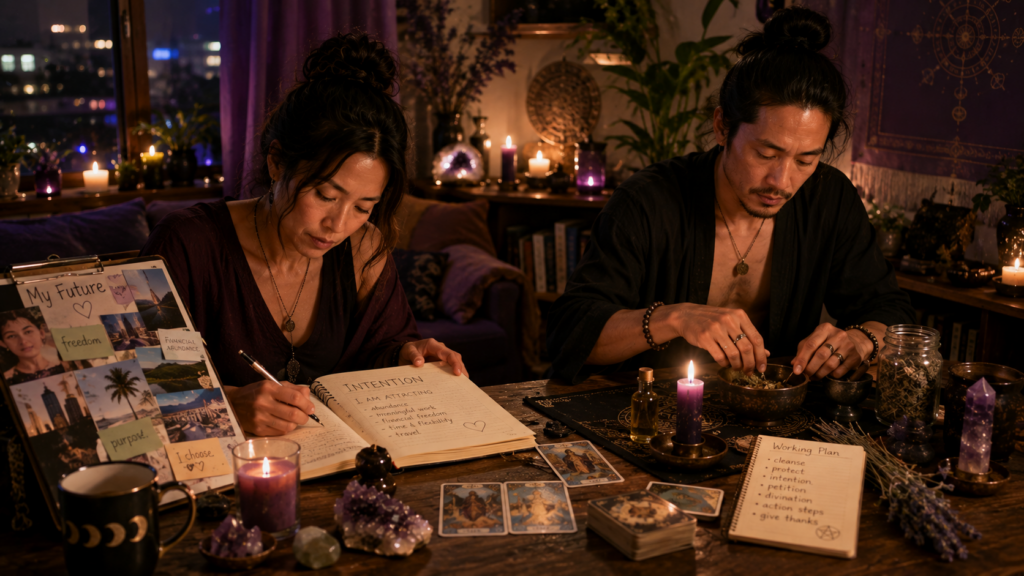
The modern manifestation boom owes a great deal to Rhonda Byrne’s The Secret, released as a film and book in 2006. Its version of the Law of Attraction popularized the idea that thought, gratitude, expectation, and emotional alignment can attract desired circumstances into a person’s life. The official Secret material still presents manifestation in sweeping terms, extending it to wealth, relationships, happiness, and health.
That message is enormously appealing because it gives the individual a sense of agency. Life can feel chaotic, unfair, and frustratingly beyond our control; the suggestion that consciousness itself offers a lever against that uncertainty can be comforting. Practices associated with manifestation—clarifying goals, visualizing outcomes, cultivating hope, noticing opportunities, and directing attention toward what one wants to build—can also be useful without requiring us to accept every metaphysical claim made around them.
The difficulty begins when a useful principle of intention expands into a theory of total personal responsibility for reality.
If positive thought attracts positive outcomes, failure can easily become evidence that the person thought incorrectly. Perhaps they doubted too much, failed to maintain a high enough vibration, focused on scarcity, secretly resisted abundance, or somehow blocked what the universe was trying to provide. A teaching that begins by promising empowerment can therefore create a second wound when life goes badly: not only did something painful happen, but now the person may be told that they participated in attracting it.
That is particularly troubling when manifestation language is applied to serious illness, disability, abuse, unemployment, poverty, grief, or circumstances largely beyond an individual’s control. Human beings influence their lives, sometimes enormously, but influence is not omnipotence. Other people have wills. Bodies have limitations. Institutions and economies exist. Chance exists. Weather exists. Accidents happen. Magic itself operates in a world already crowded with causes.
Hope does not become stronger when we pretend those realities disappear.

Manifestation also becomes more useful when we stop treating ordinary action as somehow less spiritual than intention. If someone wants employment, a working might focus will, confidence, opportunity, favorable circumstances, or the ability to be noticed—but the résumé still needs to be sent. A prosperity working does not make budgeting irrelevant. A love working does not eliminate communication. Healing ritual can support comfort, resilience, meaning, and participation in one’s care without replacing appropriate medical treatment.
For witches, this is not an embarrassment or a failure of magic. The mundane and the magical are part of the same world. We work on the conditions we can influence through ritual while also acting through the ordinary means available to us.
This is where manifestation can become something more substantial than wishing. Intention becomes linked to method. Will becomes linked to action. Imagination becomes a way of giving form to possibility rather than proof that possibility must obey us.
And when an outcome does not arrive, the response does not have to be shame.
We can reconsider the goal, change the technique, use divination, examine circumstances, try again, accept a limitation, or recognize that another person’s will and the larger world were involved. Mature magical practice leaves room for failure because reality is larger than the practitioner.
That humility does not weaken magic.
It makes practice more real.
From Intention to Craft
Manifestation can be a beginning. Intention, visualization, and will are genuine components of many magical practices, but developed witchcraft asks what we do with them: how we build technique, choose appropriate tools, act in the ordinary world, work within relationships and traditions, evaluate results, and learn when reality gives us an answer different from the one we wanted.
Love, Light & the Shadow It Avoids
Hope is not the problem. Neither are gratitude, optimism, forgiveness, compassion, or the deliberate choice to look for possibility when life becomes difficult. Spiritual practices have always helped people endure circumstances they could not immediately change, and there are times when choosing where to place our attention is an act of strength.
The problem begins when one emotional register becomes a spiritual requirement.
In some New Age and wellness spaces, love and light can shift from an aspiration into an expectation that spiritually healthy people should remain positive, grateful, peaceful, and “high vibration” regardless of what is actually happening. Anger becomes evidence that someone has more healing to do. Grief is something to move through quickly. Fear is treated as an energetic mistake. Talking about harm can be criticized as “giving energy to negativity,” while difficult questions are reframed as evidence that the person asking them is not sufficiently aligned.
That is not emotional freedom. It is simply another set of rules about which parts of ourselves are permitted to appear.
Human beings experience anger, sorrow, jealousy, disappointment, fear, resentment, exhaustion, and despair because those emotions are part of being human. They are not automatically wise, and they should not control every decision, but neither are they spiritual contaminants that must be removed before someone can be considered evolved. Sometimes anger identifies a boundary that has been crossed. Grief recognizes that something mattered. Fear can warn us of danger. Disappointment can tell us that an expectation was unrealistic or that something genuinely important was lost.
Trying to transform every painful experience immediately into gratitude can prevent us from understanding what the experience is actually asking of us.
This is also where toxic positivity can join the harsher versions of manifestation culture. If thoughts and emotional “frequency” are believed to determine circumstances too literally, a person experiencing illness, financial trouble, abuse, loneliness, or repeated disappointment may receive an additional burden: perhaps they attracted it, failed to remain positive enough, or somehow blocked the life they should have been able to manifest. The spiritual language sounds empowering until the promised result does not arrive. Then responsibility can turn almost entirely back toward the person who is already hurting.
There is an important difference between finding meaning in suffering and telling someone what their suffering means. A person may eventually understand a loss as transformative, discover unexpected strength during illness, or find wisdom in a terrible period of life. That meaning belongs to them. It becomes something very different when another person announces that tragedy was “meant to happen,” that the universe was teaching a lesson, or that greater positivity would have prevented it.
Psychotherapist and spiritual teacher John Welwood gave a useful name to another version of this problem: spiritual bypassing. The term describes the use of spiritual ideas or practices to move around unresolved psychological and emotional material rather than engaging with it.
Welwood was not arguing against spirituality. His work was concerned with bringing psychological and spiritual development into a more integrated relationship, rather than allowing one to substitute for the other. His book Toward a Psychology of Awakening specifically brings psychotherapy and contemplative spirituality into conversation.
For MCC, this is one of the places where Shadow Work becomes especially important. Shadow work is not a command to wallow in misery, romanticize trauma, or search endlessly for something wrong with ourselves. It is a willingness to turn toward what we habitually exclude from our preferred image of who we are. A spirituality interested only in the pleasant portions of the self leaves too much of the person unattended.
The goal is not to choose darkness instead of light.
It is to become capable of seeing in both.
“People often have to acknowledge and come to terms with their anger before they can arrive at genuine forgiveness or compassion.”
— John Welwood , The Psychology of Awakening · See also Toward a Psychology of Awakening
Where “Love & Light” Can Go Wrong
The phrases themselves are not necessarily harmful. The question is what happens when they are used to close a conversation rather than deepen it.
“Good Vibes Only”
Choosing supportive surroundings can be healthy. Requiring constant positivity is something else. Grief, anger, fear, frustration, and disappointment do not become spiritually unhealthy merely because they are uncomfortable.
“Raise Your Vibration”
As metaphor, this may describe seeking a clearer, calmer, or more compassionate state. Trouble begins when “vibration” becomes a moral ranking system in which happy people are spiritually elevated and struggling people are treated as responsible for being energetically low.
“Everything Happens for a Reason”
People often create meaning from painful events, and that can be deeply healing. But meaning discovered by the person who lived through an experience is different from meaning imposed on them by somebody else. Sometimes the kindest response to suffering is not an explanation but presence.
Forgiveness Before Feeling
Forgiveness can be meaningful, but demanding it too early may ask someone to bypass anger, grief, boundaries, or accountability. A spiritual ideal should not require a person to pretend an injury no longer matters before they have actually worked through what happened.
Spiritual Bypassing
Spiritual practice can help us engage more fully with life, but it can also become a sophisticated way of avoiding what hurts. Meditation, prayer, manifestation, mystical language, or ideas about transcendence do not remove the need to examine patterns, wounds, boundaries, relationships, and the ordinary human work that remains unfinished.
Going Deeper Means Looking Inward, Too
Spiritual growth does not require us to eliminate the difficult parts of being human. These MCC pages explore what can happen when we engage them instead.
Universalism, Omnism & the Flattening Problem
One of the most appealing instincts within post-religious spirituality is the desire to move beyond religious conflict. After seeing traditions argue over doctrine, authority, salvation, gods, scripture, or whose path possesses the truth, it is understandable that many seekers arrive at a gentler conclusion: perhaps everyone is approaching the same sacred reality from different directions.
There is generosity in that impulse. It can encourage curiosity instead of hostility and make it easier to recognize wisdom in traditions other than our own. A Christian mystic, a Buddhist contemplative, a Pagan polytheist, an animist, a Hindu devotee, and someone who simply speaks of “the universe” may all describe experiences that invite comparison and conversation.
The difficulty begins when similarity becomes sameness.
A common New Age formulation is that all religions are ultimately teaching the same truth, all gods are expressions of the same divine source, and cultural differences are mostly different names or costumes placed over one underlying spiritual reality. Some people sincerely believe this, and as a personal metaphysical position it is theirs to hold.
MCC becomes much more cautious when that belief is applied to other people.
If a practitioner understands several deities as faces of one divine reality, that may be an important part of their spirituality. But telling someone who understands those gods as distinct beings that they are actually worshipping different versions of the same god overrides their own theology. Telling members of different religions that their traditions are “really saying the same thing” can do something similar. What sounds inclusive from the outside may erase distinctions that the people inside those traditions consider fundamental.
Those distinctions are not merely intellectual. Religions and spiritual traditions arise within cultures, histories, languages, communities, ritual systems, relationships, obligations, sacred places, and particular understandings of the world. Shiva is not simply Jesus with different iconography. Hekate is not automatically another name for the Virgin Mary. Ancestors are not interchangeable with spirit guides, and the Fae are not merely angels translated into Pagan vocabulary. Sometimes traditions resemble one another. Sometimes they influence one another. Sometimes practitioners consciously build syncretic systems that bring different traditions into relationship. None of those things requires us to pretend the differences were never real.
From an MCC perspective, genuine pluralism leaves room for difference to remain difference.
The world may contain multiple religions because human beings have interpreted one ultimate mystery in different ways. It may contain multiple gods, spirits, powers, and realities that are genuinely distinct. It may contain some combination of unity and plurality that no human theology has fully described. We do not need to resolve that question by flattening every tradition into one metaphysical answer.
For us, respect begins by allowing people and cultures to describe their own sacred relationships.
That is also why phrases such as “all gods are one,” “all religions teach love,” or “every tradition is just another path up the same mountain” deserve more examination than they usually receive. They may be intended as gestures of tolerance, but they can quietly replace the beliefs of millions of people with the speaker’s preferred universal system.
Pluralism asks something more difficult of us. It asks us to live beside difference without requiring difference to disappear.
Unity Is Not Sameness
MCC does not object to someone personally believing that many spiritual paths emerge from one underlying reality. We object when that belief is used to overwrite the beliefs of people and cultures that understand themselves differently. Respectful pluralism allows traditions to resemble one another, influence one another, disagree with one another, and still remain genuinely distinct.
This becomes especially important in a spiritual culture built around personal selection. Post-religious practitioners may encounter meditation in one place, a deity in another, an Indigenous concept somewhere else, a ritual through social media, and a spiritual technique in a book or workshop. Eclectic practice can be thoughtful and creative, and MCC itself is not opposed to syncretism. Traditions have encountered, borrowed from, influenced, and transformed one another throughout history.
But borrowing responsibly requires more than liking something.
A practice may carry obligations, restrictions, history, theology, community meaning, or cultural memories that are invisible when it appears as a beautiful image or thirty-second explanation online. Something that looks like a universally available spiritual technique may belong to a much larger system. Learning where practices come from does not prevent spiritual exploration; it makes exploration more informed.
This is another place where the language of personal resonance can become misleading. This resonates with me tells us something meaningful about our response to an idea. It does not automatically tell us that we understand the idea, that we have represented its source accurately, or that the people who inherited it would recognize what we have made from it.
The goal does not have to be spiritual purity. Cultures have never existed in sealed containers, and modern spiritual lives are often genuinely mixed. The more useful goals are curiosity, attribution, humility, context, and honesty about what we are doing.
A practitioner can say, “I have combined these ideas into my own practice,” without claiming that every tradition was secretly teaching that combination all along.
That difference matters.
Explore the Difference
Unity, religious pluralism, and Pagan spirituality ask different questions about what the sacred is and how human beings relate to it. These MCC pages explore those differences in greater depth.
When Spirituality Becomes a Product
Post-religious spirituality developed alongside another powerful feature of modern life: almost anything can become a product.
There is nothing inherently wrong with buying spiritual tools. Witches have always needed materials, books are worth paying for, artists deserve compensation, readers and teachers deserve to be paid for their time, and someone who makes candles, jewelry, oils, ritual objects, or divination decks is doing real work. MCC has no interest in pretending that spirituality becomes purer simply because nobody exchanges money.
The problem begins when buying becomes mistaken for becoming.
It is remarkably easy to assemble the appearance of a spiritual life. A few crystals, an altar cloth, a deck of cards, candles, incense, a shelf of books, a subscription to a meditation app, and perhaps a collection of online courses can make someone feel as though they are moving deeply into practice. Sometimes those things genuinely help. But objects can accumulate much faster than knowledge, and purchasing the next tool can become a substitute for spending six months learning how to use the one already sitting on the table.
That dynamic is especially visible online. Etsy and similar marketplaces have made it possible for independent witches, artists, readers, and craftspeople to reach people who would never find them locally, which is a genuine benefit. The same environment also makes room for guaranteed spell results, instant soul-mate workings, mass-produced “haunted” objects, endless spiritual upgrades, and services whose claims become more dramatic as the price increases. A beautiful storefront does not tell us whether the practitioner behind it is knowledgeable, ethical, inexperienced, sincere, manipulative, or simply very good at marketing.
The same caution applies at the inexpensive end of the market. A crystal purchased through Temu, a dollar store, a gem show, or a local metaphysical shop is not magically inferior because it cost less. Spiritual power does not come with a luxury price tag. But quality still matters where quality actually matters. Is the stone really the mineral advertised? Has it been dyed, coated, reconstructed, or manufactured? Is an oil safe for skin? Is an herb correctly identified? Is a supposedly handmade object actually mass-produced? Knowing what we are purchasing is part of responsible practice.
A five-dollar stone that is honestly represented can be a better spiritual tool than a ninety-dollar stone sold with extravagant claims.
And sometimes a found object is better still.

Consumer spirituality becomes more troubling when it sells certainty.
Spiritual life contains uncertainty by its nature. We do not always know why something happened, whether a coincidence was meaningful, whether a working will succeed, what another person feels, or what the future will bring. An ethical practitioner can work within that uncertainty. A marketplace has an incentive to remove it.
That is how we arrive at guaranteed outcomes, claims that a reading is “100 percent accurate,” practitioners who repeatedly discover increasingly serious curses that require increasingly expensive removals, or spiritual services that always seem to reveal another problem only the same seller can solve. Fear is particularly profitable because frightened people are easier to convince that they need immediate help.
The same structure can appear in less dramatic forms. There is always another certification, another activation, another course, another level, another deck, another ritual kit, another frequency, another premium membership, another object that promises to unlock what ordinary practice supposedly cannot.
Learning can certainly cost money. Good teaching often should.
But a healthy spiritual path should gradually make a practitioner more capable, not permanently dependent on purchasing the next answer.
The Price Is Not the Practice
A costly tool is not automatically powerful, and an inexpensive one is not automatically poor. Quality matters where material, safety, authenticity, craftsmanship, or honest representation matter. Spiritual depth comes from what we learn, practice, cultivate, and build in relationship with our tools—not from how impressive the receipt looks.
A Few Things Worth Watching
Paying for spiritual tools or services is not inherently suspicious. The question is whether the exchange supports practice—or exploits uncertainty.
Guaranteed Spiritual Outcomes
Anyone can promise certainty. Reality is less cooperative. Spellwork, divination, healing practices, spirit work, and other spiritual services involve variables no ethical practitioner can completely control. Confidence in one’s craft is different from guaranteeing another person’s future.
Fear That Always Requires Another Purchase
Be cautious when every reading reveals a new curse, attachment, blockage, or danger that conveniently requires another paid service from the person who discovered it. Spiritual care should increase discernment rather than manufacture dependency.
Mass-Produced Mystique
There is nothing wrong with using mass-produced objects. The problem is misrepresentation. A factory-made item should not need an invented ancient lineage, false handmade story, or supernatural certificate in order to have beauty or usefulness.
The Endless Certification Ladder
Training and credentials can be valuable when they represent actual study. They become less meaningful when every weekend course creates another grand spiritual title or when advancement exists mainly to sell the next level. A certificate can document training; it cannot manufacture wisdom.
Tools Before Technique
New objects can be exciting, but skill develops through use. Before buying another deck, stone, oil, candle, or ritual kit, it can be worth asking what the tools already present have actually taught us.
The answer is not to make spirituality joyless or suspicious of beautiful things. A well-made deck can inspire practice. A crystal can become deeply meaningful. Buying a handmade ritual tool can support another practitioner and place something beautiful in our own working space. Paying an experienced reader, teacher, or witch for skilled work can be entirely appropriate.
We simply should not confuse the market surrounding spirituality with spirituality itself.
At some point the package arrives, the candle is lit, the book is opened, and the practitioner still has to practice.
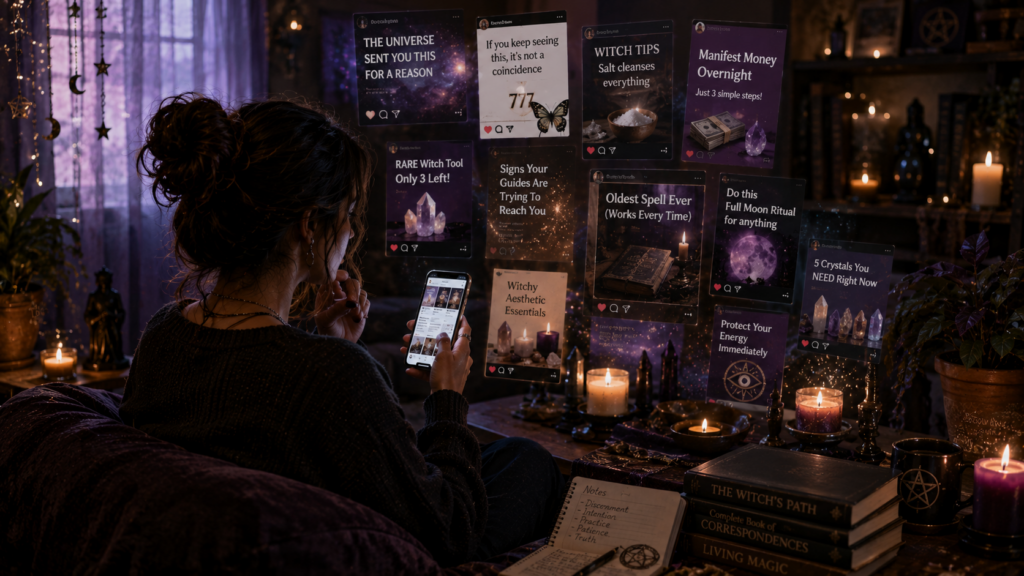
When Repetition Becomes Tradition
Social media did not invent spiritual misinformation. Magical and religious traditions have always carried disputed histories, local variations, bad translations, embellished stories, mistaken correspondences, and claims repeated long after anyone remembered where they began. What has changed is the speed at which an idea can now travel and the number of times a person can encounter it before ever thinking to ask where it came from.
A statement may appear first in a video, then on an infographic, then in a Facebook group, then on Pinterest, then in an AI-generated article, and finally in another creator’s video citing the general fact that “witches have always known this.” By the time someone encounters the claim for the tenth time, its familiarity can begin to feel like evidence.
Psychologists have a name for part of this problem: the illusory truth effect. Repeated statements tend to feel more believable simply because they have become familiar, even when repetition has added no new evidence. Research on misinformation continues to find this familiarity effect, which is one reason repeated false claims can be so difficult to dislodge.
Spiritual communities are particularly vulnerable because much of what we discuss cannot be checked in the same way we can verify the boiling point of water or the date of an election. Traditions may be oral. Experiences may be personal. Magical correspondences can genuinely differ among systems. Deities may be encountered differently by different practitioners. There is often legitimate room for interpretation.
But room for interpretation is not the same as freedom from evidence.
If someone says, “This is how I work with Hekate,” they are describing practice or experience. If they say, “Ancient Greeks always did this for Hekate,” they have made a historical claim. If someone creates a new ritual for the full moon and finds it powerful, that may become a meaningful modern practice. If they present it as a forgotten Celtic rite from three thousand years ago, we are entitled to ask where that information came from.
Reality Check: Repetition Is Not Evidence
A claim does not become historically old, magically effective, or spiritually authoritative because thousands of accounts repeat it. Popularity can create a tradition; it cannot create a past. New traditions are perfectly capable of becoming meaningful traditions. What matters is being honest about when and how they began.
This distinction matters because new traditions are not inherently fake traditions. Every tradition had a beginning. Communities create observances, rituals, symbols, phrases, and customs constantly. If witches decide that a particular date is worth celebrating together, continue observing it, tell stories about it, and pass that observance onward, they may quite genuinely be creating a tradition.
What becomes misleading is giving the new tradition a history it never had.
A useful contemporary example is International Witch’s Day, commonly circulated online as July 21. The date now appears in social posts, Pagan calendars, and modern event listings, so people really do observe it. What I have not been able to locate is a documented older Witchcraft tradition, established historical origin, or broadly recognized body that originally instituted July 21 as an international witches’ observance. Current discussions themselves sometimes acknowledge uncertainty about where the date came from, and competing “Witches Day” dates also circulate.
That does not mean witches are forbidden to celebrate it. Quite the opposite: if people enjoy International Witch’s Day, they can make it real by celebrating it now.
What we should resist is quietly changing the sentence from “witches have begun celebrating this” into “witches have traditionally celebrated this for centuries.”
The first statement describes living culture.
The second invents history.
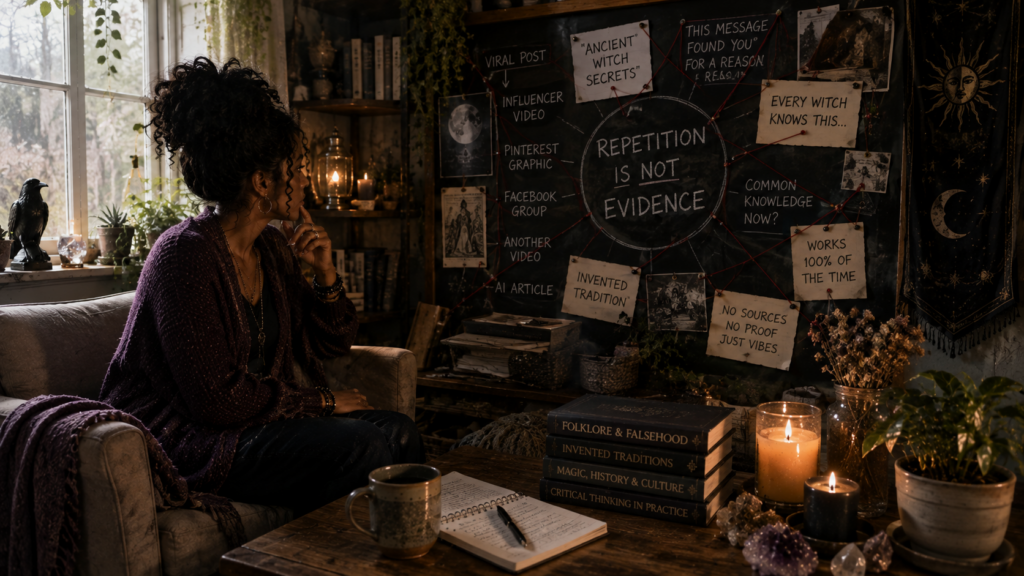
Social platforms complicate this further because algorithms do not primarily decide what to show us according to historical accuracy, theological sophistication, magical experience, or quality of sourcing. Their job is to select material likely to hold attention and encourage further engagement. Repetition can therefore become self-reinforcing: a popular claim inspires more creators to repeat it, repeated versions make the claim appear familiar, and familiarity helps it seem increasingly established.
Eventually the source can disappear entirely.
A correspondence may be attributed to “ancient witches.” A deity may acquire a modern association that nobody can trace earlier than a viral post. A recently invented ritual becomes “traditional.” A quote migrates from one famous occultist to another. A beautiful piece of modern folklore is repeated as archaeology. An individual’s personal spirit experience is copied until it becomes a rule that other practitioners are told they must follow.
This does not require anyone to be deliberately lying. People often pass along information because they encountered it repeatedly and reasonably assumed someone else had already checked it.
That is precisely why critical thinking matters.
Before You Call It Tradition
Not every claim needs an academic paper behind it. The source we need depends on the kind of claim being made.
Is This History or Practice?
“I use this herb for protection” describes practice. “This herb has been used by witches for protection since antiquity” describes history. The second statement requires evidence the first one does not.
Can You Find the Claim Before Social Media?
If every path backward ends with another account repeating the same sentence, we may be looking at modern internet folklore rather than inherited tradition. That does not automatically make the practice useless; it tells us something about its likely age.
Does the Source Actually Say It?
Quotations, historical claims, deity associations, and magical correspondences are often repeated with a book title attached. When possible, checking the actual source can reveal that it said something narrower, different, or occasionally nothing of the kind.
Could This Be a Modern Tradition?
New does not mean meaningless. Modern witches create rites, customs, observances, symbols, and community practices all the time. Calling something modern when it is modern allows us to appreciate what our own communities are actually creating.
Would You Change Your Mind?
Discernment includes asking what evidence would cause us to revise a belief. If no source, contradiction, historical record, ordinary explanation, or failed prediction could ever count against a claim, we are no longer testing the idea; we are protecting it.
Critical thinking is sometimes portrayed as the enemy of enchantment, as though investigating a claim makes the world less magical. We see the opposite. Knowing that a beautiful modern ritual was created in 2019 does not prevent us from using it in 2026. Discovering that an attractive “ancient correspondence” is actually recent gives us the freedom to decide whether it works for our practice instead of obeying an authority that never existed.
Research also protects the genuinely old things.
When every new idea is labeled ancient, actual historical traditions become harder to see. When every personal experience becomes universal doctrine, the richness of individual spiritual relationships disappears. When everything circulating online becomes “witch lore,” we lose the ability to tell inherited tradition, modern innovation, personal gnosis, folklore, scholarship, and simple error apart.
A living magical culture needs all of those categories.
It simply needs to know which one it is holding.
When Discernment Becomes Distrust of Everything
Questioning authority can be healthy. Religious institutions, governments, corporations, medical systems, media organizations, academics, spiritual teachers, and other sources of authority are all capable of error, bias, self-interest, and abuse. Many people arrive in post-religious spirituality precisely because they learned that an institution they were once expected to trust did not deserve unquestioning obedience.
But skepticism can develop its own blind spot when distrust itself becomes the worldview.
In some New Age, wellness, and alternative-spiritual communities, suspicion of conventional authority can combine with the belief that hidden spiritual knowledge is available primarily to those who are sufficiently awake, intuitive, or willing to reject mainstream explanations. This overlap between spiritual seeking and conspiratorial thinking is sometimes called conspirituality.
The pattern can be seductive because it transforms uncertainty into significance. If institutions cannot be trusted, perhaps intuition becomes the safer authority. If experts disagree with us, their disagreement can be interpreted as evidence that they are compromised. If friends question a claim, perhaps they are simply less awakened. An influencer who promises access to what “they don’t want you to know” can begin to occupy much the same position once held by the authority we believed we had escaped.
That is not discernment. Discernment requires the possibility that we might also be mistaken.
There are real conspiracies, real institutional failures, real conflicts of interest, and good reasons to challenge authority. Critical thinking does not mean assuming official explanations are always correct. It means refusing to give automatic credibility to the alternative explanation merely because it is alternative.
The same standard should apply to spiritual authority. A channeler can be wrong. A reader can misinterpret something. A healer can misunderstand a situation. A witch can make a bad judgment. An influencer can repeat misinformation. Our intuition can confuse fear, hope, expectation, pattern recognition, and genuine insight.
Post-religious spirituality is at its healthiest when leaving one unquestionable authority does not simply result in finding another.
Skepticism Has to Work in Both Directions
Questioning established authority can be wise. So can questioning the person who claims to possess the secret truth that established authority supposedly hides. Discernment asks for reasons, context, evidence, and humility regardless of which side of the mainstream a claim comes from.
This subject extends far beyond post-religious spirituality, and it deserves more room than we can give it here. The important point for this page is simpler: spiritual openness should increase our ability to examine claims, not make every extraordinary explanation more attractive merely because it challenges conventional authority.
For a fuller look at how mistrust, hidden-knowledge claims, communities, algorithms, and conspiracy thinking can reinforce one another:
Conspiracy CulturePsychology, Therapy Language & Spiritual Meaning
Modern post-religious spirituality has absorbed an enormous amount of language from psychology. People talk about trauma, boundaries, attachment, the inner child, shadow work, nervous-system regulation, emotional triggers, projection, narcissism, healing, and self-sabotage with a familiarity that would have been unusual outside a therapist’s office only a few generations ago.
Much of that has been useful.
Psychological language has given people better ways to recognize patterns in relationships, understand how earlier experiences continue to shape the present, name behavior that causes harm, and take emotional life seriously. For people leaving rigid religious environments, therapy can also provide a place to examine guilt, shame, authority, identity, fear, and belief without replacing one doctrine with another.
Spiritual practice can support some of that work. Meditation may help someone notice their reactions before acting on them. Journaling can make recurring patterns visible. Ritual can give emotional transitions form. Prayer, divination, time in nature, community, or magical practice may provide meaning and a sense of participation in one’s own healing.
But spiritual practice and psychological treatment are not interchangeable.
A ritual may help someone process grief without being psychotherapy. A cleansing may provide a meaningful sense of release without proving that every difficult emotion came from an outside spiritual force. Meditation can support wellbeing while also being insufficient for a problem that needs professional care. Therapy can help someone understand their mind without deciding whether a spiritual experience was metaphysically “real.”
The two worlds can meet without one swallowing the other.
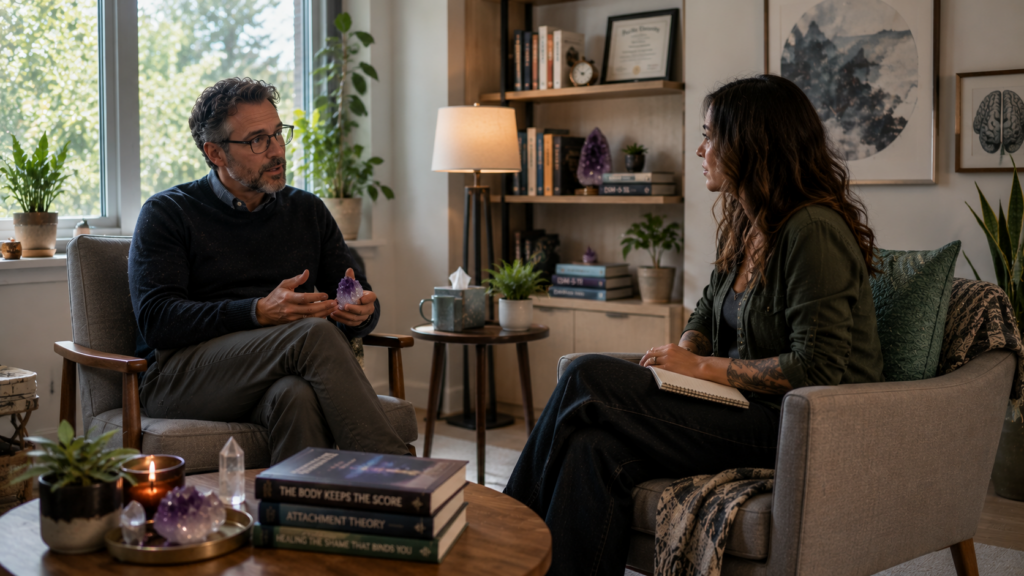
Trouble begins when psychological terminology becomes another kind of spiritual certainty.
Online, a difficult former partner can quickly become a narcissist. A painful memory becomes trauma. Discomfort becomes a trigger. Any relationship requiring compromise may be described as violating a boundary. Ordinary anxiety can be explained entirely through the nervous system, while complex patterns of behavior are compressed into a handful of popular labels.
Sometimes those words are exactly right. Sometimes they are approximations. Sometimes they have drifted far from the meanings they carry in professional psychology.
The same thing can happen in spiritual language. A disagreement becomes energetic incompatibility. Anxiety becomes psychic attack. A difficult relationship becomes a karmic contract. An intrusive thought becomes a message from a spirit. A strong attraction becomes proof of a past-life connection.
Any of those interpretations might be meaningful to the person experiencing them, but interpretation becomes safer when it remains an interpretation rather than an unquestionable diagnosis of what is happening.
This is one reason MCC values both discernment and psychological understanding. Spiritual explanations deserve to be considered without automatically excluding ordinary psychological ones, and psychological explanations do not have to be used as weapons to dismiss every spiritual experience.
Sometimes more than one kind of explanation can be useful at the same time.
When Therapy Language Travels
Psychological ideas can be enormously useful outside the therapist’s office, but popular language often becomes broader and less precise as it travels.
Trauma
People use the word for experiences ranging from severe psychological injury to events that were simply painful or difficult. All suffering deserves care, but using one word for every kind of distress can make important differences harder to understand.
Boundaries
Healthy boundaries help us decide what we will participate in, tolerate, disclose, or allow in our own lives. They are not the same as controlling another person or requiring everyone around us to behave exactly as we prefer.
Triggers
The term can describe a real reaction connected to earlier distress or trauma, but online it is sometimes used for anything upsetting, irritating, or disagreeable. Discomfort and psychological triggering are not always the same thing.
Nervous-System Language
Breath, rest, movement, sleep, safety, and calming practices can affect how we feel physically and emotionally. But phrases about “regulating the nervous system” can become so broad online that they are used to explain nearly every emotional state. Useful language becomes less useful when it explains everything.
Narcissism & Diagnosis at a Distance
Selfish, manipulative, abusive, or difficult behavior can be named without diagnosing another person from a social-media checklist. Clinical labels can become powerful weapons when used casually in conflicts they were never designed to settle.
Inner Child & Shadow
These can be useful frameworks for exploring neglected needs, learned patterns, hidden emotions, or parts of ourselves we prefer not to acknowledge. They work best as tools for reflection rather than rigid explanations for every problem in a person’s life.
Spiritual practices can also support health and wellbeing without needing to pretend they are medicine. Ritual, prayer, meditation, meaningful objects, time in nature, community, cleansing practices, and other forms of spiritual care may help someone feel calmer, more supported, more hopeful, or more actively involved in their own wellbeing.
There is nothing wrong with that.
The line becomes important when supportive practice is sold as a substitute for appropriate medical or psychological care, or when illness is blamed on spiritual failure, low vibration, insufficient belief, or the inability to “heal correctly.” We can make room for both medical care and the rituals, relationships, symbols, and spiritual practices that help people endure what medicine alone cannot make meaningful.
For MCC’s fuller treatment of psychological ideas, mental life, perception, behavior, and the deeper work of examining hidden patterns:
Opening Is Easy. What About Closing?
A great deal of modern spiritual culture teaches people how to open.
Open your intuition. Open yourself to signs. Ask the universe for guidance. Pull a card. Begin meditating. Listen for spirit. Raise energy. Attend the sound bath. Try channeling. Follow the synchronicity. Become more receptive to whatever may be moving beneath ordinary awareness.
There is nothing inherently wrong with becoming more attentive. Spiritual and magical practices often involve precisely that shift: ordinary attention becomes quieter, symbolic perception becomes stronger, and experiences that usually remain in the background are given room to emerge.
But learning how to open is only half of the skill.
A practitioner also needs to know how to return to ordinary life, decide which impressions deserve further attention, cleanse when a practice leaves them feeling unsettled, maintain boundaries around what they welcome, and recognize when continuing to seek another sign or message is no longer helping.
This does not require living in fear of spiritual contamination. MCC’s own approach to spiritual hygiene is deliberately more ordinary than that. Cleansing can be as simple as opening a window, washing after difficult work, tidying a space, bathing, using sound, returning to familiar routines, or consciously marking that a working has ended. Our existing Spiritual Hygiene page makes the same point: regular cleansing does not need to be dramatic, and boundaries matter because not every person, spirit, emotion, request, or impression deserves access.
Grounding serves a related purpose. After meditation, ecstatic work, divination, intense ritual, emotional processing, or an experience that feels spiritually charged, the goal is not to remain permanently suspended in an altered state. We still inhabit bodies, homes, relationships, schedules, jobs, meals, and ordinary responsibilities. Returning attention to those things is not spiritually inferior to the experience that came before them.
In fact, the ability to enter and return is part of mature practice. MCC’s Threshold & Otherworld material makes much the same point: when threshold experiences become destabilizing, grounding, cleansing, and returning to ordinary rhythms are forms of calibration rather than failures of spiritual courage.
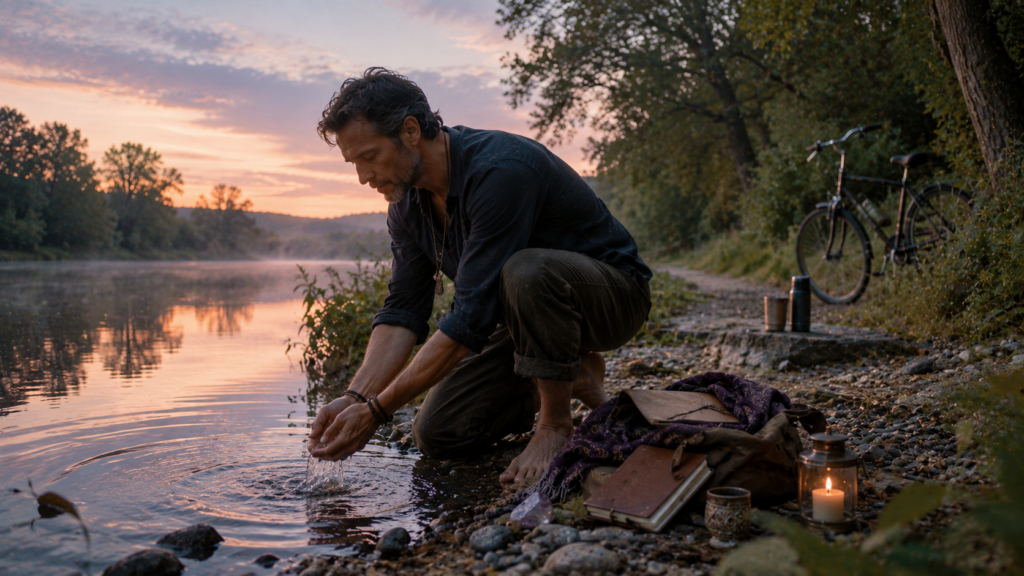
Boundaries become especially important when spirituality is built around responsiveness. If every coincidence might be a message, every unexpected thought might belong to a spirit, every emotional shift might be someone else’s energy, and every unusual dream requires interpretation, ordinary experience can become crowded very quickly.
Discernment includes being able to say no.
Not every impression needs a divination session. Not every dream requires decoding. Not every presence needs engagement. Not every invitation—human or spiritual—deserves acceptance. Sometimes the appropriate response to a strange experience is to make a note of it and continue with the day.
This is also where personal boundaries and spiritual boundaries begin to resemble one another. We learn what we permit into our homes, attention, emotional lives, intimate relationships, working spaces, and ritual environments. A boundary does not have to arise from fear. It can simply express the fact that access to us is not unlimited.
Protection belongs within that larger ecology. It does not have to mean assuming that invisible danger is everywhere. MCC’s Protection Magic material emphasizes layered protection, clear boundaries, preparation, and stable relationships rather than treating every unseen presence as hostile.
For post-religious seekers, that can be an important shift. Spiritual openness is frequently presented as an uncomplicated virtue, but openness without selection is simply permeability. Mature practice includes the ability to receive, evaluate, refuse, cleanse, close, and return.
Opening, Working & Closing
A spiritual practice does not need an elaborate opening and closing ceremony. What matters is learning how to enter intentionally and return intentionally.
Ground Before You Reach
Notice your physical state before interpreting spiritual impressions. Hunger, exhaustion, anxiety, excitement, grief, substances, stress, and expectation can all shape perception. Grounding does not disprove spiritual experience; it gives us a steadier place from which to encounter it.
Decide What You Are Actually Opening To
“I am open to anything” is rarely necessary. Prayer, meditation, divination, spirit work, and magical practice can all be approached with intention and limits. Naming the purpose of a practice can help prevent curiosity from becoming indiscriminate invitation.
Cleanse Without Becoming Afraid of Everything
Cleansing can mark transition, release emotional residue, reset a working space, or help the practitioner feel settled again. Water, sound, smoke where appropriate, salt, sweeping, bathing, fresh air, prayer, or simple physical cleaning may all serve. Hygiene is maintenance, not evidence that something terrible must have happened.
Close the Practice
Thank what was intentionally engaged where appropriate, end the divination, extinguish or safely tend candles, put tools away, record what matters, release the working, and let the session be finished. A clear ending helps prevent the rest of the day from becoming an extension of the ritual.
Return to Ordinary Life
Eat something, drink water, shower, walk, talk to someone, tend the garden, wash dishes, care for an animal, go to work, or simply rest. Ordinary life is not what spiritual practice takes us away from. It is where practice eventually has to live.
The goal is not to make spiritual practice rigid. It is to make it sustainable. A person who knows how to close a session can explore more confidently because they do not have to treat every experience as something that must remain active forever.
Openness has value. So does a door that closes.
For deeper MCC guidance on maintaining a practice that can open, protect, cleanse, set boundaries, and return safely:
One of the great promises of post-religious spirituality is that nobody has to stand between the individual and the sacred. A person can meditate, pray, perform ritual, study, seek mystical experience, work with divination, or simply sit beneath a tree without first receiving permission from an institution.
That freedom has real value. It also changes the social structure around spiritual life.
Religions and established traditions do more than tell people what to believe. At their best, they preserve memory, train teachers, create shared ritual, gather people through births and deaths, maintain calendars and customs, care for members in crisis, and provide communities that may continue long after the enthusiasm of any particular individual has faded. None of that excuses abuse or bad authority, but it helps explain why leaving an institution can mean losing more than doctrine.
Post-religious spirituality often replaces formal community with something looser: friends who share an interest, a yoga studio, an online group, a meditation circle, a favorite reader, a social-media community, a spiritual teacher, or a handful of people who meet when they feel called to do so. Sometimes those relationships become deep and enduring. Sometimes they remain temporary, organized more around shared interests than shared responsibility.
There is nothing automatically inferior about an informal community. A small circle of people who genuinely know one another can offer more care than a large institution in which nobody notices when someone disappears. But community becomes meaningful through more than proximity. It grows through reliability, memory, disagreement, repair, shared work, and the willingness to remain present when the experience is no longer exciting.
That last part matters.
Spiritual communities are easy to enjoy when everyone feels inspired. Their real character often appears when someone is grieving, ill, struggling financially, questioning a belief, making a mistake, becoming difficult, or simply needing help that cannot be delivered through an inspirational quote or a group meditation.
A community does not need elaborate hierarchy to develop depth.
It does need people who show up.
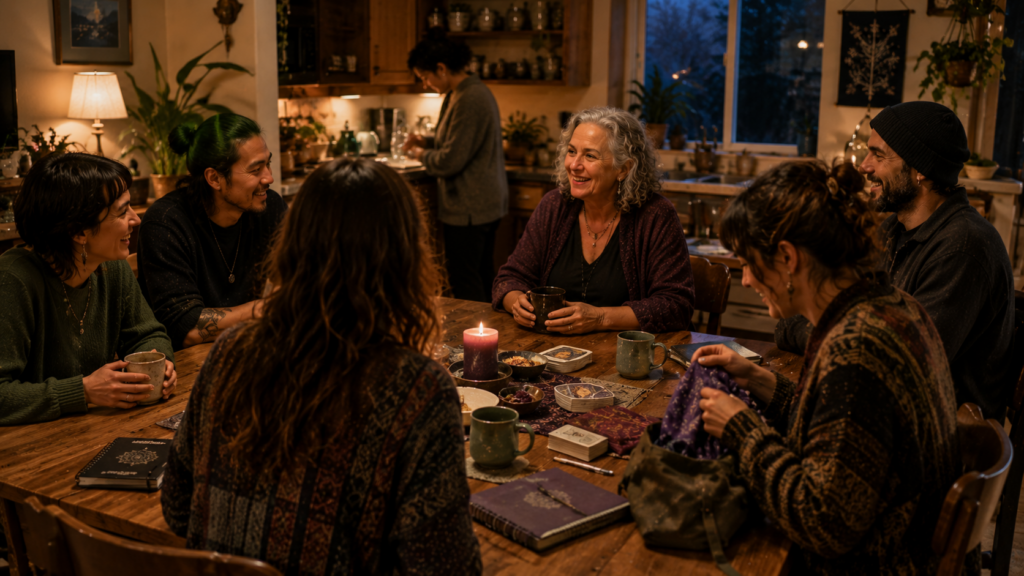
The question of authority also becomes more complicated outside institutions.
Leaving formal religion does not make authority disappear. It often makes authority less visible.
A person who would never accept a priest telling them what God wants may nevertheless reorganize their life around the statements of a spiritual influencer. Someone suspicious of religious doctrine may treat every pronouncement from a favorite channeler as revelation. A seeker who values personal freedom may pay a coach to explain what their higher self “really wants,” or repeatedly consult a tarot reader until the reader has effectively become responsible for decisions the client is afraid to make alone.
Even intuition itself can become an authority structure.
Trusting ourselves is important, particularly for people who have spent years being taught to distrust their own perceptions. But there is a difference between listening seriously to intuition and declaring intuition incapable of error. Human beings interpret experience through memory, emotion, expectation, fear, desire, culture, and habit. Sometimes what feels like certainty is insight. Sometimes it is simply certainty.
This is why healthy authority is not only about who gets to speak. It is also about whether a person, teacher, community, or tradition can be questioned.
Good teachers can say I don’t know. Good readers can say a message is unclear. Good communities can revise practices. Good traditions can acknowledge their own history. Good practitioners can discover that something they believed five years ago no longer seems convincing.
Accountability does not require a rigid hierarchy. It requires relationships in which feedback is possible and where disagreement does not automatically become betrayal.
Community can take many forms. Explore MCC’s own approach and some of the traditions through which witches organize practice, identity, and belonging.
Where It Overlaps With Witchcraft
The boundary between post-religious spirituality and witchcraft can be surprisingly porous. Both worlds may include candles, crystals, herbs, divination, meditation, cleansing, intention, visualization, spiritual protection, meaningful objects, altered states, work with symbols, and attention to experiences that do not fit neatly inside conventional religious categories.
For many modern witches, that overlap is part of their actual history. Someone may begin with an oracle deck, manifestation journal, crystal collection, meditation practice, astrology app, or simple cleansing ritual long before they use the word witch. What begins as personal spirituality can gradually become more deliberate as the practitioner studies correspondences, ritual structure, magical history, divination, protection, spirit relationships, traditional techniques, or the different systems through which magic has been practiced.
That does not mean post-religious spirituality is merely unfinished witchcraft. A person can use candles, meditate, keep crystals, practice divination, or believe in spiritual energy for an entire lifetime without becoming a witch. Paganism and witchcraft are not interchangeable either, and witchcraft itself can be religious, nonreligious, devotional, folkloric, ceremonial, traditional, eclectic, or highly individual depending on the practitioner.
The distinction is often found less in the object than in what the practitioner is actually doing with it.
A candle can create atmosphere, hold an intention, honor a deity, mark sacred time, or serve as part of a spell intended to produce a concrete change. Tarot can support reflection or be approached as divination. Herbs can be comforting, symbolic, medicinal where appropriate, devotional, or deliberately incorporated into magical technique. The same physical tool can belong to very different kinds of practice.
From an MCC perspective, developed witchcraft usually asks more than what do I want? or what feels spiritually meaningful? It asks how the work is constructed, what forces or relationships are involved, what correspondences and timing are appropriate, what protections or boundaries are needed, what tradition or experience informs the method, and what actually happened afterward.
That is why manifestation can overlap with magic without exhausting it. Focused intention and directed will matter, but witchcraft turns those capacities into craft through technique, knowledge, repetition, material action, relationship, and the willingness to examine results.

Shared Territory, Different Practice
The same tools and techniques can appear in both worlds. What changes is often the framework, depth, purpose, and relationship in which they are used.
Common Ground
Meditation, visualization, candles, crystals, herbs, divination, cleansing, protection, intention, meaningful objects, astrology, spiritual experiences, work with symbols, and attention to place or synchronicity can all appear in post-religious spirituality and in witchcraft. None of those practices alone determines someone’s path.
Where Witchcraft Often Deepens
Witchcraft commonly develops through technique, magical correspondences, repeated practice, ritual structure, divination used to guide workings, protection and spiritual hygiene, relationships with spirits or deities where relevant, tradition or lineage where applicable, study of magical systems, and attention to whether the work actually produces results.
There is another reason the boundary can look blurry: sometimes people are practicing something very close to witchcraft while deliberately using another name for it.
The word witch still carries religious, familial, cultural, and social baggage. Someone may be comfortable telling coworkers that they meditate, use crystals, practice manifestation, burn cleansing herbs, work with energy, or pull oracle cards while being far less comfortable saying that they practice witchcraft. Others genuinely prefer the language of wellness, folk practice, metaphysical spirituality, or New Age spirituality and do not understand themselves as witches at all.
Those differences should be respected.
At the same time, the softer language sometimes provides a kind of cultural camouflage. A candle for “setting intentions” may function very much like a candle spell. A ritual bath may look remarkably like cleansing magic. A manifestation practice may employ visualization, petition, correspondences, and directed will while carefully avoiding the word spell.
There is no requirement that someone claim the identity of witch simply because another person thinks their practice looks witchy. But there is value in recognizing how much modern post-religious spirituality has inherited from magical, occult, folk, metaphysical, and witchcraft-adjacent cultures.
For people who do eventually claim the name, that recognition can feel less like abandoning one spiritual life and more like discovering a deeper vocabulary for something they had already begun.
If this overlap feels familiar, these MCC pages explore witchcraft itself, the traditions that shape it, the many forms magic can take, and the reasons some practitioners choose to keep that identity private.
A Gateway, Not a Failure
For some people, post-religious spirituality becomes a place to stay.
They build a personal practice that is thoughtful, ethical, sustaining, and sufficiently deep for the life they want to live. They meditate, observe meaningful days, work with divination or ritual, spend time in nature, cultivate wonder, care for their emotional and spiritual lives, and remain comfortable without joining a formal religion or adopting a more defined magical identity.
There is nothing incomplete about that simply because it remains personal.
Depth does not require institutional membership, and spiritual seriousness cannot be measured by how complicated someone’s vocabulary becomes. A person who practices quietly and consistently for twenty years may have a far more developed spiritual life than someone who collects elaborate titles, expensive tools, initiations, or increasingly exotic beliefs without ever learning how to integrate them.
For other people, however, this broad spiritual territory eventually begins to feel like a doorway.
A person who starts with meditation may become interested in Mysticism. Someone drawn to seasonal ritual, gods, sacred land, or pre-Christian traditions may begin exploring Paganism. A seeker who discovers that intention alone is not enough may begin studying Witchcraft, magical technique, ritual structure, and the different traditions through which magic is practiced. Someone who experiences the world as living and relational may find language for that experience through Animism.
None of those movements requires rejecting what came before.
The crystal that first made someone curious does not become embarrassing because they later study mineral correspondences or magical technique. The oracle deck that began as casual reflection does not become meaningless when the practitioner develops a more disciplined divination practice. Yoga, meditation, journaling, manifestation, or time spent asking the universe questions may remain part of someone’s spiritual life even after the framework around those practices changes considerably.
A gateway is useful because it opens somewhere. It does not become worthless once we walk through it.
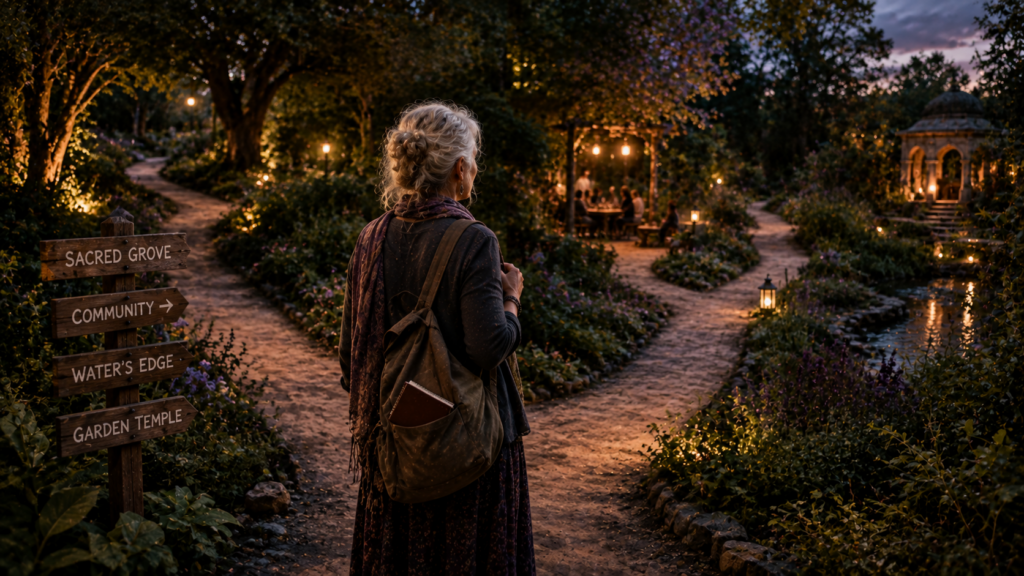
The distinction we care about is not between shallow people and advanced people. It is between shallow engagement and deep engagement, and either can occur inside almost any spiritual framework.
New Age spirituality can be studied seriously. A solitary spiritual life can develop discipline. An eclectic practice can retain context and responsibility. A person can remain spiritual but not religious while learning history, testing claims, maintaining boundaries, building community, refining technique, and allowing experience to correct assumptions.
Likewise, joining a named tradition does not automatically create depth. A Pagan can remain superficial. A witch can perform poorly constructed magic. A mystic can mistake every emotional experience for revelation. A religious institution can preserve profound wisdom while also producing people who have barely examined what they were taught.
Labels tell us something about where a person stands. They do not tell us how carefully they stand there.
What often changes when a seeker moves toward a more defined path is not simply the number of practices they perform. Relationship begins to matter differently. A deity may cease to be an interchangeable symbol and become a particular being with history, character, preferences, and traditions of devotion. A place may become more than somewhere that has “good energy” and develop into a relationship with land. Divination may stop being something pulled whenever reassurance is wanted and become a discipline with methods, limits, and accountability.
Practice acquires memory.
There are things to learn from people who came before us, things to repeat long enough to understand, and occasionally things we discover that our preferences do not get to decide.
For some seekers, that is exactly what they have been looking for. Others find that their own flexible spiritual practice already gives them the meaning, responsibility, and connection they need.
Both possibilities are legitimate.
Depth Is Not a Ladder
Post-religious spirituality does not sit on the bottom rung with witchcraft, Paganism, mysticism, or organized religion waiting above it. Any path can be approached superficially or deeply. What changes with depth is usually attention, knowledge, relationship, discipline, context, responsibility, and the willingness to keep learning.
Paths That May Open From Here
Some seekers remain comfortably in a personal spiritual practice. Others discover that a more particular path gives language and structure to something they have already begun to experience.
When Personal Spirituality Becomes a Path
A spiritual path is not necessarily a religion, and it does not have to come with a formal name. What begins to distinguish a path from a collection of practices is usually continuity. Certain things are returned to long enough that they begin shaping the practitioner rather than simply serving whatever need appeared that day.
Meditation becomes something practiced even when the session is not especially profound. Divination develops methods and limits instead of being used only when reassurance is wanted. Seasonal observances begin carrying memories from previous years. A relationship with a deity, spirit, ancestor, or place may become more particular through repeated attention. Study accumulates. Mistakes become part of experience rather than reasons to abandon the practice and replace it with the next interesting thing.
Even a highly eclectic spiritual life can develop this kind of depth.
Tradition can help because it gives a practitioner something larger than personal preference to encounter. A tradition may preserve techniques, stories, ritual forms, ethics, correspondences, or ways of understanding experience that have been refined over time. But tradition does not have to mean surrendering judgment, and depth does not require claiming a lineage a person does not actually possess. Sometimes a practitioner follows an inherited path. Sometimes they build carefully from several sources and remain honest about what they have combined.
Study becomes increasingly important because familiarity is not the same as understanding. A person may have burned herbs for years without knowing where a particular practice originated, worked with a deity primarily through modern material without encountering older sources, or repeated a magical correspondence that entered circulation only recently. Learning more does not invalidate earlier practice. It gives the practitioner more choices about what to keep, revise, deepen, or leave behind.
Ethics also becomes less abstract when practice continues over time. Questions about consent, responsibility, secrecy, power, cultural context, spirit relationships, magical consequences, teachers, money, and community eventually stop being hypothetical. The practitioner has to decide not simply what they can do, but what kind of practitioner they intend to become.
For some paths, community or initiation becomes part of that development. A coven, order, temple, lineage, study circle, or other group may carry teachings that cannot be reproduced simply by reading about them alone. Initiation can mark a genuine change in relationship and responsibility within traditions that use it. But it is not a universal measure of spiritual maturity, and many serious practitioners follow paths where initiation is irrelevant.
What matters is that the spiritual life gradually develops memory, structure, relationship, and accountability.
A path also begins to have boundaries of its own. The practitioner does not have to adopt every practice that appears interesting, follow every spiritual trend, work with every deity who catches their attention, or interpret every new idea as something missing from their current practice. Depth often comes from remaining with something long enough for the less glamorous parts to appear.
That may be one of the largest differences between spiritual exploration and sustained practice. Exploration asks what is possible. A path gradually asks what we are willing to return to, learn from, care for, and become responsible to.
A Practice With Memory
A path begins to take shape when practice carries something forward: knowledge from earlier work, relationships that continue, rituals that deepen through repetition, ethical decisions that matter again later, and experiences that are remembered rather than constantly replaced. Depth is often less about adding more and more about learning what deserves to remain.
For someone who remains spiritual but not religious, this may be all the structure they ever want. For another person, the same process may lead naturally toward witchcraft, mysticism, Paganism, an initiatory tradition, or another spiritual community. Either way, the important change is not the adoption of a more impressive label. It is the movement from sampling spiritual life to participating in it over time.
If exploration is beginning to feel like a path, these MCC pages can help with choosing direction, understanding traditions, and building a stronger foundation for continued study.
Sources & Further Reading
Post-religious spirituality is a broad and evolving subject, and no short reading list can represent every community, practice, or interpretation found within it. The sources below offer useful starting points for understanding spiritual-but-not-religious identity, the history of New Age spirituality, manifestation and positive-thinking culture, spiritual bypassing, conspirituality, and some of the psychological processes that shape how repeated ideas become familiar and authoritative.
We have included both sympathetic studies and critical works. That balance matters. Understanding a spiritual culture means taking seriously what people find meaningful within it while remaining willing to examine its history, assumptions, and consequences.
Sources Behind This Page
Open a section for books, research, surveys, and primary material related to the major themes explored on this page.
Spiritual but Not Religious & Post-Religious Spirituality
Survey-based research useful for understanding who identifies as spiritual but not religious, as well as the beliefs, practices, experiences, and patterns found within that population.
A sustained study of people who identify as spiritual but not religious and the beliefs, questions, experiences, and identities found behind that broad description.
A contemporary scholarly treatment of the rise of individualized spirituality and the social world surrounding spiritual-but-not-religious identity.
A foundational study of personal religious experience that remains useful when thinking about spiritual life occurring beyond formal institutions.
New Age History, Belief & Modern Spirituality
A concise modern academic overview of New Age history, beliefs, practices, diversity, and social organization.
An important scholarly study of New Age religion and its historical relationship to Western esoteric and modern spiritual currents.
A collection examining New Age and holistic spirituality as forms of lived religion, including healing, divination, meditation, spiritual experience, gods, spirits, and contemporary practice.
Manifestation, Positive Thinking & Spiritual Bypassing
A primary text for understanding the enormously influential modern manifestation and Law of Attraction culture discussed on this page.
A critical examination of positive-thinking culture and the problems that arise when optimism becomes an explanation for success, failure, illness, prosperity, and personal responsibility.
Welwood’s work brings psychological and spiritual development into conversation and provides important background for understanding spiritual bypassing.
Repetition, Misinformation & Conspirituality
A broad review of research into the tendency for repeated information to become more believable through familiarity, relevant to the discussion of repeated online spiritual claims becoming accepted as common knowledge.
The influential scholarly article that introduced the term conspirituality for the overlap between alternative spirituality and conspiratorial worldviews.
For broader MCC reading paths, research guidance, source texts, recommended materials, and ways to deepen study beyond this page:
Study, Practice & Resources
Freedom With Discernment
Post-religious spirituality begins, for many people, with a remarkably simple discovery: I am allowed to seek.
That permission can change a life. It allows someone to ask spiritual questions without first knowing the approved answers, to experiment with practices that make the sacred feel present again, and to build a spiritual life that fits more honestly than one inherited by accident or obligation. It can return ritual to the home, contemplation to ordinary days, wonder to nature, and spiritual agency to people who may have spent years believing that someone else possessed the authority to define all of those things for them.
We do not think that freedom should be surrendered merely because it sometimes produces shallow practice, bad history, questionable products, toxic positivity, or spectacularly silly claims. Every spiritual culture develops excesses. The existence of “woo-woo” does not make every unusual experience meaningless, just as the existence of bad religion does not make every religious life empty.
The better response is discernment.
Discernment does not require us to become cynical. It asks us to remain curious enough to explore and grounded enough to ask what we are actually experiencing. It allows intuition to speak without declaring intuition infallible. It lets us use magical and spiritual language without pretending that metaphor is laboratory science. It lets traditions influence one another without insisting that they were secretly identical all along. It permits hope without blaming people for suffering when hope does not change the outcome.
It also allows spiritual practice to mature.
A crystal can remain beautiful without needing to cure cancer. A ritual can carry meaning without needing an invented ancient pedigree. Meditation can change the way someone lives without proving every metaphysical explanation attached to it. Manifestation can sharpen intention and will without turning the practitioner into the sole author of everything that happens. A new observance can become a genuine modern tradition without pretending that witches celebrated it a thousand years ago.
None of those distinctions make the spiritual world smaller.
They give us more accurate ways of understanding what is actually there.
For some people, the spiritual-but-not-religious world will remain home. They may never need a formal tradition, deity relationship, initiation, coven, church, temple, or named magical identity. Their spiritual life may remain personal, eclectic, contemplative, nature-centered, mystical, or difficult to categorize, and it can still possess depth.
Others will eventually want something more particular. They may move toward witchcraft, Paganism, mysticism, animism, a religious tradition, an initiatory path, or a community in which spiritual life develops through shared practice and responsibility. The broad freedom of post-religious spirituality may have given them the room to discover what they were actually looking for.
Neither destination proves that the earlier seeking was a mistake.
The question is not whether someone has found the correct label. It is whether their spiritual life is becoming more thoughtful, more grounded, more capable of relationship, more honest about what it knows and does not know, and less dependent on fear, fantasy, consumption, or unquestionable authority.
A mature spiritual life does not have to explain everything.
It needs enough openness to encounter mystery and enough discernment not to manufacture mystery where none is required.
That balance leaves considerable room for wonder.
And perhaps that is the best promise of post-religious spirituality: not a world in which anything we want to believe becomes true, but one in which we remain free to seek the sacred without giving up our responsibility to think.
Permission, Then Responsibility
The freedom to seek is valuable precisely because it gives us choices. Discernment is how we learn to make those choices well. We can remain open to mystery, magic, intuition, spiritual experience, and unconventional ideas while still asking where a claim came from, what it means, how it affects other people, and whether experience gives us reason to revise it.
Where to Explore Next
Post-religious spirituality can remain a path of its own or open into many others. If something on this page has given you a direction to follow, these MCC gateways offer places to continue exploring belief, practice, experience, magic, and the ways people make meaning beyond inherited religious structures.
There is no single destination beyond post-religious spirituality. Follow the subject, practice, or question that genuinely asks for more of your attention.
Paths, Traditions & Spiritual Worlds
Explore traditions and frameworks that can give spiritual experience a more particular language, history, relationship, or practice.
Belief, Experience & Interpretation
Go deeper into some of the questions that appear throughout this page: mind, personal experience, unity, skepticism, divination, and meaning.
Practice, Magic & Continued Study
If curiosity is becoming sustained practice, these pages can help you explore magical work, traditions, techniques, and deeper study.
Connect With MCC
If your questions have become more personal than a general guide can answer, you can reach out to the coven or request one of MCC’s available services.