Astrology
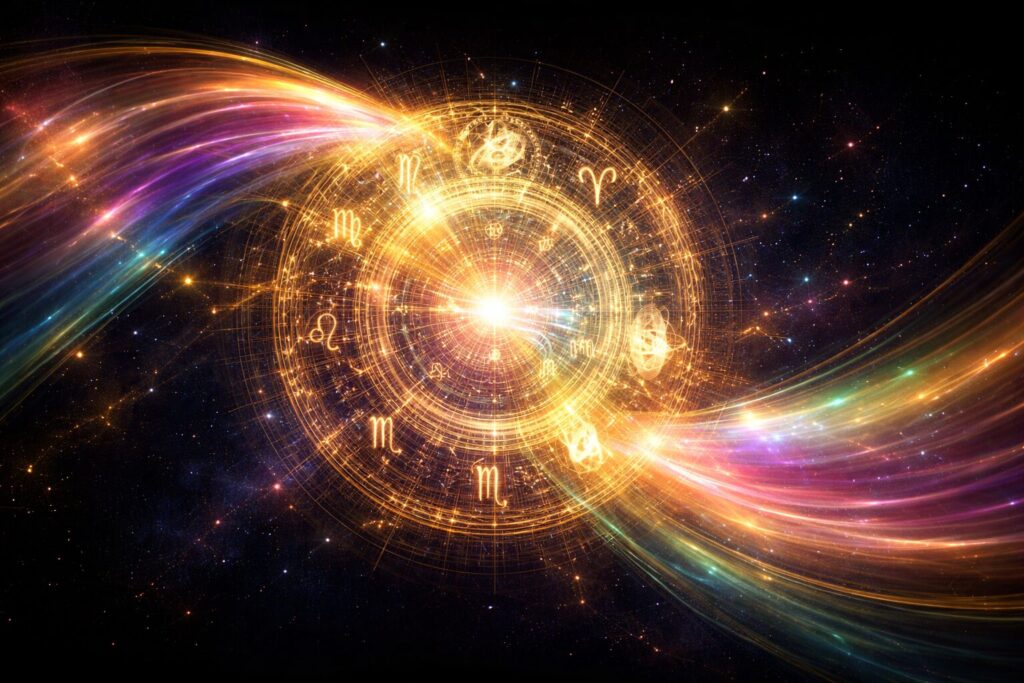
To read the stars is to read the oldest text — a script written before language, before firelight, before myth itself. Long before humankind inscribed symbols on clay or card, we lifted our eyes upward and found meaning among the lights that moved. The sky was the first oracle: vast, recurring, alive with pattern. From its turning the ancients learned rhythm, from its anomalies, omen. Astrology was thus born — not as science or superstition, but as divination in its purest form: the art of perceiving the signature of spirit within the motions of the cosmos.
At its heart, astrology is a theology of correspondence. The maxim as above, so below — Hermetic, eternal — describes its entire method. The heavens and the earth are reflections of one another, the visible and invisible woven together in a single pattern of meaning. The astrologer’s work is to interpret the relationship between celestial motion and human experience, to read the rhythm of the macrocosm within the microcosm of the soul. Every planet becomes a power, every sign a mode of expression, every aspect a dialogue between forces. The chart is not a machine of fate, but a mirror of becoming.
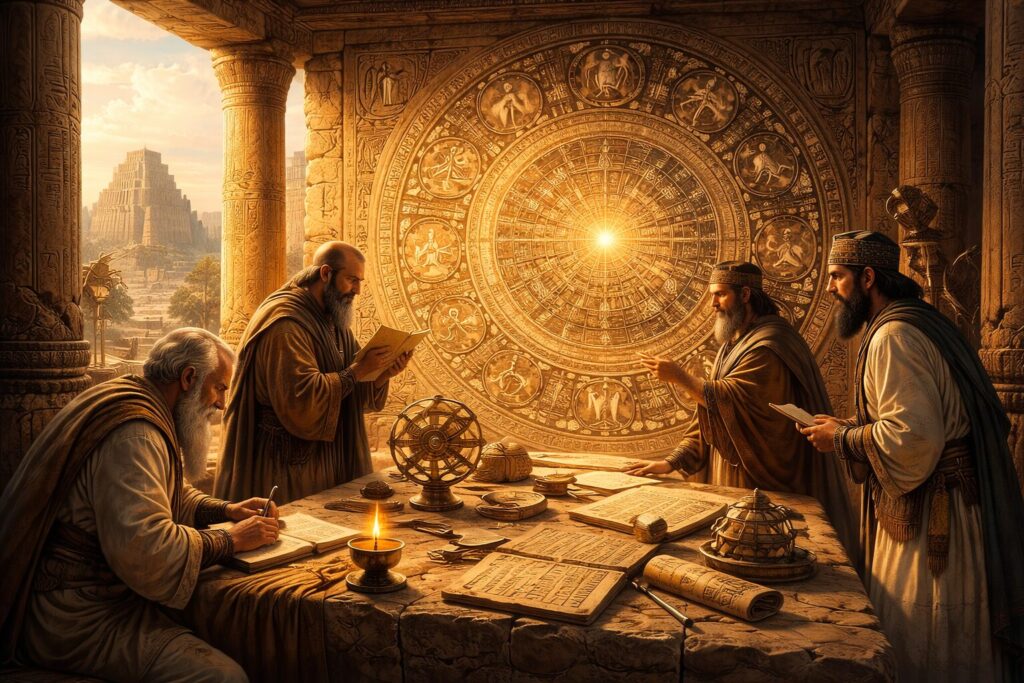
Historically, astrology has always been a divinatory art before it was a predictive one. In ancient Mesopotamia, where the practice first took shape, priests observed the heavens to discern divine will, not to calculate probability. The Babylonians saw eclipses, conjunctions, and comets as messages from the gods to the kingdom — celestial correspondences to earthly affairs. In Egypt, the movement of Sirius marked the Nile’s flood and therefore the rhythm of all life. The Greeks, refining astrology through geometry and philosophy, transformed it into a symbolic language of soul. Ptolemy’s Tetrabiblos systematized this vision: the planets became archetypes, their interplay a grammar of destiny.
Yet astrology’s greatest strength as divination lies not in its charts or tables, but in its symbolism — its capacity to reveal inner truth through outward pattern. The birth chart is not an instruction manual for the self but a mirror held to the psyche. When the astrologer interprets planetary aspects, she is not predicting inevitabilities but uncovering resonances: the moods of fate, the potential energies that shape one’s story. In this, astrology functions as revelation, not fortune-telling — it describes the climate of possibility, not the forecast of certainties.
This is where astrology aligns most closely with other divinatory arts. Like Tarot or scrying, it invites reflection rather than command; it speaks in symbols rather than absolutes. A natal chart, like a spread of cards, offers a pattern that must be read intuitively as well as intellectually. The astrologer listens not only to ephemerides and degrees, but to the subtle voice that rises through them. The stars provide the alphabet; the diviner reads the poetry that the moment composes.
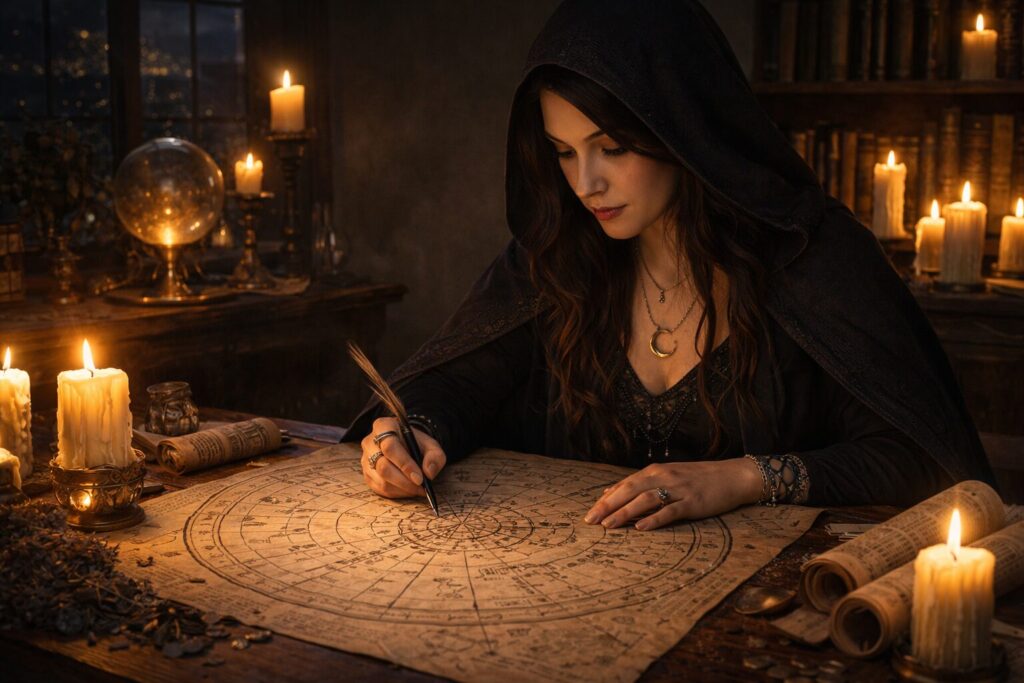
In practice, astrologers use several modes of divination, each tuned to a different kind of question. Natal astrology reveals the soul’s architecture — the divine pattern imprinted at the first breath. Horary astrology answers specific inquiries by casting a chart for the exact moment a question is asked, allowing the astrologer to interpret how the heavens respond. Electional astrology selects auspicious times for action, weaving the will of the witch with the rhythm of the cosmos. Mundane astrology reads the fate of nations, eclipses, and great conjunctions — echoes of the collective psyche written in planetary cycles. Each method seeks not control, but alignment: to act in harmony with cosmic motion rather than against it.
Within witchcraft and Wiccan practice, astrology often serves as both divinatory and ritual compass. The phases of the moon guide spellwork; planetary hours and days align the witch’s intent with the appropriate current. To cast a chart before a working is to attune one’s energy to the celestial tide — to know when the heavens are fertile, when they are still, and when they turn inward. Even beyond the technical, astrology shapes the witch’s worldview: it reminds her that magic is relational, that every act on earth participates in a larger dance above.
Yet, as with all forms of divination, astrology’s power rests not in its precision but in its poetry. Its symbols do not describe causation but correlation; they do not bind, they reflect. The planets influence only insofar as we resonate with them — not as puppets of gravity, but as participants in pattern. To treat astrology as determinism is to miss its essence. True astrological divination is contemplative: it invites the practitioner to see themselves as a node in the vast conversation of being. The chart does not predict what will occur; it reveals the way energies move through us, and how consciousness might respond.
This is also astrology’s limit — and its wisdom. It cannot foretell every event, for it is not fortune-telling in the mechanistic sense. The sky is archetypal, not literal. The same aspect may manifest as conflict or transformation, depending on the will of the soul. The stars incline; they do not compel. The diviner’s task is not to deliver decree, but to awaken awareness: to illuminate the paths that shimmer under the same constellation, and to help the seeker choose their own.
In this way, astrology occupies a unique threshold between mysticism and method. It requires discipline and calculation — the geometry of the heavens, the precision of ephemerides — yet its true insight arises in trance and intuition. The astrologer, like the witch, reads pattern through both eye and spirit. She may spend years mastering the houses and aspects, but the moment of revelation — when a chart suddenly speaks — is always an act of grace. The mathematics dissolve, and what remains is divination: that electric moment when symbol becomes soul.
Ultimately, astrology endures because it restores meaning to motion. In a world that often feels random, it offers coherence — not by controlling the future, but by sanctifying the present. To see the heavens as mirror is to remember that the divine is not elsewhere, but everywhere. Each rising moon, each retrograde, each eclipse is an echo of our own becoming.
Astrology, when practiced as divination, is thus not about prediction but participation. It is the art of standing between heaven and earth and recognizing the conversation already taking place. To read the chart is to read the moment — to understand that every breath is timed to a cosmic rhythm, and every soul, like every star, burns according to its own mysterious geometry.
And so the astrologer looks upward, not to escape the world, but to enter it more deeply — to hear, in the silence between constellations, the whisper of the infinite saying: As above, so below; as within, so without.
Explore Astrology
Astrology unfolds across several layers: symbolic, technical, and ritual. Whether you are seeking archetypal insight, structural understanding, or practical application in the craft, each path offers a different doorway into the same celestial language.
History in Brief
𒀭Mesopotamia — the sky as divine message
Astrology begins in the temple observatories of ancient Mesopotamia, where priest-astronomers recorded celestial motion with extraordinary discipline. The heavens were treated as a public text written by the gods. Eclipses, comets, and planetary anomalies were interpreted as messages about harvests, wars, and the stability of kingship.
The omen series Enūma Anu Enlil represents one of humanity’s earliest systematic attempts to correlate celestial patterns with earthly consequences. Astrology here is already historical science, theology, and governance intertwined. Later figures such as Berosus helped transmit this knowledge into the Greek world.
ΔHellenistic synthesis — symbolic language of soul
Greek philosophers inherited Babylonian sky lore and fused it with geometry and metaphysics. The birth chart emerges as a diagram of the individual psyche. The architecture of modern astrology — zodiac, houses, aspects — crystallizes in this era.
The Tetrabiblos of Ptolemy presents astrology as rational symbolic science, while Vettius Valens preserves practical craft rooted in lived observation.
☉Medieval & Renaissance — learned craft
Astrology flourishes in Arabic scholarship and later European universities. Thinkers like Al-Biruni and Abu Maʿshar expand technique and preserve classical sources. Astrology becomes medical tool, agricultural guide, and philosophical debate.
⚙Enlightenment — critique and transformation
Scientific modernity challenges astrology’s authority. Figures like Johannes Kepler straddle both worlds — astronomer and astrologer — seeking reform rather than rejection. Astrology survives by shifting toward symbolism rather than mechanical causation.
✧Modern revival — psychology and archetype
Twentieth-century astrologers such as Dane Rudhyar, Liz Greene, and Stephen Arroyo reinterpret astrology through psychology and depth symbolism. The chart becomes a mirror of inner life rather than a decree of fate.
Mesopotamia
c. 2000–300 BCETemple astronomy and omen reading
Hellenistic
300 BCE–500 CEBirth of natal astrology
Medieval
500–1500Arabic & European scholarship
Enlightenment
1500–1900Critique and transformation
Modern Revival
1900–presentPsychological astrology
How Astrology Works
Astrology is a symbolic system built on correspondence. It does not claim that planets “force” events the way a lever moves a stone. It claims something subtler: that recurring celestial patterns correlate with recurring patterns in experience, psyche, and time. The chart is a map of relationships—between powers, modes, and angles— that can be interpreted as a meaningful story.
Functions and drives: how energy moves, initiates, resists, desires, and transforms.
Style and expression: how energy speaks—its tone, temperament, and symbolic “accent.”
Life arenas: where the pattern shows up—work, love, selfhood, home, community, and more.
Relationships and tension: how energies dialogue—supporting, challenging, and shaping one another.
In divinatory practice, astrology reads the climate of a moment: the kinds of pressure, openness, and possibility that are present. Two people may live the same transit very differently—because the chart is not a command, but a mirror. The value is awareness: naming what is active so we can respond with intention.
This is why astrology belongs beside Tarot and other symbolic arts. It invites reflection, pattern-recognition, and ethical choice—rather than mechanical certainty.
MCC note: belief, discipline, and discernment
MCC treats astrology as a real divinatory language—useful, resonant, and often uncannily accurate when practiced with skill. But we do not treat it as infallible or as a substitute for thought. We read charts the way we read symbols: with study, with intuition, and with humility.
We reject deterministic readings. The stars describe conditions and tendencies, not cages. Astrology is most honest when it helps a person see their patterns clearly, and most dangerous when it is used to outsource responsibility. The chart can illuminate the road; it cannot walk it for you.

Astrology today occupies a strange and revealing place in popular culture. It is everywhere and nowhere: printed in newspapers, embedded in memes, debated in academic circles, and whispered between friends as shorthand for temperament and desire. Pop astrology often reduces the art to personality tags and daily predictions, yet even this simplified form reveals something important—the human hunger for pattern has not disappeared.
What survives in popular astrology is not technical rigor but symbolic intuition. People recognize themselves in archetype long before they learn terminology. While serious practice requires more discipline than social media horoscopes suggest, the popularity of astrology signals a persistent truth: modern people still seek a language that connects inner experience to cosmic order.
For practitioners, the task is not to sneer at pop culture nor to mistake it for mastery, but to treat it as a doorway. Many begin with entertainment and arrive, through curiosity, at contemplation. The deeper art remains available to anyone willing to study.
Modern astrology did not emerge from nowhere; it was rebuilt in the twentieth century by thinkers who treated it as a symbolic discipline rather than a superstition. Writers like Dane Rudhyar reframed astrology through psychology and philosophy, arguing that charts describe the unfolding of a person rather than a fixed fate — a view articulated most clearly in The Astrology of Personality. Liz Greene, blending Jungian analysis with traditional technique, helped establish astrology as a language of archetype and depth psychology, especially in works like The Astrology of Fate. Stephen Arroyo emphasized energy, temperament, and lived experience, making astrology readable without stripping its complexity in foundational surveys such as Astrology, Psychology, and the Four Elements. Richard Tarnas extended the conversation into cultural history in Cosmos and Psyche, proposing that planetary cycles echo through eras as well as individuals.
These authors do not agree on every detail, but they share a conviction: astrology is meaningful when practiced thoughtfully. For readers seeking a strong foundation, their books function less as rulebooks and more as frameworks for perception. A good astrology text does not tell you what to think — it trains you how to see.
Resources
Modern astrology was shaped by twentieth-century thinkers who treated the art as a symbolic discipline rather than a superstition. Dane Rudhyar reframed astrology through philosophy and psychology, Liz Greene brought Jungian depth to chart interpretation, Stephen Arroyo emphasized lived energy and temperament, and Richard Tarnas extended astrological thinking into cultural history. While their approaches differ, they share a serious conviction: astrology becomes meaningful when practiced with study, reflection, and intellectual honesty.
Their work functions less as rulebooks and more as training in perception. A strong astrology text does not dictate belief—it teaches the reader how to observe pattern. For anyone seeking a modern foundation that is both scholarly and spiritually literate, these authors remain central.

Astrology endures because it speaks to a dimension of experience that pure mechanism cannot exhaust. It offers neither escape from reality nor perfect prediction, but participation in meaning. To read a chart is to pause long enough to notice that time itself has texture—that moments differ in tone, pressure, and possibility.
The heavens do not command the soul; they converse with it. Every alignment is an invitation to awareness, every cycle a reminder that change is patterned rather than chaotic. Astrology, at its best, restores dignity to timing. It teaches patience, discernment, and the art of moving with the tide instead of pretending the tide is not there.
And so the practice continues—not as superstition, not as certainty, but as a discipline of attention. To study the sky is to study relationship: between motion and meaning, symbol and choice, cosmos and consciousness. The stars remain where they have always been. The work is learning how to look.