The Liminal Arts
A Guide to Study, Practice, and Resource
Witchcraft, magic, parapsychology, and the many arts that orbit them are living, evolving traditions—shaped across centuries by study, experiment, interpretation, direct experience, and the many ways human beings have encountered mystery. This page is both a starting place and a library: a guide for those beginning their path, and a resource for those seeking deeper study, stronger discernment, and a broader view of the currents that move through magical practice.
The materials gathered here are meant to be approached with both wonder and rigor. We look to the wisdom of the ancients because it is foundational, not because the past is beyond question. Older sources can show us how others understood gods, spirits, ritual, symbol, and power; modern sources can help us read those inheritances with greater clarity, context, and care. Ancient does not automatically mean expert, complete, or universally applicable—but it often reveals roots that still matter.
No single tradition, author, teacher, or text can speak for the whole of magic. This is a field shaped by many voices: historical, cultural, experiential, intuitive, and devotional. Some sources will resonate deeply. Others will challenge, complicate, or even contradict what you think you know. That tension is not a flaw in the work; it is part of how understanding deepens. To study magic well is to learn how to read widely, think critically, listen carefully, and record what experience teaches.
If you are just beginning, begin simply. Start with the guided sections below before moving into the deeper resource library. If you are already well along the path, use this page as a research companion: a place to compare sources, revisit foundations, and continue sharpening both knowledge and practice. In the end, this page is not the territory itself. It is a set of pathways into it.
Where Do I Begin?
Beginning in magic does not require perfection, special tools, or complete certainty. It requires attention, curiosity, and a willingness to learn. Start with one path below. You do not need to follow all of them at once.
🕯️ Start Your Practice
Begin with simple acts: observation, intention, grounding, and awareness.
Spellwork Essentials →📚 Learn How to Research
Understand sources, methods, and how knowledge is built in magical study.
Go to Research Section →🧠 Think Critically
Discernment is part of the craft. Learn to question, verify, and evaluate.
Go to Critical Thinking →🔮 Explore Traditions
Different paths approach magic in different ways. Understanding them deepens your own.
Explore Traditions →📖 Build a Grimoire
Record your practice, insights, and experiences over time.
Grimoire / Book of Shadows →🧪 Experiment & Record
Practice becomes knowledge through repetition, observation, and reflection.
Go to Experimentation →🧙 Ask a Witch
Sometimes the best way forward is to ask. Guidance can clarify what books cannot.
Ask a Witch →How to Learn Well
Magical study is not just a matter of collecting facts or repeating what others say. It is a practice of encounter, reflection, comparison, and refinement. A healthy rhythm of study helps turn information into understanding, and experience into knowledge that can actually support your path.
Most understanding comes in layers. Return to sources over time; they often reveal more once you have lived with them.
Direct encounter matters, but so do history, context, symbol, and the accumulated insight of others.
Questioning what you find does not weaken magic. It helps you encounter it with greater depth, honesty, and care.
Magical literacy is more than familiarity with a few terms, symbols, or practices. It is the ability to read, interpret, and move responsibly through systems of meaning: ritual, symbol, myth, history, intuition, cosmology, and the many ways traditions name and encounter the unseen. To become magically literate is not simply to collect information, but to learn how different kinds of knowledge speak, where they come from, and how they shape one another.
This kind of literacy deepens practice. The more you understand how different traditions, currents, and worldviews approach spirits, gods, symbols, divination, ethics, and ritual, the better you can understand your own path. Reading broadly does not dilute practice; it often sharpens it. It helps you recognize patterns, avoid shallow synthesis, and better understand where your own assumptions begin and end.
Reading is fundamental to magical research. Not slogan-level reading, not headline-level reading, and not merely collecting quotes, correspondences, or fragments from posts and videos. Real reading asks you to sit with a source long enough for it to say more than what you expected. It asks patience, comparison, and the willingness to encounter complexity rather than flatten it. In this sense, magical literacy is part of magical maturity.
How to Research in Witchcraft
Good magical research asks not only what a source says, but what kind of source it is, how it knows what it knows, and what lens will help you understand it best.
Primary Sources
Firsthand material such as historical texts, ritual records, letters, journals, field notes, interviews, testimony, and original documents. These can bring you closer to how people actually practiced, believed, feared, interpreted, and structured their worlds. Some primary sources are not about magic on the surface, yet still reveal how a culture understood danger, devotion, taboo, morality, disorder, or the unseen. Legal records, prison documents, sermons, medical texts, and household materials often tell us what a society feared, punished, protected, or considered important.
Secondary Sources
Interpretive works such as scholarship, commentary, analysis, history, translation notes, and comparative studies. These help place primary sources in context and often make difficult material more understandable, especially when older texts are fragmentary, biased, or shaped by unfamiliar assumptions.
Experiential Sources
Direct practice, observation, intuition, gnosis, dreams, divination, and lived encounter. These can be meaningful and powerful, but are often subjective and are strongest when recorded and compared rather than treated as automatically universal.
A source can tell you more than it intends to. Even when a document is not trying to explain magic, it may still reveal what a culture emphasized, what it feared, what it considered deviant, what authorities tried to control, and what ordinary people were expected to believe or do. Read not only for explicit statements, but for pressure points, assumptions, omissions, and patterns of concern.
Historical Lens
Ask what was happening in time and place. Who wrote this, when, and under what conditions? What belonged to its world and what is being projected onto it now?
Cultural Lens
Ask what community, values, customs, and assumptions shaped the material. Respectful learning includes context, not just extraction.
Symbolic Lens
Ask what meanings, metaphors, correspondences, and patterns are at work. Many magical texts say more than one thing at once.
Practical Lens
Ask how something functions in actual practice. What does it ask you to do? What does it produce, clarify, or change?
Magical Lens
Ask what worldview is operating. What does this source assume about gods, spirits, power, fate, relationship, ritual, and the structure of reality itself?
Gnosis, Intuition, and Personal Knowing
Intuitive or revealed knowledge—often called gnosis—can be a genuine part of magical life. It should not be dismissed simply because it is personal, but neither should it be treated as beyond reflection. Personal knowing becomes more useful when you work with it carefully, respectfully, and in conversation with other forms of understanding.
Cultural respect does not mean refusing to learn from traditions other than your own. It means learning with care: understanding context, avoiding flattening or careless borrowing, and approaching other peoples’ sacred worlds with humility rather than entitlement.
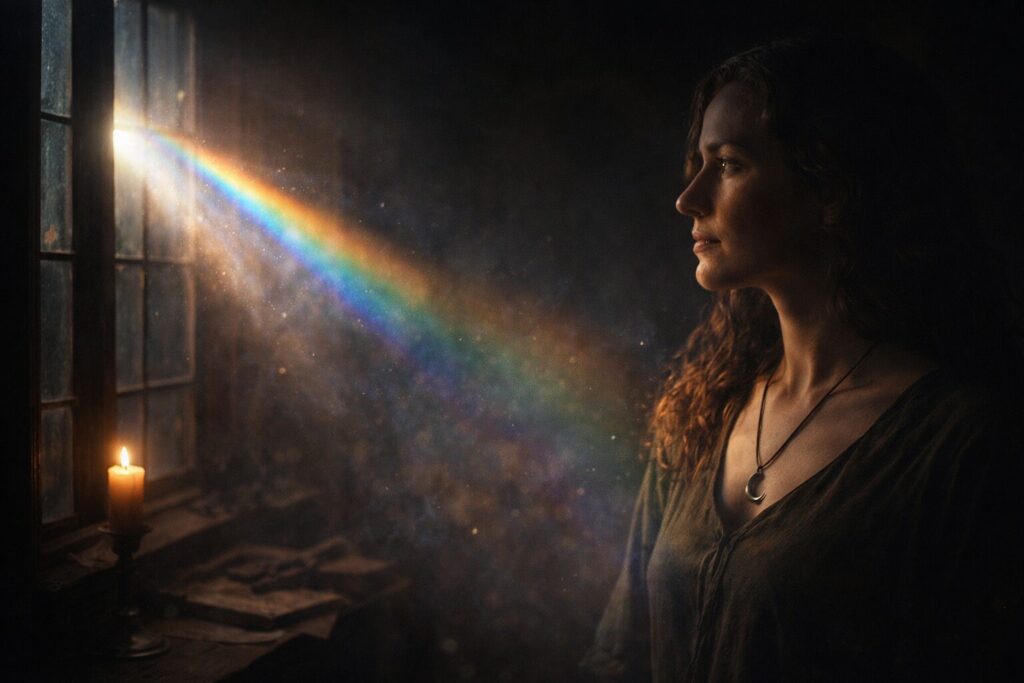
Research in witchcraft is not identical to research in other fields, though it benefits from many of the same strengths: close reading, comparison, historical awareness, and careful attention to sources. Magical study asks you to hold more than one mode of knowing at once. You may be reading folklore, theology, history, ritual instructions, visionary accounts, field notes, or your own records of experience. Each kind of source reveals something different, and each has limits.
A strong research practice does not ask you to flatten everything into one standard. It asks you to become more skillful at recognizing what kind of knowledge you are encountering, what lens may help you understand it, and how to keep experience, intuition, and study in meaningful conversation. Research, in this sense, is not opposed to magic. It is one of the ways we learn to meet it more clearly.
How to Research in Witchcraft
Good magical research asks not only what a source says, but what kind of source it is, how it knows what it knows, and what lens will help you understand it best.
Primary Sources
Firsthand material such as historical texts, ritual records, letters, journals, field notes, interviews, firsthand testimony, and original documents. These can bring you closer to how people actually practiced, believed, and interpreted their world.
Secondary Sources
Interpretive works such as scholarship, commentary, analysis, history, translation notes, and comparative studies. These help place primary sources in context and often make difficult material more understandable.
Experiential Sources
Direct practice, observation, intuition, gnosis, dreams, divination, and lived encounter. These can be meaningful and powerful, but are often subjective and are strongest when recorded and compared rather than treated as automatically universal.
Historical Lens
Ask what was happening in time and place. Who wrote this, when, and under what conditions? What belonged to its world and what is being projected onto it now?
Cultural Lens
Ask what community, values, customs, and assumptions shaped the material. Respectful learning includes context, not just extraction.
Symbolic Lens
Ask what meanings, metaphors, correspondences, and patterns are at work. Many magical texts say more than one thing at once.
Practical Lens
Ask how something functions in actual practice. What does it ask you to do? What does it produce, clarify, or change?
Magical Lens
Ask what worldview is operating. What does this source assume about gods, spirits, power, fate, relationship, ritual, and the structure of reality itself?
Gnosis, Intuition, and Personal Knowing
Intuitive or revealed knowledge—often called gnosis—can be a genuine part of magical life. It should not be dismissed simply because it is personal, but neither should it be treated as beyond reflection. Personal knowing becomes more useful when you work with it carefully, respectfully, and in conversation with other forms of understanding.
Cultural respect does not mean refusing to learn from traditions other than your own. It means learning with care: understanding context, avoiding flattening or careless borrowing, and approaching other peoples’ sacred worlds with humility rather than entitlement.
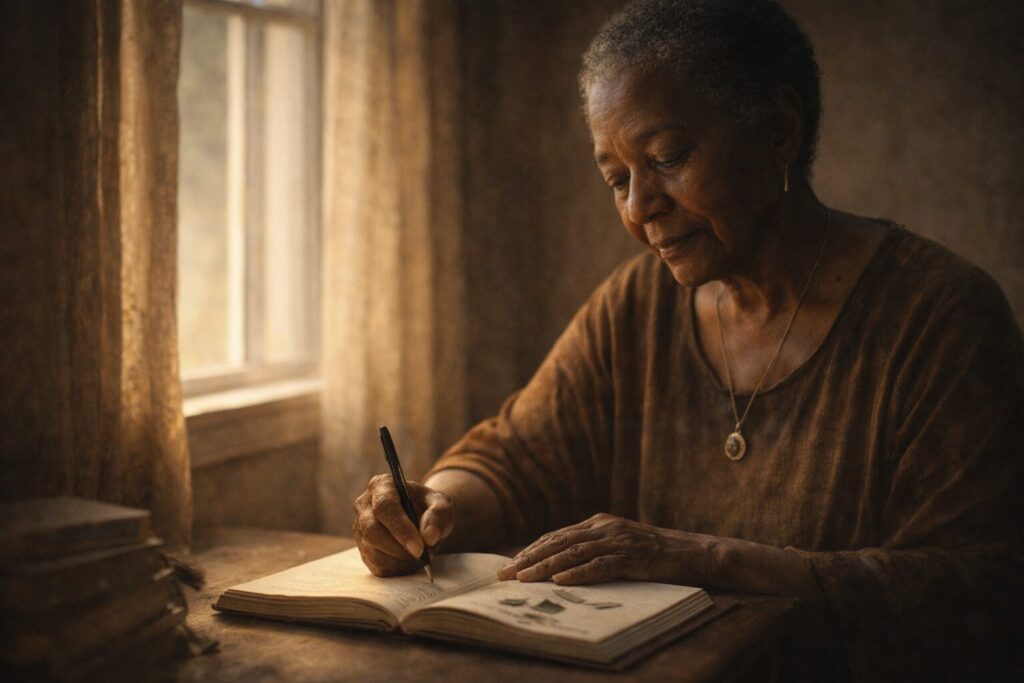
Critical thinking is not opposed to magic. It is part of how magical maturity develops. Discernment does not require cynicism, nor does belief require gullibility. We hold that magic exists and works regardless of whether any individual believes in it, and that gods, spirits, and currents do not depend on human belief in order to be real. Belief may shape how someone encounters, interprets, or responds to those realities, but it is not their engine.
Because of this, magical study requires seriousness. Not every repeated claim is true. Not every aesthetic presentation carries knowledge. Not every teacher is trustworthy. Not every old idea is wise, and not every new one is shallow—but both must be examined. To think critically in magic is to ask better questions, notice patterns of distortion, and protect wonder from manipulation, confusion, and performance.
Critical Thinking, Discernment, and Misinformation
Discernment is one of the tools of the craft. It helps you protect practice from confusion, manipulation, shallow repetition, and the false authority of things that only sound profound.
Belief is not the engine
Magic, spirits, and gods do not run on human belief. Belief may shape how a person encounters or interprets them, but it does not create them.
Discernment is not cynicism
Questioning a claim does not weaken magic. It helps distinguish depth from confusion, sincerity from performance, and pattern from projection.
Repetition is not proof
A claim repeated across posts, videos, or communities may still be unsourced, distorted, or simply wrong. Circulation is not the same thing as truth.
Aesthetic is not authority
Atmosphere, confidence, and symbolic styling can feel convincing. They are not substitutes for clarity, ethics, experience, or grounded knowledge.
Questions to Ask a Source
- Who is saying this, and from what position or tradition?
- Where does this claim come from?
- Is it sourced, contextualized, or simply repeated?
- What is the source trying to do: inform, persuade, sell, inspire, provoke?
- Is this a symbolic claim, a historical claim, a practical claim, or an experiential one?
- Does it align with anything else you have encountered, or does it stand alone?
- Can this be tested, compared, or better contextualized?
Common Distortions
- Meme-level “facts” detached from source or context
- Misattributed folklore or invented “ancient” claims
- Cultural flattening and oversimplified borrowing
- Confusing personal gnosis with universal truth
- Presenting confidence as proof of authority
- Turning complex traditions into quick-consumption content
Meme Culture, Surface Knowledge, and the Problem of Fast Mysticism
In magical communities, misinformation often spreads in attractive forms: short posts, dramatic claims, aesthetic videos, bite-sized correspondences, or confident declarations presented without history, context, or method. These forms are not useless, but they are incomplete. Headline-level knowledge can make a person feel informed while leaving them unable to explain where an idea came from, what tradition shaped it, or whether it can bear any real weight.
Serious magical research requires more than collecting fragments. Read the full text where you can. Sit with contradiction. Notice tone, agenda, omission, and context. A source becomes more useful when you understand not just what it says, but what world it came from and what kind of truth it is trying to communicate.
Traditions and Approaches
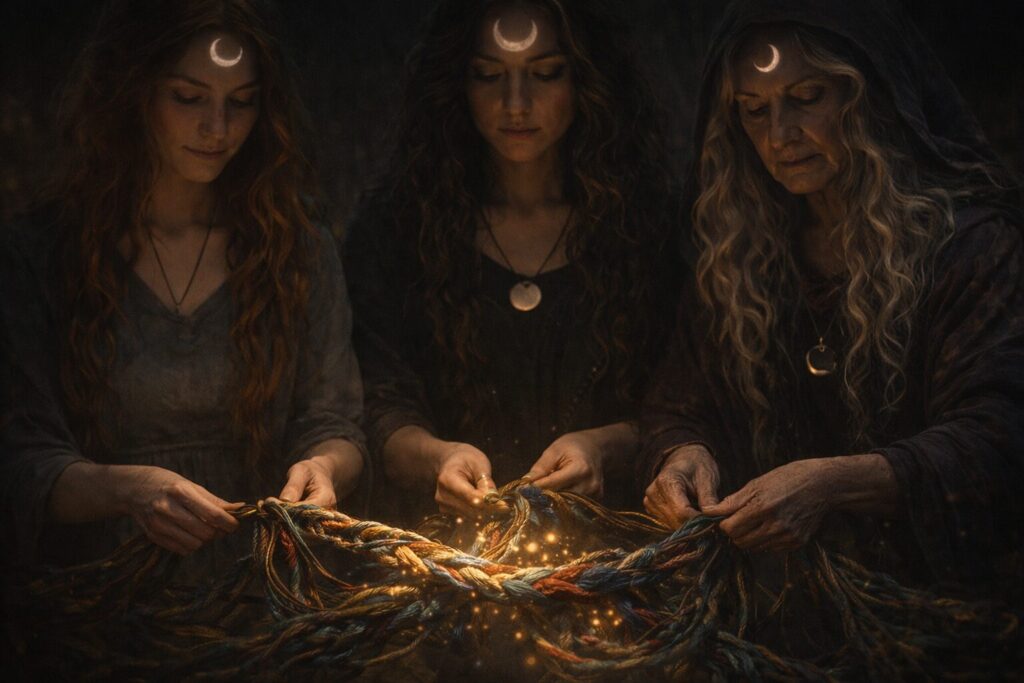
There is no single path through magic. Different traditions carry different histories, methods, cosmologies, and relationships to gods, spirits, and practice. Understanding these approaches does not weaken your path—it helps you recognize what you are doing, where it comes from, and how it differs from others.
Wicca Reading →
The wisdom of the ancients is foundational—but not infallible. Ancient sources show how people encountered gods, spirits, ritual, and meaning in their time. They are not always complete, unified, or directly transferable into the present without thought and adaptation.
Reconstructed Practice →
This approach requires care. Connections should be explored with awareness of context, not forced into sameness. Synchronism is strongest when it deepens understanding rather than flattening difference.
Explore Synchronism →
Understanding these neighboring spaces can help clarify both overlap and distinction. Not everything that uses similar language comes from the same tradition, carries the same assumptions, or operates in the same way.
Explore Adjacent Belief →

Beginning research in witchcraft is not only about what you read, but where you begin. Many foundational texts are historically important but difficult, fragmentary, or shaped by contexts that are not immediately clear to modern readers. For this reason, beginners are often better served by starting with reputable modern works that provide structure, language, and orientation before moving into older material.
We look to the wisdom of the ancients because it is foundational, not because it is complete or beyond question. Historical texts show us how others encountered gods, spirits, ritual, and meaning in their own time. They are not always unified, accessible, or directly transferable without interpretation. Modern works can help bridge that gap, providing context, translation, and clarity that make deeper study possible.
The selections below are starting points—reputable, widely respected, and useful for building a grounded understanding before moving into the larger research library.
Beginner Research Library
Start with clear, reputable works that provide structure and context. Build your foundation before moving into more difficult or fragmented historical material.
Modern Foundations
A widely respected entry point into modern Wiccan practice. Clear, approachable, and structured for beginners.
An influential modern text blending ritual, spirituality, and ecological awareness within contemporary witchcraft.
A clear introduction to initiatory traditions and how coven-based Wicca operates in practice.
Historical & Foundational Texts
Historical texts are foundational, but not always easy entry points. Many are incomplete, symbolic, culturally specific, or shaped by translation. Approach them with context, patience, and comparison rather than expecting direct instruction.
A well-known ceremonial magic text. Often referenced, but best approached with historical context and supporting study.
An influential but debated text in modern witchcraft history. Important for understanding narrative and mythic development.
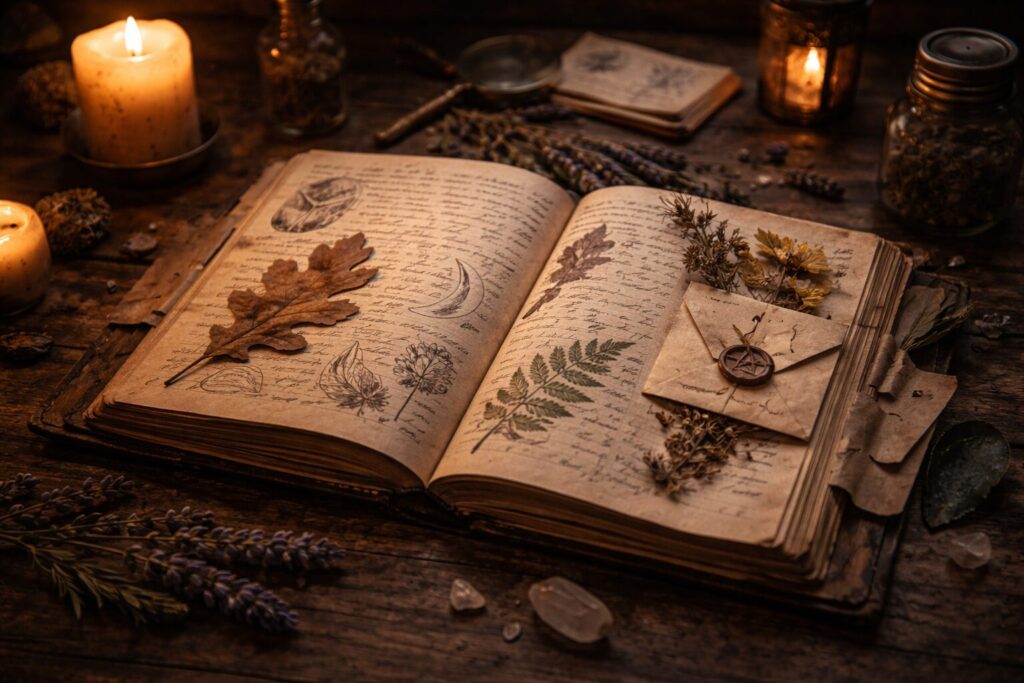
A grimoire, journal, or Book of Shadows is more than a notebook of spells. It is a record of encounter, experiment, memory, symbol, devotion, and change. It can hold what you inherit, what you learn, what you test, and what gradually becomes your own. Over time, it becomes less a static container of information and more a living record of relationship.
For many practitioners, keeping a grimoire is one of the most important ways to turn experience into knowledge. It gives form to intuition, preserves what might otherwise be forgotten, and creates a place where research, ritual, dreams, symbols, and personal gnosis can meet. A grimoire does not need to be ornate to be meaningful. It needs to be honest, usable, and returned to.
Grimoire / Book of Shadows
A grimoire is not only a place to store information. It is a place where practice becomes visible, repeatable, and personal.
What a grimoire can hold
Your grimoire may contain ritual notes, dreams, symbols, prayers, correspondences, divinatory records, reflections, historical excerpts, spell results, spirit encounters, family teachings, inherited fragments, and personal discoveries. It may be highly structured or simple and evolving. What matters most is that it helps you remember, compare, and deepen what you are learning.
What to begin recording
If you are just starting, keep it simple. Begin by recording what you actually do, what you notice, and what seems to change.
- Dates and timing
- Intentions and methods
- Symbols, dreams, or impressions
- Rituals, offerings, and divination
- Results, patterns, and later reflections

Experiment and Record
Practice becomes knowledge through observation, repetition, and reflection. Experimentation in magic does not mean carelessness. It means approaching practice with enough structure to notice what happened, what changed, and what deserves to be revisited.
When to Experiment
Experiment when you have enough grounding to observe clearly, enough patience to avoid rushing conclusions, and enough honesty to record both strong and ambiguous results. Start simple. Change one variable at a time where possible. Give yourself something real to notice.
How to Record
Write down what you did while the details are still fresh. A good record helps you separate memory from event, mood from result, and a meaningful pattern from a one-time impression. Over time, recording is what lets practice become cumulative rather than scattered.
A single experience may be meaningful, but repeated patterns carry more weight. Returning to a method over time allows you to notice what is consistent, what is circumstantial, and what may be emerging more slowly than you first realized.
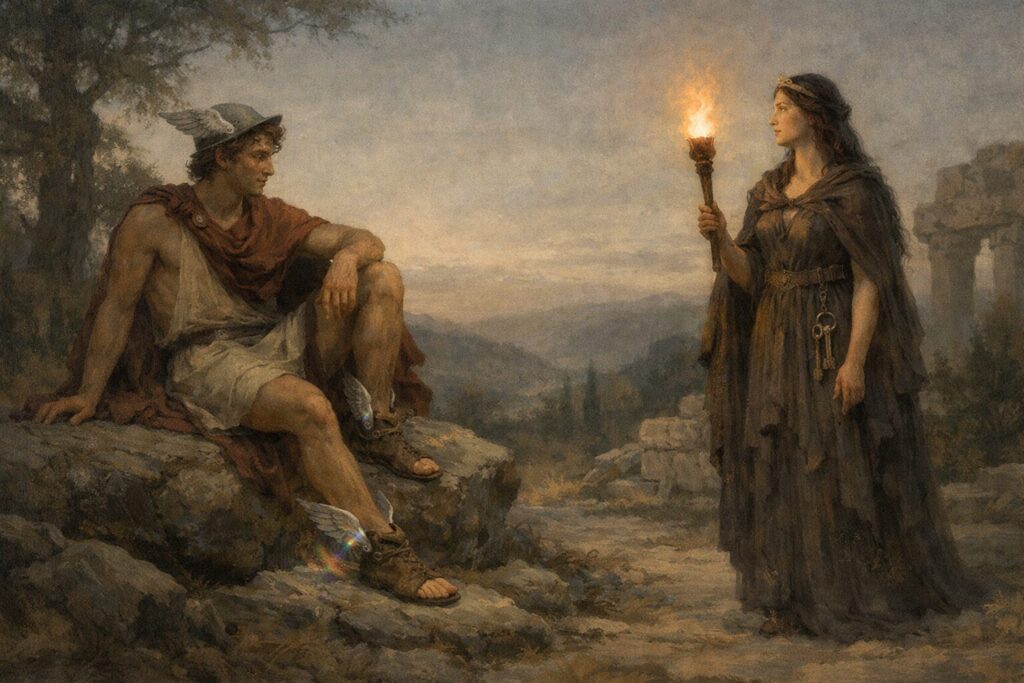
Myth, story, symbol, and sacred language are not separate from magical practice—they are some of the primary ways it is carried, preserved, and transmitted. Myths are not only narratives to be believed or dismissed. They are layered expressions of how people have understood gods, forces, relationships, morality, and the structure of the world. Folklore and tales carry memory across generations. Symbols and alphabets encode meaning in forms that can be read, worked with, and encountered in multiple ways.
To read myth well is not to take everything literally, nor to dismiss it as fiction. It is to learn how to read symbolically, comparatively, and contextually. The same is true of magical alphabets and symbolic systems: they are not only decorative, but part of how meaning is structured, communicated, and made active in practice. These sources do not always explain themselves directly. They reward patience, repetition, and attention to pattern.
Myth, Story, Symbol, and Sacred Language
These are not only stories to read—they are ways of thinking, remembering, and encountering meaning. They often speak indirectly, through pattern, symbol, and repetition rather than direct instruction.
📜 Myth
Myths encode relationships between gods, forces, and the structure of the world. They are best read symbolically and comparatively.
Encountering Myth →🜁 Lore of the Witch
Traditions carry accumulated knowledge across generations. Lore helps reveal how practices evolved and were understood.
Explore Lore →🌲 Tales & Folklore
Stories, fairy tales, and folk narratives often preserve symbolic knowledge in narrative form.
Explore Tales →🔤 Symbol & Magical Alphabets
Symbols and alphabets carry structured meaning. They can be read, worked with, and used as tools in practice.
Magical Alphabets →Read for pattern, not just plot. Compare versions of the same story. Notice repetition, inversion, symbolism, and what is emphasized or omitted. These materials often reveal more through structure than through literal statement.

Teachers, mentors, classes, and experienced practitioners can be some of the most meaningful resources in magical life. A good teacher can offer structure, context, correction, encouragement, and forms of insight that are difficult to gain from solitary reading alone. Learning from others is not a weakness; it is one of the oldest ways knowledge has ever been carried.
At the same time, magical communities can attract unhealthy authority dynamics. Some people present themselves as gatekeepers of hidden truth, masters of exclusive knowledge, or the sole legitimate voice in a tradition. Others use mystery, hierarchy, or spiritual language to gain access, loyalty, money, or control. There is an important difference between teaching someone with care and context, and withholding knowledge in order to build dependence. A healthy teacher helps you grow in discernment, not shrink beneath their certainty.
Mentors, Teachers, Gatekeeping, and Ask a Witch
Learning from others can deepen practice, but healthy guidance should lead toward greater understanding, not greater dependence.
The value of teachers
Good mentors and teachers can help clarify method, provide historical and ritual context, correct misunderstandings, and offer forms of transmission that books alone cannot always provide. Reputable classes and practitioners can be deeply worthwhile when their values, methods, and approach align with your needs and when they encourage thoughtful, ethical learning.
Why caution matters
Magical communities can also contain manipulation, gatekeeping, ego inflation, secrecy used as leverage, and false claims to exclusive authority. Mystery has a place in initiatory and devotional contexts, but secrecy used to control access, isolate students, or inflate status is a different matter altogether.
Red Flags and Cult Warnings
Teaching with care
Good teaching may unfold in stages. It may ask for preparation, context, discipline, or readiness before moving deeper. This is not the same as gatekeeping. Teaching with care is meant to protect understanding, preserve context, and help knowledge land well.
Gatekeeping as control
Gatekeeping uses access itself as power. It withholds knowledge in order to create hierarchy, maintain dependence, elevate the teacher, or prevent independent thought. If someone presents knowledge as theirs alone, or makes access itself the basis of their authority, it is often wise to go elsewhere.
How to choose teachers and classes well
- Notice whether your values and interests actually align with theirs.
- Trust your instincts when something feels coercive, inflated, or opaque in the wrong way.
- Look for teachers who welcome questions and encourage independent reading and reflection.
- Ask whether they clarify context, lineage, and method rather than only selling atmosphere or certainty.
- Remember that a good teacher helps you become more discerning, not less.
Part of the mission of the Coven of the Veiled Moon is to support access to knowledge, thoughtful inquiry, and ethical engagement with magical study. Learning should deepen understanding, not place unnecessary barriers between people and the information they need to grow with care.
Research & Study Library
This library is meant as a guided starting place for readers exploring witchcraft, modern paganism, druidry, divination, folklore, and related esoteric study. It is not exhaustive, nor is it intended as a final authority. It is designed to help newcomers begin well, and to help more experienced seekers find threads worth following.
The collection leans toward modern, accessible works while still making room for older and foundational texts. It favors sources that have remained useful over time, are frequently respected by serious readers, practitioners, teachers, or scholars, and offer substance beyond trend or sensation. Some entries are included because they are especially strong; others because they are historically influential, debated, or useful to understand in context.
Our approach is newcomer-friendly by design. You do not need to read everything here, agree with everything here, or move through it in any fixed order. Part of study is learning how traditions differ, how authors interpret evidence, and how practice grows through time. Good reading can teach through insight, disagreement, contrast, and even error—provided it is approached with care, curiosity, and comparison.
How this list was vetted: this library favors works that are well regarded over time, repeatedly recommended by serious readers, useful for study, and meaningful within their area of practice or research. We give preference to books and resources that add depth, clarity, or historical value rather than repeating weaker material.
About purchase links: suggested links are included only to make browsing easier. Readers should absolutely shop around if price, availability, or access is a concern. When possible, we encourage supporting independent booksellers, local metaphysical or occult shops, libraries, used booksellers, and small presses.
Study Pathways
These pathways are here to make the library easier to use. You can browse freely, or begin with a path that matches your interests. Some pathways point toward sections below; others are simply a gentle way to organize where to start.
🕯️ Start Here: Beginner Witchcraft
For readers who want clear, grounded introductions to modern witchcraft without being thrown immediately into dense history or highly specialized material.
- Begin with accessible modern practice-oriented books.
- Then move into folklore, ethics, and historical context.
- After that, branch into divination, ritual, or tradition-specific study.
🌿 Understanding Modern Paganism
For readers who want a broader religious and cultural frame, especially where witchcraft overlaps with neo-pagan and modern pagan currents.
- Start with broad modern pagan resources.
- Then move into Wicca and related traditions selectively.
- Use Druidry and myth sections to deepen religious context.
🌲 Druid & Nature-Based Paths
For readers drawn to pagan traditions centered on landscape, seasonal practice, poetic imagination, ecological relationship, and nature-based spirituality.
- Begin with modern druid resources.
- Add myth, folklore, and historical context carefully.
- Treat reconstruction and revival as related but not identical.
🔮 Divination & Symbolic Systems
For readers interested in tarot, symbolic interpretation, intuitive methods, and systems that sit between spiritual practice, reflection, and discipline.
- Start with one strong system rather than many at once.
- Focus on interpretation before collecting tools.
- Pair practice texts with mythic or symbolic reading.
📜 Historical & Folklore Context
For readers who want to understand where ideas come from, how traditions shift over time, and how practice differs from later retellings or idealized histories.
- Use this path to balance practice with historical grounding.
- Read folklore and anthropology alongside practitioner texts.
- Expect complexity rather than one clean lineage.
🜏 Advanced Cross-Study
For readers who already have a grounding and want to compare witchcraft, paganism, folklore, ceremonial overlap, primary sources, and research tools more seriously.
- Move between practice, scholarship, and source texts.
- Compare arguments rather than relying on one authority.
- Use debated works as context, not automatic conclusion.
Continue below through the library by section. Each later block should be placed in its own Custom HTML block directly under this one.
This section is a little different from the rest of the library. Ancient and early magical texts matter, but they do not come to us cleanly. Many survive in fragments, compilations, later manuscripts, or translations shaped by the choices of editors and translators. Even when a text is “available,” interpretation is never neutral.
We do not treat older as automatically more authentic, nor newer as automatically better. Ancient people were not less intelligent than we are; they were engaging many of the same mysteries, forces, and questions through the language, assumptions, and conditions of their own cultures. At the same time, knowledge grows, contexts shift, and modern practitioners often build from older currents rather than simply repeating them.
Historians may emphasize what the text can securely support. Practitioners often look for meaning, pattern, and continuity in use. Both approaches can be valuable. Read these works with curiosity, care, and context—and whenever possible, compare editions, translators, and companion scholarship rather than relying on a single presentation.
Greek, Late Antique, and Syncretic Magical Currents
These are among the most important surviving sources for ritual magic in the ancient Mediterranean world, especially where Egyptian, Greek, and other traditions intersect.
- Why it matters: Few collections are as important for understanding surviving ancient magical operations, divine names, spirit work, ritual materials, and cross-cultural magical practice.
- Who it may suit: Readers who already have some grounding and want direct exposure to primary material rather than modern summaries.
- Edition note: This is a translation and scholarly edition. As with any translation, choices of wording, reconstruction, and commentary affect how the material is understood.
- Use carefully: Best approached alongside context rather than as a plug-and-play manual for modern practice.
- Why it matters: Important for readers who want to understand how ritual was philosophically justified in late antiquity, especially in relation to divine presence and transformation.
- Who it may suit: Readers interested in theory, ritual worldview, and deeper philosophical underpinnings of sacred practice.
- Edition note: Translation choice matters a great deal here; some editions are far more readable and useful for contemporary readers than others.
- Why it matters: Hermetic thought shaped enormous portions of later Western esotericism, philosophy, alchemy, and magical religion.
- Who it may suit: Readers interested in worldview, metaphysics, and the spiritual imagination behind later esoteric traditions.
- Edition note: Translation and commentary strongly shape readability. Some editions are better for scholarship, others for approachability.
Medieval and Early Modern Grimoires
These texts are historically influential, often heavily mediated, and not all are equally useful for the same kind of reader. They matter as part of the record, and often as later currents shaping modern imagination.
- Why it matters: A major historical touchstone for later ceremonial magic and a key influence on many modern occult systems and assumptions about ritual form.
- Who it may suit: Best for readers with patience for manuscript history, ritual complexity, and edition comparison.
- Edition note: Editions differ greatly in quality and fidelity. Scholarly or manuscript-aware editions are preferable to sensationalized reprints.
- Why it matters: Hugely influential in later magical literature and practice, even where modern usage diverges significantly from historical context.
- Who it may suit: Readers studying historical ceremonial magic, occult revival movements, or the development of spirit catalogs and ritual authority.
- Use carefully: Important historically, but often misunderstood through modern simplification, aestheticization, or decontextualized use.
- Why it matters: One of the most influential bridge texts between classical, medieval, and later Western occult frameworks.
- Who it may suit: Readers who want to understand the architecture of correspondences and the learned magical worldview behind later occult revival movements.
- Use carefully: Dense, system-heavy, and better for study than for immediate practice unless read with patience and context.
Norse, Celtic, and Early Vernacular Materials
These are often the most romanticized areas for modern readers. They can be meaningful and important, but they require especially careful handling when modern spiritual identity, reconstruction, nationalism, or wishful certainty enters the picture.
- Why it matters: Essential for any serious engagement with Norse mythic material beyond modern paraphrase and internet simplification.
- Who it may suit: Readers interested in mythic imagination, source-based study, and pagan or comparative context.
- Edition note: Translation choice dramatically affects tone, readability, and implied certainty.
- Why it matters: Necessary for understanding how much modern knowledge of Norse myth was transmitted, framed, and preserved.
- Who it may suit: Readers pairing mythic study with caution about authorship, preservation, and historical lens.
- Use with: Best read alongside the Poetic Edda and later scholarly commentary rather than alone.
- Why it matters: Important for readers drawn to Celtic material, poetic imagination, landscape, and mythic pattern—but best approached as layered literature, not transparent ancient doctrine.
- Who it may suit: Readers interested in druid-adjacent mythic study, literary source material, and symbolic imagination.
- Edition note: Readable modern translations can make this much more approachable without pretending away the interpretive complexity.
Companion Studies for Reading Older Material Well
These are not ancient sources themselves, but they are often the difference between merely collecting old texts and actually learning from them responsibly.
- Why it matters: Helps modern readers understand revival, reinvention, and lived religious practice rather than imagining direct and unbroken access to antiquity.
- Who it may suit: Nearly everyone using this library, especially readers who want context before making big claims about lineage or continuity.
- Why it matters: Essential for understanding one of the strongest historical frameworks brought to bear on modern pagan origins and development.
- Who it may suit: Readers ready to compare historical method with practitioner narratives and living tradition.
Ancient and early sources are not here to flatten the past into certainty. They are here because they still matter: as records, as influences, as arguments, as inspirations, and as reminders that the currents modern practitioners work with did not begin yesterday. Read them with respect, but also with comparison, humility, and an eye for translation, transmission, and context.
This section leans toward modern, accessible, practice-centered works. It is not meant to define one “correct” form of witchcraft, but to offer readers a stronger starting place than trend-driven or overly diluted material. Some books here are especially beginner-friendly; others become more useful once a reader has a little grounding.
The emphasis is on works that have remained influential, useful, or respected over time. Where authors differ sharply in style or worldview, that is part of the point: comparison is one of the best ways to learn.
- Why it matters: Gives readers a grounded sense of practice and tone without rushing into inflated claims or aestheticized occult branding.
- Who it may suit: Readers looking for a serious but approachable introduction to non-Wiccan witchcraft currents.
- Why it’s useful: Especially good for people who want something practical and reflective rather than encyclopedic.
- Why it matters: Offers a living-practice approach that many readers find more grounded and relational than purely ceremonial or abstract texts.
- Who it may suit: Readers ready to move from general curiosity toward a more embodied and devotional style of practice.
- Why it’s useful: Helpful for understanding how modern practitioners build on older currents without pretending to simply replicate the past.
- Why it matters: Builds depth without losing readability, especially for readers already drawn to traditional witchcraft language and imagery.
- Who it may suit: Readers who found introductory craft material useful and want to go further into symbolism and current.
- Why it’s useful: Helps bridge practical reading and deeper initiatory or imaginal language.
- Why it matters: One of the enduring postwar books that shaped how many readers imagined practical witchcraft outside purely devotional or religion-first frameworks.
- Who it may suit: Readers interested in influential modern craft texts, especially where folk-style witchcraft and ceremonial influence meet.
- Why it’s useful: Important historically even when readers do not adopt all of its assumptions or methods.
- Why it matters: Very good at helping readers shift from passive reading into attentive, disciplined personal practice.
- Who it may suit: Beginners, returning practitioners, and readers who want something living and workable without excessive dogma.
- Why it’s useful: Especially helpful for readers who resonate with practical experimentation and relational magical worldview.
- Why it matters: Offers one of the clearest skill-building ramps for readers who need structure and exercises.
- Who it may suit: Readers who want a workbook-style beginning and benefit from practice prompts rather than broad overview alone.
- Why it’s useful: Good at building confidence early without requiring a reader to already belong to a specific tradition.
- Why it matters: Useful for readers wanting a living, adaptable practice that still retains seriousness and integrity.
- Who it may suit: Readers drawn to contemporary witchcraft but wary of superficial branding or vague spirituality.
- Why it’s useful: Makes room for creativity and individuality without abandoning discipline.
- Why it matters: Helps readers enter traditional witchcraft themes in a less intimidating way before tackling denser or older material.
- Who it may suit: New readers who want something more craft-focused than broad neo-pagan overview texts.
- Why it’s useful: Good stepping-stone text between curiosity and deeper study.
- Why it matters: Helps keep practice concrete and personal rather than purely conceptual.
- Who it may suit: Readers who want usable guidance and steady practice language.
- Why it’s useful: Works well alongside broader historical or symbolic reading.
- Why it matters: Helps prevent the library from implying that all magical practice descends from one stream or can be responsibly merged without attention to tradition and context.
- Who it may suit: Readers ready to understand overlap without erasing difference.
- Why it’s useful: Serves as a bridge into more careful comparative study rather than a one-size-fits-all category.
- Why it matters: Very useful for readers who want to understand witchcraft not only as text, but as living culture, creativity, and practice.
- Who it may suit: Readers who want strong context for how modern magical identity and communal practice actually work.
- Why it’s useful: Pairs especially well with practical books so readers can compare self-description, community life, and scholarship.
- Why it matters: Offers depth for readers who want to push beyond introductory craft books into denser magical philosophy and witchcraft worldview.
- Who it may suit: More experienced readers comfortable with symbolic and layered writing.
- Why it’s useful: Helps round out the library so it speaks to serious long-term students, not only beginners.
A good witchcraft library should do more than hand over spells or slogans. It should help readers build judgment, language, and a deeper sense of how practice is shaped by worldview, culture, relationship, and time. These works are starting points, not finish lines.
This section is for readers who want a wider frame than witchcraft alone. Modern paganism includes many overlapping religious, devotional, magical, and reconstructive currents. Not every pagan path is centered on witchcraft, and not every witchcraft path is best understood as pagan religion. That distinction matters.
These works help readers understand the shape of the modern pagan landscape: how communities formed, how older sources were reinterpreted, how revival differs from reconstruction, and how belief, ritual, identity, and practice meet in lived traditions.
- Why it matters: Few books have done more to help readers see modern paganism as lived religion rather than stereotype, rumor, or abstraction.
- Who it may suit: Almost anyone using this library, especially readers wanting one strong broad-context book before moving into narrower traditions.
- Why it’s useful: Good orientation for understanding overlap, diversity, and the social reality of modern pagan paths.
- Why it matters: Helpful for readers looking for a broad, practical introduction to pagan religion rather than a purely historical or academic treatment.
- Who it may suit: New readers unsure where paganism begins, especially those not looking first for witchcraft-specific instruction.
- Why it’s useful: Offers a readable starting place before moving toward more tradition-specific material.
- Why it matters: Helps readers understand broad pagan structures without assuming one path speaks for all.
- Who it may suit: Readers wanting something approachable and orientation-focused.
- Why it’s useful: Good bridge text between curiosity and more historically or tradition-specific study.
- Why it matters: Useful for seeing how modern paganism functions socially and imaginatively, not just textually.
- Who it may suit: Readers who want more depth than a basic introduction and appreciate ethnographic or cultural study.
- Why it’s useful: Helps balance insider practice books with outside observation and analysis.
- Why it matters: One of the most cited major studies for understanding the historical development of modern pagan witchcraft.
- Who it may suit: Readers who want to move beyond internal tradition narratives and engage serious historical argument.
- Why it’s useful: Especially valuable when read alongside practitioner accounts and living religious perspectives.
- Why it matters: Useful as a tradition-insider perspective on pagan religious life and practice.
- Who it may suit: Readers who want a more devotional or spiritual framing alongside history and anthropology.
- Why it’s useful: Helps keep the section from leaning only scholarly or external.
Modern paganism is not one thing. It is a field of overlapping traditions, revivals, reconstructions, innovations, communities, and personal paths. Reading across this breadth helps keep any one current from pretending to be the whole.
Wicca matters here because of its influence on modern witchcraft and paganism, but this section stays intentionally selective. The goal is not to duplicate a dedicated Wicca reading page, but to include a few strong entry points and historically important works so readers understand the tradition’s role and shape.
Some of these books are especially useful for beginners; others matter because of their influence on the wider landscape.
- Why it matters: For many readers, this is still one of the clearest doors into Wiccan practice and ritual rhythm.
- Who it may suit: Beginners wanting an accessible and practical Wiccan introduction.
- Why it’s useful: Important both as a teaching book and as a document of how modern solitary Wicca was popularly transmitted.
- Why it matters: Few books have had as much influence on the spiritual imagination of modern witchcraft and pagan readers.
- Who it may suit: Readers interested in ritual, sacred immanence, activism, goddess spirituality, and modern witchcraft currents.
- Why it’s useful: Even when readers do not fully share its framing, it remains an essential modern text for context and influence.
- Why it matters: Important for understanding how Wiccan forms, rites, and language became widely accessible to readers outside coven structures.
- Who it may suit: Readers who want something more historically influential and structurally detailed than beginner-only introductions.
- Why it’s useful: Useful both as a reading text and as a record of how published Wicca shaped the wider scene.
- Why it matters: Helps readers place Wicca within broader historical development instead of treating it as context-free or self-explanatory.
- Who it may suit: Readers ready to compare tradition narratives, evidence, and historical argument.
- Why it’s useful: Prevents the section from being only devotional or instructional.
This Wicca section is intentionally selective. For readers who want to go much deeper into founders, branches, and more specialized Wiccan reading, that belongs on your dedicated Wicca page. Here, the goal is orientation, influence, and a few strong starting points.
This section focuses on modern druidry and related nature-based pagan study. It is not meant to claim a simple, unbroken line from the ancient world to the present. Instead, it brings together works that help readers understand revival, inspiration, practice, landscape, mythology, and spiritual relationship in a grounded way.
Druidry especially benefits from careful reading. It often draws on older materials, poetic imagination, historical fragments, revival movements, and modern ecological or devotional practice all at once. These books are here to help readers move through that complexity thoughtfully.
- Why it matters: Gives a balanced doorway into druid practice without pretending that druidry is historically simple or culturally flat.
- Who it may suit: Readers curious about druidry, nature-based ritual, and pagan spirituality who want an approachable first book.
- Why it’s useful: Especially good for readers drawn to seasonal, landscape-based, and reflective practice.
- Why it matters: One of the more widely known modern introductions to druidry as a lived spiritual path.
- Who it may suit: Readers interested in contemplative practice, seasonal relationship, and nature-based pagan spirituality.
- Why it’s useful: Helps orient readers before they move into more historical or source-based material.
- Why it matters: Offers a version of druidry that feels personal and lived without losing seriousness.
- Who it may suit: Readers drawn to liminality, land-relationship, and quieter or solitary forms of druid-inspired practice.
- Why it’s useful: Adds texture and diversity to the druidry shelf beyond broad introductory overviews.
- Why it matters: Useful for readers who want something more formal and developmental than broad inspirational reading.
- Who it may suit: Readers who appreciate structure, curriculum-like progression, or order-based practice language.
- Why it’s useful: Helps show how modern druidry can take shape as a disciplined path rather than only a loose identity.
- Why it matters: Represents a softer, more poetic stream of druid-adjacent reading that still matters to many seekers.
- Who it may suit: Readers drawn to story, land, silence, and contemplative spiritual language.
- Why it’s useful: Helpful as a complement to more structured or historically careful texts.
- Why it matters: Helps readers encounter source-adjacent material rather than only modern paraphrase.
- Who it may suit: Readers interested in mythic imagination, literary depth, and the symbolic background of Celtic-inspired practice.
- Why it’s useful: Important when paired with modern druid reading that acknowledges transmission and interpretation.
Druidry is often strongest when approached with both imagination and restraint: open to poetry, symbol, and devotion, but careful about history, transmission, and claims of certainty. These works are meant to support that balance.
Divination belongs in a serious library because it is not only about tools—it is about symbol, pattern, interpretation, attention, and disciplined relationship with meaning. This section leans toward works that help readers read well rather than simply collect decks or keyword lists.
Tarot appears most here because of its depth and availability, but the wider purpose is to give readers a way into symbolic study that can support magical, devotional, and reflective practice.
- Why it matters: Few tarot books are as widely respected for depth, clarity, and lasting influence.
- Who it may suit: Beginners and long-time readers alike, especially those wanting more than quick-reference meanings.
- Why it’s useful: Excellent for building symbolic literacy rather than rote memorization.
- Why it matters: Encourages readers to practice, record, compare, and think rather than rely on static meanings alone.
- Who it may suit: Readers who learn best through exercises, journaling, and ongoing engagement.
- Why it’s useful: Especially good for turning tarot into a lived practice rather than a novelty skill.
- Why it matters: One of the strongest modern one-volume resources for readers who want depth and breadth together.
- Who it may suit: Readers ready for a more serious, extensive reference after learning the basics.
- Why it’s useful: Particularly valuable for building a long-term study library.
- Why it matters: Helps keep divinatory study historically aware and symbolically literate.
- Who it may suit: Readers wanting more grounding than guidebook-only tarot education provides.
- Why it’s useful: Good companion to more practice-centered tarot books.
- Why it matters: Important for readers who want to encounter tarot as a symbolic and contemplative language of great depth.
- Who it may suit: Advanced readers interested in spiritual symbolism, esoteric theology, and cross-traditional study.
- Why it’s useful: Broadens the divination section beyond how-to reading and into deeper symbolic work.
- Why it matters: Builds beyond introductory tarot reading into richer symbolic and interpretive thought.
- Who it may suit: Readers who already know the cards reasonably well and want deeper study.
- Why it’s useful: A strong continuation after Seventy-Eight Degrees of Wisdom.
- Why it matters: Keeps the divination section from collapsing into tarot alone.
- Who it may suit: Readers interested in cartomancy but wanting a different logic and structure than tarot provides.
- Why it’s useful: Encourages comparison across systems and sharper attention to method.
The strongest divination study does not rush. It pays attention to symbol, repetition, pattern, method, and experience. Good books in this area help readers become more thoughtful, not merely more certain.
Myth and symbol are not decoration—they are part of how people understand the world, the sacred, and themselves. This section supports readers in developing symbolic literacy, not just collecting stories.
- Why it matters: Helps readers see patterns rather than isolated stories.
- Use: Good foundation before deeper myth study.
Folklore and history ground practice. They help separate assumption from evidence and imagination from transmission—without diminishing either.
These resources help readers evaluate sources, understand context, and develop stronger research habits. This is where study becomes skill.
- Why it matters: Brings academic rigor into experiential topics.
This section includes materials that overlap with witchcraft and pagan study but come from broader occult traditions. Inclusion here does not imply equivalence—only relevance.
- Why it matters: Influential framework for correspondences and magical philosophy.
Overlap does not mean sameness. These materials are included to support comparison, not collapse traditions into one another.

You have likely noticed by now that there is no single path through this material. There are many voices, many systems, many interpretations, and many people speaking with confidence—sometimes with clarity, and sometimes without it. At the beginning, this can feel like a barrier. Too much information. Too many directions. Too many claims to sort through.
But this is also where the work begins to change.
What first appears as confusion often becomes pattern. What feels like contradiction begins to reveal difference. What seems overwhelming starts to organize itself as you read more carefully, compare more thoughtfully, and return to sources with greater awareness. Over time, you begin to recognize tone, intention, depth, distortion, lineage, and structure. The field does not necessarily become smaller—but it becomes more navigable.
Research is not separate from practice. It is one of the ways the path becomes clearer under your feet.
You are not expected to understand everything at once. You are not required to resolve every contradiction immediately. You are allowed to move slowly, to revisit what you have read, to change your mind, to deepen your understanding, and to let experience and study inform one another over time.
There will always be people who claim certainty, mastery, or exclusive access to truth. There will also always be those who are still learning, still questioning, still refining. You are allowed to be among the latter.
If there is a single orientation to carry forward, let it be this:
Where you go from here is not predetermined. It is something you build, piece by piece, as you continue.
“The mind is not a vessel to be filled, but a fire to be kindled.”
—Plutarch
Continue Exploring
If you are ready to go further, these pages offer practical next steps, broader frameworks, and deeper ways into the Craft. Follow the thread that feels most useful from here.