WICCA
A Pagan Religion of Ritual, Magic & Relationship
Wicca is a Pagan religion centered on ritual, magic, relationship with the sacred, and the cycles of the natural world. For many Wiccans, religion and magical practice are not separate activities. Devotion, seasonal observance, moon rites, spellcraft, meditation, symbolism, and ritual all become different ways of participating in a living spiritual world.
The religion took its recognizable organized form during the twentieth century, particularly in Britain, but it did not arise without roots. Wicca drew together much older currents of thought and practice: ritual magic, folklore, Pagan imagery, seasonal customs, ideas about sacred nature, occult philosophy, ceremonial forms, and centuries of speculation about witchcraft itself. Some of those influences are ancient, some medieval or early modern, and others comparatively recent. Wicca brought them into conversation and shaped them into something that could be practiced as a religion.
That distinction matters. Calling Wicca simply a “modern religion” can be technically correct while still obscuring more than it explains. Its organized form is comparatively young, but many of the ideas from which it grew are not. Religions have always inherited, reinterpreted, combined, and reorganized what came before them. Synthesis does not make a religion less real, nor does a tradition require an uninterrupted institutional line back to antiquity for its symbols, practices, and spiritual ideas to carry older histories.
There is also no single expression of Wicca. Some traditions are initiatory and coven-based, with teachings passed through established lines. Others developed as openly taught, eclectic, or solitary forms of practice. Wiccans may differ in theology, ritual structure, ideas about divinity, the meaning of polarity, ethics, initiation, and the degree to which magic occupies the center of religious life. What connects them is less a single creed than a recognizable family of ritual, religious, and magical ideas.
Wicca is closely connected with both Paganism and witchcraft, but the three words are not interchangeable. Wicca belongs within the wider Pagan religious landscape, while witchcraft reaches far beyond Wicca and can be practiced within many different religious or nonreligious frameworks. A person may be Wiccan and a witch, Pagan but not Wiccan, or a witch with no relationship to Wicca at all. We will look more closely at those distinctions below.
For anyone approaching Wicca for the first time, it is worth meeting the religion on its own terms before deciding what it means to you. Its history is richer than the shorthand often used to describe it, its internal diversity is greater than outsiders sometimes assume, and its influence on contemporary Paganism and witchcraft is difficult to overstate. The sections that follow offer several ways into that story: its name, its emergence, its ideas, its ritual life, its ethics, its traditions, and the ways it continues to develop.
Wicca, Wica, Wicce & Witch
The name Wicca carries more history than its modern spelling might suggest. Old English used wicca for a male practitioner of magic and wicce for a female practitioner. By Middle English, forms of these words developed into wicche, one of the linguistic ancestors of the modern English word witch. The deeper origin of the word remains uncertain, and scholars have proposed several competing explanations for it.
That older vocabulary should not be mistaken for proof that the twentieth-century religion called Wicca existed unchanged in Anglo-Saxon England. The words are old; the organized religious tradition that now bears the name developed much later. What the language does show is that witchcraft and the language of the witch have deep roots in English history, even though those roots do not describe one continuous institution.
When Gerald Gardner began writing publicly about the Craft in the 1950s, his preferred spelling was usually Wica, with one c. More importantly, he generally used it for the people rather than as the formal name of a religion: an individual could be described as a Wica, and collectively they were the Wica. Gardner more often described the religion itself simply as witchcraft or the Craft.
“They are the people who call themselves the Wica.”— Gerald Gardner, Witchcraft Today (1954)
The spelling Wicca, with two cs, eventually became the conventional name for the religion, while Wiccan became the usual adjective and term for its practitioners. That development happened as the Craft moved beyond its earliest circles, entered print culture, crossed the Atlantic, and developed into a much larger family of initiatory, coven-based, eclectic, and solitary traditions.
The changing name is therefore more than a curiosity of spelling. It reflects something about Wicca itself. The religion has always existed in conversation with older language and older ideas while continuing to reinterpret them in the present. The word may carry an ancient linguistic ancestry, but what generations of Wiccans have built around it is a living religious tradition.
Wicca, Witchcraft & Paganism
These traditions overlap so often that their names are sometimes treated as though they mean the same thing. They do not. Understanding the difference makes the wider landscape much easier to navigate.
Paganism
A broad family of religious and spiritual traditions that engage with pre-Christian religions, revived or reconstructed traditions, nature-centered spirituality, polytheism, animism, and related contemporary paths.
Wicca
A distinct religious and magical tradition within the wider Pagan landscape, with recognizable ritual forms, seasonal observances, theological ideas, initiatory traditions, and an enduring relationship with witchcraft.
Witchcraft
A much broader field of magical practice and identity that can exist inside Wicca, within other religions, as traditional or folk practice, or entirely outside a religious framework.
Many Wiccans are also witches, and Wicca itself places magical practice close to the center of religious life. But not every witch is Wiccan, and witchcraft did not begin with Wicca. Folk magic, cunning traditions, ceremonial magic, spirit work, devotional magic, family practices, and other forms of witchcraft have histories and identities of their own.
Paganism is broader still. Wicca belongs within the contemporary Pagan landscape, but Pagan religions and communities include many traditions that are not Wiccan and may not practice witchcraft at all. Heathenry, reconstructionist traditions, devotional polytheisms, Druidry, and other Pagan paths may share certain concerns with Wicca while retaining very different theologies, histories, and ritual structures.
The overlap is real, but overlap should not erase distinction. Wicca helped give contemporary Paganism and witchcraft a powerful public vocabulary for ritual, sacred nature, magic, seasonal observance, and religious community. Other traditions have developed their own languages around those same questions. Understanding where they meet is useful precisely because they do not have to become the same thing.
“Wicca is a living religion.”— Raymond Buckland
Wicca Emerges
Wicca took recognizable organized form in Britain during the middle decades of the twentieth century, but the religion that emerged was shaped by ideas already moving through Western culture. Folklore, ritual magic, occult philosophy, nature religion, Romantic ideas about the Pagan past, seasonal custom, and older speculation about witches all contributed to the environment from which Wicca developed.
Margaret Murray was enormously influential in that environment. Her theory that the European witch trials preserved evidence of an organized surviving Pagan religion has not been supported by later historical scholarship, but her work helped reopen the possibility of thinking about the witch as something other than the figure described by persecutors. Her historical answer was too sweeping; the religious and cultural question she helped place before the public proved far more enduring.
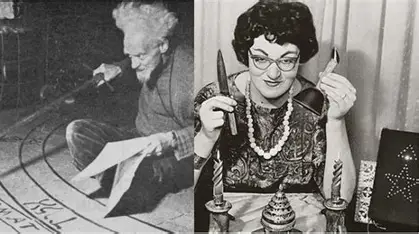
Gerald Gardner became the central public figure in bringing this developing Craft into view. But Wicca was never the work of one person alone. Most important among the people who shaped its early ritual language was Doreen Valiente, Gardner’s High Priestess and one of the most consequential voices in the history of Wicca. Valiente helped revise and compose material that became central to early Gardnerian practice, including work associated with the Charge of the Goddess and The Witches’ Rune.
This is one reason we prefer to understand Wicca as a synthesis rather than an invention. Its recognizable religious structure took shape in a particular historical period, but the thoughts, symbols, rituals, magical methods, and religious longings that fed it came from many places and many times. Wicca gathered those strands, changed them, gave them ritual form, and became something capable of being practiced and transmitted in its own right.
“I only just scratched the surface.”— Doreen Valiente, reflecting late in life on her study of witchcraft
The deeper history is complicated, and that complexity is part of what makes it worth studying. Questions about influence, transmission, reconstruction, religious experience, and the stories early Wiccans told about their own origins deserve more room than a landing page can give them. Our deeper history page follows those threads more closely.
Wiccan Thought
Wicca has never depended upon a single creed that every practitioner must affirm. Its traditions share recognizable ideas, symbols, and ritual patterns, but Wiccans have interpreted them in remarkably different ways. Two people may participate in very similar rites while understanding the gods, magic, nature, and even the purpose of ritual quite differently.
That does not mean Wicca has no theology. It means its theology has often been expressed through ritual, myth, poetry, relationship, and experience rather than through a universally binding statement of belief.
Sacred Nature
The natural world is commonly approached as spiritually meaningful rather than merely as scenery. Seasons, lunar cycles, birth, growth, decline, death, and renewal become religious as well as natural realities.
Divinity
Wiccan understandings of the divine range widely. Some traditions emphasize a Goddess and God; others understand many distinct deities, divine forms, powers of nature, an encompassing sacred reality, or combinations of these approaches.
Polarity & Relationship
Complementary forces appear frequently in Wiccan symbolism: Goddess and God, Sun and Moon, light and darkness, life and death. Some Wiccans understand these strongly through gendered polarity; others interpret them more broadly as relationship, tension, exchange, and creative difference.
Magic & Participation
Magic is not simply an accessory added to religion. In many forms of Wicca it is one of the ways practitioners consciously participate in the sacred world through will, symbol, relationship, ritual, transformation, and disciplined practice.
Even one of Wicca’s most familiar images — the Goddess and the God — does not produce a single theology. For some Wiccans they are distinct divine beings. For others they are great divine powers through which many gods may be encountered. Still others understand them symbolically, psychologically, pantheistically, or as expressions within a larger sacred reality. Contemporary Wicca also includes practitioners whose theology moves well beyond a simple two-deity model.
The same is true of polarity. Male and female symbolism was especially prominent in formative Wiccan traditions and remains spiritually important to many practitioners. But polarity need not mean that all existence can be reduced to two fixed categories. Opposites can meet, mingle, generate something new, or prove less opposite than they first appeared. Wicca has continued to develop as practitioners ask what its inherited symbols mean in their own religious lives.
What often holds this diversity together is a preference for encounter over abstraction. The meaning of the Moon is discovered partly by observing it. The meaning of a deity may deepen through devotion. The Wheel of the Year becomes more than a diagram after it has been lived repeatedly. A ritual can teach something that an argument cannot.
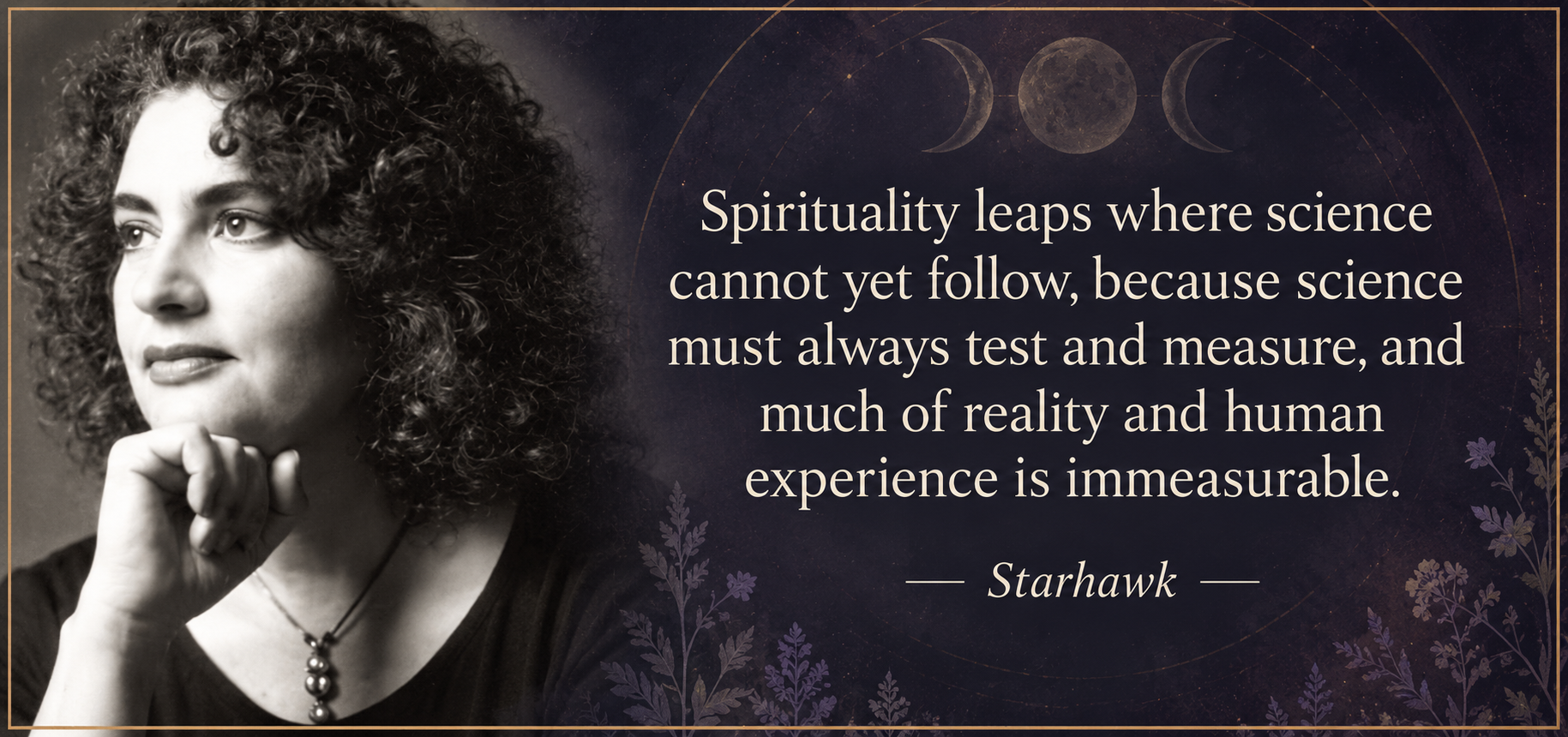
“Witchcraft offers the model of a religion of poetry, not theology. It presents metaphors, not doctrines.”— Starhawk, The Spiral Dance
That description does not speak for every Wiccan tradition, but it captures something important about the religion’s development. Wiccan thought is often carried not only in propositions about what is true, but in the stories people tell, the relationships they cultivate, the symbols they return to, and the rituals through which those ideas become lived experience.
Ritual, Sacred Time & Practice
Wicca is not only a set of ideas about nature or divinity. It is a religion of practice. Its teachings are repeatedly encountered through ritual, through the turning seasons, through the changing Moon, and through the act of gathering sacred space around ordinary human life.
This repeated movement through sacred time is one of Wicca’s most recognizable characteristics. Rather than placing the sacred only in a distant past or future, Wiccan practice continually returns attention to what is happening now: this Moon, this season, this threshold, this death, this renewal.
The Wheel of the Year
Eight seasonal festivals, commonly called Sabbats, form a ritual cycle through the year. They mark turning points in season, light, harvest, growth, decline, death, and renewal. Their exact meanings and forms vary between traditions, but together they create a religious calendar meant to be lived rather than merely studied.
Moon & Esbat
Lunar observance forms another rhythm of Wiccan practice. Esbats are commonly associated with the Moon and may be occasions for devotion, magic, divination, teaching, coven work, or quiet personal observance. Full moons are especially familiar, though practices differ considerably.
The Ritual Circle
Many Wiccan rites take place within a deliberately established circle. Depending on the tradition, the circle may be understood as sacred space, a boundary, a meeting place between worlds, a ritual container, or several of these at once. Directions, elements, invocations, blessings, and other formal acts may help establish it.
Magic as Practice
Spellcraft, meditation, divination, raising and directing power, devotional work, trance, blessing, cleansing, and other magical acts may all appear within Wiccan life. Their importance differs by tradition, but magic remains one of the clearest ways Wicca joins religious devotion with deliberate spiritual practice.
Formal ritual can be elaborate or remarkably simple. A coven rite may involve carefully structured movement, spoken liturgy, invocation, music, shared food and drink, and magical work. A solitary observance may consist of little more than a candle, an offering, a few words, and time spent beneath the Moon. Both can belong recognizably within Wiccan practice.
What matters is not the number of objects on an altar or the theatrical appearance of a rite. Ritual gives intention a form. It establishes a beginning and an ending, marks a space as different from ordinary space, and gives communities and individuals a way to encounter ideas bodily rather than only intellectually.
Over time, repetition also creates memory. Returning to the same festival year after year changes its meaning. The first Samhain a person observes is not the same as the twentieth. The Moon may be astronomically repetitive, but religious experience is not. The practitioner returns changed, carrying another year of relationships, losses, discoveries, mistakes, and growth.
Wiccan sacred time moves in circles, but a circle is not the same as standing still. We return to familiar places as different people.
Ethics & Responsibility
Wiccan ethics are sometimes reduced to one sentence: “harm none.” The reality is more demanding than that. Wiccan traditions have long wrestled with questions of will, consequence, restraint, responsibility, relationship, and the proper use of magical power.
The best-known expression of this ethical current is the Wiccan Rede. Its familiar short form was strongly associated with Doreen Valiente and became one of the most recognizable sayings in modern Wicca.
“Eight words the Wiccan Rede fulfill:— Doreen Valiente
An it harm none, do what ye will.”
The Rede is influential, but it has never functioned as a universal commandment imposed identically upon every Wiccan. Even the word rede means counsel or advice. Its importance lies less in creating a list of forbidden actions than in forcing the practitioner to think carefully about what their will may create.
Harm itself is rarely simple. Refusing someone can cause pain. Protection can restrict another person. Ending an unhealthy relationship may produce grief. Confronting wrongdoing may create conflict. Ethical maturity therefore asks more than whether an action feels gentle. It asks whether the action is proportionate, necessary, responsible, and whether the practitioner is prepared to answer for its consequences.
Intent
What are you actually trying to accomplish? Naming the real purpose of a working prevents protection from quietly becoming punishment, guidance from becoming control, or desire from becoming entitlement.
Consent
Magical work can involve other people, their privacy, their choices, and their boundaries. Ethical practice takes those relationships seriously rather than treating spiritual intention as permission to override another person.
Context
The same act can carry very different meaning in different circumstances. Tradition, relationship, urgency, power, knowledge, and vulnerability all matter when deciding what responsible action looks like.
Consequence
Magic does not remove responsibility for what follows. A mature practitioner considers who may be affected, what outcomes are foreseeable, and what obligations remain after the working is done.
Some Wiccans also understand ethical consequence through teachings sometimes called the Threefold Law or Law of Return. Interpretations vary widely. Some take such ideas spiritually or karmically, others as lessons about the way actions shape character and relationship, and still others do not treat them as literal laws at all.
What matters more than any single formula is the habit those teachings attempt to cultivate: pause before acting, understand what you are doing, consider who may be affected, and accept that power does not exempt the practitioner from accountability.
Ethical practice is not the absence of difficult choices. It is the discipline of making those choices with awareness, proportion, and responsibility.
Initiation, Coven Life & Wiccan Traditions
Some of Wicca’s oldest continuing traditions are initiatory and coven-based. In these forms of the Craft, Wicca is not learned only from books. It is also learned through relationship: practicing with others, experiencing ritual repeatedly, receiving instruction, taking responsibility within a coven, and gradually understanding material that may make little sense when removed from the ritual context that gives it meaning.
This is one reason initiation carries weight in traditional Wiccan settings. It is not simply a certificate declaring someone a “real witch.” It may mark entry into a particular religious community, lineage, body of ritual practice, or priesthood. What is transmitted differs between traditions, and some teachings or rites remain private or oathbound.
Learning
A prospective member may spend considerable time learning the language, rituals, expectations, ethics, and culture of a coven before initiation is ever considered.
Initiation
Initiation can mark entry into a specific tradition or coven and establish new religious relationships, obligations, and access to practices transmitted within that community.
Practice
Much of coven learning happens by doing: observing ritual structure, taking roles, celebrating the seasons together, working magic, and learning how a group creates and maintains sacred space.
Transmission
Some Wiccan traditions understand lineage as a chain of initiation connecting one generation of practitioners to another. Others place less emphasis on lineage while still valuing mentorship, community, and structured religious formation.
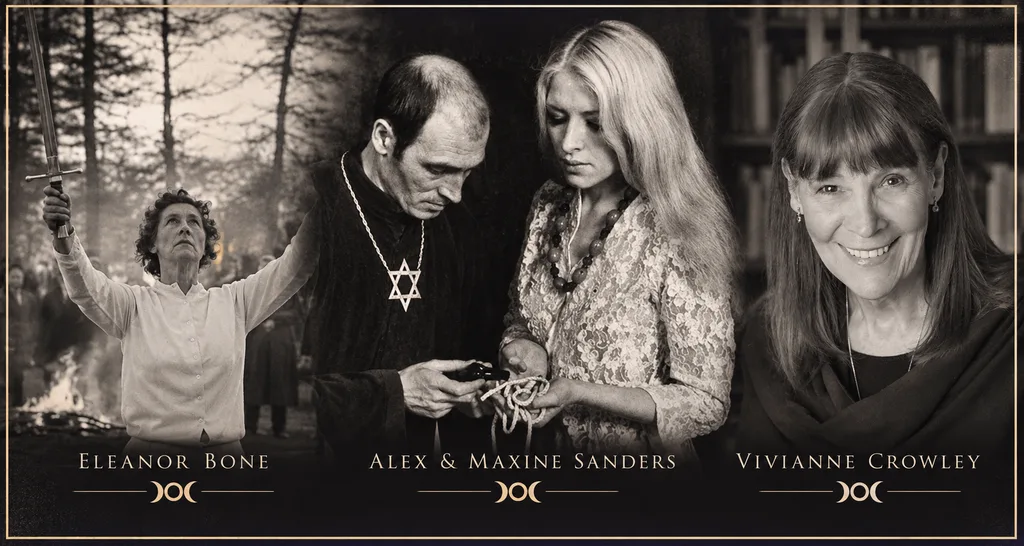
Gardnerian and Alexandrian Wicca are among the best-known examples of initiatory Wiccan traditions, but they are not the whole of Wicca. Other traditions have developed their own structures, and large parts of contemporary Wicca are practiced openly, eclectically, or solitarily.
That distinction matters. A solitary practitioner does not become spiritually insignificant because they lack a coven lineage, just as an initiatory tradition does not become unnecessary because books and public teaching are widely available. They represent different ways of carrying religious knowledge. Some knowledge is readily written down. Other knowledge emerges only through relationship, repetition, responsibility, and shared experience.
Coven life also creates obligations that solitary practice does not. People must learn how to disagree, how to share authority, how to protect confidence without using secrecy as a weapon, how to teach without creating dependence, and how to recognize when tradition is serving the people who carry it rather than the reverse.
Initiation can open a door, but what matters afterward is the life lived on the other side of it.
For readers interested specifically in lineage-based Wicca, our guide to initiatory traditions looks more closely at Gardnerian, Alexandrian, and related forms. For the wider landscape of witchcraft traditions — including paths that are not Wiccan at all — our broader traditions guide places them beside one another without collapsing their differences.
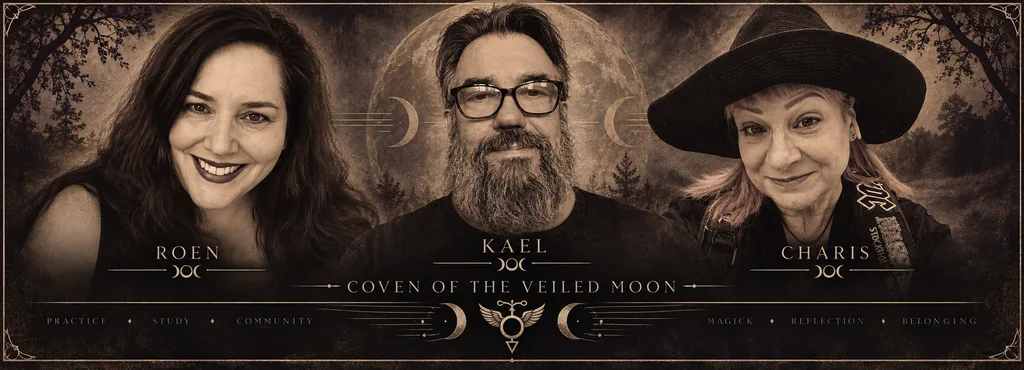
Wicca & Coven of the Veiled Moon
Coven of the Veiled Moon did not inherit an initiatory Wiccan lineage, and we do not describe ourselves simply as a Wiccan coven. But Wicca was one of the important roads by which we entered the wider landscape of Pagan religion and organized witchcraft, and its influence remains clearly visible in the way we practice.
Buckland, Cunningham & the Door They Opened
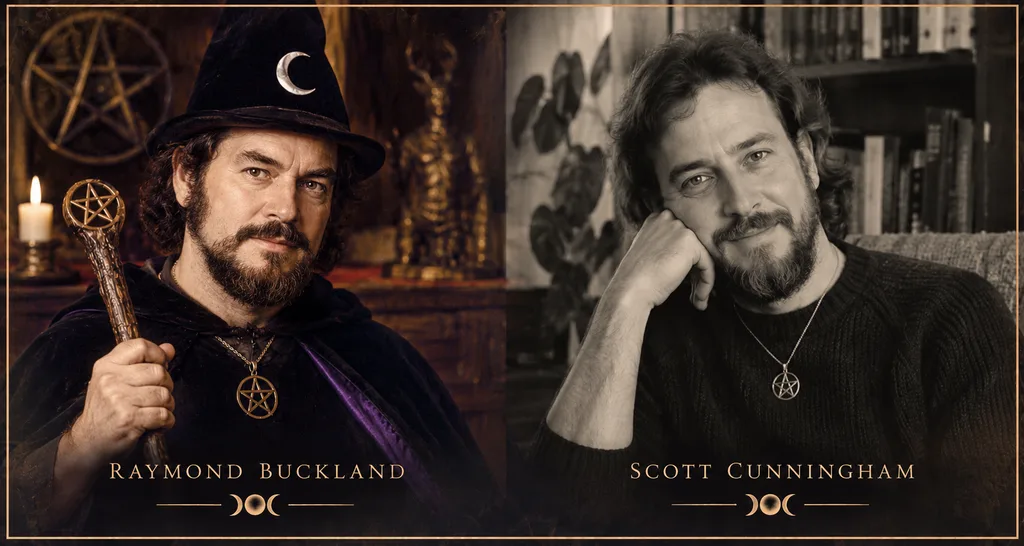
Our early encounter with Wicca came especially through Raymond Buckland and Scott Cunningham. Buckland’s Complete Book of Witchcraft — familiar to generations of practitioners as the “Big Blue Book” — presented Wicca as something that could be studied, structured, practiced, and taken seriously as religion.
Cunningham opened another door. His work made room for the solitary practitioner and demonstrated that meaningful religious practice did not disappear when a coven was unavailable. For many people of our generation, these writers were not the final word on Wicca. They were the beginning of the conversation.
From there we moved deeper into the history and ritual development of the Craft, particularly the work of Gerald Gardner and Doreen Valiente. Valiente in particular remains, from our perspective, one of the most important figures in the development of Wicca: a priestess, poet, practitioner, editor, and thinker who helped give the religion a voice capable of surviving beyond its first generation.
Where Wicca Remains With Us
Our formal ritual life carries strong Wiccan influence. Circle-based ritual, the directions and elements, grounding, invocation, sacred space, seasonal observance, and lunar practice remain familiar parts of our religious vocabulary.
The Sabbats and Esbats are not decorative additions to our practice. They provide part of its rhythm. The repeated movement through season and Moon gives the coven a shared religious calendar and reminds us that practice develops through time.
Wicca also influenced the way we think about coven learning, initiation, ethical formation, and the importance of developing a practitioner through experience rather than information alone.
Where Our Path Has Moved Beyond It
Our theology is not built around a strict Goddess-and-God duotheism. We recognize polarity and real complementary qualities, but we do not believe that every divine being or every sacred force must ultimately be reduced to one of two categories.
Our formal or higher ritual often draws as strongly from ceremonial magic as it does from Wicca, while ordinary spellcraft and household practice may look much closer to traditional or eclectic witchcraft. We do not require one ritual technology to perform every kind of magical work.
We also understand traditions as living things. They can preserve, borrow, encounter, adapt, and develop while still remaining accountable to their histories. Influence matters to us; imitation does not.
Coven formation reflects some of the same values. Our novitiate lasts approximately one solar cycle, giving a prospective member time to experience the seasons, the group, the practice, and themselves before deciding whether initiation and deeper coven membership are right for them. Initiation is therefore neither automatic nor merely ceremonial. It follows relationship.
None of this requires us to deny our Wiccan influence simply because our path continued developing. Religions and magical traditions have always grown through encounter. We would rather name our influences clearly than manufacture a purity that never existed.
Wicca remains deeply present in our formal ritual structure, our seasonal and lunar observance, our ethical formation, and our respect for coven learning and initiation. But we are not strictly duotheistic, we do not require one fixed ritual method, and our practice draws substantially from ceremonial and traditional witchcraft as well. For those reasons, Wicca-adjacent describes Coven of the Veiled Moon more accurately than simply Wiccan.
Anyone interested in tracing these influences further can visit our Witchcraft & Pagan Research Library, where Wicca has its own developing section alongside the larger religious, magical, and historical traditions that have informed our work.
Wicca has been praised, criticized, misunderstood, commercialized, defended, revised, and argued over for most of its public life. Some of that criticism has been deserved. Some of it has been shallow. And some of it comes from holding a comparatively young religion to standards that older religions could not possibly meet themselves.
Its historical beginnings are one obvious example. Early Wicca developed alongside claims that witchcraft represented the survival of an ancient Pagan religion. Modern historical scholarship has not supported that story in the simple form in which it was sometimes presented. Margaret Murray’s reconstruction of a surviving organized witch-cult reached much further than the evidence could sustain, and the precise history behind Gerald Gardner’s own accounts continues to be debated.
We do not think the useful response is either to defend every early claim or to conclude that Wicca was therefore fabricated. History can tell us what documents demonstrate. It is much less equipped to decide whether someone believed they had encountered an older religious current, experienced something they understood as revelation, or participated in the emergence of something spiritually real. Religions have always contained sacred memory, origin stories, revelation, reconstruction, interpretation, and myth alongside documentary history. Those categories should not simply be confused with one another.
Wicca may be younger than some religions, but youth is not the same thing as shallowness, and synthesis is not the same thing as fabrication.
Other criticisms deserve serious attention as well. Early Wiccan language around male and female polarity can feel restrictive when treated as a complete map of human identity or of the universe. Yet its Goddess-and-God imagery also emerged in a religious culture overwhelmingly accustomed to imagining sacred authority as male. That was itself a substantial disruption. The work now is not necessarily to discard polarity, but to ask what it can teach without demanding that every divine being, force, body, or person fit permanently into one of two boxes.
The same care applies to Wicca’s tendency in some forms to find common patterns among many gods and traditions. Similarity does not require sameness. Deities may share domains, encounter one another, influence one another, or change as cultures meet without becoming interchangeable names for a single being. Religious synthesis can be creative and meaningful, but it also requires context, humility, and respect. Learning from another culture is not automatically appropriation; neither does spiritual interest excuse taking what is not ours to take.
Wicca’s extraordinary visibility has created another tension. For decades it became one of the most recognizable public faces of Pagan religion and witchcraft. That sometimes caused outsiders to assume that every Pagan was Wiccan and every witch followed Wiccan ethics, theology, festivals, or ritual structure. Other traditions have good reason to correct that assumption. But Wicca’s visibility is also evidence of what its practitioners accomplished. They created organizations, published books, defended religious practice, built communities, educated the public, and helped make space in which later Pagan and witchcraft traditions could identify themselves more openly.
That influence also created a marketplace around Wicca that can look very different from the religion itself. Crystals sold beside pentacles, mass-produced spell kits, social-media aesthetics, and simplified slogans may borrow Wiccan imagery without conveying much about Wiccan religious life. Commercialization is worth criticizing. It should not, however, be mistaken for the totality of the tradition being commercialized.
Nor should Wiccan ethics be reduced to “harm none,” its theology reduced to “the Goddess and God,” or its ritual reduced to candles, robes, and a circle. Those are recognizable pieces of the tradition. They are not the whole of it. Wicca has produced generations of priests, priestesses, writers, solitary practitioners, covens, teachers, activists, mystics, ritualists, and ordinary people who have spent decades asking what it means to live religiously within the cycles of nature and to practice magic responsibly.
There are abuses of authority in Wiccan communities, as there are wherever human beings create religious institutions. There are historical claims that deserve correction, inherited assumptions that deserve examination, and practices that should continue evolving. None of that requires contempt for the religion itself.
Wicca is mature enough to withstand criticism without being reduced to it.
For us, that may be the most useful way to approach it. Learn its history accurately, question what deserves questioning, preserve what remains meaningful, acknowledge the people whose work built the tradition, and allow living practitioners to continue changing it.
And when evaluating Wicca, judge it by more than the stereotypes that gathered around it. Look instead at the practices people sustained, the books and rituals they left behind, the traditions they preserved and revised, and the communities that grew because those early practitioners opened a door others could walk through.