Bound through Difference
Witchcraft Paths and Traditions
“Are you a good witch, or a bad witch?”
— Glinda, The Wizard of OzReal witchcraft has never fit neatly into two boxes. Even the simple question “What kind of witch are you?” can point to very different things: a tradition, a religion, a way of practicing, a magical specialty, or simply the language someone uses to describe their Craft.
A Gardnerian witch, a green witch, a solitary witch, and a death witch may all use the word witch, but those labels are not telling us the same thing. Understanding the difference makes the landscape easier to navigate and helps us avoid treating every modern identity as though it were an ancient tradition.
This guide focuses mainly on the witchcraft traditions, folk practices, Pagan neighbors, and occult currents most often encountered in Europe and North America. Some are openly taught, while others are initiatory, culturally rooted, restricted in part, or carried through particular communities. We include neighboring paths such as Druidry, Heathenry, and ceremonial magic where they genuinely meet witchcraft, without pretending they are all the same thing.
Think of this page as a map rather than a personality test. Before we look at the paths themselves, it helps to understand what kind of label we are actually looking at.
Asking what “kind” of witch someone is sounds simple until the answers start coming back. One person may say Gardnerian, another green witch, another Pagan, another solitary, another death witch, and another Left-Hand Path. All may genuinely identify as witches, but those words are describing different things.
Some labels identify a tradition with a history, teaching structure, or lineage. Others describe a religion, a practice path, a magical specialty, or the way someone practices. Still others belong to neighboring Pagan or occult systems that overlap with witchcraft without being witchcraft themselves. A person can occupy several of these categories at once without contradiction.
That distinction matters. A Gardnerian witch is describing something specific about tradition and transmission. A green or kitchen witch is usually describing a modern practice path. A solitary witch is telling us how they practice, while a death witch is usually telling us what kind of work holds their attention.
What Kind of Label Is It?
Witchcraft vocabulary mixes several kinds of information together. Before deciding what a label means, it helps to ask what the label is actually describing.
Tradition
A recognizable body of practice with a history, teachings, community, or means of transmission.
Examples: Gardnerian Wicca, Alexandrian Wicca, Feri, Reclaiming
Religion
The religious framework or family through which someone understands gods, ritual, sacred relationship, and the world.
Examples: Wicca, Paganism, Heathenry
Practice Path
A recognizable way of practicing that may be widely shared without requiring formal lineage or initiation.
Examples: Green Witchcraft, Kitchen/Hearth Witchcraft, Hedge Witchcraft
Specialty
The work, spirits, tools, or subject matter someone concentrates on within a larger practice.
Examples: death work, divination, Fae work, lunar work
Practice Structure
How someone practices or how knowledge is organized and transmitted, rather than what tradition they belong to.
Examples: solitary, coven-based, family-taught, initiatory
Magical System or Orientation
A broader magical method, philosophy, or esoteric framework that may overlap with witchcraft without being a witchcraft tradition in itself.
Examples: Chaos Magic, ceremonial magic, Hermeticism
Common Doors into Modern Witchcraft
These six are among the most recognizable ways people enter or encounter contemporary witchcraft in Europe and North America. They are not six equivalent historical traditions. Some are religious or traditional families, while others are modern practice paths organized around a particular way of working.
Folk & Traditional Witchcraft
A broad landscape of household magic, charms, healing, protection, divination, spirit relationships, and regional practice. Some currents are openly studied; others are family-taught, initiatory, or deeply rooted in particular cultures and places.
Wicca
A modern Pagan religion of witchcraft that includes initiatory traditions as well as solitary and non-lineaged forms. Wicca helped shape much of the ritual language now familiar across modern witchcraft.
Eclectic Witchcraft
A self-directed approach that draws thoughtfully from more than one source. Eclectic practice can be highly structured or very personal; its strength comes from learning where practices come from, what belongs together, and why.
Green Witchcraft
Witchcraft centered on plants, land, seasons, cultivation, wild places, and relationship with the living world. The modern name is relatively new, while many of the practices beneath it have much older parallels.
Kitchen & Hearth Witchcraft
Magic practiced through food, herbs, cleaning, brewing, household protection, hospitality, and the repeated work of tending a home. Modern kitchen witchcraft gives a contemporary identity to work rooted in one of humanity’s oldest centers of practical knowledge.
Hedge & Liminal Witchcraft
An often solitary practice concerned with thresholds: trance, journeywork, dreams, spirit contact, divination, and movement between ordinary awareness and visionary experience. Grounding, protection, and discernment are especially important when spirit work is involved.
The Earliest Craft
Hearth, herb, healing and home
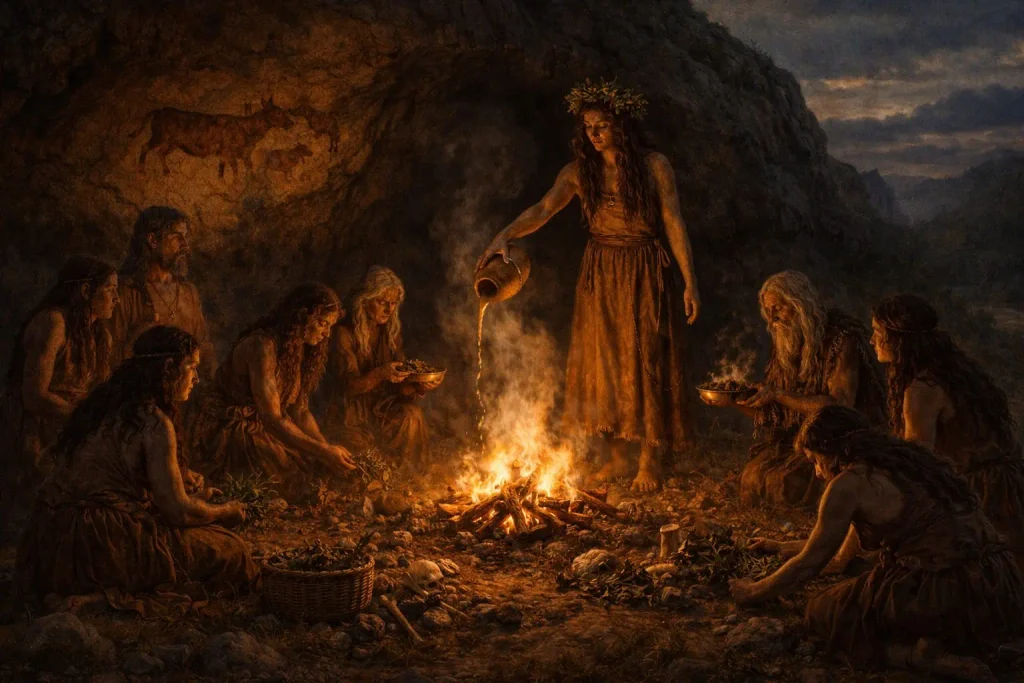
Long before there were named witchcraft traditions, people were already doing work we recognize as belonging to the oldest roots of the Craft. Plants were gathered and prepared. Foods were preserved and transformed. Remedies were made, births attended, weather watched, animals cared for, homes protected, fortunes read, and knowledge passed from one generation to another.
Magic and religion lived in that world as well. Charms, blessings, protective objects, divination, healing rites, prayers, offerings, and practices against misfortune existed beside cooking, medicine, agriculture, and ordinary household work. The boundaries modern people draw between religion, magic, medicine, and practical knowledge were not always the boundaries earlier communities used.
We regard these household, healing, protective, divinatory, and practical magical traditions as some of the earliest roots of the Craft. That does not mean their practitioners all used the same name for themselves. Green Witchcraft and Kitchen or Hearth Witchcraft, for example, are modern identities built around kinds of work with much older roots. We do not need to project the modern labels backward in order to recognize the continuity of the work.
Food, fire, hospitality, preservation, transformation, and the ordering of household life.
Plants, remedies, cultivation, gathering, observation, and knowledge carried through experience.
Care, practical treatment, prayer, charms, protection, and responses to illness and misfortune.
Wards, blessings, luck, fertility, family, local spirits, and the magical work of everyday survival.
The household was also a place where practical knowledge accumulated. Recipes, remedies, charms, protective methods, and household techniques were copied, changed, tested, remembered, and passed between families and communities. Observation and experience mattered, even though inherited practice could contain useful knowledge, religious belief, ritual, symbolism, and error all at the same time.
The Wider Reference
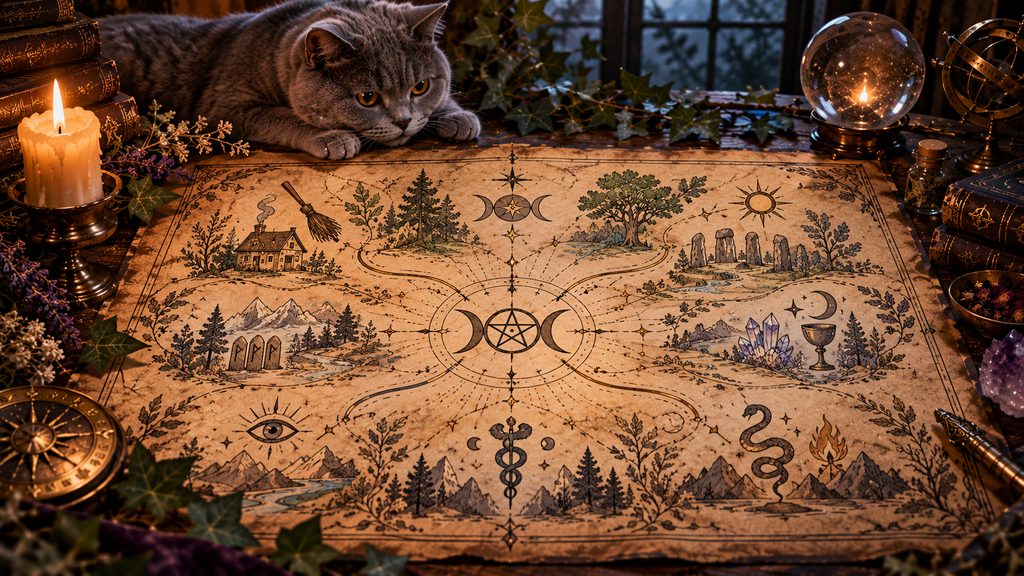
The common paths above are only the beginning. The sections below look more closely at named traditions, regional currents, neighboring Pagan religions, magical systems, and the many labels modern witches use for themselves.
Wicca appears more than once here on purpose. Wicca is a broad modern Pagan religion of witchcraft, while Gardnerian, Alexandrian, Seax-Wica, Blue Star, and other forms describe more particular traditions within or alongside that larger family.
Gardnerian Wicca
One of the foundational traditions of modern Wicca. Gardnerian covens trace initiatory lineage through Gerald Gardner and the priestesses who worked with him. Its ritual material also bears the important influence of Doreen Valiente.
Alexandrian Wicca
A British initiatory Wiccan tradition associated with Alex Sanders and Maxine Sanders. It shares much of the ritual ancestry of Gardnerian Wicca while developing its own lines, emphases, and ceremonial influences.
Dianic & Feminist Witchcraft Currents
Dianic Witchcraft developed within the modern Goddess and feminist spirituality movements. One of its most influential figures is Zsuzsanna Budapest, whose work helped establish a specifically feminist Dianic current. Dianic practice is not one completely uniform organization, and different communities have developed different structures and membership policies.
Seax-Wica
Created by Raymond Buckland, Seax-Wica is a modern Wiccan tradition inspired by Saxon religious material rather than a reconstruction of historical Anglo-Saxon religion.
Feri Tradition
A modern American witchcraft tradition arising from the teachings of Victor Anderson and Cora Anderson. Feri developed through multiple initiates and lines rather than through a single centralized institution.
Reclaiming Tradition
An evolving tradition of contemporary Witchcraft that emerged in the San Francisco Bay Area. Its early development is closely associated with Starhawk and Diane Baker, although Reclaiming developed through community, collective teaching, and shared ritual rather than around a single permanent leader.
Modern Traditional Witchcraft
Modern Traditional Witchcraft is best understood as an umbrella, not one universal tradition. The term covers several modern non-Wiccan Craft currents that look toward folklore, spirit work, land, ancestral material, and older magical traditions while developing distinctive forms of their own.
One influential example is the Craft associated with Robert Cochrane and the Clan of Tubal Cain. Cochrane-derived currents are important to the history of Traditional Craft, but they should not be treated as the source of every tradition using that label.
Wicca — The Larger Family
Wicca is larger than any one initiatory lineage. Gardnerian and Alexandrian Wicca are specific traditions; other Wiccans practice through later traditions, public systems, solitary study, or eclectic forms influenced by Wiccan ritual and theology.
The Craft Keeps Moving
Living Traditions Continue to Form
More recent traditions and teaching communities
Began as a Pennsylvania coven and developed into a wider Wiccan tradition with multiple covens, groves, and regional lines.
Blue Star Foundation ↗A Wiccan tradition founded in Bakersfield, California, with initiatory training, autonomous covens, and an established body of transmitted practice.
Georgian Wicca ↗A modern Wiccan tradition combining Witchcraft with shamanic practice, later developing communities and branches beyond the United States, including Italy.
Temple of Ara ↗Began as a system of magical training and personal development and later developed into a formal Witchcraft tradition and organization.
Temple of Witchcraft ↗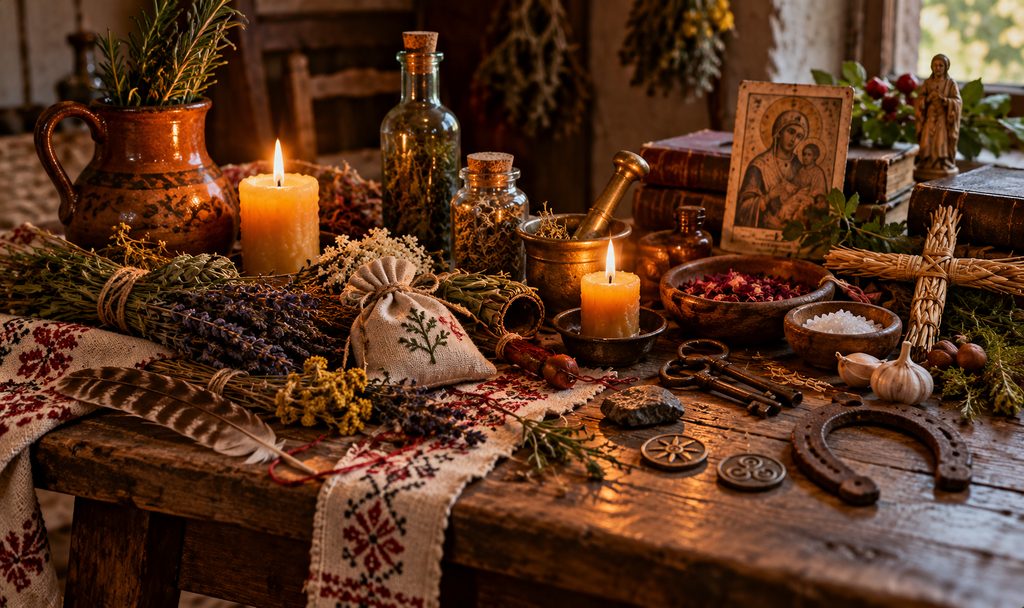
Folk & Regional Magical Currents
Household magic, healing, charms, protection and regional traditions carried through communities, families and places
Some practitioners were Pagan. Many were Christian. Some would have recognized the language of magic; others would have rejected it entirely. Modern witches may recognize familiar kinds of work here without assuming that every healer, charmer or cunning person understood themselves as a witch.
British & Irish Folk Magic
Cunning folk, charms, fairy belief, healing & protection
Britain & Ireland
The British Isles preserve a wide range of magical and supernatural traditions: cunning people and charmers, magical healing, protective rites, divination, curse-breaking, sacred wells, fairy belief, household charms and practices intended to counter witchcraft or misfortune.
These practices were never one hidden witch religion. Many practitioners worked comfortably within Christian communities, and some of the very people hired to remove witchcraft would have strongly resisted being called witches themselves.
Italian & Sicilian Folk Magic
Healing, malocchio, household rites & folk religion
Italy & Sicily
Italian folk practice varies enormously by region. Healing prayers, saints, charms, protective objects, herbal knowledge and household rites exist alongside beliefs concerning the malocchio, or evil eye, harmful workings such as the fattura, and ritual methods for diagnosing or removing misfortune.
Sicilian traditions in particular preserve spoken healing formulas and responses to conditions understood through ideas such as fright, envy, the evil eye and magical harm. Religion, family custom and vernacular magic often overlap rather than forming clean modern categories.
Scandinavian & Nordic Folk Magic
Charms, healing, luck, divination & spirit traditions
Nordic Regions
Scandinavian and Nordic traditions preserve long histories of charms, healing, divination, protection, beliefs about harmful magic, spirit relationships and ritual practices surrounding luck, illness, animals and the household.
Christian and pre-Christian materials interacted for centuries, so later folk practice should not be treated simply as untouched Viking religion surviving into modern times.
Slavic & East European Folk Magic
Spoken charms, household custom, healing & folk religion
Eastern Europe
Slavic and neighboring East European cultures preserve rich bodies of spoken charms, folk healing, protection, household custom, seasonal rites, divination and supernatural belief. Christianity frequently became interwoven with older regional traditions rather than simply replacing them.
“Slavic folk magic” is therefore a useful umbrella for orientation, but it is not the name of one tradition. Polish, Ukrainian, Russian, Balkan, Czech, Slovak and neighboring traditions each have their own histories and local forms.
Braucherei / Pennsylvania Dutch Powwow
Christian healing, blessings & protective folk practice
Pennsylvania German
Braucherei, often called Pennsylvania Dutch Powwow in English, is a Pennsylvania German tradition of ritual healing and protection. Prayer, blessings, gestures, spoken charms and ordinary objects may be used for the health of people and animals or for protection from physical and spiritual harm.
Despite the English nickname powwow, the tradition is not Native American in origin. Its foundations are primarily Pennsylvania German and European, and Christianity is central to much of its traditional practice.
Appalachian Folk Magic & Healing
Remedies, prayer, omens, protection & regional lore
Appalachia
Appalachian folk practice includes plant knowledge, household remedies, prayer, signs and omens, protective customs, divination, healing and a large body of supernatural folklore. Christianity has been especially important in many communities, and Biblical prayer may sit comfortably beside practices a modern observer might describe as magical.
There is no single ancient “Appalachian witchcraft” lineage. Appalachia is a large and culturally complex region shaped by many communities and migrations, and its folk traditions developed through that history.
Hoodoo, Conjure & Rootwork
African American healing, protection, roots & conjure
African American • U.S.
Hoodoo, Conjure and Rootwork refer to closely related African American magical traditions shaped under slavery and throughout the history of Black life in the United States. Their sources include African spiritual inheritances, the American environment, Biblical and Christian traditions and other influences encountered in North America.
Healing, protection, luck, justice, spirit work, roots and other materia, Biblical texts and both benevolent and harmful workings can appear within this broad historical complex.
Mexican & Borderlands Magical Traditions
Curanderismo, brujería, healing & regional folk practice
Mexico & U.S. Southwest
Mexican and Mexican American traditions include several categories that outsiders sometimes collapse into “Mexican witchcraft.” They include folk healing, religious devotion, herbal practice, Indigenous and European inheritances, magical practice and traditions described through words such as curanderismo and brujería.
Curanderismo is a tradition of folk healing and is not automatically witchcraft. Brujería can refer to witchcraft or sorcery, but the word has also carried accusation, stigma and different local meanings. Practices involving mal de ojo, cleansing and protection may occur within this larger cultural landscape.
Reading living and inherited traditions responsibly
Family transmission is real. Remedies, prayers, charms, divination and ways of working may genuinely pass between parents, grandparents and other relatives. That inheritance provides history and relationship; it does not mean ancestry alone automatically transmits a trained Craft.
Study is not the same as membership. Learning about another community’s traditions does not automatically confer its titles, authority or inheritance. Public information can teach history and encourage respect while particular family, initiatory or culturally rooted practices remain connected to the people who carry them.
This guide does not catalogue Indigenous North American religions and ceremonial traditions as forms of witchcraft. Haitian Vodou is likewise an Afro-diasporic religion rather than a type of witchcraft, while Louisiana Voodoo has its own North American cultural history. Magical practices may occur within or alongside these traditions, but they should not be reduced to a generic collection of techniques for eclectic practice.
Ways of Working
Some witchcraft paths are defined less by lineage or religion than by the kind of work a practitioner chooses to place at the center of the Craft.
These paths can overlap. A kitchen witch may also be green, a hedge witch may be Pagan, and an eclectic witch may work within several different currents. The label usually identifies an emphasis rather than the whole person.
Green Witchcraft
Green Witchcraft centers relationship with plants, land, weather, cultivation, wild places and seasonal change. For some practitioners it is strongly magical; for others it may also become devotional, ecological or animistic.
The identity green witch is modern, but plant lore, household remedies, agricultural observance and magical relationships with the natural world are considerably older than the label.
Kitchen & Hearth Witchcraft
Kitchen and Hearth Witchcraft places magical attention on the work of daily life: cooking, brewing, cleaning, hospitality, household protection, family care and the transformation of ordinary ingredients into something useful.
Its modern identity is new, but its underlying logic is old. Kitchens and hearths have long been places where practical knowledge, ritual, healing, preservation and household protection meet.
Hedge Witchcraft
Modern Hedge Witchcraft is usually concerned with thresholds: the boundary between ordinary and visionary awareness, the human and spirit worlds, waking and dream, cultivated place and wilderness. It is commonly practiced outside formal coven structure.
The term draws much of its modern meaning from the image of crossing or riding the hedge — the boundary between worlds. Contemporary hedge practice varies widely, so it is better understood as a liminal practice path than as one standardized historical tradition.
Eclectic Witchcraft
Eclectic Witchcraft describes a practice assembled from more than one source rather than inherited wholesale from a single tradition. It is one of the most common ways contemporary solitary witches build a working practice.
Eclectic does not have to mean random. A thoughtful eclectic witch studies where practices come from, learns which systems fit together, respects initiatory and cultural boundaries and develops enough consistency for the practice to become more than a collection of interesting techniques.
When a Practice Path Becomes a Specialty
Some labels describe an entire way of organizing a practice. Others tell us mainly what someone works with. A green witch may structure much of their Craft around land and plants; someone who calls themselves a death witch may simply be telling us that death work, ancestors, necromancy or psychopomp practice is one important part of a larger tradition.
There is no insult in calling something a specialty rather than a tradition. It simply tells us what kind of information the label actually contains.
Neighboring Occult Currents
Esoteric traditions, magical systems and occult philosophies
that have crossed paths with modern witchcraft without necessarily
being forms of witchcraft themselves
Hermeticism
Hermeticism is a philosophical and esoteric current associated with writings attributed to Hermes Trismegistus. Its ideas about the relationship between the divine, humanity and the cosmos became deeply influential within later Western esotericism.
Ceremonial Magic
Ceremonial magic is a broad family of highly structured magical traditions using ritual, symbolism, correspondences and formal methods of working with spiritual or esoteric forces.
Rosicrucianism
Rosicrucian currents developed around early modern manifestos describing a hidden fraternity devoted to spiritual, philosophical and intellectual transformation.
Thelema
Thelema is a modern esoteric religious and philosophical system centered on the discovery and fulfillment of True Will. Ceremonial magic, mysticism and initiatory practice are important within many Thelemic communities.
Chaos Magic
Chaos magic developed as an experimental approach that often treats belief, symbolism and magical technique as adaptable tools rather than components of one required religious system.
Western Qabalah
Western or Hermetic Qabalah is an occult system developed partly from interpretations of Jewish Kabbalistic ideas and incorporated into later Christian, Hermetic and ceremonial magical traditions.
Occult Does Not Automatically Mean Witchcraft
A ceremonial magician may never identify as a witch. A witch may use Hermetic correspondences without becoming a Hermeticist. A chaos magician may borrow witchcraft techniques while understanding their own practice very differently.
These currents belong beside witchcraft because the traditions have met, borrowed, argued and evolved alongside one another.
18+
Restricted Occult Material
Adult-oriented, transgressive and initiatory occult currents.
Age confirmation required.
Confirm Adult Access
MCC keeps this material behind an adult-content threshold. Confirm that you are at least 18 years old before continuing.
MCC places this material behind an adult threshold because some currents engage questions of religious autonomy, taboo, antinomian practice, invocation, sexuality, transgressive symbolism or deliberate challenges to inherited religious boundaries.
Left-Hand Path
The modern Western Left-Hand Path is better understood as a broad esoteric orientation than as one religion or one witchcraft tradition. Different currents may emphasize individual sovereignty, antinomian practice, self-transformation, self-deification or the deliberate crossing of established religious boundaries.
Some Left-Hand Path practitioners identify as witches. Others use terms such as magician, occultist, Luciferian, Satanist, Setian or the name of a particular order or philosophy.
Important distinction: Left-Hand Path does not simply mean evil magic, harmful magic or Satanism. Satanic currents exist within the wider milieu, but Satan is neither required nor central to every Left-Hand Path system.
Luciferian Witchcraft
Luciferian witchcraft can occupy a crossroads between modern witchcraft, Western esotericism and Luciferian religious or philosophical currents. Lucifer may be understood as deity, spirit, archetype, initiator, liberator or symbol depending on the practitioner and tradition.
Satanic Witchcraft
Some Satanists incorporate magical practice or identify as witches, while others do neither. Modern Satanism includes substantially different religious and philosophical currents, so “Satanic witch” describes a particular intersection rather than Satanism as a whole.
Internet Identities & Witch Types
Death Witch, Cosmic Witch, Shadow Witch, Crystal Witch,
Cottage Witch and dozens more — useful descriptions,
personal identities, aesthetics and specialties that do not
necessarily amount to separate traditions
Some of those labels communicate something genuinely useful. Others are mostly aesthetic, social or personal shorthand. They may tell us something about the practitioner. They do not necessarily tell us very much about a tradition.
What I Work With — Specialty Labels Death, Fae, lunar, weather, sea, crystal and similar labels usually describe a concentration of practice rather than a lineage
This is probably the most useful category of modern witch label. It tells us where someone’s attention tends to go. It still does not necessarily tell us where they trained, what religion they practice or which larger magical system they belong to.
Death Witch
Usually describes a practitioner whose work centers on death, ancestors, funerary practice, cemetery work, psychopomp work, necromancy or related spirit relationships. Those are real areas of magical practice. Death Witch itself is not one historical tradition.
Fae Witch
Usually means that relationships with the Fae or fairy traditions occupy an important place in someone’s practice. Serious historical fairy traditions exist; the modern label alone does not tell us which of them, if any, is being practiced.
Lunar Witch
Usually indicates a strong emphasis on moon phases, lunar timing, divination or lunar devotion. Moon work can appear inside Wicca, Paganism, folk magic, ceremonial magic or a completely eclectic practice.
Storm or Weather Witch
Describes an emphasis on weather, wind, storms, atmospheric phenomena or related elemental and spirit work. It tells us what someone enjoys working with more reliably than where they learned it.
Sea Witch
A modern descriptive label for practice centered on the sea, tides, coastlines, maritime folklore, water, weather or ocean-related spirits. Coastal folk traditions may have much older histories than the modern identity label.
Crystal Witch
Usually means that crystals and stones are a prominent tool or area of study. Crystal work can appear in witchcraft, New Age practice, folk belief and other esoteric systems. Owning a great many rocks remains, by itself, inconclusive.
Shadow Witch
Usually describes a practitioner who places unusual emphasis on shadow work, introspection, difficult emotions, trauma narratives or psychologically framed magical practice. The phrase is modern and its meaning varies considerably.
Bone Witch
Usually signals work involving bones, animal remains, mortality symbolism, divination, ancestor work or related spirit practices. The title tells us very little about the actual tradition until the practitioner explains further.
The Algorithm Likes a Theme — Aesthetic & Lifestyle Identities Cottage, cosmic, nocturnal, forest, urban, dream, art and other labels where practice, setting, personality and aesthetic begin to blur
Online witchcraft culture is exceptionally good at turning an interest, environment, hobby or preferred hour of the day into an identity label. That is not automatically meaningless. It simply means we should read these terms as modern shorthand rather than assume each one names an independent magical system.
Cosmic / Celestial Witch
Usually signals interest in stars, astrology, planets, celestial timing or cosmic symbolism. Depending on the person, the practice may range from serious astrology to a strongly celestial aesthetic.
Nocturnal Witch
Usually means the practitioner prefers night work, darkness, moonlight, dreams or nocturnal symbolism. Night remains available to practitioners of several traditions.
Cottage Witch
Usually combines domestic magic, herbs, baking, home care, seasonal living and a cozy rural aesthetic. There can be substantial real practice underneath it; the cottage itself is not an initiation requirement.
Forest Witch
Generally indicates an emphasis on forests, plants, local spirits, wild places or woodland symbolism. In practice it often overlaps heavily with Green Witchcraft.
Urban Witch
A useful modern descriptor for witches who deliberately work with city environments, infrastructure, local spirits, public spaces or materials available in urban life.
Dream Witch
Usually refers to a strong emphasis on dreams, lucid dreaming, dream divination, incubation or visionary work. Dream practice itself is much older than the label.
Art / Music Witch
Indicates that creative work itself functions as magical expression, ritual or spellcraft. Useful description, especially when followed by an explanation of what the person actually does.
Tech / Cyber Witch
A contemporary label for magical practice that incorporates digital systems, electronics, coding, networks or online environments. Modern subject matter does not make the underlying magical logic entirely new.
Born This Way? — Family, Hereditary & Bloodline Claims Family teaching, inherited aptitude, ancestral connection and genetic descent are different claims and should not be collapsed together
This subject deserves more precision than it usually gets. Practices can genuinely travel through families. A parent, grandparent, aunt, uncle or other relative may teach charms, prayers, divination, spirit work, remedies, protection or an entire family way of practicing.
At MCC, we also leave room for the possibility that certain natural sensitivities or aptitudes appear more strongly in some families: mediumistic sensitivity, intuition, unusual perceptiveness, facility with divination or similar traits. We understand these as attributes, not completed skills. Training still matters.
A person with strong natural aptitude and little discipline may be less capable in practice than someone with more ordinary aptitude who has trained carefully for years.
Biology alone tells us even less. Sharing DNA with someone who practiced magic does not transmit their techniques, relationships, initiations or experience.
And discovering an ancestor who was accused of witchcraft tells us that an ancestor was accused of witchcraft. It does not establish that a secret Craft has traveled silently through the bloodline ever since.
Color-Coded Witchcraft — White, Black & Grey Old magical color-language, modern identity labels and the understandable human desire to sort ethics into three convenient boxes
Words such as white magic and black magic have histories much older than social media. Using White Witch, Black Witch or Grey Witch as personal identity labels is a more modern classificatory habit.
Here, white and black refer to traditional magical color-language, not race or ethnicity. Even within occult usage, the terms have carried different meanings in different periods and communities, so context matters.
These can be meaningful personal descriptions. They are not three ancient branches of witchcraft, and earlier magical cultures were not waiting for the internet to finish color-coding them.
Related: New Age Belief →Love, Light & Extremely High Vibrations Manifestation, positivity, universal signs, vibration language and the point where modern witchcraft frequently wanders into New Age territory
Online New Age and witchcraft communities often overlap around manifestation, “high-vibration” living, signs from the universe, crystals, affirmations, synchronicity and the idea that thought or emotional state helps attract corresponding experiences.
Some people find these practices meaningful and constructive. The difficulty begins when positivity becomes an explanation for suffering, a substitute for practical action, or a reason to treat ordinary human emotions as evidence of spiritual failure.
Witchcraft has room for joy, hope, beauty and healing. It also has room for grief, anger, uncertainty, protection, boundaries and the occasional thoroughly bad mood.
This site begins simply, welcoming newcomers with an accessible introduction to modern witchcraft, Pagan practice, Wiccan-influenced spirituality and the foundations of ritual and magical work. As visitors journey deeper, the teachings unfold into layered explorations of spellcraft, symbolism, intuitive development, sacred philosophy and the living traditions of the Craft.
Blending mystical insight with practical guidance, this space serves as a broad survey of witchcraft, Pagan spirituality and esoteric study as understood through the Coven of the Veiled Moon — an evolving resource for seekers, beginners and seasoned practitioners alike.
Where possible, we deliberately link to outside organizations, scholarship, archives and other useful sources so readers can compare perspectives beyond our own.
If you belong to a tradition discussed here and believe we have misrepresented something, we welcome thoughtful correction. Please include supporting sources or research when possible so we can cross-reference them with our own material and present the clearest, most accurate account we can.
How the Currents Meet
Modern witchcraft did not descend through one unbroken family tree. Older magical practices continued, religions were revived, occult systems supplied ritual language, and new traditions formed through transmission, borrowing and recombination. The lines below do not all mean the same thing — and that distinction matters.
A Larger Craft
Witchcraft has never been one thing practiced in one way. It contains named traditions, family and regional practices, modern paths, specialties, religious commitments and magical systems that meet, separate and sometimes meet again.
Knowing the difference between those categories does not make the Craft smaller. It makes its history clearer. A modern label can be useful without pretending to be ancient, a living tradition can change without losing its identity, and two paths can influence one another without becoming the same path.
The useful question is not whether every witch fits neatly into a single box, but whether we understand what the words we use actually mean, where our practices came from and what responsibilities come with them.
Continue Exploring
Follow whichever part of the landscape has your attention now.