
Ethics of the Veiled Moon
About Our Ethics
The Coven of the Veiled Moon is a pluralistic, initiatory witch coven with a broadly Pagan religious orientation and a syncretic practice. Our ethics are relational and consequence-aware, centered on agency, discernment, reciprocity, service, and responsibility.
Notice carefully. Think clearly. Choose freely. Act deliberately. Accept what follows.

Ethics, for us, are less a rulebook than a practice of discernment. Principles matter, but real situations rarely arrive cleanly separated into right and wrong, harmless and harmful, permitted and forbidden. People have competing needs. Relationships create responsibilities. Actions have consequences that may be difficult to predict, and sometimes doing nothing is itself a choice with consequences.
MCC therefore places considerable weight on attention, judgment, agency, and responsibility. We ask what is actually happening, what we know and what we are merely assuming, whose agency is involved, what choices are available, and what may follow from the choice we make. Compassion, restraint, evidence, intuition, experience, and spiritual discernment can all have a place in that process.
This does not mean that every choice is equally ethical, or that “anything goes.” It means that ethical maturity requires more than applying a slogan to a complicated situation. We try to act deliberately, remain willing to reconsider what we think we know, and accept responsibility for what our choices set in motion.
How We Approach a Choice
We do not expect every difficult situation to produce an instant or obvious answer. Instead, we try to move through a process: paying attention first, separating knowledge from assumption, considering agency and alternatives, acting deliberately, and then remaining responsible for what follows.
Notice
What is actually happening? What has changed, and what deserves our attention?
Discern
What do we know? What are we assuming? What do evidence, experience, intuition, divination, and context suggest?
Choose
What responses are available? Whose agency is involved, and what alternatives remain?
Act
What response belongs to us? What degree of intervention is warranted?
Observe
What followed? What changed? What responsibility remains after the action is taken?
The process does not guarantee certainty. Its purpose is deliberate responsibility: to notice more carefully, choose more consciously, and remain accountable to what our choices set in motion.
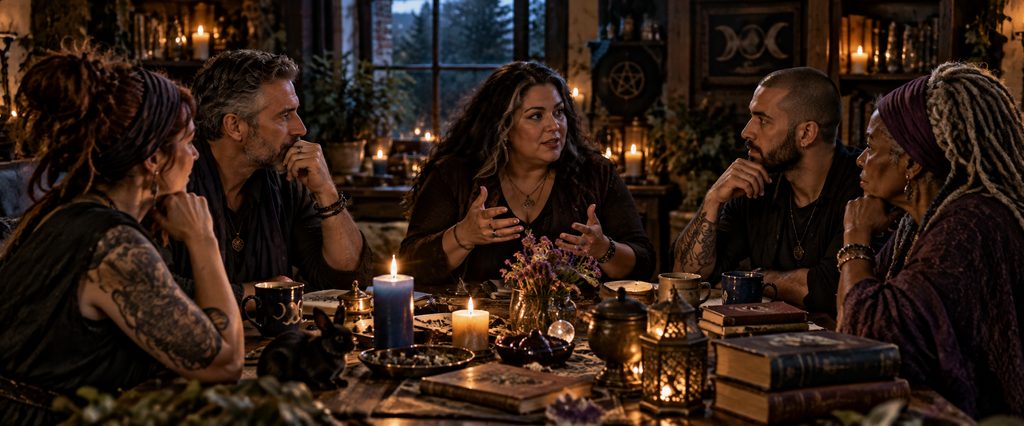
Principles We Return To
These are not commandments or tests of moral purity. They are values we return to when teaching, practicing, helping others, working together, and deciding what responsibility asks of us in a particular situation.
Agency & Sovereignty Choice matters because other beings have choices, boundaries, interests, and responses of their own.
We understand people, practitioners, spirits, communities, animals, and other beings as participants with agency of their own. Our wants do not automatically erase another participant’s ability to choose, resist, refuse, withdraw, or respond.
Consent therefore matters strongly to us. At the same time, relationship can create competing responsibilities, and not every difficult situation can be resolved by treating consent as a simple mathematical rule. Protection, dependency, immediate harm, intrusion, and conflicting claims may require deeper discernment.
Truth & Discernment Open-mindedness asks us to remain curious without surrendering evidence, judgment, or uncertainty.
MCC values honesty and has little patience for deliberate deception or manipulation. We try to speak truthfully about what we know while remaining equally honest about uncertainty, interpretation, and the possibility that we may be mistaken.
Evidence matters. Experience matters. Spiritual experience, intuition, divination, context, and accumulated practice may also matter. Discernment means allowing these sources to inform us without pretending they are interchangeable or equally certain.
Service Knowledge and ability create opportunities to help, but service remains freely offered rather than endlessly owed.
Service is one of MCC’s central values. Knowledge, experience, skill, and access can create opportunities to make another person’s path easier, clearer, safer, or more hopeful. When we are able to help responsibly, we generally believe there is value in doing so.
But service is freely chosen. MCC may say no, change course, decline a request, or step away when responsible work is no longer possible. A willingness to help does not require self-erasure or surrendering healthy boundaries.
Reciprocity & Relationship Relationships create responsibilities in more than one direction, including room for gratitude, boundaries, and refusal.
Much of our ethical thinking begins in relationship: with people, spirits, gods, animals, places, traditions, communities, and the wider world in which our lives unfold. We are neither completely isolated nor entitled to everything we encounter.
Reciprocity asks what we receive, what we offer, what we owe, and where appropriate boundaries belong. Respect is part of this relationship, but respect does not mean submission.
Curiosity & Knowledge Understanding a difficult subject is not the same as endorsing every possible use of it.
Curiosity is deeply valued within MCC. Knowledge can empower, protect, preserve, challenge assumptions, and make responsible choice possible. We would rather understand a difficult subject than depend upon ignorance as a form of protection.
Studying difficult or potentially harmful forms of magic does not mean approving of every possible use. Some knowledge still requires maturity, context, preparation, initiation, or limits on practice.
Creativity, Beauty & Joy A meaningful life involves more than avoiding harm; it also includes creating, enjoying, celebrating, and participating.
Ethics are not only about restriction. MCC values creativity, art, beauty, play, humor, sexuality, pleasure, friendship, celebration, craftsmanship, and the simple enjoyment of being alive.
Creativity can also be understood as participation, on a human scale, in the larger creative movement of existence. Beauty is partly an act of attention: noticing what is present, arranging what we can, and adding something worthwhile of our own.
Loyalty & Community Trust, reliability, and long relationship matter, while conscience and honest disagreement remain personal.
MCC values loyalty deeply. Long relationships matter. Reliability, confidence, discretion, trust, and the willingness to stand beside one another are part of what allows an initiatory coven to become a genuine community rather than merely a collection of practitioners.
Loyalty does not require lying, defending harmful behavior, abandoning conscience, or agreeing blindly with leadership. Respectful disagreement can itself be an expression of care for a relationship worth preserving.
Courage & Openness Being willing to stand in who you are can carry its own quiet form of courage.
Witch and Pagan identities exist within a long history of religious suppression, suspicion, social othering, and pressure to conform to dominant religious and cultural expectations. Depending on a person’s circumstances, openness about spiritual identity can therefore carry real personal weight.
MCC does not romanticize danger or demand public heroism. Privacy can be wise, and no one owes strangers a declaration of belief. But there is also value in dignity, authenticity, and the freedom to stand openly in who we are when we choose to do so.
Wicca and Our Ethics
MCC is Wiccan-adjacent, not Wiccan. Wicca has influenced parts of our ritual culture and ethical vocabulary, and we respect much of what Wiccan traditions have contributed to modern witchcraft. We do not, however, treat Wiccan ethical teachings as binding law for our coven.
Shared Ground
- Personal sovereignty and responsibility
- Restraint and awareness of harm
- Respect for consequence
- Reverence and relationship
- Accountability in magical practice
- Responsibility in spiritual leadership
Our Particular Emphasis
- The Rede is a guide toward thoughtful restraint rather than an absolute prohibition against all harm.
- Threefold ideas are reminders that actions carry consequence, rather than literal cosmic arithmetic.
- Protection, justice, removal, binding, and forceful defensive action may sometimes be ethically appropriate.
- Consent is foundational, while context and competing responsibilities still matter.
- Difficult knowledge is not inherently unethical knowledge.
- Members may reach different conclusions while sharing the same method of ethical discernment.
We respect the traditional advice to consider harm before acting. We simply do not believe that a human life—or a magical practice—can be reduced to never causing harm at all. The more useful question is what responsibility requires when consequences cannot be avoided entirely.
What These Principles Do — and Do Not — Mean
Ethical language can sound simpler than the situations it is meant to guide. These distinctions help clarify what we mean when we speak about compassion, openness, service, protection, pluralism, and respect.
Compassion is not passivity.
Understanding why harm occurs does not require permitting it. Compassion can coexist with boundaries, removal, refusal, and decisive protection.
Open-mindedness is not credulity.
An experience can be treated with respect without pretending certainty. Curiosity should make room for evidence, alternative explanations, and the possibility of being mistaken.
Mercy is not forgiveness.
Mercy may simply mean choosing restraint when a harsher response is available. It does not require declaring an injury harmless or restoring a relationship.
Forgiveness does not automatically restore trust.
Forgiveness, reconciliation, renewed access, and restored relationship are different decisions. One does not automatically require the others.
Service is not obligation.
Help is offered through discernment. A willingness to serve does not give another person unlimited claim over someone’s time, knowledge, attention, or labor.
Pluralism is not “anything goes.”
Members may reach different conclusions, but those conclusions should still emerge from serious engagement with agency, consequence, relationship, responsibility, and context.
Protection is not helplessness.
Boundaries may be quiet, firm, or forceful. Defensive action is not unethical merely because another person or presence dislikes the boundary being imposed.
Respect is not submission.
A person, spirit, god, teacher, leader, or tradition may be treated with genuine respect without surrendering judgment, conscience, boundaries, or personal agency.
Our ethics are not built around appearing harmless or morally pure. They are built around noticing relationship, exercising judgment, and remaining responsible for what our choices actually do.
A Request Begins a Conversation
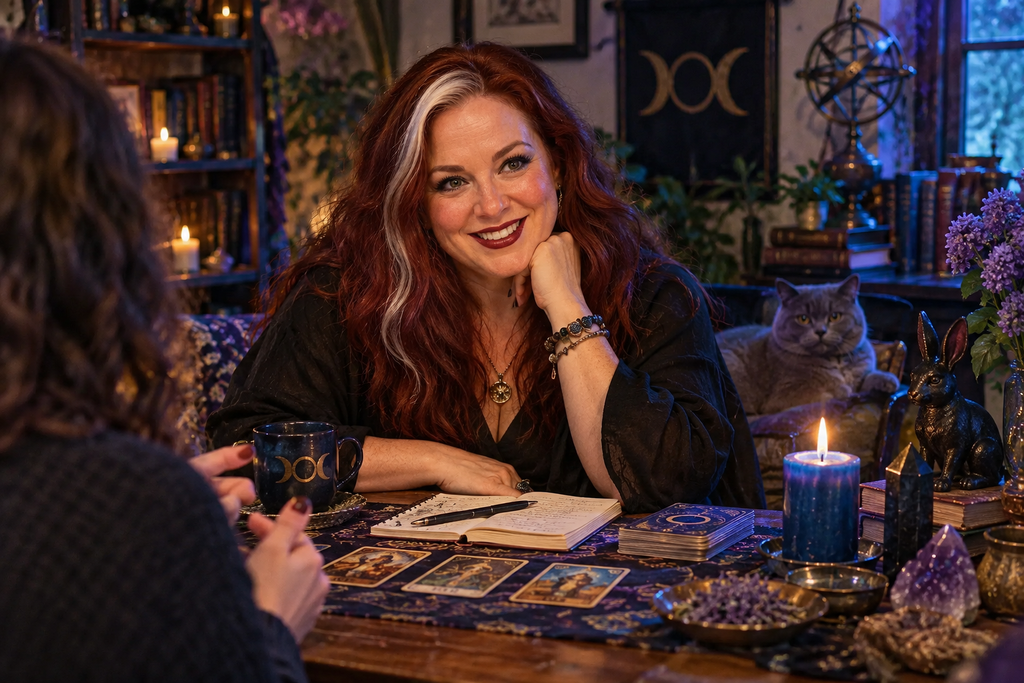
When someone comes to MCC for a reading or working, we begin by trying to understand the situation rather than simply acting on the first requested outcome. Sometimes the best path is obvious. Sometimes the situation needs questions, divination, clarification, or a different approach entirely.
Before We Act, We May
- Ask questions or request more information.
- Recommend or require divination before a working.
- Separate what someone wants from what the situation appears to support.
- Look for clarification before acting on assumption.
- Consider whether a less coercive or less forceful approach is available.
- Consult other MCC members or leadership when a situation warrants it.
We May Decide To
- Suggest a different kind of working.
- Favor attraction over unnecessary coercion.
- Favor removal over retaliation when that better serves the situation.
- Seek broader consensus for unusually consequential work.
- Pause or stop a working if circumstances change.
- Decline a request or decide MCC is not the right fit.
A requested outcome tells us what you want. It does not automatically determine what we will do.
Truthful Communication Matters
Good discernment depends on the information available to us. Someone asking for help does not need to tell us every private detail of their life, but deliberate dishonesty, manipulation, or withholding information that materially changes the situation can make responsible work impossible.
When We May Decline
MCC may choose not to work with someone who is deliberately dishonest, abusive, manipulative, persistently disrespectful, or otherwise incompatible with our ability to work responsibly. Service does not mean that anyone is entitled to MCC’s labor.
MCC does not believe that every ethical response must be gentle. Protection often begins with the least force necessary: establishing boundaries, removing an intrusion, uncrossing, disengaging, clarifying what is happening, or simply refusing further access. In many situations, that is enough.
Sometimes it is not. Binding and strongly coercive targeted work require much greater scrutiny and, within our coven, would generally involve leadership rather than one person’s impulse. We regard such measures as unusual and closer to last-resort responses than ordinary magical tools.
Justice can also include consequence. We distinguish that from cruelty. There is an ethical difference between wanting someone to understand the weight of what they have done and wanting them to suffer simply because their suffering feels satisfying. Being wronged does not grant unlimited moral permission.
When force is necessary, the question is not whether the response is perfectly harmless. The question is whether it is warranted, proportionate, bounded, and connected to a defensible purpose. A boundary may sometimes need to be strong enough that repeating the violation becomes undesirable. That does not remove the practitioner’s responsibility for how the boundary is made or what it sets in motion.
Compassion can coexist with refusal. Mercy can mean choosing restraint when something harsher is available. Protection can be forceful without becoming vengeance, and understanding why harm occurred does not require permitting it to continue.
Understanding why harm occurs does not require permitting it.
A defensive response may deliberately demonstrate strength and make repetition undesirable, while still remaining bounded by responsibility.
MCC approaches spirits, presences, gods, currents, and other beings through the same relational ethic we apply elsewhere: agency belongs on more than one side of an encounter. A practitioner has agency. So does the being encountered. Relationship can involve invitation, refusal, negotiation, boundaries, misunderstanding, cooperation, conflict, or departure.
We therefore avoid treating every unfamiliar or hostile presence as inherently evil. Anger, hunger, fear, loneliness, instinct, strangeness, or incompatibility are not the same thing as malice. We are more concerned with what a being does, how it relates, whether it respects boundaries, and what consequences follow from continued interaction.
Respect also does not require submission. MCC may communicate with a presence, negotiate with it, refuse it, dismiss it, banish it, bind it, or defend against it when necessary. The ethical question is not whether a being is human, familiar, beautiful, frightening, divine, or strange. The question is how the relationship is functioning and what responsibility belongs to each participant.
We also avoid using “angel” and “demon” as our primary taxonomy for the unseen. Those categories can be useful in specific traditions, but we prefer broader language when the nature or identity of a presence is uncertain. We would rather describe what we actually encountered than force every experience into a preexisting moral category.
“You may not remain here” is not the same as “you have no right to exist.”
Banishment, dismissal, and defensive action are usually about place, access, relationship, and boundary—not about declaring another being unworthy of existence.

MCC does not ask one way of knowing to do every job. Empirical knowledge, artistic knowledge, lived experience, relationship, intuition, myth, ritual, and spiritual experience can occupy different territories while sometimes overlapping.
Science matters enormously when the question is empirical. We are not interested in using spiritual language to replace evidence, and we avoid pseudoscientific claims made simply to “prove” spirituality. When something can be tested, measured, documented, compared, or corrected through evidence, that matters.
At the same time, an empirical description does not necessarily exhaust the meaning of an experience. Art, myth, poetry, ritual, music, correspondence, and narrative can communicate pattern and significance in ways that are not reducible to laboratory claims. A myth does not have to be literal history in order to carry meaning, and a work of art does not become false because its truth is expressed symbolically rather than statistically.
We take spiritual experiences seriously without pretending that sincerity gives us perfect knowledge of what objectively occurred. Sometimes the most responsible answer is simply: something meaningful happened, and we are still discerning what it was.
MCC allows empirical knowledge, artistic knowledge, lived experience, relationship, and spiritual experience to occupy different but sometimes overlapping territories.
Respecting one form of knowledge does not require pretending that it can answer every kind of question. Discernment includes knowing what sort of claim we are making—and what kind of evidence that claim can reasonably support.
We Are Not a Monolith
MCC is initiatory and communal, but it is not built around identical belief. Members may differ in the gods they honor, how they understand spirits, how strongly they identify with Paganism, which magical methods they prefer, what philosophical language they use, and how they interpret particular ethical situations.
What holds us together is not theological uniformity. It is a shared way of approaching responsibility: noticing carefully, asking what is actually happening, considering agency and consequence, making choices deliberately, and remaining accountable for what follows. Two members can sometimes reach different conclusions honestly while still working from the same ethical method.
That pluralism does not mean MCC lacks structure. We have leadership because an initiatory coven needs people who can teach, coordinate work, preserve standards, protect members, and make collective decisions. Leadership is functional rather than a claim of spiritual superiority, and no single leader is meant to carry unchecked authority.
Individual conscience still matters. A member may decline participation in collective work they cannot ethically support. Private practice is not policed, but members remain personally responsible for what they do and should not present a private action as though it were a Coven position.
Shared Responsibility, Different Voices
Personal Conscience
Members retain responsibility for their own beliefs, practices, choices, and participation. Respectful disagreement is allowed.
Collective Structure
Leadership exists so MCC can teach, coordinate, preserve standards, protect members, and make responsible decisions as a coven.
Shared Accountability
Important collective actions should involve more than one person’s will, especially when the consequences may be significant.
MCC does not require identical answers. We ask members to approach difficult questions seriously, honestly, and with responsibility for the part they choose to play.
A Life Worth Participating In
Ethics are not only about restraint, danger, obligation, or the avoidance of harm. They also ask what kind of life we are helping to create and whether we are actually willing to participate in the world we have been given.
MCC values beauty, creativity, curiosity, humor, sexuality, pleasure, friendship, food, ritual, knowledge, science, service, learning, nature, technology, relationship, and creation. Some of these things are sacred because we make them sacred. Others are valuable simply because they make life richer, more interesting, more connected, or more alive.
We do not understand spiritual maturity as an escape from existence. We are participants in it. That means learning from the world, creating within it, enjoying it, protecting what deserves protection, repairing what we can, and leaving enough space for other beings to participate too.
A life lived ethically will not always be tidy, harmless, certain, or comfortable. It can still be thoughtful, beautiful, courageous, curious, responsible, and deeply worth living.
We notice it, learn from it, create within it, enjoy it, defend what deserves defending, repair what we can, and leave room for other beings to participate too.
Notice carefully. Think clearly. Choose freely. Act deliberately. Accept what follows.
Ethics as discernment • relationship • responsibility
No single writer, tradition, or philosophical school produced MCC’s ethics. They developed through practice, relationship, study, disagreement, experience, and several streams of Pagan, occult, philosophical, and religious thought. We inherit selectively. An influence can teach us something without becoming an authority over us, and appreciation does not require agreement with everything a person or tradition has taught.
Among the voices we recognize as especially useful is Emma Restall Orr, whose writing on Pagan ethics places unusual emphasis on relationship, responsibility, animism, and our encounters with other beings. That relational approach comes particularly close to our’s understanding that ethics emerge among participants rather than from an abstract rulebook imposed outside relationship.
The work of Michael York has also helped frame Pagan ethics as a serious philosophical conversation rather than a single inherited moral code. Starhawk represents another important current: her feminist and earth-centered writing on power, community, personal authority, shared responsibility, and the ways hierarchy operates within spiritual groups has influenced modern Pagan thinking well beyond any one tradition.
Our occult inheritance includes figures such as Dion Fortune, whose work helped join disciplined occult practice, psychology, initiatory training, service, and the Western magical tradition, and Doreen Valiente, whose writing and work helped shape the language, ritual, and ethical imagination of modern witchcraft and Wicca. MCC is not descended from all of these people in any formal sense. Influence is not lineage, and appreciation is not blanket agreement.
There is also a quieter influence that is more personal to MCC. Several of our members received some of their earliest religious formation within Catholicism. We are not Catholic or christian as a coven, and Catholic doctrine does not govern our practice, but that background did give some of us an early education in service: feeding people, caring for the sick or struggling, maintaining community, showing up when help is needed, and understanding that spiritual life carries obligations beyond oneself. We have not carried that tradition forward whole, but we are comfortable acknowledging what it taught us well.
It is equally useful to say clearly what MCC is not. We are not monotheistic as a coven, and we do not locate morality in the commands of one exclusive deity, scripture, or religious authority. We are not Catholic or Christian, although some members carry formative influences from those traditions. We are Wiccan-adjacent, but we are not a Wiccan coven. We are not fundamentalist, moral-purity based, or committed to an absolute rule that all harm or force is forbidden.
Nor are we moral relativists. Pluralism does not mean that every choice becomes equally responsible simply because someone can explain why they wanted to make it. Agency, consequence, honesty, relationship, motive, proportionality, and responsibility still matter.
Coven of the Veiled Moon is also not politically conservative as an institution. Our ethical framework does not arise from modern conservative political doctrine, rigid social hierarchy, or the assumption that inherited authority deserves obedience simply because it is inherited. At the same time, we are not a political party, and members are not expected to become ideological copies of one another. Our shared emphasis is on personal agency, freedom of conscience, pluralism, equal human dignity, curiosity, responsible leadership, and the freedom to question authority.
We are not anti-science, and we do not believe spiritual claims become stronger by borrowing scientific language they cannot support. We are not anti-pleasure, anti-sex, anti-technology, or suspicious of knowledge simply because it is difficult. We do not divide witchcraft into tidy categories of morally pure and morally impure magic, and we do not believe kindness requires helplessness. Protection, refusal, removal, and—in unusual circumstances—force can belong within an ethical life when they are approached deliberately and responsibly.
Most importantly, this framework is not intended to police every private choices. Individual members retain conscience and responsibility for their own practices. For coven life, however, we need enough shared ethical language to navigate one another: how we teach, disagree, set boundaries, exercise leadership, protect confidence, respond to requests for help, undertake collective workings, and decide when we should act—or decline.
That is what this framework is ultimately for. It does not promise that everyone will always reach the same conclusion. It gives us a way to ask better questions together, recognize where our responsibilities meet, disagree without abandoning relationship, and remain answerable for what we choose to set in motion.