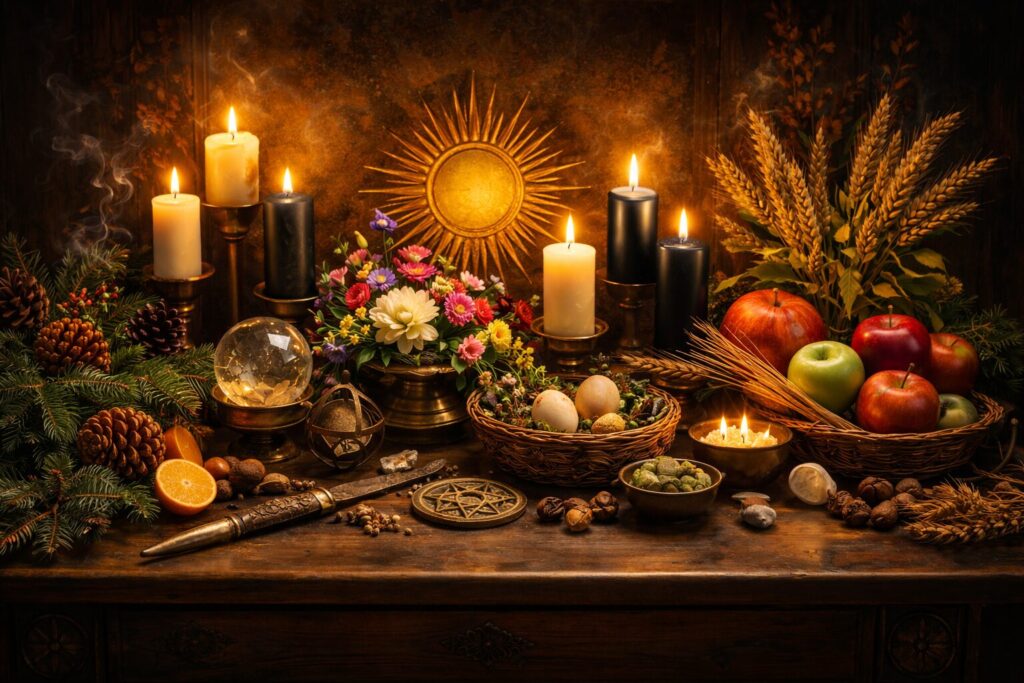
For many practitioners, the altar is not rebuilt from scratch for every celebration. Instead, it is a standing, living space — one that evolves as the year turns. Objects are rotated, colors are shifted, offerings are refreshed, and symbols are layered or removed in response to the season.
In this way, the altar becomes a seasonal instrument. It teaches the rhythm of the year not only through ritual days, but through daily presence. The sabbats mark thresholds. The seasonal altar holds those thresholds in view between them.
At My Cousins Coven, seasonal altar work is understood as a practice of continuity. The altar remains. The year moves through it.
This guide focuses on how to treat, adapt, and rotate a standing altar through seasons and holy days — while deeper altar construction and ritual fundamentals are explored in our foundational guides.
The Seasonal Altar as Sacred Technology
A seasonal altar is not simply a place where seasonal objects are placed. It is a ritual interface — a physical structure that trains awareness, memory, and response to time.
When the same altar space is used across months and years, it begins to store seasonal memory. The return of certain colors, scents, and symbols becomes a form of embodied teaching. The hands remember before the mind does.
Over time, the altar also trains the nervous system. Light, scent, texture, and familiar arrangement signal safety, focus, or transition in ways that bypass conscious thought. This is part of how ritual becomes grounded in the body rather than held only in belief.
This is why many practitioners maintain a standing altar:
- The altar becomes a continuous threshold
- The seasons move through it rather than replacing it
- Ritual time is made visible in daily life
- The body learns the Wheel through repetition
What we place on the altar repeatedly is what we train ourselves to see as sacred. In this way, attention itself becomes a form of power.
The Threefold Structure of a Seasonal Altar (and How to Rotate It)
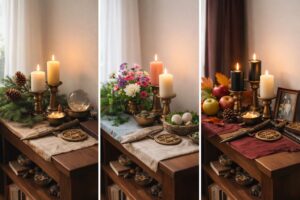
A standing altar that shifts with the seasons is best understood in layers. This makes rotation intuitive rather than disruptive.
Seasonal Markers — The Time Layer
- Greenery, flowers, grain, fallen leaves
- Seasonal colors and fabrics
- Fruits, seeds, or natural materials
- Weather-related symbols (sun, frost, rain, fire)
Symbolic Focus — The Meaning Layer
- Balance symbols at equinoxes
- Solar imagery near solstices
- Ancestral tokens near Samhain
- Fertility and growth symbols in spring
Personal Thread — The Living Layer
- Petitions, goals, or written intentions
- Photos or tokens tied to current cycles
- Tools being actively worked
- Offerings reflecting present needs
Sabbat Altar Themes & Seasonal Shifts
Yule — Return of the Light
Evergreen, solar imagery, gold and deep green. Focus: holding light through darkness.
Imbolc — Stirring Flame
White tones, seeds, forge or flame symbols. Focus: hidden growth and preparation.
Ostara — Quickening Earth
Eggs, flowers, bright greens and yellows. Focus: emergence and balance.
Beltane — Fire and Fertility
Red and green, flowers, ribbons. Focus: sacred joining and vitality.
Litha — Crowned Sun
Gold, solar symbols, bright herbs. Focus: power at its height.
Lughnasadh — First Harvest
Grain, bread, harvest colors. Focus: sacrifice and gratitude.
Mabon — Second Harvest
Apples, wine, balance imagery. Focus: accounting and equilibrium.
Samhain — The Veil
Black and deep purples, ancestral tokens, food offerings. Focus: communion across thresholds.
Adapting to Land, Climate, and Lineage
Seasonal altar work is shaped by where you live. A forest altar, a desert altar, and an urban apartment altar will all express the same sabbats differently.
Consider local harvest times, native plants, and regional climate patterns. These influences are not secondary to the Wheel. They are how the Wheel becomes real.
Over years, certain objects may return again and again, accumulating seasonal memory and becoming anchors of lineage as well as time.
Rotating a Standing Altar (Practical Rhythm)
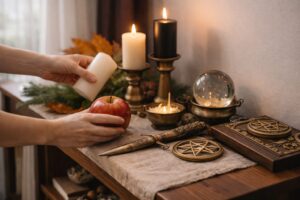
Many practitioners maintain a core altar structure and rotate only a few key elements as the seasons move:
- Fabric or altar cloth changed at sabbats or equinoxes
- Seasonal natural items refreshed monthly or as they fade
- Candles shifted in color and meaning by season
- Ancestral or working items added or removed as needed
Simplicity, Continuity, and Real Power
A seasonal altar does not gain power through quantity. It gains power through repetition.
One candle and one seasonal object, returned year after year, will often hold more ritual weight than a crowded altar assembled for appearance.
Continuity teaches the body. The hands learn the Wheel. The eye learns the turn. The altar becomes a living memory of sacred time.
Perfection is not required. Presence is.
Further seasonal guides and resources to support ongoing practice, altar work, and engagement with the turning of the ritual year: