Paganism
A Living Sacred World
Paganism is not a single religion, nor simply an attempt to recreate the religions of the ancient world. It is a broad family of living religious and spiritual traditions, and one part of the much larger human landscape of religion. For a broader look at what religion is, how it differs from spirituality and magic, and how religious traditions take shape.
Some Pagan traditions carefully reconstruct older religions. Others have developed through modern revival, new religious movements, or practices created within living communities. Some Pagans are polytheists, some animists, some pantheists, and others understand divinity in entirely different ways. There is no single Pagan creed that binds them all together.
What they share is harder to reduce to one belief. Paganism is often found in relationship: with the land beneath us, with the powers and beings we regard as sacred, with inherited traditions and newly made ones, and with a world that many Pagans experience as alive with meaning.
Modern Paganism is therefore both old and new—rooted in humanity’s long history of religious life while continuing to grow, change, and create traditions of its own.
Paganism is an umbrella term for a wide and varied family of religious and spiritual traditions. There is no single Pagan church, sacred text, creed, founder, or governing authority, and there is no one set of beliefs that every Pagan is expected to hold.
That diversity is not incidental to Paganism; it is one of its defining characteristics.
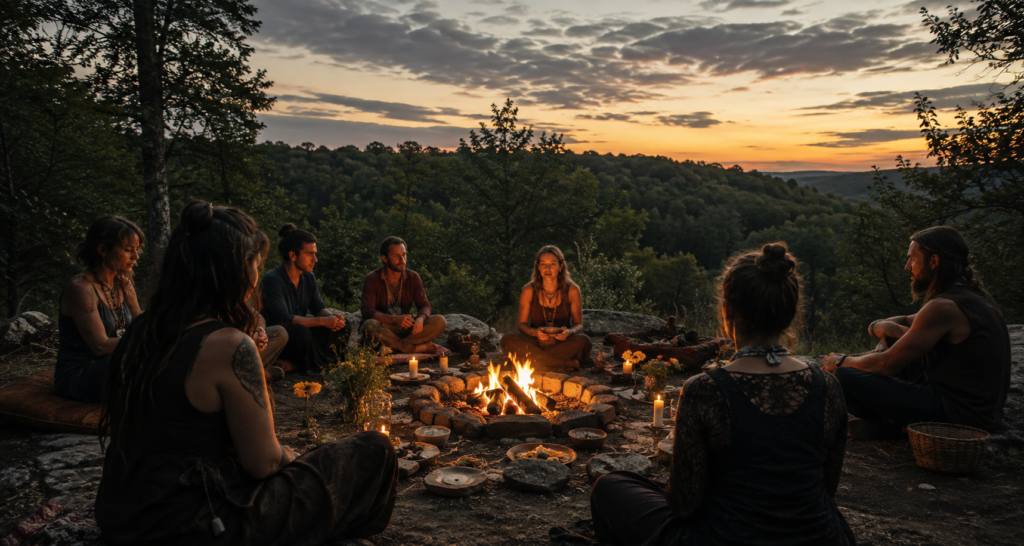
A Pagan may worship many gods, understand divinity as present throughout nature, work primarily with ancestors or spirits, follow a reconstructed ancient religion, participate in a modern tradition such as Wicca or Druidry, or practice in ways that do not fit neatly into any of those categories. Some belong to established organizations or covens. Others practice alone. Some inherit traditions through teachers and communities, while others build a religious life through study, experience, and personal devotion.
Even the word Pagan has changed considerably over time. Today it is most often used as a broad religious identity connecting a number of modern traditions that draw, in different ways, from pre-Christian religions, folk practices, revived traditions, nature-centered spirituality, polytheism, animism, and newer forms of religious practice.
This means that statements beginning with “Pagans believe…” should usually be treated with some caution. There are beliefs common among many Pagans, and there are important shared influences, but very few claims can truthfully be applied to everyone beneath the Pagan umbrella.
It is usually more accurate to speak of Paganisms—many traditions, communities, practices, and understandings of the sacred sharing space within a larger religious movement.
Ancient Paganism & Modern Paganism
The word Paganism can refer to two related but very different things: the many pre-Christian religions of the ancient world, and the modern religious movement that draws inspiration from them.
Ancient Pagan religions were not one unified faith. Greeks, Romans, Egyptians, Germanic peoples, Celts, Slavs, and countless other cultures maintained their own gods, rites, sacred places, priesthoods, household customs, and relationships with the dead. The people practicing these religions would not generally have understood themselves as members of a single religion called Paganism.
Modern Paganism is different. It developed much later through revival, reconstruction, scholarship, folklore, esotericism, changing attitudes toward nature and religion, and the creation of new spiritual traditions. The term Neopaganism is sometimes used, particularly in historical or academic writing, to distinguish this modern movement from the religions of antiquity. On this site, we generally use modern Paganism or simply Paganism when the meaning is clear.
Modern Pagans relate to the ancient past in very different ways. Some reconstructionist traditions work carefully with archaeology, surviving texts, historical scholarship, language, and cultural evidence to restore religious practices as faithfully as possible. Other traditions draw inspiration from older religions while openly adapting them to contemporary life. Still others are distinctly modern creations that have developed their own rituals, theology, and community traditions.
There is therefore no contradiction in saying that modern Paganism has ancient roots and a modern history.
The past matters deeply within Paganism, but Pagan religion does not exist only in ruins, old manuscripts, or reconstructed ceremonies. It is practiced now—in homes and gardens, temples and rented halls, city apartments and rural landscapes, online communities and established congregations. Ancient traditions remain sources of memory and inspiration, while modern Pagans continue creating religious lives suited to the world in which they actually live.
Many Traditions, No Single Pagan Theology
One of the easiest mistakes to make about Paganism is to imagine that its many traditions share a single theology beneath the surface. They do not.
Some Pagans are polytheists who understand the gods as distinct beings with their own identities, relationships, histories, and wills. Some are animists, experiencing the world as inhabited by many kinds of persons and presences—human and other-than-human. Some are pantheists or panentheists, understanding divinity as present throughout the universe or as something that both fills and exceeds it.
Others approach the gods symbolically, psychologically, archetypally, or through combinations of these perspectives. Some Pagan traditions center devotion to particular deities. Others place greater emphasis on land, ancestors, spirits, seasonal cycles, ritual practice, or the sacredness of the natural world.
The differences between traditions can be substantial. A Heathen offering to the gods and ancestors, a Hellenic polytheist maintaining household devotion, a Wiccan working within a ritual circle, and a Druid honoring a sacred landscape may all identify as Pagan while understanding religion, divinity, and practice in noticeably different ways.
Even within individual traditions there may be disagreement. Pagan communities often contain long-running conversations about whether gods are literal beings, manifestations of something greater, cultural forms through which humans encounter the sacred, or realities that resist such neat categories altogether.
Paganism does not require those questions to have one universal answer.
Its religious diversity is better understood as a shared landscape containing many paths than as a single belief system divided into denominations.
The Sacred World
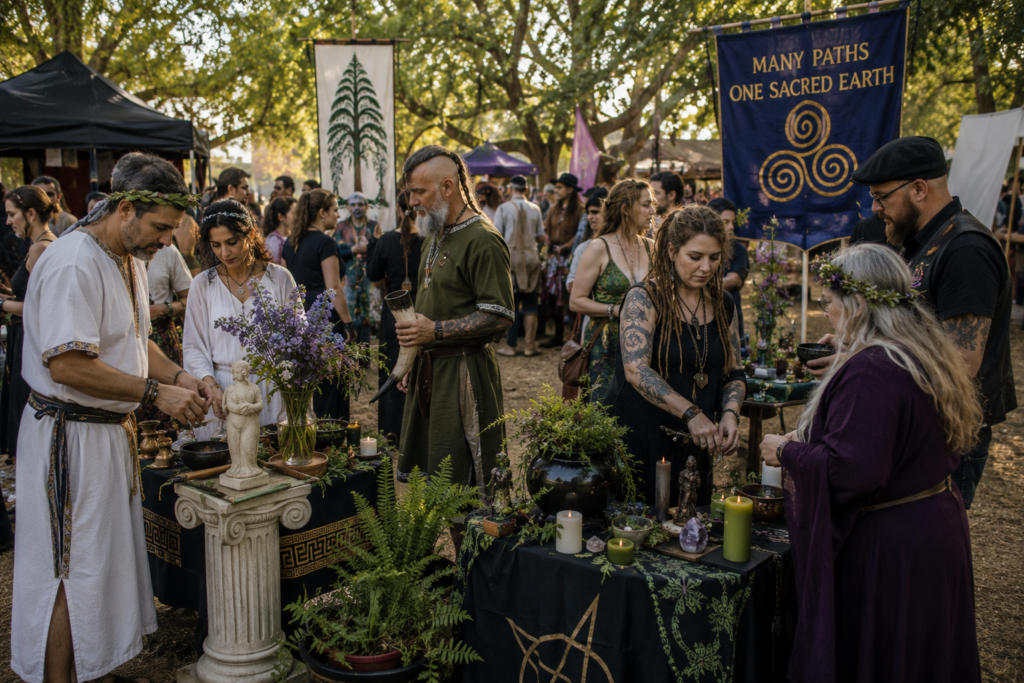
For many Pagans, the sacred is not understood as something entirely separate from the ordinary world.
It may be encountered in a forest or river, at a household altar, beside a grave, beneath the changing Moon, in a city garden, through a deity, in the presence of ancestors, or simply through sustained attention to the place where one lives. The material world can carry religious meaning rather than merely pointing toward something beyond it.
This does not mean that every Pagan “worships nature,” nor that all Pagan traditions understand nature in the same way. For some, particular landscapes, springs, mountains, trees, animals, or other features of the world may possess their own sacred character. For others, the land is part of a larger network of relationships involving gods, spirits, ancestors, humans, and other-than-human beings.
Relationship and reciprocity are important ideas in many Pagan traditions. Offerings may be given. Hospitality may be extended. Sacred places may be tended rather than simply visited. The seasons may be observed not only because they are beautiful, but because they locate human life within larger cycles of growth, decline, death, and renewal.
This can also make Paganism intensely local. A person practicing in the Pacific Northwest, the Mediterranean, Scandinavia, a desert, or the center of a large city does not inhabit the same landscape or encounter the same rhythms. Modern Pagan practice increasingly asks what it means to belong responsibly to the place where one actually lives rather than imagining every sacred landscape as an ancient European grove.
For many Pagans, then, the world is not merely the setting in which religion happens.
It is part of the relationship itself.
Gods & Divinity
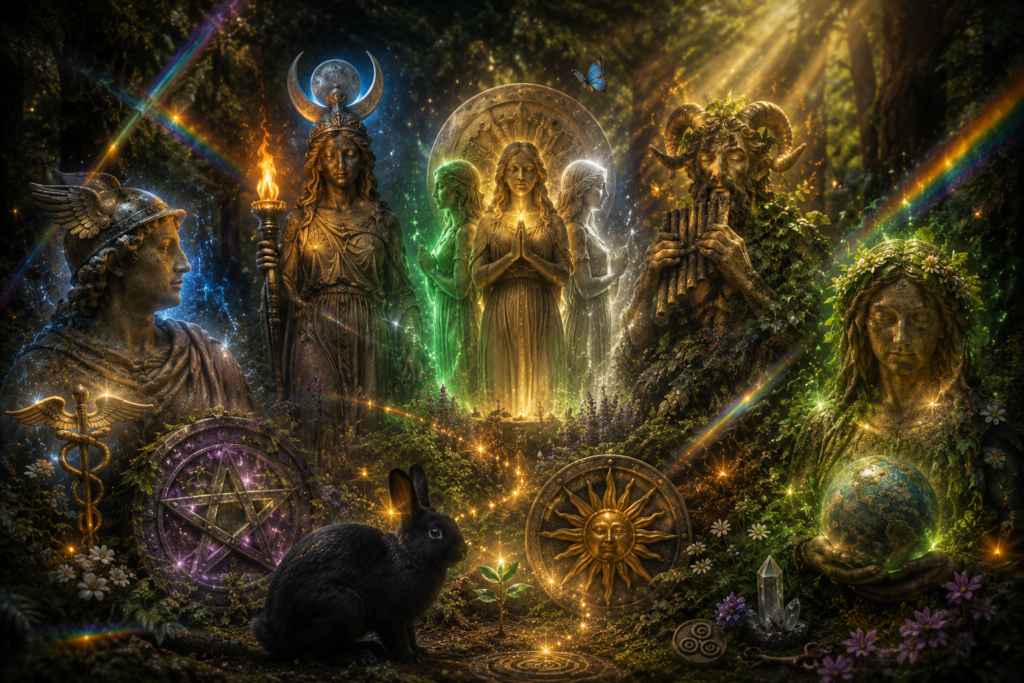
There is no single Pagan understanding of what a god is.
For some Pagans, the gods are distinct beings with their own identities, personalities, histories, relationships, and agency. A Hellenic polytheist may approach Athena or Hermes as individual deities worthy of devotion, just as a Heathen may understand Odin, Freyja, or Thor as gods encountered through a particular religious and cultural tradition.
Others understand divinity differently. Gods may be experienced as expressions of a greater sacred reality, manifestations of nature, archetypal powers, cultural forms through which humans encounter the divine, or realities that cannot be reduced comfortably to any one explanation.
Some Pagan traditions emphasize a Goddess and God, many gods, local spirits, ancestors, or an immanent sacred presence within the world itself. Others make little attempt to define divinity at all.
Paganism has also always existed within cultures that meet, trade, migrate, conquer, borrow, and change. Because of this, syncretism—the meeting and blending of religious traditions—has both ancient and modern precedents. Gods have been identified with one another across cultures, ritual forms have traveled, and religious ideas have been adapted into new settings. Modern Paganism continues this process in some communities, while others deliberately maintain stronger cultural or historical boundaries around their practice.
Neither approach represents Paganism as a whole.
A modern Pagan may devote themselves closely to one pantheon, maintain relationships with deities from several traditions, understand different gods as culturally distinct expressions of something larger, or avoid pantheon-based practice entirely.
The important distinction is that Paganism does not require everyone beneath its umbrella to answer the question “What are the gods?” in the same way.
For many Pagans, theology begins less with achieving a perfect definition and more with learning how to enter into relationship with what they experience as sacred.
Practice Rather Than Creed
Because Paganism has no universal statement of belief, it is often easier to understand Pagan religions by looking at what people actually do.
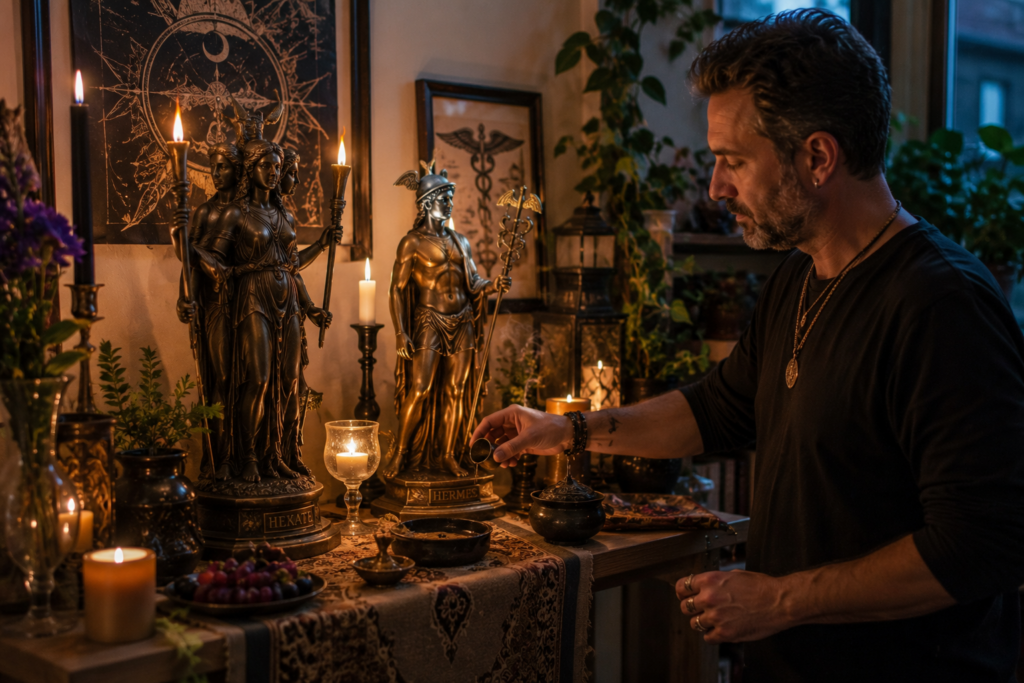
A Pagan religious life might include prayer, offerings, devotional work, seasonal rites, meditation, divination, tending an altar, honoring ancestors, celebrating with a community, maintaining relationships with particular gods or spirits, or caring for a place understood as sacred. Magic may also be part of a Pagan practice, but it is not required, and many Pagans do not identify as witches at all.
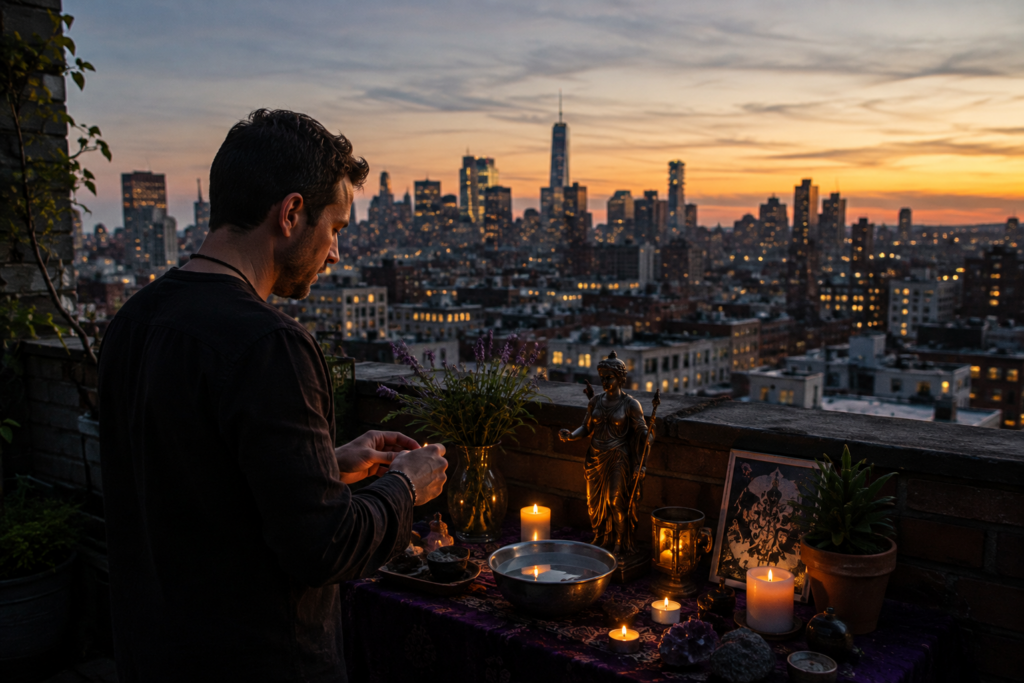
Some practices are quiet and domestic. A candle may be lit before a household shrine in the morning. Food or drink may be offered to a deity or ancestor. A person may keep particular festival days, speak prayers before meals, tend a garden with religious intention, or maintain a small devotional space in an apartment.
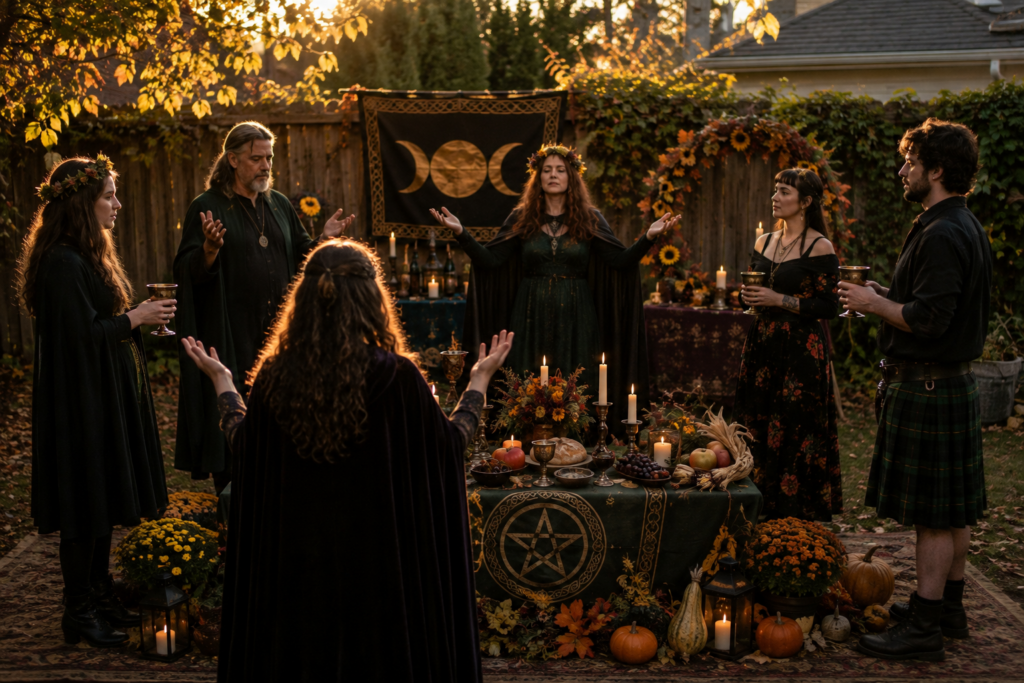
Others are communal and ceremonial: a Wiccan coven casting a ritual circle, Heathens gathering for offerings and feasting, Hellenic Pagans making libations, Druids marking seasonal changes, or an eclectic Pagan community gathering for a public rite.
Modern Pagan practice may be carefully reconstructed from historical sources, inherited through a particular tradition, created within a contemporary community, or consciously syncretic, combining practices and ideas that have come together through study, culture, personal experience, and religious exchange.
What matters to one Pagan may be almost absent from another’s practice. There is no requirement to keep an altar, perform magic, celebrate every festival, worship a particular kind of deity, or practice outdoors.
For many Pagans, religion develops through repeated relationship: showing up, making offerings, keeping observances, learning the stories, tending sacred things, and allowing practice to deepen over time.
Belief matters. But in much of Paganism, belief is something that is lived as much as declared.
Sacred Time & the Wheel of the Year
Religion is often shaped not only by sacred places, but by sacred time.
Pagans may organize religious life around seasons, lunar cycles, agricultural changes, anniversaries, feast days, ancestral observances, or festivals associated with particular gods. These calendars can look very different from one tradition to another.
The best-known modern Pagan calendar is the Wheel of the Year, a cycle of eight seasonal festivals: Samhain, Yule, Imbolc, Ostara, Beltane, Litha, Lughnasadh, and Mabon. Together they mark the solstices, equinoxes, and the seasonal points between them.
The familiar eightfold Wheel developed largely through modern British Paganism, especially Wicca, before spreading widely through the larger Pagan movement. It has become so familiar that it is sometimes presented as though it were an ancient calendar once observed by Pagans everywhere.
It was not.
Several of its festivals have genuine historical roots, but they come from different cultures, periods, and religious settings. Their arrangement into one unified annual cycle is a modern Pagan development—and one that has become a tradition in its own right.
Today, Wiccans, witches, Druids, eclectic Pagans, and many other practitioners celebrate some or all of the Wheel. Communities have also adapted it to their own climates, landscapes, and traditions. A festival shaped around an English agricultural year may naturally feel different when practiced in the Pacific Northwest, the American Southwest, Scandinavia, Australia, or within an urban environment.
Other Pagan religions follow very different sacred calendars. Hellenic Pagans may observe festivals derived from ancient Greek religious calendars. Heathens may mark seasonal feasts and days associated with particular gods or ancestors. Reconstructionist traditions often turn to historical sources rather than adopting the Wiccan Wheel wholesale.
And some modern Pagan practice is consciously syncretic: a practitioner may celebrate part of the Wheel while also keeping deity festivals, ancestral observances, local seasonal rites, or customs drawn from another religious tradition.
There is no requirement that a Pagan celebrate eight Sabbats—or any Sabbats at all.
What these different calendars share is the idea that time itself can be given religious attention. Returning observances create rhythm: a moment remembered last year is encountered again, but neither the practitioner nor the world around them is quite the same.
Sacred time turns repetition into relationship.
Paganism, Witchcraft & Wicca
Paganism, witchcraft, and Wicca overlap extensively, but they are not interchangeable words.
Paganism is the broadest of the three: a family of modern religious and spiritual traditions containing many different theologies, cultures, and forms of practice.
Wicca is one religion within that larger Pagan landscape. Developed during the twentieth century and drawing from ceremonial magic, folklore, earlier occult currents, ideas about pre-Christian religion, and modern innovation, Wicca brought religious devotion and ritual witchcraft together in a particularly influential form.
Witchcraft, meanwhile, is better understood as a practice, craft, or magical identity rather than a religion that automatically determines what someone believes. Many Pagan witches practice witchcraft as an expression of their religion, but not every Pagan is a witch, and not every witch is Pagan. Witchcraft can also exist within Christian, folk-religious, occult, secular, and other spiritual settings.
The boundaries are made more complicated by history. Wicca was enormously influential in the growth of modern Paganism, particularly in the English-speaking world. Its ritual structures, seasonal festivals, magical vocabulary, Goddess and God imagery, and understanding of witchcraft traveled far beyond initiatory Wiccan traditions. Some became so widespread that they are now encountered throughout eclectic Paganism and modern witchcraft.
The exchange has never moved in only one direction. Wicca itself developed within a syncretic environment, bringing together material from several religious, magical, folkloric, and esoteric currents. Later Pagan and witchcraft traditions borrowed from Wicca, adapted what they inherited, rejected parts of it, and created new practices of their own.
Other Pagan religions developed along different lines. A Heathen, Hellenic polytheist, reconstructionist, or devotional Pagan may have little interest in witchcraft at all. Conversely, someone may practice spells, folk magic, divination, or ritual magic while having no Pagan religious identity.
For newcomers, the simplest distinction is useful:
Paganism describes a religious landscape. Wicca is one religion within it. Witchcraft is a craft that may—or may not—be practiced there.
The three share a great deal of history, but none can stand as a synonym for the others.
Reconstruction, Revival & New Traditions
Modern Pagans do not all approach the past in the same way.
Some traditions are reconstructionist. They draw carefully from archaeology, surviving religious texts, inscriptions, folklore, linguistics, and historical scholarship in an effort to understand how a particular pre-Christian religion was actually practiced. Modern Hellenic polytheism, Heathenry, Roman reconstructionism, and several Celtic, Slavic, and other traditions contain strong reconstructionist currents.
Reconstruction does not mean pretending that the modern world does not exist. Ancient societies cannot simply be recreated, and historical evidence is often incomplete. Reconstructionists therefore make choices about how an older religious tradition can be practiced responsibly under modern conditions while remaining as historically grounded as possible.
Other Pagans work more through revival. A revived tradition may look toward older mythology, folklore, seasonal customs, sacred landscapes, or cultural memory without attempting to reproduce an ancient religion exactly. Modern Druidry is one important example: deeply influenced by the Celtic past, but also shaped by centuries of modern religious, literary, philosophical, and cultural development.
Still other traditions are openly modern. Wicca, for example, drew from older religious ideas, folklore, ceremonial magic, folk practice, occultism, and modern innovation to form something new. Its value does not depend upon being an unchanged survival from antiquity.
And many contemporary Pagans practice eclectically or syncretically. They may bring together devotional practices, deities, magical systems, seasonal observances, philosophies, or cultural influences that originated in different places. At its best, syncretism is not simply collecting appealing pieces from everywhere; it involves learning where practices come from, understanding their context, and considering how they fit together.
These approaches sometimes disagree with one another. A reconstructionist may place great importance on historical continuity and cultural context, while an eclectic Pagan may place greater weight on religious experience and adaptation. Both conversations have helped shape modern Paganism.
There is no single correct relationship with the past.
Some Pagans seek to restore. Others seek to revive. Some deliberately adapt, combine, or create.
What matters is being clear about which of those things we are doing.
A Modern Religious Movement with Ancient Roots
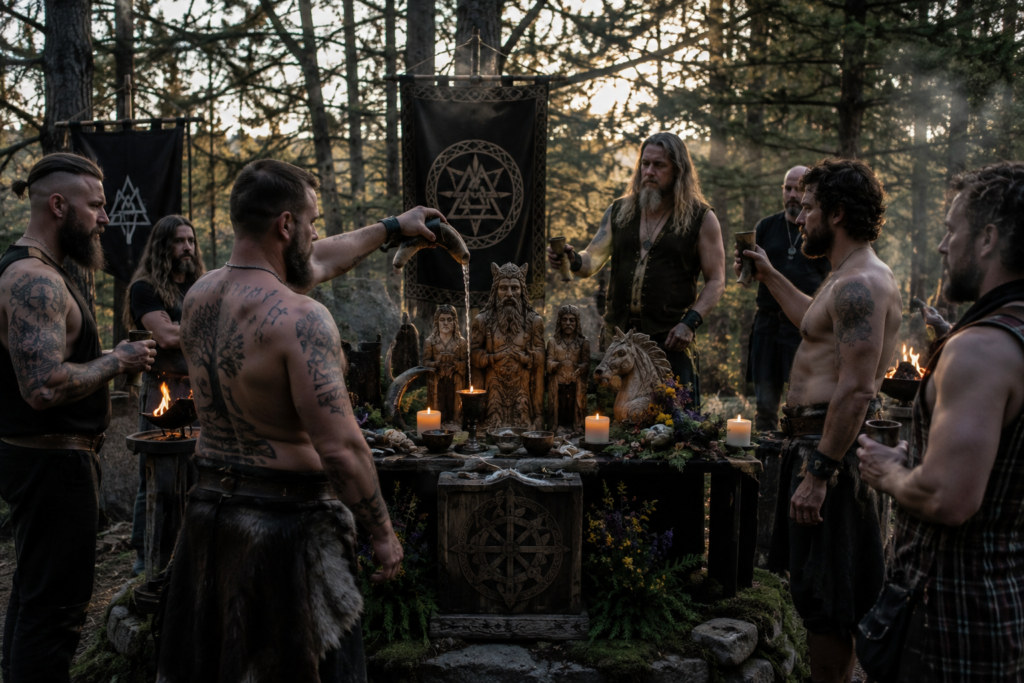
Modern Paganism looks toward the ancient world, but its own story belongs largely to the modern one.
Its emergence was shaped by changing European attitudes toward pre-Christian religion, the recovery and translation of ancient texts, archaeology and folklore, Romantic ideas about nature, ceremonial occultism, new understandings of mythology, and the gradual reimagining of religions that Christianity had long treated primarily as remnants of a superseded past.
During the nineteenth and early twentieth centuries, antiquarians, folklorists, artists, poets, occultists, and early religious innovators all helped create new ways of imagining the Pagan past. Some of their conclusions would later prove historically mistaken. Others preserved traditions, texts, symbols, and questions that became important to people seeking religious alternatives in the modern world.
The twentieth century changed the landscape dramatically. Modern Druidry continued to develop. Wicca emerged publicly and became enormously influential. Heathen, Hellenic, Goddess-centered, reconstructionist, ecological, and other Pagan movements grew alongside them. Books and correspondence connected practitioners who might once have remained isolated, while later festivals, organizations, the internet, and social media made Pagan communities increasingly visible to one another.
The counterculture, feminism, environmentalism, LGBTQ+ communities, alternative spirituality, and changing ideas about religious authority also influenced the movement. Paganism became a place where people could reconsider the relationship between religion and the body, nature, gender, sexuality, magic, personal experience, and authority.
None of this makes modern Paganism less real because it is modern.
Religions have always developed through encounter, reinterpretation, migration, disagreement, syncretism, revival, and change. Modern Paganism is particularly open about that process. It reaches backward, but it does not live backward.
Ancient gods are worshipped by modern people. Old festivals are reconstructed while new ones become traditions. Ancient philosophies meet contemporary ethics. Historical research can change religious practice, while experience and community continue to generate practices that no ancient source ever recorded.
Modern Paganism is therefore neither an untouched survival of an ancient religion nor a tradition invented without a past.
It is a modern religious movement in sustained conversation with the ancient world.
Where We Stand Within Paganism
My Cousin’s Coven belongs within the broad modern Pagan landscape, but we do not mistake our particular way of practicing for a definition of Paganism as a whole.
We are a practicing coven shaped strongly by modern witchcraft and Wicca, while drawing from a wider Pagan and occult inheritance. Ritual, magic, deity, seasonal observance, divination, protection, spirit relations, and devotional practice all have places within our work. Some of what we do would feel familiar to a Wiccan; other parts come through folk practice, ceremonial magic, polytheistic devotion, animism, and traditions that have developed within the coven itself.
Our Paganism is therefore eclectic and syncretic, but not indiscriminate. We are comfortable acknowledging that traditions influence one another, that practices travel, and that modern Pagan religion has always developed through exchange. At the same time, we believe that knowing where a practice comes from matters. Borrowing becomes more meaningful when it is accompanied by study, context, and respect.
We tend toward a world in which gods, spirits, land, ancestors, and other presences are approached as relationships rather than merely symbols. Members of the coven may understand those relationships somewhat differently, and we do not require one philosophical explanation for every spiritual experience.
The sacred world is not separate from ordinary life for us. It is encountered at the altar and the crossroads, in ritual and household practice, through the seasons, in places we return to, and through the relationships we maintain with gods and spirits over time.
We also practice witchcraft as part of our religious life. That distinction matters. We do not believe all Pagans must be witches, nor do we believe witchcraft belongs exclusively to Paganism. For us, however, Pagan religion and the Craft are deeply intertwined.
Our calendar reflects that same mixture of inheritance and living practice. We observe the modern Pagan seasonal cycle, lunar rites, deity observances, and other occasions meaningful to the coven. Some have old roots; some are modern; some have changed through use. We do not regard newness as a weakness when a tradition has meaning, continuity, and a community willing to carry it forward.
Perhaps most importantly, we understand Paganism as something still being made.
We inherit. We study. We revive. We borrow carefully. We adapt. We create.
And then we pass something onward.
Pagan Philosophies
Paganism does not stop at ritual and practice. Beneath those practices are larger questions about what the world is, what the gods are, where consciousness resides, what makes something sacred, and how humans belong within a world filled with other forms of being.
Pagans have never answered those questions in only one way.
A polytheist may begin from the reality and individuality of many gods. An animist may begin with a world populated by many kinds of persons, only some of them human. A pantheist may understand the universe itself as divine, while a panentheist sees the sacred as present throughout existence yet greater than it. Other Pagans approach divinity through mysticism, archetype, philosophy, direct religious experience, or combinations of several perspectives.
These ideas can overlap. Someone may regard the gods as distinct beings while also believing they participate in a larger sacred reality. Another may understand a river as both a physical ecosystem and a presence with whom relationship is possible. Pagan thought does not always require choosing between the material and the sacred.
That openness has also made modern Paganism fertile ground for syncretic philosophy. Ancient religious ideas meet modern ecology, occult philosophy, psychology, mysticism, and contemporary understandings of consciousness and nature. Sometimes those combinations produce fruitful new ways of thinking; sometimes they create contradictions that deserve closer examination.
There are also questions of ethics. If the world is alive with relationships, what obligations follow from that? What does reciprocity mean between humans and land, gods, spirits, animals, ancestors, or communities? How do personal religious experiences remain open to discernment rather than becoming unquestionable truths?
MCC has its own developing answers to many of these questions, but we do not present them as the Pagan answer.
We regard Pagan philosophy as an ongoing conversation—one in which ancient thought, modern scholarship, lived practice, religious experience, and disagreement can all have a place.
Sometimes the deeper path begins not with finding the correct answer, but with learning how to ask a better question.
A Religion Still Being Lived
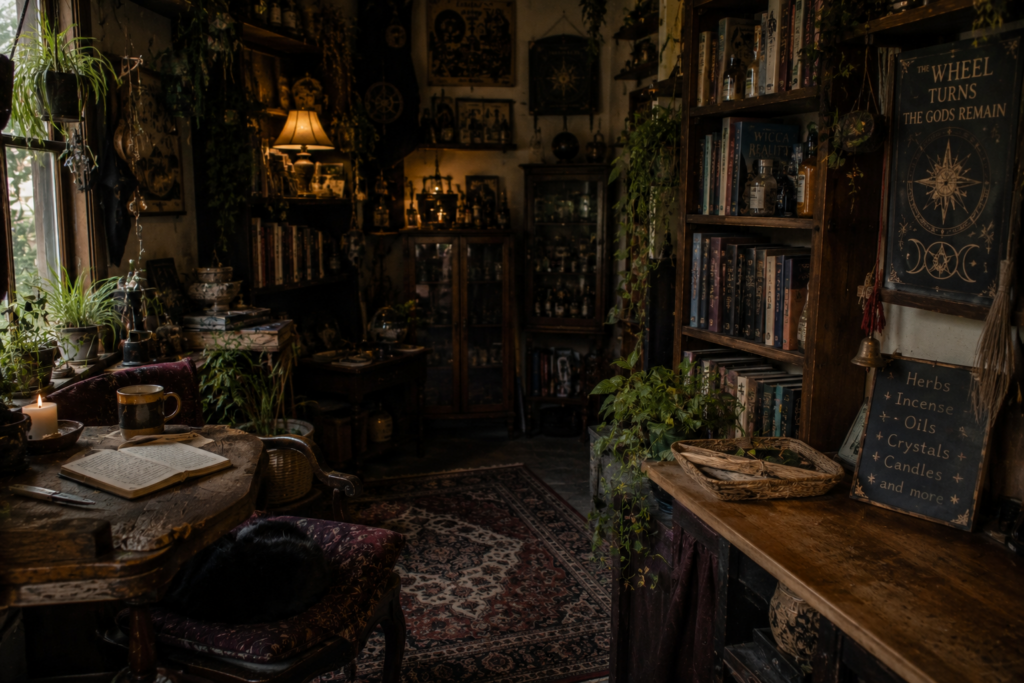
Paganism is sometimes spoken about as though its most important days are behind it—as though the real religion belongs to ancient temples, lost groves, old gods, and people whose worlds disappeared centuries ago.
Modern Pagans tell a different story.
The past matters. History matters. Knowing where our gods, rituals, symbols, and traditions come from matters. But religion cannot survive as archaeology alone. It lives when people pray, make offerings, gather in community, mark sacred time, care for places, tell old stories again, question inherited ideas, and create practices that become meaningful enough to pass onward.
That is why modern Paganism can contain reconstruction and invention, scholarship and experience, solitude and community, ancient gods and contemporary lives. Its diversity can be difficult to define precisely, but perhaps that is also one of its strengths. Paganism has room for traditions that preserve carefully, traditions that adapt freely, and ongoing arguments about where the boundaries between those approaches should lie.
For us, Paganism is not primarily an escape into an imagined past. It is a way of entering more deliberately into relationship with the world we inhabit now—with gods and spirits, land and place, other people, inherited traditions, and the mysteries that remain larger than our explanations of them.
The old material matters.
But Paganism lives because people continue to make something living from it.
Where to Go Next
Paganism opens into many subjects, and the best next step depends on what brought you here.
Follow its modern history, explore individual Pagan traditions, look more closely at Wicca, enter the living world of animism and sacred ecology, follow the seasonal Wheel, or trace the occult currents that helped shape modern Pagan religion and witchcraft.
There is no required order. Choose the path that interests you and go deeper.