Synchronized Will
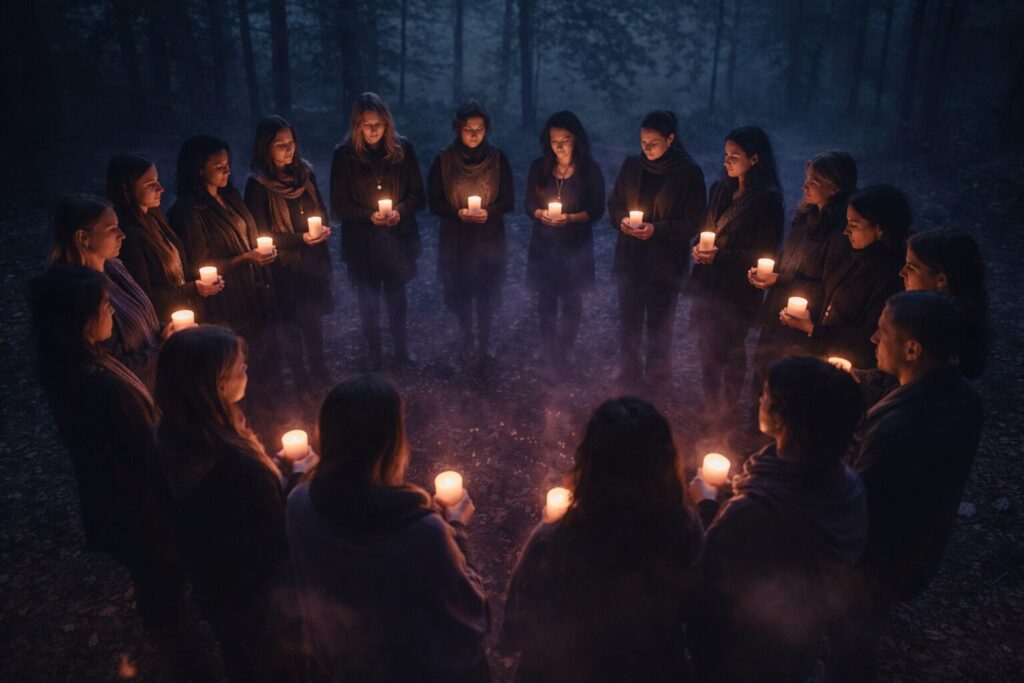
Even the witch who works alone carries inherited rhythms — language, symbols, myth, breath patterns learned from others, emotional templates shaped by culture. Magic emerges from human nervous systems, and human nervous systems evolved in groups. The solitary practitioner is real, but solitude itself is a position within a social field, not an escape from it.
A coven makes this truth visible.
When practitioners align attention, breath, and intention, something emerges that cannot be reduced to any single participant. The circle becomes a structure that stabilizes intensity. The ritual space acquires memory. Emotions circulate rather than dissipate. Focus compounds rather than fragments. What one person could hold for seconds, a synchronized group can sustain for minutes or hours.
This is the collective field.
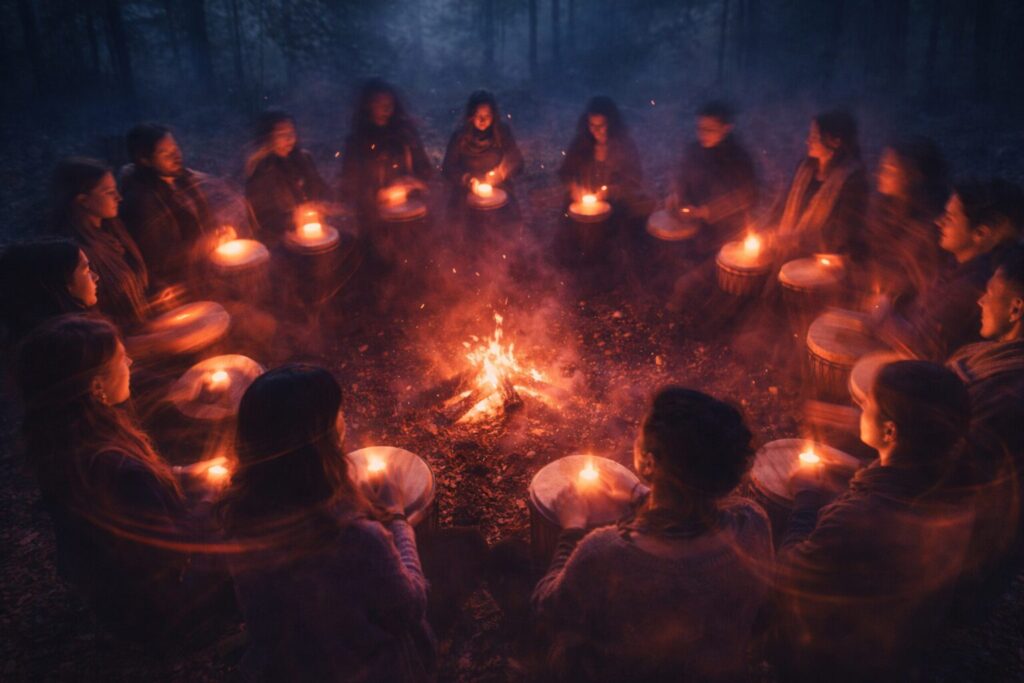
It is not metaphorical. It is not mystical exaggeration. It is the observable phenomenon that occurs when multiple minds enter rhythmic coordination. Chanting, drumming, coordinated movement, shared silence, and synchronized visualization entrain bodies and perceptions into a temporary system larger than its parts. The coven becomes an instrument. The ritual becomes the music played through it.
Festivals, liturgy, protests, choirs, trance dance, and ancient temple rites all operate on the same principle: synchronized humans generate amplified experience. Witchcraft did not invent this technology; it inherited and refined it. The coven is one of the oldest laboratories for studying how shared attention alters reality — psychological, emotional, and magical at once.
To understand collective magic is to understand that power does not only reside in the individual will. It also arises in the space between practitioners. That space is not empty. It is structured, responsive, and trainable.
The craft of the coven is the craft of shaping that space.
How Collective Fields Form
A collective field is not created by belief alone. It forms through synchronization — bodies and minds entraining into shared rhythm until the group begins to function like a single, coherent instrument.
Human nervous systems are designed to coordinate. Breath naturally matches cadence. Attention locks onto whatever the group treats as “central.” Emotional tone spreads through subtle cues: posture, pace, voice, and silence. A coven does not need perfect agreement to generate a field; it needs shared timing and shared orientation — a mutual willingness to step into the same ritual grammar.
This is why the old technologies endure. Chant harmonizes breath. Drumming harmonizes heartbeat. Repeated gestures harmonize muscle tension. A circle harmonizes direction in space — everyone facing inward toward the same symbolic center. Even a shared altar or candle line becomes a visual anchor that keeps the group’s imagination “looking” in the same direction.
Over time, the group stops feeling like separate operators performing parallel actions and begins to feel like a system with internal flow — energy circulating, attention rippling, intention holding steady. The field becomes the container that carries what no single practitioner can hold alone: sustained focus, layered symbolism, deep emotion, and extended trance.
Ritual structure is therefore not decoration. Opening, casting, raising, blessing, banishing, and closing are stages in building and dissolving a temporary shared mind. When done skillfully, the coven constructs a field that is structured, responsive, and trainable — not a vague haze, but a living architecture.
Why Group Magic Amplifies Power
Group magic amplifies power because it distributes the work of intention across multiple bodies — and then multiplies it through feedback. In solitary practice, the practitioner must generate, focus, regulate, and sustain the current alone. In a coven, those functions become shared roles within a single circuit.
Attention layers. One person holds the chant steady. Another holds the image. Another carries the emotional charge. Another watches the edges — grounding, containment, timing. Even when roles are unspoken, a mature group naturally spreads functions across the circle. This is why coven work often feels “easier” even when it is more intense: the field does part of the holding.
A coherent field also corrects drift. If one mind wanders, the rhythm pulls it back. If one person spikes with anxiety, the group’s steadiness dampens it. If someone surges with force, the field absorbs and redistributes the pressure so the working remains stable rather than chaotic. This circulation is one of the great secrets of coven craft: it prevents burnout while raising peak output.
The result is not simply “more energy.” It is stability — the ability to sustain complexity, symbolism, and emotional charge for longer than a solitary mind can manage. A coven can hold a working in layered focus: myth and intention, protection and blessing, trance and precision, all at once.
And because groups build memory, the amplification compounds over time. A coven that practices together develops shared cues, shared timing, and a shared energetic vocabulary. Each rite reinforces the next. The circle becomes a vessel that remembers how to become a field.
The Shadow of the Collective Field
Every force that unites can also overwhelm. The collective field is powerful precisely because it pulls individuals into coherence — and coherence can blur boundaries if consent and reflection are not actively maintained.
In a strong group current, emotions spread quickly. Excitement can become pressure. Reverence can become uncritical obedience. Shared intensity can silence dissent, not because anyone intends harm, but because people instinctively protect the group’s momentum. This is how “good intentions” become coercive: the field starts to matter more than the person inside it.
This is not a witchcraft problem. It is a human group problem. Coven work simply makes it visible. The same mechanisms that produce healing communion can also produce unhealthy hierarchy, spiritual bypassing, and a subtle loss of agency — especially when charisma replaces accountability.
Skillful covens build safeguards on purpose: explicit consent, room for disagreement, clear boundaries, and leadership that facilitates rather than dominates. The goal is not to weaken the field but to keep it humane. A field should amplify practitioners, not absorb them. Resonance is the aim — not erasure.
Communion without coercion is one of the clearest marks of mature group craft.
Designing Healthy Collective Ritual
A strong collective field is crafted. It does not rely on hype, vague positivity, or “hoping it works.” It is built through clear intention, reliable structure, and human care.
Begin with agreements. What is the working for? What is off-limits? How do people opt out without shame? Clarify roles when helpful: who keeps time, who leads the chant, who anchors the circle, who tends the altar, who watches the emotional weather. Structure creates safety, and safety allows depth.
Build coherence intentionally: shared breath, shared rhythm, shared symbolic focus. Keep the circle grounded. Encourage hydration, posture shifts, and “return to the body” moments when intensity rises. A healthy field is not constant escalation — it has pulse, rest, and integration.
Closing is non-negotiable. The nervous system needs a ritual return: release excess charge, unhook from the shared rhythm, and re-differentiate the self. Without closure, the field can cling as irritability, fog, or emotional spillover.
Aftercare turns intensity into nourishment. Simple debrief, food, laughter, quiet companionship, and gentle transition back to ordinary reality help the working settle into the psyche and the story of the group. Done well, the coven becomes not only a magical engine, but a stable communal hearth — a place where power and tenderness can coexist.
Shared ritual is not meant to erase individuality. It is meant to expand it — to let each practitioner grow stronger through being held, witnessed, and aligned within a living circle.
Magic is often imagined as solitary heroism — a single will bending reality through discipline and insight. The coven reveals a quieter truth. Humans evolved to think, feel, and transform in groups. The collective field is not an enhancement layered onto magic; it is one of its native environments.
Even solitary practice echoes communal patterns learned long before. Every circle cast alone carries the memory of circles once shared. Every chant carries ancestral voices. The practitioner is never isolated from the human web that produced the craft.
To enter a coven is to step consciously into that inheritance. Shared ritual is not merely efficient. It is a reminder that power circulates — through bodies, stories, symbols, and relationships. The collective field is where intention is witnessed, held, and magnified by others standing inside the same circle.
The architecture of shared power is not about dissolving the self. It is about discovering that the self extends farther than the skin. And in that extension, magic finds one of its oldest homes.