Types of Magic
A Compendium of Magical Practices and Currents
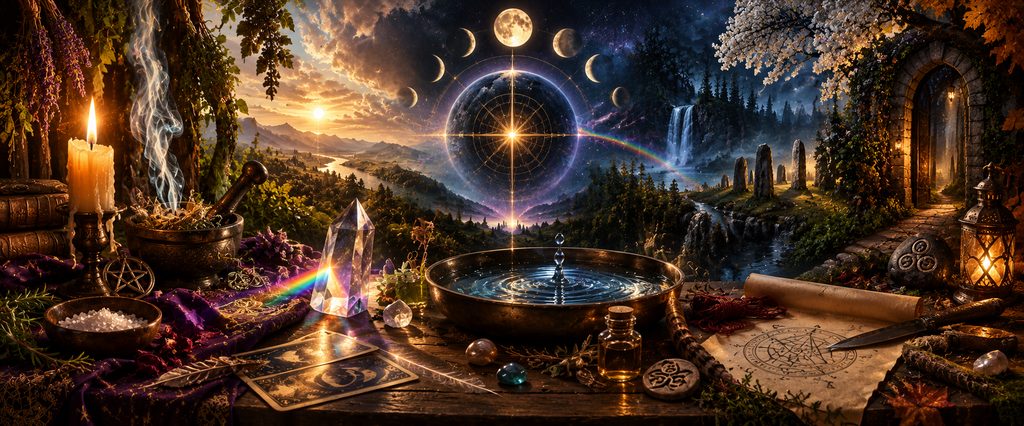
Within the tradition of the Coven of the Veiled Moon, magic is regarded as both a disciplined study and a living art. At its foundation lies a simple principle: magic is intentional participation in the relational field of reality. Through developed Will, a practitioner engages relationships, conditions and available thresholds in an attempt to influence what may become. Magic is not a single substance or universal force waiting to be commanded; it is a way of entering deliberately into a world already alive with pattern, possibility, agency and consequence. The perspectives offered here reflect our present understanding and are presented in broad, practical terms.
Across generations, witches and magical practitioners have developed many ways of doing that work—some rooted in prayer and devotion, others in ritual, symbolism, spirit relationship, altered states, natural materials or highly structured systems. We do not practice every form represented here, nor do all of them operate through exactly the same kind of relationship. Some describe methods, some aims, some media, some forms of access, and others are better understood as devotional, divinatory or supporting practices. Understanding those differences deepens both discernment and respect for the Craft. A working does not exist apart from the practitioner or the conditions it enters; what we attempt, how we attempt it and what follows all become part of the same relational field.
This compendium is therefore offered as both map and mirror: a guide for the curious seeker, a reference for the experienced practitioner and a reminder that magical practice is larger than any one technique. A working begins not by creating power from nothing, but by recognizing what is already present—relationships, possibilities, resistance, openings and agencies—and deciding how, or whether, to intervene. Threshold provides access. Will gives direction. Method gives the intervention form. Consequence becomes part of the world that follows.
Relationships · Conditions · Resources
Channels of Access
The relationships and conditions through which a working gains access, support, or usable connection
Magical workings rarely depend upon Will alone. They take place within existing relationships, places, histories, bodies, objects, communities, spiritual alliances, symbolic systems and conditions of time. Coven of the Veiled Moon uses channels of access for these recurring routes through which a practitioner may establish or strengthen connection, gain support, engage another agency, draw upon a resource, or reach a possibility that would otherwise be more difficult to engage. These channels are not separate kinds of universal magical fuel. They frequently overlap, and access through one does not automatically grant control over what lies beyond it.
MCC Model of Magical Action
In the MCC Model , method gives an intervention form, while a channel describes a relationship, condition, resource, or route through which useful access may be established. A channel may reveal a threshold, strengthen coupling, provide support, introduce another agency, or alter the conditions surrounding the work. Several channels may operate within a single working. The Finger of Light is not one of those channels. It represents continuity through becoming: the carrying forward of relationship and consequence through the changing field.
Personal Will & Capacity
The practitioner brings developed Will, attention, discipline, bodily presence, experience, imagination, emotional stability and available personal resources into the working. Personal capacity matters, but Will is more than wanting something intensely.
P · W · S
Divine & Spiritual Relationship
Relationship with deities, spirits, ancestors and other presences may create access, support, knowledge, alliance or independent participation within a working. Petition and collaboration remain relationships between agencies, not ownership or automatic command.
A⁺ · C · T
Lineage & Initiatory Continuity
Teaching, initiation, inherited practice, coven participation and continuity within a living tradition can provide knowledge, relationship, authorization, shared symbolism and established ways of entering forms of practice carried across generations.
K · C · A⁺ · S
Place & Environmental Relationship
Land, ecology, atmosphere, local history and the particular relationships gathered around a place can materially and magically shape a working. Some locations offer stronger familiarity, correspondence, history or access than others.
Π₀ · C · T
Object & Material Links
Tools, talismans, relics, personal concerns, consecrated materials and significant objects may provide correspondence, continuity, memory, targeting or relational access. Their importance lies in the connection they establish or carry, not merely in possessing power as isolated things.
C · K · S
Collective Participation
Coordinated people, shared ritual, repeated participation and common intention can create forms of access and support unavailable to a solitary practitioner. More participants do not automatically make stronger magic; coherence, relationship and alignment matter.
W · C · A⁺
Energy & Resource Exchange
Many practitioners experience energy as something that can be sensed, raised, shared, circulated, balanced or depleted. MCC recognizes that experience as part of magical practice while not treating energy as the universal substance or complete mechanism behind every form of magic.
S · C · A±
Symbolic & Archetypal Structures
Myth, image, sacred language, number, geometry, story and correspondence give magical intervention structure and meaning. Symbols can help establish relationship and clarify a working, but resemblance alone does not automatically create access.
K · C · W
Temporal & Cyclical Conditions
Timing, lunar and celestial rhythms, seasonal change, ritual calendars and moments of transition may alter the conditions under which a working is attempted. Time does not supply magical fuel; timing matters because possibilities, resistance and available thresholds change as becoming unfolds.
T · Π₀ · C
Method gives the intervention form. Channels describe relationships, resources and conditions through which the practitioner gains access or support. Threshold determines what is reachable; coupling determines how clearly and strongly the connection holds. Access is not control.
Orientation · Foundations · Return
Where to Begin — or Begin Again
Magic can become dense quickly. Whether you are just beginning, returning after time away, or simply want to step back from more complicated material, these paths bring the work back to its foundations: orientation, practical structure, familiar workings, spiritual steadiness, and guidance when you need it.
Returning to foundations is part of practice, not a retreat from it.
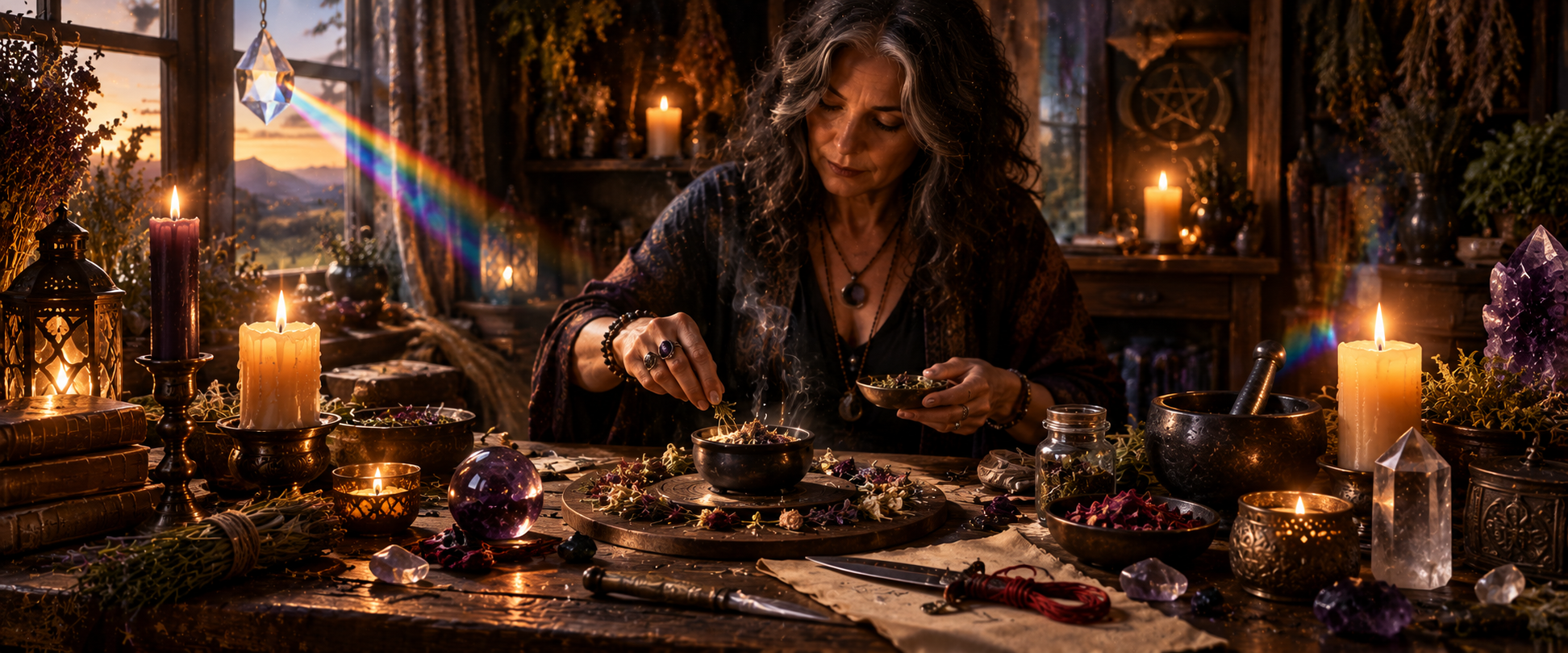
“The road into magic begins not with certainty, but with the courage to notice.” -Kael, MCC
A Working Map of Magical Practice
Types of Magic
Magic takes many forms, and no single list can contain every tradition, method, operation, or name used across cultures and communities. The entries below offer a working map of commonly encountered magical practices, but they are not all the same kind of category. Some are methods, some are aims, some are media or conditions, some are forms of relationship, and some are divinatory or devotional practices that may accompany magic without being identical to magical intervention. For goal-based spellwork and familiar magical needs, visit Common Workings. For help understanding a practice or deciding where to begin, Ask a Witch.
In the MCC Model, M names the method or form of intervention, but this Compendium is broader than M alone. It also includes aims, media, relationships, conditions, channels of access, devotional acts, and forms of inquiry that commonly appear within magical practice. The small notes on each entry indicate model factors that the practice often brings into greater focus; they are not required ingredients, scores, fixed weights, or claims that every entry operates in exactly the same way.
Fit Matters
A practice is not effective simply because it is elaborate, traditional, intense, or impressive. The same method may fit one landscape well and another poorly. Part of magical skill is recognizing what is actually present: the available thresholds, strength of coupling, timing, resistance, relationships, resources, other agencies, and the demands of the intervention being considered.
See Matching the Working to the Landscape →Begin with Stability
Foundations of Practice
Before complex spellwork, spirit contact, or altered states, many practitioners learn to stabilize themselves, clear unwanted influence, establish boundaries, prepare sacred space, and work deliberately with attention, relationship, personal resources, and—where it is part of their practice—experienced magical energy.
Grounding & Centering
Stabilizing awareness in the body, the present moment, and the place where magical work is performed.
Explore Grounding & Centering →Cleansing & Purification
Clearing unwanted residue or influence from people, objects, tools, and ritual environments before or after a working.
Explore Cleansing & Purification →Warding
Establishing durable magical boundaries that deter, redirect, contain, or alert against unwanted intrusion.
Explore Warding →Sacred Space
Preparing and defining ritual space so attention, relationship, boundaries, roles, and working conditions can be held intentionally.
Explore Sacred Space →Energy Work
Sensing, raising, directing, balancing, holding, or releasing what practitioners experience as subtle energy or force. MCC treats this as a real part of some practice without making it the universal mechanism behind all magic.
Explore Energy Work →Transformation of matter and self through laboratory, symbolic, and spiritual processes.
Honoring and maintaining relationship with ancestors through remembrance, offerings, guidance, protection, and continuity.
Averting or turning away harmful influence through protective signs, gestures, charms, boundaries, and objects.
Deliberately shifting awareness beyond ordinary bodily perception to explore subtle, imaginal, or spiritual environments.
Reading celestial placements and cycles to interpret tendencies, relationships, timing, and changing conditions.
Separating, driving away, or clearing unwanted presences, influences, or conditions from a person, object, or place.
Constraining an action, influence, pattern, or harmful behavior through symbolic or direct magical means.
Using flame, color, material, scent, inscription, and timing to give a working structure, correspondence, focus, duration, or a clear point of release.
Structured magical systems using established rites, symbols, correspondences, invocations, tools, and disciplined practice.
A flexible, results-oriented approach that treats belief, symbol, technique, and paradigm as adaptable magical tools.
Setting apart and dedicating an object, tool, place, or act for sacred or specifically magical purpose.
Working through a continuing relational link believed to remain after contact, as with hair, clothing, soil, or personal objects. Such links may strengthen targeting, access, or coupling within a working.
Working at literal or symbolic crossroads where choice, convergence, transition, exchange, or changing conditions make multiple routes or relationships especially visible and accessible.
Working with stones and minerals through correspondence, relationship, placement, grids, talismanic use, and ritual preparation.
Making food, drink, ingredients, preparation, and shared meals part of intentional magical and devotional practice.
Magic intended to impose harm, obstruction, consequence, or misfortune; ethically disputed and approached with particular care.
Using symbols, patterns, tools, or impressions to inquire into hidden conditions, tendencies, relationships, and possible pathways. Divination primarily seeks information; it may guide a magical intervention without being identical to the intervention itself.
Using dreams as a field for insight, divination, spiritual encounter, incubation, problem-solving, and magical practice.
A persistent group-associated form or entity shaped through shared identity, attention, symbolism, ritual, and accumulated history.
Working with earth, air, fire, water, and spirit as forces, relationships, ritual structures, or symbolic principles.
Establishing and sustaining a deliberate magical purpose in relation to an object, place, condition, or ongoing pattern.
Calling an independent presence toward external encounter or manifestation within a defined ritual field.
Everyday and community-rooted magic expressed through charms, customs, household practice, remedies, signs, and inherited techniques.
Shaping perception, presentation, attention, or social presence through magical and symbolic means.
Magical or devotional work intended to support balance, vitality, recovery, comfort, and wholeness alongside appropriate practical care.
Everyday witchcraft rooted in home, boundary, land, practical relationship, domestic protection, and the meeting of cultivated and wild.
Using deliberate speech, chant, prayer, formula, repetition, song, or command as an operative part of magical action.
Inviting a deity, spirit, power, or sacred aspect inward or into embodied, indwelling, or closely participatory relationship.
Tying, weaving, binding, measuring, encoding, holding, or releasing intention and symbolic relationship through cord, thread, and knots.
Working with plants through correspondence, relationship, cultivation, preparation, scent, offering, and ritual use.
Aligning intention, attention, symbolic action, and practical movement toward a desired change while working with pathways that are actually available—or attempting to create the conditions through which access might open.
Receiving, interpreting, or mediating communication attributed to spirits or the dead through trained receptive practice.
Using names to identify, define, confer identity, establish relationship, designate purpose, conceal, transform, or precisely target.
Magical work involving the dead, ranging from divinatory or relational contact to formal rites of calling and petition.
Binding promises, vows, offices, or commitments with magical or sacred force and defined consequences or obligations.
Giving food, drink, incense, service, art, attention, or other valued acts within devotional and reciprocal relationship. An offering may support magical work, but its meaning need not be reduced to transaction.
Moving through deliberately structured imaginal, symbolic, or spiritual landscapes for encounter, insight, training, or transformation.
Operative work with planetary powers through timing, correspondences, seals, talismans, prayer, invocation, and ritual alignment.
Direct devotional communication, praise, petition, gratitude, lament, or relationship with deities, spirits, ancestors, or sacred presences. Prayer may accompany magic, but devotion is not automatically a spell.
Establishing safeguards through wards, charms, talismans, boundaries, guardianship, cleansing, and other defensive practices.
Tending passage, transition, and boundaries associated with the dead, including guidance, settling, and liminal care.
Using traditional runic systems or deliberately constructed sigils and seals to encode, focus, carry, or direct magical meaning.
Using sustained receptive attention with mirror, crystal, flame, smoke, water, darkness, or other fields to receive symbols and impressions. Scrying is primarily receptive and interpretive, though it may inform later magical action.
Working with lunar phases, seasons, solstices, equinoxes, festivals, recurring observances, and other rhythms of sacred time. Timing matters because conditions, resistance, and available pathways change as becoming unfolds—not because time itself supplies magical fuel.
Deliberately creating a task-focused magical construct with defined purpose, boundaries, support, and an intended lifecycle.
Engaging hidden, rejected, or unintegrated aspects of the self so magical and spiritual practice can proceed with greater awareness.
Formal methods of calling, addressing, petitioning, negotiating with, or establishing ritual encounter with independent presences.
Working through resemblance, representation, or correspondence so a likeness can stand in meaningful relation to what it depicts. Resemblance can support targeting or coupling, but similarity alone does not automatically establish a usable threshold.
Designing, preparing, consecrating, carrying, or wearing objects intended to hold and continue a magical purpose.
Working deliberately with liminal boundaries, passages, doorways, crossings, beginnings, endings, and transitional states. In the broader MCC Model, a threshold is any meaningful opening that provides access; liminality is one important family of threshold conditions, not the whole concept.
Using breath, rhythm, chant, movement, stillness, sensory focus, or repetition to enter altered and ecstatic states.
Ritually adopting, exchanging, or embodying forms, traits, identities, or symbolic qualities; shapeshifting also appears extensively in magical lore.
Working in relationship with atmosphere, season, land, and weather patterns in attempts to influence or negotiate local conditions.
Ethical, relationship-based gathering of plants, stones, waters, woods, and other natural materials for magical or devotional use.
Put the Compendium to Work
From Method to Practice
Need help choosing a method, identifying a usable threshold, reading resistance, or deciding what kind of working fits? MCC can help you explore the conditions before deciding how—or whether—to proceed.
Method gives intervention form; fit shapes what the working can actually reach, sustain, and change.
Restricted Practice Library
Restricted Practice Threshold
The material beyond this point addresses practices for which MCC places additional adult, consent, safety, ethical, or contextual boundaries. Much of it is also advanced, but difficulty alone is not what makes material restricted. Some subjects require greater context because they involve intimate practice, altered states, significant influence, difficult spiritual work, or other circumstances where maturity, discernment, and informed choice matter.
Why MCC Includes Difficult Material
MCC’s purpose here is education, recognition, discernment, and harm reduction. We do not necessarily practice, recommend, endorse, or condone every method discussed in this library. Difficult knowledge does not become safer simply because it is ignored. We believe informed understanding is one of the strongest defenses against unsafe instruction, coercion, manipulation, reckless experimentation, and misuse of magical authority.
Threshold Magic
Threshold Magic is the liminal family of practices concerned with crossings, boundaries, passages, transition, choice, protection, and movement between conditions. Within the wider MCC model, however, threshold means something broader: a meaningful opening through which one relationship, agency, condition, or possibility becomes accessible to another. Liminal places and moments matter because they often make that access unusually visible, unstable, or significant. These practices therefore attend closely to the between without treating betweenness as the whole meaning of Threshold.
Explore Threshold MagicCrossroads Magic
Work at points of decision, divergence, possibility, and redirection—where more than one route may become accessible at once. Crossroads make choice visible, but their magical importance lies equally in the opening of several possible directions through a single point of passage.
Enter the CrossroadsThreshold Protection
Protection focused upon doors, borders, crossings, sacred boundaries, and other points where one condition or space opens into another. The work is not only to block passage, but to regulate access: what may cross, under what conditions, and into which space.
Explore ProtectionRites of Passage
Ritual recognition and deliberate construction of meaningful transition: entering, leaving, becoming, committing, mourning, naming, joining, releasing, or establishing a threshold between an earlier status and what comes next.
Explore the PassagePsychopomp Work
Work concerned with accompaniment, guidance, death-facing practice, and the sacred responsibility of helping movement across profound boundaries where access, passage, relationship, and uncertainty meet.
Explore Psychopomp WorkThreshold Magic is a family of methods that deliberately works with liminal conditions, crossings, and boundaries. In the broader MCC Model, however, the threshold is the access itself: the opening through which one relationship, condition, agency, or possibility becomes reachable from another. Liminality may reveal, strengthen, regulate, dramatize, or complicate that access. Coupling is a separate question: a threshold may exist without the connection through it being strong, clear, or stable.
Explore the MCC ModelRitual studies has long used liminality for transitional states of betweenness. Arnold van Gennep described rites of passage through separation, transition, and incorporation; Victor Turner later developed the study of the liminal state further. Their work concerns culture and ritual rather than magical mechanics. MCC’s Threshold Magic is its own magical framework, but it engages a related recognition: crossings and transitional states can carry distinctive ritual significance. In MCC usage, liminality is one important family of threshold conditions, not the full definition of Threshold.
A threshold is access, not a single technique. Crossroads, guarding, passage, and psychopomp work meet here because each works deliberately with openings, boundaries, crossings, and transitions. Liminality is one family of conditions in which access may become especially visible, unstable, regulated, or meaningful.
Method · Access · Conditions · Consequence
Reading the Map
The categories on this page are useful because they help us describe different layers of magical practice, but lived work rarely stays inside one category. A candle may give an intervention form, a name may strengthen targeting or relationship, timing may alter the conditions, a deity or spirit may participate as an independent agency, and ordinary action may create or strengthen the threshold through which change becomes possible.
In the MCC Model, M identifies the method or form of intervention. Candle work, naming, sympathetic magic, glamour, ritual speech, or another practice may occupy that role. But not every entry on this page is always a method: prayer may be devotional, divination may be inquiry, and an offering may be relational rather than operative. Naming the form therefore does not explain everything happening in the work.
A working may be supported through personal capacity, divine or spiritual relationship, lineage, place, objects, collective participation, symbols, timing, or experienced energy and other resources. These channels describe recurring routes of access, relationship, and support, not separate species of magical substance. A threshold is the opening that makes access possible; coupling describes how clear, strong, and stable the connection through it becomes. Access is not control.
Timing, knowledge, coherence, targeting, resistance, resources, available thresholds, coupling, mundane circumstances, and assisting or competing agency all matter. Magic therefore does not occur in an empty room. Every working enters a relational field already shaped by history, choices, material conditions, established patterns, and other wills.
Every intervention becomes part of the field that follows. The practitioner therefore remains responsible not only for intention, but for method, access, consent, reciprocity, preparation, foreseeable consequences, ordinary action, and knowing when not to intervene. Magic does not place the practitioner outside the relationships being changed.
A single working may therefore be described in several ways without contradiction. Method tells us what form the intervention takes. Access and relationship describe what can be reached and how connection is established. Conditions describe the field in which the work occurs. Consequence describes what the intervention adds to that field. The result emerges from their interaction—not from one ingredient acting alone.
Practice is not a collection of isolated tricks. It is the art of recognizing what is present, what is accessible, which intervention fits the moment, and what consequences you are willing to carry forward.
Even in its simplest form, a magical working often follows a recognizable rhythm. The practitioner prepares through grounding, cleansing, orientation, or other forms of stabilization; establishes whatever boundaries or protections the work requires; performs the intervention; and then closes, clears, or settles the space afterward. This cycle is not merely ornamental. It helps define the conditions of the working, clarify what is being invited or excluded, strengthen useful connections, and reduce unnecessary interference. Advanced practice rarely abandons these foundations. Instead, it condenses, layers, or internalizes them. Several forms of practice may operate at once: developed Will joined to divine or spiritual relationship, correspondence supported by place, timing strengthening an available pathway, or ordinary action creating the conditions through which a threshold can open. Complexity does not replace fundamentals; it grows from them.
As practice deepens, the boundaries between magical categories become less rigid. What appears to be a single act may actually involve several layers at once: method, relationship, correspondence, timing, material conditions, other agencies, and the available thresholds through which change can occur. Skill lies less in collecting techniques than in recognizing which relationships are active, what access is actually available, where resistance lies, and which form of intervention fits the situation without introducing unnecessary contradiction.
At the center of the working is not a reservoir of personal power, but the practitioner as an agent within the relational field. Developed Will gives direction, but Will does not act alone. The practitioner brings attention, judgment, skill, capacity, history, relationships, and responsibility into the work. Assistance received through deities, spirits, ancestors, people, places, traditions, or other relationships is not simply fuel to be taken and spent. Access does not erase agency, and relationship does not imply ownership. Where reciprocity, consent, obligation, or gratitude are appropriate, they remain part of the magical relationship itself. Magic is not strengthened by extraction. It is strengthened by clearer relationship, stronger coupling, appropriate method, and better understanding of the conditions being entered.
The compendium offered here is an invitation to explore those relationships consciously. Every working, from the simplest charm to the most elaborate rite, enters a world already in motion. The practitioner does not create possibility from nothing, nor stand outside the field being changed. Threshold provides access. Will gives direction. Method gives intervention form. Consequence becomes part of the conditions that follow. To practice magic is therefore to participate deliberately in becoming—with clarity, restraint, skill, and respect for the fact that what we change also changes the field in which we continue to live.