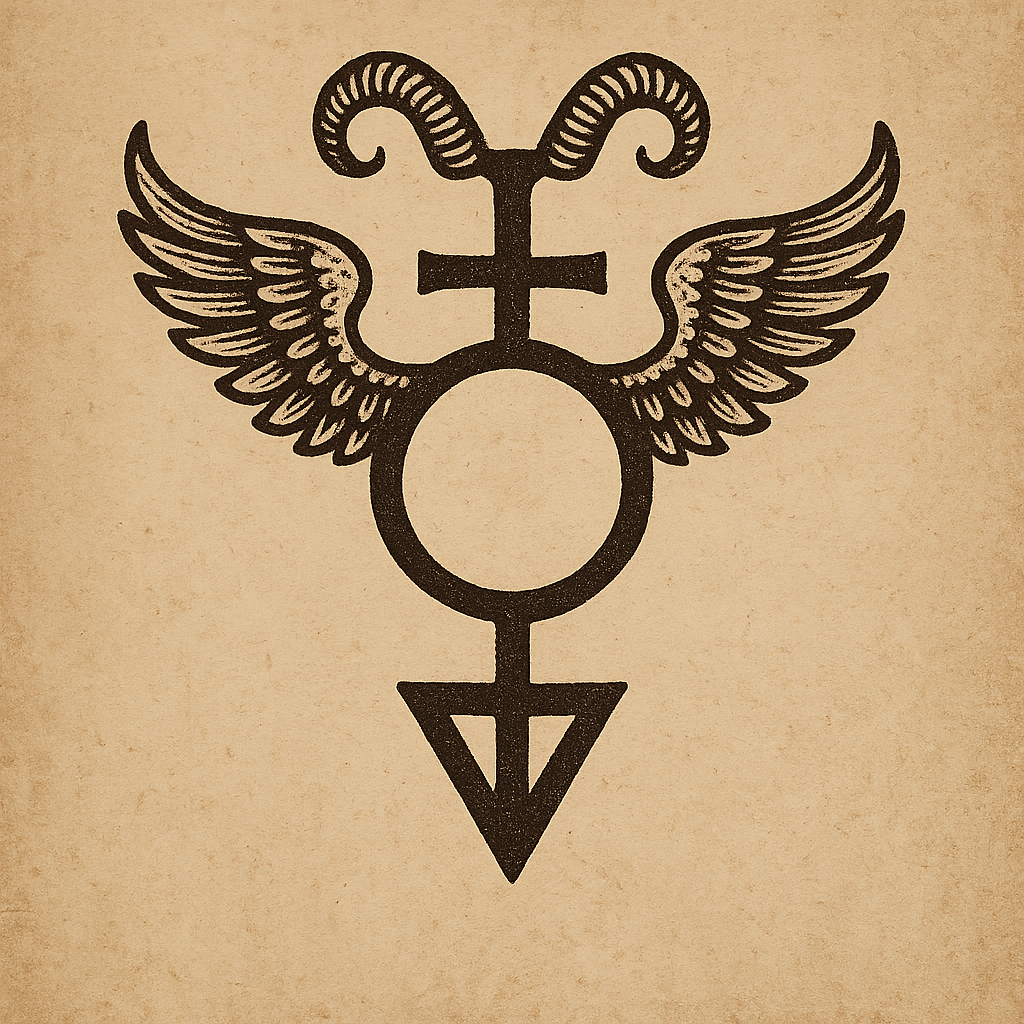
Pan
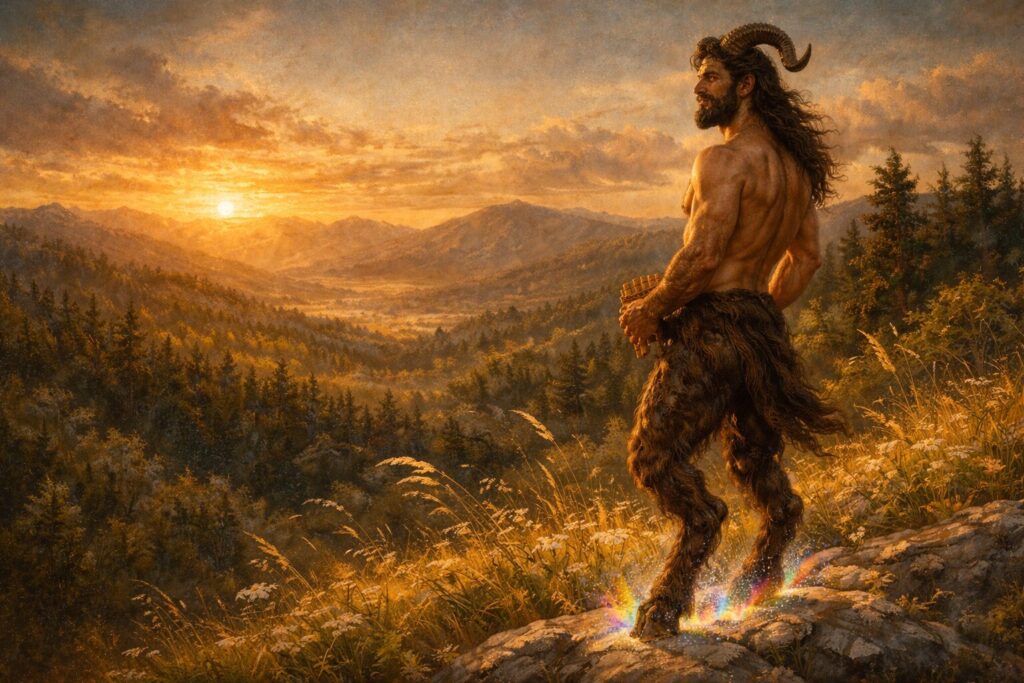
Among the gods of the ancient world, few feel as old, as immediate, or as difficult to tame as Pan. Though later myth sometimes sought to fold him into Olympian genealogy by calling him a son of Hermes, Pan has always seemed to belong to a deeper and older layer of sacred imagination: not a polished god of city, law, throne, or heaven, but a being of the living earth itself, a power encountered where the cultivated world frays and the wild begins again. In this sense, Pan is not merely one god among others. He is the Greek name for a more ancient current: the wild pulse of life before it is organized, civilized, or contained.
In the tradition of the Coven of the Veiled Moon, Pan is understood as one of the clearest expressions of the Horned Current: the sacred force of vitality, instinct, sexuality, wilderness, generative power, and untamed being that appears in many forms across cultures and ages. He is not merely “rustic,” nor merely pastoral, nor only a fertility god in the narrow sense. He is more foundational than that. Pan belongs to the base layer of life itself: to the body, to hunger, to desire, to laughter, to the sudden rush of fear that preserves life, to the music that rises out of reeds and wind, to the field’s edge, the cave mouth, the hillside, the grove, the place where human order still stands close enough to hear the breathing of the wild.
This is part of why Pan feels older than Olympus. The Olympians, in many ways, represent powers shaped into divine persons within a more ordered mythic world. Pan, by contrast, often feels as though he precedes that ordering. Even when honored by the Greeks as a great god, he remains outside the heavenly symmetry of Olympian religion. He is not properly a god of the sky, nor of the afterlife, nor of civic hierarchy. He belongs to the living places of earth: to Arcadia, to mountains and fields, to caves and thickets, to the ecology of places still alive enough to bear his presence. Pan is special in this way. His current is not equally felt everywhere. He belongs most strongly where the world remains porous to wildness.
That ecological dimension matters. Pan is not simply a symbol humans project onto nature; he is a way of perceiving that some landscapes still carry a fierce, unsoftened life of their own. Forest edges, old hills, bee-loud gardens, rough grasslands, hidden springs, and half-wild clearings all belong more readily to him than paved cities or sterilized ground. Pan thrives where life still exceeds human management. For that reason, to speak of Pan in the modern world is also to speak about what remains of the wild, and what is being lost. A place does not need to be untouched by human hands to carry Pan’s presence, but it must still possess living depth. He is the god of life that has not been flattened.
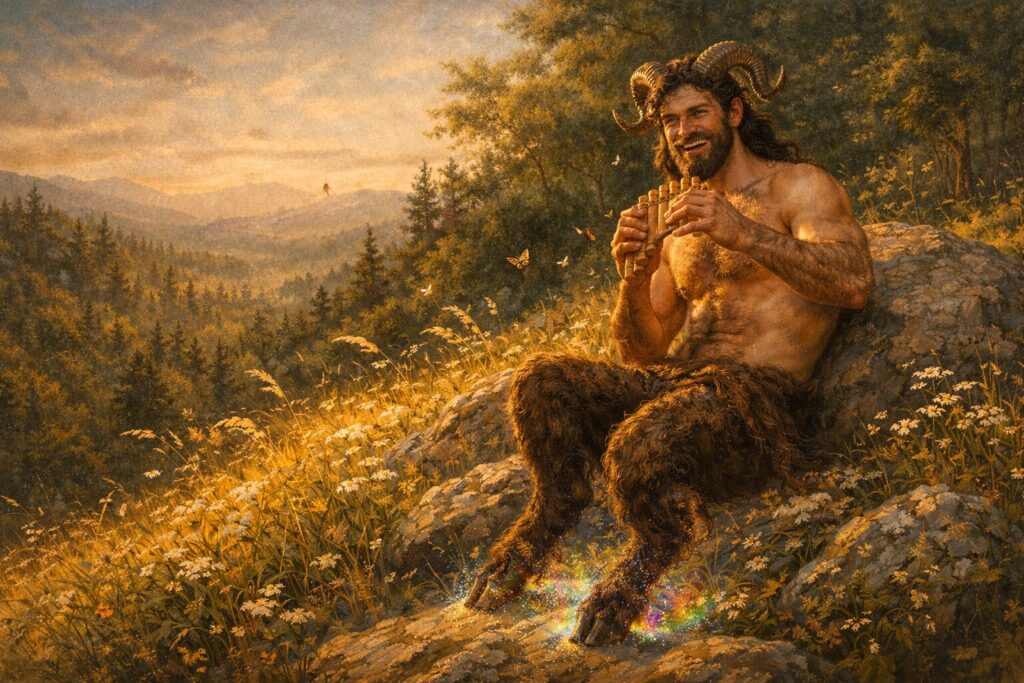
Pan is also one of the most honest gods. He does not flatter the human wish to be pure abstraction. He reminds us that we are embodied beings, animals with imagination, creatures of appetite, instinct, nerves, attraction, fear, play, and ecstatic release. His sexuality is therefore not incidental. It is central, though not in a crude or merely erotic way. Pan expresses sexuality in its widest sacred sense: the generative charge of life itself, the male principle in one of its oldest and wildest forms, but also sexuality more broadly as vitality, attraction, fertility, danger, abandon, pleasure, and creative force. There is risk in him, yes. There is danger in all strong life. But there is also health, revelry, release, and the refusal to split spirit away from the body.
This is why Pan is both joyous and terrifying. He is not a gentle pastoral decoration. He is a grand and wild god. He startles. He laughs. He disrupts. The very word panic bears his mark, yet even here he is often misunderstood. Panic is not only irrational fear. In the wild, sudden fear can be protective. It can be the body knowing before the mind knows. It can be the nervous system’s flash of truth. Pan governs that threshold too: the instinctive intelligence that belongs not to theory but to survival, presence, and embodied awareness. He is the old shiver in the grass, the crack in the brush, the sudden stillness before movement.
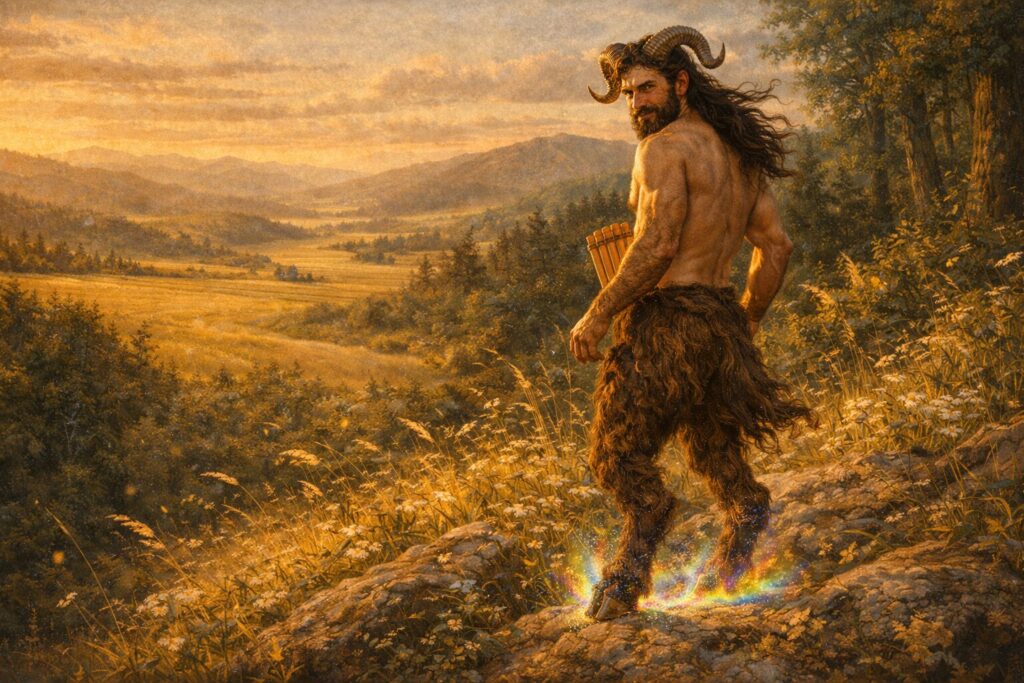
Pan’s closeness to wild spirits also sets him apart from many other gods. He is companion to nymphs, to land-beings, to presences of grove, stream, cave, and field. In our understanding, this places him nearer than most gods to what many today might call the fae or the wild spirits of place. Pan is not primarily heavenly. He is not chiefly chthonic in the underworld sense either. He is of life. Of this world. Of the animated earth and the subtle presences moving through it. If Hermes travels between worlds and Hekate stands at thresholds, Pan more often dwells in the living thicket itself, among the spirits that belong to place, season, growth, and hidden motion.
For this reason, Pan has endured in unusual ways. Even when the old temples faded, Pan did not vanish. He lingered in folklore, in the memory of the horned god, in the Green Man, in romantic longing for the lost wild, in poetry, in music, in the strange modern ache for a world more alive than the one industry has left us. In some respects, he may be one of the most persistent pagan gods of the modern age, because the idea he carries has never gone away. Whenever people rediscover the sacredness of the living earth, the holiness of instinct, the mystery of desire, the intelligence of wild places, or the need to step beyond sterile civilization into something older and more breathing, Pan rises again.
Christianity, like it did with many pagan symbols, badly misunderstood this current. Horns, goat imagery, wilderness, sexuality, and ecstatic life were recast through the lens of sin and the demonic, and Pan’s form was gradually folded into later images of the devil. But this says far more about Christian anxieties than it does about Pan. The older symbols were not originally signs of evil. They spoke of fertility, animal vitality, embodied life, wilderness, and sacred generative force. Pan became one more lesson in what happens when a religion no longer understands the gods of the land it has replaced. He was not a devil. He was a god of living reality, and living reality is often exactly what systems of control fear most.
The Greeks called him great, and rightly so. Pan is great not because he rules from above, but because he abides below and within: in the roots, in the body, in the field beyond the road, in the cave by the hearth, in the edge-land where the known world opens again into living mystery. To welcome Pan is not merely to study an old god. It is to remember that beneath all civilization, beneath all polished identity, beneath even religion’s more ordered faces, there still runs a deeper current: wild, fertile, musical, dangerous, laughing, and alive.
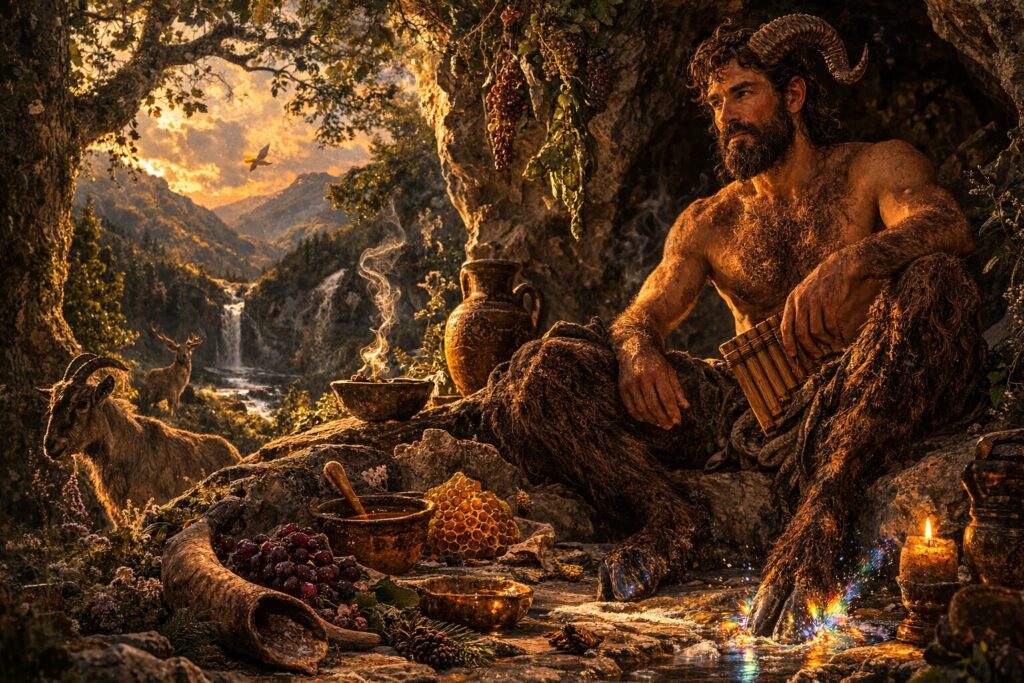
Pan is not honored best through abstraction alone. He is a god to be encountered in lived places, at living edges, through sound, sensation, instinct, laughter, and the subtle re-enchantment of the world around you. In our tradition, bringing Pan into life does not mean forcing drama or imitation. It means making room for the wild current where it can still breathe.
Pan in Fields, Edges, and Wild Places
Pan is most easily felt where cultivated life gives way to something older. He belongs to caves, hillsides, rough grass, thickets, field edges, springs, garden borders, woodland paths, and open places where the land still carries its own will. A field matters here not because it is fully tamed, but because it remains closer to the wild than town, street, or enclosed domestic order. It is an in-between place: touched by human life, but not entirely claimed by it.
In the Coven of the Veiled Moon, we often think of Pan as especially present in landscapes that still hold ecological depth. He is not equally available everywhere. Some places have been paved over so thoroughly that his current can barely root there at all. But where life still spills beyond control—where bees gather, grasses lean, birds startle from brush, and the land retains layered vitality—Pan may still be encountered.
To welcome Pan, one need not live in ancient Arcadia or on a remote mountain. One can begin with the edge of a garden, a grove beside a trail, a hill above town, a patch of rough earth left unsoftened, or simply the places in daily life where the world still feels animate. Pan teaches us to notice where the land has not gone silent.
Music, Sound, and the Breath of the Landscape
Pan is a musical god, but not in the polished or courtly sense. His music comes from reeds, wind, pulse, breath, rhythm, and the sudden rise of feeling through the body. The panpipes are one of his clearest symbols because they show how landscape itself may become voice: hollow reed, moving air, song born from the living world.
Sound is one of the easiest ways to bring Pan into practice. This can take the form of outdoor drumming, dance around a fire, ecstatic ritual music, folk instruments, hand-clapping rhythms, humming while walking through the woods, or simply learning to listen more deeply to birdsong, rustling grass, moving water, and evening insects. Pan does not require musical perfection. He responds more readily to living sincerity than performance.
In practice, a small devotion to Pan might include music played near a hearth, in a garden, at a field’s edge, or beneath a tree. Even laughter and unselfconscious singing can belong to him. Pan reminds us that the world is not only seen. It is heard, breathed, and answered.
Instinct, Panic, and the Intelligence of the Body
Pan is often remembered through the word panic, but this deserves deeper understanding. Panic is not merely irrational terror. In the wild, sudden fear can be protective. It can be the body knowing danger before the conscious mind has caught up. It can be the flash of awareness that keeps a creature alive.
Pan governs this instinctive intelligence. He is the quickening in the nerves, the hairs rising on the neck, the immediate sense that something has shifted in the atmosphere. In this way, Pan reminds us that the body is not inferior to thought. It is a knowing being in its own right.
Bringing Pan into one’s life can therefore include practices of listening to instinct: slowing down long enough to notice bodily reactions, honoring intuition instead of overriding it, learning the difference between social anxiety and genuine warning, and restoring trust in the animal wisdom carried in the flesh. Pan is not merely the cause of fear. He is also the force that teaches why fear exists.
Sexuality, Vitality, and the Male Generative Principle
Pan’s sexuality should neither be reduced to caricature nor politely erased. He is one of the clearest divine expressions of generative force in its raw and living form. This includes male potency in a symbolic and sacred sense, but it also extends beyond that into sexuality itself as vitality, attraction, fertility, pleasure, bodily joy, and the dangerous beauty of life seeking more life.
In our view, Pan embodies a current that is healthy precisely because it is honest. Desire can be reckless. It can be disruptive. It can also be deeply life-giving, playful, connective, and restorative. Pan teaches that spirit does not become holier by pretending the body is unreal. He draws the practitioner back toward wholeness: instinct and reverence, appetite and wisdom, abandon and discernment.
To bring this aspect of Pan into life may mean healing shame around the body, honoring attraction without making it shallow, celebrating sensuality in grounded ways, tending one’s vitality, or recognizing sexuality as one thread within a wider web of natural power. Pan does not ask for prudery, nor does he excuse carelessness. He reveals that strong life always contains both delight and risk.
Wild Spirits, Nymphs, and the Living World
Pan moves among nymphs, land-spirits, and the subtle presences of grove, spring, cave, and hillside. For this reason, he feels closer than many gods to what modern practitioners may call wild spirits or even the fae. He is not primarily a sky god, nor a ruler of the dead. He belongs to the animated world of life itself.
This makes Pan especially meaningful for those who work with place-based spirituality. A shrine to Pan is often best placed where cultivated order meets living growth: near a garden edge, beside a pollinator patch, close to a bee hive, at the margin of a wooded path, near stones warmed by the sun, or in a hearth-space symbolically linked to the cave. One of the simplest and most powerful devotions may be to place his image where the home opens toward the more-than-human world.
In this way Pan is not only honored as a god of myth, but welcomed as a presence who mediates relationship with the breathing landscape and the spirits moving through it. He stands close to life because he is woven through life.
Ways to Bring Pan Into Daily Life
Pan may be invited not only through ritual, but through placement, atmosphere, and lived attention. A statue near the fireplace may represent the cave. A shrine at the edge of a garden can honor the threshold between tended ground and encroaching wildness. Some keep Pan near bee hives, orchards, vines, woodland borders, or rough places where grasses and herbs grow with minimal control. Others honor him through outdoor music, bonfires, dancing, seasonal revelry, and simple offerings given where the land still feels alive.
Offerings may include wine, honey, fresh water, bread, goat symbolism, reeds, pine, rustic music, or moments of sincere embodied joy. But perhaps more important than any formal offering is attention itself: walking outside without hurry, listening to the world as if it were inhabited, leaving some corners of life less managed, allowing laughter and instinct to return where numbness once ruled.
Pan comes most readily where there is still room for him. To bring him into life is to make such room: in the home, in the garden, in the body, in seasonal celebration, and in the soul’s relationship to the untamed world.
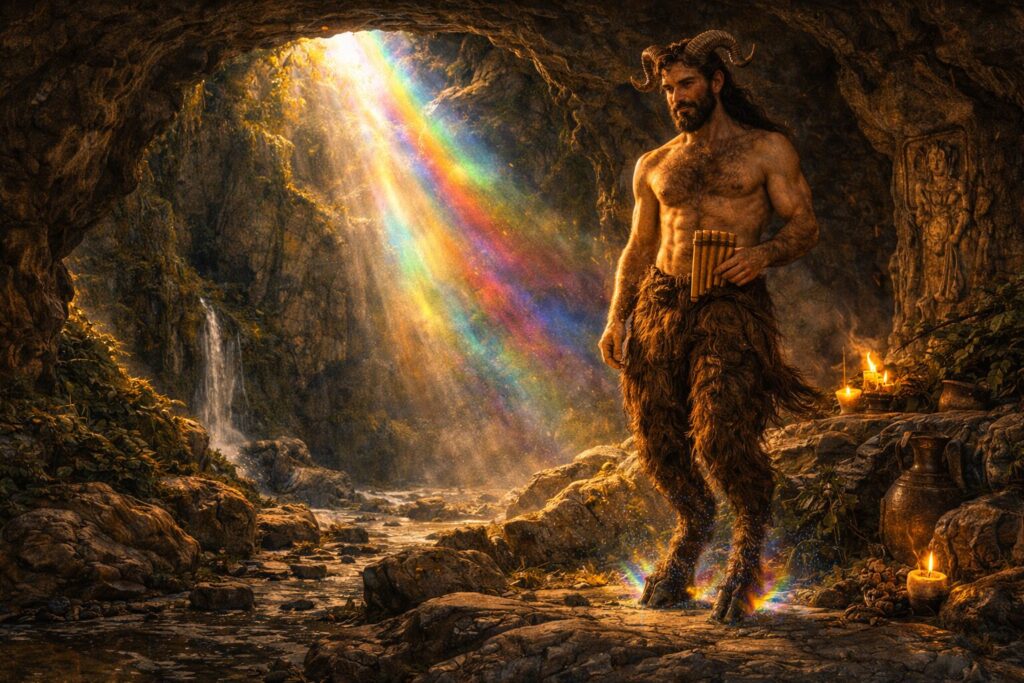
Pan speaks through symbol as much as through story. His signs are not decorative details, but living expressions of the current he carries: wildness, instinct, vitality, music, earth-life, and the fierce generative pulse that moves beneath civilization. To understand Pan is to understand the world of meanings that gathers around him.
Panpipes
The pipes are among Pan’s clearest emblems because they unite breath, reed, wind, and song. They show that nature itself may become music, and that sound can arise directly from the living body of the world. In Pan, music is not merely entertainment. It is enchantment, atmosphere, instinct, and the voice of landscape made audible.
Goat Form
Pan’s goat legs, horns, and rough-bodied imagery do not signify evil. They signify wildness in its most foundational sense: animal vitality, mountain resilience, sexuality, unruly power, and life that has not been polished into civility. The goat in Pan represents the base current of nature itself—strong, fertile, restless, and impossible to fully domesticate.
Caves and Hearth-Caves
Pan is a god of caves because caves are old places: sheltering, hidden, earthy, and close to the inward body of the land. In modern practice, a fireplace or hearth may become a symbolic cave, a place where Pan is invited into the home without losing his tie to the primal world. Cave symbolism reminds us that Pan does not descend from the sky. He rises from the living places of earth.
Fields and Edges
Pan is often felt in fields, especially those that border woodland, hill, or rough grass. Such places are neither fully wild nor fully controlled, and that threshold quality suits him well. A field near the wild carries openness, movement, animal life, and the possibility of sudden encounter. Pan belongs wherever the managed world still stands close enough to hear the breathing of untamed land.
Panic
Panic is one of Pan’s oldest gifts and one of his most misunderstood. In its sacred sense, it is not mere disorder but sudden instinctive knowledge: the body recognizing danger, tension, or unseen movement before the mind can explain it. Pan rules the protective quickening of the nerves as much as he rules ecstasy. He is the shock that startles, but also the warning that preserves life.
Wild Spirits and Nymphs
Pan moves in the company of nymphs, grove-spirits, spring-spirits, and land-beings that belong to the living world. In our understanding, this places him near what many would call wild spirits or the fae. He is not chiefly a ruler of heaven or death, but of animated earth. His presence is strongest where place itself still feels inhabited.
Green Man Current
Though not identical in every tradition, Pan is one of the oldest and clearest expressions of the same vegetative and horned current that later appears in Green Man imagery, woodland kings, and wild gods of leaf, branch, and seasonal life. The forms change, but the underlying force remains: nature as person, vitality as presence, growth as sacred mystery.
Pan Megas — Great Pan
The Greeks could call him Pan Megas, Great Pan, not because he sat upon Olympus, but because his current runs beneath and through life itself. He is great in the old sense: immense, ancient, and irreducible. Pan embodies the power of the earth’s living places, and so his greatness is not imperial or celestial, but rooted, ecstatic, and wild.
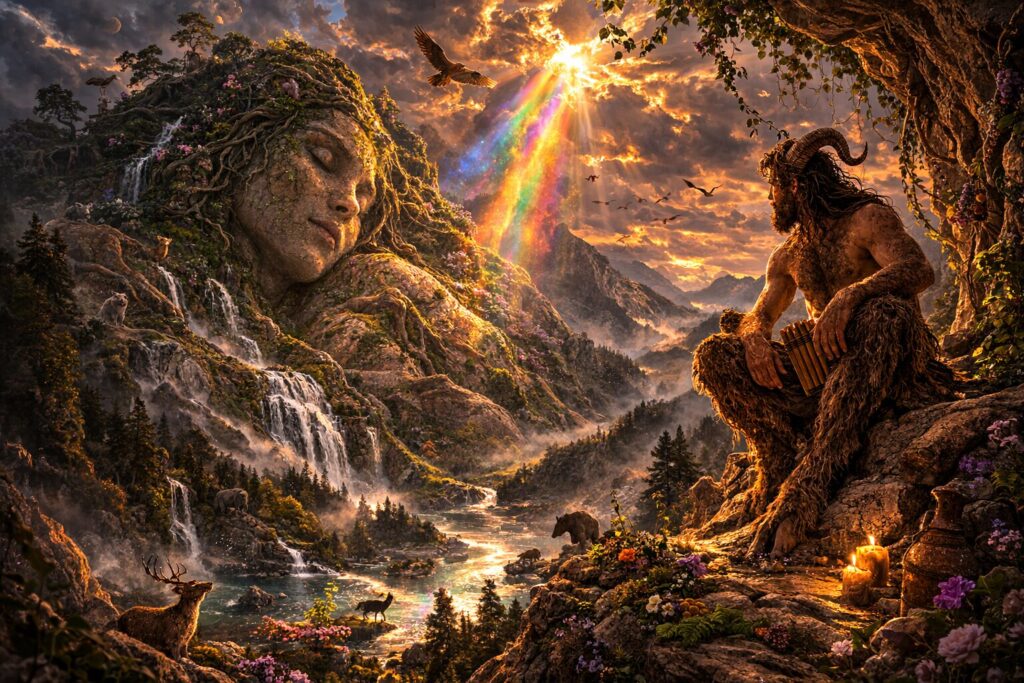
“
Great Pan is dead.
— Plutarch
A famous line later misunderstood by many, but in our view Pan never died — people simply forgot how to hear him.
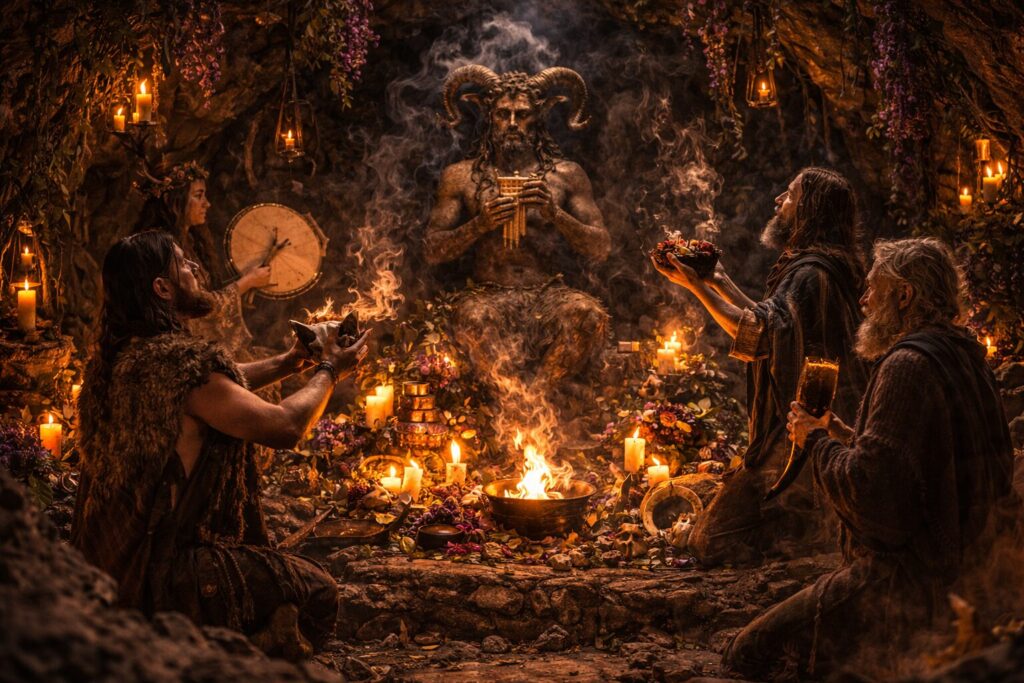
To understand Pan fully, one must look beneath the later stories and toward the older force they were trying to name. Pan is not only a god of rustic myth, but one of the deepest expressions of the wild current itself: foundational nature, generative life, instinctive intelligence, ecological presence, and the fierce vitality of the earth before it is overruled by systems of order.
Pan Before Olympus
Later Greek myth often tried to situate Pan within Olympian genealogy by naming him a son of Hermes, but this reads less like an original truth than a later attempt to absorb an older god into a more orderly divine structure. Pan has always carried the feel of something earlier, rougher, and more primordial than Olympus. He does not move like a courtly god, nor does he embody law, civic hierarchy, or celestial sovereignty. He belongs to the living places of earth.
In our understanding, Pan represents a current that predates the Olympians in spiritual character, even if later stories tried to give him a place among them. Ancient Arcadia preserved many deeply archaic layers of Greek religion, and Pan seems to rise from those old, pastoral, mountainous, half-wild strata where divine life had not yet been fully polished into mythic order. In this sense he stands closer to the primordial and Titanic atmosphere of older sacred forces than to the structured symmetry of Olympus.
This matters because it explains why Pan feels so different from the high Olympians. He is not a god of heaven. He is not enthroned above the world. He is among the greatest precisely because he is beneath, within, and throughout the life of the world itself. The Greeks could call him Pan Megas, Great Pan, because his current runs through foundational nature—through what is oldest, most vital, and hardest to contain.
The Horned Current and the Green World
In the Coven of the Veiled Moon, Pan is understood as one of the clearest Greek expressions of the Horned Current: that ancient pattern of sacred life-power associated with wilderness, fertility, instinct, virility, animal force, growth, and the untamed pulse of being. Horned figures appear again and again across cultures because the symbol itself speaks to something very old in human spiritual memory. It points toward life that is vigorous, embodied, generative, and not yet subdued by abstraction.
Pan’s goat form belongs to this symbolism. The horns, legs, rough body, and mountain-beast qualities do not reduce him to animality in a dismissive sense; they reveal how close he stands to base nature in the deepest meaning of the word. By base we mean foundational: the root-layer of life from which later refinement arises. Pan is not “less divine” because he is wild. He is more direct, more primary, and more honest.
In later eras, this same current may be glimpsed again in figures like the Green Man, woodland kings, leaf-faced spirits, and horned gods of seasonal life. We do not collapse all such beings into a single figure, but we do recognize a family resemblance of current. Pan is among the clearest ancient names for the green, horned, fertile, laughing, and dangerous force of living nature made personal.
Pan, Ecology, and the Living Wild
Pan is not only a symbol of wildness; he is bound to the actual ecology of wild and half-wild places. His presence depends on living depth. There are environments that can still support his current and environments that can hardly bear it at all. Pan thrives where ecosystems remain porous, layered, and animate: forest margins, mountain paths, rough grasslands, springs, caves, bee-loud gardens, old fields, sun-warmed stones, and places where human life has not entirely silenced the more-than-human world.
This ecological dimension makes Pan unusually important in the modern age. To speak of Pan today is also to speak of habitat, biodiversity, and the survival of wild presence. He cannot be reduced to a literary symbol if the living places that carry his force are destroyed. A world paved over, sterilized, and over-managed becomes harder ground for Pan. He belongs where life still exceeds control.
For this reason, devotion to Pan may include acts of ecological reverence: tending pollinator spaces, protecting edges where life gathers, preserving rough places rather than trimming everything into submission, and learning again how to inhabit landscapes as participant rather than conqueror. Pan teaches that the sacred wild is not merely a fantasy of the past. It is a living condition that must be allowed to continue.
Wild Spirits, Nymphs, and the Fae-Like World
Pan stands unusually close to the world of nymphs, grove spirits, spring presences, and the subtle beings that belong to place itself. In our understanding, this is one reason he feels nearer than many gods to what modern people might call the fae or wild spirits. He is not chiefly oriented toward heaven above or the dead below. He is oriented toward life moving now through field, cave, branch, water, hillside, and hidden glade.
This makes Pan a particularly intimate god for place-based spirituality. He is a divine presence not simply over nature, but among its subtle inhabitants. If Hermes travels the roads between worlds and Hekate governs thresholds and crossings, Pan may be said to dwell amid the breathing interior of the world itself, where the visible and invisible mingle in growth, scent, sound, motion, and sudden atmosphere.
Those who feel drawn to wild spirits, fae-adjacent experiences, land wights, or the old sense that certain places are inhabited may find Pan a natural point of contact. He does not domesticate that world. He keeps it lively, uncanny, and real.
Sexuality, the Male Principle, and the Joy-Risk of Life
Pan’s erotic and generative nature is not a side note. It is central to his divinity. He embodies the male principle in one of its oldest and wildest forms, yet he also expresses sexuality in a broader sense: the life-drive itself, attraction, pleasure, fertility, physical joy, virility, seduction, danger, and the ecstatic urge toward contact and creation. Pan does not present sexuality as sanitized, sentimental, or safely contained. He reveals it as one of the great powers of nature.
This does not mean that Pan endorses thoughtlessness. Strong life always carries risk. Desire can overrun wisdom. Attraction can destabilize. Pleasure can intoxicate. Yet none of this makes sexuality impure. It makes it powerful. Pan teaches that a mature spiritual life must reckon honestly with embodied power rather than pretending holiness lies in denial. Sex, in this vision, is not separate from the sacred. It is one of the sacred’s most immediate and dangerous expressions.
There is laughter in Pan, but also appetite. There is freedom, but also consequence. There is revelry, but also the reminder that life is strongest where it refuses total control. He draws us toward wholeness by refusing false divisions between body and spirit, instinct and reverence, delight and seriousness.
Panic, Instinct, and the Nervous System of Nature
Modern people often hear the word panic and think only of irrational fear, but Pan’s older association is more subtle and more sacred than that. Panic is the sudden quickening that happens when the body recognizes something before the mind can form a conclusion. In the wild, that kind of fear can save a life. It is not merely disorder. It is embodied perception at speed.
Pan therefore governs not only revelry and abandon, but also the protective intelligence of the nerves. He is the sudden stillness in animals before flight, the sense that the air has changed, the shiver that says something is present. Panic can be destructive when untethered from wisdom, but in its root it belongs to the animal clarity that keeps living beings alert, responsive, and whole.
In this way Pan teaches that instinct is not inferior knowledge. It is one of the oldest forms of knowledge there is. To recover relationship with Pan is to recover some respect for the body’s truth.
Pan and the Christian Misunderstanding
Pan became one of the clearest examples of how Christianity repeatedly misunderstood pagan symbolism. Horns, goat-features, wilderness, ecstatic vitality, sexuality, and untamed life were gradually recast through the imagery of sin and the demonic until Pan’s form helped shape later images of the devil. This was not a discovery of hidden evil within pagan religion. It was a cultural reinterpretation born from suspicion toward precisely those parts of life Christianity often found hardest to sanctify: the body, desire, animal being, the land, and the gods of the living world.
The older meanings were very different. Horns signified power, fertility, and natural force. Goat symbolism pointed toward resilience, appetite, mountain vitality, and life beyond polished civility. Pan was not a devil hiding in ancient religion. He was a god of the earth’s living wildness. That later generations demonized him tells us far more about their theology and anxieties than it does about Pan himself.
This pattern repeated across much of pagan history. Symbols once tied to fertility, vegetation, sex, wildness, and sacred place were repeatedly translated into images of danger or evil by traditions that no longer understood them on their own terms. Pan stands as one of the clearest reminders that religious conquest often rewrites what it replaces. To reclaim Pan is therefore not only to reclaim an old god, but to reclaim the meanings that were distorted when the gods of the land were forced into alien moral frameworks.
“Great Pan is Dead” — Or So They Said
The famous ancient report that “Great Pan is dead” has echoed for centuries, but in our view it says less about the death of a god than about a shift in cultural hearing. Gods like Pan do not die because a society changes its theology. They become harder to perceive when the world they inhabit is ignored, denied, or destroyed. Pan never truly died. People panicked, forgot, translated, suppressed, and moved away from the kind of world in which he was easily heard.
In this sense, Pan’s “death” is one of the great misunderstandings of religious history. He persists anywhere the wild remains alive, anywhere instinct still speaks, anywhere the body remembers it belongs to the earth, anywhere music rises from reed and breath, anywhere laughter breaks through sterile control, anywhere the old spirits still move among field and grove.
Pan survives because life survives. And whenever human beings rediscover the sacredness of living nature—not as metaphor, but as presence—Great Pan returns once more.
Arcadia, Ancient Sites, and the Long Memory of Pan
The Greeks most strongly named Pan through Arcadia, that mountainous and pastoral region whose older religious atmosphere preserved many archaic currents of the sacred. Arcadia became the homeland of Pan not because it created the wild current from nothing, but because it gave one of its clearest names and forms. The current itself is older than the name.
Historically, Pan was honored not only in Arcadia, but at caves and rural sanctuaries such as the Cave of Pan in Athens, the cave sanctuary at Banias—ancient Paneas—and shrines associated with mountains like Parnassus. These were fitting sacred sites for a god who was rarely confined to monumental temple culture. Pan was honored where land still felt alive enough to answer.
For those called to sacred travel, these old places still matter as echoes of Pan’s memory in the world. They remind us that pilgrimage to Pan often means seeking caves, springs, mountain roads, and living edges rather than imperial ruins alone. For more on sacred journeys and places of power, visit our Pagan Pilgrimages page.
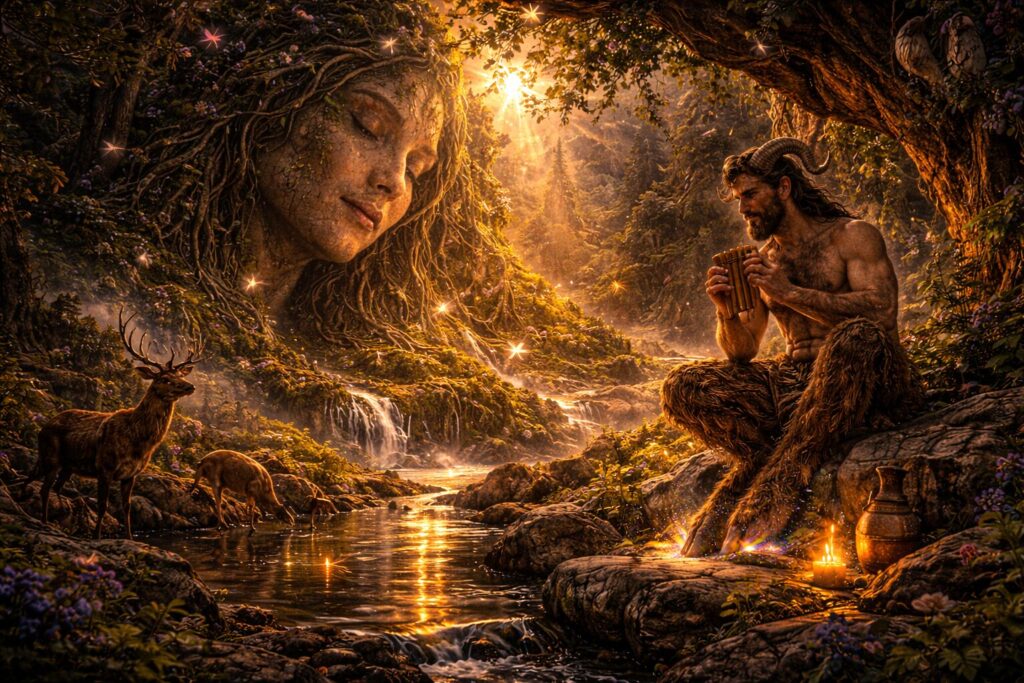
Pan is not a god easily confined to myth, temple, or page. He is encountered where the living world still moves with its own will: in fields where wind bends the grass, in hills where goats climb impossible stone, in caves that hold the deep breath of the earth, in gardens where bees hum and vines climb without asking permission. To speak of Pan is therefore not only to remember an ancient god, but to remember a way of seeing the world as alive.
In the Coven of the Veiled Moon, Pan represents the wild current that runs beneath all the more orderly faces of religion. Civilizations build temples, write laws, organize the heavens, and polish the stories of the gods into clear hierarchies. But beneath all that order there remains something older: the pulse of life itself, untamed and irreducible. Pan belongs to that layer of reality. He laughs where life overflows the boundaries humans try to impose upon it.
This is why Pan has never truly disappeared. Cultures may forget his name for a time, reinterpret his symbols, or mistake his wildness for something dangerous or forbidden, but the current he embodies cannot vanish as long as the earth remains alive. Wherever people rediscover the sacredness of forests, fields, rivers, caves, animals, instinct, music, and embodied joy, Pan rises again. Not always with horns and pipes, perhaps, but always with that unmistakable sense that the world is more alive than we have been taught to believe.
To welcome Pan is therefore not merely to honor a figure from the Greek’s myth. It is to allow the wild to remain present in one’s life. It may mean leaving a corner of the garden untamed, walking a hillside without headphones, placing a small shrine where the hearth becomes a cave, tending bees or vines, dancing when the fire is lit, or simply remembering that the body itself belongs to the same ancient earth as the gods.
Pan reminds us that we are not visitors to the living world. We are part of it. Beneath our cities, beneath our philosophies, beneath even our spiritual systems, there still runs a deeper and older rhythm. It is the rhythm of breath, blood, instinct, music, fear, laughter, fertility, and growth. The Greeks called that rhythm Pan, and they were not wrong to call him great.
For as long as the hills still echo with wind and the grass still bends under sunlight, Great Pan has never truly left the world. He waits in the places where life still remembers itself.