The Triple Goddess
The Living Trinity of Time, Cycle, and Becoming
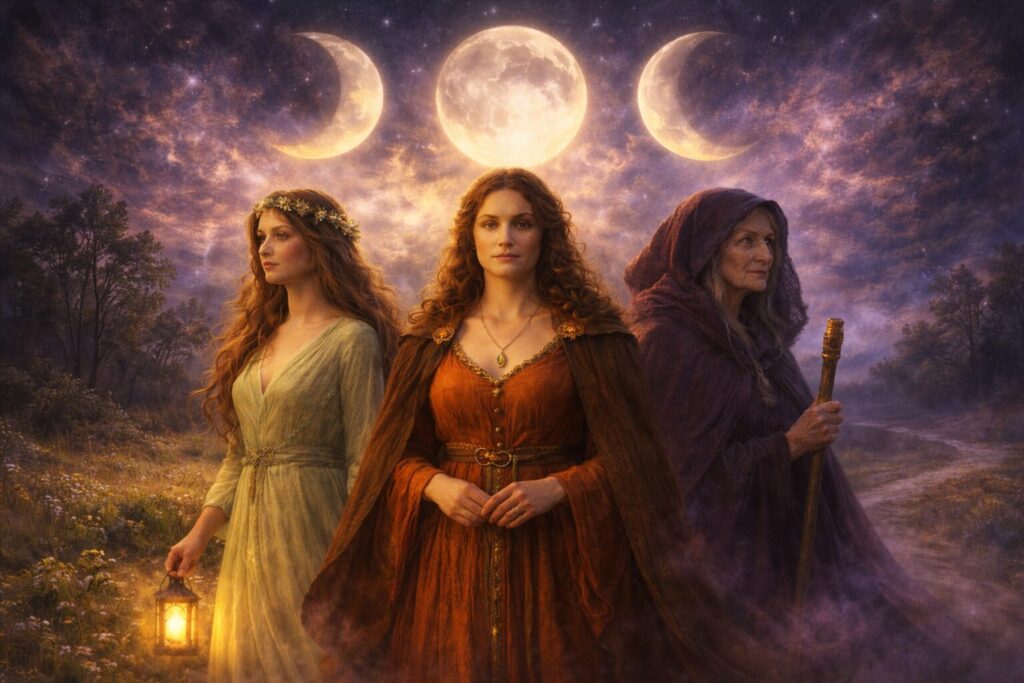
The Triple Goddess is not an invention of any one tradition, nor a figure confined to a single name or form. She is an ancient recognition—one that appears wherever human beings have watched the world closely enough to notice that nothing simply exists, but everything moves. She is the awareness that life does not unfold in a straight line, but in cycles: waxing and waning, rising and falling, becoming and dissolving. Where this movement is understood, she is found.
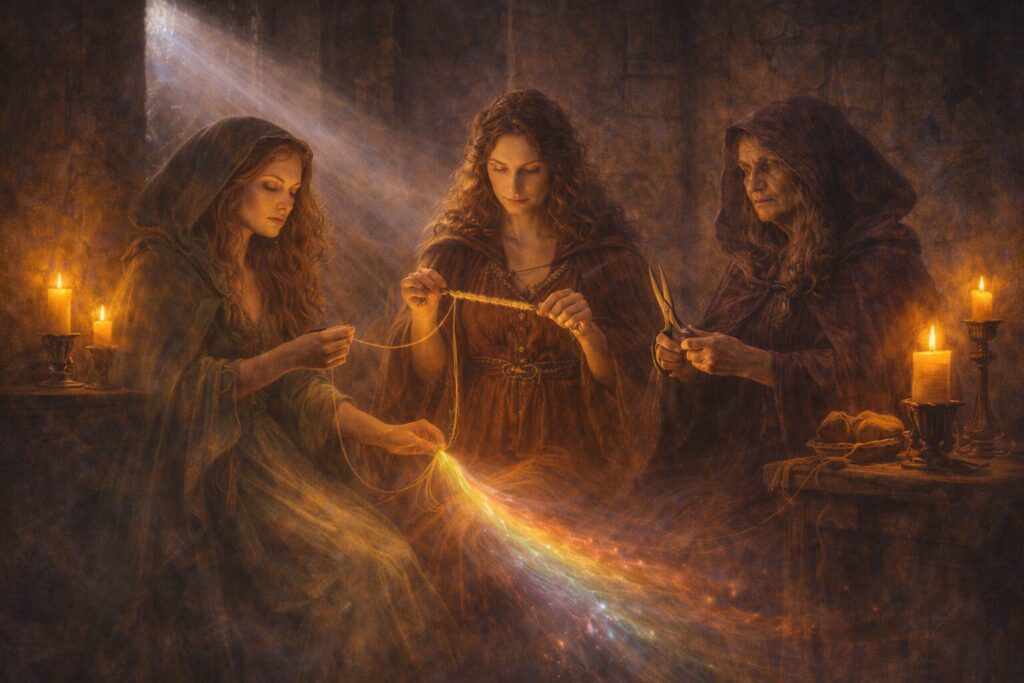
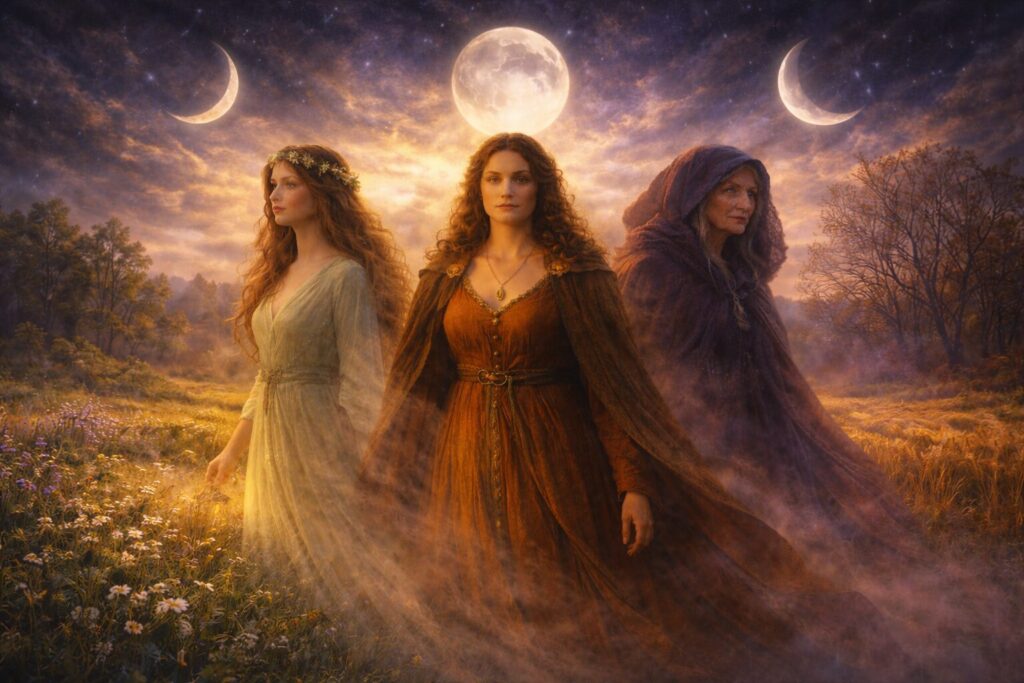
She is encountered as three—not because she is divided, but because her nature reveals itself in sequence. What begins must grow, what grows must be sustained, what is sustained must eventually release. These are not separate acts, but phases of a single current. In this way, she is known as Maiden, Mother, and Crone—not as rigid identities, but as expressions of one continuous intelligence moving through time.
To understand her is to recognize that time itself is not empty passage, but patterned unfolding. The moon traces her rhythm in a month, the earth across a year, and the human life across decades. The waxing light, the full radiance, the waning return—these are not merely celestial events, but reflections of a deeper structure. The same pattern governs the birth of an idea, the arc of a relationship, the rise and fall of civilizations. The Triple Goddess is not imposed upon these cycles; she is the presence through which they become intelligible.
She is often associated with the moon, not simply because it changes, but because it reveals change without breaking continuity. Even in darkness, the moon is not gone—it is hidden, working beyond sight. In the same way, the Goddess does not vanish between her expressions. There is always a continuity beneath what is visible, a thread that carries form from one state into another. She does not oppose shadow; she illuminates its structure. What is unseen is not meaningless—it is formative.
Many modern traditions, including forms of witchcraft influenced by Dianic Wicca and the liturgical writings of Doreen Valiente, have given her renewed voice and central place, particularly through the familiar language of Maiden, Mother, and Crone. These expressions have helped restore attention to the sacredness of feminine cycles and the continuity of becoming. Yet the pattern itself is far older than any one articulation. It appears in the Fates who spin, measure, and cut; in the seasonal descent and return of Persephone; in the many triads of women, sisters, and watchers who appear across myth and folklore. The names shift. The structure remains.
Within our understanding, the Triple Goddess is not only a symbol or teaching—she is a presence. Complex, layered, and not easily reduced, she is approached not through simplification, but through recognition and reverence. She is the one who holds the pattern, who measures the unfolding, and who completes what has been set in motion. She is not merely gentle, nor only nurturing. She sustains, but she also releases. She reveals, but she also closes. What begins under her watch will, in time, come to its proper end.
If light is scattered into many paths—fractured through the prism of experience—it is she who gathers and weaves those strands into meaning. What is lived becomes understood through her. What is begun finds its place within a greater pattern. She does not create the cycle, but she makes it readable.
To encounter the Triple Goddess, then, is not simply to look outward toward a distant figure, but to recognize a movement already unfolding. In the timing of action, in the rise and fall of desire, in the quiet knowing that something has reached its end—she is present. Not as an abstraction, but as the very structure through which becoming occurs.
Three Faces, One Current
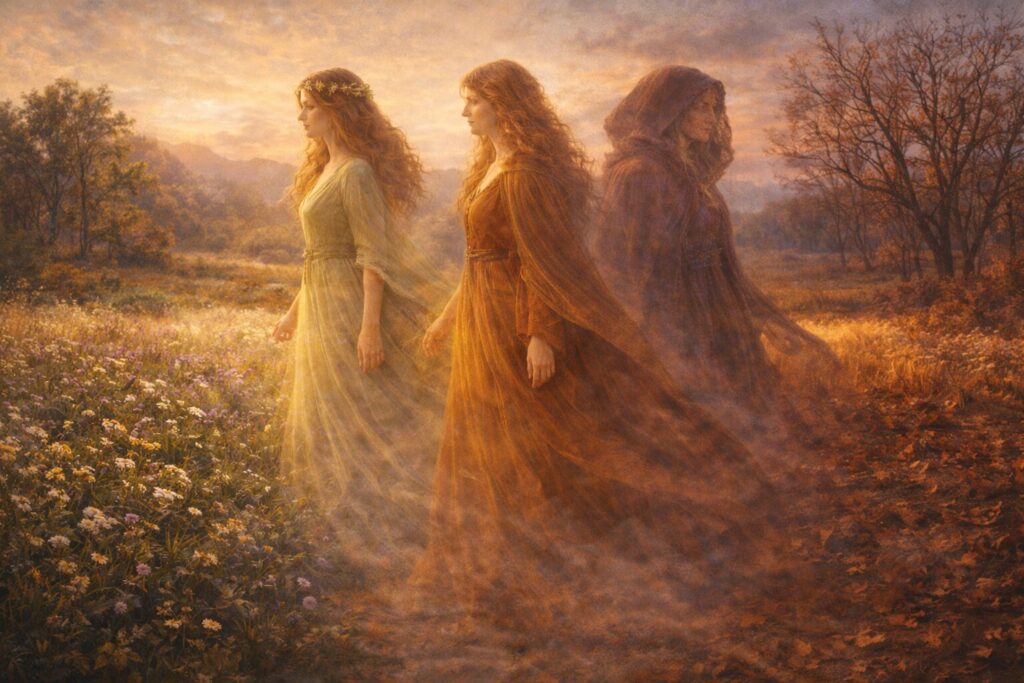
The Triple Goddess is encountered in three primary expressions: the power that begins, the power that sustains, and the power that completes. These are not separate beings set against one another, but the living trinity through which her nature becomes visible in moon, season, fate, and the long unfolding of time.
Maiden
She arrives as opening, ignition, and unfixed possibility—the first stirring of a path not yet fully shaped.
- Beginnings, emergence, and invitation
- Potential before form has hardened
- Curiosity, desire, risk, and first movement
- The quickening of what is ready to enter life
Waxing Moon and the ascending light of growth
Spring and the opening surge of the living year
Mother
She appears as fullness, continuance, and sacred containment—the power that gives shape enough stability to endure.
- Nourishment, protection, and ripening force
- Containment strong enough to sustain creation
- Presence, maturity, and embodied abundance
- The field in which things become fully themselves
Full Moon and the bright culmination of revealed power
Summer and the season of fullness, warmth, and strength
Crone
She comes as release, depth, and pattern-recognition—the wisdom that sees what a thing has become and what must now be laid down.
- Integration, truth, and the gathering of meaning
- Consequences ripening toward completion
- Ending as revelation rather than mere loss
- The elder current that reads the whole of the weave
Waning Moon and the returning pull toward release and inwardness
Autumn and the season of harvest, reckoning, and return
Enter the Three Expressions
Each expression of the Triple Goddess can be contemplated more deeply in its own right. These are not separate divinities, but sacred concentrations of the same current—one opening, one sustaining, one completing.
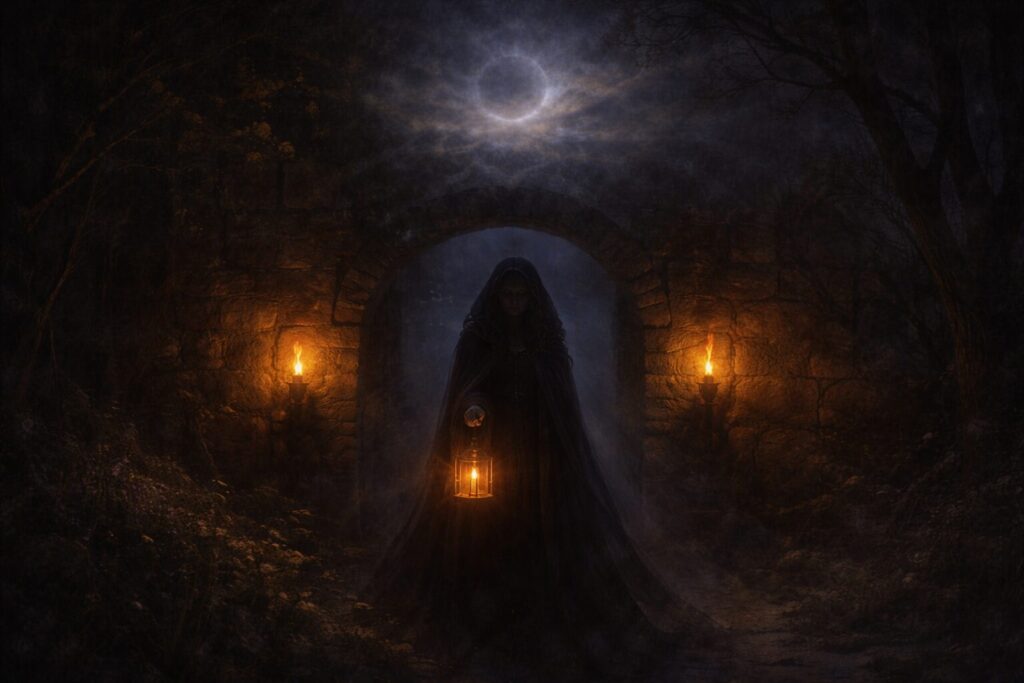
There is also a part of her rhythm that does not present itself as a face, but as a withdrawal from visibility. This is the hidden interval, the dark non-phase within the cycle—the point at which the pattern has not ended, but has passed beyond easy sight. It is not properly a fourth expression, nor a separate goddess, nor an interruption of the trinity. It is the unseen chamber through which becoming continues when outward signs have gone quiet.
The moon teaches this well. When her light disappears, she has not ceased to be. She has entered concealment. So too with the Triple Goddess. Maiden, Mother, and Crone remain the principal expressions through which she is known, but between revelation and return there is a sacred obscurity: a silence in which what has been gathered is turned inward, worked upon, and prepared for reemergence. This hidden condition belongs especially to mystery, gestation, waiting, and the kind of transformation that cannot be hurried simply because it cannot yet be fully seen.
This is also where the conversation around <a href=”https://www.mycousinscoven.com/hekate/”>Hekate</a> becomes important. She is often drawn into discussions of the dark moon, and not without reason. She walks the thresholds. She carries the torch where ordinary light has thinned. She is encountered at the edge of endings, crossroads, descents, and nights in which one must continue by guidance rather than certainty. Yet she is not the dark moon itself, nor should she be reduced to a simple “Crone” figure because later symbolism blurred such distinctions. It is more accurate to say that where the cycle passes into hiddenness, Hekate is one of the presences who may be found there: not as the phase, but as the one who can walk within it.
In this way, the hidden non-phase matters deeply to any serious understanding of the Triple Goddess. It reminds us that time is not only marked by what appears, but by what ripens in secrecy. Not every turning is public. Not every becoming is illuminated. Some truths are woven below the threshold of sight until the proper season calls them upward again.
Working Within Her Cycle
The Triple Goddess is not only contemplated—she is worked with. Her current governs timing, ripening, release, and the hidden intervals in which a thing must remain unforced. To understand her is to act with greater precision, patience, and reverence for what phase you are truly in.
Lunar Practice Waxing, Full, Waning, and the discipline of right timing
The moon is one of the clearest mirrors of the goddess’s trinity. In the waxing moon, her Maiden current is strongest: beginnings, invitations, first efforts, openings, and the courage to set something into motion. In the full moon, her Mother current swells toward visibility and power: amplification, embodiment, protection, nourishment, and the strengthening of what is already alive. In the waning moon, her Crone current becomes more available: release, reduction, reckoning, cutting away, completion, and the gathering of meaning at a cycle’s end.
To work with her well is not merely to match a spell to a phase, but to understand what the phase is asking of you. Some workings fail not because the will was weak, but because the timing was wrong. The Triple Goddess teaches that power matures through sequence. What belongs to growth should not be forced into harvest. What is ready to end should not be endlessly fed.
Seasonal Movement The moon in a month, the earth in a year
The same current that appears in the moon’s monthly rhythm can be seen on the scale of the year. Spring bears the signature of the Maiden: emergence, instability, risk, greening, and the first declaration of intent. Summer belongs most clearly to the Mother: fullness, heat, ripening, labor, abundance, and the visible holding of life in form. Autumn bends toward the Crone: harvest, consequence, discernment, and the wisdom that comes when one must separate what will continue from what must now return to the dark.
Winter need not be treated as a fourth face to matter. It can be understood as the hidden interval within the cycle: gestation, silence, retreat, and the work that continues beyond outward display. In this sense, the Wheel of the Year does not replace the Triple Goddess—it gives one of her grandest earthly demonstrations.
Timing in Magic Knowing when to begin, sustain, release, or refrain
Her governance of time is not abstract. It touches ritual, spellcraft, emotional process, shadow-work, and practical decision-making. The Maiden current favors initiation, petition, invitations to change, and the first shaping of intention. The Mother current supports protection, growth, continuity, embodiment, strengthening, and maintenance. The Crone current aids uncrossing, endings, truth-telling, severance, simplification, discernment, and the sober acceptance of what a thing has become.
Yet one of her deepest lessons is restraint. Not every moment is meant for action. Sometimes the most aligned work is waiting, watching, or refusing to interfere before a pattern has finished revealing itself. The goddess governs not only what rises into creation, but the pacing by which it does so. To follow her well is to stop mistaking urgency for readiness.
Divination and Fate Reading pattern without pretending the future is dead and fixed
The Triple Goddess is closely bound to divination because she governs pattern, sequence, and ripening outcome. In many traditions, the triple feminine appears in some relation to fate: as spinners, measurers, watchers, judges, or those who know what has already been set in motion. Yet fate need not be understood as an inescapable script. It may be better understood as a landscape of probable outcomes, a field of converging tendencies through which choice still matters.
Divination, then, is not only about prediction. It is about recognition. It tells us what cycle we are in, what forces are ripening, what consequences are gathering, and whether a thing is still in becoming, in holding, or already in decline. The goddess does not merely announce endings; she reveals the weave from which they emerge.
The Hidden Interval and Threshold Work The non-phase, descent, concealment, and torchlight in the dark
There are workings that do not belong to visible increase, visible fullness, or visible release. They belong instead to concealment: grief that has not found its language yet, initiations still under seal, endings not yet publicly spoken, and transformations that can only proceed in private. This hidden interval is not a separate face of the goddess, but a condition within her cycle—a chamber in which the weave tightens before anything rises again.
This is also where Hekate is often rightly encountered. Not as the dark moon itself, but as a torch-bearing threshold presence who can be found where the path has dimmed and one must continue through mystery rather than certainty. Threshold work asks for reverence, steadiness, and less theatrical force than many assume. Often the work is not to make something happen, but to remain with what is still becoming in darkness.
The Pattern Across Worlds
The Triple Goddess is not confined to one myth, one calendar, or one theological language. Her trinity appears again and again wherever life reveals that things begin, ripen, and pass on; wherever pattern becomes readable through change; wherever time gathers meaning through sequence.
Moon
The moon offers one of her clearest mirrors. Its visible rhythm shows increase, fullness, and release without breaking continuity. Even when its light vanishes, the cycle continues beyond sight.
Seasons
What the moon completes in a month, the earth expresses across a year. Spring opens, summer sustains, autumn gathers and releases, while winter shelters the hidden work that prepares return.
Fate
Across many traditions, triple feminine figures stand near destiny as watchers, measurers, or keepers of outcome. Fate is not always a closed script, but it is often a discernible pattern with consequences that ripen in time.
Creation
Ideas, works, relationships, and rituals often move through the same goddess-shaped sequence. First they stir into life, then they are held long enough to become real, and finally they must be completed, transformed, or let go.
Life
The human being carries her pattern inwardly as well. Youth, maturity, and elderhood are not merely biological categories, but modes of relation to time, responsibility, memory, power, and meaning.
Mythic Expressions
The names change, but the structure persists. Persephone, Demeter, and Hekate; the Fates; the Morrígan; triads of mothers, sisters, and watchers—each preserves some echo of the same deeper current.
Justice and Consequence
The Triple Goddess is not only a keeper of beginnings and nurture. She is also witness, measure, and completion. Under her watch, what has been set in motion ripens toward its proper consequence.
Not every surviving image of the Triple Goddess appears in the clear form of a great named divinity. Just as often, she lingers in fragments—in the strange persistence of three women at the edge of a story, three sisters who know more than they should, three old wives, three mothers, three watchers, three weavers, three women at the well, three women at the crossroads, three women who bless, warn, measure, or avenge. Folklore preserves patterns long after theology has forgotten how to explain them. Where the full name has dimmed, the shape often remains.
This is part of why the figure of the “triple witch” appears so often across imagination, legend, and tale. She may not be called a goddess. She may even appear reduced, feared, mocked, or obscured beneath later religious discomfort. Yet the pattern persists with remarkable force. Again and again, we find feminine triads tied to timing, prophecy, moral consequence, weaving, initiation, protection, curse, memory, or death. These are not always direct survivals of one singular cult or lineage, and it is wiser not to pretend that every set of three women in folklore points to exactly the same origin. But neither is it accidental that the recurrence is so widespread. Human beings recognized something here. The old structure kept surfacing because it answered to something real in the way life is experienced.
In some forms, these triads stand near fate. They spin, measure, cut, announce, or witness. In others, they stand near birth and threshold: appearing at the cradle, at the hearth, at the crossing from girlhood into womanhood, from marriage into motherhood, from maturity into elderhood. In others still, they hover at the dangerous edge of justice. The triple feminine is not only a nurturer. She may also be the one who sees what has been done, who remembers what others wish forgotten, who follows a broken oath to its end, or who returns consequence to the one who set it in motion. This is one reason so many old tales give triadic women an uneasy atmosphere. They do not merely decorate the world. They measure it.
The “witch” form is especially revealing. A witch in folklore is often what remains when sacred feminine knowledge has been pushed to the margins. She becomes a suspicious old woman, a hedge figure, a teller of truths others do not want, a keeper of herbs and timing and crossings, a dangerous mother, an impossible maiden, a terrifying elder, or some combination of all three. When the triadic pattern appears in such figures, it can read as a cultural memory of something older: the goddess no longer enthroned, but still expressed in shattered and local ways. Not fully remembered, yet not erased. This does not mean every triple witch is secretly “the Triple Goddess” in a literal sense. It means that where reverence declines, pattern often survives in disguise.
This is also why the Triple Goddess cannot be reduced to softness. She governs becoming, but she also governs reckoning. The same current that blesses fertility may carry curse, severance, and judgment. The same wisdom that midwives birth may oversee the consequences of abuse, oath-breaking, neglect, or spiritual arrogance. The old stories remember this better than many modern retellings do. Triple feminine powers are frequently dangerous not because they are evil, but because they are aligned with realities larger than personal comfort. They uphold timing. They expose what ripens in darkness. They bring hidden things due.
To read these echoes well requires balance. One should avoid flattening all traditions into a single universal claim, but one should also avoid the opposite error of refusing to recognize recurring structures at all. The more careful approach is to say that triadic feminine figures often preserve an archetypal and spiritual pattern that many modern witches and Pagans recognize as belonging, in some measure, to the current of the Triple Goddess. Sometimes that current appears as sovereign divinity. Sometimes it appears as fate. Sometimes as prophecy. Sometimes as mothers. Sometimes as witches. Sometimes as the uneasy but unforgettable knowledge that the world is being watched by powers older than human certainty.
Where the full form is forgotten, the pattern remains.
Where the name is lost, the current still speaks.
Names Spoken Beneath the Moon
The Triple Goddess has long been approached through names, titles, and invocatory epithets that do not define her completely, but illuminate something of her current. Such names are not cages. They are facets of approach—ways of speaking toward what exceeds any single phrase.
Maiden
Mother
Crone
In the unseen chamber between endings and return, she is also remembered as She Who Waits Unseen and The Quiet Loom—not a fourth face, but the concealed condition in which the weave tightens before it rises again.
In the Craft, we do not believe in the Goddess — we connect with her.
Archetype, Divinity, and the Shape of Becoming
The Triple Goddess can be approached devotionally, mythically, psychologically, and philosophically without reducing her to any one of those modes. She remains more than a device of interpretation. She is a presence whose current can be encountered through them, but not exhausted by them.
Archetype and Divine Expression How the gods speak through pattern without becoming “mere symbols”
The language of archetype is useful because it helps explain why the same structures recur across myth, psyche, ritual, story, and spiritual experience. Yet an archetype is not, by itself, the whole of a god. It is better understood as one mode through which divine personality becomes readable. The Triple Goddess is therefore not diminished by being archetypal. Rather, her archetypal power is one of the ways her current touches human understanding.
This matters because the Maiden, Mother, and Crone are not only social roles or psychological categories. They are sacred concentrations of becoming, continuance, and completion. They may act inwardly, mythically, ritually, and cosmically all at once. To say that the gods speak through archetype is not to deny their reality. It is to admit that the human mind often receives divine intelligence through pattern before it can fully receive it through presence.
Fate, Probability, and Outcome Pattern recognized without collapsing the future into a dead script
The Triple Goddess stands close to fate because she governs sequence, timing, maturation, and consequence. Yet fate need not be imagined as a rigid line from which nothing can depart. It may be better approached as a field of strong tendencies, likely outcomes, and ripening consequences through which choice still matters. Divination, prophecy, and omen-reading belong here not because they freeze the future, but because they reveal what is already gathering shape.
In this sense, the goddess is not merely the announcer of what will happen. She is the witness of what has been set in motion, the keeper of its unfolding, and the one under whose current its consequences become legible. The page on fate can carry the fuller treatment; here it is enough to say that her wisdom is not only mystical, but sequential. She knows how patterns ripen.
Light, Shadow, and Dualism Not the rejection of darkness, but its interpretation
The Triple Goddess is often associated with shadow not because she is simply “dark,” but because she governs what becomes visible through contrast, passage, and depth. She is lunar in part because the moon reveals transformation without losing continuity. She is shadow-aware because shadow is where meanings gather before they can be consciously named. The hidden is not an error in the cycle. It is part of its intelligence.
This is where she joins your larger cosmology so naturally. She does not merely shine; she organizes and weaves. She gathers fractured light, holds it against shadow, and allows pattern to rise into creation. The result is not a denial of dualism, but a more subtle understanding of it. Light and dark are not always enemies. Often they are the very conditions by which meaning takes form.
Modern Witchcraft and the Renewed Goddess Why this page becomes especially witchy without becoming historically careless
Modern witchcraft gave the Triple Goddess a renewed centrality, especially through the language of Maiden, Mother, and Crone and the devotional recovery of a feminine divine that is at once cosmic, intimate, and cyclical. This modern articulation matters. It helped restore serious attention to sacred feminine power, to women’s spiritual experience, to lunar and seasonal timing, and to the idea that divinity may be approached relationally rather than only abstractly.
At the same time, not every modern formulation should be projected backward as if all ancient peoples meant exactly the same thing in exactly the same way. It is stronger, and truer to the spirit of the Craft, to say that modern witchcraft recognized and re-voiced an older pattern rather than invented it from nothing. In that sense, the witch’s lore becomes a place where remembrance, intuition, and reconstruction meet.
Hekate, Thresholds, and Late Triple Associations How she overlaps, where she belongs, and why distinction matters
Hekate is often drawn into Triple Goddess discussion, and not without reason. She walks thresholds, crossroads, descent, hidden chambers, and the places where one must continue with torchlight rather than daylight certainty. These are all deeply relevant to the non-phase, to shadow, and to the hidden work of transformation. She therefore belongs in the conversation.
But she should not be flattened into a simple “Crone” formula, nor treated as though all triple goddess language originates in her. Her triple associations developed in their own ways, and her personality remains more liminal, more crossroads-bound, and more threshold-governing than the usual modern shorthand allows. She is best understood here as one who may emerge where the Triple Goddess passes into obscurity: not as the dark moon itself, but as a presence who can be found there, torch in hand.
The Triple Goddess is not only a figure of fertility, intuition, moonlight, and sacred becoming. She also belongs to consequence. Any treatment of her that leaves out judgment, correction, or the return of what has been set in motion remains incomplete. The old feminine powers were rarely imagined as soft in the modern sense. They could nourish, guide, protect, heal, and initiate—but they could also measure, remember, expose, withhold, sever, and return. The same current that opens life may also close upon what has violated its proper bounds.
This is one reason triple feminine figures so often stand near fate, oath, curse, prophecy, justice, and revenge. Not because they are merely wrathful, but because they participate in a deeper lawfulness. They are watchers of pattern. They know when something has been broken, when a threshold has been crossed wrongly, when an oath has been betrayed, when an abuse has ripened toward answer. Their justice is not always sentimental, and it is not always immediate. Often it appears as consequence finally arriving in its proper season.
The Maiden herself is not exempt from this harder dimension. She is often imagined as innocence, but she is also the one who begins movement, awakens process, and stirs what cannot remain sleeping forever. In her current, choices are made, paths are opened, vows are spoken, risks are taken, and the first threads are cast into the loom. She is the beginning not only of blessing, but of consequence. What is initiated under her watch enters the larger order of becoming and will not remain untouched by outcome.
The Mother protects, but her protection is not passive. She holds form. She nourishes what is rightful, strengthens what has living purpose, and shelters what is still growing toward maturity. Yet the same Mother current may also defend fiercely, refuse corruption, starve what has become parasitic, and preserve boundaries against violation. In this sense, she is not merely gentle abundance. She is the force that says: this shall continue, and this shall not. Her love is not shapeless. It has law within it.
The Crone, perhaps most obviously, carries the power of reckoning. She sees the pattern entire. She knows what has ripened and what has rotted, what must be grieved and what must be cut away, what truth can no longer be postponed. In her, the hidden account is brought forward. She is not simply old age or detached wisdom. She is completion, exposure, and the sober authority that names what a thing has become. This is why so many traditions associate the elder feminine with prophecy, death, curse, endings, and terrible clarity. She is the one before whom illusion has less room to survive.
When people speak of the goddess as punisher, avenger, or enforcer, it is worth being careful with the language. The deeper principle is not petty revenge, nor the projection of human anger onto the divine. It is more accurate to say that she governs correction. She belongs to the reassertion of balance. She carries the return of what has been woven. She may appear terrible not because she is cruel, but because reality itself becomes terrible when one has lived in defiance of pattern long enough to forget that pattern still holds.
This is especially important for witches and spiritual practitioners. The Triple Goddess is not merely a source of empowerment. She is also a reminder that power moves within law, sequence, and consequence. To invoke her while ignoring timing, ethics, reciprocity, reverence, or the maturity required to bear what one calls in is to misunderstand her. She is not a decorative symbol of feminine mystique. She is a current in which things are measured. What is spoken under her may continue farther than intended. What is bound under her may ask its price. What is prayed for under her may come through the pathway most fitted to truth rather than comfort.
In this way, justice within her current is neither abstract nor merely moralistic. It is woven into the structure of becoming itself. Beginnings matter. Continuance matters. Endings matter. What is set in motion lives in the weave. What is fed gains strength. What is ignored gathers shadow. What is violated seeks answer. The Triple Goddess watches not as a distant judge seated outside life, but as the intelligence within life by which timing, measure, and fulfillment remain possible at all.
She blesses, but she also remembers.
She protects, but she also measures.
She opens the path, but she also closes the account.
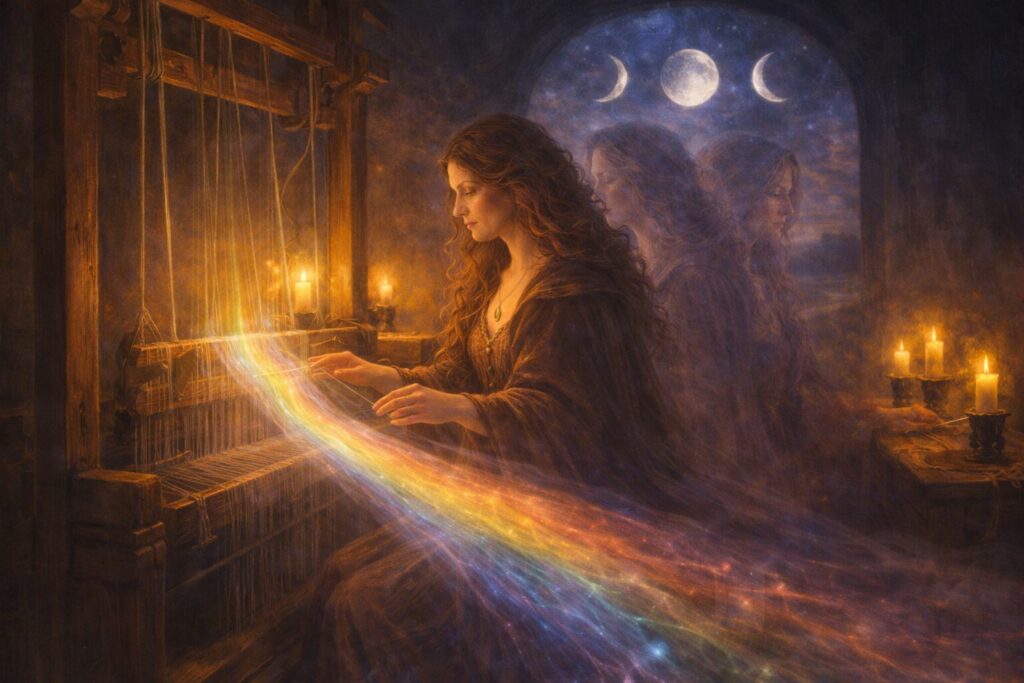
To come to the Triple Goddess in the end is not to arrive at a definition, but at a recognition. What has been described as Maiden, Mother, and Crone does not remain contained within myth, symbol, or page. It reveals itself in the texture of lived experience—in the beginning of things that feel uncertain but necessary, in the long middle where effort must be sustained without guarantee, and in the moment when something has reached its truth and asks either to be kept, changed, or released.
Her presence is not always dramatic. Often it is subtle, almost indistinguishable from the ordinary movement of life. A decision that cannot be postponed. A season that will not be hurried. A truth that has ripened beyond denial. A quiet sense that something is beginning again, though its shape is not yet clear. These are not abstractions. They are the places where her current becomes perceptible.
To recognize her is to begin seeing pattern where there once seemed only circumstance. It is to understand that timing is not accidental, that phases matter, that what is hidden may be as significant as what is revealed, and that endings are not failures but necessary movements within a larger unfolding. It is also to accept that participation in this cycle carries responsibility. What is begun must be tended. What is sustained must be honored. What is completed must be acknowledged. To ignore any part of the movement is to lose clarity about the whole.
There is also a humility that comes with this recognition. The Triple Goddess is not controlled, simplified, or reduced to a single role that serves personal desire. She may align with intention, but she is not governed by it. Her current is wider than any individual life, and to work with her is to learn to listen as much as to act. There are moments when she opens the way, moments when she asks for steadiness, and moments when she closes a door that cannot be forced open again. Each of these is part of her presence, not a departure from it.
For those who walk a spiritual or magical path, this recognition becomes practice. One begins to ask not only what one wants, but when it is right to act, when it is right to wait, and when it is right to release. One begins to notice which phase is speaking, and what that phase requires. In time, this is less a technique and more a way of being—an attunement to the rhythm by which things actually unfold.
And perhaps most importantly, one begins to see that the goddess is not somewhere else. She is not only encountered in ritual, in symbol, or in the stories of the past. She is present in the structure of becoming itself. The same movement that turns the moon, that carries the seasons, that shapes the arc of a life, is the movement through which she is known.
You are not outside that movement.
You are within it.
You are not moving toward her.
You are moving as part of her.
To recognize this is not to claim mastery, but to step into awareness. And in that awareness, the cycle becomes not something that happens to you, but something you begin, slowly and carefully, to move with.
Walk Further Through the Gods and Currents
The Triple Goddess does not stand alone. Her current touches the older gods, the primal forms, the mystical streams of Pagan thought, and the living traditions through which these presences are still approached today.