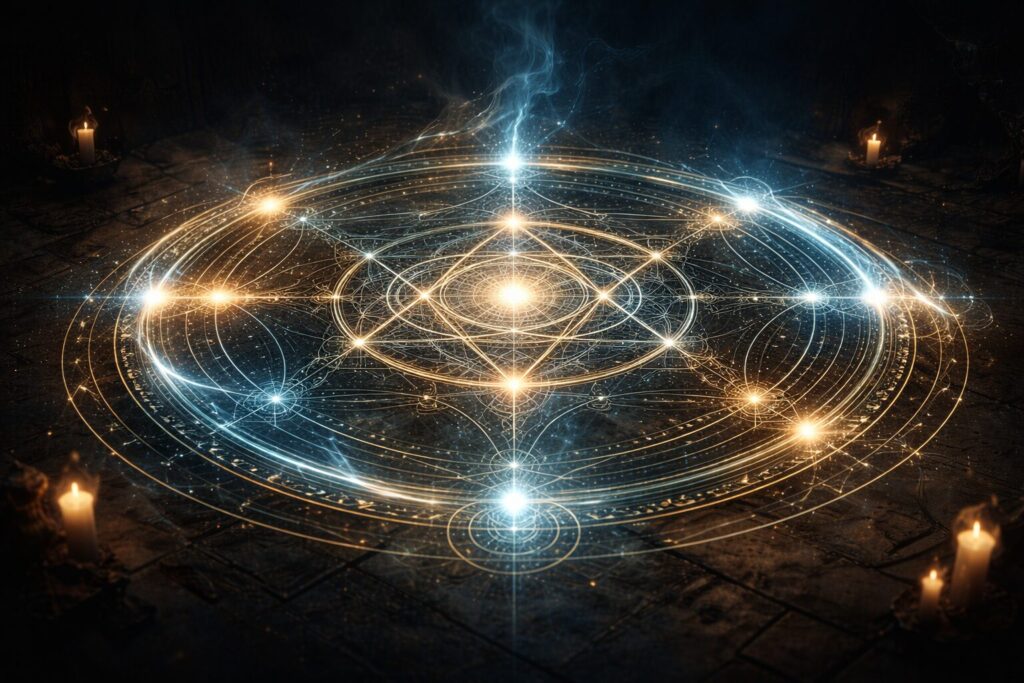
Energetic exchange is the hidden architecture of magical practice. Power does not originate in isolation, nor does it move as a simple projection from will to world. It circulates. It passes through bodies, symbols, landscapes, intelligences, and communities in patterned routes that resemble ecological systems more than mechanical engines. The practitioner is not a solitary generator of force but a node within a living network of currents. To practice magic is to enter circulation.
This perspective reframes nearly every aspect of occult work. Healing is not the addition of energy but the redistribution of flow. Invocation is not possession but temporary alignment with a larger reservoir. Enchantment is the stabilization of a loop. Burnout is not moral weakness but structural overload. Even ethics emerge not as imposed commandments but as the natural consequence of closed or broken circuits. Energy returns because circulation seeks completion.
Thinkers as different as Carl Jung and William James observed that encounters with transpersonal force reshape identity rather than merely adding experiences. In magical terms, sustained participation in a current alters the practitioner’s structure. Exchange is formative. Every alliance, ritual field, and object of devotion leaves a trace. A magician becomes recognizable not by declared beliefs but by the pattern of forces they habitually circulate.
This is why power borrowed without proportion destabilizes, why certain alliances intoxicate, and why some intelligences bind through generosity. Circulation builds identity. Dependency circuits form when exchange loses reciprocity. Predatory systems do not require mythic demonology to exist; they arise whenever flow is trapped rather than returned. The danger is not supernatural evil in a moralistic sense but asymmetry that erodes autonomy.
Yet the same mechanics that allow imbalance also make mastery possible. A skilled practitioner learns regulation: how to open and close circuits, how to ground excess, how to accept force without collapse, how to store charge without stagnation, and how to release what cannot be carried. Magical maturity is less about accumulating power than about stewarding circulation.
Energetic exchange, then, is not a side topic. It is the connective law linking personal will, divine alliance, environmental currents, and collective fields into a single ecology of force. To understand exchange is to understand why magic works, why it sometimes fails, and why every working leaves a residue that shapes the worker in return. The magician is not outside the system. The magician is one of its moving parts.
Energetic Exchange
Power that moves through flow, circulation, and interaction — healing, polarity, and the routing of force between beings.
This section treats magic as an ecology of currents: not metaphor, but operating logic.
Mechanics of Flow
▶
Energetic exchange begins with a simple principle: power behaves less like a projectile and more like a current.
A working is not “force thrown outward,” but a temporary architecture that redirects what is already moving — attention,
emotion, symbol, spirit, landscape, memory, desire — into a patterned route that can produce change.
Circulation and completion. In any system that carries charge, incomplete circuits leak. Closed circuits amplify.
Magical results often fail not because will is weak, but because the pattern never resolves: the practitioner opens a flow and
leaves it hanging. This is why closure matters (grounding, release, sealing, offerings, rest): not as superstition, but as
circuit completion.
Polarity and motion. Exchange requires difference. Polarity is not a gender claim; it is vector logic — a
structured contrast that allows movement. Ritual uses polarity constantly: invocation/evocation, receptive/active, vessel/flame,
silence/word, boundary/opening. Without tension there is no drift, and without drift there is no routing.
Resonance and stability. Resonance is what makes a current coherent rather than chaotic. Correspondence, timing,
repetition, and symbol do not “decorate” a working — they tune it. When resonance is strong, less raw effort is needed; the system
begins to carry itself. This is one reason myth and devotion matter even in technical magic: they generate stable channels.
Feedback loops. Exchange produces feedback. Some is nourishing (clarity, synchronicity, support, momentum). Some is
destabilizing (fixation, inflation, obsession, depletion). A mature practitioner learns to read feedback as data. In that sense,
magic is closer to systems thinking than to wish-fulfillment.
If you want a psychological bridge without reducing the reality of spirit, it’s worth remembering how
Carl Jung described “inflation” —
the way overwhelming archetypal force can flood the human vessel. In magical terms: voltage matters. The current can be real
and still exceed the structure’s capacity to carry it cleanly.
Regulation & Healing
▶
Regulation is the hidden discipline behind almost every form of effective magic. It is the art of keeping exchange
sustainable — not only “strong,” but clean, rhythmic, and survivable.
Healing as redistribution. Healing rarely means “adding energy.” More often it means clearing congestion,
dissolving stagnation, and restoring circulation. Pain concentrates. Trauma binds. Illness often manifests as narrowing —
attention stuck, body tight, spirit dulled, hope collapsed into a single point. Healing re-opens the field.
Throughput and capacity. Every practitioner has a capacity — physical, emotional, psychic, spiritual. Burnout
is what happens when throughput exceeds capacity for too long. This is not a personal failure. It is a systems mismatch.
Even benevolent powers can overwhelm if the vessel is not prepared, rested, and properly earthed.
Valves, not walls. Boundaries are not meant to freeze the world out. They are meant to regulate flow:
to decide what enters, what leaves, what is transformed, and what is refused. Mature boundaries behave like valves and filters,
not like permanent fortresses.
Group fields and co-regulation. Coven work often feels powerful because exchange becomes distributed.
A group field can stabilize currents that would destabilize an individual — but the inverse is also true: group dynamics
can amplify obsession, fear, or dependency if the field is poorly tended.
Advanced note: In your practice, track the difference between energized and regulated.
Energy without regulation produces spectacle. Regulation produces results.
Energetic Exchange
The advanced questions of exchange: borrowing, reservoirs, stored charge — and the shadow side of circulation
when power becomes coercive, overwhelming, or asymmetrical.
Borrowing & Storage
▶
Borrowing power is not inherently suspect — it is normal magical engineering. Practitioners borrow constantly:
from ritual structure, from symbols that already carry charge, from group fields, from land currents, from devotional
relationships, from timing, from ancestors, and from gods. The question is never “Is borrowing real?” but:
what is the circuit you have entered, and what completes it?
Borrowing versus stealing. Borrowing implies relationship. It implies consent, reciprocity, and return.
The return may be literal (offerings, service, vows, praise, maintenance) or structural (carrying the work forward,
embodying the current responsibly, transmitting it cleanly). A healthy circuit leaves both parties more coherent, not less free.
Overwhelm and “voltage mismatch.” Deity currents can be profoundly stabilizing — and also overwhelming if the
practitioner’s capacity is exceeded. This is not a moral indictment of the deity or the relationship; it’s an engineering truth.
You can hold a storm in your hands only if your structure can carry it. Preparation, pacing, grounding, and closure are not optional.
Storage as frozen circulation. Enchanted items are reservoirs because circulation has been stabilized
inside boundary conditions: the charge is “held” by pattern, containment, repetition, and resonance. Over time, all storage decays
unless it is maintained — not because magic is fake, but because systems drift. A talisman is not a permanent battery. It is a
maintained loop.
If you want a scholarly bridge for “how experiences and forces shape us,” you can point readers toward
William James on religious experience as
something that alters the person, not merely informs them. In magical terms: sustained exchange changes the practitioner’s field.
Predatory Exchange
▶
Any ecology of currents has predators. You do not need Christian demonology to describe this; you only need systems literacy.
Predatory exchange is simply exchange that stabilizes itself through asymmetry: it feeds by trapping flow, inducing dependency,
or overwhelming a host so the host cannot regulate.
“Battery dynamics.” Using another being as a battery is the extreme end of a spectrum that begins with ordinary
co-regulation and mutual amplification. The line is not mystical drama; it is structure: consent, reciprocity, and sustainability.
Extraction without a return path destabilizes both parties — not because the universe punishes, but because broken circuits deform.
Dependency loops disguised as empowerment. One of the oldest tricks in any power ecology is the “easy current”:
force that comes too quickly, too effortlessly, and then produces craving. When the practitioner comes to believe they cannot act
without that source, autonomy collapses. The “gift” becomes a collar. This can happen with human relationships, groups, egregores,
and certain spirit contacts.
Hungry or angry intelligences. Some presences feed on agitation, fear, obsession, or exhaustion because those states
produce unstable, high-output flow. This doesn’t require a theology of absolute evil — it’s closer to scavengers in a storm drain.
The practitioner’s task is not panic, but regulation: strengthen boundaries, close circuits, ground excess, and refuse dynamics that
trade freedom for intensity.
Advanced warning, stated plainly: If a current repeatedly overwhelms you, isolates you, demands exclusivity,
weakens your discernment, or makes you dependent — treat that as a structural red flag. It may be “powerful,” but it is not
necessarily healthy.
Energetic exchange is the part of magic that refuses fantasy. It is where the work becomes accountable to structure. Power moves. It concentrates, disperses, resonates, overloads, decays, and returns—not because the universe is moralistic, but because circulation has laws. A practitioner who learns those laws stops chasing intensity and begins cultivating coherence.
This is why “more power” is rarely the answer. More power without regulation is simply a louder imbalance. The mature question is always: what is the circuit? Where does the current enter, where does it exit, what stabilizes it, and what completes it? The same question applies to healing, to enchantment, to devotion, and to group work. It also applies to danger. Predatory exchange thrives wherever flow becomes asymmetrical—where dependency is rewarded, where overwhelm is mistaken for holiness, where the practitioner’s autonomy is traded for access.
To practice well is to become a steward of circulation. That stewardship includes discernment: learning the difference between a relationship that strengthens the field and a dynamic that collapses it; between a reservoir that supports your work and a bargain that makes you smaller; between surrender that expands you and surrender that erases you. In the end, the magician is not outside the system, issuing commands. The magician is within the ecology, shaping routes—closing cleanly, returning what was borrowed, maintaining what was stored, and refusing currents that demand your freedom as payment.
If magic is real, then exchange is real. And if exchange is real, then mastery is not domination. It is the ability to move through power without being unmade by it—carrying force with elegance, and leaving the world, and the self, more coherent than before.