The First Gods
Where the World Begins to Answer
The oldest gods are not the first beings to exist—they are the first ways existence becomes knowable as presence.
Before name, before form, before story, there are conditions: movement, tension, awareness, emergence. These are not yet gods. They do not speak, do not choose, do not enter into relationship. They simply are. But over time—through repetition, interaction, and the gathering of awareness—these conditions begin to take on recognizable shape. They become encounterable. They become relational.
They become gods.
What we call the “First Gods” are not a fixed pantheon, nor a single origin story. They are the earliest stable expressions of recurring divine patterns—forces that have been encountered across cultures, across time, and given many names. In this space, we approach them primarily through an Indo-European lens, not because they originate there, but because that is the lineage through which we most clearly perceive them. These patterns, however, are not bound to any one culture. They are global, persistent, and re-emergent.
The gods do not require belief to exist. They are not sustained by worship, nor diminished by its absence. But relationship changes the nature of the encounter. When attention, ritual, and recognition are brought to a current, it becomes sharper, more present, more responsive. Not created—but focused.
The gods are not separate from reality—they are how reality becomes relational.
They are not inherently good or evil. They do not operate within human moral frameworks. They are consistent to their nature, and it is that consistency—not moral alignment—that defines them. To engage with a god is not to judge it, but to understand what it is, how it moves, and what it asks in return.
They do not die. They may withdraw. They may become quiet, dormant, or culturally forgotten. But absence is not extinction. When they return, they do not come back as they were—they emerge again through the present moment, shaped by the world as it is now.
Across cultures, these currents appear again and again—not identical, but recognizable. This is the foundation of what we call Holy Synchronism: not the collapsing of all gods into one, but the recognition that the same underlying forces are encountered through different names, symbols, and relationships.
What follows is not a definitive list, but a map—a way of understanding how the earliest divine patterns emerge, differentiate, and become the gods we know. Not as distant figures, but as presences still active in the world, still available for relationship, and still shaping the reality we move through every day.
How Gods Emerge
Before gods are named, they are experienced. Before they are worshiped, they are encountered.
Awareness distributed through reality itself—the condition that allows anything to be known.
Patterns begin to register, respond, and organize. Not yet personal, but no longer inert.
The capacity to act, influence, and direct movement within reality begins to form.
A presence becomes recognizable, relational, and distinct. At this point, we encounter a god.
Even the smallest structures of reality follow patterns. Atoms “know” how to behave, forces interact with consistency, and systems organize without conscious thought. This is not yet godhood—but it is the ground from which it becomes possible.
What we call the Protogenoi are these underlying conditions—fundamental forces, natural laws, and structuring realities. They are not relational in the same way gods are. Where the Protogenoi are law-like, gods are responsive.
Gods emerge when awareness gathers into agency, and agency gathers into presence. They are not created by belief—but belief, attention, and ritual can bring them into sharper focus.
Some figures, such as Gaia, exist at the boundary—both foundational and relational, both condition and presence. These are rare, and they mark the places where reality itself becomes most directly encounterable.
Before the gods can be named, reality must first become capable of distinction.
In the beginning there is not yet personhood, not yet story, not yet devotion—only the deep, unformed field from which all things may eventually arise. But the deep does not remain undifferentiated forever. Darkness gathers. Light emerges. Shadow is cast. Tension appears where one state meets another, and the threshold is born.
The threshold is not merely a boundary. It is where tension is held, focused, and made productive. Resistance gives that tension shape. Transformation follows. Time begins. Motion continues. Matter gathers. Consciousness awakens.
This sequence is not meant as a literal timeline, but as a sacred pattern: the way becoming seems to unfold whenever reality moves from undifferentiated potential into form, relation, and presence.
The First Differentiation of Reality
A cosmological sequence of emergence—moving from undifferentiated potential into form, tension, change, and conscious presence.
1. The Deep
The undifferentiated field. Not emptiness, but unformed potential—before distinction, before motion takes recognizable shape, before the world can be encountered as presence.
2. Nyx
Darkness stabilizes. Not simply night, but the first gathered field of concealment—the dark that forms when the deep begins to clot into condition. Nyx is the first veil, the first holding of what is not yet revealed.
3. Light Emerges
Revelation begins. Light does not erase the dark; it makes distinction possible. With light comes visibility, direction, and the first clear sense that reality may be known.
4. Shadow Is Cast
Once light meets form, shadow appears. Shadow is not evil, nor absence alone—it is the mark of relation, the sign that difference has begun. Here the world first carries depth.
5. The Threshold Forms
At the meeting of light and dark, one state and another, the threshold appears. This is not merely a boundary, but the place where transition becomes possible—shadow, tension, crossing, and change all gathered into one living edge.
6. Tension and Resistance Arise
The threshold holds tension and focuses it. Resistance gives that tension shape. Without resistance, nothing coheres; without tension, nothing transforms. Here becoming gains structure.
7. Transformation Begins
What is held in tension cannot remain unchanged forever. Transformation is the result of difference meeting pressure, and it is through transformation that the cosmos begins to move from condition into becoming.
8. Time, Change, and Motion Unfold
Once transformation begins, continuation follows. Time becomes meaningful. Motion develops direction. Change is no longer accidental, but intrinsic to the unfolding of reality itself.
9. Matter and Consciousness Emerge
Form gathers. Awareness deepens. The world becomes capable not only of existing, but of responding, recognizing, and eventually entering into relationship. Here the conditions are finally present for gods to emerge as distinct and encounterable beings.
This sequence is not offered as a strict historical chronology, but as a sacred pattern of emergence. It describes how reality seems to move from potential into distinction, from distinction into tension, and from tension into the forms through which presence, force, and eventually divinity can be recognized.
The Currents
These are not fixed pantheons, but recurring patterns of divine emergence. What follows is an Indo-European lens on very old currents—useful, partial, and reconstructive, not absolute.
Names such as *Dyēus ph₂tḗr, *Perkʷunos, or *H₂éwsōs are scholarly reconstructions. They are useful markers for recurring forms, not preserved original names in a pure or final sense.
In this framework, the Protogenoi are closer to primordial forces, conditions, or natural laws than to fully relational gods. They are foundational rather than personal. Gods emerge when those conditions gather into awareness, agency, and presence. Gaia is one of the rare figures who can meaningfully overlap both categories.
A. Foundational Conditions
B. First Differentiation
C. Stabilized Forces
D. Structuring Currents
Apollonian and Dionysian Energies
These are not separate primordial gods in this framework, but a spectrum running through many of the currents above. The Apollonian tends toward pattern, measure, visibility, and form. The Dionysian tends toward ecstasy, disruption, wildness, and dissolution. Solar and lawful currents often lean Apollonian; threshold, storm, ecstatic, and transformational currents often lean Dionysian. Most living gods contain both in different proportions.
The term Protogenoi is often used to describe the earliest divine beings—those that appear at the beginning of myth, before the familiar gods take shape. In this work, however, the term is used a little differently.
Here, the Protogenoi are understood less as gods in the relational sense, and more as primordial conditions—forces of nature, structuring realities, and underlying laws through which existence operates. They are not personalities in the way later gods are. They do not enter into relationship in the same way. They do not respond, negotiate, or express themselves through presence and preference. Instead, they are the ground from which such things become possible.
Where the Protogenoi are law-like, gods are responsive.
This distinction matters. Without it, everything collapses into a single category, and the difference between force and presence becomes unclear. Gravity is not a god, but it shapes the world in ways no being can ignore. Time is not a personality, but it governs all becoming. The Protogenoi exist closer to this level—fundamental, pervasive, and not dependent on recognition.
And yet, the boundary is not absolute.
Some figures stand at the edge between these categories. Gaia is one of the clearest examples—both a foundational condition and a presence that can be encountered, honored, and related to. In such cases, the distinction between force and god begins to blur, and we see how one may emerge from the other.
In different traditions, similar ideas have been expressed through different language: aeons, emanations, archons, cosmic principles. None of these terms are exact equivalents, but they point toward a shared recognition—that there are levels of reality which structure existence without necessarily presenting themselves as personal beings.
The gods arise when these conditions gather.
When awareness becomes focused.
When agency begins to act.
When presence becomes recognizable.
This is the movement from condition to encounter—from the Protogenoi to the gods.
Understanding this distinction allows for a clearer relationship with both. It allows us to recognize that not everything must be approached as a personality, and that not everything without personality is inert or meaningless. Some forces are engaged through alignment rather than devotion, through understanding rather than relationship.
And still, from these same depths, the gods continue to emerge.
Not all gods are vast, distant, or ancient in the way we tend to imagine them. Many are local, immediate, and deeply embedded in the world we move through every day.
These are what we call small gods—not lesser, but closer.
Small gods arise from the same creative field as all other divine forms, but they do not expand into broad cultural recognition or large mythic identity. Instead, they remain rooted in place, in pattern, and in relationship. They are the presence in a particular river, the spirit of a hill, the awareness that gathers in a home over years of living, memory, and care. They may be tied to a family line, a stretch of land, a doorway, a grove, or a repeated act of attention.
They are often the most accessible gods, and in many cases, the most responsive.
Small does not mean unimportant. It does not mean weak. In fact, because they are local and relational, small gods are often the most potent forces a practitioner will encounter. They are not diffused across cultures or diluted through abstraction—they are immediate, specific, and present.
They are also more difficult to carry.
A great god may travel through symbol, story, and shared recognition. A small god is often bound to where it is known. Its presence is strongest in the place, pattern, or relationship that sustains it.
Small Gods and the Fae
It is important to distinguish small gods from the Fae, though the two are often confused.
Small gods arise from the immanent creative field of this world. They are of the land, the home, the lineage, the pattern of lived reality.
The Fae, by contrast, are more often understood as belonging to an adjacent realm—parallel to this one, sometimes overlapping, sometimes intersecting, but not identical in origin or behavior.
Small gods are of the world. The Fae are alongside it.
Animism and the Living World
At the broadest level, all of this rests within an animist understanding: that reality itself participates in awareness.
But not all awareness gathers into godhood.
Some remains diffuse, responsive, ambient. Some gathers into presence, into agency, into personality—and becomes a god. Small gods sit at this threshold between environment and presence, where the world itself becomes something you can relate to, speak to, and be answered by.
Examples of Small Gods
Localized presences shaped through place, memory, and relationship
The presence that gathers through repeated living—habit, memory, protection, and care within a home.
A current-bound presence shaped by flow, path, and time—responsive to attention and interaction.
A presence tied to a specific place—field, hill, grove, or threshold—often protective and watchful.
Not all ancestors become gods, but some gather into presence—remaining active within lineage and memory.
A presence rooted in living growth—slow, patient, and deeply responsive to long-term attention.
A presence that forms through repeated action—work, ritual, or skill becoming something that responds in return.
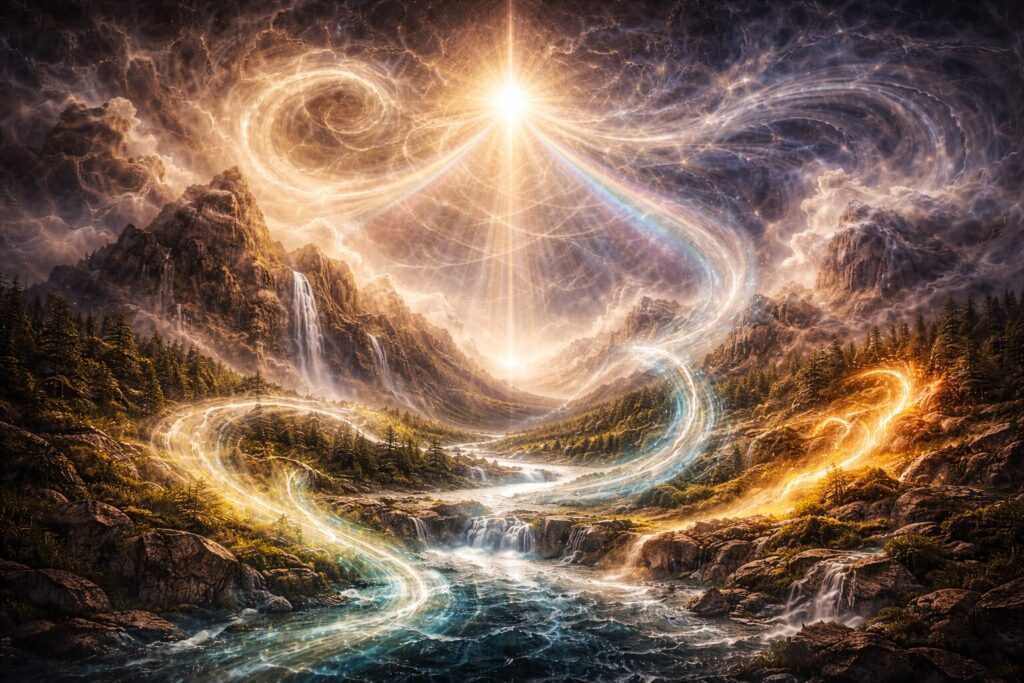
Working With the Currents
To work with a divine current is not to control it. It is to recognize it, approach it properly, and enter into relationship with care.
Symbolic Faces of the Currents
These are not fixed icons or final forms, but symbolic ways the oldest currents are often felt, imagined, and encountered.
The Deep
A dark sea without horizon. A cavern before echo. A silence so complete it has not yet become absence.
The symbol of pre-form, unshaped potential, and the condition before distinction.
Nyx
A starless veil. Velvet dark stretched over forming things. The first chamber in which becoming can hide.
The symbol of gathered darkness, concealment, gestation, and the first stable night.
Solar Principle
A wheel of gold. The noon path. A law written in light across the world.
The symbol of revelation, coherence, visibility, continuity, and ordered radiance.
Threshold
A doorway at dawn. A road fork at twilight. The line where shadow lengthens and one state gives way to another.
The symbol of shadow, tension, resistance, crossing, transformation, and change held in focus.
The Twins
Two riders at the horizon. Two flames from one spark. Two faces turned toward each other and outward at once.
The symbol of mirrored emergence, division becoming relationship, polarity, and co-creation.
Earth Mother
Black soil under the fingernails. A stone warmed by sun. The field that receives, holds, and nourishes form.
The symbol of containment, embodiment, material stability, and sustaining matrix.
Sky / Storm Father
Thunder over open land. A bright sky split by strike. The pressure of command descending from above.
The symbol of force, authority, upper order, storm-pressure, and visible will.
Lunar Principle
A silver bowl. Tide under moonlight. A face seen only in phases and reflected truth.
The symbol of cycle, reflection, subtle timing, inward motion, and psychic rhythm.
Fire
A hearth flame. A torch in ritual dark. A blaze that blesses and burns by the same nature.
The symbol of transformation, offering, release, purification, and dangerous change.
Water
A spring in stone. A river carrying old names. A mirror that remembers what has passed through it.
The symbol of flow, continuity, depth, memory, dissolution, and transmission.
Air / Wind
Breath in cold air. A message carried over distance. The unseen motion that animates what would otherwise remain still.
The symbol of movement, communication, spirit-breath, transfer, and living animation.
Fates / Triple Pattern
Three threads on a spindle. Three women at the edge of time. A pattern that cannot be bypassed, only met.
The symbol of allotment, sequence, weaving, inevitability, and patterned consequence.
Order ↔ Disorder
A temple and a forest. A crown and a frenzy. A measured song breaking into wild ecstatic cry.
The symbol of the sacred tension between coherence and rupture, law and wildness, pattern and becoming.
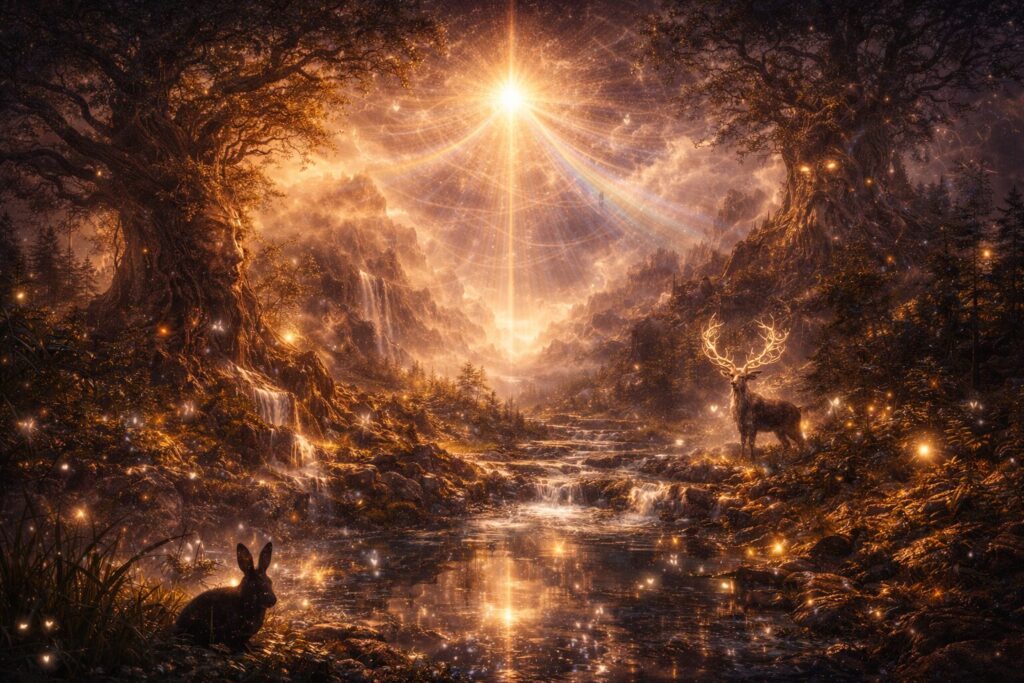
Polytheism is not confusion. It is not a failure to simplify. It is the recognition that reality is multiple because reality is alive.
The world does not speak in a single voice. It speaks in presences, tensions, patterns, forces, and relationships. Some of these gather into gods. Some remain closer to law, place, or condition. Some speak broadly across cultures. Some remain local, intimate, and rooted. Polytheism begins in the recognition that difference is not a problem to be solved, but part of the sacred architecture of existence.
This does not mean every god is identical to every other, nor that every divine figure is merely a mask of one hidden source. Distinction matters. Names matter. Relationships matter. The gods are not interchangeable. Yet neither are they sealed away in absolute isolation. They resonate. They overlap. They form constellations.
This is where Holy Synchronism becomes important. Synchronism is not the flattening of gods into sameness, but the recognition that recurring divine currents may be encountered through different names, symbols, cultures, and ritual grammars. The same fire may be spoken differently in different lands. The same threshold may wear many faces. To recognize this is not to erase difference, but to understand lineage, resonance, and relation more clearly.
Archetypes belong here as well—but in the proper place. Gods are not archetypes in the reductive sense. Rather, archetypes are the imprint left on human perception when divine patterns recur often enough to become recognizable. The gods speak through archetype because their influence leaves marks in story, symbol, dream, ritual, and memory. The archetype is not the source. It is the trace.
For this reason, monotheism is not simply rejected because it is singular. It is rejected because it collapses living multiplicity into a single exclusive frame while often continuing, in practice, to generate plurality through saints, angels, emanations, divine attributes, and differentiated roles. What is called one often behaves as many. We do not reject unity itself. We reject the demand that unity erase distinction.
The gods are not moral in the human sense. They are not divided neatly into good and evil. They are complex beings, consistent to their natures, and often beyond the scale of human ethical simplicity. This does not make them meaningless or lawless. It means relationship requires discernment rather than projection.
Polytheism, in this sense, is not only belief in many gods. It is a discipline of perception. It is the practice of learning how to recognize plurality without panic, relationship without collapse, and sacred difference without forcing all things into one voice.
A Philosophy of Polytheism
Polytheism is not a lesser theology waiting to be simplified. It is a way of recognizing the sacred as plural, relational, and alive.
Gods do not die in the way living beings do.
They do not cease, vanish, or pass out of existence simply because they are no longer named, worshiped, or remembered in the same way. What changes is not their being, but their presence within relationship.
A god becomes quiet when the conditions that sustain its recognition fall away. Cultures shift. Languages disappear. practices change. The patterns that once held a divine current in clear form loosen, and what was once widely encountered becomes distant, diffuse, or difficult to perceive.
This is not death. It is dormancy.
A dormant god is not gone. It is withdrawn—less active in the shared field of human awareness, less anchored in collective pattern, less immediately accessible. Its current still exists, but it no longer gathers into a strong or stable presence without renewed relationship.
When such a god returns, it does not come back unchanged.
It emerges again through the present moment—through new language, new context, new forms of recognition. The current is continuous, but its expression is always shaped by the world it re-enters. What was once a widely known figure may return as a fragment, a feeling, a symbol, or a quiet presence encountered by only a few.
Revival is not restoration. It is re-emergence.
This is why discernment matters. Not every ancient name carries the same presence it once did. Not every reconstruction reanimates a living current. Some do. Some do not. The difference is not found in historical accuracy alone, but in whether the current itself gathers, responds, and enters into relationship again.
The gods do not require us in order to exist.
But relationship determines how, and whether, they are encountered.
Dormancy reminds us that divine presence is not static. It moves, withdraws, concentrates, disperses, and returns. To work within a living polytheistic framework is to recognize this movement—and to approach it with patience, respect, and clarity.
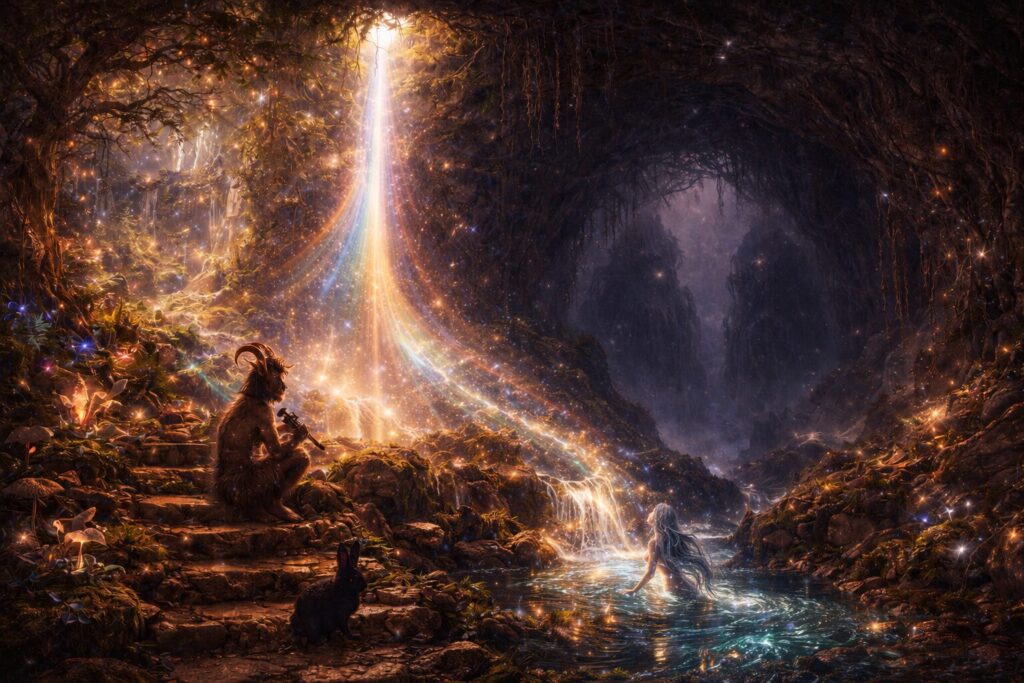
To study the gods in this way is not to reduce them to a system, nor to fix them in place. It is to learn how to recognize them when they move.
They are not confined to myth, though myth remembers them.
They are not contained by symbol, though symbol points toward them.
They are not dependent on belief, though belief can sharpen the encounter.
They are present in the world—in pattern, in pressure, in change, in continuity, in the subtle sense that something is not only happening, but acting.
To approach the gods is not to escape the world, but to enter it more fully. To notice where forces gather into presence. To recognize where relationship is possible. To understand that what we call divine is not separate from reality, but a way reality becomes responsive, relational, and known.
This does not make the work easier.
It asks for attention.
It asks for discernment.
It asks for patience.
Not every presence will reveal itself clearly.
Not every current will be meant for you.
Not every encounter will become a relationship.
But some will.
And when they do, they will not ask you to believe in them.
They will ask you to recognize them—and to respond accordingly.
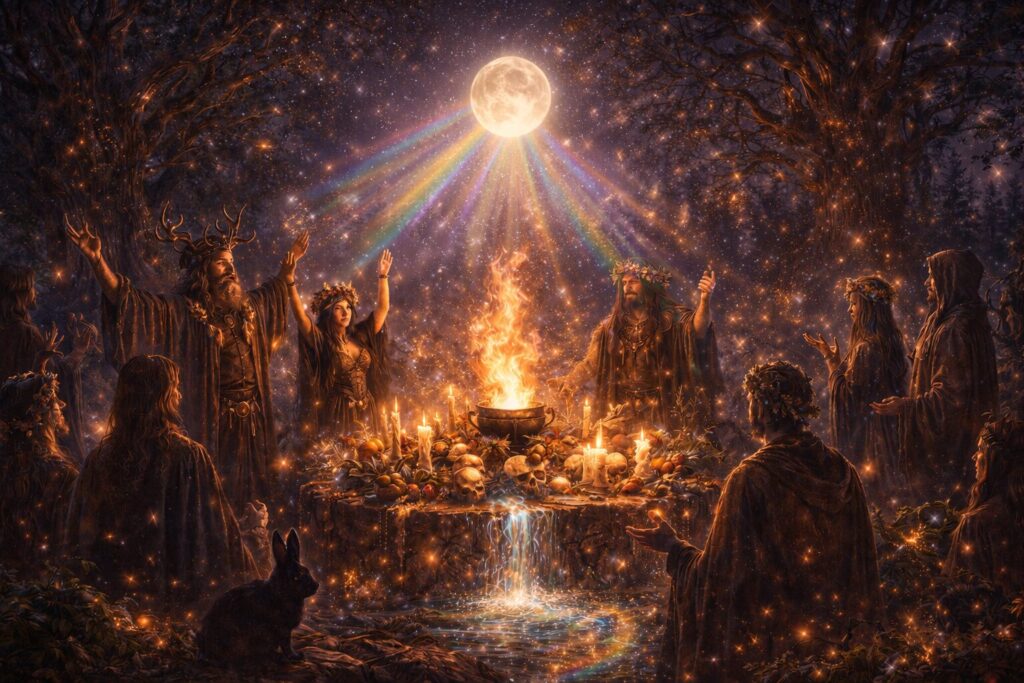
To live within a polytheistic world is to accept that the sacred is not singular, not silent, and not finished. It is multiple, speaking, and ongoing.
The gods are not distant.
They are here, where the world begins to answer back.
Continue Exploring
Follow the currents outward into practice, philosophy, and the gods we most often work with.