The Crown of the Cycle
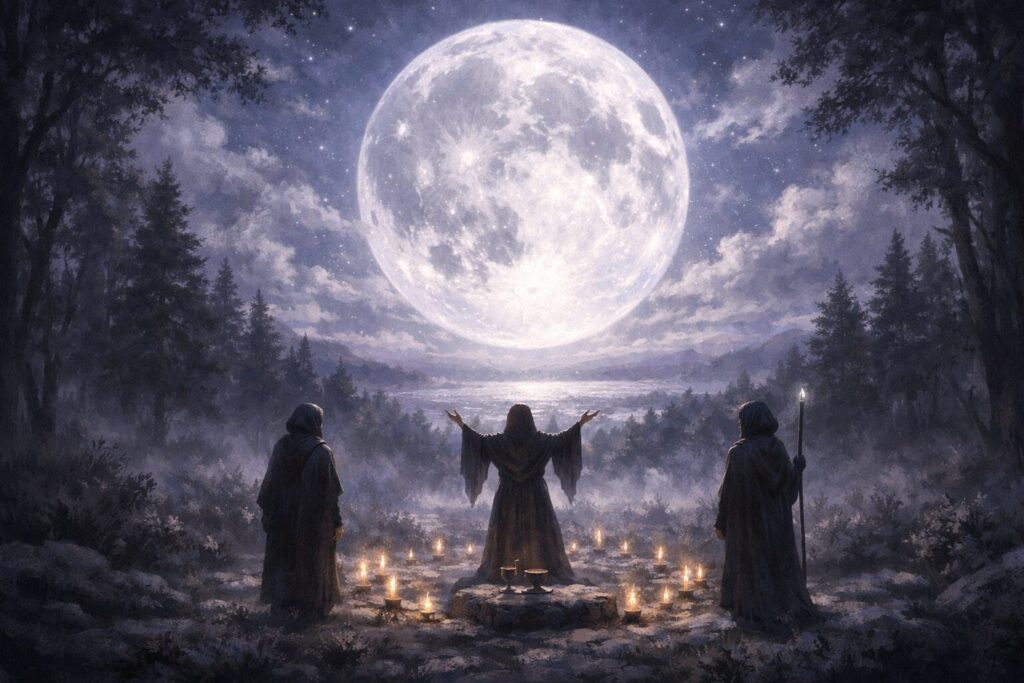
If the New Moon is the vow and the Waxing Moon is the build, the Full Moon is the moment the work becomes visible. Not always finished — but revealed. This is the phase of presence: what you have been feeding now shines back.
The Full Moon is often described as a time of “power,” but in mature practice its power is less about volume than clarity. The Moon’s face is whole; the night is bright enough to show edges. In magic, that brightness behaves like a mirror: it illuminates the strength of a working and also exposes the weak joints — the places where desire outran discipline, where momentum became noise, where a promise was made without structure.
This is why Full Moon work thrives when it is treated as a crown, not a shortcut. The phase favors rites that benefit from visibility: divination, blessing, gratitude, charging, and honest assessment. It can also support release — not the deep unmaking of the Dark Moon, but the lucid shedding of what can no longer hide. Under the Full Moon, truth does not have to be cruel; it can be clean.
Many modern witches hold the Full Moon as the archetypal Esbat: a recurring return to the cycle as a living teacher. Some circles practice Drawing Down the Moon as a formal rite of invocation; others keep it simpler — candle, water, breath, and attention. Either way, the essential gesture is the same: to stand in the light and ask, without flinching, What is actually here?
Mythically, the Full Moon has never belonged to one story. It has been read as the eye of the night, the lantern of travelers, the judge of oaths, the blessing of harvest, the radiant face of the goddess, and the quiet witness of the dead. In MCC practice, we treat these as lenses. You might approach the Full Moon through Artemis or Diana for clarity of aim and self-possession, through Selene or Luna for luminous devotion, through Isis for restoration and sacred sovereignty, or through Hekate in her torch-bearing aspect when the work touches thresholds and hidden truth. The point is not to collect names — it is to choose a language that helps the work become honest.
Coven lens: The Full Moon is the phase of shared sight. It is excellent for group divination, group blessing, and results review — naming what worked, what misfired, and what must be refined before the cycle turns toward waning. When done well, this is not judgment. It is craft: the discipline of learning.
Practical rule: crown what you truly built — and only charge what you are willing to carry forward.
Full Moon — How the Current Behaves
The apex of the cycle: illumination, culmination, and reflection. The Full Moon doesn’t simply add power — it makes what you’ve been feeding unmistakably visible.
From Full → Waning: illumination becomes refinement; what is revealed can now be adjusted or released.
Common misfires: overcharging unfinished work, inflating a moment into a destiny, substituting ritual theater for structure, or refusing to examine results honestly.
Full Moon Workings
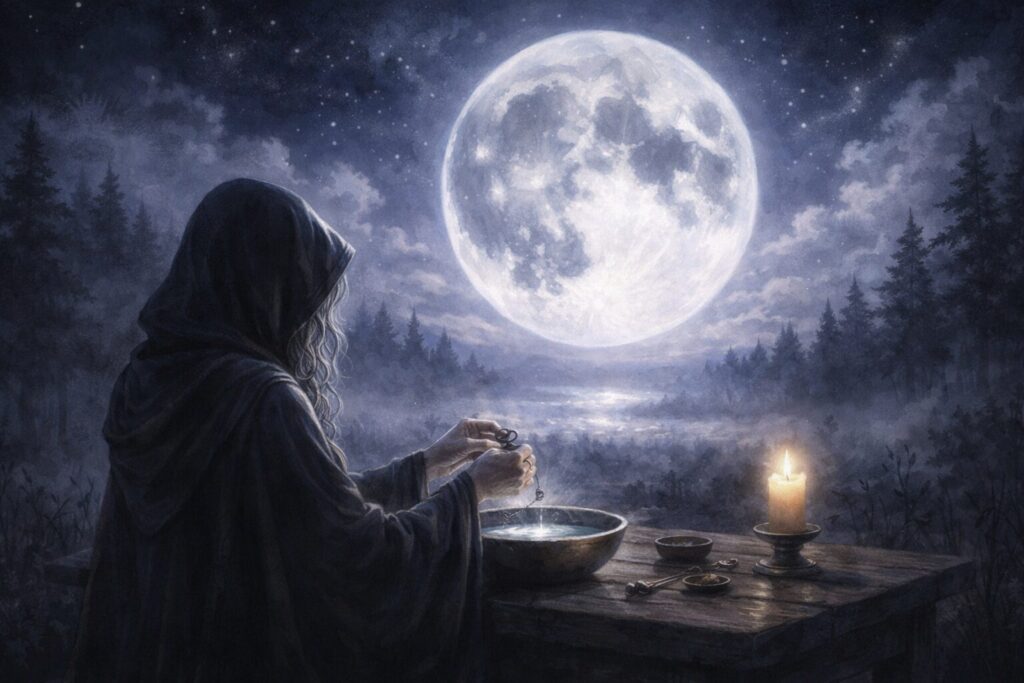
The Full Moon crowns what you’ve built: it blesses what is coherent, charges what is ready, and reveals what must be refined. Work cleanly — brightness magnifies both strength and flaw.
Spell Families That Thrive in Full
Crown, charge, bless, reveal — and release with clarity.
Crown (Culmination)
Mark progress, seal a chapter, bless a threshold you’ve reached. Crown magic is about completion you can name.
- Project finish / milestone rites
- Commitments made visible (vows, boundaries, announcements)
- “This is what we built” gratitude work
Charge (Amplification)
Charge tools, talismans, and long-form workings that already have structure. Full Moon amplifies coherence.
- Amulets, wards, consecration water/oil
- Devotional objects (moon water, candles, charms)
- Reinforcing protections built during Waxing
Reveal (Divination & Truth)
Clarity magic: seeing what is present, what is hidden, and what you’re refusing to admit.
- Tarot/scrying with focused questions
- Truth rites (what is real? what is illusion?)
- Dream incubation (simple and specific)
Release (Clean Shedding)
Not the deep unmaking of the Dark Moon — but the lucid release of what cannot justify itself in the light.
- Letting go of habits that no longer hide
- Ending a cycle with dignity
- Refining intentions before Waning work
Charging Tools Without Overcharging
A bright phase, best used with restraint and purpose.
Best things to charge
Talismans with a clear job: protection, clarity, confidence, safe attraction, stable prosperity.
- One charm per purpose
- One sentence per charge
- One ethical boundary clause
What to avoid
Charging messy, contradictory goals. Full Moon makes contradictions louder.
- Vague “more love/money/anything”
- Charging many items at once
- Trying to force a result that isn’t built
- Name the function: “This is for protection / clarity / steadiness.”
- Add a boundary: “Only if honorable, safe, and sustainable.”
- Use one medium: moonlight, candlelight, breath, or water — not everything.
- Seal briefly: three breaths, three passes of the hand, then stop.
- Store respectfully: wrap or place it where it won’t become clutter.
Divination That Fits the Phase
Questions the Full Moon answers best.
Ask for visibility
Full Moon divination is strongest when it requests truth, not comfort.
- What is the real state of this situation?
- What am I refusing to see?
- What is working — and why?
- What is the cost of continuing as-is?
Ask for refinement
Let the light diagnose the structure before you begin Waning correction.
- What must be simplified?
- Where is my intention contradictory?
- What needs to be released next?
- What needs to be protected as the cycle turns?
Draw Down the Moon (Optional Rite)
A traditional Wiccan-style approach, offered as one lens among many.
Best conditions
Calm circle, clear consent, and a role-holder who can stay grounded.
- Agree on boundaries before you begin
- Keep it brief and dignified
- Close the rite cleanly
Safety + clarity
Invocation is not proof of holiness; it is a technique. Respect it and don’t romanticize it.
- If anyone feels unwell, stop and ground
- Don’t do this while emotionally unstable
- End with banishing/closing and food/water
- Set the container: cast circle (or your MCC equivalent), name intention and boundaries.
- Purify simply: water, smoke, or breath—keep it clean.
- Invite the lunar current: use a short invocation or a respectful call in your own words.
- Receive: the role-holder stands still; the group holds quiet attention.
- Speak or bless: if words arise, keep them measured; if not, bless in silence.
- Release: thank and dismiss the current; return the role-holder to themselves.
- Ground: food, salt, touch, breath—then close the circle.
Coven Patterns for Full Moon
Shared sight: blessing, review, and unified charging.
Three-part Full Moon rite
Simple, repeatable, effective — the Full Moon rewards clean structure.
- Open: gratitude + clarify purpose
- Work: divination or blessing + one charge
- Close: results notes + grounding
Results review (MCC)
Make learning part of the craft: crown what worked, refine what didn’t.
- What succeeded, and why?
- What misfired, and what did it teach?
- What must be released into waning?
Full Moon — Deep Dive Reflection
The Full Moon is not only a “high tide” of magic. It is a mirror that demands honesty: what you built is visible, what you denied is visible, and what you truly value becomes measurable by what you are willing to carry forward.
The Full Moon Lesson: Illumination Without Drama
Clarity is power — but it doesn’t have to become spectacle or judgment.
What illumination does
It reveals structure: where intention is coherent, where it is contradictory, and where your life is not aligned with your desire.
- It crowns what is ready.
- It exposes what is unstable.
- It makes self-deception harder to maintain.
How to meet it well
Approach the phase like a craftsperson: observe results, name what’s true, and refine with restraint.
- Choose clarity over intensity.
- Choose a single focus over scattered effort.
- Choose one correction instead of ten punishments.
Shadow Expression at Full
When brightness turns into inflation, obsession, or performative spirituality.
Common traps
Full Moon shadow is often a misuse of visibility: wanting the feeling of power more than the discipline of truth.
- Inflation: “This proves I’m chosen / special / unstoppable.”
- Overcharge: pushing a working past its structural limits.
- Purity theater: turning clarity into moral superiority.
- Emotional flood: mistaking intensity for insight.
Corrections that work
Bring the phase back to craft: reduce, clarify, contain.
- Shorten the ritual. Keep one focus.
- Write one sentence: “What is actually true?”
- Add a boundary clause: “only if safe / honorable / sustainable.”
- Ground physically (food, water, breath) before interpreting visions.
Coven Dynamics Under Brightness
Shared sight can unify — or magnify unresolved tension.
Healthy Full Moon coven signs
Visibility becomes learning and gratitude.
- Clear roles and modest structure
- Results discussed without shaming
- Shared blessing that feels calm afterward
Unhealthy Full Moon coven signs
Visibility becomes competition, projection, or theater.
- Performing power instead of doing craft
- “Who is strongest” energy
- Unspoken conflicts surfacing as “messages”
Devotion, Deity Lenses, and the Full Moon
Choosing a language that makes the work honest, not crowded with names.
Bright-lens figures
Use these as lenses, not requirements: pick one current that fits your aim.
- Selene / Luna: luminous devotion, beauty of the night
- Artemis / Diana: clarity of aim, self-possession, clean boundaries
- Isis: restoration, sovereignty, holy competence
Threshold-lens (light-touch)
When Full Moon truth exposes what is hidden, a threshold lens can help you face it without fear.
- Hekate (torch-bearing aspect): illumination of crossroads, honest seeing
- Use gently: the goal is clarity, not heaviness.
How Full Moon Interacts with the Rest of the Cycle
Seed → build → crown → refine → veil → seed.
- Before Full: Waxing built the structure; Full shows whether it holds.
- After Full: Waning refines and releases; it takes what Full revealed and makes it livable.
- Where people misread it: treating Full as “instant manifestation” instead of “crown + clarity.”
- Prompt: What is clearly working in my life right now — and why?
- Prompt: What is clearly not working, even if I keep defending it?
- Prompt: If I crown this outcome, what responsibility comes with it?
- Prompt: What must I refine or release as the Moon turns toward waning?
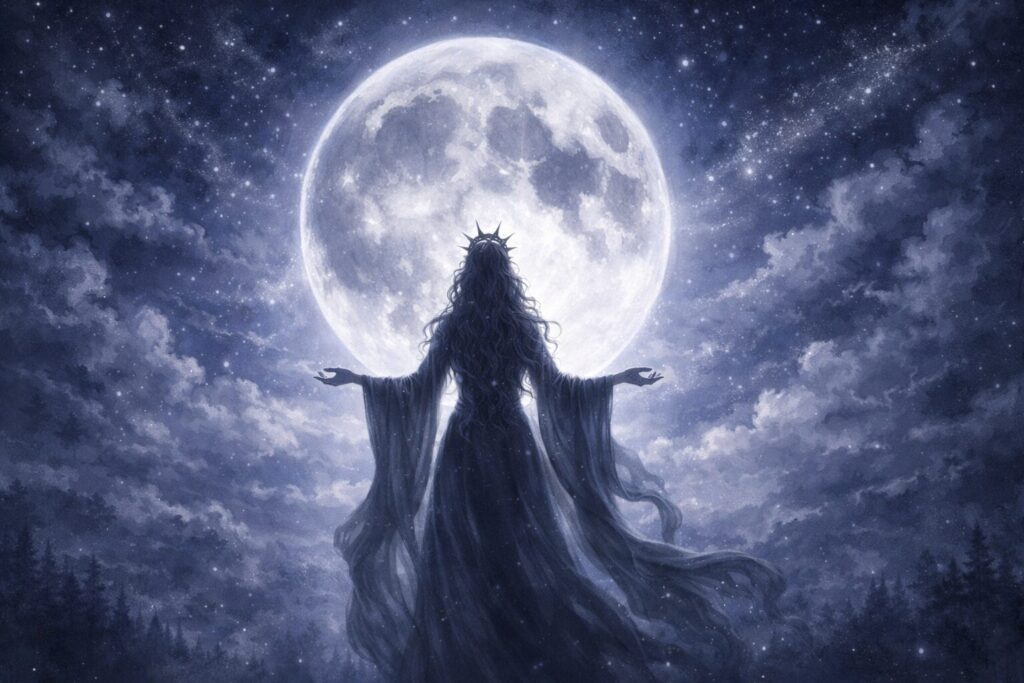
Full Moon — The World’s Old Language for a Crowned Night
Across cultures the Full Moon has been read as the night’s “open eye” — a crown of visibility that blesses, exposes, and measures. In practice, treat myth as a set of lenses: ways to speak to what the phase does without turning it into a rulebook.
The Crown / The Witness
The Full Moon is the crowned moment: what was hidden is visible, what was hoped is measurable, and what was built either holds or reveals its weak joints.
Tide, Orchard, and Lantern
A “high tide” in the psyche: feelings rise, intuition brightens, and the nervous system can feel louder. Like harvest light, it helps you see what is ripe — and what is not.
Full / Bright / High Moon
Folk naming often treats the Full Moon as a public marker: time to gather, bless, divine, and name what the season (or the self) has produced.
Luminous Sovereignty
The Full Moon’s mythic mood often belongs to figures of radiance, integrity, and clear sight — not simply “power,” but power that can be carried without distortion.
Solar-Clarity at Night
Correspondence thinking often reads the Full Moon as a moment of “solar clarity” within lunar space: illumination, vitality, and intensified perception — best used with restraint.
Oaths in Brightness
Many traditions treat bright moonlight as a time when promises are tested. In practice: take stock. Crown what deserves continuation — and admit what needs refinement as the cycle wanes.
Full Moon — Lines on Illumination
The Full Moon is the phase where light becomes judgment, blessing, and mirror. These voices speak to visibility, presence, and the discipline of being seen.
Everyone is a moon, and has a dark side which he never shows to anybody.
The moon does not fight. It attacks no one. It does not worry. It does not try to crush others. It keeps to its course, but by its very nature, it gently influences.
At the full moon the veil is thin; what is hidden speaks if you are quiet enough to hear it.
We are all like the bright moon, we still have our darker side.
As the moon reaches the height of its cycle, the Full Moon stands as both mirror and lantern — illuminating what we have cultivated, revealing what has been hidden, and calling forth the clarity that only peak light can offer. This is not merely a moment for doing; it is a moment for seeing: seeing our intentions reflected in the silver glow, seeing shadows where we once walked in ease, and seeing ourselves in the larger rhythm of sky and earth. Under the full moon, magic moves with fullness rather than force, with receptivity rather than grasping. It is a time to charge and consecrate, to celebrate emergence and communion, to tend to spirit as one tends to flame. And when the light is at its brightest, let your inner witness be equally present — not as judge, but as steady companion. Walk with your fullness, honor your revelations, and carry the moon’s illumination with you as you return to shadow and silence. For in this cycle — as in all — the moon teaches us that illumination is not the end of the path, but a clear view of the next horizon.