
Hearth & Hedge: Kitchen Magic as Everyday Witchcraft
The hearth as the first temple, the hedge as the first threshold.
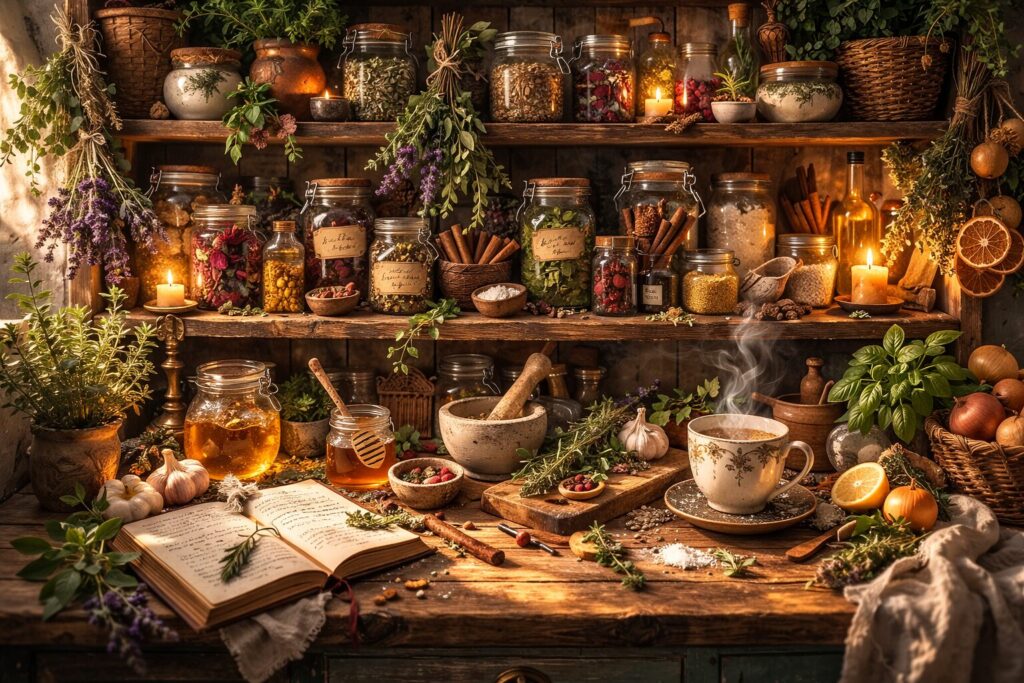
Among the oldest magics known to humankind, none were born in cloisters or stone academies. They took shape in kitchens: in the crackle of fire, the scent of herbs hung to dry, the hiss of water meeting hot iron. Before witchcraft was a profession or identity, it was a form of literacy—an embodied knowledge of heat, plants, time, and transformation. Early cooks were chemists before chemistry, healers before medicine, ritualists before liturgy. Their wisdom lived not in written treatises but in textures, scents, and the quiet repetition of daily acts.
Modern scholarship often calls this realm low magic, a term meant to distinguish domestic folk practice from “high” ceremonial traditions. Yet the categories reveal more about historical bias than the nature of magic. The hearth was no less sacred than the temple; the hedge was no less liminal than any ritual circle. These accessible spaces—fireplaces, fields, gardens, kitchens—were where people met the sacred most directly. The home was the site of transformation. The garden was the threshold of relationship. The kitchen was the crucible where survival, healing, nourishment, and devotion met.
Hearthcraft and Hedgecraft emerge from this lineage. They represent two faces of the same ancient impulse: to work with the materials of everyday life in a way that acknowledges spirit, intention, and interconnectedness. The hearth witch tends fire, food, and home. The hedge witch listens at the land’s edge, attends to herbs and seasons. In practice, these roles blur. Many witches stir pots and gather herbs, sweep floors and read signs in wind or soil. They are scholars of the everyday—students of transformation, embodiment, place, and care.
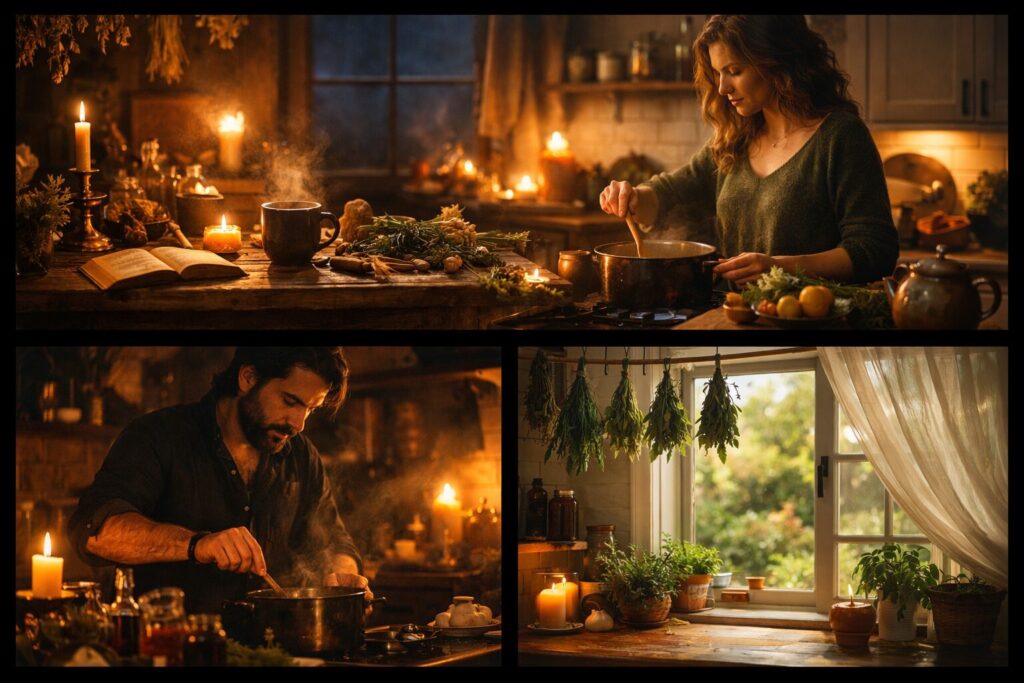
This path is approachable precisely because it is already alive in daily life. We cook, we clean, we brew, we prepare tea, we keep our homes. The witch simply does these things with awareness—treating the ordinary as sacred and the familiar as a threshold. The kitchen becomes a temple of sensory alchemy. The hedge becomes a door into the world’s intelligence. The home becomes a testament to the idea that magic is not added to life, but revealed within it.
The following sections explore this path in depth. Each is a drawer in the witch’s kitchen—where lore, history, and practice rest side by side. A poetic teaser introduces each idea; a short summary presents its thesis; an expanded essay unfolds its full depth. Together they form a long-form, reflective study of how Kitchen and Hedge magic shape the witch’s way of being: practical, poetic, and profoundly transformative.
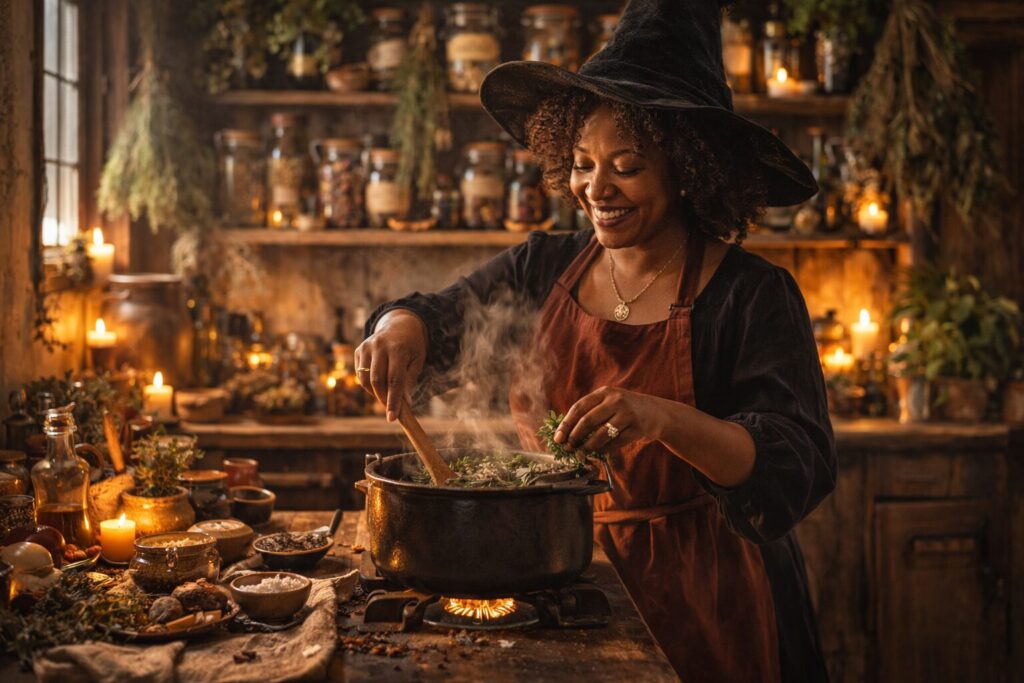
Hearth & Hedge: Kitchen Magic as Everyday Witchcraft
The hearth as the first temple, the hedge as the first threshold.
A long-form exploration of everyday witchcraft rooted in kitchens, gardens, and thresholds. Read straight through or open one drawer at a time. This is a study in slow magic—the kind already living in daily life.
Among the oldest magics known to humankind, none were born in cloisters or stone academies. They took shape in kitchens: in the crackle of fire, the scent of herbs hung to dry, the hiss of water meeting hot iron. Before witchcraft was a profession or identity, it was a form of literacy—an embodied knowledge of heat, plants, time, and transformation.
Modern scholarship sometimes calls this realm low magic, distinguishing domestic folk practice from “high” ceremonial traditions. Yet the categories reveal more about historical bias than the nature of magic. The hearth was no less sacred than the temple; the hedge was no less liminal than any ritual circle.
Hearthcraft and Hedgecraft emerge from this lineage: two faces of the same ancient impulse to work with the materials of everyday life while acknowledging spirit, intention, and interconnectedness. The witch simply does ordinary things with awareness—treating the familiar as sacred and the home as a threshold.
The following sections are drawers in the witch’s kitchen—where lore, history, and practice rest side by side. Each drawer offers a teaser, a thesis, and a full section, followed by notes, practices, and a journaling prompt for your own Book of Hearth.
How to Use This Page
This is a long-form study. You can read it straight through, or open one “drawer” at a time. Each drawer includes scholarship, folk texture, a practical rite, and a journaling prompt.
- Scholar’s Note grounds the practice in history, anthropology, and real-world context.
- Folk Note offers living lore—kept honest, framed with respect, never forced as fact.
- Kitchen / Hedge Practice gives you something you can do this week.
- Book of Hearth turns your kitchen notes and recipes into a spell-adjacent journal.
If You’re Beginning Here…
Start small. Hearth & Hedge magic becomes powerful through repetition, not intensity. Choose one drawer, one gesture, and one week. Let practice build the bond.
- Pick one drawer that feels immediately relevant (Fire, Thresholds, Pantry are common entry points).
- Choose one practice you can repeat without strain.
- Repeat it for seven days and notice what changes in mood, attention, and sense of place.
- Write one line daily—scent, feeling, timing, outcome.
- Only then add complexity. The craft grows like a garden.
Salt Quick Uses (Beginner-Friendly)
- Quick cleanse: add a pinch to warm water for wiping a counter, doorstep area, or your “hearth tray” (gentle maintenance, not obsession).
- Boundary cue: a tiny pinch in a pinch-bowl near your entry can act as a reminder: “Only what serves this home may cross.”
- Kitchen protection: salt your food with intention—preserve what matters, keep what nourishes—a daily micro-ward that stays practical.
- Reset after conflict: tidy the room, then wipe a surface with salted water while naming what you are releasing.
- Emergency grounding: hold a little salt in your palm, breathe slowly, then wash your hands—return to body, return to present.
Want deeper context? Visit the full guide: MCC — Salt.
Drawer One: Fire & Transformation
The hearth is an ancient workshop of change—timing, heat, and attention training magical discipline.
Drawer One: Fire & Transformation
The hearth is an ancient workshop of change—timing, heat, and attention training magical discipline.
The story of magic begins with fire. Long before occult ink preserved doctrines, flame transmitted knowledge through food, medicine, and ritual. The hearth changed raw into edible, cold into warm, scattered into gathered—matter and mood transformed together.
For witches, fire is not only an element; it is a teacher of limits. It rewards presence and punishes neglect. It reveals the difference between control and relationship—between domination and tending.
Domestic timing is magical timing. Bread rises on its own schedule. Broth becomes bitter if forced. The kitchen trains the body to recognize readiness, to sense the moment something turns—exactly the sensitivity spellwork requires.
Scholar’s Note
Across cultures, the hearth functions as a ritual center of the home: continuity, protection, and social cohesion are repeatedly symbolized through maintained flame. Much “alchemical” language—heating, dissolving, distilling, coagulating—describes processes practiced for millennia in kitchens, breweries, dye-houses, and households.
Folk Note
In many folk traditions, the first flame in a new home was treated as a promise: greet the fire, and the house stays warm in spirit as well as body. Even modern echoes remain—leaving a light on for “good feeling,” warming the stove before guests, treating the kitchen as where the house “wakes up.”
Kitchen Practice — The Kindle & Simmer Rite
Choose a meal that needs at least 20 minutes of heat. Before turning on the burner, place your hand near the stove and take one full breath. Name what you are asking the fire to transform (tension, fatigue, uncertainty, stagnation). Stay for the first minute and listen to the shift in sound. Stir with rhythm. When the food is finished, pause before serving and say one sentence: “I acknowledge the fire that made this possible.”
Book of Hearth — Log Entry
Record: (1) what you cooked, (2) how the heat behaved (fast, slow, uneven), (3) your mood before, (4) what changed by the end, (5) whether the meal matched the intention. Over time, your recipe notes become spell-adjacent: a record of transformation repeated into reliability.
Drawer Two: Herbcraft — The Kitchen Apothecary and the Hedge Beyond
Herbs bridge inner and outer worlds—scent, memory, medicine, and correspondence braided together.
Drawer Two: Herbcraft — The Kitchen Apothecary and the Hedge Beyond
Herbs bridge inner and outer worlds—scent, memory, medicine, and correspondence braided together.
Herbs move easily between worlds. A sprig of rosemary is seasoning on the cutting board; it is also remembrance, protection, and continuity in folk practice. The difference is not the plant—it is the attention brought to it.
Beginner herbcraft is less about memorizing lists and more about building sensory literacy. Crush a leaf; notice what it does to your mood. Brew a tea; notice what it does to your body. Your correspondence list becomes both scholarly and personal.
Keep herbcraft safe. Culinary herbs are the best entry point because they live at the overlap of flavor and function. Start with what you already own.
Scholar’s Note
Historical household books often blur boundaries between cookery, medicine, and spiritual protection—recipes, remedies, and charms coexisting without apology. Folk knowledge persists through repetition and observation: what helped digestion, what eased sleep, what signaled “clean” or “safe” in a home.
Folk Note
Many traditions treat certain plants as “threshold allies”—rosemary for remembrance and warding, bay for blessing and luck, garlic for protection, mint for freshness and clarity. Folk logic often tracks what the plant does (sharp, cleansing, warming) and then extends that into symbol.
Kitchen Practice — The Three-Herb Apprenticeship
Pick three common herbs/spices you can access easily (example: rosemary, bay, cinnamon). For two weeks, use one of them daily—cook with it, smell it, touch it, and note the effect. Once a week, make a simple culinary-safe infusion. Your goal is not mastery; it is relationship.
Book of Hearth — Herb Page Template
For each herb: (1) smell/taste notes, (2) where you got it, (3) mood it evokes, (4) body response, (5) “book lore” (one line from a reputable source), (6) your own correspondence sentence. Your journal becomes a living herbarium.
Drawer Three: Gesture, Intention, and the Ritual of Everyday Acts
Kitchen magic is embodied magic—gesture and repetition become ritual when paired with awareness.
Drawer Three: Gesture, Intention, and the Ritual of Everyday Acts
Kitchen magic is embodied magic—gesture and repetition become ritual when paired with awareness.
Occult texts often emphasize words and symbols. The kitchen emphasizes movement. Stirring, chopping, kneading, sweeping—these gestures teach the will how to inhabit the body.
Direction becomes grammar: clockwise to gather, counterclockwise to release (use it lightly—consistency matters more than dogma). The spell is the repeated pairing of motion with meaning.
The beginner insight here is simple: attention is an ingredient. If you can bring attention to one repeated action a day, you have already begun.
Scholar’s Note
Ritual studies frequently define ritual as prescribed sequence of action that shapes meaning. Domestic labor already contains sequences (recipes, cleaning routines, seasonal chores). When framed intentionally, ordinary sequences function as ritual without requiring theatrical additions.
Folk Note
Folk practice often hides in habits: a grandmother’s “always stir this way,” a parent’s blessing over bread, the broom used toward the door when “getting the bad out.” These are traces of how humans encode care into motion.
Kitchen Practice — One Gesture, One Word
Choose one daily gesture (stirring tea, wiping the counter, kneading dough). Pair it with a single word: clarity, comfort, protection, steadiness. Repeat for seven days. On day eight, change the word and observe how the gesture feels different.
Book of Hearth — Gesture Log
Write three lines: (1) the gesture, (2) the word, (3) what shifted (body tension, mood, pace). Over time you’ll see which gestures regulate you and which sharpen focus. This is practical magic: self-state control through ritualized motion.
Drawer Four: Liminality & Thresholds — Where Hearth Meets Hedge
Thresholds are sensitive places—where influence moves, where boundaries are tested, where transitions become visible.
Drawer Four: Liminality & Thresholds — Where Hearth Meets Hedge
Thresholds are sensitive places—where influence moves, where boundaries are tested, where transitions become visible.
Threshold magic is not only about spirits; it’s about transitions. Coming home, leaving home, waking, sleeping, beginning a meal—these are crossings. The witch learns to make crossings conscious.
Doors and windows are practical boundaries. They also shape mood: what enters, what leaves, how the house “breathes.” Tending thresholds is beginner-friendly protection without drama.
Keep it gentle. The most effective thresholds are maintained, not performed once.
Scholar’s Note
Cross-cultural folklore frequently treats borders as charged: doorways, crossroads, field edges, boundary stones. Such places concentrate attention and therefore meaning—an ideal substrate for protective custom and transitional ritual.
Folk Note
Many homes carry “quiet protections”: a charm near the entry, a pinch of salt, an iron object, a phrase spoken while locking the door. The logic is simple: the boundary is where you decide what is welcome.
Kitchen Practice — The Doorway Blessing + Sweep
Once a week, sweep or wipe your entry area toward the door. As you do, speak: “Out with what is stale; in with what is kind.” Then touch the doorframe and say: “Only what serves this home may cross.” If you work with salt, keep it minimal and mindful—maintenance, not obsession.
Book of Hearth — Threshold Notes
Log: (1) which threshold you tended, (2) what phrase you used, (3) whether the space felt lighter/heavier, (4) any patterns (sleep, arguments, calm). This becomes your home’s energetic map.
Drawer Five: Food, Offering, and the Ecology of Care
Food is spell, offering, and relationship—care made material, devotion made edible, ethics made daily.
Drawer Five: Food, Offering, and the Ecology of Care
Food is spell, offering, and relationship—care made material, devotion made edible, ethics made daily.
Feeding is one of humanity’s oldest blessings. Meals declare belonging. They also carry memory, hierarchy, comfort, and care. Kitchen witchcraft learns to treat nourishment as a ritual language.
Offerings extend that language outward. A small portion set aside acknowledges that the household participates in wider ecosystems: land, ancestors, spirits, community. You don’t need grandeur—only sincerity and consistency.
Ethics belong here: sourcing, waste, consent, and cultural respect. The ecology of care is magical because it is relational.
Scholar’s Note
Food rituals are near-universal: taboos, blessings, first portions, shared feasts. These practices encode ethics and belonging. Domestic magic often appears precisely where survival and meaning overlap—meals, medicine, seasonal preservation.
Folk Note
Many households keep “first-bite” customs—an ancestor plate, a sip poured to the ground, a crumb left at a threshold. Not because it “buys” favor, but because it trains gratitude into the body.
Kitchen Practice — The First Spoon Offering
Once a week, dedicate the first spoonful (or first sip) of a meal to what you honor: ancestors, land, household guardians, or simply the more-than-human. Say: “I set aside the first portion in respect.” Dispose responsibly: outdoors if appropriate, compost if possible, or a simple “thank you” before discarding.
Book of Hearth — Offering Log
Record: what you offered, to whom (or “to the household”), what you felt, and whether anything shifted afterward (mood, calm, dreams, sense of support). Keep it observational—no superstition required.
Drawer Six: The Hedge Witch’s View — Land, Spirit, and Quiet Listening
Hedgecraft is relationship with place—observation, reciprocity, and boundaries practiced gently over time.
Drawer Six: The Hedge Witch’s View — Land, Spirit, and Quiet Listening
Hedgecraft is relationship with place—observation, reciprocity, and boundaries practiced gently over time.
Hedgecraft begins at the edge: fence lines, alleys with weeds, courtyards, parks, the stubborn patch of green beside a parking lot. The hedge witch trains attention where cultivated and wild overlap.
This is not necessarily trance work. It can be simple noticing: what plants volunteer here, what birds return, what the wind does in a particular corner. Over time, place becomes presence.
Boundaries matter. Not every place feels welcoming. Respect “closed” places; choose reciprocity over extraction.
Scholar’s Note
“Genius loci” and land-spirit language can be interpreted literally or poetically; either way it fosters ethical attention. Place-based practice often functions as ecological literacy: noticing cycles, species, microclimates, and how human action shapes them.
Folk Note
Crossroads, field edges, and boundary stones appear repeatedly as “charged” in story. Folklore treats borders as where the world speaks more loudly—because the human mind is already alert at crossings.
Hedge Practice — The Seven Walks
Walk the same short route seven times (seven days or seven weeks). Each time, notice one category: plants, birds, smells, weather, litter, human traces, “feel.” Offer one small act of reciprocity once during the cycle (pick up trash, water a struggling plant, leave clean water for wildlife).
Book of Hearth — Place Notes
Make a small “map entry”: where you walked, what you noticed, what felt open/closed, and one sentence of gratitude. The hedge becomes readable. That readability becomes magical.
Drawer Seven: Everyday Alchemy — Heat, Time, and the Art of Change
Fermentation, leavening, preservation, and slow cooking teach patience—transformation as process, not spectacle.
Drawer Seven: Everyday Alchemy — Heat, Time, and the Art of Change
Fermentation, leavening, preservation, and slow cooking teach patience—transformation as process, not spectacle.
Alchemy is change under constraint: heat, time, combination, separation, recombination. The kitchen is full of this: reductions, stocks, slow simmers, ferments, leavening, preservation. You learn that not all power is fast.
Everyday alchemy also teaches humility. Some transformations cannot be rushed without ruining the work. That lesson translates directly to spellcraft and to personal change.
When you practice “slow magic,” you practice staying present through process. That is advanced craft in beginner clothing.
Scholar’s Note
Early alchemical literature frequently borrows imagery from cooking and brewing. The “furnace” and “vessel” are domestic as much as laboratory. Even modern chemistry inherits methods refined in kitchens and workshops.
Folk Note
Folk wisdom says: don’t boil what should simmer. Don’t open the oven too soon. Don’t disturb a ferment in its early days. These are practical instructions—and metaphors people use for grief, change, and healing for a reason.
Kitchen Practice — The Slow Vessel Working
Choose one slow process (a simmered broth, a long-steep tea, a bread rise). While it works, set a timer for 10 minutes and sit nearby. Breathe. Observe. End by speaking: “What is ready will become.”
Book of Hearth — Process Log
Write the stages: start state, middle state, end state. Add one line about your own inner state at each stage. You’re training magical timing: the ability to perceive the “turn” when something becomes new.
Drawer Eight: The Modern Hearth — Accessibility, Inclusion, and Real Life
Hearth magic adapts—apartments, shared kitchens, limited time, disability, scarcity. The craft remains valid.
Drawer Eight: The Modern Hearth — Accessibility, Inclusion, and Real Life
Hearth magic adapts—apartments, shared kitchens, limited time, disability, scarcity. The craft remains valid.
Online imagery often implies hearth magic requires a cottage kitchen and hanging herbs. Real life is smaller: microwaves, hot plates, roommates, chronic fatigue, tight budgets. The hearth is not an aesthetic—it’s a returning.
Magic remains valid when it is honest. A cheap staple meal cooked with care is more “witchy” than an elaborate feast made with resentment. Accessibility is not a compromise; it is a craft principle.
Build practice around what you can sustain. The hearth rewards consistency over intensity.
Scholar’s Note
Domestic ritual is shaped by class, labor, and social constraint. “Traditional” does not always mean accessible. Hearthcraft becomes more authentic when it meets the practitioner’s real conditions rather than an idealized past.
Folk Note
“Use what you have” is the oldest folk spell. Many household charms are ordinary things placed with intention: salt, iron, bread, water, a spoken phrase at the right moment.
Kitchen Practice — The Movable Hearth Tray
Create a small tray you can set out and put away: one candle (or LED), one mug, one pinch bowl of salt (or spice), one steady object. Use it before meals or tea. One minute is enough: light, breathe, name gratitude, begin.
Book of Hearth — Accessibility Notes
Write what is realistic for you this season (time, money, energy). Then write one practice that fits inside it. The journal becomes permission. The craft becomes compassionate.
Drawer Nine: The Witch’s Pantry — Archives of Memory and Meaning
The pantry is mirror and toolkit—ingredients as memory, identity, ethics, and spell materials.
Drawer Nine: The Witch’s Pantry — Archives of Memory and Meaning
The pantry is mirror and toolkit—ingredients as memory, identity, ethics, and spell materials.
Open a pantry and you see autobiography: what you can afford, what you crave, what your body tolerates, what your culture remembers. For the witch, this is not just storage—it’s a personal archive.
Pantry magic is pragmatic. It asks: what do these ingredients do in the body, and what do they do in the symbolic field of meaning? Salt cleanses and preserves. Honey sweetens and heals. Vinegar brightens and scrubs. You live inside correspondences already.
When you organize the pantry with intention, you organize the self: keeping what nourishes, releasing what no longer fits, making space for new patterns.
Scholar’s Note
Household order has long been tied to moral and spiritual meaning in many societies (for better and worse). The witch can reclaim the pantry not as perfectionism, but as mindful stewardship of resources and nourishment.
Folk Note
Folk protections often begin in the cupboard: salt at the threshold, vinegar for cleansing, bread as blessing, honey for sweetness, cinnamon for warmth and attraction. The “spell” is repeated use plus story.
Kitchen Practice — Pantry Blessing & Sorting
Once a season, choose one shelf. Remove everything. Wipe it down with warm water (a pinch of salt optional). As you return items, speak: “Keep what nourishes; release what is stale.” Donate what you can. Discard what’s unsafe. This is cleansing without superstition.
Book of Hearth — The Pantry Index
Create a one-page index of your “core allies”: salt, honey, vinegar, garlic, cinnamon, tea, rice/beans. For each: one mundane use, one magical use, one memory. This turns your pantry into a usable grimoire without pretending it’s exotic.


Hearth & Hedge: Kitchen Magic as Everyday Witchcraft
Among the oldest magics known to humankind, none were born in cloisters or stone academies. They took shape in kitchens: in the crackle of fire, the scent of herbs hung to dry, the hiss of water meeting hot iron. Before witchcraft was a profession or identity, it was a form of literacy—an embodied knowledge of heat, plants, time, and transformation. Early cooks were chemists before chemistry, healers before medicine, ritualists before liturgy. Their wisdom lived not in written treatises but in textures, scents, and the quiet repetition of daily acts.
Modern scholarship often calls this realm low magic, a term meant to distinguish domestic folk practice from “high” ceremonial traditions. Yet the categories reveal more about historical bias than the nature of magic. The hearth was no less sacred than the temple; the hedge was no less liminal than any ritual circle. These accessible spaces—fireplaces, fields, gardens, kitchens—were where people met the sacred most directly. The home was the site of transformation. The garden was the threshold of relationship. The kitchen was the crucible where survival, healing, nourishment, and devotion met.
Hearthcraft and Hedgecraft emerge from this lineage. They represent two faces of the same ancient impulse: to work with the materials of everyday life in a way that acknowledges spirit, intention, and interconnectedness. The hearth witch tends fire, food, and home. The hedge witch listens at the land’s edge, attends to herbs and seasons. In practice, these roles blur. Many witches stir pots and gather herbs, sweep floors and read signs in wind or soil. They are scholars of the everyday—students of transformation, embodiment, place, and care.
This path is approachable precisely because it is already alive in daily life. We cook, we clean, we brew, we prepare tea, we keep our homes. The witch simply does these things with awareness—treating the ordinary as sacred and the familiar as a threshold. The kitchen becomes a temple of sensory alchemy. The hedge becomes a door into the world’s intelligence. The home becomes a testament to the idea that magic is not added to life, but revealed within it.
The following sections explore this path in depth. Each is a drawer in the witch’s kitchen—where lore, history, and practice rest side by side. A poetic teaser introduces each idea; a short summary presents its thesis; an expanded essay unfolds its full depth. Together they form a long-form, reflective study of how Kitchen and Hedge magic shape the witch’s way of being: practical, poetic, and profoundly transformative.
Drawer One: Fire & Transformation
Fire is the oldest magician’s tool and the kitchen its first laboratory. Long before ceremonial magic, domestic cooks were experimenting with heat, fermentation, and transformation—practices that would later echo in alchemical theory. This section examines the hearth as ritual site, workshop, and teacher.
Read the full section on Fire & Transformation
The story of magic begins with fire. Long before ink and vellum preserved occult teachings, flame transmitted knowledge through food, medicine, and ritual. The hearth was the center of the ancient home not only because it provided warmth, but because it was the place where raw ingredients became nourishment. In this sense, the hearth was the first alchemical workshop: a place where matter changed states, where elements combined into new wholes, and where intention—spoken or silent—accompanied every shift.
Anthropologists often mark the control of fire as a threshold moment in human culture. Fire offers warmth and safety, but also demands relationship. It must be tended, fed, guarded, and respected. In many early households, the fire was treated as though it were alive—an ally and a power rather than a neutral tool. Roman families honored Vesta’s flame; Baltic and Slavic traditions speak of hearth guardians; in countless cultures, the home-fire was kept burning as a sign of continuity between generations.
Cooking is, at its core, a sequence of transformations: water into steam, raw into cooked, bitter into palatable. Long before the language of alchemy formed, domestic workers understood the stages of change in their pots and pans. A broth taken too far becomes bitter; a ferment unmonitored becomes unstable. The vocabulary of later laboratory alchemy—heating, dissolving, distilling, coagulating—describes processes that ordinary people practiced daily in kitchens, breweries, and dye-houses.
For the modern witch, the kitchen fire remains a teacher. Lighting a candle before cooking can mark the transition from ordinary time into ritual time. The act is simple: a flame, a breath, perhaps a word. Yet it acknowledges that what follows—chopping, stirring, seasoning—will be done with intention. The stove burner itself can become part of the ritual, as the witch notes how a pot responds, how quickly it comes to temperature, how the sound and scent shift over time.
Timing is itself a form of magic. A spell cast too soon may not take; a spell cast too late may miss the window of opportunity. Similarly, bread left to rise too long collapses, and milk scalded for too long curdles. Domestic labor cultivates an embodied sense of when something is “ready.” This is not abstract; it is learned through repetition, error, and attention. In this way, the witch’s sensitivity to energetic timing is trained alongside her sensitivity to steam, scent, and texture.
Fire also reveals the boundaries of control. It can be harnessed, but never fully tamed. A flame that cooks can also burn; a candle that blesses can also topple; a pot forgotten can scorch. For the witch, this ambiguity is not a flaw but a lesson. Power is never without risk, and humility is part of the craft. Fire asks for respect, presence, and the willingness to adapt. It reminds the witch that magic is not about dominating nature, but about entering into relationship with forces that exceed the self.
When we speak of “low” Kitchen magic, then, we are not describing a lesser form of practice. We are naming a tradition rooted in the ground floor of human survival. The transformation of food by fire is one of the oldest shared human rituals. Every time a witch stirs a pot, lights a burner, or kindles a candle in the kitchen, she continues a lineage in which alchemy and dinner are not separate endeavors, but facets of the same art.
Drawer Two: Herbcraft — The Kitchen Apothecary and the Hedge Beyond
Herbs bridge hearth and hedge. In the kitchen they are ingredients; at the boundary of field and wild they are teachers, medicines, and messengers. This section considers culinary and magical herbcraft as intertwined practices, rooted in folk knowledge, sensory learning, and relationship with place.
Read the full section on Herbcraft
Herbs move easily between worlds. A sprig of rosemary on a cutting board is a seasoning; the same sprig hung above a doorway is a charm. A bay leaf in the soup is flavor; a bay leaf tucked into a wallet is a spell. In this sense, herbcraft is not a separate discipline layered onto ordinary life. It is an awareness of the ways plants participate in the home’s physical and spiritual ecology.
Historically, the boundary between kitchen, pharmacy, and shrine was thin. Medieval herbals, early modern recipe-books, and household manuals often combined cookery, medicine, and magic without apology. A recipe might begin as a sauce and conclude with an aside about its healing virtues or protective uses. Many of the people who preserved herbal knowledge were neither clerics nor physicians, but householders who observed which plants soothed fevers, which aided digestion, which seemed to calm a restless child or lighten a sorrowful mood.
For the kitchen witch, the herb cupboard is an apothecary in plain sight. Basil, rosemary, thyme, bay, mint, oregano, cinnamon, garlic, ginger—these are not exotic ingredients requiring special initiation. They are the plants that have traveled along trade routes and migration patterns for centuries, adapting themselves to new cuisines and new magical languages. A witch does not need to know every Latin binomial or obscure folk name to begin. She can start with what is already on the shelf.
Hedgecraft extends this relationship outward, into gardens, hedgerows, parks, and patches of untidy green at the edge of parking lots. A hedge witch learns to recognize the plants that volunteer near her home. She notices which weeds thrive in her yard, which trees dominate the skyline, which flowers insist on blooming through cracks in the sidewalk. Over time, these observations become a form of local literacy: a sense of who lives here, plant-wise, and what those beings seem to offer or ask.
This does not require dramatic vision or trance. It can be as simple as noticing that the same mullein stalks appear every year along a particular fence line, or that clover carpets the grass where children play. The hedge witch reads these presences as part of an ongoing conversation between land, weather, human activity, and more subtle influences. She may harvest a few leaves or blossoms for teas, charms, or offerings, but she does so with consent and reciprocity in mind.
In the kitchen, herbcraft becomes intimate. Crushing leaves between fingers releases scent that travels straight to the limbic system, stirring memory and emotion. Adding a pinch of basil can recall a childhood meal; a sprig of mint can summon summers long past. The witch pays attention to these responses, because they are clues about how a plant engages not only the body, but also the mind and heart. The “correspondence” of an herb is not simply what a book says; it is also what the herb does to the witch personally.
Over time, the kitchen witch develops a personal materia medica: not only lists of properties, but stories. She remembers the rosemary that grew outside a first apartment, the mugwort that seemed to thrive only during periods of intense dreamwork, the thyme planted during illness that later refused to die. These experiences become part of the lore she carries, just as surely as any printed reference.
In this way, herbcraft is both scholarly and relational. A witch may consult herbals, scientific sources, and magical texts to understand safety and history. But she also observes what happens when a particular tea is drunk before bedtime, or when certain herbs are placed above a doorway. The kitchen and the hedge thus become twin classrooms: one inside, dealing in steam and spice; one outside, dealing in wind and soil. Between them, the witch learns that plants are not simply resources but collaborators in the art of living well.
Drawer Three: Gesture, Intention, and the Ritual of Everyday Acts
Magic is often described as “will plus imagination,” but in the kitchen it is also movement, repetition, and touch. This section explores how gestures—stirring, chopping, kneading, sweeping—become ritual acts when paired with intention, and how domestic labor can function as embodied spellwork.
Read the full section on Gesture & Intention
Much occult writing focuses on words and symbols, but in the witch’s kitchen, the primary language is movement. The hand that chops, stirs, kneads, wipes, and pours speaks in a grammar older than writing. We learn these motions long before we learn the names for them. The child stirring batter is already rehearsing the motions of spellwork, even if no one names it as such.
Gesture matters because the body is not separate from magic. Intention held only in the mind tends to evaporate, drifting among other thoughts. Intention embodied in movement gains weight. When a witch chooses to stir clockwise while thinking of drawing in resources, or counterclockwise while thinking of release, she is giving shape to her will. The direction of motion becomes a mnemonic device, a physical reminder of the work being done.
Consider the act of kneading dough. The repeated folding, pressing, and turning of the mass can be experienced as labor, meditation, or both. A witch might imagine that each fold integrates a desired quality—patience, warmth, courage—into the bread that will later be eaten. She might recall ancestors who performed the same motion, wondering what cares or hopes they pressed into their own loaves. In this way, a simple task becomes a contemplative bridge between past and present, body and meaning.
Sweeping and wiping are likewise rich with potential. Many folk traditions treat sweeping as a method of removing unwanted influences from the home. The motion of broom or cloth can be directed toward doorways or thresholds, carrying away dust and tension alike. When paired with spoken or silent phrases—“out with what is stale,” “make way for what is new”—these motions reframe tidying as banishing and inviting.
Importantly, none of this requires theatrical embellishment. The power lies not in grand gestures but in the consistency of small ones. A witch who always wipes the table with a particular phrase, or who always pauses for one breath of gratitude before pouring coffee, is building a lattice of micro-rituals throughout the day. Over time, these tiny acts create a felt sense of continuity: life may be chaotic, but certain gestures remain steady, anchoring the self within the flow of tasks.
The kitchen thus becomes a training ground for embodied awareness. The witch learns to notice how her shoulders tense or relax as she works, how her breathing changes, how her mood shifts with different activities. Rather than rushing through chores while mentally elsewhere, she experiments with attending to the gestures themselves. What happens when she stirs more slowly? When she chops with deliberate care? When she breathes out tension each time she wipes a counter or rinses a dish?
Gesture is where magic becomes inseparable from living. The same hand that steadies a knife can also trace a protective symbol in salt. The same motion that opens a window to let in air can also be the motion that invites blessing. When the witch honors these crossovers, she no longer has to step out of ordinary life to practice her craft. The practice is woven into the way she moves, the way she touches the world, and the way she allows intention to inhabit her muscles, not just her thoughts.
Drawer Four: Liminality & Thresholds — Where Hearth Meets Hedge
Liminal spaces—doors, windows, porches, hedges—have long been associated with spirits, protections, and crossings. This section explores thresholds as both physical and metaphysical sites within hearth and hedge magic, and considers how witches work with them gently and deliberately.
Read the full section on Liminality & Thresholds
To live in a house or apartment is to be surrounded by thresholds. We cross them so often that they vanish into habit: the front step, the bedroom doorway, the line between kitchen tile and hallway carpet. Yet in folklore, these boundaries are neither neutral nor empty. They are places where inside and outside meet, where one state of being gives way to another.
Many cultures mark thresholds with protective symbols. Iron nails in doorframes, charms hung above entries, chalk marks or written verses near lintels—all of these attest to an intuition that “in-between” places are both powerful and vulnerable. They are points through which not only people but also influences travel. For the hearth witch, this awareness offers an invitation: if thresholds are sensitive, they can be tended.
The kitchen is full of such liminalities. The doorway between kitchen and rest of the house marks the passage between work and reception. The window above the sink frames the changing light, weather, and seasons. Even the refrigerator door is a curious threshold: behind it, food sits in a different state of time, paused between freshness and decay. A witch may choose to acknowledge some of these boundaries consciously, tracing a small sigil above a door, running a hand along a windowsill and whispering a greeting to the wind, or pausing on the back step to thank the land before stepping into the yard.
The hedge itself is a classic liminal image. In premodern landscapes, hedgerows often marked the edge of cultivated land, separating fields from wilder ground. They served as windbreaks, animal corridors, and convenient places to gather wood and berries. In story, however, they became places where fairies walked, spirits lingered, and travelers might lose or find their way. To “ride the hedge” in some modern witchcraft vocabularies is to move between worlds, walking the border between seen and unseen.
Not every hedge witch engages in trance or journeying, but many do practice a gentler form of liminal awareness. This might involve walking the same route along the edge of a property regularly, noting what has changed. It may mean paying attention to which birds perch on the fence, or how the air feels at the boundary between yard and street. In time, these observations become a relationship. The hedge ceases to be a line on a map and becomes a presence in its own right.
Inside the home, thresholds also mark transitions of role and mood. The doorway to the kitchen may become, in a witch’s mind, a gate through which she passes when shifting from work mode to hearth mode. Crossing it intentionally—perhaps with a breath or a quiet phrase—helps the body reset. Likewise, the bedroom door can be treated as a threshold into rest and dream, the bathroom door as a threshold into release and cleansing.
Liminality, then, is not only about contact with unseen beings. It is about honoring the ways in which our lives are patterned by crossings, and about choosing to make some of those crossings conscious. When a witch pays attention to thresholds, she is less likely to feel that life happens to her and more likely to feel that she can shape how she enters and leaves the spaces that matter. The hedge and the hearth become less like static objects and more like active edges of experience.
Drawer Five: Food, Offering, and the Ecology of Care
Kitchen magic is inseparable from feeding. This section explores food as offering, bond, and spell—to deities, ancestors, spirits, and living community—and considers how cooking functions as a devotional and ethical practice.
Read the full section on Food & Offering
The act of feeding others has always carried more weight than calories alone. In virtually every culture, meals are wrapped in etiquette, taboo, blessing, and story. To share food is to declare that someone belongs at your table; to withhold food is to exclude or punish. Witches working within Kitchen and Hedge traditions recognize that food is not merely fuel. It is a medium of care, obligation, gratitude, and sometimes power.
Offerings are one of the oldest forms of ritualized feeding. A morsel of bread left on a windowsill, a splash of drink poured onto the ground, a portion of a meal set aside on an ancestor plate—these gestures acknowledge that the household is part of a wider community that includes the dead, the land, and the unseen. In some homes, the first serving of a dish always goes to the altar; in others, a tiny portion is left at a tree or stone that has become a familiar presence.
Feeding humans is equally potent. The witch who cooks for friends, family, or community is performing magic even if no spell is spoken. She is shaping experience: deciding what flavors will comfort or invigorate, what textures will ground or delight, what herbs will soothe frayed nerves or brighten a heavy mood. The same garlic that wards off sickness in a charm also strengthens immunity in soup. The same cinnamon that appears in prosperity spells warms the body and stimulates circulation.
The “ecology of care” extends beyond the immediate table. Kitchen magic asks questions about where ingredients come from, who grew them, and under what conditions. A hedge witch may prefer to gather some herbs personally, forging a relationship with the land. A hearth witch in an urban apartment may express the same care by buying from local markets when possible or by blessing and honoring whatever food is available, even when circumstances are tight.
Ancestors often sit quietly at the center of this ecology. Many people feel closest to their dead when cooking dishes they once made, using their recipes, utensils, or holiday traditions. Inviting ancestors to the table through memory and story is a form of offering as real as any formal ritual. It says: you are not erased here. Your patterns, for better or worse, flow into what we are now, and we choose how to carry them forward.
For the witch, then, food is a matrix where magic, ethics, and relationship converge. A meal can be a spell for healing, a statement of solidarity, a prayer for abundance, or a way of knitting a fragmented household back together. The point is not perfection or constant performance, but awareness. Even a simple bowl of rice, prepared and eaten with intention, can become a profound act of everyday devotion.
Drawer Six: The Hedge Witch’s View — Land, Spirit, and Quiet Listening
Hedgecraft emphasizes relationship with land, weather, and subtle presence. This section explores a gentle approach to spirit and place: one grounded in observation, offerings, and boundaries rather than spectacle.
Read the full section on the Hedge Witch’s View
To walk to the edge of a property—the fence line, the shared courtyard, the tree at the back of a parking lot—is to encounter a different texture of space. The air may feel slightly wilder, the sounds less filtered by walls and insulation. For many hedge witches, this is where their practice hums most clearly: in the places where human order thins and the wider world presses closer.
Hedgecraft does not require dramatic visions or elaborate journeys. It can be as simple as standing near a tree day after day and noticing how it changes. Are there birds nesting? What insects frequent its bark? How do its leaves respond to wind and season? This kind of attention may seem purely naturalistic, but over time it can open a sense of presence that is difficult to describe in strictly material terms. The witch begins to feel that she is not merely looking at the land, but being looked back at.
Many traditions speak of land spirits, genius loci, or place-beings. Whether one interprets these as literal entities, emergent patterns, or poetic ways of naming ecological complexity, the effect is similar: the land is treated as worthy of respect. Offerings made at the hedge—crumbs, water, a whispered promise to care for a specific patch of ground—become reciprocal gestures in an ongoing conversation.
Spirit work in hedgecraft tends to be incremental rather than explosive. A witch might begin by speaking aloud to the land, even if she feels silly. She might thank the wind for a cool breeze, apologize to a tree when breaking a branch, or ask permission before harvesting. Over time, she may notice responses: a sudden gust, a particular bird call, a sense of ease or tension in her body as she moves through certain areas. None of this requires abandoning critical thinking; it simply asks the witch to include her subtle perceptions alongside her rational ones.
Boundaries are crucial here. Just as not every human relationship is safe or nourishing, not every place feels welcoming. If a hedge or patch of scrub land feels oppressive, agitated, or “closed,” the hedge witch respects that message and chooses another area to work with. Consent applies to places as well as people. This attitude helps keep hedgecraft grounded, ethical, and responsive rather than extractive or entitled.
In the end, the hedge witch’s view is less about spectacular experiences and more about kinship. She understands that her kitchen herbs have cousins in the wild, that the water in her kettle fell as rain somewhere not long ago, that the wind entering her window may have passed through the branches of a distant tree that someone else loves. This sense of continuity makes her magic feel less like a set of isolated spells and more like participation in a shared, living world.
Drawer Seven: Everyday Alchemy — Heat, Time, and the Art of Change
Fermentation, leavening, preservation, and slow cooking embody the principles of transformation that alchemists later theorized. This section reflects on the kitchen as a living laboratory of change and what that teaches witches about patience, limits, and possibility.
Read the full section on Everyday Alchemy
Alchemy is often imagined as robed figures in stone rooms, surrounded by retorts and cryptic diagrams. Yet the heart of alchemy is far older and more humble: it is the practice of changing substances through time, heat, and combination. In this sense, every kitchen is an alchemical space, and every witch who cooks is an alchemist, whether she uses that word or not.
Consider fermentation. To make sourdough, yogurt, kimchi, or beer is to invite invisible collaborators—yeasts and bacteria—into partnership. The witch mixes flour and water, milk and culture, vegetables and brine, then waits. The ingredients do not simply sit; they become. They bubble, sour, sweeten, and complexify. The witch learns that not all transformation is immediate. Some of it is slow, cumulative, and sensitive to environment.
The logic of preservation is equally instructive. Drying herbs, salting vegetables, making jams or pickles— these are ways of bending time, stretching abundance from one season into another. The witch who preserves food is negotiating with impermanence. She cannot halt decay forever, but she can slow and shape it. Magic is often the same: we cannot control everything, but we can influence the form and pace of change.
Everyday alchemy also teaches the value of failure. A batch of bread that refuses to rise, a jar that molds instead of fermenting, a sauce that splits—these mishaps are discouraging but revealing. They show where a process was rushed, neglected, or misunderstood. When a witch approaches her magical workings with the same experimental mindset she brings to her kitchen, she can respond to a spell that “fails” not as a verdict on her worth, but as information about timing, ingredients, or intention.
The stages of alchemy—blackening, whitening, reddening; breaking down and recombining—map neatly onto emotional and spiritual processes. In the kitchen, a witch may notice that many dishes require an initial stage of apparent ruin: onions blacken slightly at the edges before turning sweet; bones and scraps simmer into clear broth only after releasing scum. Something must be disordered before it can reorganize at a higher level of coherence.
Recognizing these parallels, the witch can allow her kitchen work to become a mirror. When she finds herself in a personal “boil,” she might ask: which stage am I in? Am I expecting a finished dish from ingredients I have only just begun to heat? Am I unwilling to let anything be broken down, even when that breakdown is necessary for a richer outcome? The pot, the jar, and the oven become tutors in patience, humility, and trust in process.
Drawer Eight: The Modern Hearth — Accessibility, Inclusion, and Real Life
Not every witch has a cottage kitchen or a garden hedge. This section speaks to apartments, shared housing, disability, poverty, and busy lives—affirming that hearth and hedge magic adapt to circumstances and remain valid even when aesthetics are imperfect.
Read the full section on the Modern Hearth
Contemporary images of kitchen witchcraft often lean heavily on fantasy: stone hearths, hanging herbs, wooden tables bathed in golden light. These aesthetics can be beautiful and inspiring, but they can also unintentionally suggest that real magic requires a particular look or lifestyle. In truth, the modern hearth might be an electric stove in a studio apartment, a microwave in a dormitory, or a hot plate in a rented room.
What defines a hearth is not architecture, but function. It is the place where you attend to nourishment, where you return repeatedly to cook, heat, or assemble food. For some witches, this is a shared kitchen negotiated with roommates or family members who do not share their path. For others, chronic illness or disability may limit the kinds of cooking they can physically manage. Hearth magic must be flexible enough to honor these realities.
A witch who cannot stand for long periods might practice magic through no-cook meals, herbal teas, or store-bought foods that she blesses and adapts. A witch with limited funds might lean heavily on inexpensive staples—rice, beans, lentils, seasonal produce—and treat the act of stretching these ingredients as a spell for sufficiency and resilience. The point is not to perform an idealized version of “witchy” life, but to work with what is genuinely available.
Technology also reshapes the modern hearth. Slow cookers, pressure cookers, air fryers, and induction ranges all represent new ways of engaging with heat and time. Rather than seeing these as less magical than open flame, a witch might treat them as new kinds of cauldrons, each with its own personality and learning curve. The key question remains: how do I bring intention and awareness to this process?
Social realities matter, too. Not everyone grew up in a household where cooking was modeled as love or care. For some, the kitchen carries memories of conflict, scarcity, or criticism. Part of reclaiming hearth magic may involve gently re-patterning those associations: cooking simple, pleasurable foods for oneself; inviting chosen family into the space; or establishing new rituals that explicitly counter old stories of unworthiness.
The modern hearth, then, is less a place than a practice. It is the daily or weekly choice to engage with food and space as something more than mechanical necessity. Whether that happens over a gas burner, a camp stove, or a kettle plugged into the wall, the magic lies in the quality of attention, the ethics of care, and the willingness to see nourishment as both mundane and sacred.
Drawer Nine: The Witch’s Pantry — Archives of Memory and Meaning
The pantry holds more than ingredients. It contains family histories, migrations, habits, and hopes. This section reads the pantry as an archive of identity and a toolkit for spellcraft, tying together the themes of the entire essay.
Read the full section on the Witch’s Pantry
To open a pantry or cupboard is to glimpse a condensed autobiography. Cans and jars, boxes and bags: together they tell a story about culture, class, health, preference, and memory. There might be spices from a grandparent’s homeland, a brand of tea associated with a difficult job, a jar of honey bought on a rare vacation. For the witch, the pantry is both mirror and workshop.
On a practical level, the pantry holds the raw materials of kitchen magic: grains, beans, oils, vinegars, salts, sugars, spices. Each of these can serve double duty. Rice is food, but also a base for offerings or prosperity charms. Salt preserves and seasons, but also cleanses and wards. Vinegar brightens salads and scrubs floors. Looking at the pantry through a witch’s eyes means asking, for each item: what do you do in the body, and what do you do in the subtle field of meaning?
The arrangement of the pantry also says something about a witch’s inner landscape. Is it chaotic, with expired cans and forgotten packets? Is it meticulously organized, every jar labeled and aligned? Neither extreme is inherently virtuous or problematic, but noticing the pattern can prompt useful questions. Does the current state of this space feel supportive? Does it reflect a season of survival, of abundance, of transition?
Tidying the pantry can become a ritual of self-reflection. Sorting through shelves, the witch decides what to keep, what to transform, and what to release. Foods that no longer suit her health or values can be donated if safe and appropriate; items with difficult associations can be consciously recontextualized or removed. The process mirrors inner work: sorting beliefs, habits, and stories, deciding which still nourish and which have passed their time.
The pantry is also an archive of relationships. Gifts of food from friends, ingredients bought for shared meals, jars saved for future projects—all of these carry traces of connection. A witch might bless her pantry not only as a storehouse of calories, but as a shrine to interdependence: farmers, drivers, factory workers, shop clerks, ancestors who taught recipes, and plants and animals whose lives became nourishment.
In this sense, the witch’s pantry is a microcosm of her craft. It is at once intensely personal and deeply entangled with the wider world. It holds paradox: luxury items next to staples, old habits next to new intentions. Locating magic here affirms that the core of Kitchen and Hedge practice is not elsewhere, awaiting discovery in some remote temple. It is in the cupboard you open tonight, the meal you decide to make from what you find there, and the story you choose to tell about what it means.
Conclusion: Where Magic Begins — and Often Stays
Hearth and Hedge magic endure because they do not demand escape from the world. They ask for fuller participation in it. While some threads of witchcraft pursue intricate ceremonial systems or ecstatic journeys, countless witches remain rooted in the humble, luminous power of kitchen and hedgerow. Not because these are “beginner” practices, but because they offer inexhaustible depth.
Fire, herbs, gesture, thresholds, food, land, slow transformation, modern constraints, and the quietly potent pantry: taken together, these form a curriculum. They teach that magic is not separate from survival, that devotion can be enacted through care, and that alchemy is not confined to retorts and symbols. It is there when dough rises, when soup becomes more than the sum of its parts, when a cup of tea is prepared with the intention to comfort a grieving friend.
To stir, to simmer, to season, to bless—these actions carry the weight of centuries. They connect us to people who learned to coax nourishment from limited resources, to heal with what grew nearby, to protect households with smoke, salt, and whispered words. We inherit this lineage whether we name it or not. When we choose to honor it, we step into a stream of practice that has always been both ordinary and holy.
For many witches, Kitchen and Hedge magic are not stepping stones toward a more “advanced” path. They are the path. They are the heartbeat of the Craft: creative, nourishing, protective, and endlessly generative. Whether this becomes your foundation or your lifelong focus, it is a tradition deserving of respect, intention, and joy. It is a magic that meets you where you already live and transforms what you touch.
In this way, the witch’s kitchen becomes both classroom and temple.
The hedge becomes both border and invitation.
And the ordinary becomes, unmistakably, sacred.