Every September, the year comes to a curious threshold. Day and night approach balance at the autumn equinox, but they do not remain there. Almost as soon as they meet, the balance begins to tip and the longer nights return.
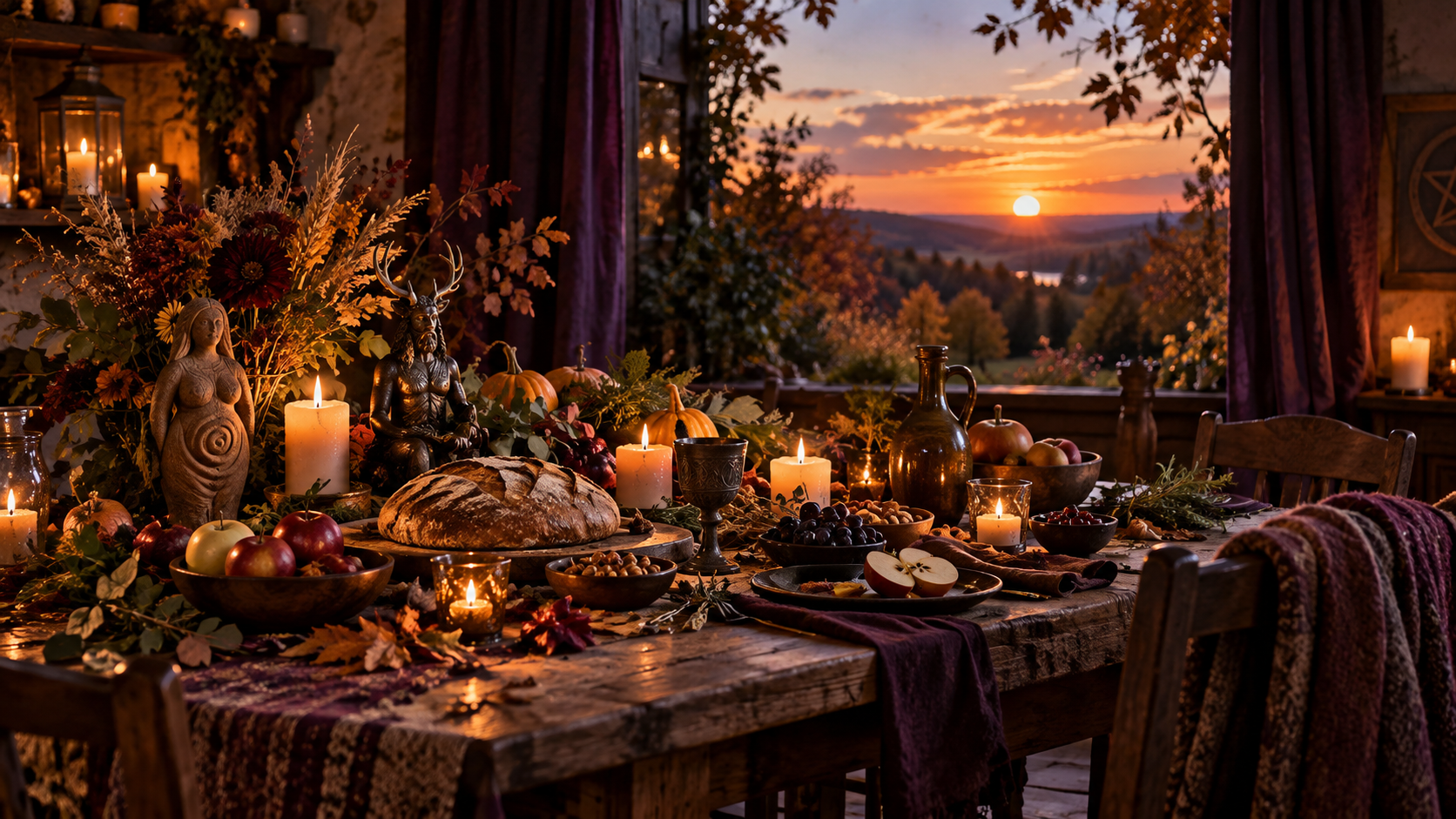
Within the modern Pagan Wheel of the Year, we call this second harvest Mabon – “the Witches’ Thanksgiving.” I have always rather liked that. There should be apples, bread, something warm from the oven, candles on the table, and probably more food than anyone actually needs. Yet the gratitude of Mabon is not quite the uncomplicated gratitude of a victory celebration. Autumn abundance carries its own reminder that nothing remains abundant in exactly the same form forever.
The fruit is ripe because the growing season is ending. Grain feeds us because it has been cut. September gives us some of the most beautiful light of the year just as that light begins to withdraw. A harvest celebrates what grew, but it also marks the moment when growth becomes something else: grain becomes bread, fruit becomes nourishment, flowers become seed, and the life of the field passes into forms that can sustain what comes after it.
That seems to me a particularly Pagan kind of gratitude. We are not thanking the season for remaining summer. We are thanking it for what it became.
The equinox itself, of course, is ancient. The name Mabon for the modern Sabbat is comparatively new. Pagan writer and scholar Aidan Kelly introduced the name into the developing modern Pagan calendar in the 1970s. There was no ancient Celtic autumn festival universally called Mabon, and I do not find that especially troubling. Traditions live precisely because old stories continue to find meaning in new circumstances.
More interesting is the story Kelly reached for when he chose the name.
Mabon ap Modron belongs to Welsh tradition and reaches back toward the older Celtic Maponos, the “Divine Youth.” Mabon is the son of Modron, the Mother, and when he is only three nights old he is taken from her and disappears from the known world.
The search for him is one of those wonderful old tales in which ordinary memory is not sufficient. Those looking for Mabon must ask creatures older and older still, reaching backward through the memory of the world until at last he is found alive but imprisoned, hidden somewhere beyond ordinary reach. He is freed and returns.
Lost, hidden, recovered, returned.
It is an old pattern, and not only because storytellers like it. Nature performs variations of it constantly. Seeds disappear into soil. Roots persist beneath fields that look empty. The green world retreats and returns. Things pass from one form into another, sometimes remaining beyond our sight long enough that absence begins to feel like ending.
Mabon is a beautiful name for an autumn festival because his story belongs to that mystery of hidden continuance. What leaves the visible world has not necessarily left the world.
There is another current running beneath the name.
In Roman Britain, the older Maponos was identified with Apollo. Surviving dedications to Apollo Maponus show that people living where Celtic and Roman religious worlds met recognized something of the Divine Youth in Apollo, the god of light and harmony. The Oracle.
I find the association more interesting for what it suggests than for any attempt to make two gods neatly identical. Apollo’s light is more than sunlight. It is the light by which things become intelligible: sound becoming harmony, uncertainty taking form, distinction emerging clearly enough to be perceived.
And near Apollo we repeatedly encounter Hermes.
Hermes belongs to another kind of mystery altogether: boundaries, language, movement, exchange, messages, roads, and the passage from one condition into another. He is the carrier of information and the walker of thresholds, the god who can move where ordinary divisions would otherwise prevent passage.
This gives us a particular affection for that current. Before there can be a message, there must be relationship. Before something can cross a threshold, there must first be difference. Before information can move, one part of reality must somehow be capable of touching another.
At some point these great currents of the world become more than abstractions. They become dynamic, conscious, relational. We encounter them as gods.
Precisely where one god ends and another begins is not always a question I feel compelled to settle.
The old stories themselves are often less tidy than later theology would like them to be. Gods share domains, inherit currents, overlap, divide, mingle, and appear differently as cultures encounter them through different landscapes and languages. There is room in that uncertainty for mystery.
Hermes, in turn, gives us Pan.
Here the movement becomes wonderfully earthy. The current that carries information and crosses boundaries meets the living material world and appears horned, fertile, musical, frightening, pleasurable, and wild. Pan belongs to the vitality of nature.
For us, Pan and Cernunnos stand very close to the mystery we call the Horned God. They come through different cultures, and I would not erase those histories, but I also see little reason to insist that the sacred must always observe the categories we create for studying it. Sometimes different names seem to look toward the same current from different sides.
And so the name Mabon begins to gather an interesting constellation around itself.
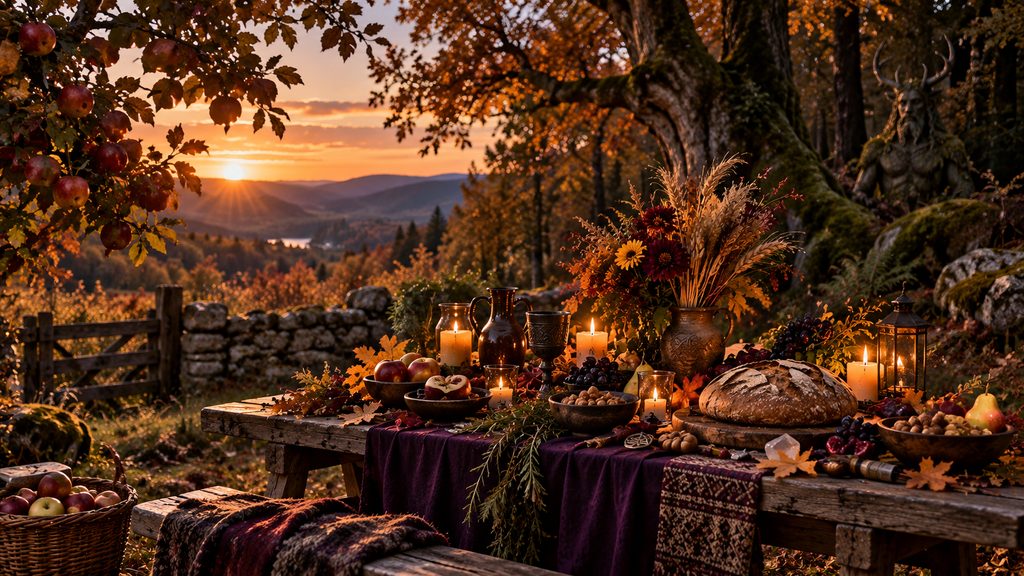
There is the Divine Youth who passes out of sight and returns. There is Apollo’s illuminating current, the light by which the world reveals its form. There is Hermes at the threshold, carrying information between what has become distinct. There is Pan—the Cernunnos—the same mystery reaching deeply into animal life, fertility, wilderness, and the living earth.
And beneath all of this is the Mother.
For us, the harvest ultimately belongs to Her because, in a very real devotional sense, the Mother is the Harvest.
She is not merely a goddess standing beside a field blessing something separate from herself. The field grows within Her, and what falls from it returns to Her. The Horned God is intimately involved in that abundance. He is vitality moving through it—the wild generative force of the living world, flourishing in sun and rain and eventually yielding into harvest. At this time of year that vitality begins to draw inward, but it does not simply disappear. What was green becomes food; what flowered becomes seed; what falls begins feeding the soil.
The Mother gathers without becoming empty.
That is where the equinox itself becomes more than an astronomical marker for me.
We often describe Mabon as a festival of balance because day and night approach equality. Yet balance does not mean sameness, and it certainly does not mean stillness. Light remains light and darkness remains darkness. They can stand in balance precisely because they are different, and the moment of balance exists only within a larger movement that continues through it.
That sits comfortably within the way we understand reality at MCC. The world is relational. Things differentiate and meet, influence one another, combine, separate, and become possibilities that neither could have produced alone. Balance is not the suspension of that process. Balance is one of its moving relationships.
The equinox reaches equality and continues.
The nights lengthen. The green retreats. What was outward begins turning inward. Perhaps that is the thought I find myself returning to each autumn: the difference between gone and hidden is larger than we usually imagine.
After all of that thinking, my own observance remains fairly simple. I cook. Usually too much.
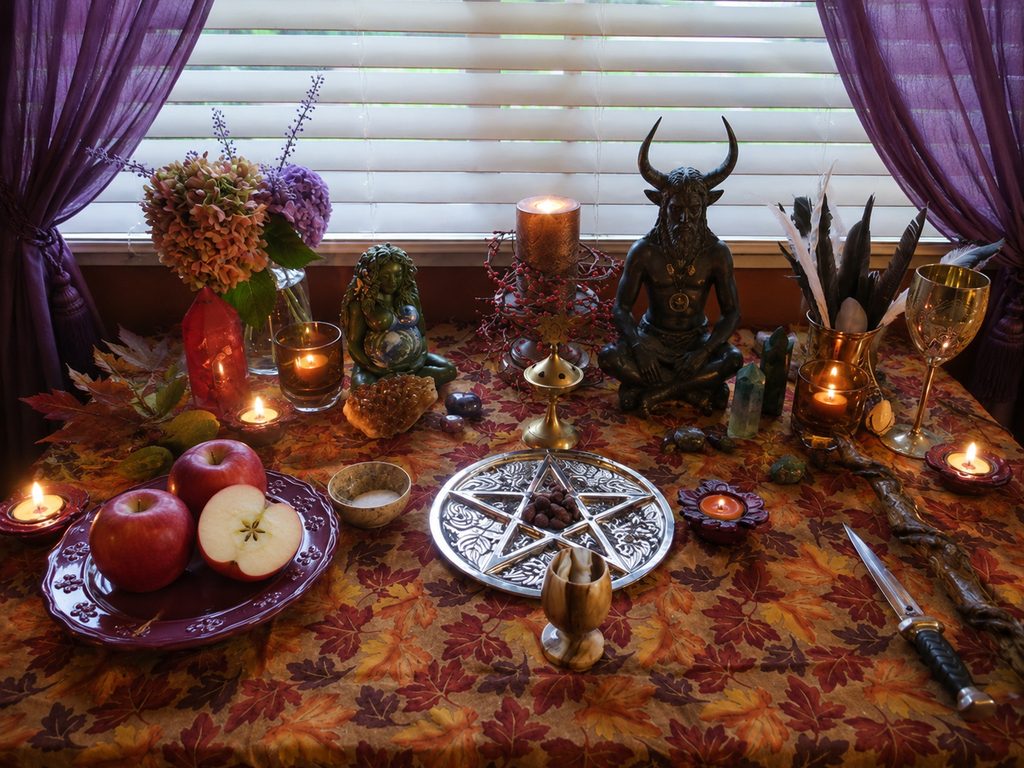
People come over, there is food on the table, and I suspect some of them simply think I enjoy being a good host. Others know perfectly well why there are apples among the candles and why I have once again prepared too much pie.
Either is fine. A sacred meal does not cease to be sacred because everyone around the table understands it differently.
There is something fittingly Pagan about gratitude made tangible. Bread says something about grain that an abstraction never quite can. An apple in the hand brings us closer to the orchard. Cooking for someone allows the harvest to continue its movement through another living body. And, perhaps that is why “the Witches’ Thanksgiving” works so well after all. We allow some things to remain hidden until their season comes.
— Kael
Leave a Reply