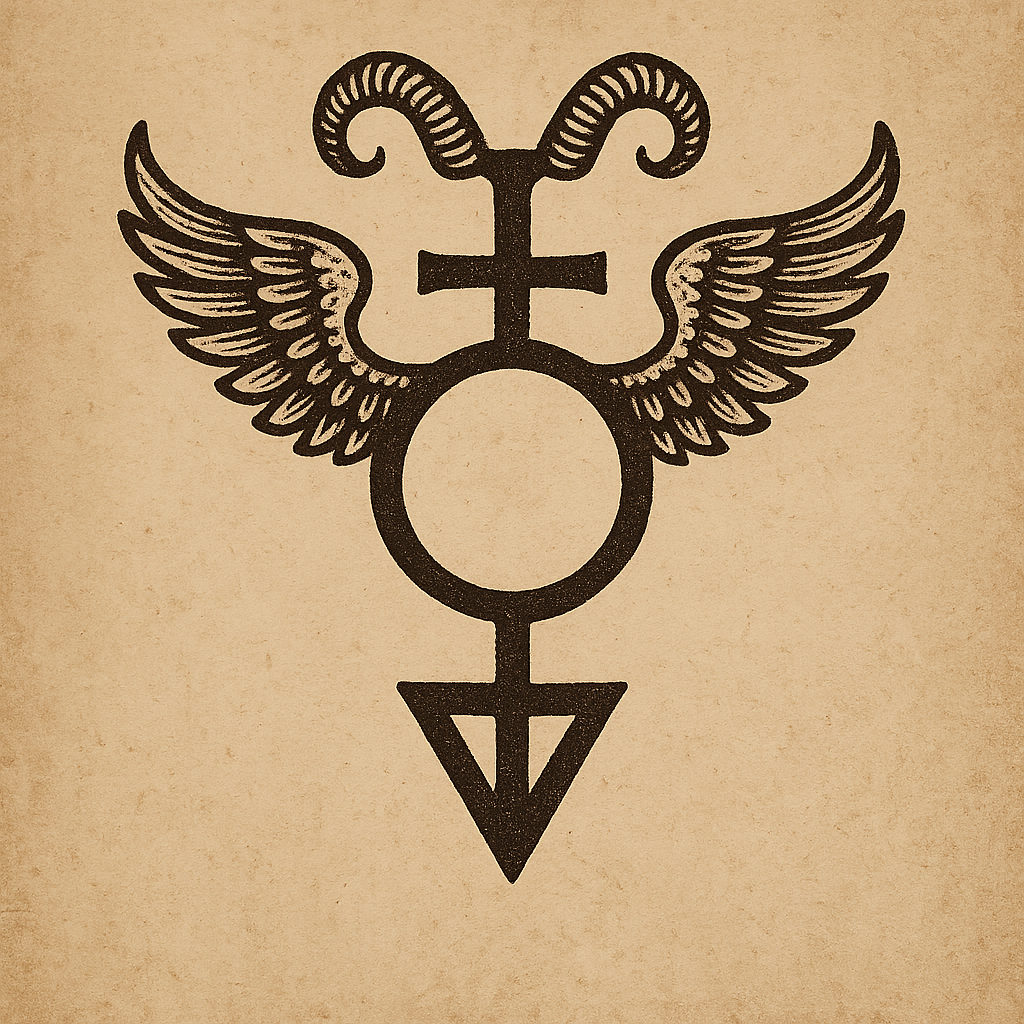

Objects are where circulation becomes tangible. Power that normally moves through bodies, landscapes, and relationships can be slowed, patterned, and anchored into matter. A charged tool is not a battery of trapped force but a stabilized loop — a structure that allows a current to persist beyond the moment of invocation. Object-linked power is therefore not about hoarding energy. It is about architecture: how movement becomes form, how exchange becomes vessel, and how pattern survives time.
Every consecrated object is a negotiated boundary. It holds because a circuit has been sealed well enough to resist immediate dissipation. But nothing holds forever. Stored currents drift, leak, accumulate history, and respond to the conditions around them. A talisman is not inert; it participates in the ecology of exchange. It remembers what passes through it. It shapes the practitioner as much as the practitioner shapes it.
This is why objects matter in every magical culture. They function as anchors for attention, archives of repeated intention, and interfaces between human structure and transpersonal force. As historian of religion <a href=”https://en.wikipedia.org/wiki/Mircea_Eliade” target=”_blank”>Mircea Eliade</a> noted, sacred objects localize the invisible without reducing it — they make currents inhabitable. Anthropologist <a href=”https://en.wikipedia.org/wiki/Alfred_Gell” target=”_blank”>Alfred Gell</a> argued that certain objects operate as distributed agency: extensions of mind embedded in matter. In magical terms, vessels carry patterned exchange across time.
But architecture implies responsibility. A container can stabilize or distort. Objects can clarify circulation or accumulate contamination. They can support autonomy or foster dependency. To work with stored power is to become a steward of boundaries — knowing when to reinforce a pattern, when to discharge it, and when to let a vessel return to silence.
Object-linked power is therefore not a side discipline. It is the material expression of magical literacy. It asks the practitioner to understand not only how to generate force, but how to house it without collapse. In this sense, tools, talismans, and relics are not accessories to magic. They are experiments in continuity: attempts to give duration to the invisible, and to carry exchange safely across the fragile span of time.


Stored power is never neutral. Every object that carries pattern becomes part of a practitioner’s environment, shaping perception, habit, and expectation. A tool is not only what it does in ritual; it is what it trains the body and mind to anticipate. Over time, vessels teach their keepers. They create grooves of movement. They encourage certain routes of exchange while discouraging others. To live among charged objects is to inhabit a constructed ecology.
For this reason, mastery is measured less by how many objects one accumulates and more by how clearly one can hear them. A well-tended set of tools forms a coherent field. Each vessel has a role, a rhythm, a place within the architecture. When objects multiply without stewardship, the field becomes noisy. Patterns overlap, compete, and erode one another. What was meant to stabilize circulation begins to fragment it.
The discipline of object-linked power is therefore the discipline of editing. Some vessels must be reinforced. Some must be emptied. Some must be retired with gratitude. And some, despite the labor invested in them, must be allowed to dissolve. Letting a container return to silence is not failure; it is recognition that all structures are temporary. The current continues. The architecture changes.
In the end, tools, talismans, and relics are not monuments to possession. They are agreements between matter and movement — brief experiments in giving duration to force. To steward them well is to remember that no object replaces practice, no vessel replaces relationship, and no archive replaces living circulation. The magician does not disappear into their tools. The magician learns, through them, how to carry continuity without becoming rigid — how to house power without mistaking the house for the source.