Our Philosophical Roots
The ideas, values, and interpretive foundations that shape our practice

My Cousin’s Coven is not a monolith of belief, and this page is not intended as a creed. Our members do not all interpret gods, spirits, magic, symbolism, or personal experience in precisely the same way. What we share is less a fixed doctrine than a broad philosophical orientation: an approach to mystery, practice, knowledge, relationship, responsibility, and the work of becoming.
Within MCC, practice is generally syncretic and pluralist. We are shaped by overlapping currents that include Neopagan and Wiccan-adjacent traditions, animistic and relational understandings of the world, ceremonial and occult practice, folk and household magic, devotional and spirit-based work, humanistic ethics, historical study, and respect for scientific knowledge. These influences are not treated as interchangeable, nor are they blended without attention to their origins, differences, and limitations.
We understand tradition as something living. Knowledge accumulates, interpretations change, practices are tested, and errors can become part of learning when they are honestly recognized. Historical roots matter, but so do experience, context, reflection, and the responsibilities of practicing in the present.
This page offers an introduction to the ideas that most often shape our work. It does not attempt to settle every question or require every member to hold one explanation. It is an invitation into MCC’s way of thinking: serious about practice, open to mystery, cautious of certainty, and grounded in the belief that power carries responsibility.
Currents that help shape our practice
Within MCC, practice is generally syncretic. We draw from more than one religious, philosophical, and magical current, allowing ideas and practices to meet where that meeting is meaningful. Syncretism, however, is not the same as treating every tradition as interchangeable. A symbol, deity, ritual form, or magical technique carries a history, and respectful practice begins by acknowledging where it came from.
Many of us may honor deities such as Hekate without claiming to be Greek reconstructionists or to possess the culture from which her worship emerged. We approach her with respect for her historical roots while also recognizing the continuing magical current she embodies: the threshold, crossroads, passage, protection, spirit work, and transformation. Living relationship does not erase historical context, and historical context does not make living relationship impossible.
The same principle appears in practical work. A protection rite might bring together a household cleansing custom, a Wiccan-style circle, a spoken charm inherited through folk practice, and a modern understanding of grounding or nervous-system regulation. These elements should not be presented as though they all share one origin. Their histories and purposes remain distinct, even when they are woven together within one working.
Syncretic practice therefore requires both creativity and restraint. We may combine what genuinely speaks to the work, but we should not flatten differences, invent false lineages, or claim authority that has not been earned. To learn from a tradition is not to own it. To enter into relationship with a deity, practice, or body of symbolism is also to accept the obligation to approach it with study, humility, and care.
Within MCC, tradition is understood as living rather than frozen. Historical sources matter. So do continued experience, accumulated knowledge, changing circumstances, and honest correction. A living tradition can grow without pretending that everything new is ancient, and it can preserve meaningful roots without insisting that the past must remain untouched.
Working Definition
Syncretism
A living process of bringing traditions, ideas, or practices into meaningful relationship without pretending that they share one origin or erasing the people, histories, and cultures that shaped them.
Syncretism without erasure; continuity without false claims of ownership.
Pluralism Without Becoming Formless
Within MCC, plurality is not treated as a problem to be solved. Members may understand gods, spirits, magic, symbolism, and personal experience in different ways, and no single explanation is required in every case. Some approach deity devotionally, some symbolically, some relationally, and some through a mixture that changes with context and experience.
Pluralism, however, does not mean that every claim is equally grounded, every interpretation is equally useful, or every action is equally responsible. Difference does not remove the need for discernment. We still ask what a claim rests upon, how an experience is being interpreted, whether historical context has been respected, what consequences may follow, and whether the practice is safe, ethical, and appropriate.
We are not a monolith of belief, but neither are we without shape. Shared practice creates shared responsibilities. Mystery leaves room for disagreement, but it does not eliminate standards, boundaries, study, or accountability. A living tradition can hold multiple voices without becoming incoherent.
Many of us understand plurality as a strength because no single viewpoint can contain the whole of mystery. One person may notice what another overlooks. One tradition may preserve a language, symbol, or discipline that another does not. Learning deepens when different perspectives can meet without being flattened into sameness.
We are not a monolith of belief.
We share a commitment to mystery, reflection, responsibility, and practice.

Duality, Threshold, and Plural Possibility
Within MCC, duality is understood as a useful way of recognizing tension, contrast, and relationship. Light and shadow, self and other, seen and unseen, order and wildness, life and death—these oppositions help us perceive structure. They give language to forces that differ, answer one another, and create movement through their encounter.
We do not, however, treat duality as a rigid binary that explains everything. Opposites may define one another, but they do not exhaust reality. Between them lies the threshold: the doorway, crossroads, edge, transition, pause, or moment of becoming. It is not merely a boundary separating one state from another. It is where categories loosen, assumptions become visible, and new forms begin to emerge.
At the threshold, intelligence encounters what has not yet been ordered. Chaos becomes legible—not because it is defeated or erased, but because pattern can be recognized within possibility. Consciousness takes part in shaping what may come next. The threshold is therefore not the absence of form. It is the place where form is still becoming.
This is where duality opens into plurality. The meeting of two forces does not always produce one simple answer. It may produce tension, synthesis, transformation, contradiction, or many possible paths. Shadow, in this sense, is not merely the opposite of light. It is also depth, ambiguity, hidden potential, and the plurality that appears when a simple division no longer holds.
Many of us therefore approach the threshold as both a philosophical idea and a practical condition. Ritual begins at a threshold. Initiation takes place through transition. Crossroads, doors, shorelines, twilight, altered states, grief, change, and uncertainty all carry the quality of being between. They are difficult precisely because the old form has loosened while the new one has not yet fully arrived.
A Working Definition
The Threshold
The threshold is the place between established states: the doorway, crossroads, edge, transition, pause, or moment of becoming. It is not merely a boundary. It is where fixed categories loosen, chaos becomes legible, and intelligence begins shaping possibility into conscious order.
The threshold is not the absence of form; it is the place where new form can emerge.
Will, Relationship, and Magical Power
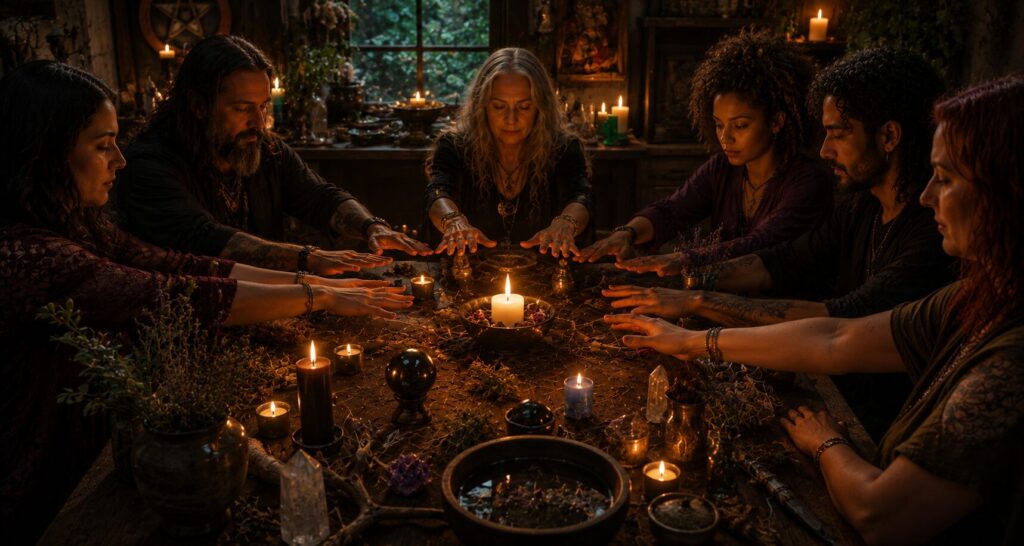
Will matters in magic. It gives practice direction, focus, and force. Through will, the practitioner chooses a purpose, gathers attention, establishes intention, and acts toward change. Without direction, power may remain scattered; without discipline, intention may never become practice.
Yet will does not act alone. Magical work also takes place through relationship: with people, spirits, deities, ancestors, places, materials, symbols, timing, and consequence. A working is shaped not only by what the practitioner wants, but by what is present, what responds, what resists, what is owed, and what may follow.
Within MCC, power is therefore not understood only as something an individual possesses and imposes. It may be cultivated, received, borrowed, exchanged, inherited, carried through relationship, or awakened through circumstance. Even strongly will-centered practice occurs within a larger field of conditions, limits, obligations, and responses.
This does not weaken will. It gives will context. A practitioner may act decisively while still listening, adapting, honoring boundaries, and recognizing that other beings and forces are not merely passive instruments. Relationship can deepen power, but it also introduces responsibility.
“Magick is the Science and Art of causing Change to occur in conformity with Will.”
Magic is not only a technique for imposing will. Will gives practice direction, focus, and force, but it does not act alone. Magic is also relationship, exchange, attention, obligation, timing, and response. Power is shaped not only by what we intend, but by how we enter into relationship with people, spirits, places, materials, symbols, and consequences.
Will may power the working, but relationship gives it context, limits, and meaning.
Embodiment and the Material World
Within our practice, spirit and matter are not treated as enemies. Magic does not occur only in thought, belief, or an invisible realm removed from ordinary life. It is expressed through bodies, breath, movement, food, homes, tools, plants, stones, weather, land, and the repeated actions through which intention takes form.
The material world is not merely a collection of objects waiting to be used. Places have histories, materials have qualities, bodies have needs and limits, and tools gather meaning through relationship and practice. Attention to matter asks us to notice what something is, where it came from, how it has been treated, and what responsibilities accompany its use.
This is one reason embodiment matters. A practitioner may hold a powerful spiritual interpretation while still needing rest, nourishment, medical care, practical preparation, or a safer environment. Magical meaning should deepen our attention to material conditions rather than become a reason to neglect them.
Some knowledge is acquired through reading and reflection; other knowledge develops through repeated physical practice. The weight of a tool, the rhythm of breathing, the behavior of flame, the growth of a plant, and the changing character of a familiar place teach in ways abstraction alone cannot. The spiritual does not excuse us from attending to the physical world.
“The sympathy connecting visible things both to one another and to the invisible powers.”
Magic takes form through
The spiritual does not excuse us from attending to the physical world.
Light, Shadow, Intent, and Responsibility
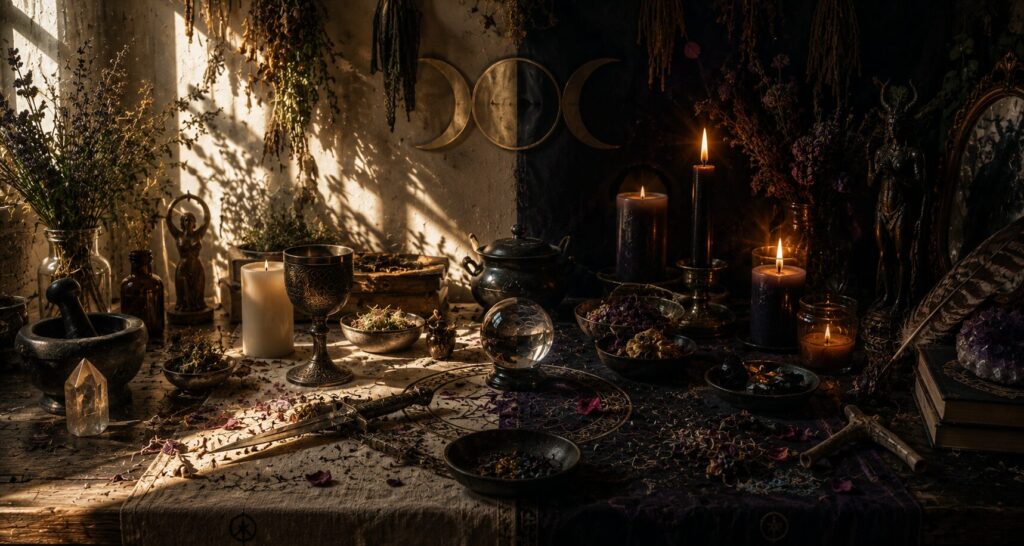
Magical language often divides practice into categories such as light and dark, white and black, benevolent and harmful. These labels can be useful as shorthand, but they become misleading when they are treated as complete moral systems. Light is not automatically good, darkness is not automatically evil, and a pleasant appearance does not guarantee an ethical action.
Within MCC, shadow is understood more broadly than wickedness or danger. It may describe what is hidden, neglected, denied, unfinished, feared, or not yet understood. Shadow can contain harm, but it can also hold grief, instinct, memory, power, contradiction, and unrealized possibility. It is part of the plurality that appears when a simple division no longer explains the whole.
Intent matters. It helps reveal what a practitioner is trying to accomplish and why. Yet good intentions do not automatically produce good consequences. A person may sincerely believe an action is helpful while ignoring consent, context, imbalance of power, likely harm, or the limits of their own understanding.
Ethical practice therefore requires more than asking whether a working feels light or whether the practitioner means well. It asks who may be affected, what has been consented to, what risks are being accepted, what alternatives exist, and who will bear the consequences if the working goes badly. Responsibility includes what we intend, what we reasonably should have foreseen, and how we respond afterward.
This is especially important when magical action involves influence, coercion, spirit work, vulnerable people, health, fear, or conflict. The ability to act does not by itself establish the wisdom or rightness of acting. Power increases responsibility because greater influence creates greater potential for consequence.
Simple ethical sayings may offer guidance, but no slogan can remove the need for judgment. “Harm none,” ideas of return, and distinctions between protection and aggression can help frame a question, but they d
Power increases responsibility; it does not remove it.
Intent matters, but ethical practice also considers consent, context, consequences, power, foreseeable harm, and the willingness to answer for what follows.
Mystery, Experience, and Humility
Mystery is central to magical and spiritual practice. Not every experience arrives with a complete explanation, and not every symbol yields only one meaning. Dreams, ritual encounters, synchronicities, intuitions, and experiences of presence may be deeply significant even when their source remains uncertain.
Within MCC, personal experience is taken seriously, but it is not automatically treated as universal proof. An experience may be genuine and transformative for the person who has it while still allowing more than one interpretation. Meaning and certainty are not the same thing.
This distinction protects both wonder and discernment. It allows us to remain open without feeling obligated to accept every claim, and cautious without dismissing everything that cannot be measured easily. Mystery should expand attention, not suspend judgment.
Symbols, myths, and deities also carry layered meanings. Their historical contexts matter, but their significance is not always exhausted by one period, text, or community. People continue to encounter, interpret, and enter into relationship with them. That living process should be approached with humility, especially when our own understanding is partial.
Certainty can be comforting, but it can also become an obstacle. When certainty prevents listening, study, correction, or the admission of error, it stops serving knowledge. “I do not know” is not a failure of intelligence. It is often the point from which honest inquiry begins.
“Instead of defining man as an animal rationale, we should define him as an animal symbolicum.”
Experience Can Be Meaningful
Personal encounters, symbols, dreams, and intuitions may shape a life even when their source cannot be established with certainty.
Meaning Is Not Universal Proof
A sincere experience may support personal understanding without requiring everyone else to accept the same interpretation.
“I Do Not Know” Is Honest
Uncertainty can preserve curiosity, humility, and the possibility of learning what certainty might otherwise conceal.
We make room for mystery without treating mystery as proof.

Knowledge Grows Through Correction
Within MCC, knowledge is not treated as a finished possession. It accumulates through study, practice, observation, conversation, error, and revision. What we understand today may be deepened, complicated, or corrected tomorrow.
Old sources matter because they preserve language, methods, assumptions, and histories that shaped later practice. But age does not automatically make a claim true, complete, or appropriate for the present. In the same way, something new is not automatically wiser merely because it is modern. Both inherited tradition and contemporary interpretation require attention, context, and judgment.
Practice is one way of learning, but experience does not interpret itself. A result may be misunderstood. A symbol may be read too quickly. A pattern may be real, coincidental, projected, or partly all three. The task is not to distrust experience, but to remain willing to examine it.
Mistakes can become part of knowledge when they are recognized honestly. Being wrong is not the same as being incapable. The greater danger is refusing correction because a belief has become tied to pride, authority, or identity.
Certainty can be useful when action is required, but it becomes a weakness when it closes the door to evidence, reflection, or change. Intelligence is not proved by never changing one’s mind. It is shown in the ability to recognize when new information, deeper experience, or clearer understanding requires revision.
A living practice therefore makes room for questions. It distinguishes confidence from infallibility and commitment from stubbornness. We can act with conviction while still leaving open the possibility that we have more to learn.
Certainty becomes a weakness when it closes the door to correction.
Intelligence is not proved by never changing one’s mind, but by recognizing when evidence, experience, or deeper understanding requires change.
Science, Math, Mundane Action, and Safety First
Within MCC, magic and science are not treated as enemies. They answer different kinds of questions and use different methods, but respect for mystery does not require rejection of evidence, medicine, practical knowledge, or the material causes of events.
When a problem has an ordinary explanation, that explanation should be considered first. Illness may require medical care. A legal problem may require legal advice. A financial problem may require budgeting, assistance, or professional guidance. A strange sound in the house may be plumbing, wildlife, wiring, or a settling structure before it is interpreted as spiritual activity.
This is what we mean by mundane before magical. It does not mean that magic is dismissed or treated as unreal. It means that magical interpretation should not become an excuse to ignore causes, risks, or solutions that are already visible and actionable.
Safety comes before spectacle. Practices that involve altered states, fire, smoke, herbs, fasting, sleep deprivation, spirit contact, dangerous locations, or emotionally vulnerable people require preparation and restraint. Risk does not become wisdom simply because it feels intense, dramatic, ancient, or forbidden.
We also reject the idea that suffering automatically proves spiritual depth. A practice should not be considered more powerful merely because it is frightening, physically harmful, psychologically destabilizing, or difficult to stop. Discipline matters, but so do limits, recovery, informed consent, and the ability to step away.
Learning before certainty completes this approach. When a situation is unclear, the responsible response is not to invent confidence. It is to gather information, ask better questions, seek appropriate help, and remain willing to revise the interpretation.
01
Mundane Before Magical
Consider ordinary causes, practical remedies, and appropriate professional help before assigning a magical explanation.
02
Safety Before Spectacle
Intensity, danger, fear, and secrecy do not automatically make a practice wise, advanced, or spiritually meaningful.
03
Learning Before Certainty
When the situation is unclear, gather evidence, ask questions, and leave room for correction rather than inventing confidence.
Respect for mystery should deepen responsibility, not replace practical judgment.
Structure, Boundaries, and Belonging
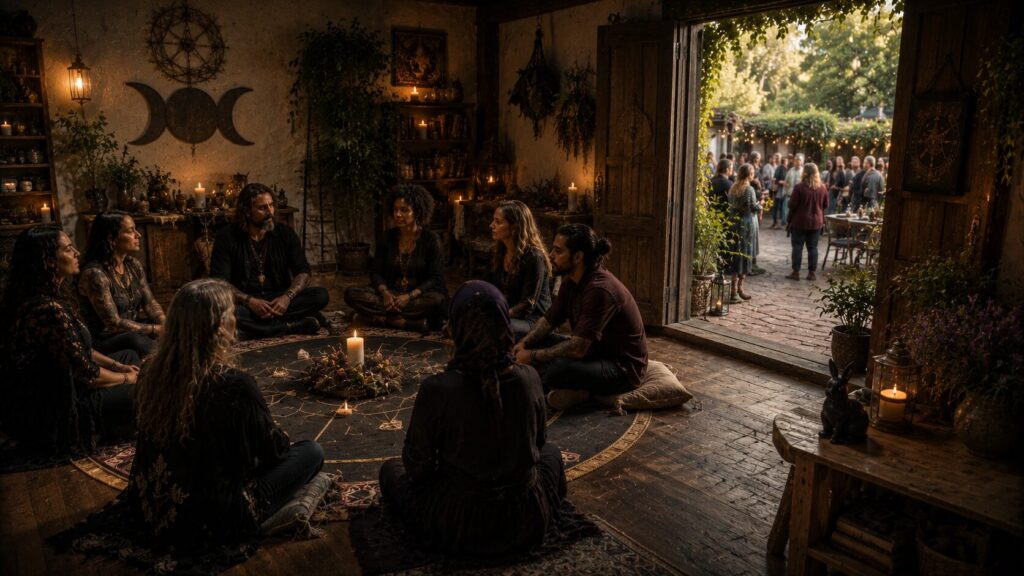
MCC is not a monolith of belief, but it is not without structure. A plurality of views can exist within a community while leadership, standards, responsibilities, and boundaries remain clear.
The coven itself is not an open-membership body. Participation involves relationship, trust, discernment, and the authority of those responsible for maintaining the group. Openness to mystery does not require openness to every person, every behavior, or every claim.
Boundaries help protect the work. They clarify who is responsible, how decisions are made, what conduct is expected, and when participation may be limited or ended. This is not a contradiction of pluralism. It is one of the conditions that allows pluralism to remain workable.
Authority within MCC is not absolute authority over truth, belief, or another person’s spiritual life. It is the practical authority to maintain our own spaces, determine who engages with the coven, protect participants, and preserve the integrity of the work.
Alongside the coven, MCC also maintains a public community where people can ask questions, exchange ideas, and take part in conversation without claiming membership in the coven itself. Belonging can take more than one form, and the public group offers a threshold into community without erasing the distinction between conversation and initiation.
Plurality
Members may differ in belief, interpretation, and emphasis without requiring one uniform theology.
Structure
Leadership, standards, responsibilities, and clear expectations support the work of the coven.
Boundaries
MCC retains authority over participation in its own spaces and over the conditions under which those spaces are maintained.
Pluralism does not require the absence of leadership, standards, or boundaries.

Where These Roots Lead
These philosophical roots are not a finished doctrine. They are a working orientation toward magic, mystery, study, relationship, responsibility, and the conditions under which practice becomes meaningful.
Within MCC, we generally approach tradition as living, knowledge as cumulative, mystery as worthy of respect, and certainty as something that should remain open to correction. We recognize the importance of will without reducing magic to domination, and we value relationship without abandoning discernment, structure, or responsibility.
We also understand that philosophy must eventually become practice. Ideas about plurality, threshold, embodiment, ethics, knowledge, and safety matter because they shape how we act: how we approach spirits and deities, how we interpret experience, how we use power, how we respond to consequence, and how we care for the people and places involved in the work.
No single page can contain every belief held within MCC, nor should it. What matters is that our differences remain in conversation with shared commitments: humility before mystery, respect for origins, willingness to learn, practical responsibility, and the recognition that power carries consequence.
These roots lead outward into deeper study and inward into reflection. They are not meant to close questions, but to help us ask better ones.
A Working Orientation
Principles We Return To
The purpose of philosophy is not only to explain the work, but to help us practice it more consciously.