Pagan Pilgrimages
A Curated Witch’s Field Guide to Travel
Pilgrimage is not tourism.
Tourism consumes. Pilgrimage listens.
To travel as a witch, a pagan, a druid, an occultist, or a mystic is to move through geography as though it were text—land as scripture, stone as archive, wells as memory, crossroads as invitation. The road itself becomes ritual. Intention becomes compass. Threshold becomes teacher.
The principle remains: intention + movement + threshold = transformation.
Across Europe and North America—and through the Mediterranean, North Africa, and the Middle East—there are places that hold current. Some are ancient and widely known: stone circles, temples, mounds, oracles. Others are quiet and half-forgotten: springs behind hedgerows, caves beneath hills, abandoned chapels built atop older shrines, old pilgrimage roads worn smooth by centuries of devotion.
Some are pagan in origin.
Some are layered Christian sites with pagan bones.
Some are occult in modern memory.
Some are living animist landscapes.
All of them require discernment.
This guide is not exhaustive. It is curated. These are suggestions for those who walk these paths. Some journeys are grand and international. Others may be a two-hour drive to a hill you have passed your entire life without noticing. Often the strongest pilgrimage is in your own region.
We begin with the assumption that travel itself is spellwork. Movement reshapes perception. Distance alters identity. A pilgrimage is not merely about arriving at a site; it is about who you become on the way there.
Some sites are for devotion.
Some are for initiation.
Some are for listening.
Some are for descent.
Some are simply for standing still and letting the land speak.
Walk carefully. Walk respectfully. Walk awake.
Choose Your Route
Every pilgrimage begins with a question. Some journeys lead toward ancestral stones, some toward healing waters, some into caves, mountains, libraries, or long wandering roads where the walking itself becomes ritual.
These are not rigid categories. Many sacred journeys weave several of these currents together — a mountain with a shrine, a well beside a barrow, a city built on older mysteries. Let the path that calls you most strongly be the place you begin.
Stone & Ancestors
Across Europe and much of the ancient world, sacred landscapes were first marked with stone. Burial mounds, dolmens, and standing stones anchor memory directly into the earth.
For witches and earth-centered traditions, these sites matter because they hold the meeting point of land and lineage. A barrow is not only a tomb — it is a threshold where the living and ancestral stand together.
Pilgrimage here tends to be quiet and reflective: offerings, silence, and deep listening to the oldest stories held in the land.
Examples include the barrows around Avebury and the passage tomb of Newgrange.
Wells & Sacred Waters
Sacred springs and wells appear across many pilgrimage traditions. Natural water sources were often believed to hold healing power rising directly from the earth.
These journeys focus on renewal, blessing, and emotional transformation. Pilgrims may leave ribbons, coins, or prayers beside the water.
Even where churches later formed around these springs, the reverence for the water itself usually remained much older than the shrine beside it.
Examples include Chalice Well in Glastonbury and the many holy wells of Ireland.
Caves & Underworld
Caves have long been seen as gateways to the underworld — places of vision, initiation, and transformation.
Ancient oracles, mystery cults, and seekers often descended into caves to encounter prophecy or spiritual rebirth.
These journeys matter because they mirror inner work. Descent into darkness often precedes spiritual clarity.
Examples include the oracle cave of Trophonius and volcanic cave traditions surrounding Mount Etna.
High Places & Sky Temples
Across cultures, mountains and high ridges were treated as places where heaven and earth meet.
The climb itself becomes part of the ritual. Effort, endurance, and wind strip away distraction and sharpen intention.
Standing on a summit often produces a sense of perspective — reminding pilgrims that sacred space is found not only in temples but in the living world itself.
Examples include Mount Olympus and Croagh Patrick.
Faery Edges
Some landscapes occupy a threshold between folklore and geography. Ring forts, hawthorn groves, misty valleys, and ancient mounds often appear in traditions as places where the veil between worlds is thin.
Pilgrims drawn to these landscapes often seek intuition, inspiration, or contact with subtle spirits of place.
These journeys emphasize respect for local tradition and careful listening to the stories attached to the land.
Examples include Irish Sídhe mounds and the folklore landscapes surrounding Tara.
Mystery Schools & Occult Strata
Some pilgrimages follow the intellectual lineage of magical traditions — Hermetic, alchemical, and ceremonial currents that shaped the occult world.
Pilgrims may visit libraries, temples, or cities associated with important teachers and traditions.
These journeys remind practitioners that magic travels not only through landscape but through knowledge and community.
Examples include Alexandria and the esoteric traditions of Prague.
Layered Christian–Pagan Sites
Many Christian shrines were built atop older sacred landscapes — springs, hilltops, and groves that had long been revered.
These places show how sacred traditions evolve and overlap across centuries.
Pilgrimage here offers a chance to witness continuity rather than conflict between traditions.
Examples include Mont-Saint-Michel and numerous Marian shrines built over sacred wells.
Urban Occult Corridors
Some magical landscapes exist inside cities rather than wilderness. Temples, occult bookshops, esoteric architecture, and magical societies create vibrant urban spiritual ecosystems.
Urban pilgrimage highlights the idea that magic thrives in living communities as much as ancient ruins.
Cities also serve as crossroads where traditions from many cultures intersect.
Examples include London, Prague, and New Orleans.
The Long Path
Some pilgrimages are defined less by a single destination and more by the act of walking itself.
Ancient roads and long-distance pilgrimage trails allow travelers to enter a rhythm of movement, solitude, and reflection.
Many pilgrims find the deepest insight not at the shrine but somewhere along the road itself.
Examples include the Camino de Santiago.
The Witch’s Intelligence Network
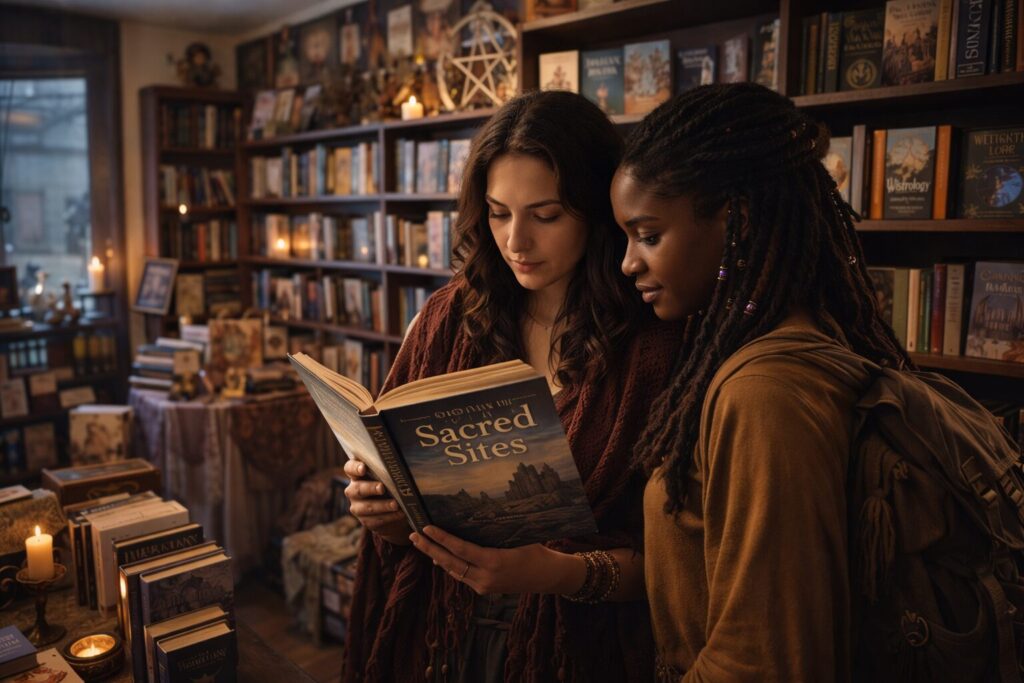
Before you cross an ocean, consult the living map: your local witch bookstores, apothecaries, and metaphysical shops. Staff and regulars often know the quiet routes— springs behind hedgerows, old stones, forgotten shrines, caves locals treat carefully, and the folklore that never makes it into tourist guides.
The Rosarium (Olympia, WA)
Apothecary + bookish field-station energy. Excellent for “what’s active locally” leads.
Love Potion Magickal Marketplace (Vancouver, WA)
Great for community pulse—events, readers, and the “where do people go for help?” chatter.
Enchanted (Des Moines, IA)
A solid Midwest anchor for regional “mound, river, and crossroads” lore scouting.
Purple Moon (Des Moines, IA)
Supply hub + local practitioner gravity. Good for finding the human map behind the land map.
Vattumannen (Stockholm)
Esoteric bookshop node—useful for “what currents are people actually working here?”
Regnbågens Böcker & Smycken (Gothenburg)
A practical stop for tools + local spiritual culture—good for regional leads and folklore threads.
Treadwell’s (London)
If you’re in London: an esoteric bookshop stop that feels like a mini-initiation.
Weiser Antiquarian (Maine)
For serious occult travelers: rare esoterica, deep research energy, and historical threads.
Sampler note: shops change over time—always verify hours and access before you go.
What to Bring
Pilgrimage is a long spell. Pack like a practitioner: practical first, magical second, and always respectful. The point is not to carry more — it is to carry what helps you move safely, stay present, and meet the place well.
A good pilgrimage kit supports both body and spirit. Good shoes can be as sacred as prayer. A journal can matter as much as a charm. What you bring should help you travel with steadiness, awareness, and care.
Core Practical
Practical items come first because discomfort narrows perception. When you are soaked, sunburned, hungry, lost, or limping, it becomes much harder to listen well, regulate emotion, or move through a site with intention. The body is not separate from the pilgrimage; it is the vessel carrying the work.
Good pilgrimage basics usually include weather layers, a rain shell, sun protection, water, snacks, reliable shoes, and an offline map or printed notes for remote locations. These are not glamorous objects, but they keep the road from becoming unnecessarily chaotic.
Why this matters: spiritual openness works best when it is supported by physical steadiness. In practical magic as in travel, preparation is often the first form of reverence.
- Weather gear — layers, rain shell, sun protection
- Water + snacks — steady blood sugar helps steady perception
- Good shoes — the road is part of the rite
- Offline map / printed notes — especially for remote or signal-poor sites
Core Magical
Magical tools for pilgrimage should be small, quiet, and purposeful. This is usually not the place for carrying a full altar in your bag. A field kit works best when it supports attention rather than turning the entire outing into gear management.
A journal gives a place for dreams, omens, fragments of local lore, and impressions that may only make sense later. A small portable ward or talisman can help maintain emotional and energetic boundaries. A few divinatory tools can be useful for reflection, but restraint often serves better than constant checking.
Why this matters: pilgrimage is often subtle. A simple charm, a few cards, or a pocket rune set may be enough to help you notice the conversation already happening between you and the place.
- Journal — dreams, omens, impressions, useful fragments
- Portable ward — charm, sachet, talisman, blessed token
- Divination pocket — 1–3 cards, a small rune set, or pendulum
- Boundary tool — salt vial, blessed water, or smokeless cleansing option
Offerings That Travel Well
Offerings on pilgrimage should be thoughtful, light, and appropriate to the place. The best offerings are often the least intrusive: clean water, flowers, prayer, song, praise, or a moment of genuine presence. Not every site wants the same gesture, and some should be left entirely untouched.
This is where discernment matters. A beautiful offering in one setting may be disrespectful in another. Coins can damage waters. Herbs may be invasive. Food can attract animals or create litter. The more culturally sensitive the site, the more important it is to observe first and act gently.
Why this matters: an offering should deepen relationship, not leave a trace of entitlement. The cleanest gift is often the one that honors the place without burdening it.
- Clean water — often the most universal libation
- Flowers or biodegradable local herbs — when appropriate and harmless
- Coins — only where culturally appropriate and not environmentally damaging
- Spoken praise — often the simplest and most respectful offering of all
Respect & Safety
Pilgrimage is not consumption. Sacred travel asks you to meet a place on its own terms, not as a collector of experiences, relics, photos, or souvenirs. This matters especially at burial sites, Indigenous or culturally sensitive landscapes, active shrines, and protected ruins.
Do not remove stones, bones, artifacts, shells, or pieces of old structures. Do not cross barriers or ignore posted rules. If a gate is closed, that is information. If a place feels delicate, slow down. If a living tradition is present, observe before participating.
Why this matters: the ethics of pilgrimage are part of the ritual itself. Respect is not an accessory to the journey. It is one of the forms the journey takes.
- No taking stones, artifacts, bones, or “souvenirs”
- No trespassing — closed gates are real boundaries
- Leave no trace — physically and spiritually
- Observe first — especially at active or culturally sensitive sites
Timing as Flavor
Timing is rarely a strict rule, but it often changes the character of a pilgrimage. A well in spring carries a different feeling than the same well in late autumn. Stones in winter may feel stark, ancestral, and stripped to essence. Solstice light can alter the entire architecture of a site.
Some pilgrims choose dates for practical reasons, others for ritual reasons, and many for both. Weather, local festivals, crowds, accessibility, and devotional calendars all shape the experience. A place may be most beautiful in one season and most spiritually potent in another.
Why this matters: sacred travel is not only about where you go, but when the place is able to meet you in a particular mood. Season becomes part of the conversation.
If you want to weave seasonal current into your route, use the ritual calendar below.
How You Travel Matters
The same place changes depending on how you approach it. A hill reached alone is not the same hill reached with a coven, a beloved, or a satchel full of notes and a scholar’s eye. Choose the mode that matches your purpose, your energy, and the kind of conversation you hope to have with the land.
No mode is inherently more serious than another. The question is not how dramatic the journey looks, but whether the form of the journey matches the work you are asking it to hold.
Solo Pilgrimage
Solo pilgrimage is often the clearest path for listening. Without conversation, group pacing, or social decision-making, the pilgrim can move more quietly through a place and attend more fully to omen, mood, intuition, and subtle shifts in atmosphere. For many practitioners, this is the mode that most easily becomes prayer.
This mode matters because it allows a direct relationship between self and site. There is less performance, less compromise, and often more honesty. A solo journey can be especially strong for divination, grief work, shadow-facing, dream incubation, or a single heartfelt question carried into the landscape.
Best for: listening, divination, private vows, ancestor contact, threshold reflection
Keep in mind: solitude is powerful, but grounding and practical safety matter more when you are alone. Bring steadiness, not bravado.
Coven Pilgrimage
A coven pilgrimage changes the field immediately. Shared purpose, synchronized attention, and ritual rhythm can make a site feel vivid very quickly. When a group arrives coherent and prepared, this mode can be deeply beautiful: blessings land more strongly, songs carry farther, and the memory of the journey becomes part of the coven body itself.
This mode matters because pilgrimage is not only personal. Sacred travel can also strengthen shared identity, seasonal practice, land relationship, and group devotion. A coven journey works especially well when everyone understands why they are there and how the ritual will open and close.
Best for: seasonal rites, land blessings, shared offerings, oath work, group devotion
Keep in mind: clarity is kindness. Decide on leadership, purpose, boundaries, and closing protocol before arrival.
Partner Pilgrimage
Partner pilgrimage is intimate without being solitary. It allows two people to witness the same threshold together while still leaving room for reflection, tenderness, and shared meaning. This mode often works well when the journey itself is part of a bond: a vow, a turning point, a reconciliation, or a promise spoken in a place meant to hold it.
This mode matters because sacred travel can deepen relationship. Two people walking with common purpose can help anchor one another, notice different layers of the place, and carry the experience home together. It is especially powerful when the reason for the journey is named aloud before the road begins.
Best for: couples, close friends, mentor-apprentice work, shared devotion, relational thresholds
Keep in mind: simplicity usually serves best. One vow, one offering, one shared intention is often enough.
Scholar Pilgrimage
Scholar pilgrimage approaches a site through history, folklore, architecture, text, and symbol. This is not a lesser spiritual mode. For many witches and occultists, research is devotion. Reading before arrival and observing carefully on site can produce a richer and more grounded encounter than vague mysticism alone.
This mode matters because it honors context. A sacred place has layers: local history, living religion, political change, old myth, later reinterpretation. Study helps the pilgrim meet those layers with humility. Done well, scholar pilgrimage joins intellect and reverence rather than forcing them apart.
Best for: occultists, historians, symbol-workers, temple visitors, site-based learning
Keep in mind: bring notes, but not ego. Let study prepare the meeting, then let the place speak beyond your reading.
Grief Pilgrimage
Grief pilgrimage is a journey made in the company of loss. It may be for mourning a death, releasing an old life, tending ancestral sorrow, or asking a place to help hold what feels too heavy to carry alone. These pilgrimages are often quiet and should not be rushed.
This mode matters because not every sacred journey is about revelation or power. Some are about tenderness, witness, and making room for sorrow to move at its own pace. A good grief pilgrimage does not force catharsis. It offers structure, place, and gentle companionship from the land itself.
Best for: remembrance, ancestor work, healing waters, quiet groves, personal release
Keep in mind: choose gentler sites and gentler expectations. A letter, a blessing, or a few spoken names may be enough.
Initiation Pilgrimage
Initiation pilgrimage is for true thresholds: vows, formal transitions, life reorientations, serious spiritual commitments, and moments when the old self is being asked to end or deepen. This mode is less about sightseeing and more about ritual architecture. The journey is part of the working.
This mode matters because some transformations benefit from formality. Travel, preparation, witness, timing, and closure can all help mark a turning point so that it is lived, not merely imagined. A site chosen for initiation becomes part of the memory-body of the vow.
Best for: oaths, serious thresholds, vowed practitioners, initiatory rites, life transitions
Keep in mind: do not treat this casually. Preparation, warding, rest, and integration afterward matter as much as the rite itself.
A starting map of sacred landscapes, historic sanctuaries, and living pilgrimage sites. Not complete — only enough to begin the road.
The Celtic & Atlantic Spine:
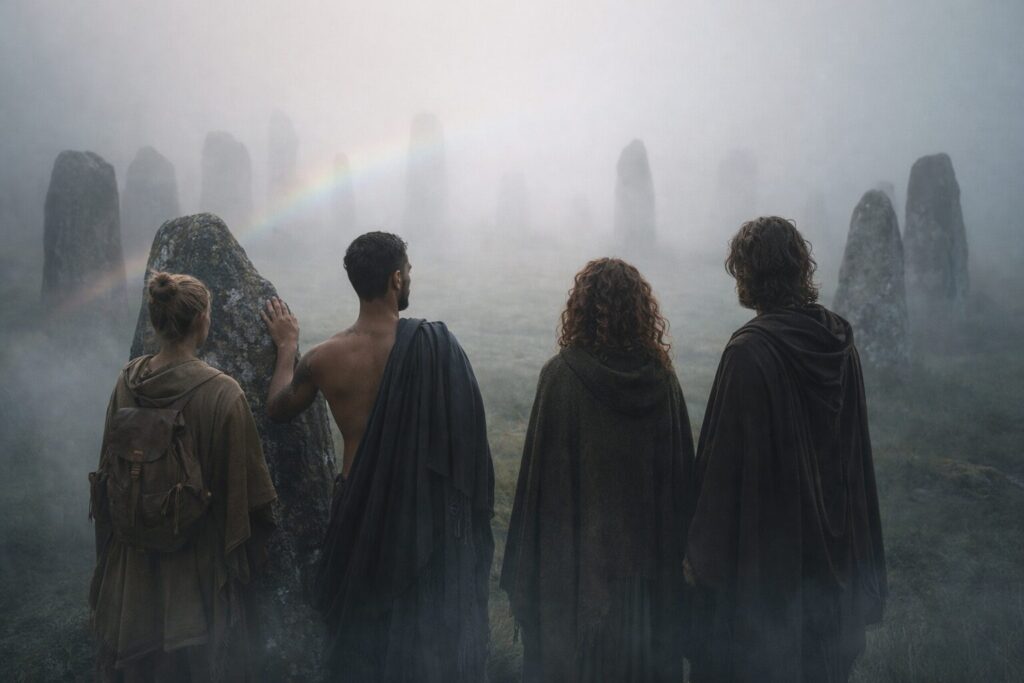
There is a spine of stone running along the Atlantic edge of Europe.
It rises in Ireland’s river valleys, hums beneath Scotland’s islands, coils through Wales and Cornwall, and drifts into Brittany’s forests. Here the land remembers long before Rome, before cathedrals, before empire. Mounds breathe. Wells whisper. Standing stones hold horizon lines like frozen lightning.
This is ancestor country.
Not sentimental ancestry, but deep time—burial chambers aligned to solstice light, cairns built with deliberate geometry, hills crowned as seats of kings. The air is wet, the light shifts quickly, and the boundary between seen and unseen feels thin without spectacle.
Travel here if you seek:
- The weight of lineage
- Earth-based initiation
- Faery-adjacent landscapes without theatrical fantasy
- Solar alignments that still function
- The quiet authority of stone
Walk gently. Much of this land is living farmland. Much of it is protected heritage. Some of it is louder than it appears.
Below are anchors and detours along the Atlantic current.
Newgrange (Ireland)
A solstice machine disguised as a tomb. Built for light, time, and the dead—still functioning.
Hill of Tara (Ireland)
A sovereignty hill: kingship, oaths, and the strange gravity of “rightful place.”
Loughcrew Cairns (Ireland)
Hilltop passage tombs with carved stones—an ancestor sky-view with wind for a priest.
Callanish Stones (Isle of Lewis, Scotland)
Stone choir in a moorland sea. A place that teaches presence through weather and scale.
Clava Cairns (Scotland)
A tight, deliberate complex—excellent for feeling how geometry shapes spiritual “pressure.”
Maeshowe (Orkney, Scotland)
A chambered mound with layers of later inscription—ancestor architecture plus human afterlife.
Avebury (England)
Not a monument you visit—an environment you enter. Village inside a megalithic engine.
Glastonbury Tor (England)
A myth-saturated hill that still teaches practical lessons: ascent, breath, and perspective.
Pentre Ifan (Wales)
A clean, sharp dolmen presence—excellent for sensing how “threshold architecture” feels in the body.
Brocéliande / Paimpont Forest (Brittany)
Folklore country with living edges: Arthurian overlays, springs, stones, and the feeling of being slightly out of time.
St Nectan’s Glen (Cornwall)
Waterfall pilgrimage energy—devotional, elemental, and often emotionally catalytic.
Holy Wells Circuit (Ireland / Britain)
Not one destination—many. Springs and wells form a pilgrimage network: healing, vows, offerings, and local saints layered over older currents.
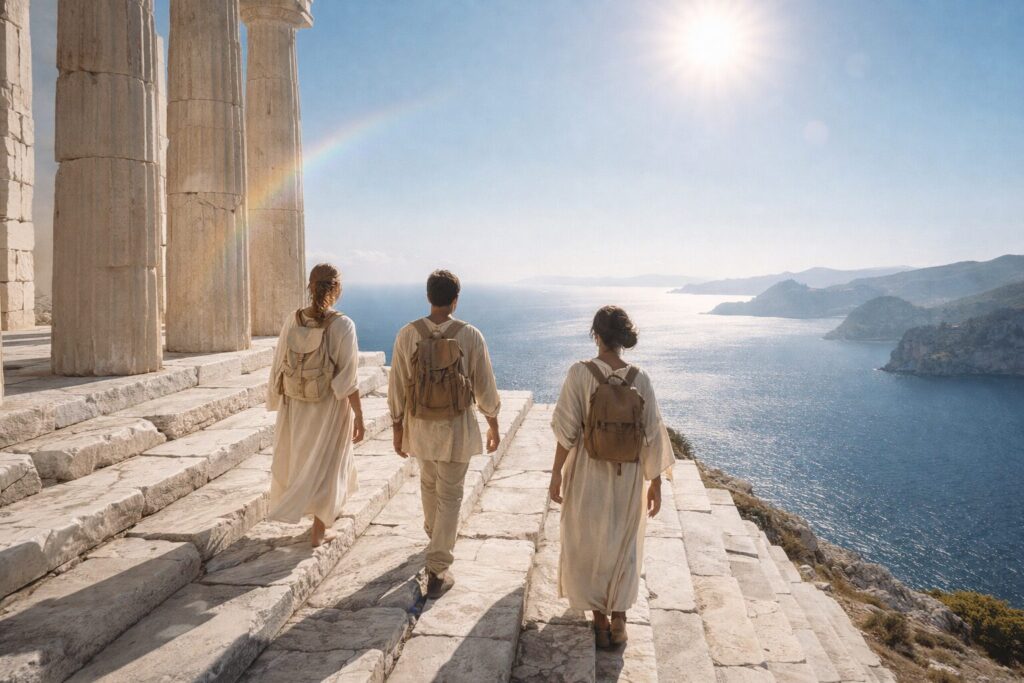
Mediterranean Thresholds:
Sea, Sun, Shrine, and Stone
The Mediterranean does not whisper — it radiates.
Here, pilgrimage is rarely hidden in forest mist or tucked behind hedgerow and hill. It stands in white stone against blue sky. It climbs marble steps. It circles ancient temples that have worn more names than centuries. The air itself carries layers: Phoenician traders, Greek philosophers, Roman magistrates, desert hermits, medieval pilgrims, modern wanderers — all moving along the same sunlit corridors.
To walk pilgrimage in the Mediterranean world is to step into continuity. Gods changed names but rarely departed. Shrines became churches, temples became basilicas, sacred groves became cloisters — and still the ground remembers.
This region teaches a particular form of sacredness: not secrecy, but endurance. Not hidden power, but power that survives conquest, translation, and time. Here, sea cliffs and volcanic islands become thresholds. Springs are guarded by saints whose footprints overlay older spirits. Mountains rise as altars, and coastlines become processional routes.
Pilgrimage in this region is rarely solitary in feeling. Even when walking alone, you sense the procession behind you — millennia deep.
You do not discover sacredness here.
You enter a conversation already in progress.
Delphi (Greece)
Once called the navel of the world. Temple of Apollo, omphalos stone, and mountain air charged with prophetic memory. Go not for spectacle, but for stillness between stones.
Eleusis (Greece)
Site of the Eleusinian Mysteries. Initiation, grain, descent, and return. The visible ruins conceal a tradition of transformation that shaped the ancient world.
Mount Etna (Sicily)
Living volcanic altar. Fire beneath earth. Walk the slopes with respect—this is a shrine of elemental power, not metaphor.
Montserrat (Spain)
Serrated stone rising like a natural cathedral. Marian devotion layered over older mountain reverence. Pilgrimage through ascent.
Sardinian Nuraghe (Sardinia)
Bronze Age stone towers. Quiet, wind-worn, and less visited. A pilgrimage for those drawn to megalithic silence and ancestral echo.
Delos (Greece)
Sacred island of Apollo and Artemis. Sun-drenched marble, sea horizon, and birth myth anchored in salt and light.
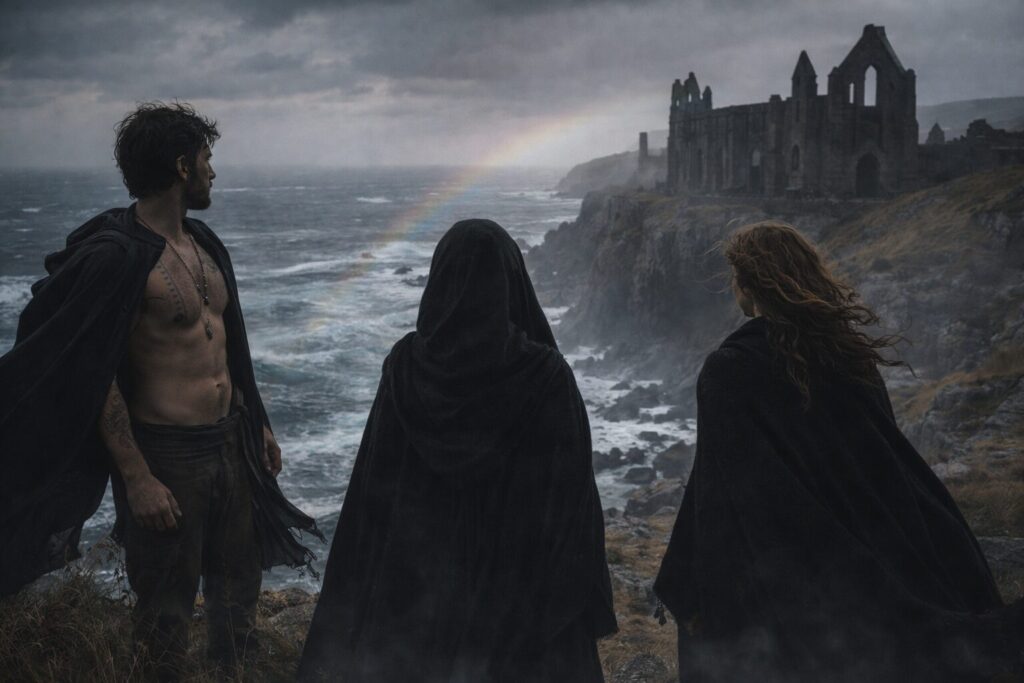
Northern Isles & Atlantic Edges:
Wind, Stone, and the Long Memory
If the Mediterranean teaches endurance in sunlit stone, the Atlantic edges teach endurance in weather.
Here, sacredness is not always announced with marble and column. It is felt in headlands and bogs, in standing stones and tide-washed ruins, in the way wind can make a place feel older than language. The North and the Isles are full of thresholds: shorelines where land ends, islands where time behaves differently, moors where the horizon refuses to settle. Even the churches and abbeys—often built atop older sites—feel less like replacements than continued occupation of a power already present.
Pilgrimage in these regions is often a practice of listening. The land’s voice comes through texture: salt air, peat smoke, rain on slate, the sudden hush that falls around a stone circle when the world goes still for a breath. You go not to “collect” sacred places, but to let a place work on you—slowly, like lichen on rock.
These routes are for witches who want to be weathered into reverence: to walk with the sea at their side, to treat each ruin as a living archive, and to meet the holy not as spectacle—but as atmosphere.
You don’t leave with souvenirs.
You leave with a changed sense of time.
Iona (Scotland)
A small island with an outsized spiritual gravity. Christian pilgrimage layered over older island sanctity—sea-wind devotion, prayer, and presence.
Skellig Michael (Ireland)
A cliff-island monastery like a stone spell against the Atlantic. Not subtle, not easy—pilgrimage as ascent, awe, and elemental humility.
Ring of Brodgar (Orkney, Scotland)
A vast Neolithic circle set between two lochs. Wind, sky, and stone in deliberate conversation—ceremony on a landscape scale.
Staffa & Fingal’s Cave (Scotland)
Basalt columns forming a sea cathedral. Waves become liturgy here—stone, echo, and Atlantic breath shaping a temple older than human architecture.
St. Ninian’s Isle (Shetland)
A tidal tombolo you can walk when the sea allows. A literal threshold path—water, sand, and silence shaping the rite of arrival.
Orkney Neolithic Heartland (Orkney)
Skara Brae, Maeshowe, Brodgar. A dense cluster of sacred architecture where stone holds ceremony like a sealed vessel.
Between ocean wind and sun-bleached stone lies another current entirely — one shaped by rivers, forests, and memory that never quite left the land.
If the Atlantic edges weather the pilgrim and the Mediterranean preserves continuity, the heartlands of Europe ask something different: attention to layered inheritance. Shrines rise beside older shrines. Forests carry rites that survived not in temples, but in folklore and feast day. Pilgrimage here often moves quietly — through villages, along woodland paths, into chapels built atop springs that were never truly forgotten.
This next region is not defined by spectacle or isolation.
It is defined by endurance through adaptation.
Walk gently. Much is still alive here.
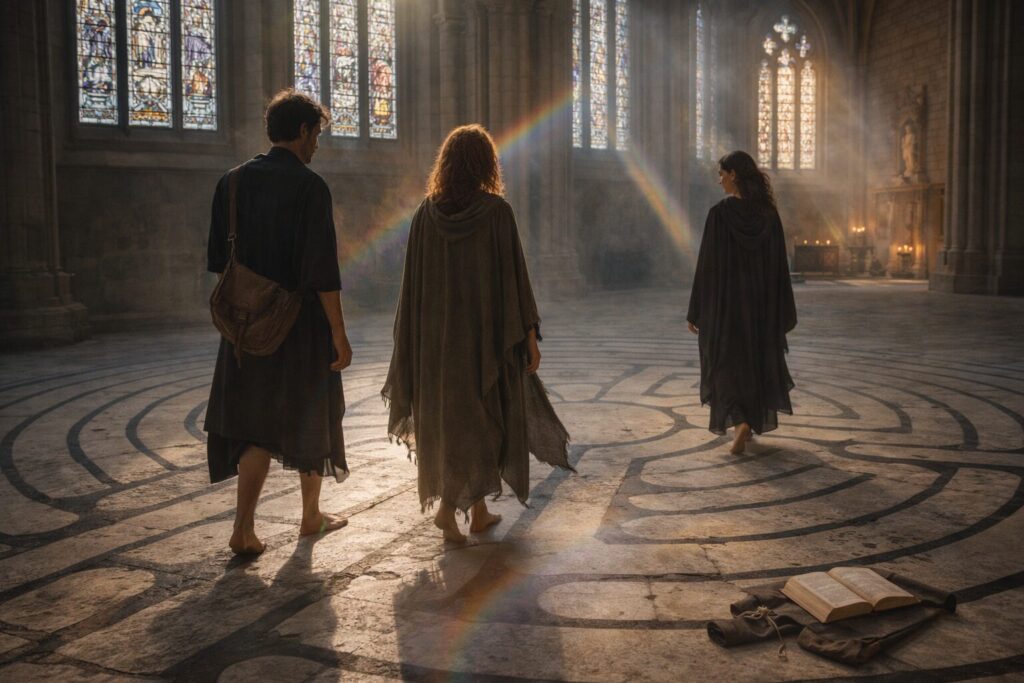
Central & Continental Europe:
Forest Memory, Mountain Shrine, Living Continuity
In Central Europe, sacredness rarely announces itself in extremes. It does not thunder like the Atlantic nor blaze like the Mediterranean. It lingers.
Here, pilgrimage moves through forest corridors and alpine passes, through towns where church spires rise above sites that once belonged to other devotions. Sacred springs were given saints’ names. Hilltop shrines became Marian. Seasonal fires were folded into feast days. The old did not vanish — it translated.
This region carries the quiet persistence of belief shaped by survival. Folk traditions endured in kitchens and village greens. Mountains became chapels. Rivers became processional routes. Sacredness is often braided: Christian iconography resting on older cosmologies, local myth nested inside official liturgy, ancestral memory held in regional festival.
To pilgrimage here is to look twice. The first glance sees cathedral or monastery. The second sees the land beneath it — older, patient, still participating.
You walk not to recover something lost.
You walk to witness how the sacred adapts and continues.
Chartres Cathedral (France)
Labyrinth pilgrimage in stone. Gothic light layered over older sacred geography. Walk the floor slowly—movement becomes meditation.
Wawel Hill (Poland)
Dragon legend, royal cathedral, and river bend power. A Slavic axis where myth and monarchy converge.
Mount Pilatus (Switzerland)
Alpine threshold long associated with dragons and spirits. Mountain pilgrimage as ascent into mythic altitude.
Rügen Sacred Groves (Germany)
Baltic coastline and remnants of Slavic temple sites. Forested silence holds what chronicles only partially recorded.
Trakai & Baltic Hillforts (Lithuania)
Living Baltic pagan revival landscapes. Lakes, fire festivals, and continuity of indigenous cosmology.
Mariazell Basilica (Austria)
Major Marian pilgrimage center in the Alps. Sacred mountain devotion layered over older highland sanctity.
Externsteine (Germany)
Sandstone pillars rising from forest earth. Contested, mythic, and atmospherically charged—approach with curiosity and discernment.
Saintes-Maries-de-la-Mer (France)
Coastal Romani pilgrimage honoring Saint Sarah. A living tradition of layered devotion at land’s edge.
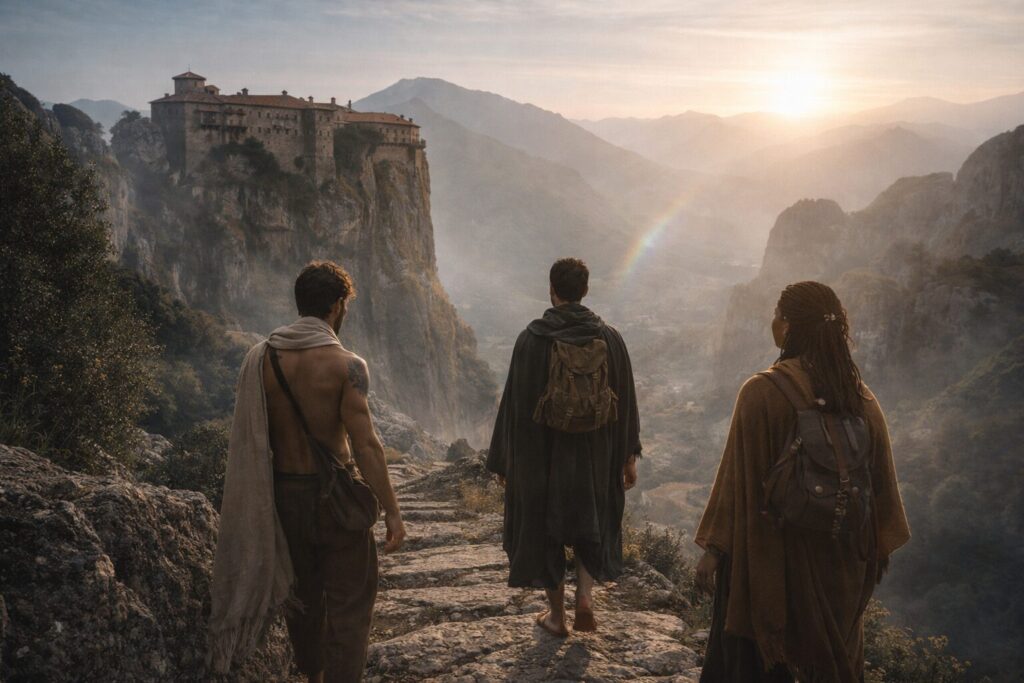
Eastern Europe & the Balkans:
Crossroads, Monasteries, and Mountain Memory
Here the land folds into itself.
Eastern Europe and the Balkans carry a different rhythm of sacredness — one shaped by borderlands, empires, and survival through adaptation. Forest and monastery, mountain and fortress, village shrine and wild spring coexist without neat separation. Pilgrimage here often moves along old trade routes and contested edges, where cultures braided rather than erased one another.
Orthodox monasteries cling to cliffs. Wooden churches rise from misty valleys. Sacred springs bear icons whose paint has been kissed by generations. Yet beneath these visible devotions run older currents: Slavic cosmologies, Thracian memory, mountain spirits, crossroads rites. The sacred was rarely extinguished — it was recontextualized.
This region teaches pilgrimage as endurance through history. You walk through landscapes that have changed flags, languages, and rulers, yet retained continuity of reverence. The sacred persists not in spectacle, but in repetition — candlelight in stone chambers, incense in forest air, bells echoing across valleys.
Here, the pilgrim learns attentiveness to layering.
Nothing stands alone. Everything stands atop something older.
Walk with humility. This land remembers.
Meteora Monasteries (Greece)
Monasteries suspended on stone pillars above the valley. Pilgrimage as ascent—sky, silence, and disciplined continuity in a landscape that feels unreal.
Rila Monastery (Bulgaria)
Forested mountain sanctuary with vivid frescoes and long devotion. A living center where pilgrimage feels like entering a protected valley of prayer.
Ostrog Monastery (Montenegro)
A white monastery embedded in cliff face. A crossroads pilgrimage site—Orthodox, regional, and deeply felt—where stone and faith meet in vertigo.
Maramureș Wooden Churches (Romania)
Tall spires, carved wood, and village-scale sacredness. Pilgrimage as intimacy: folk devotion and ancestral continuity held in timber and story.
Sarmizegetusa Regia (Romania)
Dacian sacred complex in mountain forest. A quieter, esoteric destination—stone circles and terraces that invite reverence without spectacle.
Lake Ohrid (North Macedonia)
An ancient lake-ringed landscape of monasteries and early Christian sites, layered over older waterside sanctity. Pilgrimage shaped by shoreline time.
Perperikon (Bulgaria)
Thracian rock city and sanctuary. Sun-baked stone, carved chambers, and a sense of older ritual architecture persisting beneath later histories.
Crossroads Shrines & Sacred Springs (Balkans)
Not one site, but a pattern: roadside icons, village wells, healing waters. A pilgrimage for the attentive—follow the small holy places between the famous ones.
The roads narrow as we move southeast.
Empires dissolved here, but crossroads remained. Trade routes stitched continents together long before borders claimed them. Shrines multiplied at intersections. Boundary stones marked more than property — they marked passage between states of being.
This is Hermes’ terrain: roads, ports, markets, mountain passes. The god of travelers does not vanish when languages change — he adapts, reappears, translates. A roadside cairn, a pillar at a fork in the path, a whispered prayer before departure — these belong to him.
And where roads meet, Hekate waits.
Anatolia and the Aegean rim hold some of the oldest crossroads magic in the Mediterranean world. Torches at night. Boundary rites. Shrines at city gates. Temples near caverns and sea cliffs where land ends and something else begins. These are not quiet landscapes. They are transitional ones.
Pilgrimage here is movement through thresholds — continental, cultural, spiritual. Europe leans toward Asia. Ancient Anatolian cults stand beside Hellenic temples, which stand beside Byzantine basilicas, which stand beside mosques whose call once echoed through Roman stone.
Nothing is erased. Everything is layered.
You walk not just across land —
you walk across hinge-points of civilization.
Anatolia & the Aegean Rim:
Crossroads of Continents, Torches at the Gate
This is hinge-land.
Anatolia does not belong fully to any single story. It is threshold territory — between Europe and Asia, between mountain and sea, between temple and empire. Civilizations did not merely pass through here; they layered themselves into the soil.
Sacredness in this region often gathers at edges: sea cliffs facing the Aegean, caves breathing cold air from the earth, mountain shrines perched above caravan routes. Here you encounter some of the oldest cultic continuity in the Mediterranean world — mother goddesses, mystery rites, crossroads guardians, city-protecting deities whose names shifted but whose presence did not.
Hermes belongs here — patron of roads and harbors, of merchants and messengers, of those who cross boundaries by necessity or calling. The ancient roads that cut across Anatolia carried more than goods. They carried stories, rites, and gods themselves.
Hekate belongs here too. Not only as later Greek goddess, but in older Anatolian forms — torchbearer, liminal guardian, companion of thresholds and night journeys. To walk pilgrimage here is to understand that every gate, every harbor, every mountain pass is a place of decision.
This region does not offer passive viewing.
It demands orientation.
You are always arriving.
You are always departing.
Lagina Sanctuary of Hekate (Turkey)
One of the most significant ancient cult centers of Hekate. Processional roads once linked Lagina to Stratonikeia—pilgrimage as torch-bearing movement between city and sanctuary.
Stratonikeia (Turkey)
The city linked to Lagina by sacred road. Civic stone, processional memory, and layered public religion make this an ideal companion site for understanding ritual movement across a living landscape.
Ephesus (Turkey)
Temple of Artemis, later Christian pilgrimage center. A layered site where goddess, apostle, and empire share stone. Walk slowly—history stacks densely here.
Didyma (Turkey)
Oracular temple of Apollo with massive columns and sacred spring. A site of prophetic consultation—pilgrimage as question and echo.
Claros (Turkey)
Another great oracle center of Apollo, quieter in modern imagination than Delphi or Didyma but potent for travelers interested in prophetic landscapes, sacred descent, and the discipline of inquiry.
Mount Nemrut (Turkey)
Colossal seated deities at sunrise. A syncretic royal cult blending Persian, Greek, and Anatolian traditions atop a high threshold.
Delos (Aegean Sea)
Sacred island of Apollo and Artemis—port, marketplace, and spiritual axis. Hermes’ maritime roads once converged here.
Samothrace (Greece)
Sanctuary of the Great Gods. Mystery rites tied to protection at sea. Pilgrimage here is initiatory—wind, cliff, and concealed knowledge.
Hierapolis & Pamukkale (Turkey)
Thermal waters, necropolis, healing cults, and underworld associations. A threshold site where purification, mortality, and sacred landscape meet in mineral light.
Çatalhöyük (Turkey)
Neolithic settlement with deep ritual architecture. Not a temple complex—but a reminder that sacred space predates formal religion.
Crossroads Shrines & Harbor Gates (Anatolia)
Herms at road forks, gate shrines, harbor dedications. A pilgrimage of attention—honor the thresholds between places, not only the monumental destinations.
The land narrows again.
From Anatolian highlands and Aegean harbors, the road bends toward deserts and ancient river valleys — toward cities that have been prayed over for millennia. If Anatolia is hinge-land, the Levant is convergence.
Here, pilgrimage becomes both intimate and immense.
Three major religious traditions anchor themselves in this geography, yet the land itself predates them all. Before temple, before church, before mosque, there were hills considered high places, caves considered wombs of earth, springs considered gates between worlds. Sacredness here is not singular — it is contested, revered, layered, and fiercely remembered.
Pilgrimage in this region asks for humility above all. Not romanticism. Not possession. Not spectacle. The sacred here has been loved, fought over, mourned, rebuilt. To walk these paths is to step into active devotion — living, breathing, and often fragile.
If earlier regions felt atmospheric, this one feels concentrated.
The ground itself is argument and prayer.
Walk gently.
Listen more than you speak.
The Levant:
Convergence, Covenant, and the Weight of Prayer
There are places where sacredness accumulates slowly.
And then there are places where it condenses.
The Levant is one of those regions where the air itself feels dense with invocation. Jerusalem, Hebron, Nazareth, Bethlehem, Damascus — names spoken for thousands of years in longing, in conflict, in devotion. Pilgrimage here is not symbolic. It is embodied. It is political. It is ancestral. It is alive.
This landscape carries the convergence of Judaism, Christianity, and Islam — traditions that root themselves in covenantal relationship with land. Yet beneath and alongside these traditions lie older strata: Canaanite high places, desert ascetics, cave shrines, springs of healing, burial sites revered long before formal theology codified their meaning.
Pilgrimage here is rarely quiet. It is shared space. It is tension. It is reverence coexisting with complexity. The sacred does not belong to one narrative — it is layered in covenant and memory.
To walk here as a pilgrim — especially as a modern Pagan — requires restraint and respect. You are entering an active field of devotion, not a mythic backdrop. Listen. Observe. Do not appropriate what is not yours to claim. Sacredness here is relational.
This region teaches something vital:
The holy is not always serene.
Sometimes it is burdened with history.
Walk softly. Leave no mark but gratitude.
Jerusalem — Many Traditions, One Gravity
A pilgrimage city of layered devotion and deep complexity. Enter with humility: observe first, speak softly, and treat every sacred site as actively held by living faith.
Hebron / Al-Khalil — Ancestral Weight
Revered across traditions as an ancestral and covenantal site. A place where sacredness feels heavy—approach with care, restraint, and respect.
Nazareth — Ordinary Ground, Extraordinary Story
A city shaped by devotion, visitation, and memory. Pilgrimage here often teaches that sacredness can reside in lived spaces, not only monuments.
Bethlehem — Threshold of Birth Myths
A living pilgrimage center where ritual, story, and community intertwine. The sacred here is not past-tense—enter as guest, not collector.
Jordan River Sites — Water as Covenant
River pilgrimage as immersion, vow, and return. Water-threshold magic meets historical devotion—treat the river as a living rite, not a photo backdrop.
Dead Sea & Judean Desert — Desert Discipline
Salt air, cliff paths, and ascetic landscapes. Pilgrimage here is often interior: the desert as mirror—beautiful, harsh, and clarifying.
Damascus (Old City Traditions) — Continuity in the Crossroads
One of the oldest continually inhabited cities on earth. A region of sacred layers: markets, gates, shrines, and histories braided tightly together.
Caves, Springs, & “High Places” — The Older Strata
Beyond named monuments: caves used for retreat, springs tied to healing, hilltop sanctuaries where the land’s sacredness predates formal religion.
The road turns south and the air dries.
From river covenant and contested stone, we descend into older sunlight — into landscapes where sacredness was written in sand and star, in flood and measure, in glyph and geometry.
If the Levant is convergence, North Africa is transmission.
Here, the figure of Thoth emerges — scribe of the gods, measurer of time, keeper of wisdom, patron of writing and sacred calculation. In later centuries, Greek minds would look upon him and recognize Hermes. Not identical, but resonant. Not replacement, but translation. Thus was born the figure known as Hermes Trismegistus — the thrice-great, the bridge between cosmologies.
This is not merely mythic curiosity. It is pilgrimage lineage.
Temples aligned with solstice light. Ritual architecture calibrated to celestial movement. Libraries and mystery schools that imagined the cosmos as intelligible and sacred at once. The desert did not erase knowledge — it preserved it.
Pilgrimage in North Africa asks something different than forest or mountain. It asks clarity. Vastness. Silence that reveals structure. The sacred here is not hidden. It is monumental — and yet precise.
You walk among ruins that once held star-maps and hymns to wisdom.
You stand in the long shadow of scribes.
And somewhere between ibis-headed god and winged messenger,
knowledge crosses a threshold.
North Africa & Desert Sanctity:
Temple Light, Star Wisdom, and the Keeper of Measure
In North Africa, sacredness stretches outward.
The desert does not clutter the senses. It refines them. Horizon becomes geometry. Light becomes architecture. Silence becomes a kind of instruction. Pilgrimage here is less about intimacy and more about orientation — to star, to sun, to time itself.
Egypt in particular stands as one of the great ceremonial landscapes of the ancient world. Temples were not simply places of devotion; they were cosmological diagrams. Walls encoded myth and astronomy. Columns became papyrus marsh. Sanctuaries aligned with solstice and star-rise. Ritual here was structural — precise, measured, mathematical.
Thoth belongs to this terrain — lord of writing, sacred calculation, and the articulation of cosmic order. Later thinkers would see in him a reflection of Hermes: messenger, translator, knower of hidden correspondences. In this region, the lineage of wisdom becomes visible in stone — the fusion of intellect and devotion.
But sacredness here is not confined to monuments. Desert hermitages, Sufi shrines, oasis springs, and saintly tombs continue living traditions of pilgrimage. The land carries both pharaonic scale and intimate devotional practice.
This region teaches a distinct lesson:
The sacred can be vast and exacting.
It can demand alignment, not only emotion.
Stand in the sun.
Face the horizon.
Consider what must be measured within yourself before you proceed.
Hermopolis (El Ashmunein) — Egypt
Ancient center associated with Thoth. A pilgrimage for those drawn to the scribe-god current: wisdom, measure, and the sanctity of language.
Luxor & Karnak — Egypt
Temple cities built as cosmological architecture. Columns, processional ways, and ritual geometry—sacredness expressed as scale, order, and alignment with light.
Dendera Temple — Egypt
A complex tied to stellar symbolism and ritual ceilings. Pilgrimage here is for those who feel the pull of sacred astronomy and myth encoded in stone.
Philae — Egypt
Island sanctuary of Isis, one of the great devotional and magical centers of the ancient world. Water, stone, and goddess cult meet in an atmosphere of persistent grace.
Abydos — Egypt
One of the great centers of Osiris devotion. A pilgrimage for those drawn to death, rebirth, kingship of the dead, and the older Egyptian logic of transformation through ritual.
Siwa Oasis — Egypt
Desert oasis with long spiritual reputation and historical oracular association. A threshold destination: water, palm-shadow, and the strange quiet of far places.
Saqqara — Egypt
Necropolis of step pyramids, tombs, funerary texts, and evolving afterlife architecture. A place where priestly magic, burial logic, and sacred permanence meet.
Giza Plateau — Egypt
Monumental horizon-work. Whatever your interpretation, the scale alone invites awe—and the desert teaches humility in the face of time.
Alexandria — Egypt
A city of transmission: scholarship, cosmopolitan religion, and the meeting of Egyptian and Greek worlds—the cultural soil where Hermetic currents later flourished.
Atlas Mountains & Marabout Shrines — Morocco
Living pilgrimage traditions around saints’ tombs and mountain sanctuaries. A reminder that North African sacredness is not only ancient—it is ongoing and local.
Oases, Wells, & Desert Routes — Sahara Edges
Pilgrimage as survival and reverence: the holy found in water sources, caravan paths, and the discipline of traveling with intention through vastness.
The desert does not end. It transforms.
From North African sun we turn toward mountain corridors and high plateaus — toward lands that carried silk, spice, manuscripts, and myth across continents. The Silk Road was never a single road. It was a web. And wherever webs form, sacredness gathers.
The Caucasus and Central Asian thresholds are hinge-lands of a different kind. Here, Persia speaks to Byzantium. Nomad meets empire. Zoroastrian fire altars once burned beneath skies that later echoed with minaret call and monastery chant. Caravanserais became temporary sanctuaries. Mountain passes became initiation.
Hermes would have recognized this terrain — god of merchants and movement. But here he would walk beside others: Mithra of covenant, fire priests of Ahura Mazda, Sufi mystics, mountain saints, wandering dervishes. Sacred knowledge did not stay fixed; it traveled.
Pilgrimage in these regions is rarely about one monument. It is about routes. About movement between. About the experience of crossing terrain that reshaped civilizations.
These are lands of altitude and expanse.
You walk not toward a single shrine.
You walk through corridors of exchange.
Caucasus & Silk Road Thresholds:
Fire Altars, Mountain Monasteries, and the Roads Between Worlds
In the Caucasus and along the Silk Road corridors, sacredness travels.
These are lands defined by passage: mountain passes carved by trade and migration, caravan cities that held languages like braided threads, high plateaus where sky feels closer than earth. Pilgrimage here is not only destination-based — it is route-based. It unfolds across terrain.
The Caucasus mountains themselves form a kind of spiritual spine. Monasteries cling to cliffs in Georgia and Armenia, ancient churches rise against snow peaks, and sacred springs run beneath them. Yet beneath Christian stone lie older layers — Indo-European myth, pre-Christian mountain reverence, fire rituals whose embers carried Zoroastrian cosmology across Persia.
To the east and south, Silk Road cities became crucibles of exchange. Sufi lodges, Zoroastrian fire temples, Buddhist cave complexes, and caravanserais existed within reach of one another. Sacredness here was rarely isolated. It conversed.
Fire, in particular, becomes a recurring motif in this region — not as destruction, but as continuity. Flame as witness. Flame as purity. Flame as covenant.
Pilgrimage in these lands teaches movement as devotion. You do not simply arrive — you traverse. You do not claim — you pass through.
Here, the sacred is not fixed in one tradition.
It is braided by travelers.
Walk ready to be altered by altitude, by wind, and by the long memory of roads.
Geghard Monastery — Armenia
Rock-cut sanctuaries and resonant stone chambers. A mountain pilgrimage site where sacred architecture feels carved directly out of the earth’s bones.
Etchmiadzin — Armenia
A major living pilgrimage center with deep continuity. Approach as a guest: this is active devotion, not a museum of the past.
Gergeti Trinity Church (Kazbegi) — Georgia
Iconic mountain shrine with sweeping altitude and weather. Pilgrimage here is often about the ascent—sky, stone, and the discipline of arrival.
David Gareja Monastery Complex — Georgia
Cave monasteries in semi-desert terrain. A threshold landscape where cliff walls, frescoed chambers, and wind-silence create a stripped, contemplative pilgrimage.
Ateshgah Fire Temple — Azerbaijan
A site linked to historic fire veneration in a land of natural flames. A pilgrimage for those drawn to fire as continuity, oath, and sacred witness.
Yanar Dağ — Azerbaijan
A natural gas fire burning along a hillside—simple, elemental, and strangely mesmerizing. It turns the regional fire-current from history into direct experience.
Gobustan — Azerbaijan
Rock art landscapes and ancient markings. Not a single shrine, but a time-layered pilgrimage of symbol, stone, and human presence across millennia.
Samarkand — Uzbekistan
A Silk Road jewel of transmission and convergence. Pilgrimage here is cultural: the meeting of empires, scholars, and spiritual lineages along the trade web.
Caravanserais & Pass Routes — Silk Road Corridors
Not one destination: a pattern. Roadside inns, passes, wells, and waystations where travel itself becomes rite—offer gratitude, travel with care, leave no harm.
The roads widen.
From caravan corridors and mountain passes, we cross oceans — not to discover, but to acknowledge. The Americas are not empty landscapes waiting for myth. They are lands with living memory, living nations, living ceremony.
Pilgrimage here must begin differently.
Unlike ruins of empires long dissolved, many sacred sites across the Americas belong to traditions that are ongoing, protected, and often guarded against appropriation. Sacred mountains are not relics. They are relatives. Springs are not aesthetic. They are covenantal. Ceremonies are not symbolic. They are alive.
And yet pilgrimage remains possible — if reframed.
In these lands, pilgrimage is often about witness, ecology, and humility. It may be learning the history of a place before visiting. It may be supporting preservation. It may be walking a trail with reverence instead of extraction. It may be honoring diaspora traditions carried here through migration — Catholic shrines, Afro-Caribbean syncretic temples, immigrant devotional spaces, modern Pagan gatherings rooted in landscape.
The Americas teach a particular lesson:
Sacredness is not always accessible.
Respect is the first offering.
Walk knowing that not every holy place is yours to enter.
Sometimes pilgrimage is proximity without possession.
United States & Canada:
Land, Memory, Revival, and Responsible Presence
Pilgrimage in the United States and Canada is complicated.
These lands hold some of the oldest continuous sacred traditions in the world — traditions that remain active within Indigenous nations whose sovereignty and ceremony must be respected. Sacred mountains, rivers, desert formations, and forests are not relics of the past. They are living relationships.
For Pagan and polytheist pilgrims, the question here is not “Where is the ancient temple?” It is: “How do I walk reverently on land that already belongs to story?”
Sacredness in North America often emerges through ecology. Red rock canyon, coastal fog, prairie horizon, boreal forest — these landscapes shape spiritual response. Pilgrimage becomes environmental attentiveness. Silence. Offering without intrusion.
At the same time, the Americas are layered with immigrant devotion. Catholic shrines sit beside older sacred sites. Afro-diasporic religions thrive in cities. Modern Pagan gatherings take place in forests and deserts. Contemporary witchcraft communities form pilgrimage patterns around festivals, conferences, and coven gatherings.
This region does not offer ancient ruins in the Mediterranean sense.
It offers living land.
To pilgrimage here is to:
- Learn the Indigenous history of where you stand
- Avoid trespassing on protected ceremonial sites
- Practice ecological respect
- Support preservation and sovereignty
The sacred in North America is not empty wilderness.
It is relational terrain.
Walk gently. Leave better than you arrived.
Maryhill Stonehenge — Washington
Full-scale Stonehenge replica overlooking the Columbia River Gorge. Wind, basalt cliffs, and open sky create a surprisingly potent ritual landscape.
Olympic Rainforest — Washington
Moss-draped temperate rainforest where giant trees become pillars and fog moves like breath. Pilgrimage here is slow walking through living green time.
Multnomah Falls — Oregon
One of the tallest waterfalls in the Pacific Northwest. Mist, stone, and gravity form a natural shrine of moving water.
Beacon Rock — Columbia River Gorge
A volcanic monolith rising above the Columbia River. Climbing the spiral trail becomes a literal ascent ritual: river below, wind above.
Cape Flattery — Washington
The northwesternmost point of the contiguous United States—cliffs, sea caves, relentless wind, and the feeling of standing at the rim of a continent.
Redwood Forests — Northern California
The tallest trees on earth. Walking here feels like entering a living cathedral—vertical, ancient, and deeply humbling.
Mount Rainier — Washington
Glacier-crowned stratovolcano dominating the skyline of the Pacific Northwest. Pilgrimage here is alpine—weather, altitude, and meadows teaching humility.
Mount St. Helens — Washington
A volcanic landscape of destruction and renewal. The mountain teaches regeneration through ash, rupture, and return.
Mount Shasta — California
One of North America’s most famous mystical mountains. A magnet for seekers, visionaries, and solitary pilgrims.
Banff & the Canadian Rockies — Canada
Alpine lakes, glaciers, and dramatic peaks create one of the great awe-landscapes of North America. Pilgrimage here is crystalline and sky-bound.
Chimney Rock & Great Plains Horizons — Nebraska
A pilgrimage of sky and horizon rather than enclosure. Historic migration routes give the land a powerful sense of movement and memory.
Powell’s City of Books — Portland
One of the largest bookstores in the world. Its occult, mythology, religion, and folklore shelves make it a genuine study pilgrimage site for seekers.
Witch’s Castle — Portland
A ruined stone park structure hidden in Forest Park, transformed by Portland folklore into a local witch-site and urban curiosity.
Mill Ends Park — Portland
The world’s smallest park and home to Portland’s leprechaun folklore. A reminder that playful magic belongs on pilgrimage pages too.
The Grotto — Portland
A cliffside sanctuary carved into volcanic rock and surrounded by gardens. A rare urban site where devotion, stone, and forest still speak to one another.
Seattle Underground — Washington
Buried 19th-century streets beneath the city. An urban descent into forgotten layers—part underworld symbolism, part haunted historical memory.
Bloedel Reserve — Bainbridge Island
Meditation gardens and carefully composed landscapes designed as a spiritual walking experience rather than a conventional park.
Astoria Column — Oregon
A tower overlooking the meeting of the Columbia River and Pacific Ocean. Climb it for wind, horizon, and threshold consciousness.
Thornewood Castle — Washington
A genuine English manor reconstructed stone-by-stone in the Pacific Northwest. Gothic atmosphere, ghost lore, and transplanted old-world symbolism give it uncanny force.
Port Townsend — Washington
A Victorian seaport thick with maritime history, ghost culture, and that strange old-port feeling where trade, weather, and story still cling to the buildings.
Fort Stevens & the Peter Iredale Wreck — Oregon
A coastal fort and the visible bones of a shipwreck at the edge of sea and sand. One of the best threshold sites in the region for meditating on ruin, passage, and impermanence.
Salem — Massachusetts
Historic site of the witch trials and a modern center of witchcraft revival, occult commerce, and public pagan identity.
Lily Dale — New York
Historic spiritualist community devoted to mediumship, séances, psychic study, and spirit communication.
Brushwood Folklore Center — New York
One of the best-known pagan festival grounds in North America. Pilgrimage here is communal: seasonal, temporary, and intentionally built.
Modern Pagan Gatherings & Festivals — North America
Seasonal festivals, coven gatherings, occult conferences, and regional events where temporary sacred space is built on purpose.
Cahokia Mounds — Illinois
One of the largest pre-Columbian cities north of Mexico. A profound archaeological landscape best visited as witness rather than claimant.
Serpent Mound — Ohio
An ancient serpent earthwork aligned to celestial cycles. A powerful reminder that sacred form can be inscribed into land itself.
St. Anne de Beaupré — Quebec
One of the oldest enduring pilgrimage sites in North America, long associated with healing traditions and continuing devotion.
Montreal & Quebec Sacred Architecture — Canada
Basilicas, chapels, stone churches, and old devotional routes shaped by centuries of immigrant and Catholic religious life.
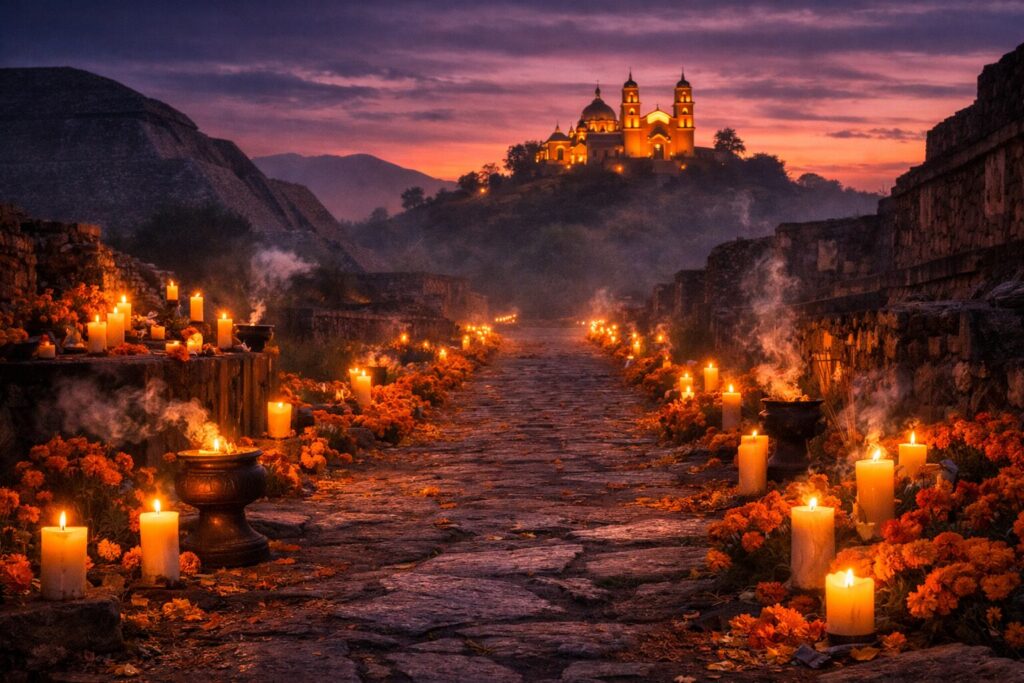
Mexico & Latin America:
Syncretic Devotion, Living Procession, and the Sacred That Survived
In Mexico and parts of Latin America, sacredness did not disappear under colonization — it transformed.
Temples became churches. Indigenous cosmologies braided themselves into Catholic iconography. Saints took on attributes of older deities. Feast days aligned with agricultural cycles that predated empire. The sacred here is not archaeological alone. It is processional, embodied, communal.
Pilgrimage in this region is rarely solitary.
It moves in crowds — barefoot penitents, candle-bearing families, dancers in feathered regalia, mariachis and incense smoke, flowers carried for miles. Devotion spills into streets and plazas. Sacredness is not hidden; it is declared.
For modern Pagan pilgrims, this region requires discernment. Many sites are living Indigenous or Catholic devotional centers. They are not aesthetic backdrops. They are relational and often protected by community memory. Yet witnessing is possible. Learning is possible. Reverent presence is possible.
Mexico in particular holds profound sacred geography:
Mesoamerican temple complexes aligned to celestial cycles.
Hilltop shrines later crowned with Marian devotion.
Day of the Dead traditions preserving ancestral cosmology beneath Catholic structure.
Living Indigenous communities maintaining ceremony despite centuries of pressure.
Latin American sacredness teaches a powerful lesson:
Syncretism is not dilution.
It is survival.
Pilgrimage here is not about reclaiming what was lost.
It is about recognizing what endured.
Arrive with humility.
Listen for drums beneath the bells.
Teotihuacán — Mexico
Pyramid of the Sun, Pyramid of the Moon, and the Avenue of the Dead. A monumental ceremonial city aligned with celestial rhythm and sacred urban design.
Chichén Itzá — Yucatán, Mexico
Temple of Kukulcán, celestial alignments, and sacred geometry tied to cosmology and calendar. One of the clearest architectural expressions of ritual astronomy in the Americas.
Basilica of Our Lady of Guadalupe — Mexico City
One of the largest Marian pilgrimage sites in the world. A powerful center of living devotion and one of the clearest examples of Indigenous-Catholic sacred layering.
Mitla — Oaxaca, Mexico
A Zapotec ceremonial site known for intricate geometric stonework and underworld associations. Quieter than more famous ruins, but deeply evocative for those drawn to pattern and ancestral architecture.
Catemaco — Veracruz, Mexico
One of the most famous witchcraft centers in Mexico, associated with brujería, folk healing, limpias, and contemporary magical practice.
Cerro de la Estrella — Mexico City
A hill with major ceremonial significance in Mexica ritual life, associated with the New Fire ceremony and cyclical renewal.
Lake Atitlán — Guatemala
A sacred highland lake surrounded by Maya communities and volcanic peaks. Pilgrimage here is relational—land, water, and living tradition held together carefully.
Day of the Dead Observances — Mexico
Not one site but a living pilgrimage season of ancestral return: cemeteries, altars, marigolds, food, candles, and remembrance woven into public ritual.
Afro-Caribbean Shrines & Syncretic Devotion — Caribbean & Latin Diaspora
Sacred traditions blending African cosmologies with Catholic forms and diasporic continuity. Approach as student and guest only, with real humility.
Hilltop Churches & Procession Routes — Rural Mexico
Village-scale pilgrimage traditions shaped by feast days, agricultural cycles, vow-making, and communal processions. Sacredness here often lives in repetition rather than spectacle.
A starting map of sacred landscapes, historic sanctuaries, and living pilgrimage sites. Not complete — only enough to begin the road.

Witchcraft, Wicca & Esoteric Lineage Sites:
Where the Circle Re-Formed
Not all sacred geography is ancient stone.
Some of it was re-enchanted in the 20th century.
Modern Witchcraft and Wicca emerged through revival, scholarship, folklore preservation, ceremonial magic, and deliberate reconstruction. Certain places became nodes in that rebirth — homes of initiators, coven meeting sites, museum archives, landscapes mythologized by practitioners, towns forever marked by witch panic and memory.
This is pilgrimage not to forgotten temples, but to turning points.
To houses where ritual texts were drafted.
To cliffs and forests where early covens gathered.
To towns where witches were executed.
To lodges where occult philosophy was formalized.
To bookstores and museums that preserved what might have vanished.
These sites are not ancient in the classical sense.
They are ancestral in a modern one.
You walk not to claim authenticity.
You walk to understand lineage.
Witchcraft & Esoteric Lineage Sites
Archives, temples, bookshops, study centers, and historical landscapes where modern magical traditions were shaped, preserved, debated, and carried forward.
Some pilgrimage sites are sacred because gods, saints, or ancestors are believed to dwell there. Lineage sites are different. They matter because ideas took shape there, books were passed hand to hand, rituals were refined, communities gathered, archives were preserved, and names for modern magical life were spoken aloud often enough to become tradition. These places do not contain the whole of Witchcraft or the occult—but they help explain how modern seekers inherited their maps.
Highcliffe & Bricket Wood — England
Associated with early Wiccan development and Gerald Gardner’s coven work. A foundational landscape in the formation of modern Witchcraft as a self-conscious religious current.
Glastonbury — England
A revival-era hub for Goddess spirituality, Avalon myth, and contemporary Pagan pilgrimage. Myth, commerce, devotion, and modern magical identity all converge here.
Boscastle Museum of Witchcraft — Cornwall
One of the world’s most important collections of magical artifacts, folk-practice materials, and modern Witchcraft archives. A major site of memory, preservation, and magical material culture.
Boleskine House — Scotland
A site associated with Aleister Crowley, Thelema, and the symbolic geography of ceremonial magic. Pilgrimage here is historical and esoteric, not romantic.
Florence Farr & Golden Dawn Sites — London
Locations tied to the Hermetic Order of the Golden Dawn: ceremonial ritual, magical correspondence systems, occult revival, and esoteric scholarship.
Rosicrucian Egyptian Museum — San Jose, California
A North American site where Egyptian symbolism, Rosicrucian currents, and Western esoteric study visibly meet in public-facing form.
Cherry Hill Seminary — Pagan Scholarship & Formation
Not a pilgrimage campus in the usual sense, but an important part of modern Pagan intellectual and ministerial formation. It represents the effort to give Witchcraft and Pagan traditions serious theological, pastoral, and scholarly infrastructure.
A major study site for the modern esoteric revival, with library-centered access to comparative religion, occult philosophy, and the cross-pollination of East-West esoteric thought.
The Atlantis Bookshop — London
A legendary occult bookshop and living node of esoteric print culture. For many seekers, the bookshop itself becomes a lineage site: the place where study became practice.
Weiser Antiquarian — New York
A deeply respected source for rare and antiquarian occult books, magical texts, and esoteric print history. More archive-minded than atmospheric, but important for serious students.
Treadwell’s Books — London
A modern esoteric bookshop strongly associated with occult culture, courses, talks, and living magical conversation. Less antiquarian than lineage-active.
Temple of Witchcraft — Salem, New Hampshire
A contemporary religious and educational institution centered on Witchcraft as lived practice, ministry, and community formation.
Aquarian Tabernacle Church — Washington
A long-running Wiccan church whose public-facing temple work makes visible the institutional side of modern pagan religion.
Modern Pagan Deity Temples — Hermes & Hekate Currents
Contemporary temple work dedicated to specific gods shows how revival paganism increasingly includes devotional specialization, priesthood, and public-facing service.
Modern Pagan Festival Grounds — Various
Temporary but powerful sacred space: Sabbat gatherings, witch camps, festival grounds, and revivalist circles formed intentionally by community.
Salem — Massachusetts, USA
Site of the 1692 witch trials. A pilgrimage of memory, mourning, and reckoning—not celebration. Honor the victims, not the hysteria that destroyed them.
Marie Laveau’s Tomb — New Orleans
A complex site of folklore, public imagination, and Vodou memory. Visit respectfully, avoiding superstition-driven vandalism or extractive fascination.
Pilgrimage Ethics & Cultural Responsibility
Pilgrimage is not tourism with incense. It is movement with intention. The locations listed on this page are examples, not a complete map of sacred geography. Many belong to living communities whose traditions continue today. Travel—especially international travel—is a privilege. Walk accordingly.
Respect Living Traditions
Many sacred sites remain active centers of devotion. Enter as guest, not claimant. Observe local custom, dress appropriately, and avoid inserting yourself into rituals not meant for you.
Cultural Exchange ≠ Cultural Appropriation
Culture travels and religions evolve. Syncretism is historically real. But participation requires relationship, study, and humility. Borrowing without context reduces living traditions to aesthetics.
Tourism & Sacred Space
Some places of power are also major tourist destinations. This does not invalidate their sacredness. It does require discernment. Avoid spectacle behavior and remember others may be present for devotion, not curiosity.
Ecological Responsibility
Sacred landscapes are ecosystems. Leave no trace. Do not remove stones, plants, or artifacts. Offer gratitude in ways that do not damage land or disrupt local practice.
Know Before You Go
Research the historical and contemporary meaning of a site. Understand whether it is protected, restricted, or culturally sensitive. Not every sacred place is open to public ritual use.
Sacredness Is Not Scarcity
Sacred geography exists in every region, often in ordinary landscapes shaped by memory and devotion. Pilgrimage does not require distance— only intention and attention.
No list can contain sacred geography.
The places named on this page are illustrative—historical nodes, revival centers, architectural marvels, landscapes shaped by devotion. They are not comprehensive, nor are they hierarchically superior to the unnamed shrines, village springs, forest clearings, neighborhood churches, roadside icons, ancestral graves, and seasonal gatherings that quietly sustain sacred life across the world.
Pilgrimage has never been solely about distance. It has been about orientation.
Travel, particularly international travel, is a privilege shaped by economics, geopolitics, and access. For many, the most meaningful sacred encounters occur not across oceans but within driving distance—or walking distance—of home. A local grove. A historic cemetery. A shoreline visited at dawn each year. A community circle that meets in rented space but casts a boundary that is no less real.
Sacredness is not scarce. It is contextual.
Throughout history, pilgrimage routes formed where memory, story, and infrastructure converged. Roads enabled devotion. Trade routes carried ritual language. Diaspora communities transplanted shrines. Empires overlaid temples. Revival movements re-enchanted landscapes. The sacred travels because people travel.
But sacredness also remains.
In an era of global mobility and digital access, the task of the modern pilgrim is not accumulation. It is discernment. To visit fewer places more deeply. To understand context before participation. To recognize when observation is appropriate and when abstention is the wiser act. To accept that some sites are living and not symbolic. To hold reverence without possession.
If you undertake pilgrimage, undertake it consciously.
Learn the land you stand on.
Support the communities who steward it.
Leave sites intact.
Allow encounter to change you rather than validate you.
And remember:
The most important threshold is not geographic.
It is internal.
Pilgrimage does not begin when you arrive.
It begins when you decide to walk differently.