
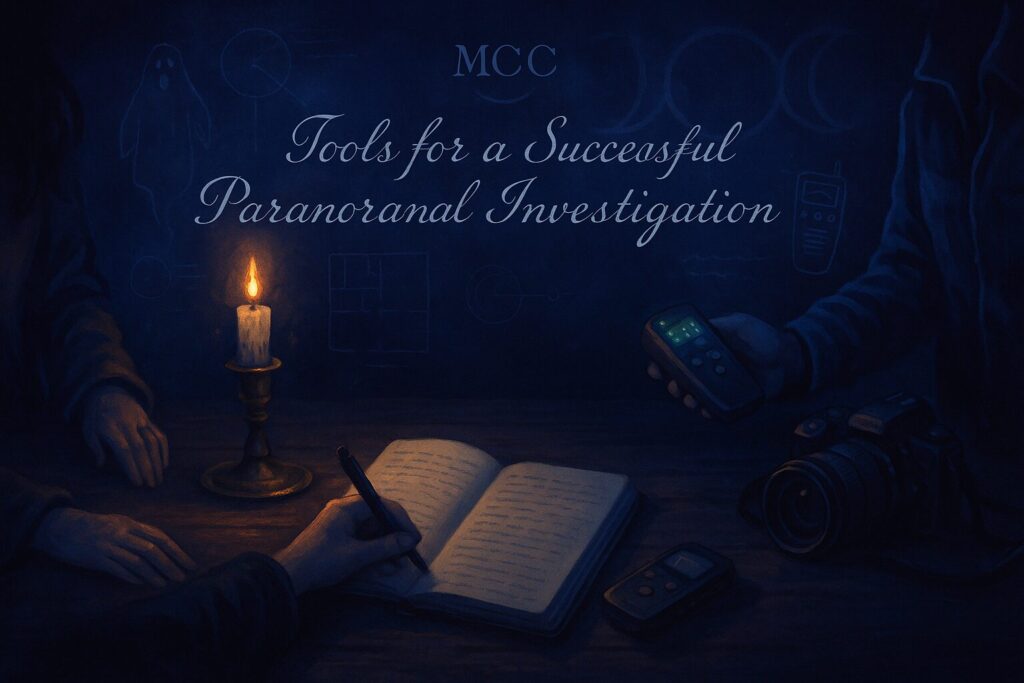
Tools for a Successful Paranormal Investigation
Field Kit: Tools of a Thoughtful Investigator
Parapsychology and paranormal investigation sit at a crossroads: part science, part art, part old witchcraft. The tools you bring to a haunted space shape not only what you can document, but how the unseen responds to you. A good kit does not make an investigator powerful. It makes them prepared, calm, and clear.
This is not a list for television. It is a field guide for people who want to work with hauntings in a way that is ethical, grounded, and respectful of both the living and the dead.
1. Foundational Tools (Non-Negotiables)
Notebook and pen
The most important “device” you will ever carry. You use it to record times, experiences,
environmental details, and impressions from each team member. Patterns appear in ink long
before they appear on camera.
Audio recorder
Used for client interviews, baseline sweeps, and quiet sessions. Its job is clarity, not
drama. A calm voice asking simple questions is more useful than hours of shouting into the dark.
Flashlight with a red filter
Red light preserves night vision and keeps the atmosphere calm. You are not raiding a
bunker; you are moving through someone’s home, history, or graveyard.
Thermometer (ambient and spot)
Many reports of “cold spots” turn out to be vents, bad seals around windows, or changes
in airflow. A simple thermometer helps you rule out the ordinary so you can see what remains.
EMF meter
Used gently and with skepticism. Electrical wiring, appliances, and even phones will spike
a meter. EMF is a clue, not proof. You log it, cross-check it with the environment, and
resist the urge to call every reading “paranormal.”
Camera (photo or video)
A camera’s first job is context: where people stood, what the room looked like, what light
sources were present. “Evidence” comes later, if at all. Think like an archivist, not a hunter.
Basic safety and first-aid kit
Houses have nails, loose boards, bad stairs, mold, and sometimes other humans. Physical
safety is part of spiritual safety.
2. Intermediate Technical Tools
For more structured teams, additional tools can help map a haunting without tipping into pure spectacle:
- Motion detectors – Placed in known quiet spaces to detect movement when no one is present.
- Static night-vision cameras – Set and left alone for long periods. Their value comes from stillness and patience.
- Environmental data loggers – Track humidity, air pressure, and sound levels to help distinguish natural cycles from anomalies.
- Laser grids – Used in stable rooms to see if something interrupts the field in ways that cannot be explained by team movement.
- Radios or walkie-talkies – Keep communication calm and prevent shouting across locations.
3. Psychic Tools & Levels of Perception
Not every investigator uses psychic tools. Not every team needs them. But many people have some degree of subtle perception, and if it is acknowledged and disciplined, it can be an asset.
Witches and sensitives often recognize three broad levels: intuitives, sensitives (including empaths), and mediums.
Intuitives
Intuition is the baseline. Many investigators are intuitives and do not name it. They get
sudden feelings that a room is important, a quiet sense that something is watching, or a
nudge that says “ask about this” or “go left, not right.” Intuitives are excellent for
mapping emotional hot spots and deciding where to spend time. Their impressions should
be logged, not obeyed blindly.
Sensitives (including empaths)
Sensitives feel the energy of places and presences directly. This includes empaths, who
absorb emotional states easily. They can feel shifts in mood, pressure, or atmosphere,
sense where grief, anger, or fear sits in a room, and react strongly to particular spaces
or objects.
Unshielded empaths can disrupt an investigation as easily as they can help it. If they are not grounded and well-practiced, they may project their own unresolved grief, trauma, or anxiety onto the site, amplify fear in themselves and others, misread ordinary emotions as attack, or become overwhelmed and need to leave abruptly.
An empath on a team must commit to shielding, grounding, aftercare, and honest self-assessment. A compassionate lead will send a sensitive home rather than ask them to push through when they are not stable enough to read a room clearly.
Mediums
Mediums are the rare specialists: those able to perceive and sometimes communicate with
spirits directly. The best mediums combine natural talent with discipline, training, and
humility. A good medium can distinguish between types of presence (ghosts, ancestors,
land-spirits, echoes, hungry spirits) and offer nuance instead of melodrama.
Mediums are never the team leader. Their role is to add a layer of information that can be compared against logs, history, and physical data. When you can work with a well-trained, grounded medium, they are often the most valuable psychic resource on a team – not because they are infallible, but because they are skilled at interpreting the subtle without collapsing into fantasy.
4. Witch’s Tools (Optional, Rare, and Very Helpful)
Not every team will have a witch. Most will not — and that is fine. But if you are fortunate enough to work with a witch who understands spirit-ecology, ethics, and boundary-setting, they bring tools that do not show up on most equipment lists:
- Grounding practices for the whole team
- Salt, water, and protective marks that keep people safe without antagonizing spirits
- Cleansing methods that reset a space gently after sessions
- Offerings and acknowledgments that help calm ancestors and land-spirits
- Language for what you are meeting that goes beyond “demon” and “shadow person”
A witch on a team is not decoration. They are a specialist in energetic safety and relational work with spirits. They are optional — but if you can collaborate with one, your investigations will usually be safer, clearer, and more respectful.
5. Tools Not Recommended
Some tools do more harm than help:
- Smartphone ghost apps that generate random words or graphics
- “Demon boxes” or devices marketed primarily with fear
- Spirit boards used by ungrounded groups as party tricks
- Any tool used for provocation rather than communication
Witches and serious investigators both understand: if you scream into the dark, you mostly hear yourself echo back.
Building a Balanced Investigation Team
A good team is not about rank or showmanship. It is about roles that support each other and keep both the living and the dead safe.
1. Lead Investigator
The calm center of the operation. They coordinate the team, set the pace of the night, keep an eye on safety, and enforce ethics and boundaries. They do not have to be the most psychic person or the most tech-savvy, but they must be the most grounded.
2. Case Manager / Researcher
The historian and archivist. They gather reports from clients, document timelines, research land, building, and family history, and follow up after the investigation. They make sure the story of the haunting is understood as fully as possible.
3. Tech Specialist
The keeper of devices. They manage cameras, recorders, and sensors; handle batteries, storage, and labeling; and review recordings for anomalies and patterns. Technology is their altar; organization is their magic.
4. Intuitive / Sensitive / Medium
The layered perception of the team. Intuitives read atmosphere and hunches; sensitives and empaths feel emotional and energetic textures (with strong shielding); mediums interpret and, sometimes, directly communicate. All are good to have if you can get them, and most people have some degree of ability. Mediums are often the most valuable in complex cases due to training and talent.
An empath who cannot maintain boundaries is not weak — they are overloaded. A wise team will protect them by limiting exposure, offering grounding breaks, or leaving them home on intense cases. Emotional safety is more important than “getting evidence.”
5. General Investigators
The feet on the ground. They take notes, observe quietly, assist with equipment, and help maintain the atmosphere of steadiness. Curiosity, patience, and respect matter more than dramatic reactions.
6. Logistics / Driver
The often-overlooked backbone. They keep track of time and weather, know all exits and safe zones, coordinate arrival, breaks, and departure, and drive home when everyone else is tired and wired. They make sure the team returns to the living world in one piece.
7. Skeptical Observer
The lens cleaner. They question assumptions kindly, check for mundane explanations, and help prevent confirmation bias. They are not there to mock or dismiss. They are there to keep the group honest.
8. Witch (Optional Specialist)
When present, the witch grounds the team before and after, sets spiritual and energetic boundaries, helps discern what kind of presence is involved, and offers cleansing or blessings when appropriate. They act like a spiritual paramedic and translator between the worlds, not a star performer.
How to Conduct a Stakeout
A stakeout is not camping in the dark hoping something jumps. It is a structured period of listening.
A. Before You Arrive
Walk the property in daylight. Note hazards such as stairs, loose boards, animals, or environmental issues. Decide roles and pairs. Establish quiet rules and a “stop now” signal. Ground yourself: breath, body, boundaries. The haunting is not the only risk. Gravity and mold remain undefeated.
B. Entering the Space
Begin with a baseline sweep: sights, sounds, smells, temperature. Note anything obviously mundane: traffic, trains, neighbors, appliances. Introduce yourselves aloud in simple, respectful language:
“We are here to observe and listen.
We will be respectful of this space and those who live here,
living and dead.”
The tone you set at the beginning shapes the entire night.
C. Team Positioning
No one wanders alone. Work in pairs or trios. Pair sensitives and mediums with a note-taker or investigator. Let the tech specialist place static equipment early and then minimize movement. The lead investigator moves last, keeping an overview of the team.
D. Session Strategy
Use 10–15 minute quiet sessions in each area. Ask short, simple questions with long pauses. Avoid shouting, demanding, or taunting. Mark timestamps when anything unusual occurs (sound, feeling, motion). Rotate rooms and roles to see if patterns follow people or locations. The goal is to invite clear communication, not chaos.
E. Red Flags and When to Stop
A good team knows when to pause or end a session. Stop immediately if a team member becomes dizzy, faint, or suddenly exhausted; if an empath or sensitive begins to cry or panic unexpectedly; if animals present become highly agitated; or if anyone feels a sense of compulsion that overrides their normal judgment.
You can always come back another night. You cannot always repair a pushed-too-far nervous system.
F. Closing the Night
Gather the team together. Thank the space and clearly end communication:
“This session is complete.
We are leaving now.
You may remain in peace, but you may not follow us.”
Ground: eat something, drink water, breathe. If you have a witch, let them perform a light cleansing or boundary blessing. Debrief offsite, not in the parking lot of the location.
For deeper context on how My Cousin’s Coven approaches spirit-ecology, ethics, and discernment, you can step sideways into:
• Parapsychology & the Study of PSI – the wider frame this page lives inside.
• Ghosts & Hauntings – ecology of spirits, ghosts vs. ancestors, and thin places.
• Demonology – how MCC separates hungry spirits, human hauntings, and true malevolence.
• Shadow Work – tending the inner landscape so your own fears do not masquerade as ghosts.
• Occult Studies – the broader magical and esoteric frameworks that inform this approach.