
Parapsychology
Ghosts are only part of the story.
Parapsychology asks serious questions about experiences that seem to fall beyond ordinary explanation—from hauntings and mediumship to telepathy, precognition, out-of-body experience, and the possibility that consciousness reaches farther than we presently understand.
At My Cousin’s Coven, we approach those questions as witches: open to mystery, experienced with spirit and unusual perception, and cautious about confusing an experience with the explanation we give it.
“`For many people, the doorway into this subject is a haunted house, an unexplained voice, a strange photograph, or the feeling that someone unseen is standing nearby. For others it is a dream that later comes true, an encounter with a medium, an out-of-body experience, or information they cannot easily explain knowing.
We cautiously believe that some of these experiences are genuinely anomalous. We also believe that human perception, memory, expectation, environment, coincidence, and ordinary physical causes account for many others. Those positions do not conflict. Discernment begins by taking the experience seriously without rushing to name its cause.
People also differ in sensitivity. Much as with music, art, or athletics, some seem naturally more attuned, some develop greater ability through practice and experience, and others notice only occasional flashes of intuition or unusual perception. We do not assume every impression is psychic, nor do we assume that what cannot yet be explained is meaningless.
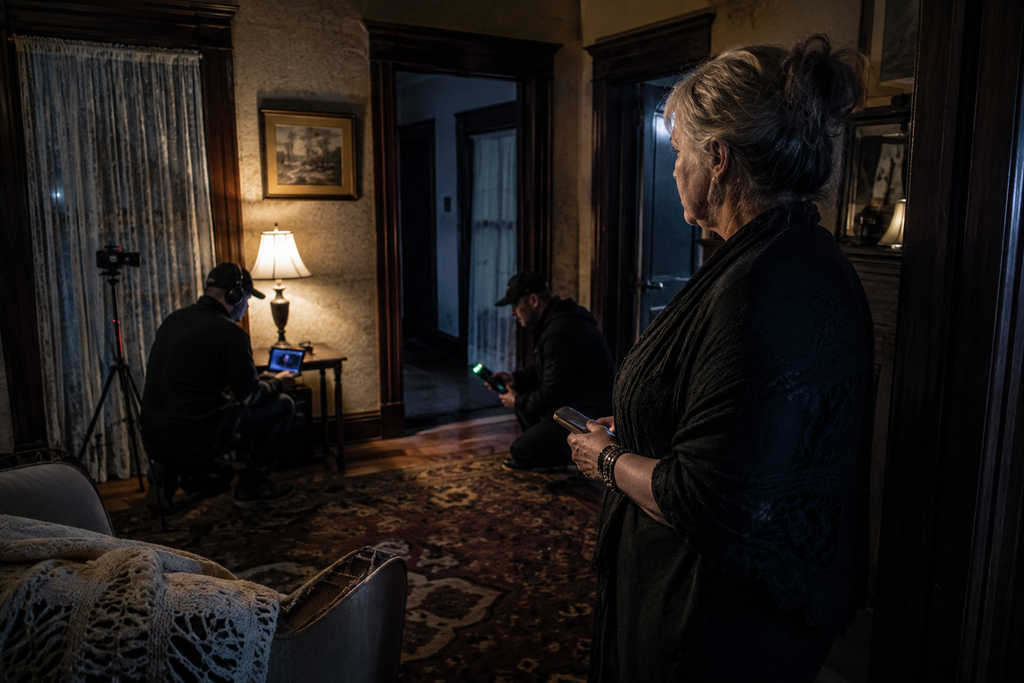
Start with the experience, not the explanation.
A voice in an empty room. Footsteps where no one is walking. A dream that later feels uncomfortably specific. A presence beside the bed. An object that seems to move without cause. Information that arrives before you know how you could have known it.
We believe experiences like these deserve to be heard without ridicule. We also believe they deserve careful thought. Something can be vivid, meaningful, frightening, or even genuinely anomalous without our first explanation for it being the right one.
Begin by writing down what happened as plainly as you can. Note the time, place, other witnesses, physical conditions, what you were doing beforehand, and anything that repeats. Check reasonable environmental and ordinary explanations without treating that process as an attempt to dismiss you. Good discernment does not erase mystery; it helps us see where the mystery actually begins.
If the experience feels personal, ongoing, or difficult to sort through in a general article, you are welcome to tell us what happened. Every situation carries its own context, and sometimes a conversation is more useful than another list of possibilities.
Ask a Witch “`What Is Parapsychology?
Parapsychology is the systematic study of experiences and reported abilities that seem to fall outside ordinary explanations of perception, mind, consciousness, and physical interaction. Depending on the researcher and the period, that can include telepathy, clairvoyance, precognition, psychokinesis, mediumship, apparitions, hauntings, out-of-body experiences, near-death experiences, and questions about whether consciousness can survive bodily death.
The word psi is often used as a broad label for the apparently anomalous information or effects being studied. It is useful precisely because it does not tell us in advance what caused them.
That distinction matters. Parapsychology does not begin with “this was a ghost,” “this person is psychic,” or “this house is haunted.” Ideally, it begins with an observation or report and asks what can reasonably be established about it.
Ghost hunting sits inside this much larger territory, but it is not the whole field. A haunted location may lead us into questions about apparitions, mediumship, environmental effects, consciousness, perception, folklore, or survival after death. Parapsychology gives us a wider frame in which to ask those questions.
Paranormal is a description. Parapsychology is an inquiry.
Paranormal is a broad cultural term for events or experiences that appear unusual, unexplained, or outside conventional expectations.
Parapsychology is the research tradition that asks whether some of those experiences can be studied systematically, what ordinary explanations must first be considered, and whether anything genuinely anomalous remains.
Psychical research is the older term and remains in use, particularly in the tradition of the Society for Psychical Research.
None of these terms requires us to decide what the phenomenon is before we have investigated it.
That makes parapsychology somewhat unusual. It occupies territory in which sincere witnesses, laboratory researchers, skeptical critics, mediums, psychologists, historians, ghost hunters, and practicing witches may all be looking at overlapping pieces of the same question while disagreeing sharply about what those pieces mean. That disagreement is not a flaw in the subject. It is part of the reason careful language matters.
The Range of Psi & Anomalous Experience
Paranormal investigation often begins with a place: a house with footsteps in an empty hallway, an apparition seen by more than one witness, an unexplained voice on a recording, or objects that seem to move without anyone touching them. These experiences belong within parapsychology, but they occupy only one part of a much larger field.
Researchers have also asked whether information can sometimes pass between minds without ordinary sensory contact, whether people can perceive distant or future events, whether consciousness can affect physical systems, and whether some aspect of consciousness may continue beyond bodily death. The terminology below describes categories of investigation—not conclusions about what causes them.
For witches, several of these categories also overlap with familiar practices. A laboratory researcher may speak of anomalous cognition where a practitioner speaks of clairvoyance; an out-of-body researcher may examine experiences a magical practitioner deliberately cultivates through astral projection. The overlap is useful, but the languages and methods are not interchangeable.
What falls under parapsychology?
Open any subject for a short orientation. Several lead into deeper MCC pages where the subject overlaps with witchcraft, spirit work, or paranormal investigation.
01 Apparitions, Hauntings & Poltergeist Phenomena The territory most ghost hunters know best
Reports of apparitions, recurring footsteps, voices, object movement, localized disturbances, and other seemingly place-based phenomena have been part of psychical research since its earliest organized investigations.
The word haunting can describe many different reports without settling what produced them. A case may involve environmental conditions, expectation and folklore, misperception, deliberate fraud, an unusual physical event, an apparent consciousness, or some combination that remains unresolved.
Poltergeist cases are especially interesting because the reported activity centers on physical disturbance—knocks, movement, breakage, or objects apparently displaced without an obvious mechanism. Historically, researchers have not always agreed that such cases are best understood as “ghosts.”
02 Mediumship & Spirit Communication When the reported phenomenon seems to answer back
Mediumship concerns reported communication with the dead or other discarnate consciousness. Researchers may test whether a medium can provide specific information under conditions designed to reduce ordinary information gathering, feedback, cueing, or chance.
Witchcraft approaches the same territory more relationally. Mediumship may become part of ancestor work, divination, haunting work, ritual, or deliberate spirit contact. MCC treats mediumistic information as meaningful but not automatically authoritative: receiving an impression and correctly identifying its source are separate skills.
03 Telepathy Information apparently passing from mind to mind
Telepathy refers to the apparent transfer of information between people without the ordinary senses or known communication channels carrying it. Experiments have ranged from early card-guessing studies to later forms of controlled sender-and-receiver testing.
Everyday stories—thinking of someone just before they call, sharing a strikingly specific impression, or seeming to know another person’s thought—are interesting experiences, but by themselves do not establish telepathy. Repetition, controls, specificity, and the possibility of ordinary information matter.
04 Clairvoyance & Remote Viewing Perceiving information beyond ordinary sensory reach
Clairvoyance broadly describes apparent knowledge of an object, event, place, or condition that is not available through the ordinary senses. Remote viewing developed as a more structured attempt to obtain impressions about a distant or hidden target under defined conditions.
Magical traditions use a wider vocabulary for comparable forms of perception—visions, scrying, psychometry, clairaudience, clairsentience, and sudden knowing among them. These categories overlap, but a practitioner’s spiritual interpretation is not automatically the same thing as a researcher’s operational definition.
05 Precognition & Presentiment Information or response apparently arriving before the event
Precognition refers to apparent knowledge of a future event that could not reasonably have been inferred from information already available. Presentiment research asks a related question: whether the body can show measurable anticipatory responses before an unpredictable stimulus occurs.
Premonitory dreams are one of the oldest and most familiar versions of this experience. They are also especially vulnerable to selective memory and interpretation after the fact, which is why recording a dream before the later event occurs makes a much stronger case than remembering the similarity afterward.
06 Psychokinesis Mind and matter: does intention sometimes leave a physical trace?
Psychokinesis, often shortened to PK, is the proposed influence of mind or intention upon a physical system without a known physical mechanism. Research has ranged from dramatic claims of object movement to much subtler experiments involving random systems and statistical effects.
This naturally interests magical practitioners because magic also makes claims about intention producing change. The similarity is worth noticing, but it should not be overstated: a laboratory PK hypothesis is not scientific confirmation of spellcraft, nor does magical experience automatically establish psychokinesis.
07 Out-of-Body Experience & Astral Projection When consciousness seems located somewhere other than the body
An out-of-body experience, or OBE, is the reported sensation of perceiving oneself or the environment from a location outside the physical body. Such experiences may occur spontaneously, around sleep, during extreme physical conditions, in altered states, or through deliberate practice.
Parapsychology may ask what produces the experience and whether information can ever be accurately perceived from beyond ordinary sensory position. Astral projection begins from a different direction: it is the deliberate magical cultivation of an experience of consciousness beyond the body. The territories overlap without requiring us to assume that every OBE and every astral journey are identical.
08 Near-Death Experience & Survival Does consciousness end when the body does?
Near-death experiences may include unusual clarity, a sense of leaving the body, encounters with deceased people or presences, movement through an altered environment, life review, or profound changes in the person’s understanding of death afterward. Not every NDE is peaceful or pleasant, and no single pattern appears in every report.
These experiences belong to a larger research question sometimes called survival research: whether consciousness, personality, memory, or some other component of the person can continue after bodily death. Mediumship, apparitions, deathbed experiences, and other cases may also be examined within that question.
09 Reincarnation & Previous-Life Reports Claims of memory, identity, and continuity across lives
Reports of previous lives occur within many religious traditions, but they also enter parapsychology when researchers examine specific claims that might be independently checked—particularly unusual statements made by young children about people, places, relationships, or events they seemingly had no ordinary way to know.
Reincarnation is one possible interpretation of such cases, not a conclusion built into the category. Memory, family influence, cultural expectation, coincidence, information leakage, and other explanations must remain part of the inquiry.
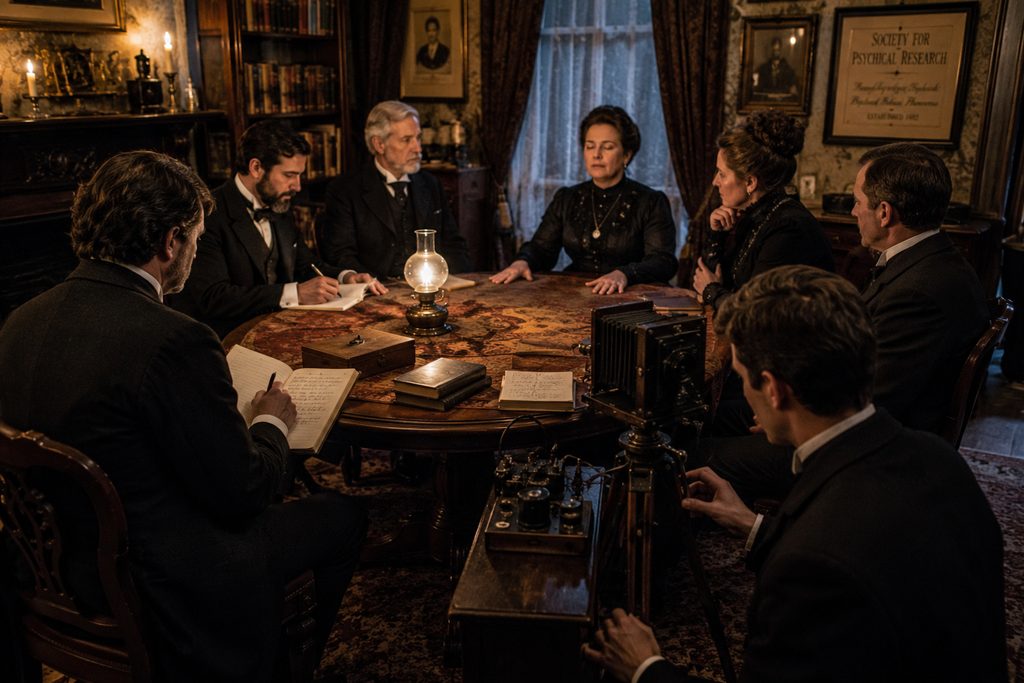
From Séance Room to Laboratory
Modern parapsychology did not appear out of nowhere, and it did not begin with people walking through abandoned buildings carrying electronic equipment. Its immediate history grew from an unusual meeting of religion, popular culture, psychology, scientific curiosity, and nineteenth-century Spiritualism.
Modern Spiritualism surged into public attention during the mid-1800s. Séances and public mediums made claims of communication with the dead unusually visible, while new technologies such as the telegraph were already changing people’s ideas about communication across distance. Believers saw evidence of another world; skeptics saw fraud, suggestion, and credulity. A third group began asking a different question: could any of it be investigated?
That question helped produce psychical research. Scientists, physicians, philosophers, psychologists, and other scholars began sitting with mediums, collecting witness accounts, examining apparitions and supposed physical phenomena, testing claims of thought-transference, and developing methods intended to separate unusual events from deception and ordinary explanation. Investigation of mediums and Spiritualist phenomena was already underway before the Society for Psychical Research formed in London in 1882; the SPR then gave that work an organized home.
The relationship was never simple. Many early psychical researchers were Spiritualists or sympathetic to survival after death; others were decidedly cautious. Disagreements over evidence, fraud, interpretation, and how skeptical an investigator ought to be appeared almost immediately. In other words, some arguments heard in paranormal investigation today are more than a century old.
MCC treats Spiritualism and parapsychology as closely related but distinct histories. Spiritualism developed as a religious and philosophical movement centered on communication with spirits and survival after death. Psychical research attempted to investigate some of the same claims without requiring researchers to share the same religious conclusions.
When spirit claims became research questions
The modern field developed through overlapping movements rather than a single moment of invention.
Spiritualism enters mass culture
The events associated with the Fox sisters at Hydesville in 1848 helped ignite the rapid spread of Modern Spiritualism. Séances, mediums, spirit photography, table phenomena, public demonstrations, exposure of fraud, and fierce debate all followed.
Whatever one concludes about particular claims, Spiritualism forced questions about spirit communication and survival after death into unusually public view.
Psychical research organizes
The Society for Psychical Research was founded in London to make an organized, systematic investigation of disputed mental, psychic, and Spiritualist phenomena. Its work included telepathy, apparitions, mediumship, hauntings, and questions surrounding survival after death.
Importantly, the Society did not require its members to agree about what the phenomena meant. That tension between serious interest and critical examination became part of the field from the beginning.
Psychology meets the séance room
Among the people drawn into psychical research was American psychologist and philosopher William James. James investigated the medium Leonora Piper for years and became convinced that some of the information produced in her trance states could not be comfortably explained by ordinary acquisition, while remaining cautious about its ultimate source.
This distinction mattered: recognizing an anomaly did not require pretending to know its mechanism.
Parapsychology enters the laboratory
At Duke University, J. B. Rhine and colleagues pushed research toward controlled experimental work involving ESP and psychokinesis. Academic parapsychology began there in 1930, the Duke Parapsychology Laboratory was established in 1935, and the Journal of Parapsychology followed in 1937.
The subject was no longer confined to séance sittings and spontaneous cases. Researchers increasingly asked whether anomalous effects could be produced, measured, repeated, and analyzed statistically.
James is particularly useful here because he refused an easy choice between belief and dismissal. His study of medium Leonora Piper persuaded him that something requiring explanation was occurring; he remained far less certain about what that something ultimately was.
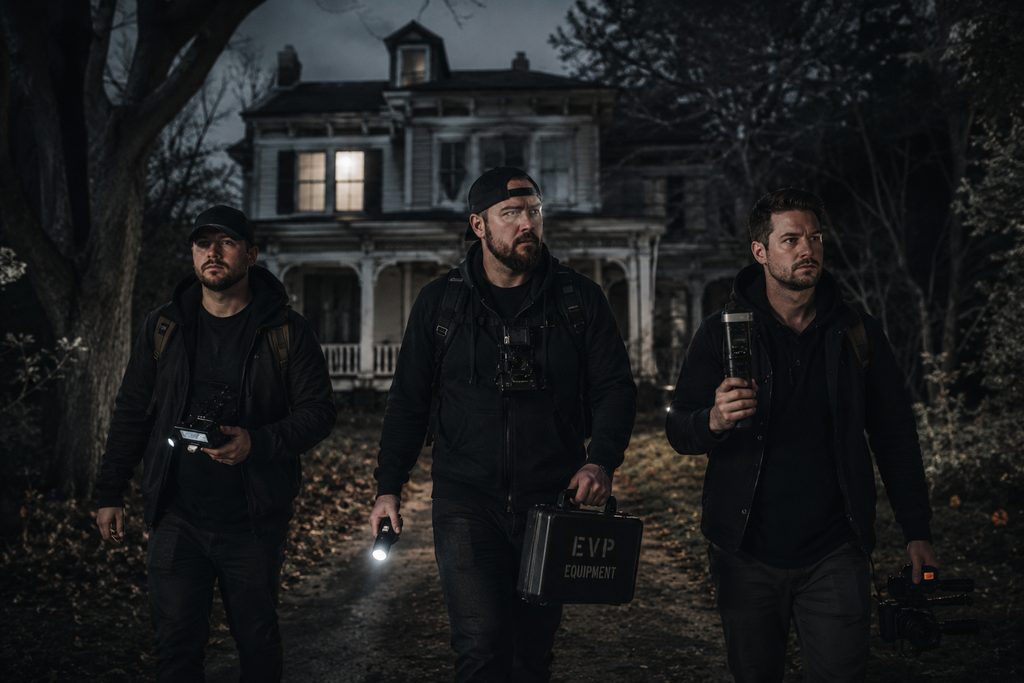
From Ghost Hunter to Paranormal Investigator
The term ghost hunter sometimes gets treated as if it belongs to an unserious past, while paranormal investigator sounds newer, broader, and more professional. The history is messier than that.
Ghost hunting long predates paranormal reality television. The Society for Psychical Research’s historical overview notes that writer Elliott O’Donnell was among the earliest people to publicly describe himself as a “ghost hunter,” while Harry Price became one of the most influential figures in bringing instruments, organized fieldwork, publicity, and method into haunted-location investigation. A generation later, Hans Holzer quite happily published Ghost Hunter in 1963 and built a long public career around the term.
So MCC does not use ghost hunter as an insult. If you primarily investigate reports of ghosts and hauntings, it is an unusually accurate description of what you do.
Paranormal investigator is useful when the work extends beyond ghosts into unidentified phenomena, psychic claims, unusual experiences, folklore, environmental anomalies, or other subjects. But the title itself does not establish someone’s training, method, skepticism, experience, or expertise. Neither does owning investigative equipment.
Psychical researcher comes from an older research tradition associated with organizations such as the Society for Psychical Research. Parapsychologist is more specific still, generally referring to someone engaged in systematic parapsychological research. A person can be an excellent ghost hunter without being a parapsychologist, and calling oneself a paranormal investigator does not automatically make one’s work scientific.
The distinctions matter because modern paranormal culture blends several different activities: research, field investigation, spiritual practice, historical storytelling, tourism, entertainment, and content creation. They can overlap. They should not be confused.
Four labels that do not mean quite the same thing
When Ghost Hunting Became Mass Culture
The modern ghost hunter also inherited something earlier psychical researchers could scarcely have imagined: a mass audience.
Harry Price understood publicity remarkably well, and his investigations helped place the investigator himself at the center of the haunted-house story. Hans Holzer carried ghost investigation further into books, radio, television, and popular culture. But cable and reality television changed the scale completely.
Britain’s Most Haunted began in 2002, mixing reportedly haunted locations, night-vision technology, investigation, mediumship, history, and the conventions of reality television. In the United States, Ghost Hunters followed in 2004 with Jason Hawes, Grant Wilson, and TAPS, emphasizing equipment, attempts to reproduce reported phenomena, and the idea of helping people understand what was happening in their homes and businesses. Ghost Adventures became another major influence beginning in 2008, emphasizing immersive investigations, technology, personalities, confrontation, and dramatic storytelling.
These programs mattered. They introduced millions of people to EVP sessions, EMF meters, thermal imaging, baseline readings, debunking, haunted-place history, and the idea that ordinary people could investigate paranormal claims themselves. They inspired an enormous number of local teams and helped move ghost hunting from a niche pursuit into mainstream culture.
They were also television.
That is not an accusation. Entertainment has value. A program has to tell a story, hold an audience, establish personalities, create suspense, and deliver enough material to justify another episode. Research has a different obligation. Sometimes a good investigation produces an exciting anomaly. Sometimes it produces a plumbing noise, a reflection, a bad electrical circuit, and six hours in which absolutely nothing unusual happens.
The second result may be excellent investigation and terrible television.
Confusion begins when the expectations of entertainment are mistaken for the requirements of evidence.
Finding out what survives scrutiny.
- Controls and baseline conditions
- Documentation
- Alternative explanations
- Repeatability where possible
- Uncertainty
- Null results
Giving an audience a reason to keep watching.
- Narrative
- Pacing
- Personalities
- Suspense
- Memorable moments
- Resolution
Social media compressed the cycle again. YouTube allowed investigations to become independently produced programs; TikTok and other short-form platforms can reduce an entire case to its most dramatic seconds. At their best, these platforms have opened the field, preserved local stories, connected investigators, and made unusual experiences easier to document and discuss. At their worst, the pressure for constant revelation rewards certainty, escalation, and spectacle.
None of that makes a popular investigator wrong. It simply gives us another variable to consider: what does the person investigating need the experience to become?
Evidence Is Not Interpretation
A great deal of disagreement in paranormal investigation comes from using the word evidence for several different things.
A witness reporting footsteps is evidence that a person experienced footsteps. A recorder containing an unexplained sound is evidence that the recorder captured a sound. An EMF meter changing is evidence that the instrument detected a change within the physical quantity it measures.
Each may deserve investigation. None, by itself, tells us what caused it.
This distinction can feel overly cautious when an experience is dramatic, but it protects the experience rather than diminishing it. If something genuinely unusual occurred, we want to know where the ordinary explanation ends and the anomaly actually begins. Every assumption we add too early makes that harder.
The same standard applies to witches, mediums, and psychics. A medium may receive the impression of an older man. A witch may sense that a room feels occupied. Divination may repeatedly point toward conflict. Those observations can contribute to an investigation, particularly when they converge with information obtained independently, but none becomes infallible simply because it arrived intuitively or ritually.
Discernment means being willing to say both “something happened” and “we do not yet know what it was.”
How a noise becomes a ghost story
Every step may be reasonable to consider. Each step also requires more evidence than the one before it.
The recorder captured a sound.
This is the strongest statement we can make from the recording alone.
The sound resembles a human voice.
Now perception has entered the process. Other listeners may hear something different.
We think the voice says, “Get out.”
A possible reading has become attached to an ambiguous sound. Expectation and suggestion now matter.
A spirit produced the voice.
This may be one possibility. The recording itself has not yet identified its source.
It is the former owner of the house.
We have now assigned identity. That requires evidence independent of our original sound.
He is angry because the house was renovated.
A complete story now exists—even though the only thing originally established was that a recorder captured a sound.
“To ignore or dismiss these accounts would be foolish, to acknowledge them as proof without question or study would be equally so.”
This is also why eliminating an ordinary explanation does not automatically prove a paranormal one. If a pipe did not make the knock, we have learned that the pipe did not make the knock. We have not yet learned that a dead person did.
Unknown is a legitimate result.
For MCC, it can also be an exciting one.
Parapsychology has an awkward evidence problem: there are findings that are difficult to dismiss casually, but there is not a body of evidence strong and consistent enough to have produced broad scientific agreement that psi has been established.
Mainstream psychology remains skeptical, particularly because extraordinary findings have often proved difficult to reproduce reliably. Replication matters. If an effect is real and experimentally accessible, researchers should be able to find it again under well-controlled conditions—not necessarily every time, but predictably enough that its existence becomes difficult to dispute.
At the same time, the research record is not simply a century of failed experiments.
One of the longest-running experimental traditions is the ganzfeld, in which a participant is placed in a state of reduced, uniform sensory stimulation and asked to identify information about a randomly selected target. A 2024 registered meta-analysis examining 113 studies conducted between 1974 and 2020 reported a small but statistically persistent overall effect. The authors found no declining trend across the decades and reported that their result survived several tests for publication bias. Participants selected for prior experience or apparent aptitude performed better than unselected participants.
That is interesting evidence. It is not the same thing as establishing what produced the effect.
Other high-profile psi claims have fared less well under unusually rigorous replication. Daryl Bem’s controversial experiments suggesting precognition helped provoke years of debate and became a useful test case for new open-science methods. The multi-laboratory Transparent Psi Project, designed with input from both psi proponents and skeptics, did not reproduce Bem’s original precognition effect. A further large replication project published in 2025 also failed to establish the originally predicted effect consistently across its studies.
That is important evidence too.
Parapsychology therefore occupies an uncomfortable middle. Some experimental literatures contain small statistical effects that proponents argue have persisted through decades of research. Critics question whether those effects arise from methodology, selection, statistical choices, publication patterns, experimenter effects, or other problems that become especially important when the claimed effect is very small. Highly controlled replication efforts sometimes produce null results.
For MCC, none of this requires embarrassment. We cautiously believe anomalous perception and spirit phenomena can be real. Scientific research does not have to validate that belief before we practice, any more than belief gives us permission to claim that science has proven what it has not.
The research is interesting precisely because the question remains open.
The evidence is more complicated than either side often admits.
- Some experimental effects appear statistically above chance across large collections of studies.
- Certain effects have persisted across decades rather than disappearing entirely with newer experiments.
- Some research suggests participant selection, experience, or testing conditions may affect results.
- Spontaneous experiences—apparitions, mediumship, NDEs, unusual knowing—continue to generate cases that invite investigation outside the laboratory.
- Reported effects are generally small and are not reliably produced on demand.
- Important claims have sometimes failed high-quality replication attempts.
- Small methodological weaknesses can become significant when the measured effect itself is tiny.
- No broadly accepted mechanism currently explains how psi would operate.
That is probably the wrong question.
A good unresolved problem should make us more careful, not more certain. Positive results deserve examination. Failed replications deserve examination. Extraordinary personal experiences deserve examination. None should be required to carry more weight than the evidence actually allows.
Readers who want to see the argument rather than summaries of it should go to the research itself. The Parapsychological Association provides an entry into the contemporary field; the Society for Psychical Research maintains the older psychical-research tradition; and published work such as the 2024 ganzfeld meta-analysis and the Transparent Psi Project shows how researchers on opposing sides are increasingly using preregistration, open data, collaborative design, and replication to make the disagreement more informative.
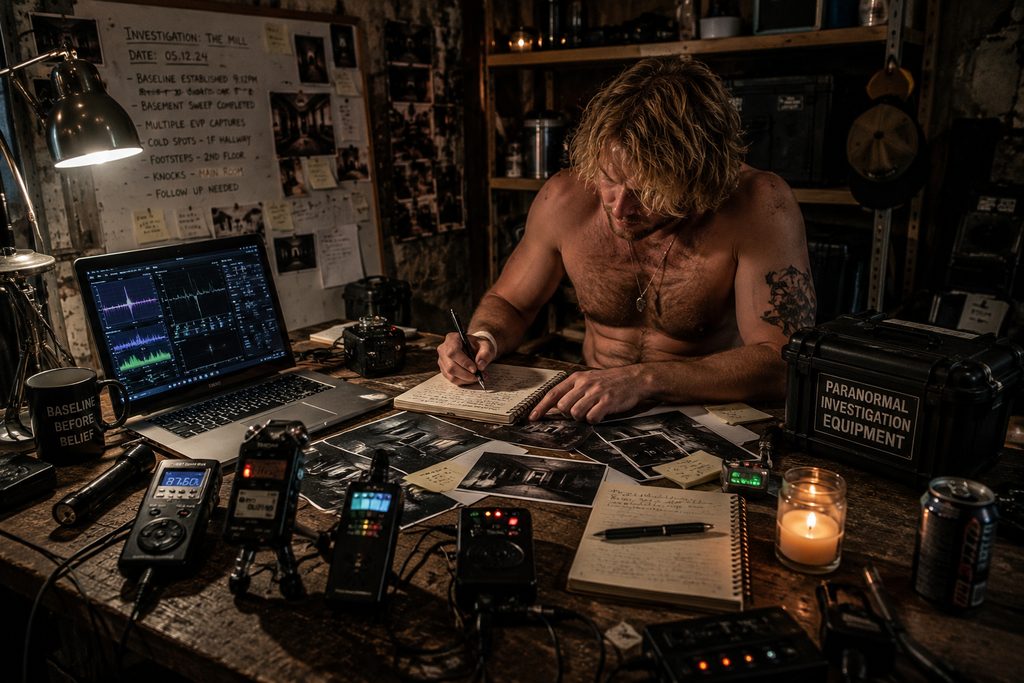
What Your Equipment Actually Knows
Equipment has a legitimate place in paranormal investigation. Cameras preserve visual conditions. Recorders preserve sound. Thermometers and thermal imagers give us information our senses may miss. EMF meters can reveal changes in electromagnetic conditions. Continuous monitoring can establish whether an unusual experience coincided with something measurable in the environment.
That can be extremely useful.
The problem begins when an instrument is asked to answer a question it was never designed to answer.
An EMF meter does not have a setting for “spirit.” A thermal camera cannot identify a dead person. A recorder does not know whether an ambiguous sound is an EVP. A device responding at the right moment may be interesting, but the timing alone does not tell us what caused the response.
The Association for the Scientific Study of Anomalous Phenomena makes a wonderfully simple point: before an investigator can recognize an unusual reading, they need to understand what a normal reading looks like. Electrical wiring, appliances, radio interference, reflective surfaces, airflow, body heat, movement of the instrument itself, and the quirks of recording technology can all produce readings that look much more mysterious when the investigator does not understand the tool.
Good equipment use is therefore less about accumulating gadgets than establishing conditions. What was the baseline? Was the device stationary? Was it calibrated? What else changed at the same moment? Can the effect be produced again? Does the anomaly occur in an allegedly haunted location but not in an appropriate comparison location?
A piece of equipment can extend our senses. It cannot replace our judgment.
What the device tells you—and what it doesn’t
Instruments can document conditions and anomalies. Interpretation still belongs to the investigator.
That electric or magnetic field conditions detectable by that particular meter have changed.
That a spirit caused the change—or who or what that spirit might be.
How infrared radiation and apparent surface temperatures vary across the scene.
That an unusual hot or cold shape is a ghost rather than reflection, airflow, materials, people, or another physical cause.
That sound was recorded, including sounds that witnesses may not have noticed at the time.
Who produced an ambiguous voice-like sound, whether words were actually spoken, or whether the source was discarnate.
That the condition the device was engineered to detect changed near the instrument.
Whether an intelligence deliberately caused that change or merely happened to coincide with it.
What audio emerges while the device rapidly scans radio frequencies or otherwise produces its audio stream.
Whether an apparently relevant word came from spirit communication, broadcast material, chance, expectation, or pattern-finding.
What light reached the camera sensor during an exposure or sequence of exposures.
That an unexplained blur, shadow, reflection, flare, or figure has a paranormal origin.
None of this makes equipment useless. Quite the opposite. A well-understood instrument can provide an independent record that human memory cannot. Continuous environmental data may show that a witness experience coincided with something unusual—or reveal the perfectly ordinary condition that caused it.
The best tool on an investigation may therefore be the least glamorous one: a good log.
Write down when something happens. Record who was present and where they were standing. Keep clocks synchronized. Note when someone enters a room, turns on an appliance, opens a door, asks a question, or performs a ritual. Preserve original files. Compare experiences before witnesses have had time to influence one another.
Equipment becomes evidence-producing equipment when the investigator knows what happened around it.
Who Gets to Name What Happened?
An unexplained experience rarely arrives with a label attached.
Someone hears footsteps crossing an empty second floor. A child repeatedly speaks about a woman standing near the stairs. A recorder captures something voice-like. Several people independently describe discomfort in the same room. Objects occasionally appear where no one remembers leaving them.
Those are the experiences.
Then people begin naming them.
One investigator may call the activity a residual haunting. Another may believe an intelligent spirit is present. A medium may describe a particular personality. A demonologist may interpret escalating fear as oppression. A psychologist may consider perception, expectation, memory, sleep, suggestion, stress, or environmental influence. A folklorist may notice that stories about the location are shaping what later witnesses expect to encounter. A witch may consider spirit, place, boundaries, relationship, history, and whether anything has invited or altered contact.
Any one of those interpretations might contain something useful. Several may be operating at once. None receives automatic authority simply because the person offering it has a title.
This matters especially when frightened people ask for help. The person who names an experience often gains enormous influence over what happens next. Telling someone that their home contains a harmless residual haunting creates one set of expectations. Telling them that an intelligent dead person wants attention creates another. Telling them that something demonic has attached itself to their family may change how they understand every strange noise, nightmare, argument, illness, or coincidence that follows.
Naming is not neutral.
At MCC, we prefer to begin one step earlier:
Tell us what happened before you tell us what you think it was.
One experience can acquire many names.
Imagine that several people report footsteps upstairs when the floor is apparently empty, along with occasional movement near the staircase.
“Someone is walking upstairs when nobody is there.”
“The location may have recurring haunting activity.”
“I sense a person associated with this part of the house.”
“What might perception, expectation, memory, sleep, stress, or suggestion contribute?”
“What stories already exist about this house, and how have they changed?”
“What is the relationship between the activity, the people, the place, and anything that has changed?”
“Could this represent hostile or demonic activity?”
The farther we travel along that line, the more careful we should become about presenting our conclusion as something the witness has already established.
There is another reason to resist premature naming: interpretations can feed back into the experience itself.
Tell a household that a particular staircase is haunted and people will begin paying closer attention to that staircase. Tell them that the spirit appears at 2:13 a.m. and 2:13 becomes meaningful. Publish a dramatic story about a location and later visitors may arrive already knowing what they are supposed to hear, feel, or see.
That does not mean later experiences are fabricated. Expectation can shape perception without conscious dishonesty, and genuine anomalous activity—if present—would still exist inside the same cultural environment.
This is where folklore becomes relevant to investigation. Places accumulate stories. Stories affect witnesses. New experiences modify the story. Investigators publish the new version. Eventually it can become difficult to determine which details belonged to the earliest reports and which entered the case later.
A good investigator therefore studies not only the alleged phenomenon but the history of the story surrounding it.
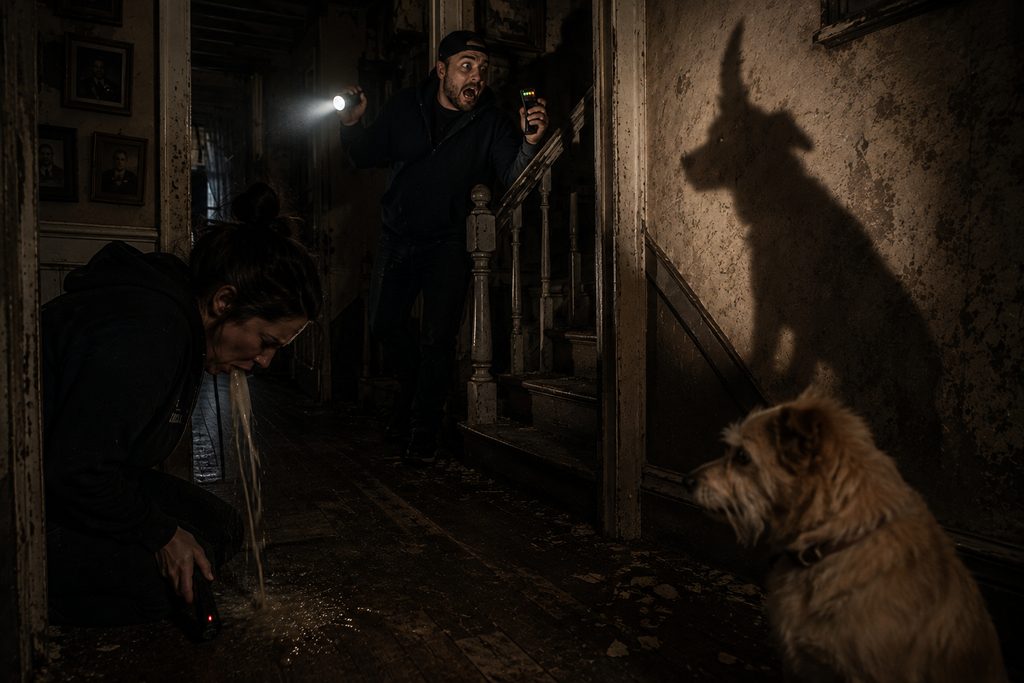
When the Explanation Becomes “Demonic”
Demonology is a real historical subject. Religions and occult traditions have developed complex ideas about hostile spirits, demons, possession, harmful presences, and spiritual protection for centuries. MCC does not dismiss the possibility of dangerous or predatory spirit encounters simply because the language makes some people uncomfortable.
We do object to using demonic as a shortcut.
In contemporary paranormal culture, an unexplained haunting sometimes begins as footsteps, shadows, disturbed sleep, unusual dreams, equipment responses, or a frightened household and gradually acquires increasingly dramatic labels: intelligent, negative, oppressive, demonic, attached, possessed.
Each of those words makes a larger claim than the one before it.
There may be cases in which a practitioner ultimately concludes that something hostile is present. But hostility does not automatically mean demon. Fear does not identify an entity. Scratches do not establish theology. A spirit box producing an unpleasant word does not establish possession. Even apparent intelligent interaction tells us surprisingly little about the nature, identity, or intentions of whatever may be producing it.
This is particularly important because demonic is not an emotionally neutral diagnosis. Tell a frightened family that their house contains a ghost and they may become nervous. Tell them that an ancient demonic intelligence has attached itself to their child and you may fundamentally alter how they interpret their home, their relationships, their dreams, and every unexplained event that follows.
The more frightening the conclusion, the greater our responsibility to earn it.
How uncertainty can become certainty without new evidence
Dramatic language can accumulate faster than information does.
“We hear footsteps upstairs.”
“There is an intelligent presence here.”
“It feels negative.”
“This is demonic.”
“It has attached itself to someone in the family.”
“You need someone with my expertise to remove it.”
Sometimes there may be quite a lot. Sometimes there is almost none. The distinction matters.
There is also a power problem worth naming.
Paranormal investigation has no single governing body that determines who may call themselves an investigator, expert, or demonologist. Some organizations provide serious training and their own ethical standards; other people acquire considerable knowledge through years of study and fieldwork. Others simply adopt the title.
The title is therefore much less interesting to us than the method behind it.
Demonology can also tend toward gatekeeping because the interpretation itself creates specialized authority. If the investigator is the person who announces that an ordinary haunting is actually demonic, and then becomes the only person in the room supposedly qualified to understand or resolve that danger, the frightened household has very little ability to evaluate the claim independently.
That does not mean the investigator is necessarily dishonest. People can sincerely believe their interpretation. But sincerity does not remove conflicts of interest, and fear can make ordinary differences in expertise feel like absolute authority.
Charging for expertise is not inherently unethical either. Researchers, mediums, clergy, writers, tour operators, educators, and experienced practitioners all have legitimate reasons to be compensated for their labor. The concern is a narrower one: be cautious whenever the person escalating the diagnosis also benefits from convincing you that the problem requires increasingly specialized intervention.
A responsible practitioner should be willing to explain what led them to their conclusion, what alternatives they considered, what would make them reconsider it, and when the situation exceeds their competence.
“Trust me, I’m a demonologist” is not a method.
- Interviews witnesses before supplying a dramatic interpretation.
- Separates observations from conclusions.
- Explains reasonable alternatives.
- Is comfortable saying “I don’t know.”
- Welcomes corroboration and second opinions.
- Recognizes when another kind of expertise is needed.
- A frightening label appears before much investigation has occurred.
- Every ambiguity is interpreted in the same direction.
- Questioning the conclusion is treated as dangerous or naïve.
- The investigator’s title becomes the main evidence for the claim.
- The household is discouraged from seeking another perspective.
- The diagnosis conveniently creates a need for the investigator’s exclusive solution.
MCC’s objection is not that witches are too sophisticated to believe in dangerous spirits. We are witches. Spirit boundaries, protection, cleansing, banishing, discernment, and knowing when not to engage are foundational parts of our practice.
Our objection is the collapse of a complicated spirit world into a single frightening category.
A troubling presence might be hostile. It might be territorial, confused, opportunistic, parasitic, attached to place rather than person, connected to a human dead, amplified by fear or attention, entangled with the emotional history of a location, misunderstood through cultural expectation, or not a spirit at all. Sometimes the most responsible answer remains unknown.
That larger vocabulary tends to make witches slower to reach for the word demon, not because we necessarily believe less, but because we have more categories available to us.
Readers interested in MCC’s fuller treatment can continue to Demonology.
The frightening explanation is not automatically the deeper one.
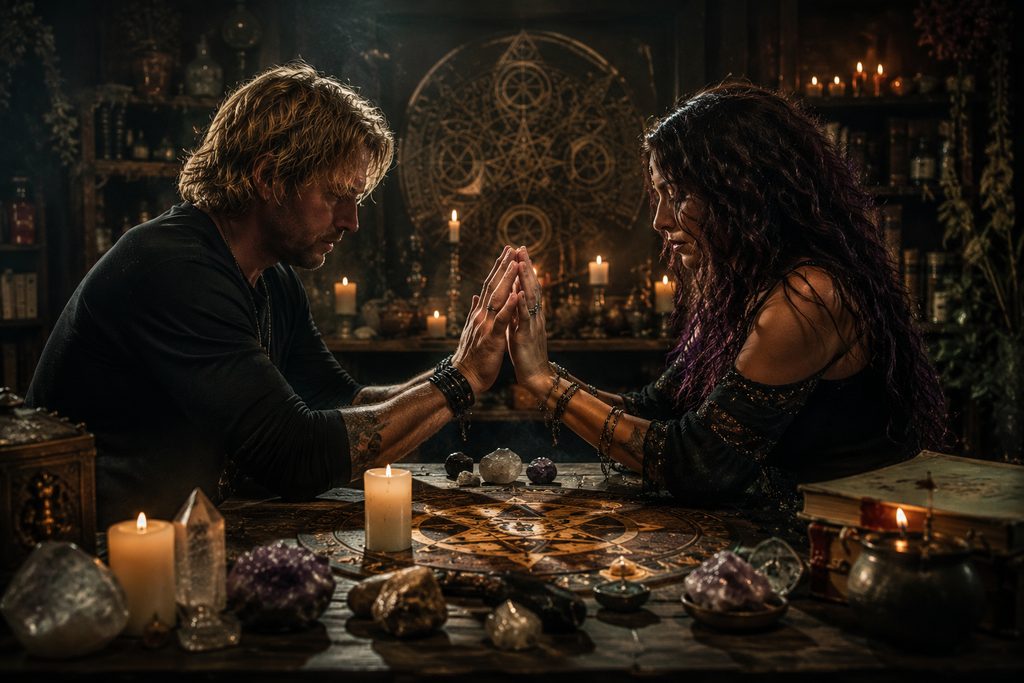
Where Parapsychology Meets Witchcraft
Parapsychology and witchcraft sometimes stand in front of the same mystery and ask different questions.
A parapsychologist may ask whether a person obtained information without ordinary sensory access. A witch may ask whether that information came through clairvoyance, divination, dream, spirit contact, or another form of altered perception. A researcher may study the phenomenology of an out-of-body experience; a magical practitioner may deliberately cultivate a comparable state through astral projection. A survival researcher may examine whether a medium can provide verifiable information about a deceased person; a practicing medium may be equally concerned with relationship, consent, boundaries, and the character of the contact itself.
The overlap is real. The explanations are not automatically the same.
Witchcraft is not parapsychology with candles, and parapsychology is not scientific witchcraft. One is primarily a research tradition attempting to study anomalous experience under controlled or carefully documented conditions. The other is a living body of religious, magical, ritual, divinatory, and spirit-working practices concerned not only with whether something happens, but with how people enter relationship with it and what they do next.
That distinction is important to MCC. We do not need a laboratory result to tell us that a magical practice is meaningful or that spirit relationship belongs within our worldview. At the same time, our belief does not entitle us to borrow the authority of science and announce that parapsychology has proven witchcraft.
We can learn more by allowing both disciplines to remain themselves.
The experience may look familiar even when the framework changes.
These are points of contact, not claims that the terms are interchangeable.
Clairvoyance / anomalous cognition
Information apparently obtained without ordinary sensory access.
The Clairs, scrying & divination
Practices and vocabularies for receiving or interpreting information beyond ordinary observation.
Precognition
Apparently obtaining information about an event before it occurs.
Dream work & divination
Traditions for working with predictive dreams, omens, cards, symbols, and intuitive foresight.
Out-of-body experience
Research into experiences of consciousness seeming to occupy a position beyond the physical body.
Astral projection
Deliberate cultivation of an altered state understood by practitioners as travel or perception beyond ordinary bodily location.
Mediumship & survival research
Asking whether apparently accurate information supports communication with or survival of the dead.
Mediumship, ancestors & spirits
Communication understood within a larger practice of relationship, boundary, reciprocity, ritual, and discernment.
Apparitions & hauntings
Documenting recurring reports, witnesses, environmental conditions, physical effects, and possible explanations.
Spirit, household & land
Considering who or what is present, how it relates to the location, what boundaries exist, and whether engagement is appropriate.
Psychokinesis
Testing whether intention or consciousness appears to influence physical systems without a known mechanism.
Intention & magical change
Working ritually to influence circumstances while recognizing that magical experience is not itself laboratory evidence for PK.
There is also a historical imbalance worth remembering. Modern paranormal investigation is relatively young. Human beings have practiced divination, trance, ritual protection, ancestor work, spirit mediation, dream interpretation, and deliberate contact with the unseen for thousands of years.
That does not mean a modern witch inherits an uninterrupted prehistoric instruction manual, nor does age make a belief automatically correct. It does mean paranormal investigators entered a conversation that human ritual specialists had already been having for a very long time.
Sometimes the modern investigator brings tools older practitioners never possessed: synchronized audio, environmental sensors, archival databases, thermal imaging, digital photography, and the ability to compare evidence across enormous communities.
The witch brings another inheritance: relationship, ritual, boundary, symbol, altered-state experience, spirit etiquette, and the expectation that contact may have consequences.
Neither toolkit is complete.
Together, they can ask better questions.
What a Witch Brings to an Investigation
A practiced witch does not automatically make a good paranormal investigator. Knowing ritual does not teach someone how to control an audio recording, interview witnesses without leading them, research property history, or recognize an electrical problem.
But an experienced witch may enter an investigation with a set of competencies that paranormal investigation does not usually teach.
The difference begins with relationship.
A ghost hunter may enter a location hoping to establish whether something unusual is happening. A witch is more likely to ask what relationships already exist there: between the living and the dead, the household and the land, the present occupants and the history of the place, or between an apparent presence and the attention being directed toward it.
That changes the investigation.
Instead of asking only, “Can we get it to respond?” a witch may also ask, “Should we?”
Instead of treating communication as a successful result by itself, we consider invitation, consent, boundary, reciprocity, intention, and how the contact will be closed.
And instead of assuming every unusual presence wants the same thing, we tend to begin with the possibility that different phenomena may require very different responses.
What witchcraft can add to an investigation
Not better gadgets. A different set of questions, practices, and forms of experience.
Relationship
Witches who work with spirits tend to think relationally. If something appears responsive or aware, the question is not only whether it exists, but what kind of interaction is developing between it and the people involved.
Place
A house is more than a container for activity. Practitioners may consider land, thresholds, household history, repeated human behavior, former occupants, sacred or ritual use, and how a location has changed over time.
Boundary
Opening and closing are basic magical skills. A practitioner may know how to permit limited contact, establish conditions, withdraw permission, cleanse, ward, banish, or simply stop engaging.
Discernment Across Methods
An impression can be compared with witness reports, historical research, divination, mediumship, environmental data, repeated observation, and what happens after conditions are deliberately changed.
Altered-State Experience
Trance, meditation, scrying, dream work, mediumship, and astral practice can make unusual perception less novel to an experienced practitioner. Intensity alone is therefore less likely to be mistaken for certainty.
Spirit Etiquette
Contact is not automatically treated as entertainment. Practitioners may consider whether something should be addressed, ignored, acknowledged, offered to, protected against, or left entirely alone.
Intervention
Witchcraft can deliberately alter the conditions of a case. A boundary may be established. An offering may be made. Contact may be closed. A room may be cleansed or warded. The important question then becomes: what, if anything, changes afterward?
Knowing When to Stop
Not every mystery benefits from another session. Sometimes the most experienced person in the room is the one who recognizes that curiosity is no longer sufficient reason to continue contact.
Observation asks whether a pattern exists. Magical practice can sometimes change a condition and then observe whether the pattern changes with it.
If activity changes afterward, that does not automatically prove the practitioner’s explanation. But a repeatable change following a deliberate intervention is information worth documenting.
None of this means intuitive information should bypass ordinary investigation.
If a witch or medium enters a location and immediately receives a name, date, image, or personal detail, the strongest use of that information is often to record it before anyone supplies additional history and then see whether it can be independently checked. If several practitioners work a location, compare their impressions before allowing them to compare notes.
The same principle applies to divination. A repeated pattern may help identify a question worth pursuing, but the cards do not get to rewrite the historical record because their story is more interesting.
Experienced practitioners can also be wrong. We can project, misidentify, become emotionally entangled, mistake expectation for intuition, or interpret unfamiliar phenomena through the traditions we know best.
Practice should make us better at recognizing those possibilities, not immune to them.
That is the witch MCC wants on an investigation: not the person most eager to announce what is in the room, but the person capable of working carefully when no one is yet sure.
Why a Witch May Hesitate
Witches are not necessarily more frightened of things that go bump in the night.
We may simply be less inclined to assume that contact is consequence-free.
A paranormal investigation often rewards response. A light flashes after a question. A recorder captures something voice-like. A knock follows a request. Someone feels touched. From an investigative standpoint, interaction can seem like the thing everyone came hoping to document.
A practitioner may view the same moment differently.
Calling into a room, repeatedly addressing an unseen presence, asking it to touch someone, inviting it to manipulate equipment, challenging it to prove itself, or announcing that anyone present has permission to communicate are not necessarily neutral acts. If no intelligence is present, perhaps nothing more has happened than an unusual social exercise. If something is present, however, the investigators may have begun a relationship whether they intended to or not.
That possibility changes the ethics of contact.
Witches tend to think in terms of openings and closings, invitations and boundaries. We are accustomed to asking what has been permitted, what has been offered, who is doing the calling, what kind of response is being encouraged, and how the interaction will end.
That is why an experienced practitioner may be the person in the room saying, “We have enough. Stop asking.”
It is not always fear.
Sometimes it is manners.
Before asking for another sign, ask what the invitation means.
Paranormal investigation often treats response as evidence. Magical practice also considers the relationship created by asking for that response.
Attention can change a situation.
Whether the mechanism is psychological, social, magical, spiritual, or some combination, repeatedly directing attention toward unusual activity can intensify how people experience it.
An invitation should have limits.
“Anyone here can speak through us” is very different from deliberately allowing a narrow form of contact for a defined period under stated conditions.
Provocation is not the same as investigation.
Taunting, insulting, daring, or threatening an alleged presence may create dramatic footage. It can also alter whatever situation existed before the investigators arrived.
The residents still live there afterward.
Investigators eventually pack the cameras and leave. The household remains. Any method that increases fear, attention, expectation, or reported activity has consequences for people who did not leave with the crew.
Opening is only half of the practice.
Ritual traditions commonly include deliberate beginnings and endings. If communication has been invited, a practitioner may close the session, withdraw permission, establish boundaries, or otherwise mark the interaction as finished.
Not everything needs a response.
Some activity is harmless. Some is ambiguous. Some may be better observed than engaged. Curiosity alone does not create an obligation to knock until something opens the door.
“Can we make it happen again?”
“Do we want to?”
There is a practical reason for this caution as well.
The investigator changes the investigation.
A quiet household experiencing occasional unexplained footsteps becomes a very different environment when six strangers arrive after dark with cameras, lights, radios, questions, equipment, a medium, and a plan to provoke a response. Floors vibrate differently. Doors open. Airflow changes. Electronics multiply. People become alert to every sound. Expectations rise.
From a magical perspective, the change may go further. Attention has been concentrated. A location has been repeatedly addressed. Invitations may have been spoken aloud. A medium or practitioner may have deliberately opened perception. Ritual objects or methods may have been introduced.
If activity changes during or after an investigation, that change is worth documenting—but it cannot automatically be treated as though investigators were passive observers of an untouched environment.
Sometimes the investigation is one of the variables.
The Investigator Changes the Investigation
No paranormal investigation takes place in a vacuum.
The moment investigators enter a location, they introduce new people, new equipment, new sounds, new expectations, and new behavior. Cameras require light or infrared illumination. People move through rooms that may normally sit empty. Radios transmit. Electrical devices multiply. Questions are spoken aloud. Witnesses retell their experiences. Everyone begins listening more closely than they ordinarily would.
That matters even if nothing paranormal exists.
Human beings notice more when they expect something to happen. Once one person identifies a sound as a voice or a shadow as a figure, other people may begin perceiving it through the same frame. Witnesses can unintentionally influence one another, particularly when impressions are discussed before they have been recorded independently.
If something genuinely anomalous is present, the same problem remains. We still need to ask whether we observed the original phenomenon or a response to our presence.
For witches and mediums, the issue becomes even more complicated. Deliberately opening perception, addressing a presence, performing divination, establishing a ritual space, making an offering, or setting a boundary may all be intended to change the relationship with whatever is occurring.
That does not make the resulting experience invalid.
It means the intervention belongs in the case notes.
What changed when the investigation began?
Before calling an event paranormal, account for what the investigators themselves introduced into the environment.
The Physical Environment
Foot traffic, doors opening, body heat, airflow, flashlights, infrared illumination, batteries, radios, cameras, EMF-producing electronics, and moved furniture can all alter conditions.
The Human Environment
People arrive alert, excited, skeptical, nervous, or hoping for contact. Attention increases. Ambiguous sounds become more noticeable. One person’s interpretation can quickly influence another’s.
The Story
Investigators often know some history before entering. Once a room is identified as “where the woman appears,” later experiences in that room are no longer occurring without expectation.
The Contact
Questions, EVP sessions, trigger objects, spirit boxes, provocation, mediumship, and ritual may actively seek response rather than merely observe existing activity.
The Magical Environment
From MCC’s perspective, intentional opening, invocation, offerings, divination, warding, cleansing, and closing may also change the conditions under which spirit interaction occurs.
The Aftermath
What happens after everyone leaves matters too. Did the household report more activity, less activity, no change, or simply greater awareness of what had already been happening?
Sometimes the answer may genuinely appear to be yes. Sometimes the investigation itself supplied the missing condition.
This is also one reason good case notes matter so much. If a medium begins work at 10:42 p.m., note it. If a protective boundary is established at 11:05 and reported activity abruptly stops, note that too. If turning off a refrigerator produces the same low-frequency sound witnesses have described as a growl, that belongs in exactly the same record.
The goal is not to privilege the magical explanation or the mundane one.
It is to notice what changed.
When Investigation Becomes Content
Paranormal investigation does not become dishonest simply because someone turns on a camera.
Television, podcasts, books, tours, YouTube channels, conventions, lectures, and social media have introduced enormous numbers of people to haunted history, investigative techniques, mediumship, folklore, and parapsychology. Skilled communicators can make difficult subjects accessible, preserve local stories, and create communities around questions that once had very few public places to go.
People are also allowed to make a living.
The ethical question is not whether money changes hands or an audience is watching. It is whether those incentives begin changing what the investigation is allowed to conclude.
Research can end with nothing unusual found. Entertainment rarely has that luxury.
A content creator may need a compelling title, a dramatic thumbnail, a frightening moment, a continuing mystery, or enough material to justify the next episode. A tour operator needs the location to remain interesting. An investigator building a public reputation may benefit from developing specialized expertise. A person selling a spiritual remedy has a financial interest once a problem has been diagnosed.
None of those incentives proves that someone’s conclusions are false.
They do mean the incentives belong in the room with the rest of the evidence.
This becomes especially important when the same person moves through several roles during a case: investigator, interpreter, authority, and finally provider of the solution. A free investigation that gradually becomes a frightening diagnosis followed by an expensive remedy deserves different scrutiny than a clearly priced tour, consultation, book, or entertainment program whose purpose was transparent from the beginning.
MCC is not opposed to commerce.
We are opposed to fear being used as a sales funnel.
The evidence may not change. The pressure around it can.
None of these stages is inherently unethical. The question is whether the next stage begins influencing the interpretation of the one before it.
“Something strange happened here.”
A witness reports an experience and asks for help understanding it.
“This is a haunted location.”
An uncertain experience becomes a coherent narrative that can be communicated to an audience.
“We investigate cases like this.”
Expertise, identity, followers, reputation, access, and audience expectations begin developing around the work.
“We know what this is—and how to fix it.”
The interpretation may now create demand for a service, intervention, event, episode, tour, membership, or specialized solution.
Ask instead: Would the conclusion have been allowed to become less dramatic if the evidence pointed that way?
It is also worth separating dramatization from deception.
A ghost program may use ominous music, compressed editing, reenactments, cliffhangers, night-vision imagery, and dramatic personalities because it is television. A YouTube creator may choose the strangest thirty seconds from an eight-hour investigation because nobody clicked to watch seven hours and fifty-nine minutes of floorboards settling.
That does not make the underlying investigation fraudulent.
But presentation shapes belief. Research into paranormal media has found that reality television deliberately combines documentary conventions with horror, suspense, technology, and personal testimony, while newer research on highly viewed YouTube paranormal videos found that haunting videos overwhelmingly presented paranormal claims but almost never included scientific sources. Media exposure was also associated with stronger belief in hauntings among surveyed viewers.
The audience therefore needs to know which layer it is looking at.
Evidence is what was recorded or reported.
Interpretation is what investigators think it means.
Editing is the selection of what the audience is shown.
Entertainment is the story constructed from those pieces.
A responsible creator can use all four.
They just should not pretend they are the same thing.
Money is not the problem.
A clearly priced tour, book, lecture, consultation, investigation, event, or media project tells people what they are purchasing and what it can reasonably provide.
Fear should not manufacture the sale.
Be cautious when an uncertain experience becomes a frightening diagnosis, questioning the diagnosis is discouraged, and the person making the diagnosis then presents their own paid intervention as the necessary solution.
There is a simple test we like:
If nothing paranormal happened, would the investigator still have something worthwhile to offer?
Perhaps the answer is a careful environmental explanation. Perhaps it is good historical research, reassurance, documentation, a fascinating night in an old building, or simply the knowledge that someone listened without ridicule.
That is still value.
An investigator who needs every case to become extraordinary eventually has a problem that no instrument can correct.
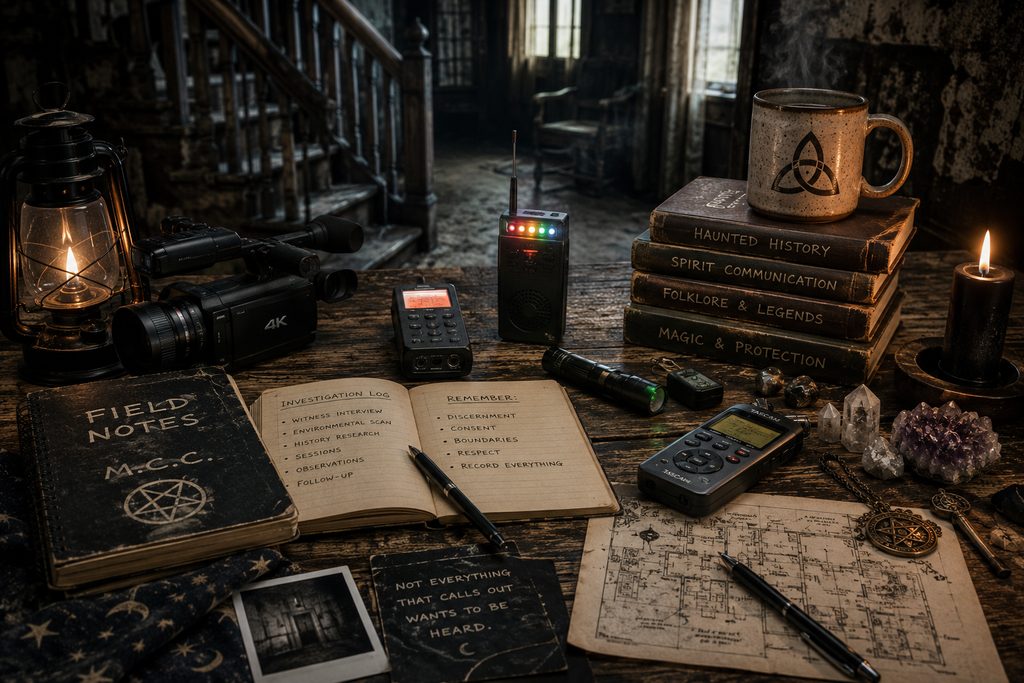
Paranormal investigation is not the primary work of My Cousin’s Coven, but it is not unfamiliar territory.
Members of MCC have participated in investigations, worked closely with mediums, contributed to podcasts and interviews, and spoken with writers and other media about witchcraft, spirit phenomena, and unusual experience. Two properties connected with our own practice have also had persistent reported haunting activity, giving us the less glamorous experience of living with unusual phenomena rather than visiting it for an evening.
That distinction matters to us.
We tend not to approach a reportedly haunted place with the expectation that something must perform before the night is over. Spirit relationship, protection, divination, mediumship, ritual, and work with place were already part of our practice before anyone unpacked an EMF meter.
When we do participate in an investigation, we value what good investigators bring: documentation, historical research, technical equipment, careful interviewing, multiple witnesses, environmental measurements, and the discipline of preserving what actually happened.
What we bring is different.
We are usually less interested in proving that mystery exists than in understanding what kind of mystery we may be standing inside.
Close enough to investigate. Close enough to be cautious.
Paranormal investigations and reportedly active locations
Mediums, investigators, writers, podcasts, and interviews
Spirit work, protection, divination, boundaries, and ritual response
Belief tempered by documentation, critical thinking, and discernment
The paranormal is not necessarily outside nature. Sometimes it is the name we give to the parts of nature and consciousness we have not yet learned how to explain.
Paranormal investigators can shine a light into that mystery. The harder question begins when we ask what the light has actually illuminated.
That is also why we tend to work well with serious investigators. We do not need them to become witches, and they do not need us to pretend ritual practice is laboratory science.
The interesting work begins when everyone at the table is capable of saying what they know, what they suspect, what their methods can actually establish, and where the mystery remains.
A Better Way to Approach the Unexplained
Unexplained experiences do not require us to choose immediately between belief and skepticism.
They require us to pay attention.
The strongest investigations usually begin with surprisingly ordinary questions: What actually happened? Who experienced it? When? Where? Was anyone else present? Has it happened before? What changed around the time it began? What ordinary conditions could produce something similar?
Only after those questions do the more interesting ones become useful.
Could the experience involve anomalous perception? Does the location have a history relevant to the reports? Are witnesses describing the same thing independently? Does a medium or practitioner obtain information that can later be verified? Does the activity respond to deliberate engagement—or to deliberate boundaries?
MCC does not believe discernment means explaining everything away. Sometimes ordinary investigation removes the mystery. Sometimes it sharpens it.
Either result is useful.
What matters is resisting the temptation to decide what happened before we have finished looking.
Begin with what happened. Earn the explanation.
A practical framework for unusual experiences, hauntings, and possible spirit encounters.
Describe what happened without naming it.
“Three knocks came from the wall” is more useful than “a ghost knocked.” Preserve the experience before attaching an explanation.
Write it down while the details are fresh.
Record time, place, witnesses, environmental conditions, equipment, photographs, audio, dreams, impressions, and anything unusual that occurred beforehand or afterward.
Look for ordinary causes seriously.
Wiring, plumbing, airflow, animals, reflections, neighbors, structural noise, sleep states, memory, expectation, and equipment behavior deserve examination before they become paranormal evidence.
Keep independent information independent.
Record witness accounts before people compare stories. Record mediumistic or intuitive impressions before providing case history whenever possible. Look for convergence without manufacturing it.
Consider several explanations at once.
Psychological, environmental, folkloric, anomalous, magical, and spirit-based interpretations do not always have to compete immediately. Ask what each explains—and what it leaves unexplained.
Determine whether contact is actually useful.
Not every presence needs communication. Not every haunting needs escalation. Sometimes observation, reassurance, boundaries, or simply leaving the situation alone is the better choice.
If you change the situation, document the change.
A boundary, cleansing, offering, banishing, communication session, environmental repair, or other intervention becomes part of the case. Note what happens afterward.
Let the conclusion change.
New evidence may strengthen a paranormal interpretation, weaken it, suggest another explanation, or leave the case genuinely unresolved. A good conclusion is allowed to move.
Do not force the mystery to become smaller than the evidence—or larger than it.
There is no contradiction in being comforted by an ordinary explanation.
There is also no failure in reaching the end of a careful investigation with something still unexplained.
For people living with the experience, the most important question may not even be whether the activity can be proven paranormal. It may be whether they feel safe in their home, whether boundaries can be established, whether something meaningful is being communicated, or whether the experience can simply be allowed to exist without taking over their lives.
If you are dealing with something ongoing and need help thinking through the details, Ask a Witch. We cannot identify every strange event from a distance, but we can help you slow the situation down, ask better questions, and consider what kind of response—if any—makes sense.
Explore the Mystery
Parapsychology is a crossroads rather than an endpoint. A haunting can lead into mediumship, folklore, psychology, spirit work, environmental investigation, or questions about survival after death. An out-of-body experience may be approached through consciousness research or magical practice. A psychic impression may raise questions about both the clairs and the ways perception can mislead us.
Follow the part of the mystery that interests you. The pages below take these subjects further without requiring every unexplained experience to have the same explanation.
Go deeper
These are the closest companion subjects to Parapsychology.
Ghosts
Apparitions, hauntings, lingering presence, place memory, spirit contact, and how witches approach the dead.
Explore GhostsMediumship
Receiving, testing, interpreting, and safely containing apparent communication with spirits and the dead.
Mediumship & Spirit ChannelingSurvival of Consciousness
NDEs, mediumship research, previous-life cases, apparitions, OBEs, and the larger question of what may survive death.
Survival of ConsciousnessSpiritualism
The religious movement that brought mediumship, séance culture, and survival claims into extraordinary public prominence.
Explore SpiritualismAstral Projection
Deliberately cultivated magical experience that overlaps with—but is not identical to—parapsychological study of OBEs.
Astral ProjectionThe Clairs
Clairvoyance, clairaudience, clairsentience, claircognizance, and the language practitioners use for unusual perception.
Explore the ClairsParanormal Tools
Equipment, recording, environmental measurement, investigation methods, and the limits of what a device can establish.
Paranormal ToolsPsychology
Perception, expectation, symbolism, altered states, cognition, and the indispensable human side of unusual experience.
Explore PsychologyFollow the research, too.
If this subject interests you seriously, read beyond paranormal media and beyond witchcraft sources. Different organizations approach anomalous experience with different assumptions, methods, and histories.
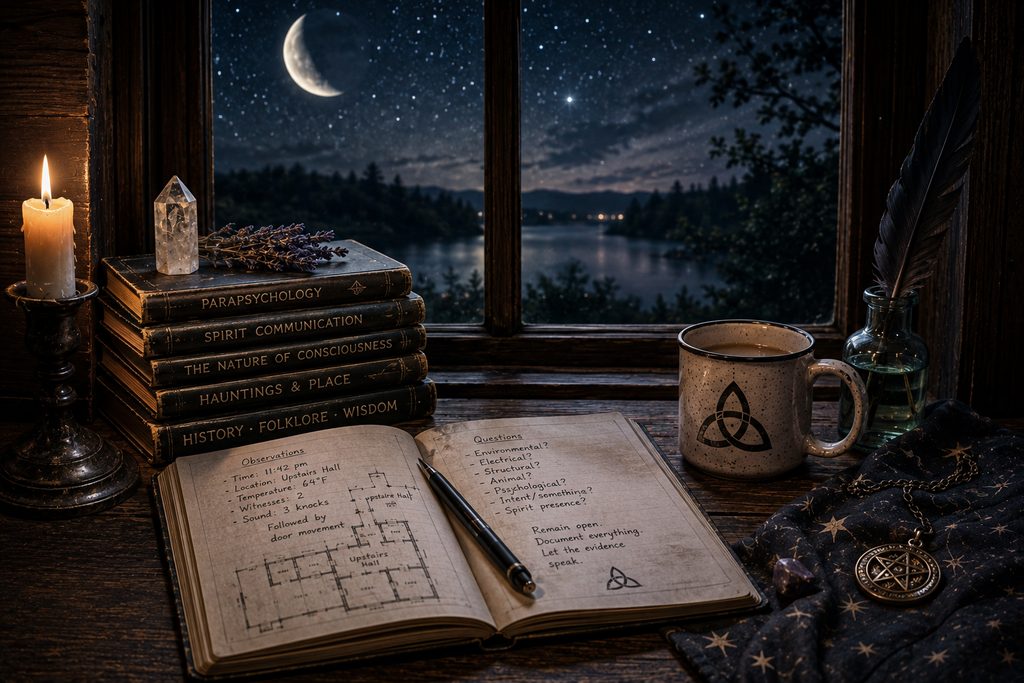
Mystery Is Still Part of Nature
Human beings have always lived beside things we could not completely explain.
Some mysteries eventually become ordinary knowledge. Others change shape as we learn more. Some remain stubbornly at the edge of what our instruments, traditions, psychology, or language can presently describe.
MCC does not think the word paranormal necessarily means outside nature.
It may simply mark the place where our current understanding of nature becomes incomplete.
That is one reason witches can be comfortable in this territory. Magic, spirit, intuition, dream, divination, altered consciousness, and relationship with the unseen already ask us to live with possibilities that cannot always be reduced to certainty. But comfort with mystery should not become permission to fill every unknown with whatever explanation we prefer.
Wonder and discernment belong together.
A ghost hunter may preserve a voice no one can explain. A psychologist may reveal how expectation changed a witness’s perception. A medium may offer information that deserves checking. A historian may uncover the story that reshaped a haunting. A witch may change the relationship with a place and discover that the activity changes with it.
Sometimes one of those approaches will explain the case.
Sometimes several will contribute pieces.
And sometimes something will remain.
“Psychical research is of all subjects the one where it is most important to keep the mind open for new interpretations of the facts.”
That is close to our own position.
We believe magic exists. We believe spirit can be real. We believe people can experience forms of intuition, sensitivity, and anomalous perception that deserve more than ridicule. We also believe every strange noise is not a ghost, every intuition is not prophecy, every difficult presence is not a demon, and every unexplained reading is not proof.
Belief should make us curious enough to look.
Experience should make us careful enough to look twice.
Mystery deserves both.
Where will you go next?
Follow the part of the mystery that calls to you, return to the wider Craft, or reach out if your question is personal. There is more than one way through the unseen.