The Occult & the Craft
How esoteric traditions shaped modern witchcraft—and how witches made them their own
Witchcraft and occultism are not the same thing, but their histories have crossed, separated, borrowed from one another, and crossed again. Modern witches inherited languages of correspondence, ritual, symbol, invocation, timing, and hidden knowledge from older esoteric currents—and then adapted those ideas into something distinctly their own.
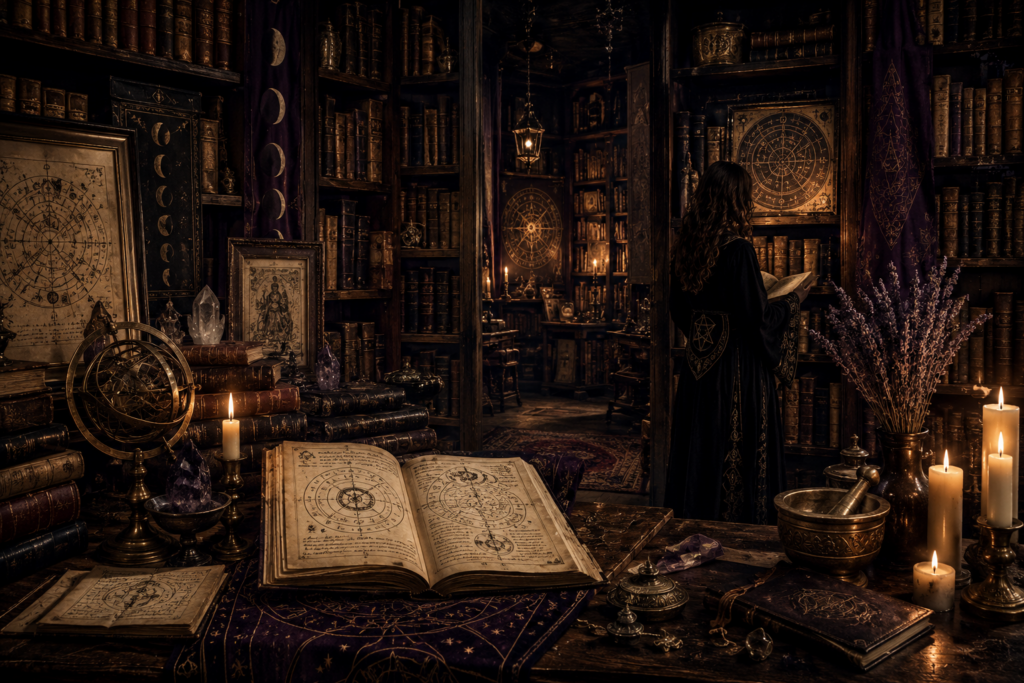
Witchcraft and occultism have never been identical, but modern witchcraft would look very different without the occult traditions that surrounded its emergence. Ideas that now feel almost ordinary to many witches—elemental correspondences, ritual circles, planetary associations, consecrated tools, invocation, symbolic alphabets, magical timing, and carefully structured ritual—did not all arise from one ancient body of witchcraft. Many entered the modern Craft through a much larger conversation involving ceremonial magic, Hermetic philosophy, grimoires, mystical systems, secret societies, folk practices, and the occult revival of the nineteenth and early twentieth centuries.
Wicca became one of the most important bridges in that exchange. Its founders and early practitioners drew from older magical and esoteric material, but they did not simply reproduce ceremonial occultism inside a new religion. They adapted it. Ritual structures were placed beside seasonal festivals, nature-centered spirituality, deity, coven practice, folklore, and an explicitly witchcraft identity. As Wicca spread, much of that shared magical vocabulary traveled with it and eventually passed well beyond Wiccan circles into the much wider world of modern witchcraft.
The influence did not move in only one direction. Occultists had long looked toward folklore, cunning traditions, magical practice, alleged witchcraft, and older ritual material for inspiration of their own. Later witches, with access to books, archives, translations, scholarship, and eventually digital collections that earlier practitioners could scarcely have imagined, began returning directly to occult source material. Some discovered that ideas they had first encountered through witchcraft books had older and considerably more complicated histories. They studied them again, questioned them, simplified some, restored others, and folded them back into living practice.
That continuing exchange helped create something close to a shared technical language across large parts of modern Western witchcraft. Not every witch uses it, and it should never be mistaken for a universal explanation of magic. Folk traditions, culturally specific practices, devotional systems, spirit traditions, and individual witches may understand magical action very differently. But terms such as correspondence, element, planetary influence, invocation, banishing, consecration, talisman, and ritual circle now allow practitioners from very different backgrounds to recognize at least some of what one another are doing.
This is why the occult belongs on My Cousin’s Coven—but also why it has limits here.
MCC is a witchcraft site, not an encyclopedia of occultism. Our interest is primarily in the places where occult history, philosophy, symbolism, and practice have shaped the Craft, where witches have reshaped them in return, and where those inherited ideas remain useful today. Readers who want to follow individual esoteric traditions more deeply will find them mapped through our Western Esoteric Traditions material, while the separate Occult Study and Occult Practice pages will carry subjects that would otherwise make this gateway far too large.
What matters here is the meeting place.
The occult gave modern witches powerful structures for thinking about unseen relationships. Witches took those structures into circles, homes, covens, gardens, seasonal rites, solitary practice, and ordinary life. Somewhere in that exchange, material once considered hidden became part of the everyday vocabulary of the modern Craft.
What “Occult” Actually Means
The word occult comes from the Latin occultus: hidden, concealed, secret, or out of ordinary sight. At its simplest, something occult is something whose nature or operation is not immediately visible. The word itself says nothing about whether that hidden thing is benevolent, dangerous, religious, magical, scientific, or imaginary.
That older meaning matters because occult has accumulated a much darker reputation in popular culture. Horror films, conspiracy theories, religious polemics, and sensational journalism have often used the word as shorthand for sinister ritual, forbidden power, or demonic activity. Those associations are part of the word’s cultural history, but they are not its definition.
Historically, people also spoke of occult qualities or occult properties: forces whose effects could be observed even when their causes were hidden or poorly understood. Over time, the occult became increasingly associated with systems concerned with hidden relationships in nature and cosmos, invisible influences, symbolic correspondences, spiritual realities, and forms of knowledge believed to lie beneath ordinary appearances.
Occultism is a somewhat narrower historical term. It is especially useful for the collection of movements, theories, and practices that developed into recognizable form during the nineteenth-century occult revival. Figures such as Éliphas Lévi, later organizations such as the Hermetic Order of the Golden Dawn, and movements including Theosophy helped gather older material—magic, Hermetic philosophy, Kabbalah, astrology, alchemy, divination, mystical speculation, and ritual systems—into new combinations suited to their own time.
That does not mean occultism suddenly appeared in the nineteenth century. Its ingredients were much older. What changed was the way those ingredients were collected, interpreted, published, systematized, and eventually presented as parts of a recognizable field.
Today, occult is often used as a broad umbrella, while scholars frequently use esotericism when discussing the larger family of historical currents that includes subjects such as Hermeticism, alchemy, astrology, Kabbalah, Rosicrucianism, ceremonial magic, Theosophy, and related movements. The terms overlap considerably, but they are not perfect synonyms—and neither one is simply another word for witchcraft.
For witches, perhaps the most useful idea preserved in the word is its oldest one: the hidden.
The relationships that are not immediately obvious. The symbolic pattern beneath the surface. The unseen influence. The meaning carried by correspondence, image, number, planet, gesture, word, or ritual structure.
Whether one believes those hidden relationships are spiritual realities, magical forces, psychological structures, symbolic languages, or some combination of these is another question entirely.
First we need to understand the territory.
Where the Craft Meets the Esoteric
Witchcraft shares borders with several neighboring fields, but none of them completely contains the others. A witch may move through several of these territories—or hardly touch some of them at all.
practice, identity, lore & living tradition Magic spellcraft • intention
ritual action • technique Occultism hidden knowledge • correspondences
symbolic & ritual systems Esotericism inner teachings • initiation
symbolic interpretation Mysticism direct encounter • revelation
ecstasy • altered consciousness
transformation • inner life
community • sacred tradition
The important point is not to place every practitioner in the “correct” circle. It is to recognize that these traditions exchange ideas while remaining distinct. Some witchcraft is religious. Some is mystical. Some is deeply occult. Some is almost entirely practical. No single neighboring field defines the whole Craft.
Three Ways Into the Hidden
Go deeper through study, practice, or the wider traditions that shaped the occult landscape.
The Occult & the Craft remains the meeting place between them.
Before Modern Occultism — Older Currents Feeding the Stream
Long before anyone spoke of occultism as a distinct field, people were already asking the questions that would eventually gather beneath that name. Could the visible world reveal an invisible order? Did planets, numbers, plants, metals, words, spirits, and human beings participate in hidden relationships? Could ritual alter those relationships—or allow a practitioner to perceive them more clearly?
There was never one ancient “occult tradition” carrying a single body of secret knowledge intact through the centuries. What eventually became Western occultism grew instead from many currents that repeatedly met, separated, disappeared from view, were translated into new languages, and were reinterpreted for new religious and intellectual worlds.
In the eastern Mediterranean of late antiquity, philosophical and religious traditions developed ways of imagining the cosmos as layered, interconnected, and alive with meaning. The writings attributed to Hermes Trismegistus combined philosophical reflection with material concerned with astrology, magic, and alchemy. Neoplatonism described reality as flowing through levels of being from a divine source, while theurgy explored ritual as a means of approaching or participating in divine realities. Gnostic movements offered still other accounts of hidden knowledge, revelation, and the human relationship to a world whose deepest nature was not immediately apparent.
These traditions were not interchangeable, and their practitioners would not necessarily have recognized themselves as members of the same “esoteric” family. That family resemblance was constructed much later. What they left behind, however, were powerful ideas that later magicians and philosophers could recover: correspondence between greater and lesser worlds, ascent through levels of reality, divine names and intelligences, the transformation of the practitioner, and the possibility that nature contained meanings invisible to ordinary perception.
Through the medieval centuries, magical knowledge moved through a complicated landscape of religion, scholarship, medicine, astrology, folklore, and translated texts. Grimoires preserved and developed ritual instructions, prayers, charms, spirit operations, protective procedures, talismans, and other forms of learned magic. Their contents did not exist neatly outside religion. Christian, Jewish, Muslim, classical, and local traditions encountered one another through translation and transmission, sometimes uneasily and sometimes creatively.
At the same time, magic was never confined to books or educated ritual specialists. Charms, healing practices, divination, protective objects, plant lore, blessings, curses, and dealings with spirits also existed in ordinary communities. Learned magic and folk practice were different worlds, but they were not sealed away from one another. Materials, symbols, prayers, stories, and techniques could move between social levels, accumulating new meanings as they traveled.
The Renaissance accelerated that exchange.
The recovery and translation of ancient philosophical material encouraged scholars to imagine that fragments of a very old wisdom might lie scattered across different traditions. Marsilio Ficino translated the Corpus Hermeticum into Latin and worked within a world where philosophy, astrology, medicine, religion, and natural magic could still participate in the same search for cosmic order. Giovanni Pico della Mirandola incorporated Jewish Kabbalah into a Christian philosophical project, helping create what later became known as Christian Cabala.
Magicians such as Heinrich Cornelius Agrippa attempted something witches today may find surprisingly familiar: collecting an enormous range of correspondences into a workable magical cosmos. Planets, elements, numbers, plants, stones, animals, divine names, spirits, music, and human faculties could all be understood as parts of an interconnected structure. John Dee likewise moved through mathematics, astrology, navigation, theology, angelic communication, and natural philosophy without drawing the hard boundaries between “science,” “religion,” and “magic” that later centuries would impose.
Alchemy added another enduring language: transformation. Its laboratories dealt with matter, but its imagery could also become philosophical, religious, and eventually psychological. Purification, dissolution, conjunction, death, rebirth, and the perfection of substance created a symbolic vocabulary that occultists—and much later witches—would repeatedly reinterpret.
None of these people were practicing modern witchcraft. Nor should medieval grimoires, Renaissance magicians, Kabbalists, alchemists, village healers, and ancient philosophers be folded together and retroactively called witches simply because modern witches recognize parts of their work.
The connection is more interesting than that.
They created, preserved, argued over, translated, and reinvented pieces of a magical vocabulary: correspondence, planetary influence, ritual preparation, sacred names, talismans, spirits, elements, cosmic sympathy, transformation, and the belief that visible things may participate in relationships that are not immediately visible.
Centuries later, occult revivalists would gather many of those scattered pieces and attempt to arrange them into increasingly systematic forms.
And eventually, modern witches would inherit part of that arrangement.
The Occult Revival — Orders, Publishing & New Systems
By the nineteenth century, many of the older streams we have just followed—Hermetic philosophy, ritual magic, astrology, alchemy, Rosicrucian ideas, Freemasonry, mystical Christianity, spirit communication, and newly translated religious material—were being gathered into something recognizably modern.
This was not simply a return to the past. It was a period of reconstruction and invention.
The nineteenth-century occult revival developed in a world being transformed by industrialization, new sciences, expanding literacy, mass publishing, colonial contact, religious doubt, and fascination with phenomena that seemed to sit just beyond the boundaries of accepted explanation. Romanticism had already encouraged renewed interest in mystery and the unseen, while Spiritualism brought séances, mediumship, trance, and communication with the dead into parlors and public halls rather than leaving such questions solely to churches or learned magicians.
At the same time, occult writers began reorganizing older magical material into increasingly coherent systems.
One of the most influential was Éliphas Lévi, whose nineteenth-century writings helped reframe ritual magic for a new audience. Lévi connected magic with Tarot, Kabbalah, ceremonial symbolism, will, initiation, and a grand vision of correspondences linking the human being to the cosmos. His work did not preserve an untouched ancient system; it was a creative synthesis. That synthesis would influence generations of later occultists.
What changed just as importantly was how occult knowledge circulated.
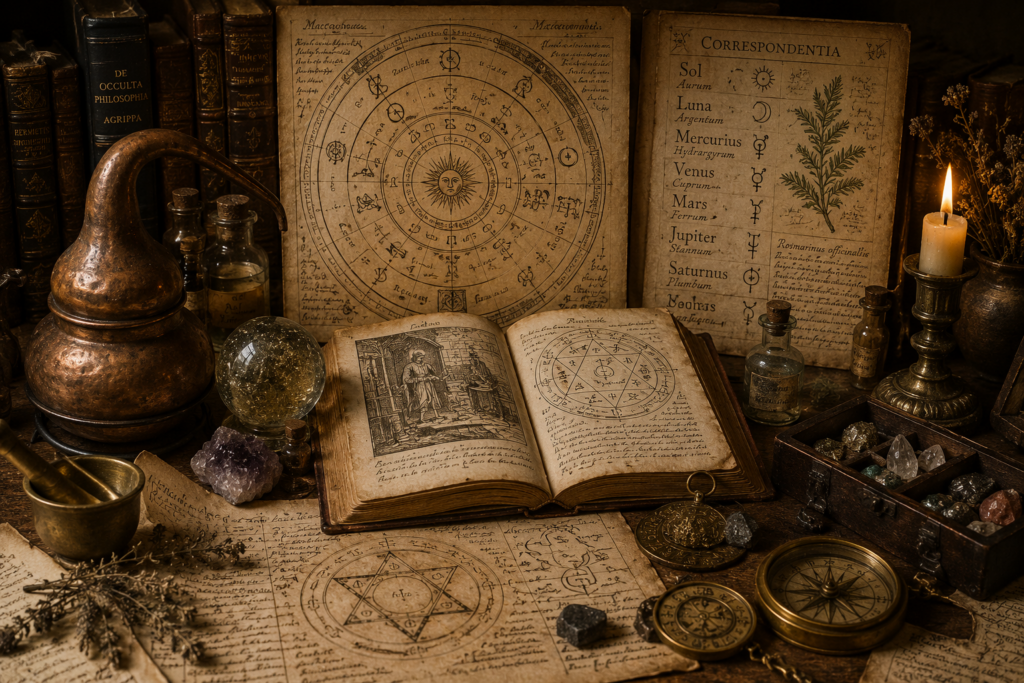
Printed books, occult journals, correspondence networks, lectures, lodges, reading societies, and mail-order materials allowed ideas once confined to scattered manuscripts, private collections, initiatory circles, or specialized scholars to move much farther and faster. A person no longer needed access to a monastery library or a private grimoire collection to encounter ritual magic. Increasingly, one could buy a book.
That change may sound ordinary now, but it was profound. The occult was becoming not merely a collection of hidden subjects, but a field that could be studied.
Organizations gave that field social structure. The Theosophical Society, founded in 1875, helped internationalize esoteric discussion and brought Western occult thought into complicated conversation with Hindu, Buddhist, and other Asian religious ideas. Freemasonry and Rosicrucian currents provided models of initiation, degrees, symbolism, secrecy, and organized fraternity. French occultists developed their own networks and schools. Across Britain, continental Europe, and the United States, people increasingly encountered occultism as something one could join, read, debate, practice, and identify with.
The Hermetic Order of the Golden Dawn became one of the most consequential examples.
Founded in Britain in the late nineteenth century, the Golden Dawn assembled material from Hermeticism, Kabbalah, astrology, alchemy, Tarot, elemental symbolism, ritual magic, Rosicrucianism, and other sources into a graded initiatory system. Instead of leaving ritual magic primarily as the work of isolated individuals, it placed magical training inside an organized order with lessons, grades, ceremonies, correspondences, and increasingly sophisticated ritual practice.
For modern witches, that organizational achievement matters enormously.
A great deal of what later feels like a tidy magical “system”—elements assigned to directions, colors associated with forces, planetary and zodiacal correspondences, carefully ordered ritual sequences, symbolic weapons and tools, banishing procedures, invocations, graded training, and tables showing how one symbol relates to another—was preserved, reorganized, or elaborated in this kind of occult environment.
The systems were not ancient in the form in which nineteenth-century occultists presented them. They were constructed from older materials. That distinction is important.
Occult orders frequently spoke the language of ancient wisdom, secret lineages, hidden masters, recovered traditions, and teachings passed down from remote antiquity. Sometimes genuine older material lay beneath those claims. Sometimes the lineage was heavily reconstructed, symbolically interpreted, or simply impossible to verify. The nineteenth-century occult revival was remarkably productive, but it was also a culture fascinated by antiquity and willing to fill historical gaps with imaginative certainty.
That does not make its accomplishments insignificant. If anything, it helps us understand them more clearly.
The occult revival turned scattered traditions into curricula. It turned symbols into comparative systems. It turned private magical experiments into organized training. It produced books, diagrams, tables, rituals, and initiatory structures that later practitioners could actually inherit.
And its influence did not end when particular orders fractured.
Golden Dawn material traveled outward through former members and successor organizations. Aleister Crowley developed Thelema from a world deeply shaped by ceremonial occultism. Other writers carried occult ritual into new organizations, private study groups, books, correspondence courses, and eventually the wider magical revival of the twentieth century.
By then, the conditions were in place for a particularly important meeting. Occultism had built an elaborate ritual vocabulary. Modern witchcraft was about to make extensive use of it.
Orders & Movements That Shaped the Landscape
Modern occultism was carried not only through books, but through lodges, societies, initiatory schools, correspondence courses, and networks of practitioners. These are some of the currents most useful for understanding how that material eventually reached modern witchcraft.
This is a map of influence, not a single lineage. Some entries are formal organizations; others are broader movements whose ideas were inherited by later orders.
| Order or Current | Period | What It Carried | Why It Matters to the Craft |
|---|---|---|---|
| Rosicrucianism Movement rather than one historical order | Early 1600s onward | Hidden fraternity, spiritual reform, alchemy, Hermetic imagery, initiation, and the ideal of an unseen body preserving wisdom. | Rosicrucian mythology strongly influenced later esoteric orders, especially the Golden Dawn, helping establish the model of secret teaching revealed through graded initiation. |
| Freemasonry & Esoteric Masonry Not all Freemasonry is occult | 1700s onward | Lodge organization, degrees, initiatory drama, symbolic tools, passwords, ritual offices, and structured progression. | Its organizational vocabulary became a major model for later occult orders. The influence on witchcraft is mostly indirect, arriving through those later esoteric systems. |
| The Theosophical Society | Founded 1875 | Comparative religion, reincarnation, spiritual evolution, occult cosmology, and extensive—sometimes problematic— reinterpretation of Asian religious ideas. | Theosophy helped make esotericism international and popular, influencing later occultism, alternative spirituality, and the language in which many twentieth-century seekers discussed unseen reality. |
| Hermetic Order of the Golden Dawn | Founded 1888 | Hermeticism, Qabalah, Tarot, astrology, alchemy, elemental ritual, ceremonial magic, correspondences, and graded magical training. | One of the most important sources for the ritual grammar later encountered in modern witchcraft: elements, directions, correspondences, ritual tools, banishing and invoking structures, and a systematic approach to magical training. |
| A∴A∴ Crowley and George Cecil Jones | Established 1907 | Individual magical attainment, mysticism, disciplined practice, Golden Dawn-derived grades, yoga, ceremonial magic, and the developing system of Thelema. | Its importance is largely through Crowley’s writings and the wider Thelemic current, which later became one of the occult sources encountered by the founders of modern Wicca. |
| Ordo Templi Orientis — O.T.O. | Early 1900s onward | Initiatory fraternity, Masonic-derived structure, ceremonial ritual, Gnostic liturgy, sexual esotericism, and eventually Thelema. | O.T.O. became an important vehicle for Crowley’s religious and magical ideas. Its relevance to witchcraft lies primarily in the wider Crowley–Gardner–Wicca exchange rather than direct institutional descent. |
| Society of the Inner Light Founded by Dion Fortune | Founded 1924 | Qabalah, ritual magic, psychology, mysticism, psychic development, inner-plane work, and a distinctly British Western Mystery tradition. | Dion Fortune became one of the most widely read bridges between ceremonial occultism, psychology, nature-oriented spirituality, and ideas later familiar within modern Pagan and witchcraft communities. |
| Builders of the Adytum — B.O.T.A. Associated with Paul Foster Case | 20th century | Tarot, Qabalah, Hermetic symbolism, meditation, alchemy, and correspondence-based occult study presented through structured lessons. | Less directly influential on Wicca than the Golden Dawn or Crowley, but representative of the way lodge material became teachable, portable, and accessible beyond the older initiatory temple. |
The names changed, the organizations divided, and the teachings were repeatedly rewritten—but the material kept moving.
The Great Bridge — Wicca Meets the Occult
By the middle of the twentieth century, occultists had spent generations collecting, comparing, and systematizing magical material. Ritual orders had developed elaborate correspondences, initiatory structures, ceremonial tools, invocations, banishings, planetary systems, and methods for moving deliberately through sacred space.
Then something important happened.
Those structures met a religion calling itself witchcraft.
Wicca was not simply ceremonial magic renamed, nor was it an untouched survival of one ancient witch religion. It emerged from a much more complicated meeting of older folklore, Pagan imagination, ritual magic, nature religion, contemporary occultism, and the particular interests and experiences of its early practitioners. Recent scholarship describes Gerald Gardner as creating a genuinely new synthesis from both Western and non-Western magical and religious influences.
Gardner was unusually well positioned to make that synthesis. Before Wicca emerged publicly, he had read widely in religion and occultism and had experience with Freemasonry, Spiritualism, and other esoteric environments. He did not approach witchcraft from outside the occult revival; he was already moving within the world it had created.
That helps explain why early Wicca could feel simultaneously old and strikingly modern.
Its identity reached toward folklore, the imagined witches of earlier centuries, seasonal rites, the land, the Goddess and Horned God, and the idea of a surviving or revived Craft. Yet its ritual language could sound much more like the Western magical revival: circles were deliberately constructed; directions and elements mattered; tools were consecrated and given symbolic functions; invocation had structure; ritual words and gestures were ordered; initiation transmitted knowledge; and correspondences helped organize the magical world.
One of the clearest occult connections runs through Aleister Crowley. Gardner knew Crowley personally late in Crowley’s life, and Crowley’s writings supplied material that appears in the early development of Gardnerian ritual. Historian Ronald Hutton has shown that Gardner drew heavily on Crowley during Wicca’s formative period, while also emphasizing that this dependence diminished as the tradition developed its own voice.
That distinction matters.
Crowley did not “invent Wicca,” and Wicca cannot be reduced to Thelema in different clothing. Crowley was one contributor within a much wider mixture. The ceremonial world that influenced Gardner already contained Golden Dawn material, Hermetic correspondences, Qabalistic structures, Masonic forms, ritual magic, mystical literature, and several generations of occult experimentation.
Wicca absorbed pieces of that world and changed their setting.
A correspondence table studied in an occult lodge could now become part of a witch’s working knowledge. Elemental symbolism could move into a coven circle. Ritual tools could stand beside seasonal celebration and deity devotion. Invocation could belong not only to ceremonial attainment but to a religious encounter with Goddess and God. Magical training could be carried through initiation into a community that understood itself explicitly as a coven of witches.
And Wicca continued changing from within.
Doreen Valiente became one of the most important voices in that process. A gifted poet and practitioner as well as an initiate, she helped give early Wiccan liturgy a language that felt increasingly like the Craft itself rather than simply a collection of inherited occult fragments. Her influence extended far beyond one coven, and her writing helped shape how later generations encountered Wicca and modern witchcraft.
From a practitioner’s point of view, this is where the historical argument becomes especially interesting.
Whether a witch understands Wicca as revival, reconstruction, inspired continuation, new religious movement, or some mixture of these, its practical effect on modern witchcraft is difficult to miss. Wicca took a large amount of previously specialized magical vocabulary and placed it inside a repeatable witchcraft framework.
The occult lodge was no longer the only obvious home for structured ritual magic. The coven could be one too.
As Wicca spread through Britain and then internationally, its ritual forms traveled with it. Gardner publicly promoted the new witch religion during the 1950s, and subsequent initiates established additional covens in Britain and abroad; Gardnerian Wicca became a foundational model for the broader Wiccan movement.
Eventually, much of that language traveled even farther than Wicca itself. Witches who had never joined a Gardnerian coven—and in many cases never considered themselves Wiccan at all—could still encounter circles, elements, quarters, correspondences, ritual tools, planetary timing, invocation, consecration, and other ideas that had passed through the same twentieth-century magical environment.
This does not mean that all modern witchcraft descends from Wicca. It does not. Folk traditions continued alongside it, other forms of witchcraft developed independently or in reaction to it, and culturally specific magical systems have their own histories that should not be folded into a Wiccan family tree.
But across a large part of modern Western witchcraft, Wicca became an extraordinarily effective carrier. It took specialized occult language and helped make it portable.
That is why Wicca matters so much to the story of occultism and the Craft—not because it merely copied occultism, but because it translated parts of the occult world into a form witches could inhabit, practice, adapt, argue with, and eventually carry in directions its original occult sources could never have predicted.
A Two-Way Street — What Witchcraft Took, and What Witches Changed
It would be easy to tell this story as a one-way inheritance: occultists developed elaborate magical systems, Wicca borrowed them, and modern witches inherited the result.
The history is messier—and more interesting.
Occultists had already been looking toward witchcraft, folklore, popular magic, trance, spirits, and older accounts of magical practice long before Wicca appeared. The nineteenth-century occult revival did not simply preserve learned ceremonial magic; it also participated in reshaping the modern cultural idea of the witch. Victorian occultists studied older magical beliefs, experimented with ritual, and helped reinterpret witchcraft for an age already fascinated by Spiritualism, hidden forces, folklore, and the possibility that supposedly discarded forms of magic still contained something worth investigating.
So when modern witchcraft emerged, occultism had already spent decades reaching outward.
Then the direction changed.
Wicca drew heavily from the magical environment around it, but once that material entered the Craft it acquired a different life. A ceremonial correspondence was no longer necessarily something memorized for advancement through an occult grade. It might become the reason a witch chooses a particular herb, candle, direction, planetary hour, or ritual tool. An elemental invocation developed within ceremonial magic might become part of opening a coven circle. An occult diagram might be simplified into a working pattern that could be remembered and used outside a lodge.
The structure survived, but the setting changed. That mattered enormously.
Occult orders had often organized magical knowledge through grades, formal initiation, specialized texts, complicated tables of correspondence, and highly structured ritual. Witchcraft could carry much of the same underlying logic into a more intimate environment: the coven room, the kitchen table, the garden, the woods, a seasonal rite, or eventually the solitary practitioner’s altar.
Wicca was especially effective at making that translation because it combined occult structure with a religious and magical life that could be repeated through the year. Ritual was not only an exercise in attainment. It could celebrate a Sabbat, honor a deity, mark a moon, bless a tool, initiate a witch, protect a space, or work toward a practical change. Scholars increasingly describe Gardner’s Wicca not as a preserved ancient system but as a new and adaptable synthesis drawn from several sources, including the Western occult world in which Gardner had already immersed himself.
And witches did not preserve everything they inherited. We simplified, rearranged, renamed, combined, discarded, and reinterpreted.
Some ceremonial structures became shorter. Dense Qabalistic or astrological explanations might survive only as a practical correspondence. Ritual language could become more poetic and nature-centered. Techniques originally framed around spiritual attainment might be turned toward protection, healing, divination, prosperity, or devotional practice. Material designed for a lodge could become something performed by a small coven—or by one witch alone.
At the same time, witchcraft added things occult ceremonial systems did not supply on their own: a strong identity built around the figure of the witch, seasonal Pagan religion, folklore, land and nature symbolism, domestic and practical magic, Goddess-centered theology in many traditions, and eventually an enormous range of eclectic and culturally distinct approaches.
This was not simply occultism made easier. It became something else.
Then the exchange turned again.
As occult books became easier to obtain, archives and translations expanded, and later digital collections placed historical material within reach of ordinary practitioners, witches could increasingly move backward through their own inherited vocabulary. A witch who first learned planetary correspondences from a modern spell book could later encounter Agrippa. Someone who learned ceremonial banishing secondhand could eventually study the Golden Dawn material from which later versions developed. A practitioner who first met Thelemic phrases through Wiccan history could go directly to Thelema and discover how different its original context actually was.
The growth of publishing was already crucial to the occult revival itself, widening access to material that had once circulated among much narrower audiences. That same process of expanding access continued into the twentieth century and beyond.
This produced a curious feedback loop.
Occultism helped systematize magical material. Wicca helped carry parts of that system into modern witchcraft. Modern witchcraft spread and adapted it. Later witches returned to the occult sources and sometimes brought more detailed versions back into the Craft.
That is one reason contemporary witchcraft can feel both remarkably eclectic and strangely familiar across traditions. Two witches may disagree completely about theology, spirits, ethics, or what magic ultimately is, yet both recognize the language of elements, correspondences, planets, circles, invocation, consecration, and magical timing.
That language is not universal, and it is not the property of one tradition. Much of it has traveled too widely, changed too often, and accumulated too many meanings for that.
But it gave large parts of modern Western witchcraft something extremely useful: a shared vocabulary for talking about magical relationships that otherwise might be difficult to describe.
And witches did what witches have always tended to do with useful things. They made it their own.
What Witches Changed
When occult structures entered modern witchcraft, witches did not simply preserve them. They changed their purpose, scale, atmosphere, and center of gravity.
One of the largest changes was purpose. Ceremonial systems often organized practice around initiation, progressive training, mystical attainment, and mastery of increasingly complex symbolic systems. Witchcraft could use some of the same tools for very different ends: celebrating the seasons, honoring gods, blessing a home, protecting a family, healing, divining, working practical magic, or simply maintaining an ongoing relationship with the sacred.
The same ritual language became more intimate.
A formal temple became a coven circle, a living room, a garden, or a clearing in the woods. Elaborate ceremonial structures could be shortened, rearranged, or translated into forms that made sense for a small group. Contemporary Wiccan ritual still commonly works with the circle and the four directions, but actual covens have long adapted how those structures are marked and performed to suit their own spaces and creativity.
Eventually, even the coven ceased to be necessary for many practitioners. Modern Paganism and witchcraft developed a substantial culture of solitary practice, allowing people to learn, improvise, and construct personal forms of ritual outside initiatory groups. Research on contemporary Pagan communities identifies the growth of solitary practice as a major feature of the modern movement.
That changed authority as well.
Traditional initiatory Wicca continued to value lineage, training, and coven transmission—and still does. But alongside it grew forms of witchcraft in which books, personal experience, informal teachers, community exchange, experimentation, and eventually online access became legitimate ways of learning. Modern Paganism consequently developed into an unusually diverse field: some traditions remain highly structured and lineage-conscious, while others are spontaneous, egalitarian, eclectic, or entirely solitary.
Witches also shifted the center of magical attention.
The occult lodge had often looked upward and inward: toward initiation, cosmic hierarchy, spiritual attainment, hidden knowledge, and mastery of symbolic systems. Much modern witchcraft placed those systems alongside the turning seasons, land, moon, body, household, deity, fertility, ecology, and community. Gardner’s original synthesis was itself unusually mutable and nature-centered, and later forms of witchcraft expanded that quality considerably.
The transformation became even more pronounced as feminist and Goddess-centered witchcraft developed during the later twentieth century. Practitioners such as Zsuzsanna Budapest and Starhawk helped move some forms of witchcraft toward women’s spiritual authority, Goddess theology, political engagement, ecological concern, healing, and more participatory ritual. These movements did not simply inherit nineteenth-century occultism; they used parts of the magical vocabulary they had received to construct very different religious and social worlds.
Even the word witch changed.
Earlier occultists could practice elaborate magic without identifying themselves as witches at all. Modern religious witchcraft reclaimed a word that Western culture had overwhelmingly associated with accusation, danger, superstition, and diabolism and made it into a chosen religious and magical identity. Historians of modern witchcraft describe that reclamation as one of the conditions that made contemporary religious witchcraft possible.
And perhaps most importantly for practice, witches tended to ask a very practical question of inherited occult material: Does this help us do the work?
A correspondence did not always need an elaborate philosophical defense if it consistently helped construct ritual meaning. A planetary association could be remembered through a candle color. A ceremonial tool could become part of a personal altar. An invocation could become poetry. An elemental structure could become the bones of a circle. What had once required specialized study could sometimes be reduced to a pattern a practitioner could carry in memory and use with confidence.
There is a cost to that process. Simplification can remove context. Symbols can become detached from the traditions that produced them. Later witches sometimes inherit rules without knowing who created them, or repeat correspondences as though they were ancient and universal when they are actually the product of a particular occult school. That is one reason returning to the sources can be so valuable.
But adaptation is not necessarily corruption. It is one of the ways living traditions remain alive. Modern witchcraft did not simply receive an occult system. Witches selected from it, argued with it, embodied it, made it seasonal, made it domestic, made it devotional, made it solitary, made it communal—and sometimes discarded it altogether.
Occultism supplied part of the grammar.
Witches changed the way it was spoken.
Occult Study & Occult Practice — Where the Roads Divide
By this point, two different ways of approaching the occult begin to emerge.
The first is study.
A witch may want to know where a correspondence came from, why a particular symbol appears in several traditions, how the Golden Dawn organized its magical system, what Hermetic writers actually taught, or how later occultists reinterpreted Kabbalah, astrology, alchemy, Tarot, and ceremonial magic. None of that requires adopting an occult identity or performing every practice being studied.
Our Occult Study page will follow that road: history, source texts, important thinkers, competing interpretations, symbolic systems, and ways of reading occult material without treating every claim of ancient lineage or secret wisdom as established fact.
The second road is practice.
Occult ideas have also produced practical techniques: ritual preparation, consecration, correspondences, planetary timing, invocation, banishing, talismanic work, altered states, symbolic construction, and methods for deliberately structuring magical space. Many of these already have close relatives—or direct descendants—within modern witchcraft.
Occult Practice will explore those points of contact. It is not intended to turn MCC into a training school for every ceremonial or initiatory system. Its purpose is to show where occult technique intersects with the Craft, what witches have inherited or adapted, and when a subject is better followed into one of our existing practice pages.
There is also a third route for readers who want to understand the traditions themselves. Western Esoteric Traditions maps the larger landscape—Hermeticism, Kabbalah, ceremonial magic, Thelema, alchemy, Rosicrucian currents, Gnosticism, Neoplatonism, and other traditions that contributed to the world we now call Western esotericism.
The distinction is useful:
Occult Study asks, “Where did this come from, and what does it mean?”
Occult Practice asks, “How has this been used, and where does it meet witchcraft?”
Western Esoteric Traditions asks, “What are the traditions and systems themselves?”
The main Occult page remains where those roads meet the Craft.
Where Do You Want to Go Next?
The Occult & the Craft is the crossroads. From here, follow the part of the subject you actually want to explore.
Follow the history, texts, thinkers, symbols, and sources.
Explore techniques and where they overlap with witchcraft.
Meet the larger schools, movements, and philosophies themselves.
You do not need to follow all three roads. Study can remain study, practice can remain practical, and a witch can borrow from occult traditions without adopting an occult identity.
The Occult Eye — Art, Symbol & Hidden Knowledge
Occult knowledge has never traveled only through words.
Sometimes the image is part of the teaching.
Astrological wheels, alchemical emblems, magical seals, Kabbalistic diagrams, planetary figures, Tarot cards, sacred geometry, illuminated manuscripts, ritual drawings, and visionary paintings can hold several layers of meaning at once. A written paragraph usually moves in a line. An image allows relationships to appear simultaneously: above and below, center and circumference, color and number, human and divine, death and transformation.
That made visual art particularly suited to traditions built around correspondence.
An alchemical image could place king and queen, Sun and Moon, vessel and fire into one composition rather than explain their relationships separately. A magical diagram could show where names, planets, elements, or spiritual powers belonged in relation to one another. A symbol could become something to contemplate, remember, reproduce, wear, place upon an altar, or eventually use in ritual.
The image was not always merely an illustration of occult thought. Sometimes it was a way of thinking occultly.
The visionary poet and artist William Blake is an especially powerful example, although it would be too simple to label him merely an “occultist.” Blake created his own extraordinary religious and mythological universe and claimed visionary encounters throughout his life. In works such as The Marriage of Heaven and Hell, The Ancient of Days, and The Ghost of a Flea, poetry, engraving, mythology, theology, and vision become almost impossible to separate. His images do not simply decorate his ideas; they are part of the language through which those ideas exist. Tate describes Blake as a poet and artist of mystical themes whose work grew from a distinctive visionary imagination.
Later occult artists could make that connection even more explicit.
Pamela Colman Smith may have transmitted more occult imagery into everyday modern witchcraft than almost any other artist. A member of the Golden Dawn milieu, Smith was commissioned by Arthur Edward Waite in 1909 to illustrate what became the Rider–Waite–Smith Tarot. Her great innovation was not simply drawing attractive cards. She gave the Minor Arcana fully developed narrative scenes, allowing symbolic relationships to be read visually across the entire deck. The Morgan Library describes her work as merging folklore and occult traditions, while the Whitney notes how the deck created a visual vocabulary drawing heavily upon occult magic.
That imagery became astonishingly portable.
A person who has never read a Golden Dawn paper, studied ceremonial Qabalah, or opened a nineteenth-century occult text may still recognize The Magician standing before the four suit symbols, The High Priestess between pillars, The Wheel, The Devil, Death, the Star, and dozens of other visual arrangements descended from that occult environment.
Art carried the system farther than the lodge could.
Tarot is also a useful reminder that occult traditions often reinterpret existing objects rather than simply inventing them. European Tarot began as a card game centuries before modern occultists constructed elaborate esoteric meanings around it. Later practitioners transformed the cards into a dense visual language of divination, correspondence, spiritual development, and magical symbolism. Today, Tarot sits so comfortably inside modern witchcraft that its complicated journey can easily disappear from view.
Other artists pushed the relationship between image and occult practice in still different directions.
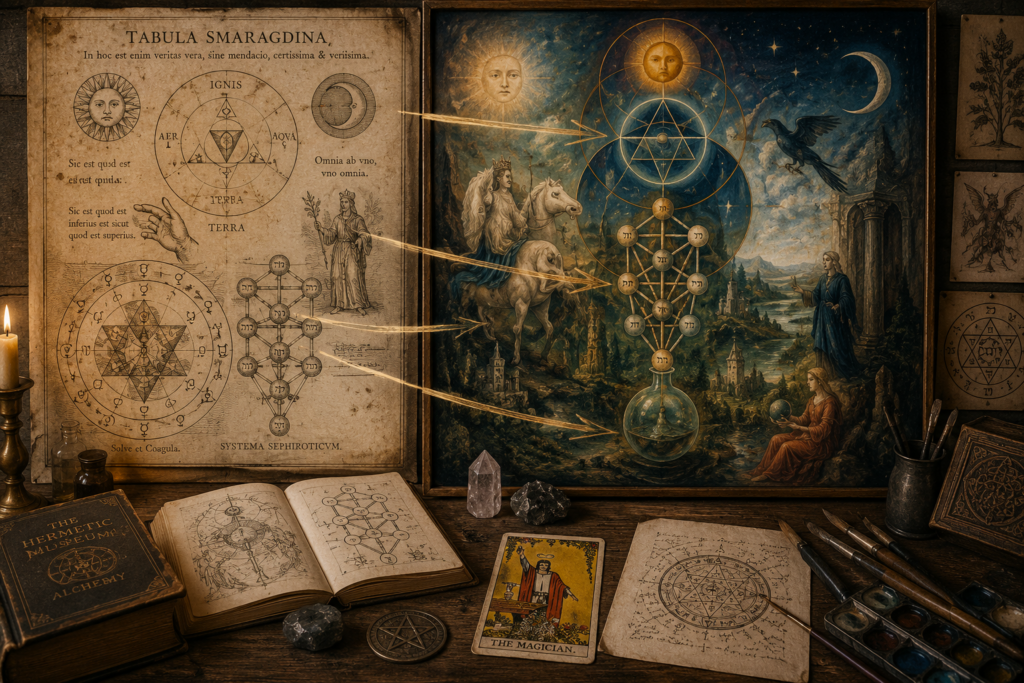
British artist, writer, and occultist Ithell Colquhoun explored alchemy, Kabbalah, automatic techniques, psychic imagery, and forms she called “psychomorphologies.” Her Tree of Veins deliberately combines imagery from the Kabbalistic Tree of Life with the alchemical Tree of the Philosophers. For Colquhoun, occult systems were not simply subjects to paint; they provided structures through which art itself could become exploratory and transformative.
Leonora Carrington similarly filled her work with alchemical transformation, mythological creatures, ritual gatherings, magical kitchens, hybrid beings, and symbolic landscapes. Her art drew from mythology, alchemy, Gnosticism, folklore, and the strange logic of dream without turning those sources into a neat doctrinal system. Her official museum describes a creative world populated by symbolic beings moving between the individual and the cosmos, nourished by her extensive reading in mythology, alchemy, and Gnosticism.
This visual current matters enormously to witches.
Modern witchcraft is filled with things meant to be seen: pentacles, sigils, planetary seals, altar arrangements, Tarot spreads, elemental symbols, lunar diagrams, deity images, magical alphabets, ritual jewelry, sacred geometry, colors, herbs arranged by correspondence, and circles drawn upon the ground.
Some of those forms carry direct occult ancestry. Others are newer creations using the same principle: that an image can gather relationships together until the practitioner does not merely read an idea but encounters it as a pattern.
That is why occult art deserves to be treated as more than decoration around occult history.
Books carried teachings. Orders carried initiations. Practitioners carried techniques. Images carried worlds.
Art Is Part of the Archive
Paintings, Tarot, film, fiction, diagrams, symbols, and visual culture can preserve magical ideas just as surely as books do. Follow that thread into MCC’s wider resources for studying art, story, and media as part of the magical record.
Secrecy, Initiation & the Opening of Hidden Knowledge
The word occult begins with hiddenness, so it is hardly surprising that secrecy became one of the recurring structures of occult life.
For centuries, magical and esoteric knowledge could be difficult to obtain for very practical reasons. Manuscripts were rare. Literacy was limited. Books were expensive. Some teachings circulated among particular religious, scholarly, familial, professional, or initiatory communities. In other cases, practitioners deliberately restricted material because they considered it sacred, dangerous, easily misunderstood, or meaningful only after a student had received the preparation necessary to use it.
Those are different kinds of secrecy, and it is useful not to collapse them together.
Sometimes secrecy protects a rite. An initiation whose words, symbols, and sequence are unknown beforehand can create an experience that would be fundamentally altered if every detail had already been read online.
Sometimes secrecy protects privacy and trust. A coven, lodge, or working group may reasonably decide that what happens inside its ritual space belongs to its members.
Sometimes knowledge is withheld because teaching is progressive. A student learns one structure before being given another, not necessarily because the later material is forbidden forever, but because it makes more sense after the earlier work has been understood.
And sometimes the “secret” is not entirely something that can be written down. Initiatory and mystical traditions have often distinguished between information someone can be told and an experience that must be undergone. Scholarship on esotericism points out that secrecy is not simply about concealed facts; it also functions socially, experientially, and through the way knowledge is transmitted.
But secrecy also creates power.
The person who possesses hidden knowledge can decide who receives it, when they receive it, and whether they are considered ready. Orders can build authority around grades, initiations, inaccessible archives, secret chiefs, private teachings, and claims that outsiders simply cannot understand what insiders know. The very announcement that a secret exists can increase its value even when its contents remain concealed. Historian Hugh Urban has described this paradox particularly well in modern Theosophy: hidden knowledge could be publicly advertised precisely because its secrecy made it desirable.
That does not make initiatory secrecy inherently dishonest. It does mean that “I know something you are not permitted to know” should never be treated as proof that the speaker is correct. The nineteenth-century occult revival began changing this old economy of access.
Groups still initiated members and maintained private material, but publishing increasingly carried esoteric ideas beyond the lodge. The Theosophical Society, for example, combined lodges and esoteric teaching with an energetic public publishing culture of books, magazines, pamphlets, lectures, and classes. Cambridge scholarship describes Theosophy as helping move esoteric ideas toward the visible margins of mainstream culture through precisely these networks of public dissemination.
Occult writers discovered that even fiction could transmit what orders had traditionally guarded.
Dion Fortune, herself an initiatory occultist, deliberately used novels such as The Sea Priestess and The Goat-Foot God to communicate esoteric ideas to readers who might never enter an occult lodge. Recent scholarship describes her fiction as an attempt to democratize occult knowledge and create something approaching initiation through image, story, and psychological identification.
That development has an obvious connection to the story of modern witchcraft.
Traditional initiatory Wicca retained oathbound material, degrees, coven transmission, and the idea that some things properly belonged inside initiation. Yet Wicca also emerged into an age of mass publishing. Books about witchcraft multiplied, public Pagan communities formed, and people increasingly encountered the Craft without first knowing an initiated witch.
Eventually, books did something that would have been difficult to imagine in an earlier initiatory economy: they allowed people to teach themselves enough to begin practicing.
Raymond Buckland was especially important in that change in the United States. He explicitly described his goal as finding a way to teach people who might live hundreds of miles from another practitioner. His Buckland’s Complete Book of Witchcraft, first published in 1986, was structured as a self-study course and included material for both covens and solitary witches. Buckland himself said the book was intended to provide what someone needed to practice the Craft even without access to an established group.
That was part of a much larger shift. Publishers such as Llewellyn helped make Wicca, witchcraft, occultism, divination, astrology, and related subjects available in ordinary bookstores, and works aimed specifically at solitary practitioners became major pathways into the Craft. By the late twentieth century, one no longer necessarily needed a lodge, coven, private teacher, or inherited manuscript to begin learning magical practice.
Then the internet accelerated the process beyond anything print had done.
Texts that once required travel to specialized libraries can now appear in digital archives. Scans of old grimoires, translations, lodge documents, correspondence tables, magical diagrams, historical scholarship, and competing interpretations can be compared from a kitchen table. A witch can encounter an idea in a modern spell book in the morning and, by evening, be reading a digitized version of a source several centuries older.
That accessibility is an extraordinary gift. It also creates a new problem. Access is not the same thing as understanding.
A ritual removed from its initiatory sequence may lose part of its purpose. A symbol detached from its historical system can be given meanings its creators never intended. A fragment copied repeatedly across websites can eventually look ancient simply because nobody remembers where it came from. Material that once required years of context can now be encountered in fifteen seconds by someone who does not yet know what questions to ask.
The answer is not to put everything back behind locked doors. Nor is it to assume that everything called “secret” deserves reverence. The better inheritance is to preserve the distinction between access and readiness.
Read widely. Compare versions. Learn where material came from. Respect genuinely oathbound traditions when you encounter them. Understand that a published ritual and an initiatory experience are not necessarily interchangeable. And remember that knowledge becoming available does not automatically make every use of it wise.
Modern witches inherited a world in which much of the old scarcity has disappeared.
The hidden has become remarkably easy to find.
The harder task now is learning what deserves to be carried forward.
Borrowing, Translation & Reinvention
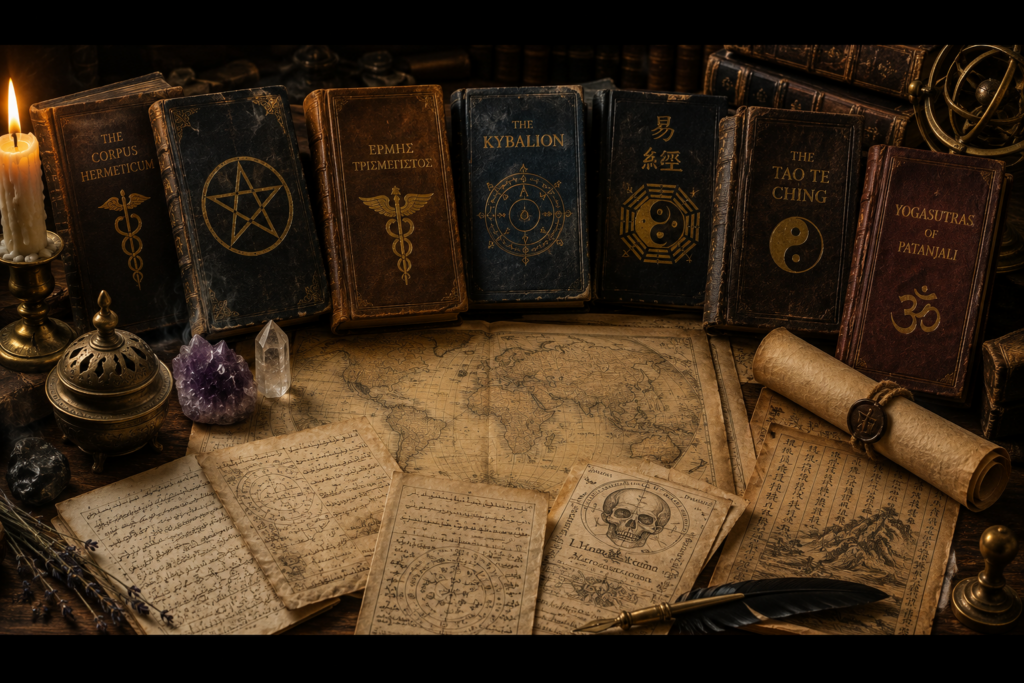
There is a temptation when studying the occult to imagine traditions as separate vessels: Hermeticism here, Kabbalah there, alchemy somewhere else, each preserving its own contents until a later magician decides to borrow from it.
History rarely behaves so neatly.
What we now call Western Esoteric Traditions developed through repeated encounters between peoples, languages, religions, and intellectual worlds. Even some of their oldest foundations emerged in culturally mixed environments. Hellenistic Egypt, for example, brought Greek, Egyptian, Jewish, and other Mediterranean traditions into contact, while the movement of texts through Greek, Arabic, Hebrew, and Latin repeatedly changed what later Europeans were able to read and how they understood it. Historians of Western esotericism increasingly emphasize that these traditions cannot be explained solely as an isolated European history of ideas; cultural movement, empire, trade, translation, and globalization were also part of the story.
Translation itself is never completely neutral.
Words do not always have exact equivalents. Religious ideas arrive carrying assumptions from one culture and are interpreted through the assumptions of another. A teaching can be preserved remarkably well in translation, but it can also be reorganized, simplified, combined with something else, or made to answer questions its original practitioners were not asking.
Kabbalah offers a particularly clear example. Jewish mystical traditions were studied and reinterpreted by Christian Renaissance thinkers, producing Christian Cabala. Later occultists transformed portions of that material again into the Hermetic Qabalah familiar within ceremonial magic. A modern witch encountering a Tree of Life diagram in an occult book may therefore be meeting something with Jewish roots that has already passed through Christian theological interpretation and later ceremonial reconstruction.
That does not make the later form imaginary. It does mean that origin and later use are not the same thing.
The same pattern appears repeatedly. Hermeticism was rediscovered, translated, and interpreted differently in successive eras. Alchemical writings crossed linguistic and religious boundaries and accumulated new philosophical meanings. Classical gods were reframed through astrology and ceremonial correspondence. Folklore entered learned magical literature, while learned magical symbols sometimes traveled back into popular practice.
Occultism has always been good at making new systems out of old pieces.
The nineteenth century expanded that process dramatically because European and American occultists increasingly encountered religious ideas from India and other parts of Asia. The Theosophical Society became especially influential in popularizing concepts drawn from Hindu and Buddhist traditions within Western alternative spirituality. Scholars describe Theosophy itself as, in significant part, a Western occult interpretation of Hindu and Buddhist ideas rather than a transparent transmission of those traditions in their original forms.
That history is complicated.
Some Theosophists sincerely admired Indian religions, challenged Christian missionary assumptions, relocated their international headquarters to India, and participated in exchanges that also affected Indian religious and political thought. Ideas did not simply move from an active “East” into a passive “West” or vice versa; scholars have documented reciprocal appropriation, resistance, reinterpretation, and influence.
At the same time, admiration did not remove the inequalities of the colonial world in which those encounters occurred.
Western occultists could romanticize an imagined “East,” treat very different Asian traditions as pieces of one universal secret wisdom, or claim that occult interpretation revealed the true meaning of traditions better than the people actually living within them. Modern scholarship on early Theosophy describes precisely this tension: respect and fascination could coexist with Orientalism, simplification, and unequal claims to authority.
That matters to witches because much of what later entered twentieth-century alternative spirituality had already been through that filter.
Terms such as karma, ideas about reincarnation, concepts derived from yoga, imagined Eastern masters, chakras, and generalized notions of “Eastern wisdom” often reached Western occult and later New Age environments through layers of reinterpretation. By the time some of these ideas entered modern witchcraft, practitioners were not necessarily borrowing directly from Hinduism or Buddhism at all. Sometimes they were borrowing from an occultist’s earlier borrowing.
The same thing can happen within Western traditions.
A witch may learn something from Wicca that Wicca adapted from ceremonial magic, which ceremonial magic derived from a Golden Dawn synthesis, which itself combined Renaissance magic, Christian Cabala, Jewish Kabbalah, astrology, alchemy, Freemasonry, Rosicrucian ideas, and nineteenth-century scholarship.
By the time the idea reaches the altar, it may have traveled a very long road.
That does not mean we need to become obsessed with finding a perfectly “pure” origin for every magical practice. Such purity often never existed. Traditions grow by encounter, adaptation, argument, borrowing, translation, and creativity.
Nor does it mean every borrowing is automatically harmless.
A useful distinction is between exchange and erasure.
Learning from another tradition is not the same thing as claiming to have invented it. Adapting a practice is not the same thing as declaring the adapted version to be the authentic teaching of the people it came from. And discovering that an occult source has misunderstood another culture does not require throwing away everything built from it—but it does give us an opportunity to name the history accurately.
For witches, that can become a very simple habit: When something matters to your practice, occasionally ask where it came from. Not because every spell requires an academic genealogy. Because knowing a source can make the practice richer.
You may discover that what seemed like an ancient universal rule was invented by one occult organization in the nineteenth century. You may find that a familiar symbol has a much deeper religious history than the spell book that introduced it suggested. You may learn that two traditions use the same word while meaning very different things by it.
And sometimes you will discover that witches themselves have genuinely created something new. That deserves to be recognized too.
Modern witchcraft is not a museum whose purpose is to preserve every inherited object exactly as it was found. It is a living family of practices. Witches translate, experiment, combine, simplify, restore, reject, and invent.
The responsibility is not to avoid change. It is to remember that inheritance becomes more honest when we know something about the journey.
By the time a symbol reaches a modern witch, it may have crossed languages, religions, empires, lodges, books, covens, and generations.
Knowing that history does not make the symbol less magical.
It tells us how much it has survived.
Occult Does Not Mean Evil
Few words in the magical vocabulary have accumulated as much unnecessary baggage as occult.
In popular culture, calling something “occult” often suggests that it is sinister, forbidden, demonic, or morally dangerous. A newspaper headline can use occult activity when it really means frightening ritual. Horror films use occult symbols as visual shorthand for approaching evil. Religious polemic has sometimes grouped witchcraft, divination, ceremonial magic, spirit work, Paganism, and anything else outside an approved religious framework beneath the same dark label.
Historically, however, occult is not a moral category.
The word refers to what is hidden, concealed, or not immediately visible. Earlier discussions of “occult qualities” concerned forces whose operations could be observed even when their causes were not obvious. Astrology, alchemy, natural magic, divination, mystical philosophy, ritual magic, and systems of correspondence could all enter the territory later described as occult without thereby making the practitioner wicked—or benevolent.
The occult describes a relationship to hidden knowledge and hidden forces. It does not tell us what someone intends to do with them. That distinction matters enormously for witchcraft.
A protection ritual can draw upon correspondences, planetary timing, consecrated objects, divine names, sigils, or ceremonial structure that came through occult traditions. A healer may study astrology. A mystic may use elaborate symbolic systems to contemplate the divine. A magician may invoke a planetary intelligence. A witch may explore Tarot, alchemy, trance, spirits, or magical alphabets.
None of those practices becomes evil merely because the material is esoteric. At the same time, saying that the occult is not inherently evil should not become the equally careless claim that everything occult is harmless or good.
Occult traditions are human traditions, and human beings have always pursued many different ends. Historical magical texts contain healing, protection, divination, love magic, treasure seeking, spirit conjuration, coercive work, curses, attempts to gain power, and practices modern readers may find ethically troubling. Some practitioners have behaved generously; others manipulatively. Some organizations have created genuine communities of study; others have built unhealthy systems of authority around charismatic leaders and secret knowledge.
There is no reason to sanitize that history. But those are questions of ethics, intent, method, power, and consequence. They are not definitions of occultism itself.
This becomes especially confused around demons.
[Demonology] is a particular field concerned with beings categorized as demons and with the religious, folkloric, theological, and magical systems surrounding them. Some forms of ceremonial magic contain material involving such spirits. Many others do not. Astrology is not demonology. Alchemy is not demonology. Tarot is not demonology. Hermetic philosophy is not demonology. Mysticism is not demonology simply because outsiders find its experiences strange.
Nor should every unfamiliar spirit automatically be translated into the Christian category of demon. Different cultures and magical traditions have understood spirits through very different cosmologies. Even within Western history, categories such as angels, demons, ghosts, fairies, planetary intelligences, intermediary spirits, ancestors, and local presences have never fitted comfortably into one universal taxonomy.
Reducing all of that to “good spirits” and “evil spirits” may tell us more about the worldview doing the classification than about the beings being described. Witches encounter a similar problem with the word dark.
Darkness can mean danger, concealment, death, grief, the unknown, night, descent, secrecy, fear, or simply the absence of light. None of those meanings automatically equals moral evil. Hekate at a crossroads, an ancestor shrine, a cemetery meditation, shadow work, a waning Moon rite, or a ritual concerned with death can all be dark in atmosphere without being malicious in purpose.
Likewise, something presented as bright, healing, spiritual, or angelic is not automatically ethical simply because it looks reassuring. Appearance is not morality.
This is one reason MCC keeps a separate discussion of Good & Evil rather than treating magical categories themselves as moral labels. Ethics require more difficult questions: What is being done? To whom? With what consent? For what purpose? What are the likely consequences? What kind of authority is being claimed? Is fear being used to control someone? Is the practitioner willing to question their own interpretation?
Those questions work far better than asking whether something merely looks occult. There is also another neighboring field worth keeping distinct: Parapsychology.
Parapsychology approaches claims such as telepathy, psychokinesis, apparitions, precognition, and other anomalous experiences through attempts at observation, experimentation, and investigation. A witch and a parapsychologist might occasionally become interested in the same reported event while interpreting it through very different frameworks.
The unusual is not automatically occult. The occult is not automatically supernatural. And the supernatural is not automatically evil. Keeping those categories separate gives us a much clearer conversation.
For witches, perhaps the most useful response to the old fear surrounding occultism is neither embarrassment nor theatrical defiance. We do not have to insist that everything hidden is wholesome, and we do not have to perform darkness merely because someone else expects witches to be frightening.
We can simply be more precise.
Some occult traditions are philosophical. Some are devotional. Some are mystical. Some are magical. Some are highly ritualized. Some investigate spirits. Some explore consciousness. Some preserve symbolic systems. Some contain practices that deserve serious ethical scrutiny.
The word alone settles none of those questions.
Hidden does not mean evil.
It means there is something we have not yet brought fully into the light.
At the Crossroads of the Unseen
Moral judgment, spirit classification, and investigation are different lenses—even when they are pointed toward the same strange experience.
Different questions require different ways of looking.
Mystery Is Not Proof
One of the pleasures of occult practice is learning to become attentive. A coincidence catches your attention. A dream repeats. A card appears again and again. A candle behaves strangely during a working. Someone enters your thoughts moments before they call. You sense a presence in an otherwise empty room, or an animal appears at an uncannily appropriate moment.
A witch does not necessarily have to shrug and declare that all of this is meaningless. But neither should we make the opposite mistake.
You may be completely certain that something happened while remaining uncertain about why it happened, what caused it, or what it means. That uncertainty is not weakness. It is one of the most useful forms of magical discernment.
Consider what happens when we begin adding interpretation to an experience.
Any of those interpretations might eventually prove meaningful. But they are not equally established simply because the original knocks really occurred.
This distinction becomes especially important in occult communities because meaning can accumulate very quickly. Once someone suspects that a particular deity is contacting them, every related image may begin to look significant. Once someone fears that a hostile spirit is present, an ordinary noise, nightmare, electrical failure, lost object, or unpleasant coincidence can become further evidence of the same conclusion.
Psychologists use the term confirmation bias for our tendency to evaluate information in ways that favor beliefs we already hold. It is not something only gullible people do. All of us are capable of noticing evidence that supports what we already suspect while giving less weight to evidence that points elsewhere, and witches are no more exempt from that tendency than anyone else.
In fact, magical practice can sometimes make the problem harder because we intentionally train ourselves to notice correspondences, symbols, repetition, timing, dreams, intuition, and unusual connections. Those are useful skills. They simply need a companion: the ability to say, “That is interesting, but I do not yet know what it means.” That sentence can save a practitioner an enormous amount of trouble.
Discernment does not require immediately explaining an experience away. It asks us to keep more than one explanation alive long enough to examine them. A candle may have sputtered because the working shifted something, but moisture may also have entered the wick. A dream may be spiritually important while also containing fragments of yesterday’s conversation, an old memory, an anxiety, or something watched before bed.
A repeated Tarot card may deserve attention, but if you are performing many readings, repetition may also be unsurprising. A shadow in the doorway may have felt like a presence; before deciding what it was, turn on the light.
None of that insults the magical explanation. If something genuinely extraordinary is occurring, ordinary questions will not make it less extraordinary. They may make the conclusion stronger.
This is also why repetition by itself is not always sufficient evidence. Humans are remarkably good at noticing patterns, especially once we have begun looking for one. A meaningful correspondence usually becomes more convincing when several different forms of information converge rather than when the same ambiguous event is interpreted the same way repeatedly.
Divination deserves particular care here. A Tarot reading can illuminate a situation, uncover a possibility, challenge an assumption, or give symbolic form to something difficult to articulate. But repeatedly asking the same question until a desired answer appears is no longer careful divination. Neither is pulling more and more cards because the first answer produced anxiety. At some point, the tool stops helping us interpret uncertainty and begins feeding it.
The same caution applies to claims of secret knowledge. Occult history is full of hidden masters, invisible orders, lost manuscripts, ancient initiations, privileged revelations, forgotten lineages, channeled authorities, and people who claim access to knowledge unavailable to everyone else.
Some of those claims may contain genuine history or sincere spiritual experience. But the words secret, ancient, channeled, initiated, or a spirit told me do not function as evidence by themselves. They tell us how authority is being claimed. They do not automatically establish that the claim is true.
This becomes especially important when invisible authority is used to override another person’s judgment: My guides say you must do this. The cards say you should leave your partner. Your deity told me you belong with me. The spirits say I am the only person who can protect you. My secret lineage proves that everyone else is practicing incorrectly.
A spiritual claim should never become a shortcut around consent, evidence, ethics, or another person’s right to make decisions about their own life.
Here is another reason to remain careful: our physical condition changes perception.
Fatigue is particularly important. Research on sleep restriction and perceptual changes has found that inadequate sleep can increase unusual perceptual experiences, suspiciousness, cognitive disorganization, and emotional distress even among people without a psychiatric diagnosis.
That does not mean an unusual experience occurring at three in the morning is automatically unreal. It means that three in the morning is additional information. So are grief, illness, intoxication, extreme stress, fasting, isolation, medication changes, and emotional exhaustion. A careful practitioner notices the condition of the observer as well as the thing being observed.
Occult practice should therefore preserve a surprisingly ordinary question:
What else could this be?
Not because the ordinary explanation must win, but because the ability to consider alternatives protects the extraordinary from becoming meaningless.
If every dream is prophecy, prophecy means very little. If every coincidence is synchronicity, synchronicity becomes impossible to distinguish from coincidence. If every uncomfortable feeling is psychic attack, genuine danger becomes harder to recognize. If every inner voice is a deity, we lose the ability to distinguish revelation from imagination, intuition, fear, desire, memory, or our own internal dialogue.
Discernment gives mystery edges. It allows us to recognize that something happened, to take it seriously, to explore it, and even to form an interpretation while still admitting that we may be wrong.
That admission is not the enemy of witchcraft. It may be one of the things that keeps witchcraft intelligent.
The occult asks us to look beyond what is immediately visible. Discernment asks us not to pretend that everything beyond the visible has therefore been understood.
Wonder can remain wonder while the evidence catches up.
When the Hidden Becomes Too Much
Occult practice can become absorbing.
That is part of its appeal.
A new system opens and suddenly there are correspondences everywhere. Tarot becomes more articulate. Dreams become vivid. Rituals deepen. Symbols begin connecting with one another. A practitioner may spend weeks reading, experimenting, recording, comparing, and discovering things that seem to rearrange the way the world looks.
There is nothing inherently unhealthy about becoming deeply interested in something mysterious.
But there is a point at which attention can become fixation.
The signs are usually less dramatic than people imagine.
A person begins performing reading after reading because uncertainty has become intolerable. They stay awake because they are afraid they will miss a dream, sign, planetary hour, or spirit encounter. They withdraw from friends because ordinary conversation feels irrelevant compared with what they believe is happening spiritually. Every coincidence becomes evidence. Every disagreement becomes interference. Every setback begins to look like magical attack.
The practice stops opening the world. It begins narrowing it. That distinction matters.
A healthy magical life should still leave room for groceries, laundry, jokes, work, friendships, family, hobbies, bad television, walking outside, taking medication, sleeping eight hours, and occasionally thinking about absolutely nothing occult at all.
Those ordinary things are not distractions from spiritual life.
They are part of the structure that keeps spiritual life inhabitable.
Problems can also develop around compulsive divination.
A Tarot deck can be an extraordinary tool for reflection, but it cannot remove every uncertainty from life. If a practitioner asks the same question repeatedly, consults several decks, checks astrology, throws another oracle, asks a pendulum, and then searches for signs because none of the answers feel reassuring enough, the problem may no longer be lack of information.
The problem may be the demand for certainty.
Magic cannot make uncertainty disappear.
Sometimes the most grounded magical decision is to stop asking.
Put the cards away.
Make the decision with the information you already have.
Allow tomorrow to arrive without consulting anything about it first.
The same principle applies to spirit work.
If every room must be scanned, every sound interpreted, every dream decoded, and every uncomfortable emotion traced to an outside presence, the practitioner can gradually lose the ability to distinguish between what they experienced and what they concluded about the experience.
That does not mean spirits are unreal.
It means spirit work requires boundaries precisely because the possibility is taken seriously.
A practice that cannot be closed is not necessarily a deeper practice.
Sometimes it is simply one that has lost its edges.
This is why closing rituals, grounding, cleansing, banishing, record keeping, and deliberate periods of ordinary life are so important. They establish a distinction between ritual time and the rest of the day.
Substances deserve particular caution.
Across many cultures, altered states have been deliberately cultivated through fasting, sleep disruption, rhythmic movement, breath, intoxicants, entheogens, sensory deprivation, and other techniques. Their presence in religious or magical history does not automatically make every modern use wise.
Combining intense occult work with heavy intoxication, repeated sleep loss, or other forms of deliberate destabilization can make interpretation much harder.
An experience may feel enormous while it is happening.
That does not mean you need to decide what it meant before you are sober, rested, fed, and back in ordinary surroundings.
Write it down first. Interpret it later.
That is often a surprisingly powerful magical discipline.
Another warning sign is isolation.
Occult traditions can encourage the idea that the practitioner possesses knowledge ordinary people cannot understand. Sometimes there really are experiences that are difficult to explain outside a magical community.
But be cautious when a belief system begins telling you that everyone who questions you is spiritually blind, hostile, possessed, jealous, unenlightened, or part of a conspiracy. A worldview that can explain away every disagreement can become impossible to challenge. And anything that cannot be challenged can become dangerous in the hands of a teacher, group, spirit-worker, or practitioner—including ourselves. Keep people in your life who are allowed to disagree with you.
Keep at least one person who can say, “I think you may be reading too much into this,” without automatically becoming your enemy. That is not spiritual weakness.
It is a safeguard against becoming trapped inside one interpretation of reality. There is also an important difference between having an unusual experience and being unable to function because of it.
A vivid dream, sensed presence, mystical experience, powerful ritual, strange coincidence, or moment of altered consciousness does not by itself tell us that something is wrong. Human spiritual experience has always included things that are difficult to categorize.
But if occult practice is contributing to persistent fear, severe sleep disruption, inability to eat or care for yourself, withdrawal from everyone around you, escalating suspicion, inability to work or manage ordinary responsibilities, or difficulty distinguishing internal experiences from events other people can also observe, it is reasonable to step away from the practice and seek outside support.
You do not have to settle the metaphysics first.
A person can say:
Something meaningful may be happening to me.
and also:
I need help sleeping.
Those statements are not enemies.
Professional mental-health care does not require a person to surrender every spiritual belief they hold. A good clinician can help address distress, anxiety, sleep, functioning, or frightening experiences without needing to decide the ultimate spiritual explanation for them. The National Institute of Mental Health maintains information on finding mental-health support when someone needs more help than ordinary grounding can provide.
The goal of discernment is not to make witchcraft timid.
It is to keep practice chosen rather than compulsive.
You should be able to close the book.
Blow out the candle.
Leave the altar.
Ignore the cards for a week.
Walk past a strange coincidence without decoding it.
Laugh at yourself occasionally.
Change your mind.
Say, “I don’t know.”
And return to ordinary life without feeling that the unseen world will punish you for looking away.
The occult will still be there tomorrow. Mystery does not require constant attention in order to remain mysterious.
And a spiritual practice worth keeping should make it possible to become more present in your life, not less.
Mystery should expand your life, not consume it.
Staying Grounded
Grounding is sometimes treated as the least glamorous part of magical practice.
It should not be.
A practitioner may spend years learning correspondences, ritual structures, divination systems, spirit work, trance, planetary timing, or ceremonial techniques, yet one of the most useful skills remains remarkably simple: being able to return fully to ordinary life.
Grounding does not mean rejecting a magical experience or explaining it away. It means restoring enough balance that you can consider the experience without being carried entirely by it.
That can begin with the body.
Eat something. Drink water. Sleep. Shower. Open a window. Step outside. Stretch. Walk around the block. Put your hands in soil. Cook dinner. Pet the cat. Talk to someone about something completely unrelated to magic.
These things may sound almost comically mundane after an intense ritual.
That is precisely why they work.
Occult practice frequently directs attention inward, upward, outward, or toward invisible relationships. Ordinary physical activity brings attention back toward where you actually are.
For witches, this need not be separate from magical practice.
Many traditions deliberately end ritual by grounding excess energy, closing sacred space, extinguishing candles, dismissing or thanking invited presences, removing ritual garments, eating, drinking, or physically touching the earth. These actions tell both practitioner and ritual space: the working has ended.
That boundary matters.
A well-built ritual should usually have an entrance and an exit.
If you cast a circle, eventually open it.
If you invoke, eventually conclude the invocation.
If you deliberately enter trance, deliberately come back.
If you establish contact with spirits, maintain clear boundaries around when and how that contact is welcome.
If something leaves you feeling unsettled, familiar practices of cleansing and protection can help mark the return to ordinary space.
The point is not fear. It is structure.
You would not leave the front door of your house open simply because you believe most visitors are friendly. Magical boundaries can function in much the same way.
Grounding also means giving experiences time before interpretation. Keep a journal.
Record what happened as accurately as you can before deciding what it meant.
Write down the dream before identifying the deity.
Record the unusual sound before deciding it was a spirit.
Note which Tarot cards appeared before constructing a theory around them.
Describe the physical sensation before deciding where it came from.
This creates something enormously valuable: a record of the experience before memory begins reshaping itself around the interpretation.
Later, return to it.
What still seems important after a night’s sleep?
What looks different a week later?
Did the predicted event actually happen?
Did the symbol repeat when you were not actively searching for it?
Did another person independently notice the same thing?
Good magical records allow experience to develop over time rather than forcing every mystery to reveal itself immediately.
This is particularly helpful with divination.
A reading does not always need another reading.
Sometimes the best response to a difficult Tarot spread is to photograph it, write down your interpretation, close the deck, and live with the question for a while.
Divination can help us think.
It should not prevent us from thinking without divination.
The same applies to magical research.
Occult study can become wonderfully absorbing, but books themselves require boundaries. If you have spent six hours moving from one obscure reference to another, there is no spiritual prize for making it seven.
Close the browser.
Close the book.
Go outside.
An old manuscript will not vanish because you made lunch.
Grounded practice also keeps other people in the picture.
Occultism has a long tradition of solitary study, private revelation, and personal interpretation. Those can all be valuable. But isolation removes one of the simplest checks on our assumptions: another person who sees things differently.
A trusted friend, coven member, teacher, partner, therapist, or fellow practitioner can sometimes notice what we cannot.
Not every disagreement means they understand the situation better than you do.
But if several people who care about you independently begin saying that you seem frightened, exhausted, isolated, unusually suspicious, or unlike yourself, that information deserves consideration.
Spiritual autonomy does not require refusing outside perspectives.
Neither does magical authority.
One of the strongest sentences a practitioner can learn is: “I could be wrong about this.”
That does not erase intuition.
It protects intuition from becoming unquestionable.
There is also value in keeping parts of life deliberately unmagical.
Not every meal requires correspondence.
Not every walk needs to become a ritual.
Not every bird needs to carry a message.
Not every dream needs to be interpreted.
Not every disagreement requires energetic diagnosis.
Not every problem requires spellwork.
Sometimes a difficult conversation needs a conversation.
Sometimes a headache needs water.
Sometimes a broken appliance needs repair.
Sometimes bad luck is simply bad luck.
Recognizing ordinary causes does not diminish witchcraft.
It prevents witchcraft from becoming an explanation for everything—and therefore an explanation for nothing.
Nature can be particularly useful here.
A walk beneath trees, working in a garden, sitting beside water, noticing weather, caring for animals, or simply placing bare feet on the ground can restore scale. Our Animism & Sacred Ecology work emphasizes relationship with the living world, but relationship does not require constant interpretation.
Sometimes the tree does not need to deliver a message. Sometimes sitting beneath it is enough. Grounding also requires caring for the practical conditions that shape perception. Sleep matters. Food matters. Medication matters. Stress matters. Grief matters. Illness matters. Substances matter. If an experience occurred while you were exhausted, intoxicated, feverish, grieving, frightened, or under enormous stress, include that information when evaluating it. You do not have to decide that the experience was meaningless. You simply have more context. And context is one of discernment’s greatest allies.
For some witches, formal banishing or protection work provides a strong ritual conclusion. For others, grounding may be as simple as washing their hands, changing clothes, eating something, opening the curtains, and returning to the household.
Both can work.
What matters is that the practice contains a way back.
Occult work should not require you to remain permanently suspended between worlds.
A threshold is meaningful because it has two sides. Crossing one direction is only half of the art.
The witch also learns how to return.
And perhaps that is one of the deepest forms of grounding: not abandoning mystery, but carrying what was useful from the experience back into a life that still contains bills, friendships, dishes, gardens, laughter, bodies, responsibilities, and tomorrow morning.
The unseen may enrich those things. It should not make them disappear.
A grounded witch can enter mystery without having to live there.
What the Occult Still Offers a Witch
After all the history, borrowing, translation, secrecy, experimentation, excess, and reinterpretation, it is reasonable to ask a simple question:
What does the occult still offer a witch? Quite a lot. Not because every occult system must be adopted. Not because ceremonial magic is somehow more advanced than witchcraft. And not because hidden knowledge is automatically deeper than ordinary knowledge. The value lies somewhere else.
Occult traditions preserve ways of organizing magical thought.
They teach us to notice relationships between symbol, timing, direction, number, color, planet, element, spirit, word, gesture, and intention. They show how a ritual can be constructed deliberately rather than assembled only by intuition. They preserve technical vocabularies for consecration, invocation, banishing, correspondence, talismanic work, planetary timing, sacred geometry, magical alphabets, trance, and altered states.
For a witch who wants greater structure, that can be enormously useful.
A simple spell may work beautifully with a candle, a written petition, and focused will.
Occult study can then ask:
Why this color? Why this hour? Why this planetary association? Why this direction? Why this sequence? Why this symbol? Why this form of closing?
Those questions do make the magic stronger. They make the practitioner more conscious of what they are building.
That is one of occultism’s great gifts.
It offers architecture. Modern witchcraft, however, has never been limited to architecture. Witches brought something else into the exchange.
They carried ceremonial ideas into kitchens, gardens, bedrooms, forests, covens, solitary rites, seasonal festivals, household protections, devotional practice, folk traditions, and improvised spellwork. They loosened systems that had sometimes become rigid. They changed language. They changed symbolism. They centered bodies, land, relationships, domestic life, nature, gender, sexuality, local spirits, ancestral practice, and lived experience in ways many formal occult orders had not.
The result is not simply “occultism made easier.” It is often something genuinely different.A witch may use planetary magic without becoming a ceremonial magician. A witch may use correspondences without believing that every table of correspondences is universal. A witch may study Hermeticism while rejecting parts of Hermetic philosophy. A witch may use sigils alongside herbs, prayer, candle work, deity devotion, or folk practice. A witch may learn formal invocation and still prefer a quiet household altar to a ceremonial temple.
That freedom to translate is part of the Craft. Witchcraft is interdiscilplinary. Occultism can also give witches added depth.
Many techniques that appear in modern spell books did not appear from nowhere. They passed through older magical literature, Renaissance philosophy, astrology, alchemy, grimoires, mystical systems, fraternal orders, nineteenth-century occult revival movements, early Wicca, Pagan publishing, and generations of adaptation.
Following those threads can change the way a practice feels. A symbol becomes more than decoration. A ritual gesture gains ancestry. A correspondence table becomes evidence of an argument someone once made about how the cosmos works. A magical alphabet becomes part of a larger history of concealment, sacred language, and symbolic authority.
Knowing those histories does not obligate us to reproduce them exactly. It gives us more informed choices about what to keep. Occult traditions also preserve a useful willingness to take symbol seriously.
Modern life tends to divide things into categories such as fact, fiction, psychology, religion, art, and superstition. Occult thought is often less tidy. A symbol can be artistic and ritual. A myth can be poetic and spiritually meaningful. A Tarot card can be an image, a divinatory instrument, a meditation device, and a piece of cultural history at the same time. A planetary symbol can represent an astronomical body, an astrological principle, a deity, a metal, a day, a color, a magical force, or several of those simultaneously. Occultism does not always demand that one meaning destroy the others.
For witches, who routinely work in layers of symbolism, that flexibility can feel natural. It can also train the imagination. And imagination matters. Not because imagining something automatically makes it objectively true. Because ritual depends upon our ability to create meaningful symbolic environments.
We imagine the circle as sacred space. We give significance to flame, water, blade, stone, incense, direction, word, gesture, and silence. We allow an ordinary object to become consecrated. We enter myth deliberately. We speak to what cannot always be seen. Occult traditions have spent centuries exploring how human beings do that.
There is much worth learning there. They can also teach patience.
The internet has encouraged a style of spirituality in which every question should have an immediate answer. Occult study often resists that. A diagram may not make sense the first time. An old text may require context. A ritual may need repetition before its structure becomes clear. A symbol may carry several contradictory meanings. A system may reveal its logic only after weeks or months of comparison.
That kind of study teaches a valuable magical habit: not everything must become instantly useful.
Some knowledge needs time. Some experiences need time. Some questions become better when they are allowed to remain questions for a while.
The occult can therefore provide depth without requiring submission.A witch may study a system thoroughly and still decide:
This part is useful.
This part belongs to another tradition.
This claim does not convince me.
This symbolism speaks to me.
This hierarchy does not.
This technique works beautifully in my practice.
This one does not.
That is not disrespect.
It is discernment.
It is also worth remembering that occultism preserves failed experiments, strange ideas, dead ends, and arguments, not merely successful magical techniques. That too has value. A historical magical text may reveal assumptions we no longer share. An occult organization may contain brilliant symbolism alongside authoritarian structure. A famous magician may offer one insight worth keeping and another worth rejecting. An old theory may be historically fascinating without needing to become a modern belief.
Studying occultism well means learning how to inherit selectively. We do not have to choose between reverence and dismissal. We can say: This mattered. That may be the most mature relationship modern witchcraft can have with the occult. Not obedience. Not rejection. Conversation.
The occult gives witches access to centuries of magical experimentation, symbolic language, ritual design, mystical speculation, and strange attempts to understand the hidden structures of reality. Witchcraft gives that inheritance another place to live.
The occult does not need to become the whole of the Craft. It never was.
But it remains one of the great libraries from which modern witchcraft has learned to read. And witches have never been afraid to write in the margins.
Where to Explore Next
The occult touches many parts of the Craft. Follow the path that best matches what you want to understand next.
The hidden is a field to explore—not a place the witch must remain.
Sources & Further Study
The occult has accumulated centuries of claims, counterclaims, reinventions, and inherited stories. These sources offer useful places to begin separating historical record, interpretation, art, and practice.
History & Scholarship
Art & Visual Culture
Discernment & Wellbeing
An MCC note on sources: Historical scholarship can tell us what the documentary record supports. Practitioners may preserve additional traditions, interpretations, and experiences. We think both are worth hearing—as long as we are clear about which kind of claim we are making.
A witch does not need to become an occultist to practice witchcraft well. Much of what modern witches inherited from ceremonial magic, folk practice, mysticism, astrology, alchemy, and other occult currents has been borrowed, adapted, returned, and reinvented so many times that some of it now feels like ordinary magical knowledge. Casting circles, working with correspondences, ritual tools, elemental symbolism, and countless other ideas have traveled far beyond the traditions that once held them.
Still, knowing where those ideas came from matters. History gives the Craft context, helps us recognize what has been changed or borrowed, and reminds us that our practices did not appear from nowhere. You do not need to follow every path that helped shape modern witchcraft, but understanding its foundations can deepen the path you have chosen.
The occult is not a requirement for witchcraft. It is part of its inheritance—and sometimes, looking back at those roots helps us understand more clearly what we are doing now.
The Hidden, Carried Forward
The occult is not the whole of witchcraft. It is one of the old conversations the Craft continues to have with mystery, symbol, technique, spirit, imagination, and the unseen.
Study it critically. Practice with discernment. Respect where things came from—and carry forward what remains useful.