
Discernment does not weaken our belief in signs. It helps us recognize the ones that matter.
I believe in signs. I believe gods, spirits, ancestors, and other presences can communicate through symbols, dreams, divination, unusual encounters, repetition, and meaningful timing. Learning to notice these things is one of the strengths of a witch.
But not everything we notice is a sign, and that distinction matters. It does not require us to dismiss the unseen or explain away every strange experience. Quite the opposite: if we believe genuine communication is possible, it deserves more care than assigning immediate meaning to every bird, number, candle flame, shadow, song, or shape in a glass of water.
A witch should be observant. A witch should also be discerning.
Notice First, Interpret Second
When something unusual happens, begin with what actually occurred rather than what you think it meant. There is a meaningful difference between saying, “A deity sent a crow to warn me,” and saying, “A crow landed near me shortly after I finished a particular ritual.”
The first statement has already decided what happened, who caused it, and why. The second leaves room for the possibility of a sign while giving us something concrete to examine. Observation and interpretation are related, but they are not the same act. That small pause between them is where discernment begins.
Some signs are immediate and difficult to ignore. They may answer something just spoken, asked, petitioned, or performed, with timing or specificity that gives the experience unusual weight. Others only become meaningful through repetition. One encounter may simply be interesting; the same unusual image, name, animal, phrase, or symbol appearing repeatedly under related circumstances may deserve closer attention.
Repetition does not prove supernatural involvement, but it can help distinguish a developing pattern from a single coincidence. Nor do signs always wait for us to ask. A symbol may begin appearing before we understand its relevance, a dream may arrive before the question is fully formed, or a presence may initiate contact rather than waiting to be invited.
Context Matters More Than a Correspondence List
Correspondences are useful because they preserve traditional, cultural, magical, and religious associations surrounding animals, colors, numbers, plants, planets, dreams, and symbols. But they are tools for interpretation, not automatic answers.
An owl does not mean precisely the same thing in every tradition, culture, location, or relationship. A symbol may have an established religious meaning, a local meaning, a personal association, or a meaning that has developed through repeated work with a particular deity or spirit.
Before searching for “the spiritual meaning” of something, consider what was happening when it appeared. What had you been thinking, asking, or doing? Was the event actually unusual for that place or situation? Does the symbol already have significance within your tradition or spiritual relationships?
A sign belongs first to the circumstances in which it appeared, not to the first correspondence list we find online.
The ordinary explanation belongs in that examination too. Animals behave like animals. Candle flames react to drafts. Algorithms repeat subjects we recently searched. Human minds are exceptionally good at recognizing faces and patterns in smoke, clouds, reflections, wood grain, and shadows.
None of that makes magic impossible. It simply gives us more information. A meaningful sign should be able to survive reasonable examination. We do not honor magic by refusing to think.
Using Divination Without Forcing an Answer
Divination can be extremely useful when something feels significant but its meaning is unclear. Tarot, runes, scrying, pendulum work, or another trusted method can help us explore whether an experience deserves attention and what kind of attention it may require.
The danger comes when divination becomes a way of demanding confirmation. Repeatedly asking the same question until the cards finally give the answer we wanted does not produce clarity. Neither does treating every difficult card as evidence of attack, punishment, or disaster. A second method can sometimes provide useful confirmation, but endless readings usually create more confusion than understanding.
Divination can help interpret a possible sign. It should not be used to manufacture one.
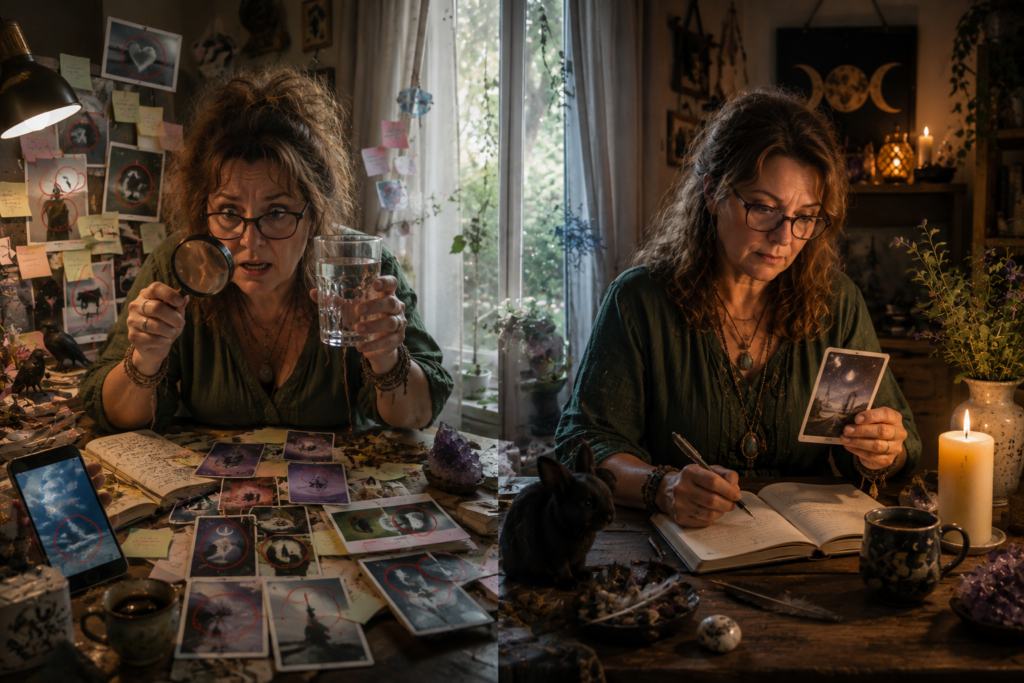
A useful practice is simply to record unusual experiences before making large conclusions about them. Write down what happened, the circumstances surrounding it, and what you were doing or thinking at the time. Watch for repetition, precision, or unusual timing. Consider both magical and ordinary explanations. Consult correspondences or divination if they are helpful, and pay attention to whether an interpretation produces greater clarity or only increasing fear and fixation.
Most importantly, avoid making major decisions from a single ambiguous occurrence. A genuine warning may be uncomfortable, and a sign certainly does not have to tell us what we want to hear. But meaningful communication usually gives us something coherent to consider. Fear by itself is not proof.
When Meaning Becomes Obsession
I once knew someone who wanted to receive signs so badly that eventually almost everything became one. She photographed water, reflections, shadows, and ordinary patterns, convinced that images and messages were constantly appearing around her. What began as spiritual curiosity gradually became an obsession, and she began pressing those interpretations onto other people until they grew concerned and withdrew from her.
In the end, the search for connection left her increasingly isolated.
I do not tell that story to mock her. I tell it because there is a real danger in teaching people that everything is a sign. When every event becomes a message, genuine signs lose their distinction. When every coincidence becomes instruction, personal judgment begins to disappear. When every shadow, uncomfortable feeling, or unexpected noise becomes a spirit, fear can begin governing the practice.
Signs can lead toward insight, relationship, and spiritual understanding. Misused, they can also feed obsession, fear, and isolation. That is why discernment is not the enemy of belief; it is one of the disciplines that allows belief to remain useful.
Believing With Care
I do not think the answer is to stop noticing signs. Signs and symbols are among the ways gods, spirits, ancestors, and other presences may communicate, and learning to recognize them can be an important part of magical and devotional practice.
But noticing something is only the beginning.
We observe. We remember. We compare. We question. We use the tools our traditions give us, and sometimes we simply wait to see whether the pattern continues.
We do this not because we doubt the unseen, but because we believe communication with it matters enough to approach carefully.
Discernment does not silence meaningful signs. It gives them room to become clearer.
— Kael
Coven of the Veiled Moon
Leave a Reply