Threshold & Otherworld
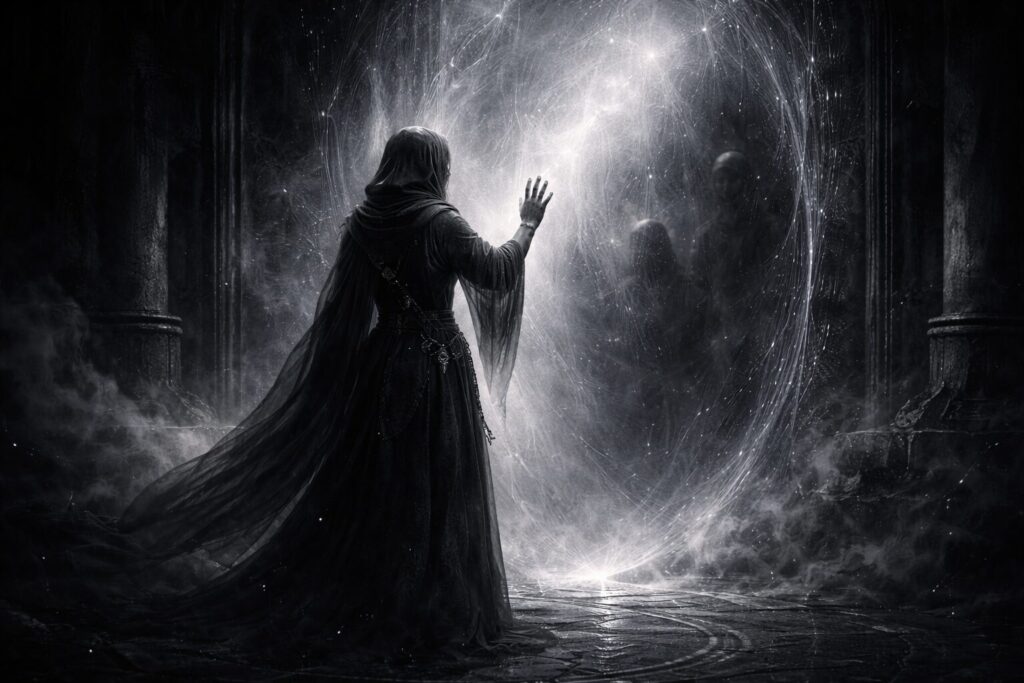
Within the coven’s deeper chambers of knowledge, the territory of Threshold & Otherworld refers to practices that engage liminal currents — states and spaces where the ordinary dissolves and hidden structures become palpable. These rites move toward the edge of perception: boundaries between life and death, self and other, this world and the unseen. In these spaces, the practitioner encounters forces that are not merely metaphorical, but animate in their own right.
This domain is not about spectacle or fear. It is about respecting the weight of threshold experience, and understanding that when the boundary is crossed, echoes of what is encountered tend to linger. Work in this domain requires grounding, clear intention, and a mature relationship to one’s own psyche and sense of self.
Below are four major currents in this category: Chthonic Summoning, Death Work, Egregores, and Major Oaths. Each engages depth and boundary in a different way. Approach them not as puzzles to be solved, but as landscapes to be navigated with care.
Chthonic Summoning
Beneath & BeyondRitual engagements with underworld forces and deep-earth currents. These works explore depths that defy surface logic.
Death Work
TransitionsPractices addressing mortality, thresholds, ancestors, and decay. This is work with endings, passages, and rebirth currents.
Egregores
Collective MindformsAutonomous thought-forms born of collective attention — powerful, persistent, and often unseen until encountered.
Major Oaths
Binding CommitmentLong-standing vows, commitments, and words that bind the practitioner to paths, charges, or thresholds beyond the self.
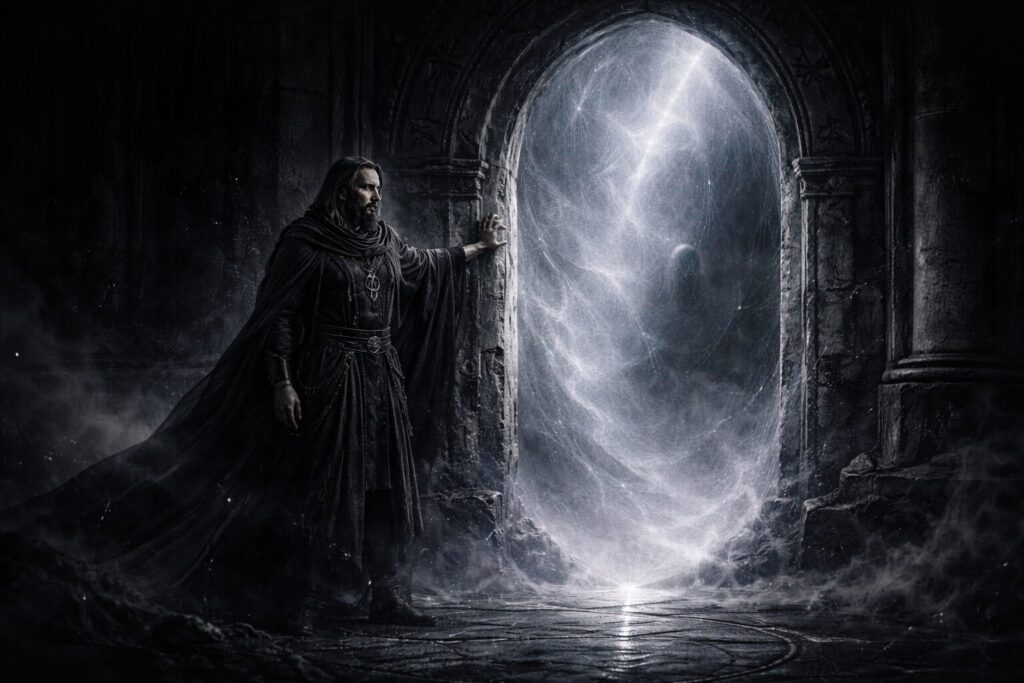
Work in the domain of threshold and otherworld currents engages places where boundaries are porous and attention roams beyond the everyday. These practices are not oblivion; they are encounters — with memories, ancestors, shadows, autonomous forces, and commitments that extend beyond the self. It is not unusual for echoes to ripple inward after threshold work: a mood that lingers, a symbol that becomes vivid, or a sense of presence that does not immediately dissipate. This is not aberration; it is the natural ripple of contact.
When encounters feel destabilizing, retreating to grounding routines, cleansing practice, and ordinary rhythms is not weakness — it is wise calibration. Balance in this domain is not avoidance of the otherworld, but the ability to enter it and return without losing the center of one’s own life-current.
Threshold experience has power not just because it alters perception, but because it expands it. Carry these encounters with care and welcome their lessons into daily life, not as burdens but as bridges.