Manifestation

Manifestation is the attempt to influence reality through thought, emotion, and belief—holding an outcome clearly in the mind and feeling as though it is already becoming real. In modern culture, it has become a phenomenon in its own right, shaped by the language of the law of attraction and popularized widely through works like The Secret and its author Rhonda Byrne. From there, it has spread into countless forms across social media: affirmations, vision boards, scripting, “lucky girl” thinking, and the quiet assumption that the universe reflects back what one believes strongly enough.
A Modern Variant
“Lucky Girl Thinking”
A recent form of manifestation, sometimes called “lucky girl thinking,” reframes the practice as identity rather than method—the belief that one is inherently fortunate, and that things simply work out as a result. The language is simple, confident, and often compelling: everything aligns, everything arrives, everything resolves.
At a glance, it can feel powerful. There is a clarity to it, even a kind of calm certainty. But it also carries a subtle distortion. Outcome is assumed without mechanism. Difficulty is treated as temporary or unreal. The world is expected to comply, rather than engaged with directly.
In this sense, it begins to resemble something less like practice and more like narrative—confidence sustained by repetition, belief maintained by exclusion. It can shift perception, and sometimes behavior, but it does not in itself constitute method.
“To assume you are lucky may change how you move. It does not, by itself, change what you are moving through.”
But, there is truth within manifestation. Focus matters. Expectation shapes perception. The ability to hold a desire steadily in the mind and align emotion with it is not meaningless—it is one of the first ways a person begins to encounter the mechanics of intention. In this sense, manifestation can function as a kind of proto-practice: an early, unrefined expression of the same current that, in more developed forms, becomes magical will.
But on its own, manifestation is limited.
Without structure, it remains diffuse. Without action, it remains inert. Without discipline, it easily collapses into wishful thinking—desire held in place, but not yet directed, enacted, or grounded. What is often presented as a complete method is, in practice, only the beginning of one.

Much of what is now called manifestation descends from the broader stream of New Thought, a movement that emphasized the power of mind, belief, and inner alignment. Over time, these ideas were simplified, repackaged, and made widely accessible. In that process, something was both gained and lost: gained in accessibility, lost in depth. What remains in popular form is often a reduced model—one that preserves the desire for change while stripping away the structure that makes change more reliable.
Manifestation differs in important ways from other approaches. It is not the same as prayer, which directs intention relationally toward something beyond the self. Nor is it the same as cultivated will, which is disciplined, directed, and enacted through choice, structure, and repeated practice. Manifestation sits between these: inward, self-referential, and often unformed.
For this reason, within the Coven of the Veiled Moon, manifestation is not rejected—but it is not mistaken for the work itself. It is a threshold. A place where intention first begins to gather shape, where attention sharpens, and where the practitioner may begin to notice subtle shifts in perception, opportunity, and response. Sometimes what is called manifestation is little more than this: increased awareness, better timing, or openness to possibility. Sometimes it is coincidence interpreted through desire. And sometimes, it is the first stirring of will, not yet fully developed.
Used alone, it is weak. Used well, it can become the beginning of something stronger.

Manifestation often borrows the language of magic while lacking the structure that gives magic its force. It encourages desire, reinforces belief, and trains attention—but it rarely teaches how to build, direct, or sustain a working. For this reason, many practitioners find that it inspires without completing, promising change while leaving the method underdeveloped.
Within a fuller practice, however, manifestation has a place. It teaches focus. It trains the imagination. It aligns thought and feeling toward a goal. When joined with ritual, timing, correspondences, and real-world action, it becomes something more than a hopeful exercise—it becomes part of the machinery of magic.
But that transition matters.
Lineage & Simplification
Each step makes the idea more accessible—but often less structured. Magic begins where intention is given form, method, and action.
To confuse wishing with working is to mistake the shadow for the flame.
At a Glance
Manifestation
A threshold practice that uses thought, feeling, belief, and symbolic reinforcement to encourage an outcome—but often remains weak unless joined to structure, discipline, and action.
Core Idea
Manifestation attempts to influence reality by holding a desired outcome steadily in mind and emotion, often with the hope that inner alignment will produce outer change.
What It Does Well
It can sharpen focus, strengthen expectancy, organize attention, and help a practitioner notice openings, patterns, and opportunities that might otherwise be ignored.
What It Does Poorly Alone
By itself, it lacks force, precision, endurance, and reliable structure. It encourages desire, but often does not teach how to direct, build, or sustain a working.
Where It Belongs
At best, manifestation is a proto-practice: a threshold exercise that introduces intention, attention, and symbolic focus before they are developed into stronger magical forms.
Common Modern Form
In popular culture, manifestation often appears as affirmations, vision boards, scripting, “signs from the universe,” Oracle Cards, candles, crystals, and law-of-attraction language.
Main Risk
It easily slips into passive wishing, aestheticized spirituality, or slogan-driven thinking—mistaking hope, mood, and repetition for method, labor, and practiced skill.

Distinctions
Manifestation, Will, and Prayer
These three are often spoken about as if they are the same. They are not. Each works differently, draws on different assumptions, and produces different kinds of results.
Manifestation
- Inward and self-referential
- Desire held in thought and emotion
- Often diffuse and unstructured
- Encourages expectancy and attention
- Commonly reinforced through affirmations, visualization, Oracle Cards, and symbolic objects
- A beginning, not a complete system
Will
- Directed, disciplined, and intentional
- Enacted through structure, choice, and repetition
- Operates through ritual, timing, and material action
- Builds force through focus and continuity
- Developed consciously as a skill
-
Central to most forms of magic
Personal Power & Will →
Prayer
- Relational and outward-facing
- Addresses intention beyond the self
- May involve devotion, request, or communion
- Operates through relationship rather than control
- Can overlap with magic, but is not the same process
-
Rooted in connection and appeal
Prayer →
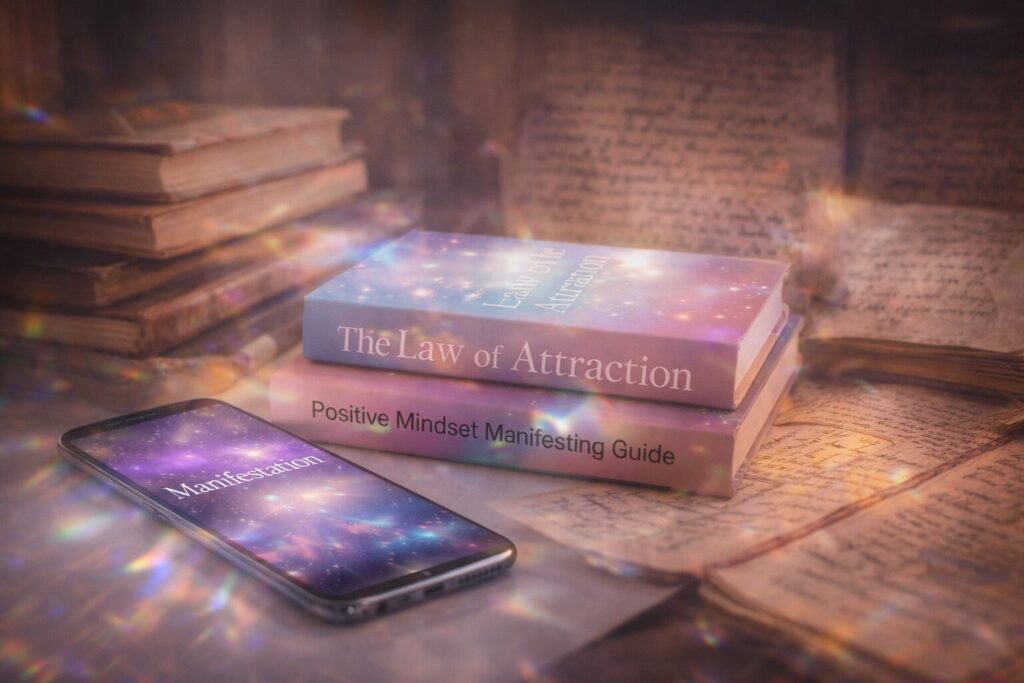
What is now called manifestation did not arise from traditional witchcraft, but from a different stream of thought that later blended into it. Much of its modern form descends from the movement known as New Thought, which emerged in the 19th century and emphasized the power of mind, belief, and inner alignment to influence lived experience. Writers such as Neville Goddard and William Walker Atkinson developed systems in which imagination, assumption, and mental focus were treated as primary forces in shaping reality.
These ideas remained relatively niche until the early 21st century, when they were repackaged for a mass audience through The Secret. That work distilled the broader philosophy into a simple and highly appealing claim: that thoughts and emotions attract corresponding outcomes. In doing so, it transformed a complex metaphysical current into a widely accessible method—one that required little structure, little training, and promised significant results. From there, the concept spread rapidly, becoming embedded in popular culture.
In its modern form, manifestation is less a single practice than a loose collection of habits and beliefs. Affirmations, visualization, journaling or “scripting,” vision boards, and symbolic gestures all circulate under the same name. Social media accelerated this further, compressing the idea into increasingly simplified forms: short phrases, repeated statements, aesthetic rituals, and trends such as “lucky girl syndrome,” where confidence and expectation alone are treated as sufficient cause for success. In many cases, manifestation has become less a discipline and more a mindset—something to adopt rather than something to practice.
This shift matters. In becoming accessible, manifestation also became reduced. The language of will, intention, and magic was retained, but much of the structure that traditionally supports those ideas was removed. Timing, repetition, ritual form, correspondences, and material action were often left behind, replaced by the assumption that clarity of desire and emotional alignment are enough.
From a witch’s perspective, this creates both overlap and tension. Manifestation touches a real principle: that attention shapes experience, that belief influences behavior, and that intention can alter how one moves through the world. But it often stops at that threshold. It encourages the beginning of a process without teaching how to carry it forward.
For this reason, manifestation culture is best understood not as false, but as incomplete. It preserves an important insight while presenting it in a form that is easy to adopt but difficult to rely on. It offers entry without depth, language without method, and desire without the full structure required to make that desire consistently effective.

Practice
How Manifestation Is Practiced
Modern manifestation often presents itself as simple, intuitive, and immediately accessible. That accessibility is part of its appeal—but also part of its weakness.
Visualization and Mental Rehearsal
One of the most common manifestation methods is visualization: imagining a desired outcome in vivid detail until it feels emotionally familiar. This can strengthen focus and expectancy, and it may help a practitioner move toward a goal with more confidence and clarity. But imagination alone is not method. A vividly rehearsed desire is still only a desire if nothing gives it form.
Affirmations and Repeated Language
Affirmations are used to reinforce belief through repetition: short statements repeated daily in the hope that thought will become reality. At their best, they can help interrupt defeatist patterns and strengthen inner alignment. At their worst, they become a ritual of self-soothing that substitutes repetition for change. Saying something often does not automatically make it operational.
Journaling, Scripting, and Future-Self Writing
Many practitioners journal as though the desired life or outcome has already arrived. This can help reveal what is actually being sought beneath the surface image: security, recognition, peace, freedom, love, or power. That insight can be useful. But when scripting is treated as causation in itself, the work stops too early. It names the desire without yet constructing the path.
Vision Boards, Objects, and Aesthetic Reinforcement
Images, arranged spaces, crystals, candles, and carefully chosen objects are often used to keep a goal visually present. These tools can anchor attention and create emotional atmosphere. This is where manifestation begins borrowing the language of magic. Yet when the object remains only decorative, its role is symbolic without being fully worked. The appearance of ritual is not the same thing as ritual.
Oracle Cards and Supportive Confirmation
Oracle Cards are especially common in manifestation culture because they tend to affirm, soothe, and encourage. They can help a practitioner feel guided, aligned, or “on the right path.” That is part of why they are popular. But this also means they are often used less as divination and more as reinforcement. The question becomes not “What is true?” but “Can I feel reassured?” That distinction matters.
Candles, Crystals, and Soft Ritual
Lighting a candle, holding a crystal, or arranging a small ritual space can begin to shift manifestation toward actual practice. These acts create focus, atmosphere, and a sense of deliberate engagement. But without timing, closure, correspondences, or repeated form, they often remain partial gestures—more adjacent to spellwork than fully developed as spellwork.
Practice Hint: If you work with manifestation, add structure. Begin at a defined time. Name the intention clearly. Use one symbolic act on purpose. Close the working when finished. Even this small change begins to separate practice from passive wishing.
“Manifestation becomes stronger the moment it stops floating and begins taking shape.”
Overlap & Development
Where Manifestation Begins Borrowing from Real Practice
Many techniques grouped under manifestation are not unique to it. In more developed forms, they belong to older and more structured branches of practice.
| Manifestation Habit | What It Is Trying to Do | Where It Becomes Stronger |
|---|---|---|
| Affirmations | Reinforce belief, confidence, expectancy, and inner alignment | More effective when joined to Personal Power & Will, where intention is directed rather than merely repeated |
| Scripting / Journaling | Clarify desire and emotionally inhabit an imagined outcome | Deepens when paired with Dream Magic, reflection, and symbolic interpretation rather than being treated as causative by itself |
| Vision Boards / Image Collections | Keep a goal visually present and emotionally reinforced | Becomes stronger when linked to material correspondences, household charm work, or intentional object use such as Crystal Work |
| Candle with Intention | Focus desire into a simple symbolic action | Crosses into actual spellcraft through Candle Magic, where timing, color, dressing, closure, and repeated structure matter |
| Oracle Cards for “confirmation” | Seek reassurance, permission, or signs that the desire is already in motion | Becomes more rigorous within Divination, where symbols are read critically rather than only supportively |
| Watching for signs and synchronicity | Look for meaning, guidance, or evidence that the universe is responding | Gains depth when balanced by discernment, divinatory method, and the willingness to question one’s own hope |
| “Letting go” of resistance | Reduce inner friction, anxiety, doubt, or self-sabotage | Becomes far more honest and effective when paired with Shadow Work, where resistance is examined rather than merely renamed |
| General positive mindset | Stay emotionally open to opportunity and keep attention on desired outcomes | Helpful as support, but rarely enough by itself. It becomes meaningful when joined to action, ritual, timing, and practiced intention |

Limits & Critique
Problems with Manifestation Culture
Modern manifestation culture is not empty, but it is often overstated. It preserves a real insight about attention and intention, then inflates it into a complete worldview that cannot reliably carry the weight placed upon it.
Mistaking Desire for Method
Wanting something clearly is not the same as knowing how to bring it about. Manifestation culture often treats strong desire as though it were already a method, when in practice it is only the beginning. Desire can orient attention, but without structure, timing, or action it remains unshaped. A wish may be sincere and still be weak.
Replacing Action with Affirmation
Repetition can influence mindset, confidence, and emotional tone. That much is real. But many manifestation systems quietly encourage the idea that saying a thing often enough is a substitute for building the conditions that make it possible. Affirmation can support action; it cannot replace it. When it does, the practice becomes passive while still feeling productive.
Reducing Practice to Aesthetic
Candles, crystals, journals, moon imagery, clean altars, soft lighting, and pleasing language can all create atmosphere. Atmosphere has value. But in manifestation culture, these elements are often presented as though the appearance of ritual were equivalent to ritual itself. The result is a spirituality of surfaces: beautiful, emotionally persuasive, and frequently underbuilt.
Overreading Signs and Synchronicity
Meaningful patterns do occur, and synchronicity can be part of a real magical or spiritual life. The problem arises when every coincidence is treated as confirmation. At that point, discernment gives way to reassurance. The practitioner stops asking what is true and begins asking only what supports the desired story.
Avoiding Difficulty, Resistance, and Reality
Modern manifestation language often treats doubt, grief, fear, resistance, or failure as “bad energy” to be cleared away as quickly as possible. But these things are not always obstacles to truth; sometimes they are the place where truth begins. A practice that cannot face discomfort honestly will struggle to mature. Not every limit is self-sabotage. Not every delay is misalignment.
Flattening Magic into Slogan
“Act as if.” “You attract what you are.” “It’s already yours.” Phrases like these can contain fragments of insight, but they are not systems. They are compressed language, not complete practice. Manifestation culture often preserves the vocabulary of magic while removing the discipline, symbolism, and labor that make magic more than a mood.
Subtle Forms of Blame
One of the harsher distortions of manifestation culture appears when outcomes are treated as the direct result of thought alone. If success reflects correct belief, then failure can begin to look like moral or psychological fault. This is one reason many witches are wary of law-of-attraction thinking when it becomes absolute. It can turn complexity into judgment and suffering into accusation.
Practice Hint: Pair every act of manifestation with one concrete step in the waking world. If you desire opportunity, create the conditions for it. If you seek change, alter something material. This keeps intention honest and prevents it from collapsing into self-soothing repetition.
“To hope is human. To align is useful. To work is what makes the difference.”
Witches are not opposed to manifestation. In fact, most forms of magic include it in some measure. The ability to hold an intention, to align thought and feeling, and to remain oriented toward a desired outcome is part of nearly every working. Without that inner alignment, even well-constructed practice can lose coherence.
What distinguishes witchcraft is not the presence of manifestation, but what is done with it.
Rather than stopping at desire, the practitioner gives that desire form. Intention is shaped through structure, supported through correspondences, timed with care, and reinforced through repetition. A candle is not only lit—it is chosen, prepared, worked, and closed. A symbol is not only placed—it is selected, understood, and maintained. A thought is not only repeated—it is directed, tested, and refined.
In this way, manifestation becomes part of a larger process rather than the whole of it.
A witch may begin with visualization, but will often follow it with action. They may use affirmation, but also examine where it fails to align with reality. They may notice signs, but also question them. They may hold a goal in mind, but will move toward it in the world—through effort, decision, and change.
Other practices deepen this further. Dream work can reveal what the surface mind cannot easily see. Divination can challenge assumptions rather than simply confirm them. Work with will develops the capacity to act deliberately and sustain effort over time. Even examination of belief itself—such as the patterns explored in modern spiritual frameworks can clarify where manifestation supports growth and where it replaces it.
The difference is not subtle.
Manifestation encourages the beginning of alignment. Practice carries it forward.
To remain only in manifestation is to circle around intention. To move beyond it is to build, test, and live that intention in forms that can endure.

Manifestation becomes meaningful when it is carried into practice. A simple sequence can help move intention out of imagination and into form:
Desire is only the beginning. To name a goal is easy. To clarify it, give it structure, act upon it, observe what actually happens, and refine the approach—this is where practice begins. Manifestation may start the movement, but only continued work carries it forward.
Manifestation endures because it speaks to something real. It recognizes that attention matters, that belief shapes experience, and that desire can orient a life. These are not small insights. For many, manifestation is the first moment where intention begins to feel like a force rather than a thought.
But a beginning is not a path.
Left on its own, manifestation circles around possibility without fully entering it. It encourages alignment, but does not require transformation. It suggests change, but does not always demand the effort, structure, or clarity that change requires. In this way, it can remain suspended—hopeful, appealing, and incomplete.
To practice magic is to move beyond that suspension.
It is to take what is imagined and give it weight. To test desire against reality. To shape intention through form, repetition, and action. To accept that not all outcomes yield easily, and that some require patience, adjustment, or even relinquishment. It is to engage with the world as it is, not only as one wishes it to be.
Within the Coven of the Veiled Moon, manifestation is understood as a threshold—an early stirring of awareness that something within can influence what unfolds without. It is welcomed for that reason. But it is not where the work ends.
The craft begins when intention is no longer only held, but built.