In the Shadow of Old Stones
The Reweaving of Old Stones
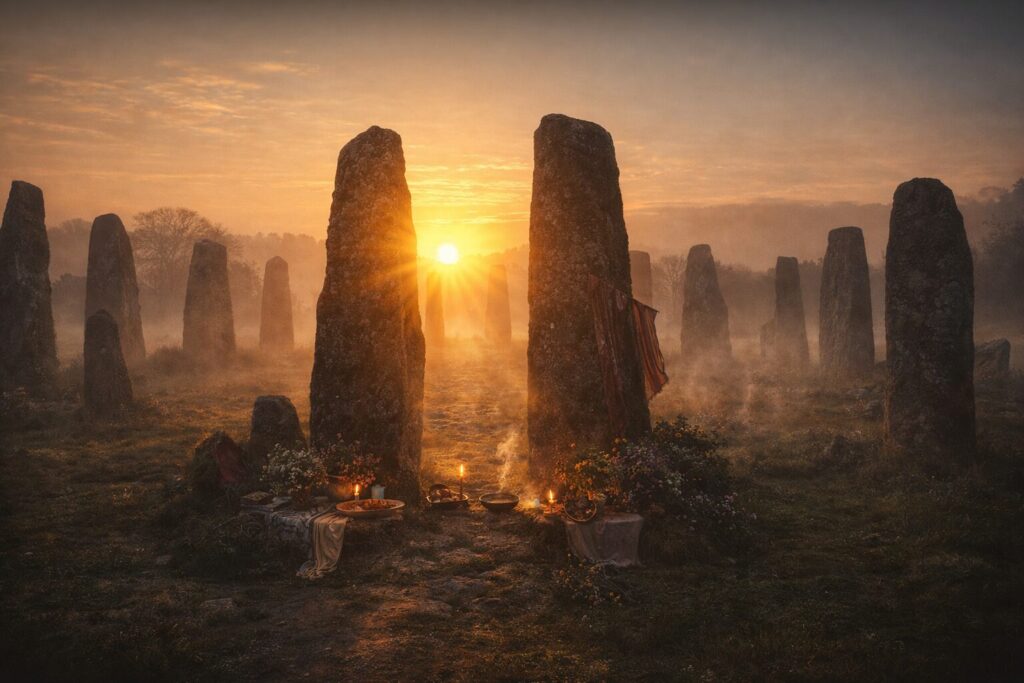
This page is not a beginner’s guide and not a manifesto. It is a meditation written from inside a living practice — an attempt to speak clearly about how reconstruction, devotion, and modern consciousness meet in contemporary Pagan life. The old religions did not vanish cleanly, nor did they survive intact. What remains is fragment, echo, and presence. Yet those remnants are not ruins alone; they are fertile ground. From them, religion rises again — differently shaped, relearned, and consciously reimagined, but still connected to the deep roots that fed it. My work stands in that generative space: not to recreate a museum past, but to participate in an ongoing renewal, a conversation with the Gods that continues to unfold in the present. This reflection is offered to those who already feel the pull of that conversation and want language for what they sense — a philosophical grammar for a devotional life still becoming.
I have never claimed to walk in the exact footprints of the ancients. The gods of old do not require imitation — they require presence. For me, Neopaganism is not a revival staged behind museum glass, but a sacred approximation: a weaving of myth, memory, and modern intuition. I do not stand as a fundamentalist guarding ruins. I stand as a mystic scholar listening for what still speaks through them.
From worn stones, scattered hymns, surviving etymologies, and fragments of ritual grammar, I approach Paganism as an act of reverent reconstruction. This work is neither archaeology nor invention. It is participation. It is the deliberate reanimation of a conversation interrupted but never silenced. Reconstruction is not about restoring a lost world exactly as it was; it is about allowing what endured to take root again in living soil.
The prefix neo- has never embarrassed me. It is a mark of honesty. The ancient religions did not survive intact. There is no unbroken priesthood, no preserved orthodoxy sealed against time. What remains are residues — poetic, linguistic, devotional — and it is from these that modern Paganism grows. The task is not to deny the gap, but to inhabit it consciously.
I do not claim to revive the old ways as they once stood. I seek instead to build a meaningful spiritual grammar from their remains. When I call upon Lugh, Helios, or Apollo, I do not collapse them into sameness. They remain distinct presences, yet they resonate across a shared field of meaning. Their names form a chord. Their stories become harmony. Reconstruction, in this sense, is not imitation — it is reweaving.
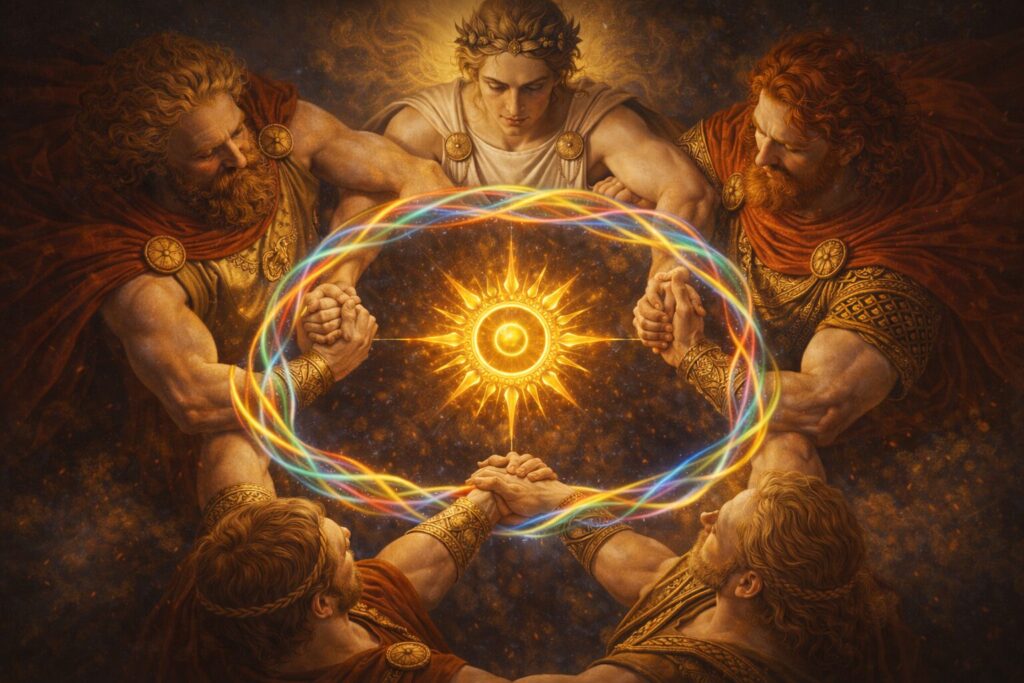
Unlike religious systems that hinge on obedience, my Paganism is relational. I honor the gods not because they command submission, but because they are worthy of honor. Relationship precedes doctrine. Encounter precedes explanation. The divine, to me, is plural, emergent, and alive — never fixed, never jealous of its own multiplicity. Reverence is not servitude. It is dialogue.
I write this not as an observer but as a participant. The gods are not metaphors to me. They are presences encountered through ritual, attention, and devotion. Theology follows experience; it does not manufacture it. Language comes after relationship, trying — always imperfectly — to describe a reality already felt.
In polytheism, difference is not a problem to be solved. It is the architecture of the sacred. The gods are distinct without requiring separation, interconnected without dissolving into abstraction. To relate to them is to enter a network of personalities, forces, and intelligences that exceed any single system. My work is not to master that network but to learn how to stand within it respectfully.
I do not seek salvation or final answers. I seek continuity of presence. Devotion is not about certainty; it is about attention. The gods endure where they are remembered, spoken to, offered to, and listened for. Relationship is maintained through practice, and practice is the language through which reverence becomes real.
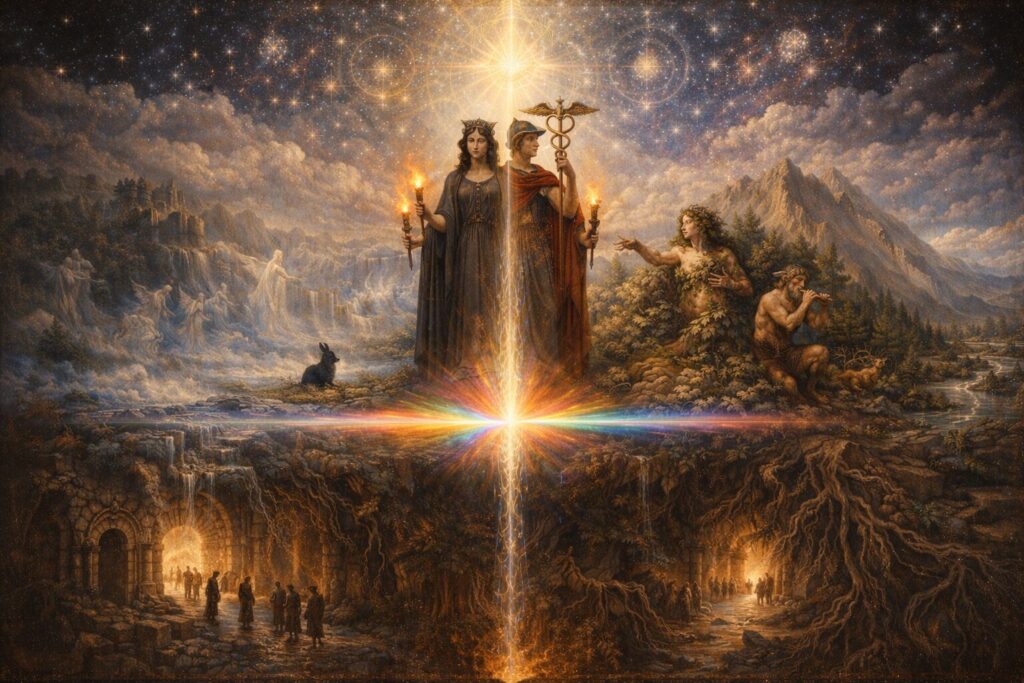
My practice leans unapologetically on scholarship. Linguistics, mythography, and comparative religion are not threats to devotion; they are tools that sharpen it. The study of myth does not dissolve the gods into symbols. It clarifies the patterns through which they speak.
Scholars such as Dumézil, Gimbutas, and generations of comparative historians have mapped recurring structures in Indo-European myth: tripartite orders, threshold goddesses, solar heroes, chthonic guardians. These patterns do not reduce the gods to archetypes. They reveal relationships — echoes traveling across cultures, names, and centuries. To recognize those echoes is not to flatten difference; it is to trace lineage.
I do not consult scholarship to contain the divine. I consult it to widen my vocabulary for encounter. Mythic continuity does not imprison the gods inside theory. It reminds me that human cultures have been listening to them for millennia, and that my work stands inside that long act of listening.
Academic study does not replace devotion. It refines perception. Comparative myth, linguistics, and historical reconstruction are instruments — ways of listening more carefully to voices that were never silent, only scattered.
Hekate is not Brigid. Apollo is not Lugh. Distinction matters. Yet the threshold where they meet — the fire’s edge where illumination touches shadow — is a shared territory. Scholarship helps me see that terrain without claiming ownership of it. The gods exceed every framework built to understand them. The frameworks remain useful anyway.
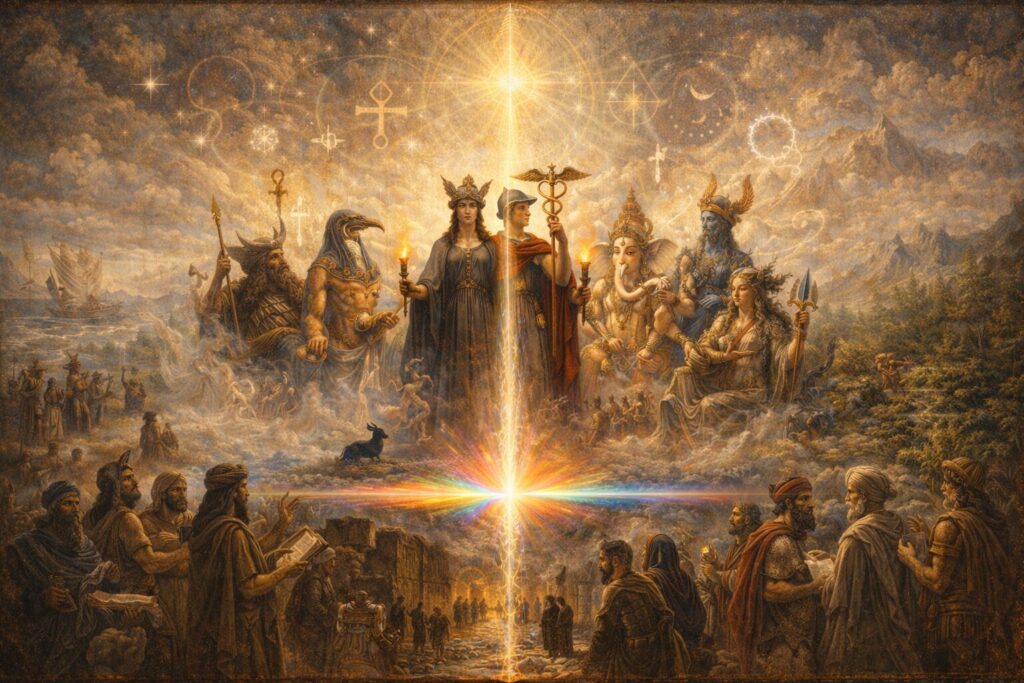
Syncretism, for me, is not confusion. It is consecration. Polytheistic religions have always grown through contact, exchange, and reinterpretation. The ancient world did not fear blending; it practiced it instinctively. Gods traveled with merchants, soldiers, and poets. Names shifted. Ritual forms adapted. Devotion survived by remaining porous.
When I layer symbols, structures, or titles, I do so consciously — not as aesthetic collage, but as liturgical composition. It is closer to music than theology. Instruments enter, withdraw, and harmonize. Tension is not failure; it is the condition that produces resonance.
My altar changes with the turning year. Solar rites lean toward light and articulation. Lunar rites move inward toward threshold and shadow. When I speak a name, I do not assume ownership of the god behind it. I make an offering of attention and wait to see what answers. Magic does not compel the divine. It invites encounter.
Syncretism is not dilution. It is the moment when many fires are allowed to burn in the same sky.
Syncretism is not the erasure of difference. It is the acknowledgment that difference can coexist without fracture. The gods do not collapse into sameness when they stand beside one another. They form constellations. To practice syncretism responsibly is to learn the grammar of those constellations — when to speak, when to listen, and when silence itself becomes an offering.
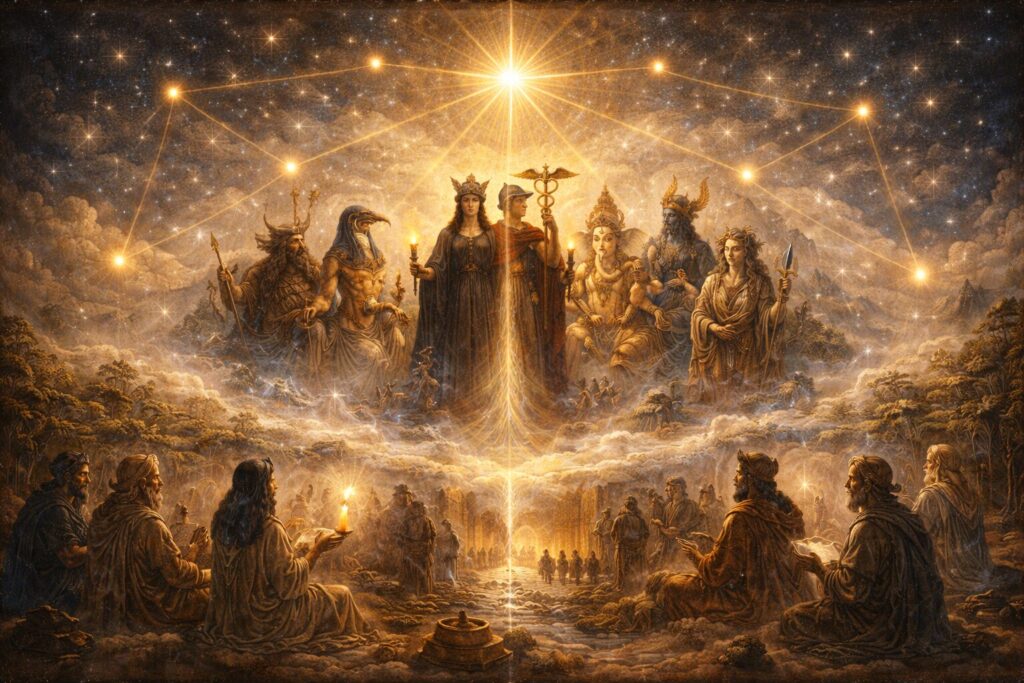
Ritual is a language. Structure gives shape to reverence, and through that shape meaning becomes audible. A rite is not a performance staged for unseen witnesses; it is a grammar through which presence becomes perceptible. Without form, devotion dissipates. With form, it gathers.
My practice moves deliberately between order and ecstasy. Intention establishes the boundary of the circle; intuition fills it. The measured gesture and the spontaneous word are not opposites. They are the twin poles of ritual speech. The Apollonian and the Dionysian meet in that tension, and it is there that the rite becomes alive.
I never believe that ritual compels the gods. It prepares the ground for encounter. A well-constructed rite does not force revelation; it cultivates attention. When presence arrives, it does so freely. The role of ritual is to make recognition possible.
Ritual is repetition without stagnation. Each return to the circle is both familiar and new. Through that repetition, relationship deepens. Through variation, it remains alive. Practice is not a ladder to escape the world. It is a discipline for inhabiting it more fully.
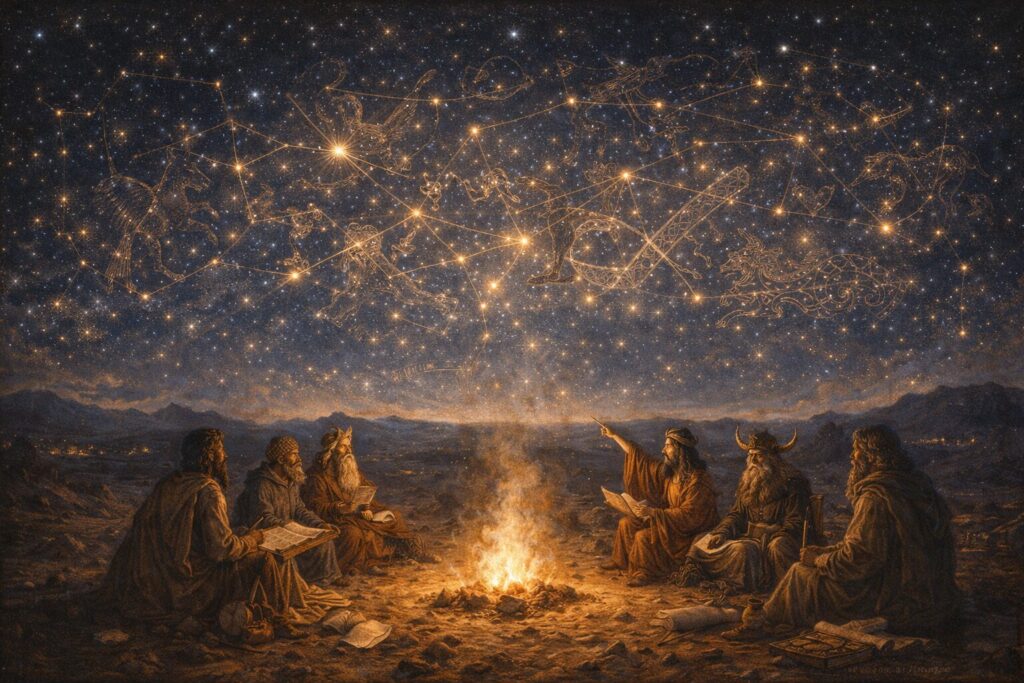
Neopaganism holds many identities, and none of them erase the others. For me, Paganism is not a single road. It is a forest. Traditions are groves within it — distinct, cultivated, and meaningful — but the forest is larger than any one path.
Wicca stands as an initiatory mystery religion shaped by Gardner and his heirs, with its own liturgy, lineage, and internal grammar. Witchcraft, by contrast, is a craft: a set of practices that can exist inside religion, outside it, or alongside it. Reconstructionist paths attempt careful historical continuity. Eclectic paths emphasize living synthesis. None of these invalidate the others. They represent different strategies for relating to the same vast terrain.
The problem arises only when one path mistakes itself for the whole forest. Paganism has no single orthodoxy to defend and no central authority to enforce it. Its coherence emerges from shared orientation: reverence for plurality, attention to land and season, and the willingness to enter relationship with forces larger than the self.
Umbrella tradition; plural religious ecology
Initiatory mystery religion with lineage
Craft practice; religious or secular
To know one’s path is not to deny the others. It is to walk clearly without demanding uniformity. The forest thrives precisely because it contains difference. Its vitality comes from overlap, edge, and exchange. A living Paganism depends on that ecology.
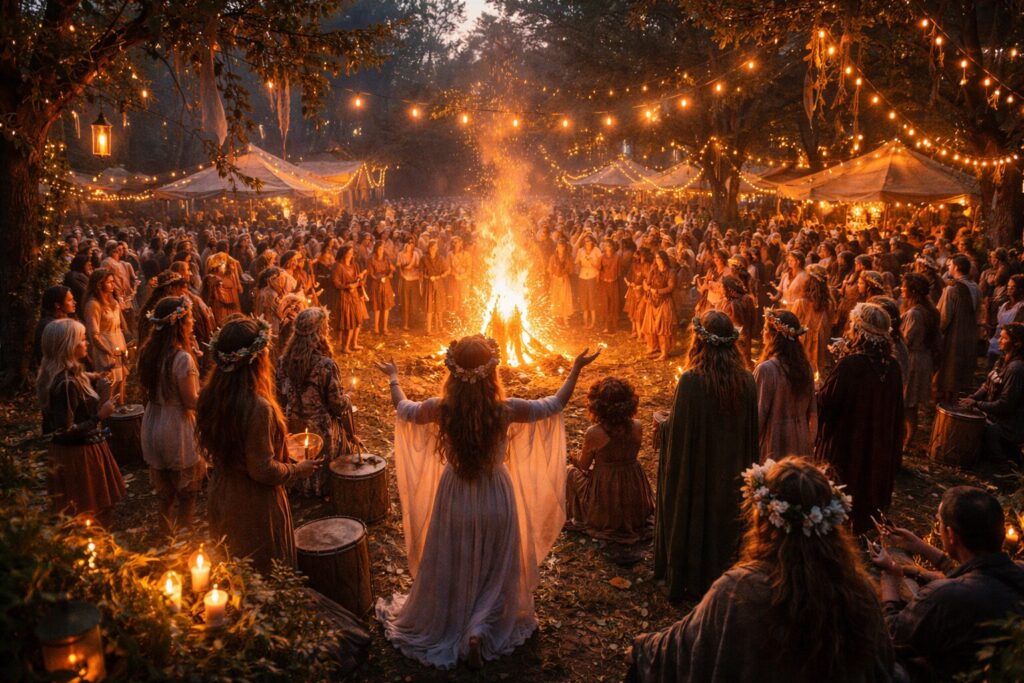
I do not pretend certainty. There are gaps, contradictions, and bridges built from speculation. Yet those liminal spaces are not failures of the path. They are where meaning takes root. Religion that claims total clarity becomes brittle. A living religion learns how to breathe inside ambiguity.
I do not worship ruins. I walk among them and speak. The gods are not relics preserved in theory; they are breath and thunder, water and word. My Paganism is not a return to an intact past. It is a reweaving — an act of continuity carried forward through attention.
When I honor them, I am changed. When I speak their names, I listen for what answers — sometimes a murmur, sometimes a silence that carries its own instruction. Devotion is not the elimination of doubt. It is the decision to remain in relationship anyway.
Certainty ends conversations. Presence keeps them alive.
For me, Paganism endures as presence. Relationship survives through practice, and practice survives through care. The gods do not demand perfection. They require attention. To remain attentive is already a form of reverence.
Gateways into the Sacred
Not a checklist, but a threshold. Choose the door that fits your questions: devotion, meaning, history, and the living work of tradition as it continues to grow.