The Triple Moon
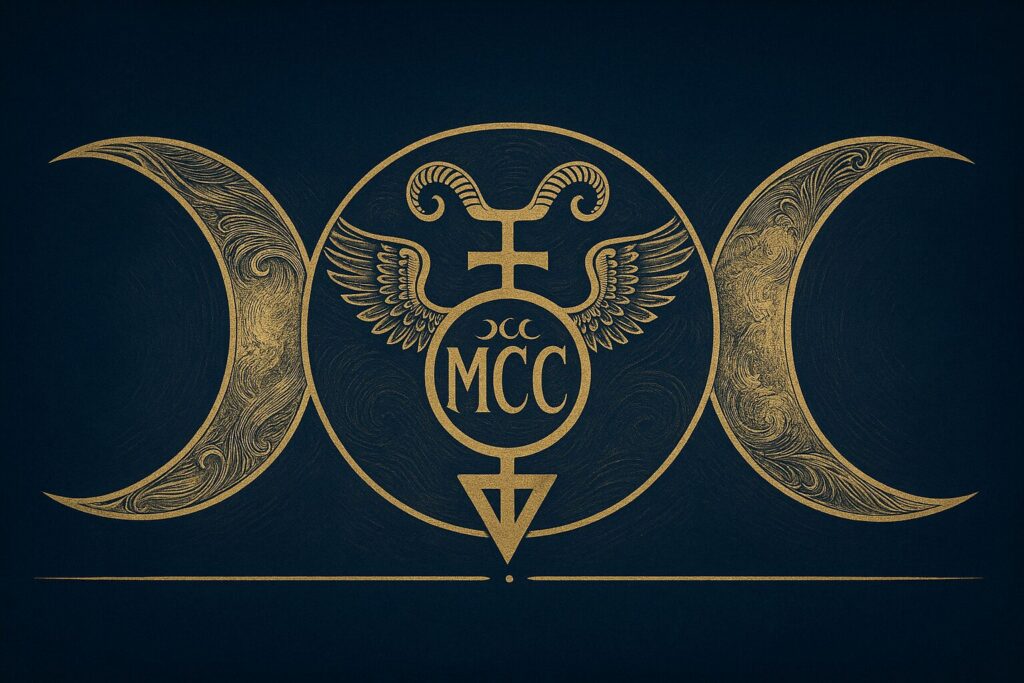
In our coven we understand the Triple Moon not simply as a symbol of the Goddess, but as a diagram of how power moves through a witch’s life. The waxing crescent, the full moon, and the waning crescent form a single gesture—a motion captured in three still shapes. While many associate the three moons with the Maiden, Mother, and Crone, we see them also as the currents of becoming, being, and releasing. Each crescent leans toward or away from fullness, reminding us that no state is static, and that every spell, every choice, every insight passes through phases of gathering, cresting, and dissolving.
In practice, the Triple Moon serves as a map for the witch’s internal seasons. The waxing crescent is the breath before the work—the spark, the intention, the reaching. The full moon is the moment of embodiment, when energy stands at its height and the witch steps fully into the current they have raised. The waning crescent is the soft and necessary undoing, the return to quiet, the wisdom of letting what has served now fall away. Within the Coven of the Veiled Moon, we use this triad to frame our workings, our teachings, and our inner journeys. To us the Triple Moon is not merely devotional; it is instructional, a compass for how magic lives, peaks, and transforms.
Though the Triple Moon is widely recognized in modern witchcraft, its lineage reaches further back than many realize. Lunar triads appear throughout ancient cultures: the Greek Selene, Artemis, and Hekate; the Roman Diana in her threefold mysteries; the Celtic Brigid whose faces shift between inspiration, craft, and transformation. These were not always depicted as crescent–full–crescent, but the idea of the moon as a being with multiple simultaneous faces is ancient, enduring, and pan-cultural.
The symbol as we know it today—waxing, full, waning in a single horizontal band—emerged into broad visibility in the 20th century with the revival of neopagan traditions. It was embraced rapidly because it distilled an old idea into a clear glyph: the moon in motion, womanhood in phases, magic in continual transformation. Some lineages attribute its spread to early Wiccan art and feminist witchcraft writings; others trace it to esoteric illustrators who began exploring lunar symbology in the 1960s and 70s. Regardless of its exact point of crystallization, the Triple Moon is not a modern invention but a modern expression of a very old intuition—that the divine, like the moon, is both cyclical and many-faced.
In our coven we understand that symbols evolve, and that their power lies not in a fixed origin but in the way they gather meaning across time. The Triple Moon carries with it the whisper of priestesses and poets, astronomers and spellcrafters, all watching the same waxing line brighten across the night sky. It is a reminder that witches today stand in a long continuum of lunar devotion, inheriting a symbol shaped by centuries of human longing, observation, and reverence.
Beyond its familiar associations, the Triple Moon holds deeper esoteric meanings that whisper beneath the surface. Some witches see the crescents as guardians or wings that bracket the full moon like an awakened eye. Others interpret it as a sigil of inner alchemy: the left crescent as past self, the center as present self, the right as the emerging form we are becoming. The symbol can also be read as the witch’s place between worlds—one foot in the seen, one in the unseen, and one in the vast, shining center where both meet. In our coven, we honor this symbol as a threshold, a reminder that every witch carries multiple selves at once, each waxing or waning with its own rhythm.
The moon is not three but one,
and we are not one but many.
What grows, glows.
What glows, teaches.
What teaches, returns us to ourselves.
The Pentacle
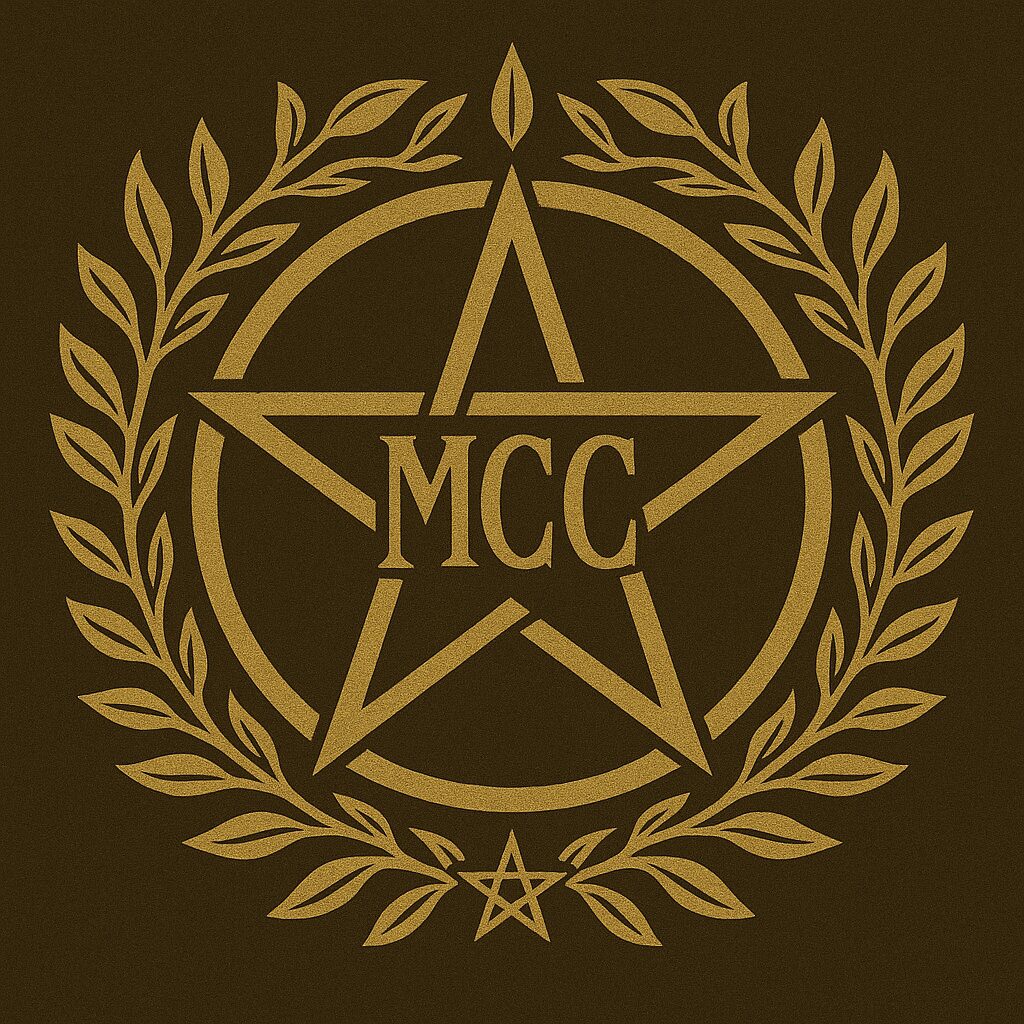
In our coven, we understand the pentacle not simply as a five-pointed star enclosed in a circle, but as a symbol of balance, protection, and the woven relationship between spirit and matter. Each point holds an element—Earth, Air, Fire, Water, and Spirit—and the circle that encloses them binds the whole into harmony. The pentacle is not an emblem of domination but of integration: a reminder that nature is not conquered by magic, but partnered with. To the witch, it is a compass of intention. To place a pentacle upon one’s altar is to declare the sacredness of the work and one’s willingness to align with forces greater and wiser than the self.
In ritual practice, the pentacle acts as both anchor and mirror. It grounds the space, delineates the center, and summons the elemental powers that shape spellcraft. The upward point—Spirit—signals that consciousness rises, guides, and illuminates the physical world. When we cast circles in the Coven of the Veiled Moon, the pentacle becomes the still point in the turning storm, the place where the witch stands in sovereignty. It is inscribed on tools, worn as jewelry, carved into candles, and placed at thresholds because it invites clarity and wards confusion. To us, the pentacle is not a charm of fear but a seal of presence.
Historically, the pentacle is far older than modern witchcraft. The five-pointed star appears in Mesopotamian tablets, Greek philosophy, Pythagorean mathematics, and early Christian iconography. Medieval grimoires used the pentacle as a sacred protective seal. Renaissance magicians saw it as the diagram of the perfected human: head, hands, and feet all extended under the guidance of Spirit. Only in the 19th and 20th centuries did misunderstandings arise that connected the symbol with malice or inversion. But these associations were born of fear, fiction, and the distortions of popular culture—not of authentic magical tradition.
In our coven we speak openly about the difference between the pentacle and the satanic pentagram, because many new witches ask. The pentacle, with the single point upward, symbolizes spirit governing matter, intention guiding energy, and the harmony of the elements. The inverted pentagram—point downward—has been used in several esoteric systems to represent materiality, instinct, or descent into the hidden or primal self. In some modern occult paths, especially LaVeyan Satanism, it was adopted symbolically, though not with the meaning many outsiders assume. The myth of the pentacle as “devil worship” is a cultural invention, not a magical truth. The two symbols share geometry but not purpose, and the inverted form’s meaning shifts depending on the tradition that uses it. For witches, the upright pentacle remains a sign of balance, sacred alignment, and the wholeness of the natural world.
Esoterically, the pentacle is a teaching in itself. Each point is a doorway, each element a teacher. Earth teaches grounding; Air, clarity; Fire, transformation; Water, intuition; Spirit, the thread that binds them all. The circle is the womb of the Great Mother, the wheel of time, and the boundary of the ritual space. Some see the pentacle as a map of the witch’s inner temple, others as a star of becoming—the luminous self rising from the crossroads of body, mind, heart, will, and soul. In our coven, we honor the pentacle as a living symbol, one that grows with the witch who works beside it.
Five points make a star,
but it is the circle that makes it holy.
What is bound is blessed,
and what is blessed endures.