Gaia: Earth Mother, First Ground, Enduring Presence
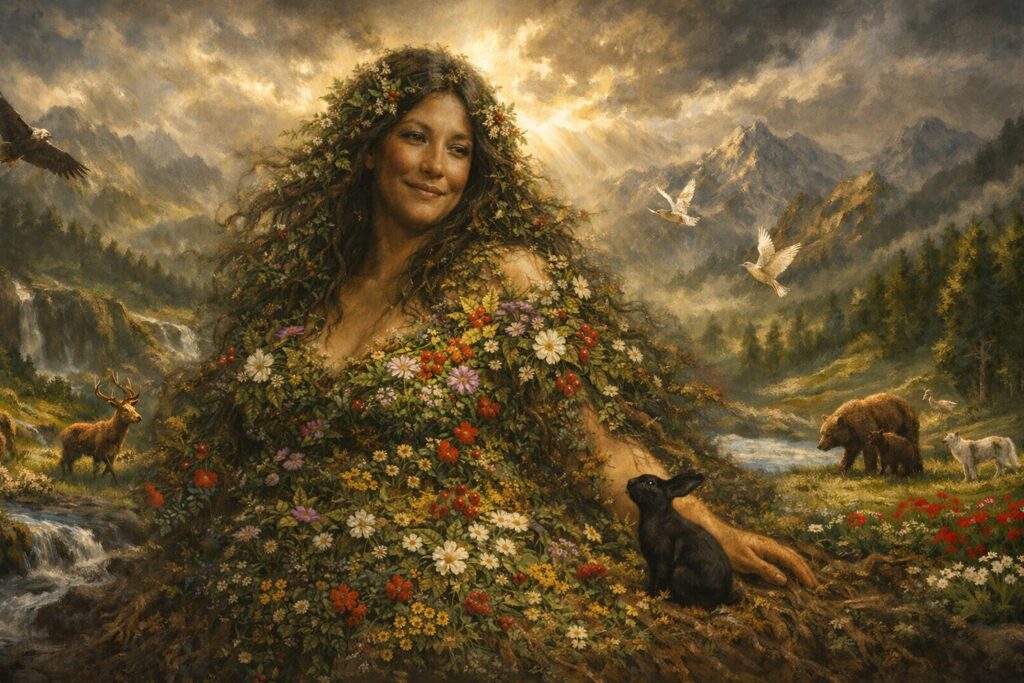
Long before her name was written in Greek, the presence we now call Gaia was already known. Human beings recognized it wherever they depended upon the living world: in the soil that yielded grain, in the forests that sheltered game, in the rivers that sustained settlement, and in the slow, faithful turning of the seasons. Before temples rose and formal theology gave language to devotion, the earth itself was already encountered as sacred — not merely as ground beneath human life, but as a presence that nourished, endured, and received all things in their time.
Within the Coven of the Veiled Moon, we use the name Gaia to speak of this ancient and abiding presence. The name is Greek, but the current it names is older than Greece and broader than any single mythology. Gaia is the Earth Mother in the deep sense: not simply a goddess of scenery, wilderness, or pleasant natural beauty, but the living consciousness of the generative world itself. She is the one through whom soil becomes harvest, root becomes tree, blossom becomes fruit, and the fragile labor of life is carried patiently forward.
To speak of Gaia, then, is not merely to speak of “nature.” Nature, in modern usage, is often reduced to landscape, environment, or resource. Gaia is more than this. She is the living earth understood as presence: the mothering ground from which life rises, the sustaining field within which it flourishes, and the enduring body to which it returns. She is abundance, fertility, nourishment, and continuity — not as abstractions, but as realities written into the world itself.
This is why Gaia has remained so spiritually powerful across time. She stands close to the beginning of religious imagination because she stands close to the beginning of human dependence. Before philosophy, before empire, before polished systems of worship, there was already the undeniable truth that life comes from the earth and remains bound to it. Every seed sown, every harvest gathered, every loaf of bread broken at table silently testifies to that older covenant.
Yet Gaia is not merely gentle. The earth that nourishes also remembers balance. The same ground that yields abundance can harden in drought, refuse the careless hand, or answer neglect with barrenness. Gaia’s generosity is immense, but it is not passive. She is motherly without being sentimental, fertile without being simplistic, sustaining without being weak. To approach her rightly is therefore to approach with gratitude, humility, and reverence rather than entitlement.
For many witches, pagans, and earth-centered practitioners today, Gaia remains one of the clearest ways of naming the sacred fact that the world is alive. She is felt in garden soil and mountain stone, in the orchard, the field, the forest, and the threshold where food is carried into the home. She is present in acts of harvest gratitude, land blessing, healing, grounding, and care for the places that sustain life. To know Gaia is not only to study an ancient goddess, but to rediscover the living world as worthy of devotion.
Within the theology of the Coven of the Veiled Moon, Gaia is therefore not treated as the deepest structure of creation itself, nor merely as a poetic symbol layered over matter. She is understood instead as the first great consciousness of the living world once it exists: the animating presence of earthly life, the mothering intelligence of generative nature, and the enduring spirit through whom the world becomes fertile, abundant, and inhabited.
Throughout history she has worn many names, appeared in many forms, and been interpreted through many traditions. Some cultures knew her directly as Earth Mother; others approached related figures under different titles, epithets, and sacred roles. Some later goddesses preserve parts of her current, while others stand beside her as distinct persons within the divine order. Yet beneath these differences the same sacred intuition persists: that the earth is not empty, not dead, and not ours to treat as mere matter.
To walk the land attentively is already to stand within her presence. To plant, to feed, to harvest, to mourn, to heal, to return gratitude to the soil — these are all ways of entering into relationship with the one who has always sustained life quietly beneath the stories of gods and humans alike.
Gaia endures because the truth she embodies endures. The ground still bears us. The world still feeds us. And the ancient mother who was known long before her name was written remains present wherever life rises from the earth.
The Presence of Gaia
Her Presence
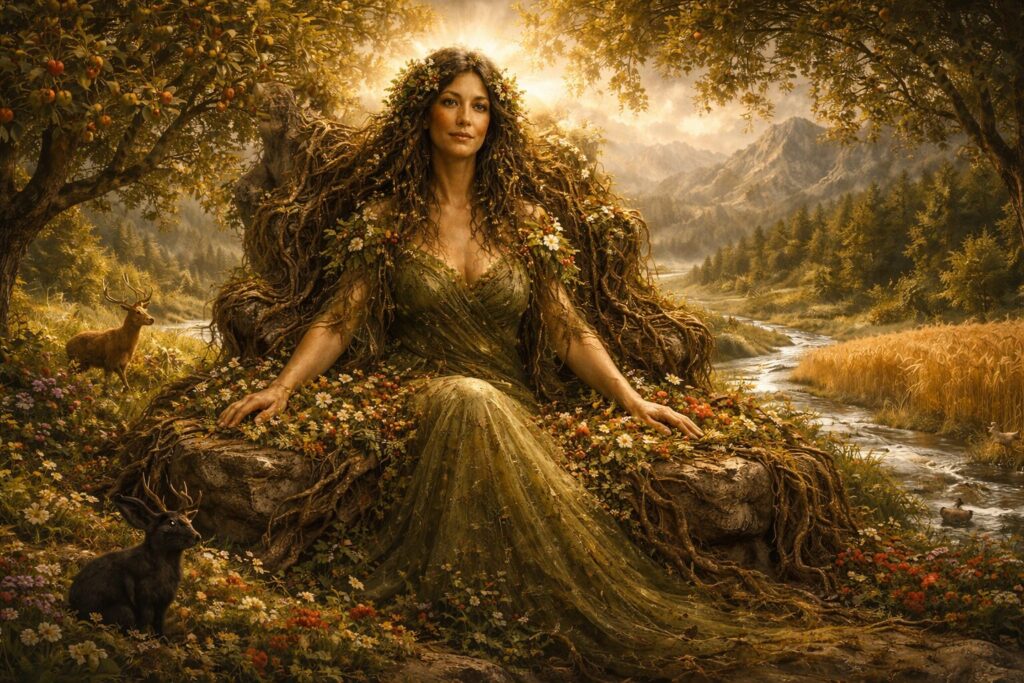
Gaia is experienced less as a distant ruler and more as the living ground beneath existence itself. She is the deep patience of soil, the slow intelligence of forests, the enduring strength of mountains, and the quiet fertility that allows life to rise again and again from the earth.
Her Temperament
Generous yet unsentimental, Gaia sustains life with immense patience but does not bend to human convenience. She embodies balance rather than indulgence, nurturing growth while allowing the cycles of decay, return, and renewal that keep the world in harmony.
What She Governs
Fertility, abundance, nourishment, healing, stability, and the generative rhythms of the natural world all fall within her domain. Wherever life emerges from soil, root, water, and stone, Gaia’s influence is present.
How She Is Encountered
Many encounter Gaia not through elaborate ritual but through relationship with the land itself — gardens, forests, fields, mountains, and the simple act of gratitude for food grown from the earth.
Her Ancient Character
Unlike many later gods who rule particular domains, Gaia represents the living world as a whole. She stands near the beginning of myth because she stands near the beginning of life itself.
The Mother Beneath All
To speak of Gaia is to recognize that life emerges from a living ground. She is the mother who feeds, shelters, and ultimately receives all beings back into the earth from which they arose.
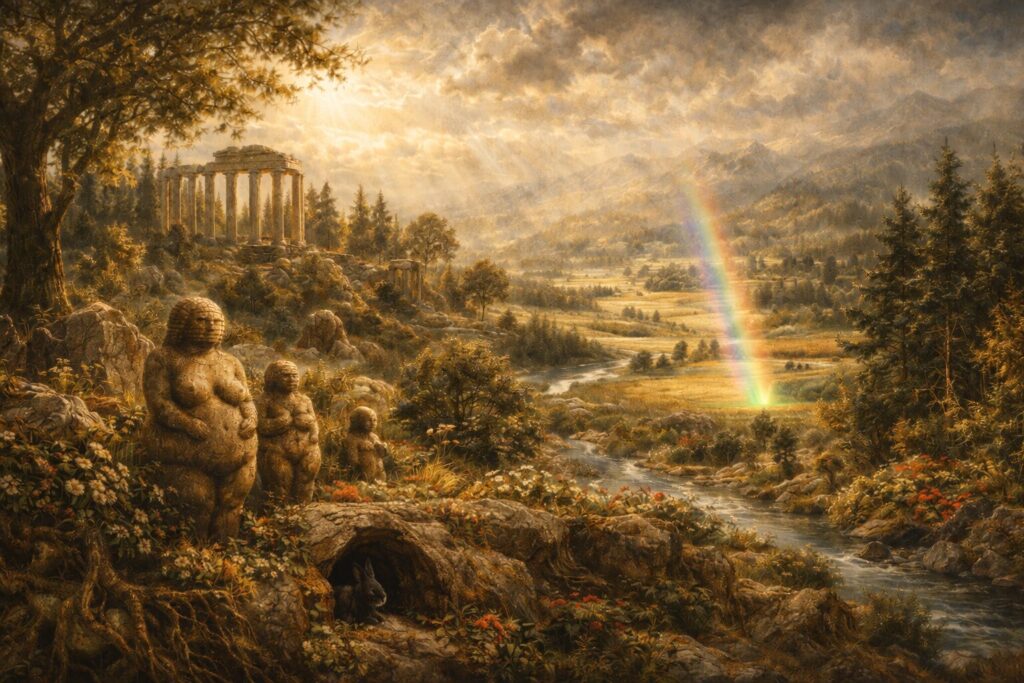
Long before her name took recognizable literary form, the presence now called Gaia was already being honored in human religious life. The earth that fed, sheltered, and received the dead was too immediate, too necessary, and too powerful to be treated as mere backdrop. Across prehistoric cultures, the recurring intuition appears again and again that the land itself is alive, fertile, and maternally sustaining. Archaeology cannot prove a single unified Earth Mother cult stretching unbroken across all regions and eras, and it is wise not to claim more certainty than the evidence allows. Yet the pattern is difficult to ignore: long before refined mythologies emerged, human beings repeatedly seem to have recognized the generative ground of life in maternal and sacred terms.
In Greek tradition this ancient current was given one of its clearest names: Gaia, the earth itself as divine presence. In early cosmological thought she stands near the beginning, among the first realities through which the world becomes habitable and alive. Yet even there she is not merely a character among others. She is the first ground, the sustaining field, the mothering presence from which many later beings arise. Greek myth preserves her not simply as a fertility figure, but as one of the oldest and most foundational divine realities imaginable: older than the Olympians, older than the dramas of heroic culture, older than the structured civic religion that later defined much of the classical world.
As Greek religion developed, Gaia’s prominence changed. The great Olympian gods became more central in literature, public cult, and temple identity, while primordial deities often receded into a more ancient and backgrounded role. Even so, Gaia did not vanish. She remained present in sacred geography, in old mythic memory, and in places where the earth itself was treated as spiritually charged. Traditions associated with deep earth sites, caves, fissures, and oracular ground preserve echoes of an older religious sensibility in which the land itself was not just symbolic, but numinous. The memory of Gaia persisted wherever the earth was still felt as witness, source, and power.
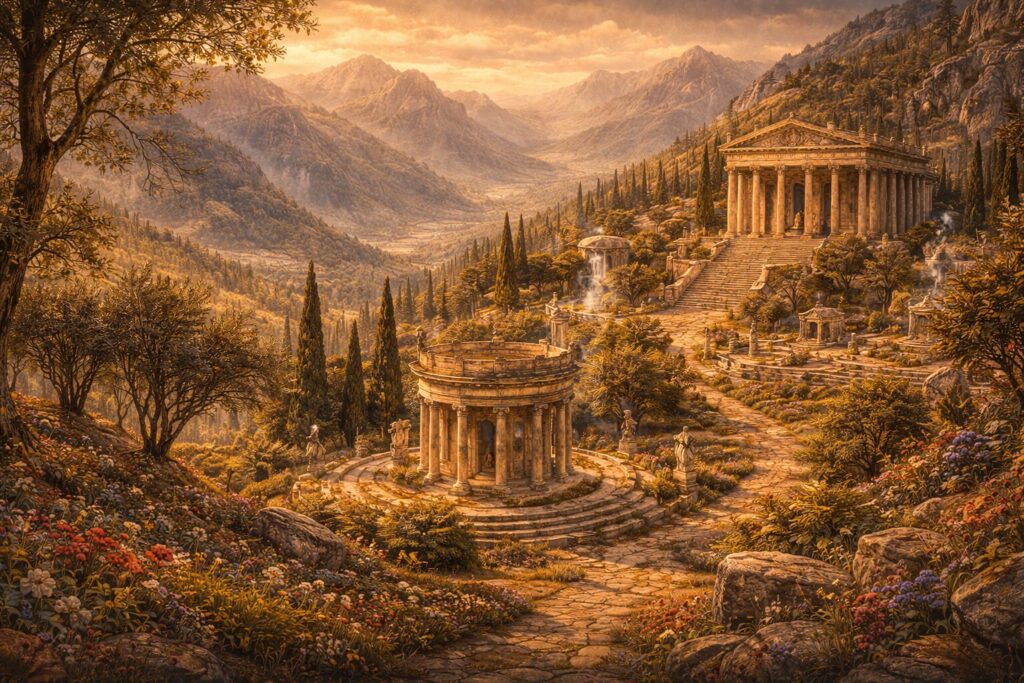
One of the most striking aspects of Gaia’s long history is the way she becomes both older and less visible at the same time. She is among the earliest divine beings, yet later traditions often mention her more as origin than as immediate object of devotion. This is not unusual for primordial powers. The older a deity is, the more likely later mythologies are to build upon that foundation rather than remain centered on it. Gaia, in this sense, was never erased completely, but she was often absorbed into later structures of meaning: ancestral genealogy, sacred landscape, agricultural reverence, and the quiet assumption that the earth itself remains alive beneath all later theology.
Outside the Greek world, closely related figures appear under other names. Roman religion knew Terra Mater. Germanic tradition preserved Nerthus as a sacred earth-associated mother. Mesopotamian religion spoke of Ki. Other cultures developed more localized or specialized mother figures tied to grain, land, fertility, mountains, or kingship. These are not all identical, nor should they be carelessly collapsed into a single interchangeable goddess. Yet they reveal a remarkable continuity of sacred intuition: the earth is not merely matter. It nourishes, bears, witnesses, and renews. That intuition survives shifts in culture even when mythic language changes.
In the medieval and early modern periods, explicit Earth Mother theology often became less visible across much of Europe, especially under dominant monotheistic frameworks. Yet old instincts endured in folk practices, agricultural customs, sacred wells, land taboos, seasonal rites, and reverence for certain landscapes. The sacredness of earth was often displaced, renamed, moralized, or concealed, but it did not wholly disappear. Human dependence on land remained too fundamental for that. Even where the old goddess was no longer openly named, the memory of living ground persisted in custom and sensibility.
In modern pagan and witchcraft traditions, Gaia returns with renewed force. Sometimes she returns through classical revival, sometimes through ecological spirituality, sometimes through animism, and sometimes through the simple recognition that the earth must again be treated as sacred if human beings are to live well within it. For some, she is encountered first as symbol; for others, as living deity. For many witches, druids, and earth-centered practitioners, she becomes a name through which reverence for the living world can be spoken again with clarity and devotion.
Yet her modern revival also requires discernment. Gaia is sometimes flattened into a vague environmental abstraction, or reduced to a sentimental “nature goddess” with little depth, personality, or theological seriousness. Such reductions miss what has made her endure for so long. Gaia matters not merely because she symbolizes nature, but because she names one of the oldest spiritual recognitions human beings possess: that the world which bears life is alive in ways deserving reverence, gratitude, caution, and love.
So across time her form changes, her language shifts, and her stories are interpreted differently, but the deeper presence remains. Before philosophy, before empire, before many later gods became culturally dominant, there was already the awareness that the earth itself is not empty. That awareness is what endures in Gaia. Her history is not simply the history of one mythological figure. It is the history of one of humanity’s oldest and most persistent ways of recognizing the sacred.
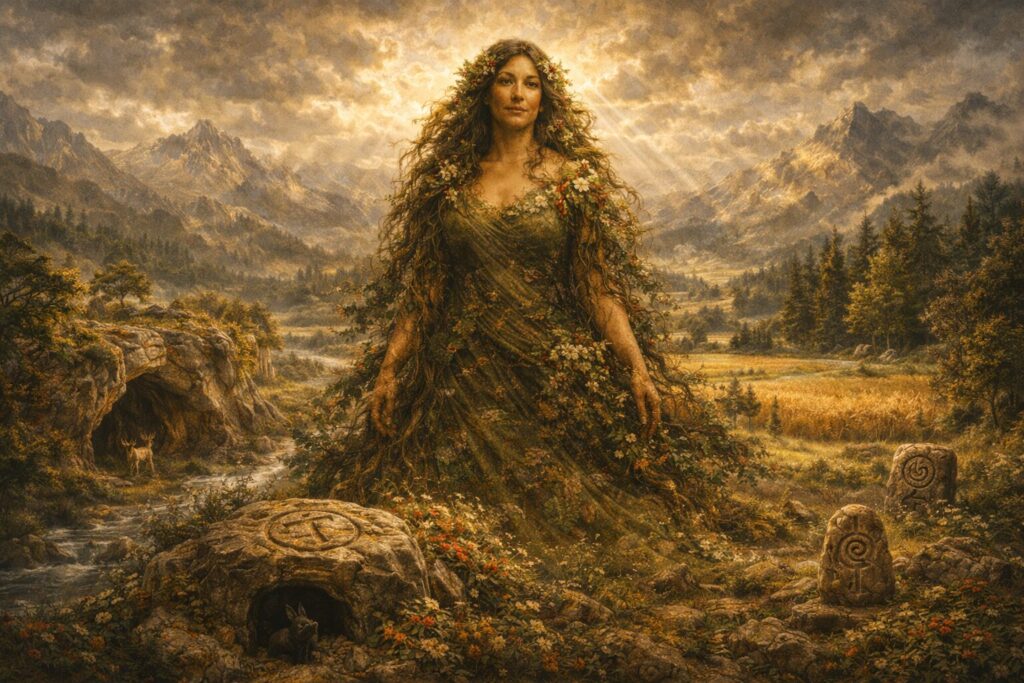
Names, Titles, and Syncretic Currents
Gaia is a Greek name, but the sacred reality it points toward is older and broader than any one mythology. Across cultures the Earth Mother has been encountered through many titles, figures, and devotional forms. Some of these clearly reflect the same deep current. Others stand beside it as related yet distinct divine personalities. To read them well requires both reverence and discernment.
In Greek tradition, Gaia names the living earth itself: fertile ground, sustaining mother, and the first great presence through which the world becomes habitable and generative. Within the Coven of the Veiled Moon, we use this name because it is clear, recognizable, and theologically rich. Yet we do not mean to confine the Earth Mother to Greek mythology alone.
Rather, Gaia functions here as a sacred name for the broader current of the living earth — the mothering consciousness of the world that nourishes, bears, and renews life. In that sense the name is specific, but the presence it names is larger than one literary tradition.
Many traditions preserve figures who appear very close to Gaia in sacred function. Roman religion knew Terra Mater, a nourishing mother of the land. Mesopotamian tradition spoke of Ki as earth. Germanic religion preserved the figure of Nerthus, associated with fertility, prosperity, and the life of the people through the land itself.
These figures are not identical in mythic detail, but they often reflect a recognizable pattern: the earth understood as a maternal, sustaining, and life-bearing presence. Within the Coven, such figures may be treated as expressions of the same broad Earth Mother current, even while their cultural forms remain distinct.
Some goddesses arise from the broader Earth Mother field yet take on more specialized forms. Demeter, for example, is deeply tied to grain, agriculture, and cultivated fertility. Rhea carries the dignity of divine motherhood in another register, especially as ancestral mother within Greek tradition. These goddesses are related to Gaia, but not reducible to her.
This distinction matters. If every maternal figure is collapsed into one undifferentiated “great goddess,” personality and theological precision are lost. Gaia is the living earth in her broadest generative sense; other mother goddesses may preserve that current, focus it, regionalize it, or develop different sacred personalities altogether.
Syncretism can be spiritually useful when it helps practitioners recognize genuine continuity across cultures. It becomes harmful when it turns every resemblance into identity. The Coven of the Veiled Moon therefore approaches such questions carefully: some figures can reasonably be read as expressions of the same deep current, while others should be honored as related but distinct.
With Gaia this means two things at once. First, the Earth Mother appears under many names in world religion. Second, not every goddess of fertility, motherhood, or land is therefore “just Gaia.” Reverence requires subtlety. The divine world is not chaos, but neither is it a single bland unity.
The names change, but the sacred intuition remains familiar: the earth is alive, sustaining, and worthy of reverence. To call her Gaia is one way of speaking clearly about that enduring presence without denying the many forms through which cultures have known her.
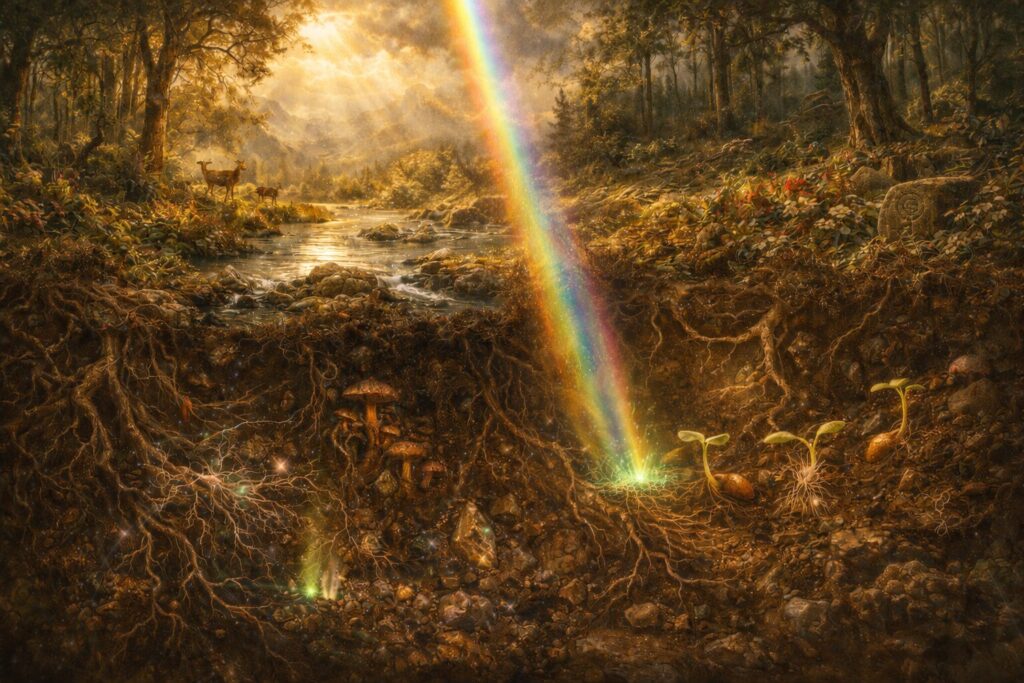
It is common in modern language to describe Gaia as a “goddess of nature,” but this phrase can easily mislead if taken too literally. In contemporary speech, nature often refers to scenery, wilderness, or the environment — forests, rivers, animals, and landscapes existing alongside human civilization. Gaia, however, represents something deeper and more fundamental than this. She is not simply the guardian of nature or its symbolic patron. She is the living earth itself, the generative ground from which the world’s life arises.
To understand Gaia only as a nature goddess would therefore be to diminish her scope. Nature is what grows upon the earth, but Gaia is the earth that makes such growth possible. Soil, stone, water, and the slow processes of fertility and renewal belong to her domain because they are expressions of the living ground itself. The forests and fields that humans call “nature” are simply the visible flowering of deeper generative powers that Gaia sustains continuously.
Within the theology of the Coven of the Veiled Moon, Gaia is therefore approached not merely as the spirit of wilderness, but as the animating presence of the entire living world. The cultivated field and the untamed forest alike arise from her body. The garden that feeds a household, the orchard that ripens fruit, and the mountains that hold ancient stone all belong to the same sacred ground. She is not confined to untouched landscapes or remote wilderness; she is present wherever life grows from the earth.
This understanding also clarifies why Gaia is both nurturing and uncompromising. The earth gives generously, but it does not suspend the laws that sustain life. Fertility requires balance. Soil must rest, water must flow, and careless exploitation eventually exhausts the very ground that once gave abundance. Gaia therefore embodies a form of wisdom older than human civilization: life flourishes only when it remains in right relationship with the conditions that sustain it.
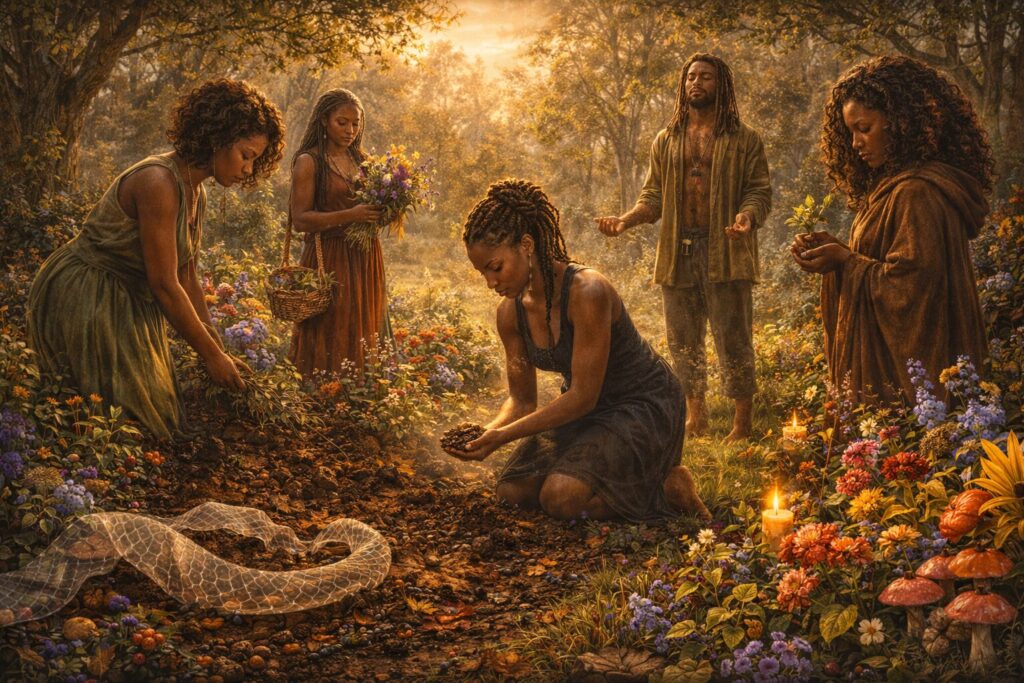
For this reason many practitioners experience Gaia not primarily through mythic narrative, but through practical relationship with the land itself. Tending soil, growing food, blessing harvest, and offering gratitude to the earth are all forms of devotion because they acknowledge the living source from which nourishment comes. Such acts recognize Gaia not as an abstraction but as the sustaining presence beneath daily life.
Seen in this way, Gaia is not simply “nature.” She is the living foundation upon which nature unfolds. Forests, fields, rivers, animals, and human communities all arise within her body, participate in her cycles, and ultimately return to her care. To honor Gaia is therefore to honor the living earth itself — the ground that feeds, shelters, and continually renews the fragile miracle of life.
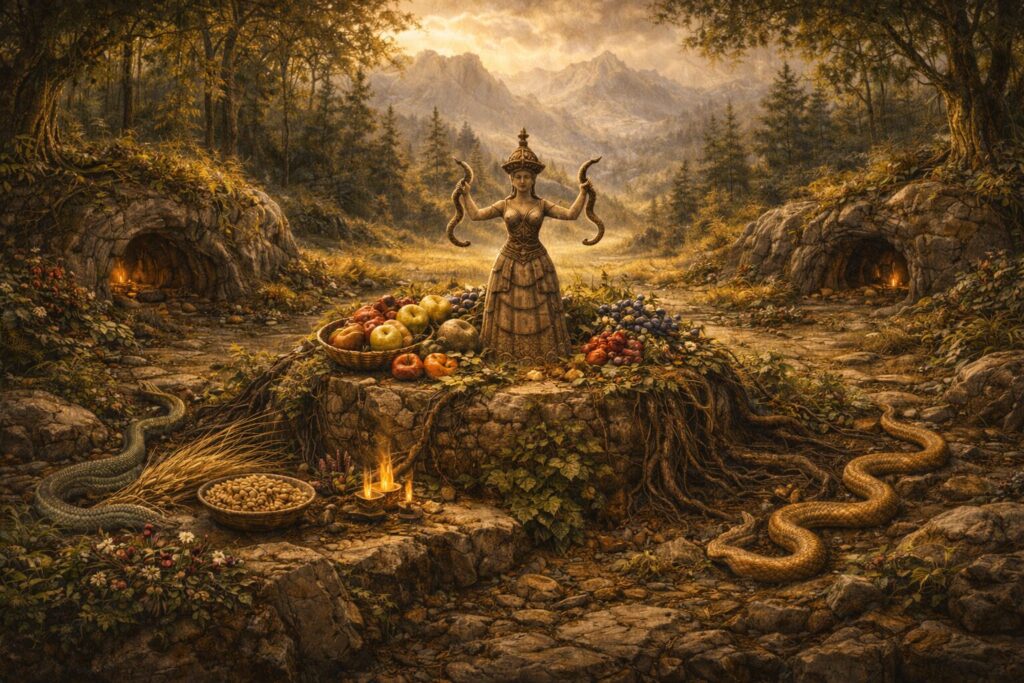
Symbols of Gaia
Across myth and tradition, certain images consistently appear in connection with the Earth Mother. These symbols do not represent Gaia in a literal sense, but they express the qualities through which her presence becomes visible in the world: fertility, endurance, nourishment, and the deep generative powers of the earth.
Fertile Soil
Rich soil represents Gaia’s most immediate gift: the power to sustain life. Every harvest, garden, and field depends upon the quiet fertility of the ground. Soil reminds practitioners that nourishment does not arise from human effort alone but from the living earth beneath it.
Mountains
Mountains symbolize Gaia’s endurance and stability. They represent the ancient bones of the earth — enduring presences that outlast generations and civilizations, reminding humanity of the immense timescales through which the world evolves.
Fruit and Grain
Fruit, grain, and cultivated crops express Gaia’s abundance. Through them the earth becomes nourishment, transforming soil and sunlight into sustenance that feeds entire communities.
Caves and Deep Earth
Caves, fissures, and deep earth spaces evoke Gaia’s chthonic dimension — the hidden depths where life begins and to which it eventually returns. Such places were often treated as sacred thresholds between the surface world and deeper spiritual realities.
Serpents
Serpents frequently appear in connection with earth powers. Their ability to shed skin symbolizes renewal and regeneration, while their association with burrows and stone links them closely to the deep living currents of the land.
The Omphalos Stone
In ancient Greece the omphalos, or “navel stone,” marked sacred centers of the earth. At Delphi such a stone was believed to represent the navel of the world — a point where divine presence and earthly ground met. For many traditions it symbolizes the living center of Gaia herself.
Sacred PlacesThe Gifts and Currents of Gaia
Those who turn to Gaia usually do not seek spectacle. They seek steadiness, nourishment, increase, healing, and a renewed relationship with the living world. Her gifts are rarely sudden or theatrical. More often they are slow, fertile, and enduring — the kind of blessings that make life possible, sustainable, and rooted.
Fertility
Gaia is deeply associated with fertility, not only in the narrow sense of reproduction, but in the broader sacred sense of all healthy increase. Gardens, fields, households, and communities flourish through the generative current she sustains.
Abundance
The Earth Mother is a source of provision. Grain, fruit, roots, herbs, and harvest all reflect the abundance of the living earth. To approach Gaia is often to seek not excess, but enough: enough nourishment, enough stability, enough life to continue in blessing.
Healing
Gaia’s healing current is patient and restorative. It appears in the medicinal virtues of plants, in rest, in bodily renewal, and in the slow mending that occurs when life is brought back into right relationship with the ground that sustains it.
Grounding
Many turn to Gaia in times of anxiety, fragmentation, or spiritual exhaustion. Her presence is stabilizing. She reminds the practitioner of first things: breath, body, food, earth, season, and the quiet reality that one is held by a world older and steadier than human turmoil.
Stability
Gaia is not quick or restless. Her power is slow, structural, and enduring. For this reason she is often approached when one seeks household peace, rootedness, prosperity that can last, or a stronger bond with place and land.
Renewal
The earth does not merely sustain what already exists; it renews what has fallen into decline. Compost becomes growth, winter yields to spring, and what returns to the soil can rise again in new form. Gaia’s current is therefore closely tied to regeneration and the long wisdom of return.
To receive Gaia’s gifts is often to be returned to simplicity: food, ground, season, healing, gratitude, and the enduring conditions that allow life to continue.
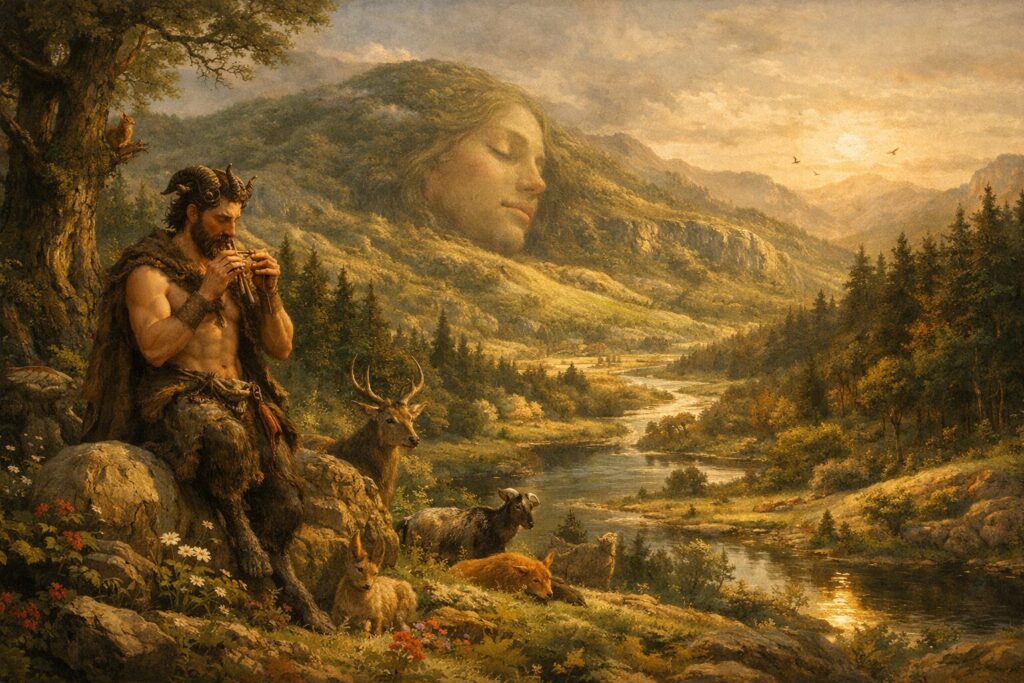
Honoring Gaia
Gaia is most often honored through sincerity, gratitude, and reverent participation in the life she sustains. Flowers, grain, fruit, bread, herbs, soil, and seasonal feasts all speak naturally to her because they arise from the earth and return thanks to it. To honor Gaia is to remember that nourishment is sacred, that land is not empty, and that the world which feeds us is alive.
Simple offerings are often the most fitting for Gaia: fresh water, bread, grain, fruit, milk, honey, seasonal produce, wine, or a small libation poured directly to the earth. Such gifts are meaningful not because they are extravagant, but because they return to the Mother something of what she has already given.
Offerings to Gaia are often strongest when they are natural, local, and sincere. A handful of grain, a crust of good bread, an apple from harvest, or water poured to the roots of a tree can carry more devotional weight than anything ornate but hollow.
Fresh flowers, herbs, seeds, roots, cut greenery, and baskets of produce all belong naturally to Gaia. These offerings speak to her generative power and to the visible beauty of life rising from the earth. Many practitioners honor her by laying flowers at the base of a tree, placing herbs upon an altar, or returning plant matter to the soil in gratitude.
For those who work closely with plants, the study of Herbs and Herbalism can become part of a devotional relationship with Gaia herself.
Gaia is especially fitting to harvest feasts, tables of thanksgiving, and communal meals offered in gratitude for what the land provides. Bread broken together, fruit gathered in season, grain made into food, and wine poured in thanks all reflect her abundance.
In this sense Gaia is not only a goddess of fertility, but of sustenance. She is present wherever food is reverently prepared, shared, and understood as a gift from the living earth rather than a thing to be taken for granted.
One of the most meaningful ways to honor Gaia is to care materially for the places that sustain life. Gardening, feeding soil, planting trees, cleaning neglected land, blessing a threshold, or leaving a place better than it was found can all become acts of devotion.
Reverence for Gaia is strongest when gratitude becomes practical. The Earth Mother may be praised in prayer, but she is also honored through stewardship, patience, and tangible care for the places where life continues.
Gaia may also be honored indoors. A bowl of fruit, seasonal flowers, a small stone from a beloved place, bread upon the table, or a dish of soil on an altar can all become simple but meaningful devotional gestures. Household reverence to Gaia often centers on food, shelter, continuity, and the sacredness of what sustains daily life.
Materials such as grain, clay, salt, stone, and water all carry the weight of the earth itself. In particular, Salt can be used in rites of blessing, preservation, and purification when one wishes to honor the earth in its older and more elemental forms.
Gaia is generous, but she should not be approached casually. The earth nourishes, yet it also remembers balance. To honor Gaia is not only to ask for blessing, abundance, or healing, but to return respect in word and deed. Offerings without gratitude, requests without humility, and reverence without responsibility ring hollow before the Mother who sustains all life.
To stand before Gaia rightly is to remember that life depends upon gifts humans did not create. Reverence begins there.
To honor Gaia well is not merely to admire the earth, but to answer its gifts with gratitude, care, and reverence.
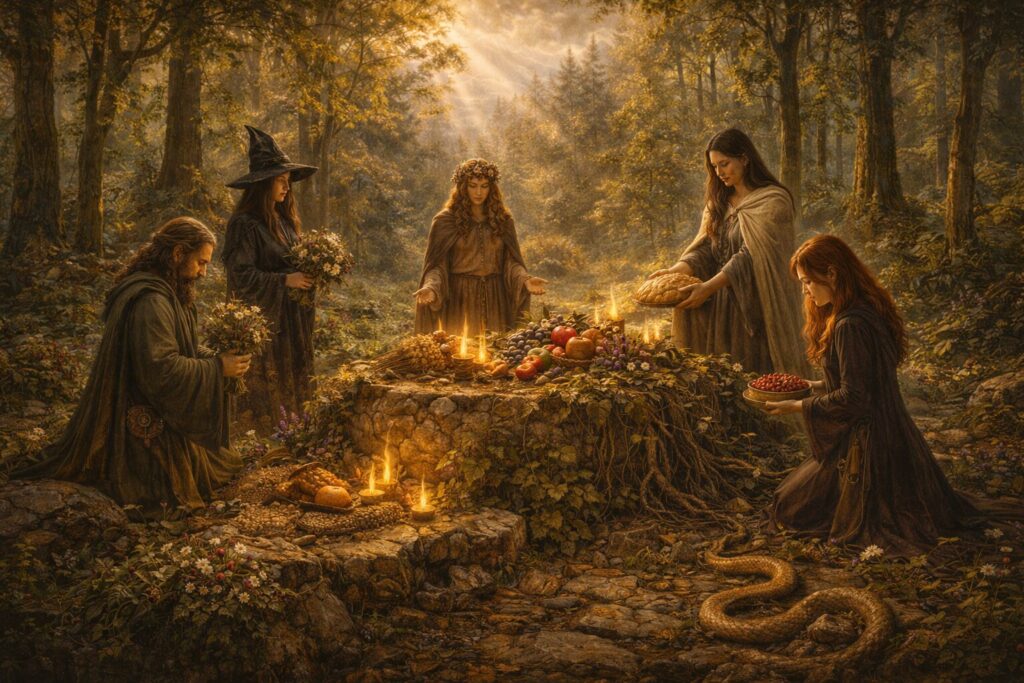
Gaia and the Wheel of the Year
While some deities are strongly associated with particular festivals, Gaia is present throughout the entire turning of the year. The sacred cycle known as the Seasonal Celebrations marks the rhythm of the earth itself — awakening, flowering, ripening, decline, and rest. The Wheel of the Year can therefore be understood as the breathing of Gaia herself.
At Imbolc the first subtle movement of spring begins beneath the soil. Seeds remain hidden, yet the earth is quietly awakening. This moment reflects Gaia’s promise that life continues even after the stillness of winter.
At the spring equinox the balance of light and darkness returns. Green shoots break through soil and the living earth reveals its renewal. Gaia appears here as the rising vitality of the world.
Beltane celebrates the fertile explosion of life. Blossoms open, animals breed, and growth becomes exuberant. Gaia is experienced as the generative power of nature at its most joyful.
At the summer solstice the earth stands at the height of vitality. Fields flourish and the power of sunlight nourishes the world. Gaia’s presence is felt as fullness, warmth, and thriving life.
Lammas marks the first harvest. Grain and food begin returning from field to table. Gaia is honored here as provider and nourisher, the source from which sustenance flows.
Harvest SabbatsThe autumn equinox brings another moment of balance. Harvest is gathered and gratitude becomes central. Gaia appears as the generous ground that has sustained life through the growing year.
At Samhain the cycle of life returns toward the soil. Leaves fall, the land rests, and what has lived returns to Gaia’s body. She becomes the keeper of endings and the womb from which life will rise again.
Wheel of the YearIn the deep winter of Yule the earth rests beneath the dark. Yet within that stillness the next cycle of life is already forming. Gaia holds the quiet promise of renewal waiting beneath the frost.
The Wheel of the Year does not merely mark seasonal change. It reflects the breathing rhythm of the living earth itself.
Gaia and Oaths
In ancient thought, the earth itself could witness truth. Gaia was not only mother and sustainer, but also a presence before whom words carried weight. To swear falsely before the living ground was no small thing, for the earth remembers what is spoken upon it.
This older intuition reflects a profound theological idea: the world is not indifferent to human conduct. The land that nourishes life also bears witness to how that life is lived. In this sense Gaia is connected not to abstract law, but to consequence — the quiet certainty that falsehood, exploitation, and broken faith eventually return to the ground from which they arose.
For modern practitioners, this aspect of Gaia can be understood as the moral gravity of the living world itself. Oaths, promises, and acts of responsibility gain depth when spoken with the awareness that the earth is not merely beneath us, but around us, sustaining us, and remembering the shape of our actions.
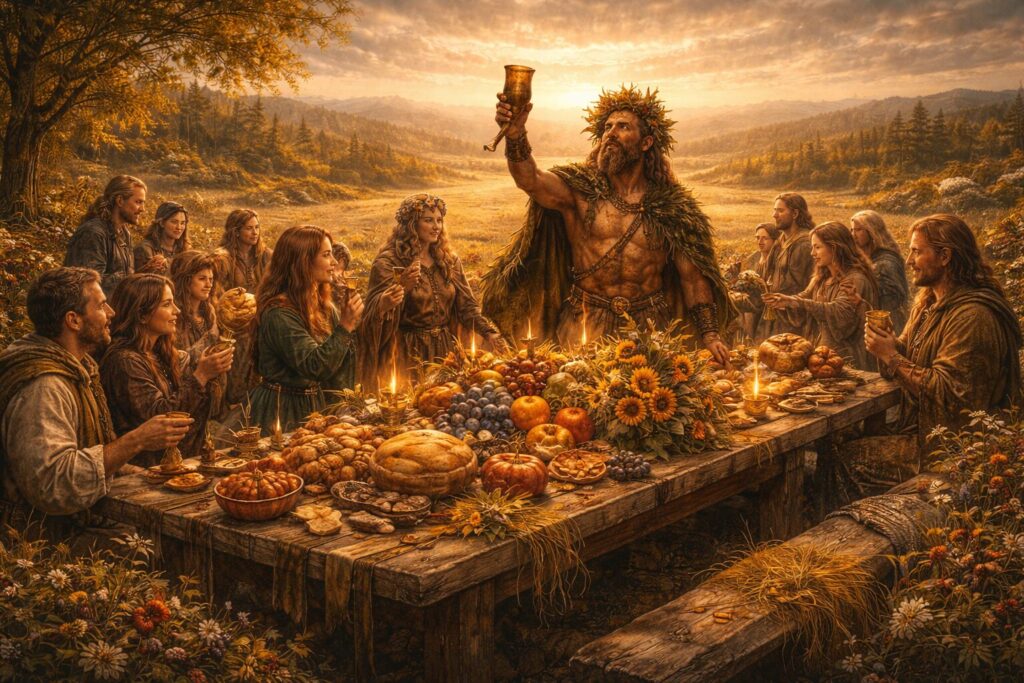
Sacred Places of Gaia
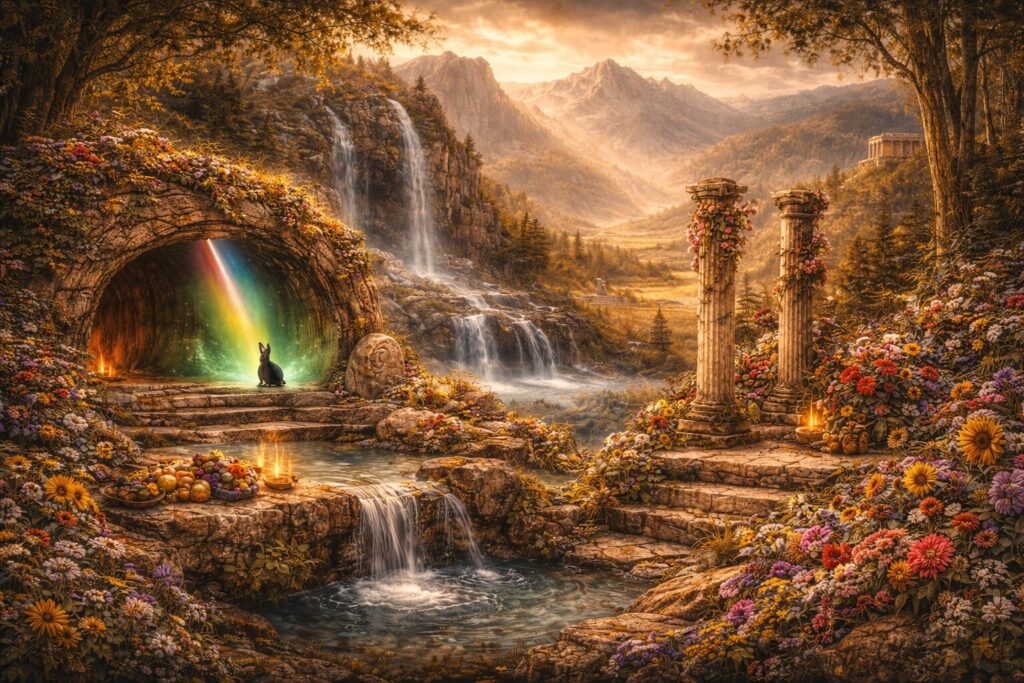
Gaia is not confined to temples or shrines alone. Her presence is most naturally encountered in the landscapes that sustain life — forests, hills, fertile fields, springs, caves, stones, and cultivated ground. Throughout history, people have recognized certain places where the living earth feels especially powerful, and such places become natural sanctuaries of the Earth Mother.
Mountains and High Places
Mountains symbolize Gaia’s age, endurance, and visible greatness. Their ancient stone and commanding presence often inspire awe, and many traditions have treated high places as natural meeting points between heaven and earth, where the body of the land is most powerfully felt.
Forests and Groves
The deep quiet of trees, the layered life beneath the canopy, and the slow rhythm of growth and decay all reveal Gaia’s generative character. Sacred groves across many cultures became places of offering, prayer, and quiet approach to the living world.
Caves and the Deep Earth
Caves and natural openings in the earth have long symbolized the womb and depth of the land. They evoke Gaia’s chthonic dimension — not death alone, but mystery, gestation, return, and the hidden power from which life arises.
Springs, Wells, and Rivers
Water emerging from the ground has often been treated as a sign of the earth’s life-giving power. Sacred wells and springs were places of blessing, offering, and healing, reminding practitioners that Gaia nourishes not only through soil, but through the flowing renewal of water.
Fields, Gardens, and Cultivated Land
Cultivated land is no less sacred than wilderness. Fields that yield grain, gardens that produce herbs and vegetables, and orchards heavy with fruit all reveal the partnership between the Earth Mother and those who tend her gifts with care and gratitude.
Ancient Stones and Centers of Earth
Certain stones, standing places, and sacred centers have long been understood as points where the earth’s power is concentrated or made visible. Such places remind devotees that sacred geography is not random — some landscapes feel like the earth speaking more directly than others.
Honoring Gaia Anywhere
Though some landscapes carry extraordinary spiritual resonance, Gaia is not limited to distant pilgrimage sites or ancient shrines. A quiet garden, a bowl of soil upon an altar, a beloved tree, a patch of earth by a doorstep, or a stone gathered reverently from a meaningful place can all become points of relationship. Wherever the land is approached with gratitude and care, the presence of Gaia may be honored.
To seek sacred ground is ultimately to rediscover the living earth itself. Mountains, fields, gardens, caves, and quiet springs remind us that Gaia is not only remembered in myth, but encountered in the landscapes that sustain us every day.
Gaia, Serpents, and the Cycle of Return
Gaia is not only the mother of growth and abundance, but also the keeper of deeper earthly rhythms: hidden power, renewal through shedding, and the great cycle by which all life returns to the ground from which it came. These symbols and ideas reveal a more ancient and solemn face of the Earth Mother.
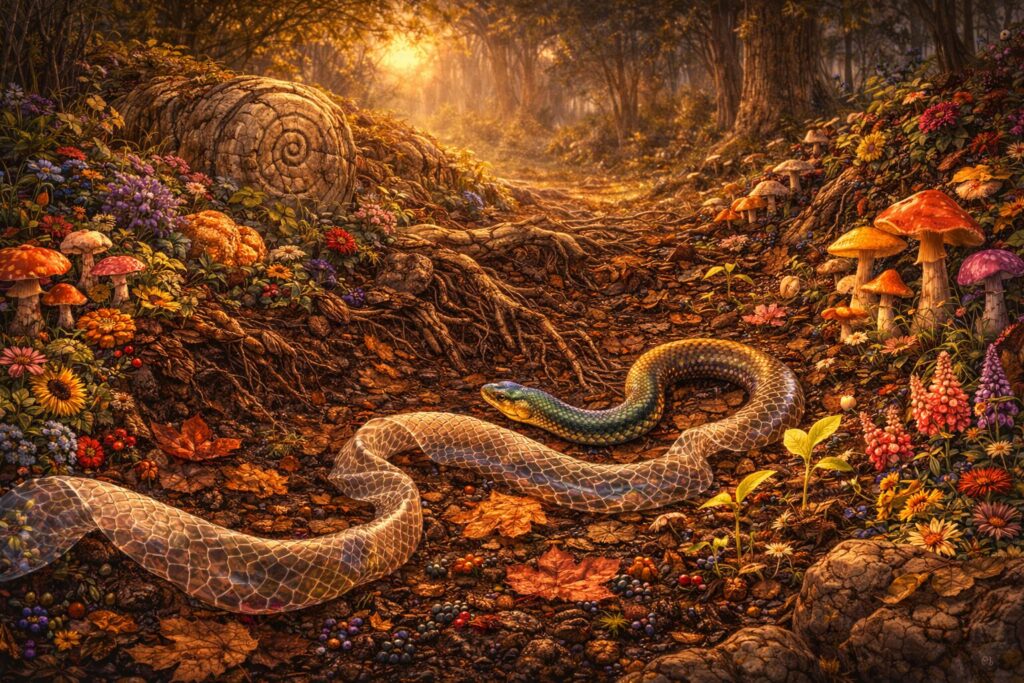
Serpents are among the most enduring symbols associated with the deep powers of the earth. Their closeness to stone, burrow, root, and hidden ground makes them natural companions of chthonic sacredness. They move where humans rarely see, crossing the boundaries between surface and depth with ease.
Because serpents shed their skin, they also symbolize renewal, regeneration, and the strange continuity of life through transformation. This makes them especially fitting for Gaia, whose power is never limited to static fertility alone, but includes the deeper earthly capacity for life to die back, renew, and re-emerge.
In sacred geography and myth alike, serpents often appear as guardians of places where the earth’s power is concentrated. They remind practitioners that the living ground is generous, but not casual; fertile, but also old, watchful, and profound.
Gaia is often approached through fields, gardens, and harvest, yet she also possesses a more hidden dimension. Caves, fissures, roots, stone, and the deep earth belong to her as surely as orchards and flowering land do. In this sense she is not only the visible mother of living growth, but the keeper of the world’s interior.
The chthonic aspect of Gaia is not merely about death. It is about depth, gestation, concealment, and the unseen processes by which life is prepared below the surface. Seeds germinate in darkness. Minerals form in silence. The world’s fertility depends as much on what is hidden as on what is seen.
To honor Gaia fully is therefore to honor not only the blossoming world, but the concealed foundations beneath it.
One of the oldest truths associated with the Earth Mother is simple and profound: what is born from the earth returns to the earth. Grain grows from soil and becomes food. Bodies are nourished by the land and in time are given back to it. Fallen leaves, dead wood, and broken things all re-enter the long economy of transformation through which the earth continually renews itself.
In this way Gaia is not only beginning, but return. She is the mother of life, but also the one who receives life again into her body without waste or final abandonment. For many practitioners this gives Gaia a special dignity in rites of mourning, remembrance, composting, burial, ancestral awareness, and seasonal release.
To understand return in Gaia’s terms is not to focus only on mortality, but to recognize a deeper continuity: nothing truly falls outside the living cycles of the earth. What descends into her care may one day rise again in changed form.
Gaia is not only the mother of what grows, but the keeper of what returns. In serpent, soil, cave, and season, her older mysteries are still quietly present.
In modern pagan and witchcraft traditions, Gaia often returns not first as a mythological figure, but as a recognition: that the living world is not empty, not mute, and not spiritually irrelevant. Many practitioners come to her through direct experience of land, weather, growth, harvest, and the quiet realization that the earth is more than a stage upon which human life unfolds. It is itself alive, sustaining, and worthy of reverence.
For this reason Gaia remains especially meaningful within forms of practice shaped by animism and sacred ecology. Where animist traditions teach that the world is populated by presences, relationships, and living intelligences, Gaia appears not as a distant abstraction but as the great mothering field within which those lives unfold. Forests, stones, rivers, roots, and the countless beings that dwell among them do not merely decorate her world; they participate in its living order. In this sense Gaia is one of the clearest ways modern practitioners name the sacred fact that earth itself is ensouled.
This also helps explain why Gaia resonates so strongly with many witches. Witchcraft, at its healthiest, is rarely cut off from land, season, or material reality. It works with herbs, thresholds, moonlight, fields, weather, hearth, soil, salt, bread, and the practical rhythms of embodied life. Gaia belongs naturally in such a world. She is approached in harvest gratitude, in garden rites, in blessings over food, in healing rooted in plants and place, and in the simple act of standing barefoot upon the ground with reverence rather than carelessness.
Modern druidry, too, often moves close to Gaia even when it does not always name her directly. Druidic currents frequently emphasize sacred landscape, grove, river, stone, seasonal turning, and the living relationship between human beings and the land that holds them. In this way druidry and Gaia devotion share an important instinct: the earth is not merely resource, but presence. The land teaches, nourishes, witnesses, and deserves to be approached with respect.
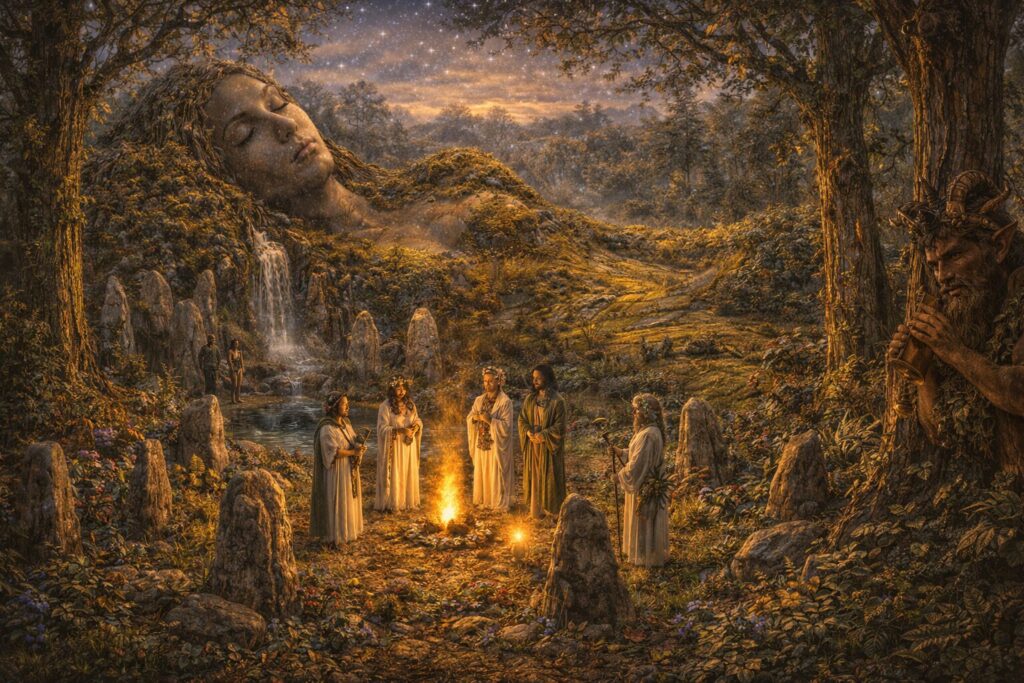
Within the theology of the Coven of the Veiled Moon, Gaia is also understood as especially close to the more animating dimensions of the world. Because she is the consciousness of living nature rather than merely a symbol laid over it, she stands in meaningful relation to the elements, to spirits of place, and even to the beings often called the fae. This does not mean that all such beings are reducible to Gaia, nor that they are identical with her. Rather, it means that where the living earth is most awake, such presences are often more easily recognized. The fae belong especially to old land, threshold places, hidden fertility, and the subtle life of the world; the elements shape the conditions through which earthly life becomes possible. Gaia, in this sense, is not their replacement, but the greater living field within which they are encountered.
At the same time, the modern revival of Gaia also requires discernment. Popular spirituality sometimes reduces her to a sentimental environmental icon or a vague “Mother Earth” slogan emptied of theological seriousness. Such flattening weakens rather than deepens devotion. Gaia is not important merely because she symbolizes ecological concern. She matters because she names a sacred relationship: humanity’s dependence upon a living world that gives life, sets limits, and deserves reverence in return.
For this reason the Coven of the Veiled Moon does not treat Gaia as simply interchangeable with the Triple Goddess. While the Triple Goddess remains an important theological and symbolic figure in many pagan paths, especially in relation to life stages, lunar symbolism, and cyclical feminine divinity, Gaia belongs to a different order of sacred presence. Her motherhood is broader, older, and more foundational. She is not primarily a maiden-mother-crone pattern, nor simply the maternal phase of that cycle. If one wishes to locate a more focused maternal agricultural figure, Demeter often serves that role more clearly. Gaia, by contrast, is the living earth itself — the mother beneath the cycle rather than one phase within it.
This distinction matters because it preserves her depth. Gaia is not merely an archetype, nor only a poetic metaphor for planetary care. She is encountered as presence: in cultivated soil, in ancient stone, in orchard and field, in storm and stillness, in food prepared with gratitude, and in every reminder that life is possible only because the earth continues to bear it.
For many modern practitioners, then, Gaia still matters because she teaches a form of reverence the modern world urgently needs: humility before the living world, gratitude for material sustenance, and the recognition that sacred life is not elsewhere. It is here, beneath our feet, feeding us even now.
Why Gaia Still Matters
- Ecological awareness. Gaia reminds practitioners that the earth is not merely a resource but a living system upon which all life depends.
- Sacred relationship with land. Through Gaia, witches and pagans rediscover reverence for soil, water, stone, and the places that sustain human life.
- Humility before nature. Gaia teaches that humanity does not stand outside the natural world, but within it, dependent upon its balance and wisdom.
To remember Gaia is to remember that life itself rests upon a sacred foundation.
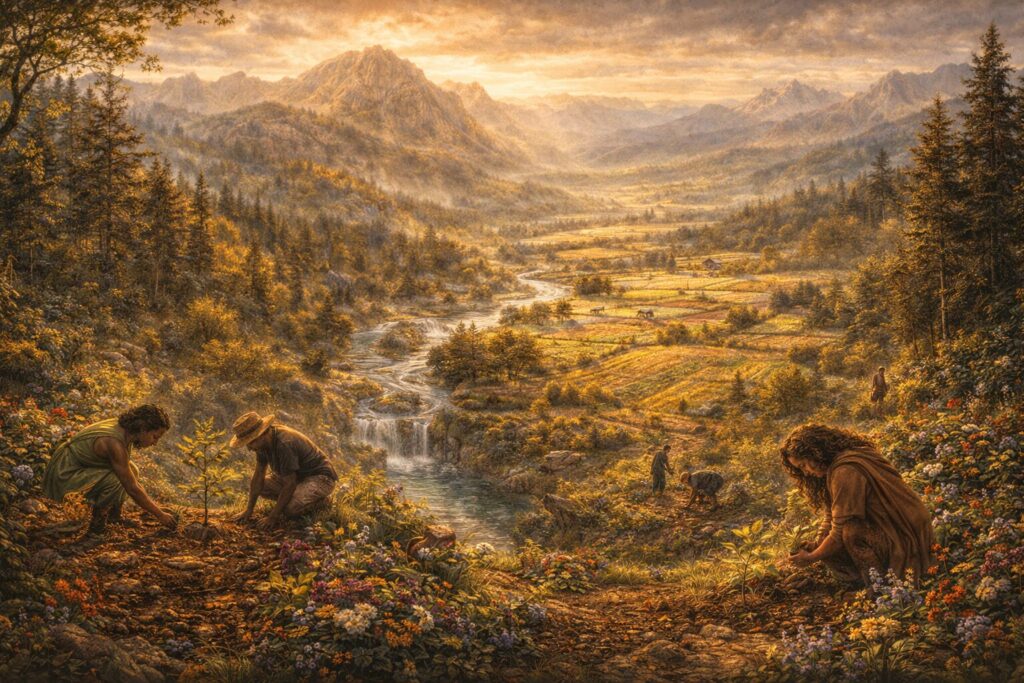
Across thousands of years, through cultures that rose and faded, the idea of the Earth Mother has endured with remarkable persistence. Long before the names of modern religions were spoken, people recognized that the ground beneath them was not merely inert matter but the living source from which food, shelter, and life itself arose. Gaia is one of the oldest ways that recognition found a voice.
Yet Gaia has never belonged to a single civilization. The Greeks spoke her name, but the intuition behind her reaches further back than any one mythology. The Neolithic farmer who thanked the soil for its harvest, the shepherd who watched storms move across the mountains, and the traveler who sensed a quiet presence in forest or field were all encountering the same underlying truth: the earth is not empty. It nourishes, supports, and shapes the lives that depend upon it.
To call this presence Gaia is therefore not merely an act of historical reconstruction. It is a way of acknowledging a relationship that still exists. The Earth Mother remains present wherever life grows from soil, wherever water rises from the ground, wherever food is gathered from fields and gardens, and wherever the living world reminds humanity that it did not create the conditions that sustain it.
For this reason Gaia is both ancient and immediate. She belongs to the earliest stories of the world, yet she is also encountered each day in the quiet realities of living upon the earth. Bread upon a table, herbs gathered for healing, stones warmed by the sun, and fields ripening with grain all testify to the same enduring presence. The Mother of the world does not withdraw simply because modern life has grown noisy around her.
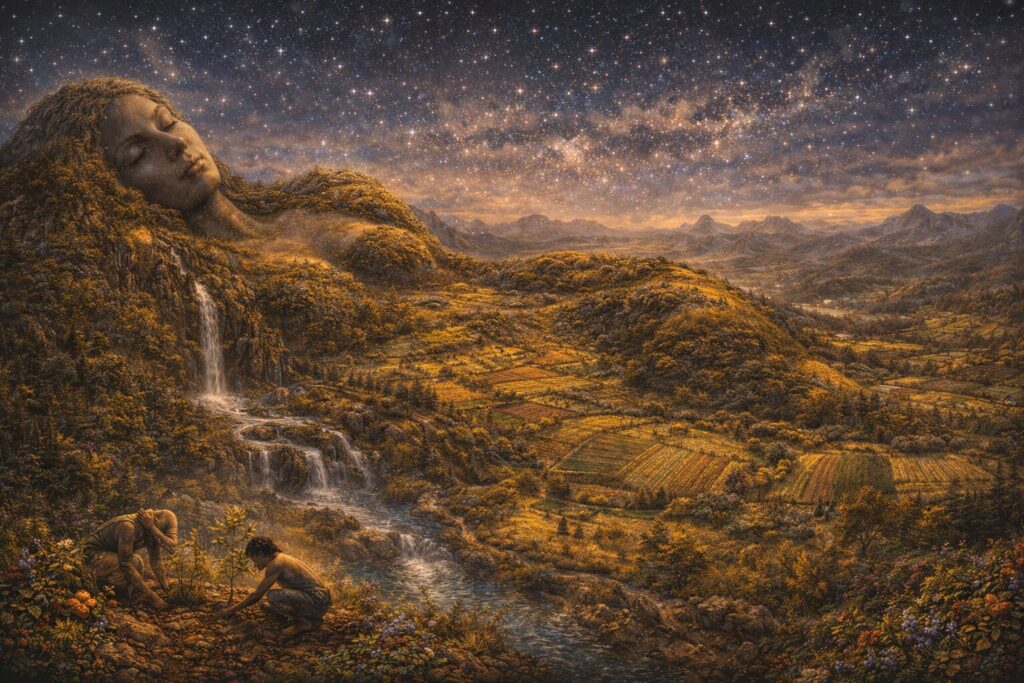
To approach Gaia with reverence is therefore to remember something fundamental: that human life rests upon a ground older than civilization itself. The Earth Mother does not demand spectacle or elaborate rites in order to be present. She is already here, sustaining life with patient generosity. What she asks in return is not grand devotion, but awareness — gratitude for the world that feeds us, humility before the powers that make life possible, and care for the living earth that continues to carry us all.
In this sense Gaia is not only a figure of myth, but a reminder. The world is alive. The ground beneath us is sacred. And the relationship between humanity and the earth, if honored with wisdom, may yet remain one of the oldest and most enduring forms of devotion humanity has ever known.
Blessing of Gaia
Great Mother of the living earth,
first ground beneath our feet and enduring presence within all growing things,
we remember the gifts that come from your body:
the soil that bears seed,
the water that nourishes root,
the grain that becomes bread,
and the patient abundance through which the world is sustained.
May we walk gently upon your ground, knowing that forests, fields, rivers, mountains, and stones are not empty, but alive with the mystery of the earth that bears us. May gratitude guide our hands when we harvest, and humility shape our care for the land that feeds us.
As life rises from you, so may we learn to live in right relationship with your rhythms — honoring growth, accepting rest, tending what is fragile, and remembering that all things return again to the earth.
Enduring Mother, generous and ancient,
may we never forget the ground that sustains us.