Ritual Architecture & Protection
The Structure That Holds Magic
A ritual is more than a collection of words, tools, gestures, or candles. It is an intentional structure—a carefully crafted vessel that gives magical work shape, direction, and meaning.
Across cultures and throughout history, people have created sacred places and ceremonies to prepare for encounters with the divine, the spirits, nature, their communities, and themselves. Whether beneath an ancient oak, around a bonfire, within a temple, or before a simple home altar, ritual creates an ordered space where ordinary life gives way to sacred purpose.
In witchcraft and ceremonial practice, protection begins long before a spell is cast or an invocation is spoken. It begins with preparation. The practitioner is centered. The space is cleansed. Boundaries are established. Relationships are honored. Every element serves a purpose, and every purpose contributes to the integrity of the whole.
The architecture of ritual explores how sacred work is intentionally designed. By understanding the principles behind ritual structure, we gain more than a sequence of actions—we learn how thoughtful preparation creates stability, supports meaningful spiritual practice, and provides a strong foundation for magic, prayer, contemplation, and devotion.
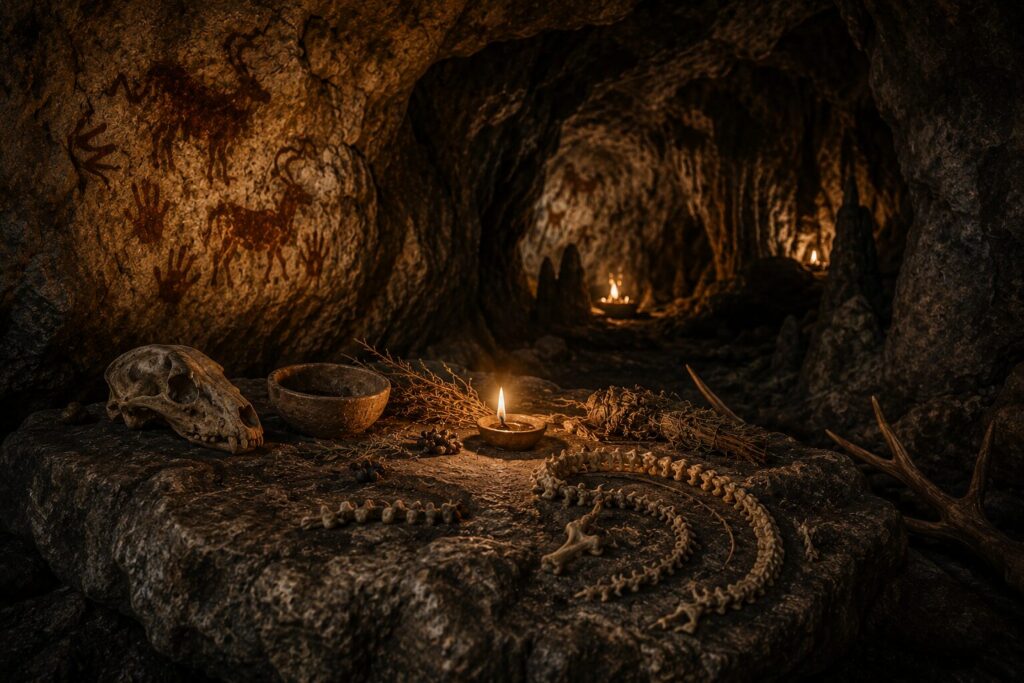
For much of human history, ritual has been one of our oldest technologies—not technology in the modern sense of machines or electronics, but in the classical sense of techne: a practiced craft, a disciplined method, or an intentional way of accomplishing something. Long before there were laboratories or engineering manuals, people developed reliable ways to mark important moments, strengthen communities, honor the divine, mourn the dead, celebrate the seasons, and seek wisdom. Ritual emerged as one of humanity’s earliest tools for bringing order to experiences that could not be measured, yet were deeply meaningful.
In magical practice, ritual serves a similar purpose. It is not simply a performance or a collection of symbolic actions. It is a carefully crafted framework that helps focus attention, establish intention, define relationships, and create an environment where spiritual work can unfold with clarity. Like any well-designed tool, its strength lies not in any single component, but in how those components work together.
This is why ritual architecture matters. An altar is more than a table. A circle is more than a line drawn upon the ground. Lighting a candle is more than creating light. Each element serves a purpose within a larger design. The structure itself helps transform ordinary space into sacred space, ordinary time into sacred time, and ordinary actions into meaningful acts of devotion, magic, remembrance, or transformation.
Protection begins long before the first invocation is spoken. It begins with preparation. A well-constructed ritual provides orientation, establishes boundaries, encourages focus, and supports a respectful relationship between the practitioner, the work, and whatever spiritual powers may be invited into that space. Whether practiced alone beneath an ancient oak, gathered with a coven around a bonfire, or performed quietly before a simple home altar, the underlying principles remain remarkably consistent: thoughtful preparation creates stability, and stability allows deeper work to unfold.
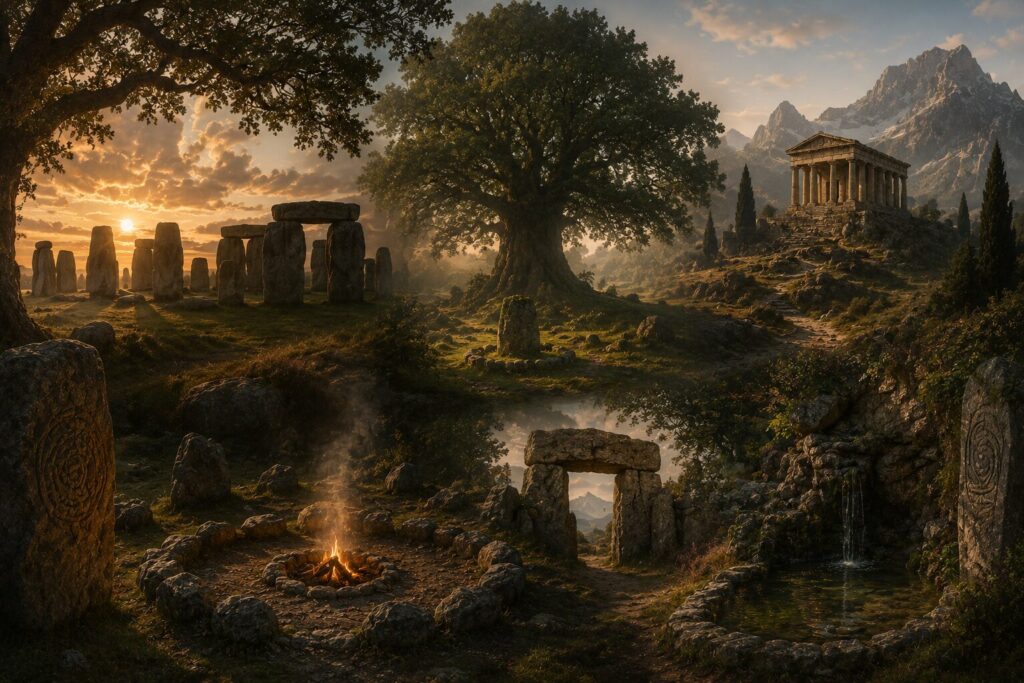
Sacred Architecture Around the World
Across cultures and throughout history, people have created places where ordinary life gives way to sacred purpose. Some are built of stone, some grow from the living earth, and some exist only for the duration of a single ceremony. The forms change, but the instinct remains.
Sacred Groves
Living temples where trees become walls, columns, and canopy.
Ancient Oaks
Sacred landmarks of endurance, wisdom, gathering, and devotion.
Bonfires
Temporary architecture made of flame, drawing community toward a shared center.
Hearth Fires
The first altar many families ever knew: warmth, food, memory, and blessing.
Standing Stones
Single stones that mark memory, orientation, mystery, and encounter.
Stone Circles
Open-air ritual spaces joining land, sky, season, and community.
Mountains
High places long associated with vision, revelation, and divine nearness.
Sacred Springs & Wells
Waters of healing, prophecy, purification, offering, and renewal.
Rivers & Waterfalls
Moving waters that mark cleansing, passage, transition, and power.
Caves & Grottos
Enclosed places of mystery, descent, initiation, ancestors, and hidden wisdom.
Crossroads
Places where roads, choices, spirits, and possibilities meet.
Shrines
Small sacred places made powerful through repeated acts of devotion.
Temples
Buildings shaped by theology, cosmology, procession, and sacred order.
Cathedrals
Stone, glass, light, height, and music arranged to awaken awe.
Mosques
Geometry, calligraphy, orientation, and prayer arranged into sacred rhythm.
Synagogues
Houses of assembly, study, prayer, memory, and covenantal life.
Buddhist Temples
Spaces of stillness, movement, bells, incense, gardens, and attention.
Shinto Shrines
Thresholds, purification, offerings, and reverence marking passage into sacred presence.
Monasteries
Architecture shaped around prayer, silence, discipline, study, and rhythm.
Ceremonial Circles
Circles of land, stone, movement, and memory created through sacred relationship.
Sweat Lodges
Enclosed ceremonial spaces of heat, purification, prayer, and renewal.
Coven Circles
Temporary temples created wherever practitioners gather with intention.
Home Altars
Personal sacred centers for devotion, spellwork, remembrance, and daily practice.
Pilgrimage Sites
Sacred places made holy through history, legend, devotion, and return.
Explore more through our pages on Sacred Places and Pagan Pilgrimages.
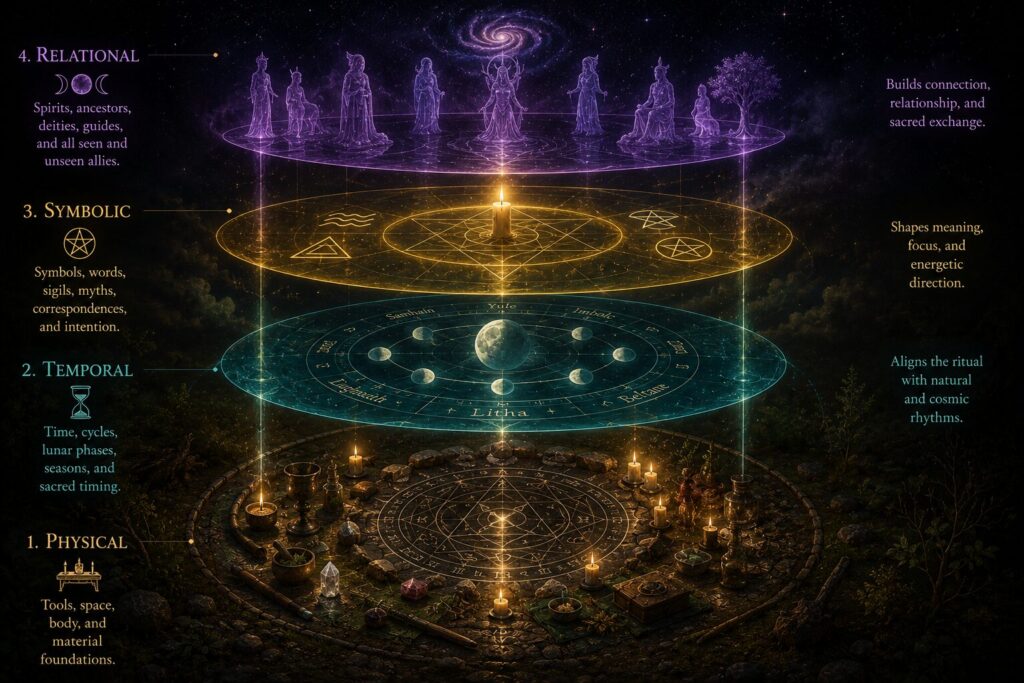
The Four Levels of Ritual Architecture
Ritual architecture is not only about where a ritual takes place. A well-built ritual has several layers working together: the space, the timing, the symbols, and the relationships involved in the work.
Physical Architecture
The arrangement of space: the altar, circle, doorway, tools, candles, offerings, and the body of the practitioner within the ritual environment.
Where does the ritual happen?Temporal Architecture
The arrangement of time: moon phases, planetary hours, seasonal festivals, sunrise, sunset, anniversaries, and the order in which the ritual unfolds.
When does the ritual happen?Symbolic Architecture
The arrangement of meaning: colors, incense, herbs, sigils, gestures, language, music, clothing, and sacred objects that give the work its shape.
What gives the ritual meaning?Relational Architecture
The arrangement of relationship: the practitioner, coven, gods, spirits, ancestors, offerings, invitations, gratitude, boundaries, and dismissal.
Who participates in the ritual?The Anatomy of a Ritual
Rituals vary widely between traditions, but many follow a recognizable pattern. A well-built ritual does not simply begin with the main working. It prepares the practitioner, shapes the space, establishes relationship, performs the work, and then returns everything to proper order.
This sequence is protective because it gives the ritual a beginning, middle, and end. Nothing is left hanging. Nothing is left half-open. The practitioner enters deliberately, works deliberately, and returns deliberately.
The exact language and tools may change, but the underlying architecture remains: preparation, containment, relationship, action, closure, and return.
Ritual Geometry
Shape has always carried meaning. Across magical, religious, and ceremonial traditions, geometry helps organize movement, define boundaries, and express symbolic ideas. These forms are not universally interpreted the same way, but many have become enduring ways of understanding and experiencing sacred space.
○ Circle
Wholeness, continuity, equality, and containment. The circle is perhaps the most recognizable ritual form, creating a shared center without beginning or end.
✚ Crossroads
Choice, encounter, and transition. Crossroads represent places where paths, possibilities, and relationships meet.
🜂 The Vertical Axis
Connecting Above and Below. Mountains, trees, pillars, smoke, and candles often symbolize the meeting of heaven and earth.
🧭 The Directions
Orienting ourselves within the world. Many traditions acknowledge the cardinal directions to establish balance and awareness within sacred space.
🌀 Spiral
Growth, transformation, cycles, and inward or outward movement. Spirals often symbolize journeys of becoming rather than simple destinations.
No single shape possesses universal meaning, yet throughout history people have repeatedly turned to geometry to help express ideas that are difficult to put into words. Ritual architecture reminds us that the way we arrange a space often shapes how we experience it.
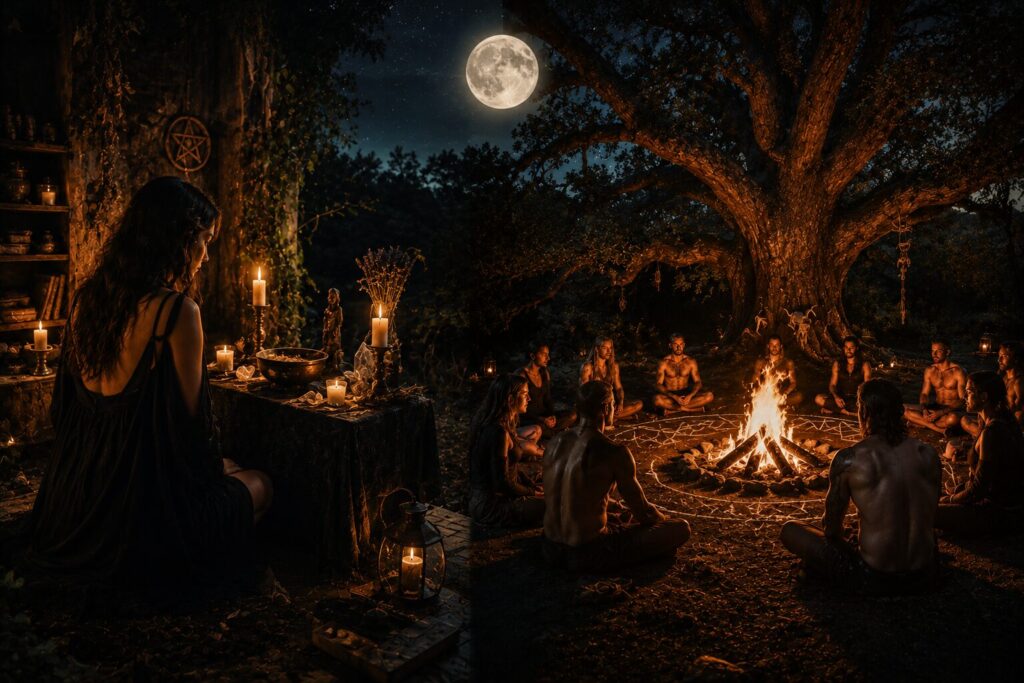
Whether practiced alone or with others, ritual architecture serves the same purpose: to create a space where sacred work can unfold with intention and integrity. The principles remain remarkably consistent, even as the scale changes.
A solitary practitioner builds the ritual around personal rhythm, reflection, and direct relationship with the work. The space can be simple or elaborate, but every element—from preparing the altar to closing the ritual—helps cultivate focus and mindfulness. Working alone often allows for flexibility and quiet contemplation while encouraging a deep familiarity with one’s own practice.
Group ritual introduces another layer of architecture. Participants must move together, share intention, and understand their roles within the ceremony. The physical arrangement of the space becomes more important, as do timing, communication, and transitions between different parts of the ritual. Well-designed group rituals allow individuals to participate as a unified whole without losing their personal connection to the experience.
Whether standing quietly before a home altar or gathering beneath the stars with a coven around a bonfire, thoughtful ritual architecture provides the structure that allows every participant to enter, work, and return together. While traditions may differ in their forms, the underlying principles remain the same: preparation, relationship, purpose, and respectful closure.
Common Structural Weaknesses
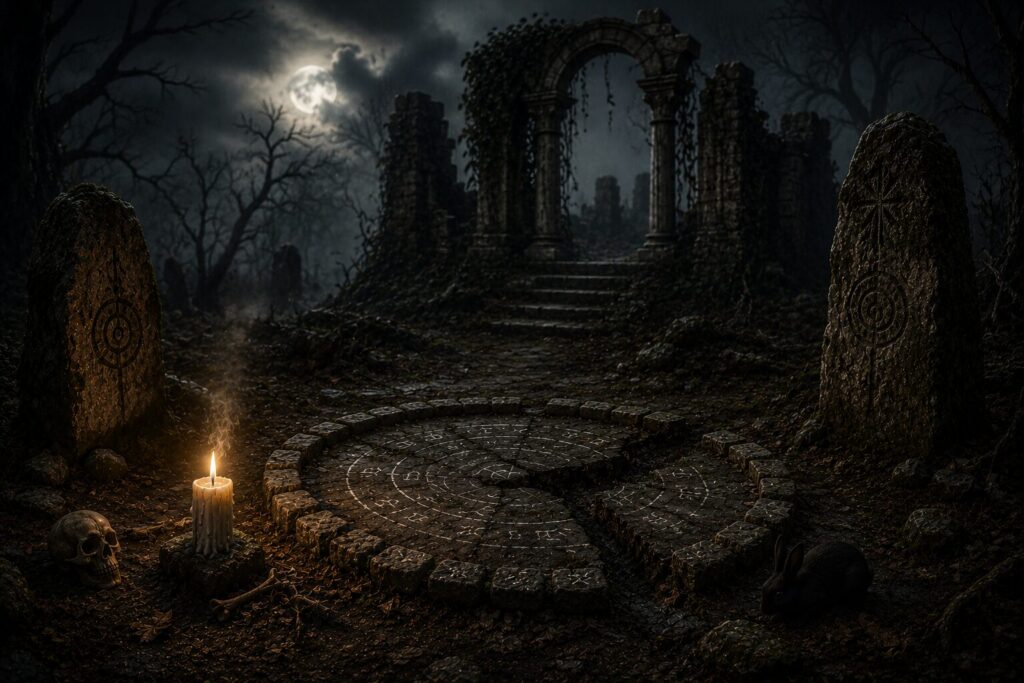
Most rituals do not become ineffective because of hostile spirits or dramatic supernatural interference. More often, problems arise from weak preparation, poor structure, or incomplete closure. Understanding these common weaknesses helps practitioners build stronger and more meaningful rituals.
Rushing Preparation
Beginning before the mind, body, or space has been prepared often leads to distraction and reduced focus. Taking time to settle into the work is itself part of the ritual.
Neglecting Boundaries
Whether physical, symbolic, or spiritual, boundaries help define where the ritual begins and ends. Without them, the experience may feel unfocused or incomplete.
Conflicting Intentions
Trying to accomplish too many unrelated goals within a single working can dilute attention. A clear purpose usually creates a stronger and more coherent ritual.
Inconsistent Symbolism
Symbols need not be universal, but they should work together. When every element points in a different direction, the ritual can lose its internal coherence.
Skipping Closure
Closing a ritual is just as important as opening one. Expressions of gratitude, releasing invited powers, and returning to ordinary awareness help bring the work to a respectful conclusion.
Neglecting Reflection
Many practitioners complete a ritual and immediately move on. Taking time to reflect, journal, or record observations helps refine future practice and deepens understanding over time.
A beginner often learns rituals by following instructions. There is wisdom in this, as established forms teach rhythm, discipline, and the importance of preparation. Over time, however, experienced practitioners begin to see beyond individual steps and recognize the principles that give those steps their purpose.
This is the difference between memorizing a ritual and understanding its architecture. Words may change. Tools may differ. Traditions may emphasize different symbols or sequences. Yet the underlying principles remain remarkably consistent: sacred space is prepared, relationships are honored, intention is clarified, meaningful work is performed, and the ritual is brought to a respectful close.
Understanding these principles allows rituals to grow naturally alongside the practitioner. New experiences, changing circumstances, and different traditions can all be incorporated without losing coherence or integrity. Rather than becoming confined by rigid formulas, practitioners learn to build rituals thoughtfully, adapting their forms while preserving their foundations.
Throughout history, people have approached the sacred in countless ways. Some gathered beneath ancient oaks, others around bonfires or hearth fires. Some built temples, cathedrals, shrines, or stone circles. Others found holiness beside a spring, atop a mountain, or within the quiet of a home altar. The architecture changed, but the human impulse remained the same: to create a place where ordinary life could give way to something greater.
Ritual is not magic itself. It is the architecture that allows magic, prayer, contemplation, and spiritual encounter to take coherent form.