The Witches’ New Year & the Season of the Veil
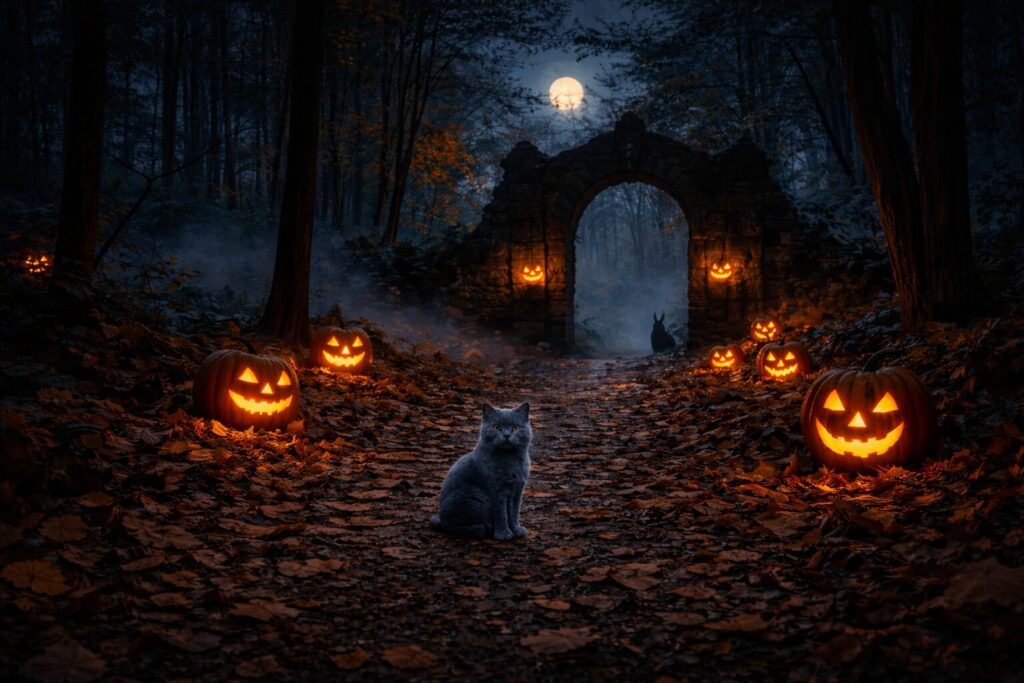
Samhain marks the final harvest and the turning of the year into its darkest quarter. Traditionally observed from October 31st to November 1st, it sits midway between the Autumn Equinox (Mabon) and the Winter Solstice (Yule). For many witches and Pagan practitioners, Samhain is understood as the Witches’ New Year — not in a calendar sense, but as a spiritual turning point where one cycle fully closes and another begins.
This is a season of endings. The outward work of the year has been completed. What was grown has been gathered. What could not be saved has been allowed to fall away. Samhain is where the year is reviewed, where what has run its course is named, and where space is made for what will eventually emerge again in the light.
Samhain is also associated with the thinning of the veil — the liminal boundary between different states of being, awareness, and experience. At this time, thresholds become more present. Memory, grief, intuition, and spiritual perception often feel closer to the surface. This does not mean that everything beyond the veil is welcomed or safe. Rather, Samhain is a time when access becomes easier and discernment becomes more important.
At My Cousins Coven, Samhain is approached as a season of clarity as much as remembrance. Ancestors, the dead, spirits, and transitional guides are understood as distinct, and not all presences are automatically honored or invited. Lineage carries wisdom, but it can also carry harm. Calling on ancestors is therefore also an act of filtering — choosing which legacies are welcomed forward and which are named, acknowledged, and left behind.
Samhain holds space for grief, memory, and honest reflection. It is not focused on fear, but on reckoning and release. It is where the year is spiritually closed, where what no longer serves is laid down, and where the conditions are set for what will come next.
The sections below explore Samhain through several lenses: endings and sacred time, the veil and thresholds, the Otherworlds, ancestors and spirits, and the role of the Crone. Together, they form a way of thinking about Samhain not only as a sabbat, but as a season of transition that touches both the outer world and the inner one.
Sacred Time, Endings, and Reckoning
Samhain functions as a point of closure in the spiritual year. Where other sabbats emphasize growth, fertility, or outward expression, Samhain emphasizes endings, review, and release.
This makes Samhain a natural time for spiritual accounting. It is a moment to look honestly at what has been carried, what has been lost, what has completed its purpose, and what no longer belongs in the next cycle.
- Reviewing the year that has passed
- Naming what is finished
- Releasing what cannot be carried forward
- Making space for what will come next
This is not about punishment or judgment. It is about clarity. Samhain provides a container for grief, memory, and honest self-examination so that the next cycle begins with intention rather than momentum alone.
The Veil & the Threshold
The veil is understood at MCC as a liminal membrane — not a solid wall, but a thinning boundary between different states of being, awareness, and experience. Samhain is traditionally associated with this thinning, meaning that the separation between ordinary awareness and spiritual awareness becomes less rigid.
The threshold refers to the act of crossing. It can describe a spiritual shift, a psychological transition, a ritual state, or a seasonal turning. At Samhain, practitioners are intentionally working within a threshold state — stepping into a time where boundaries soften and different kinds of contact, insight, and memory become more accessible.
This does not mean that everything beyond the veil is invited. Access increases, but discernment becomes more important. Samhain is about working at the boundary, not throwing it open without care.
The Otherworlds
At MCC, the Otherworld is understood as plural. Rather than a single, flat spirit realm, the Otherworlds are thought of as multiple dimensions or layers of spiritual existence. These may include ancestral realms, spirit realms, liminal spaces, and other unseen worlds that intersect with human awareness in different ways.
Samhain is associated with increased permeability between these worlds and the human world. This does not collapse all realms into one, but it can make movement, perception, and contact more noticeable.
Thinking in terms of Otherworlds helps maintain clarity. Not every spiritual presence comes from the same place, and not every contact carries the same meaning or relationship.
Ancestors, the Dead, Psychopomps, & Spirits
At Samhain, many kinds of presences are often spoken about together. At MCC, we find it helpful to be more precise, because each category involves different relationships, boundaries, and kinds of work.
Ancestors are those connected through lineage — by blood, by family of choice, or by spiritual tradition. They represent long memory: lives, struggles, skills, and patterns carried forward through time. Working with ancestors is less about ghosts and more about continuity and relationship across generations. Calling on ancestors also involves discernment. Not all ancestors are worthy of honor, and filtering harmful legacies is part of responsible ancestor work.
The Dead refers more specifically to lingering souls, visiting spirits, or unresolved presences. These may appear through mediumship, dreams, hauntings, or personal spiritual experience. Not all dead are ancestors, and not all ancestors present as the dead.
Psychopomps are beings associated with transition. Their role is to guide movement between states — life and death, worlds, or stages of being. Deities such as Hermes and Hekate are often understood in this role, along with other guides who oversee crossings rather than destinations.
Spirits, in this context, most often refers to land spirits, elemental forces, and beings associated with nature and place — including what many traditions describe as the fae. These are not the dead and not ancestors. They belong to the living landscape and the unseen ecology of the world.
The Crone & Sacred Descent
The Crone is often associated with Samhain as a figure of endings, wisdom, and descent. At MCC, the Crone is understood less as a single archetype and more as a current — the stage of life and spirit that holds what comes after growth and before renewal.
The Crone represents the authority of endings. She carries the knowledge that comes from loss, age, experience, and survival. Descent in this sense is not failure. It is a necessary movement into shadow, truth, and stripping away what no longer fits.
Working with the Crone at Samhain often includes:
- Honest self-examination
- Releasing identities that have expired
- Accepting limits and endings
- Claiming the wisdom that comes from experience
| Tradition / Path | What They Call It | How They Honor It | Core Spiritual Focus |
|---|---|---|---|
| Wiccan (MCC-leaning core) Gardnerian • Alexandrian • Eclectic Wicca • Reclaiming-influenced • Solitary | Samhain Third harvest; witch’s new year (in many lines) | Circle + Sabbat rite with ancestor candles, remembrance altar, divination, and ritual of release. | Death and rebirth; Crone wisdom; honoring beloved dead; choosing what continues into the dark half of the year. |
| Eclectic / Neo-Pagan (MCC-leaning practice) | Samhain All Hallows • Ancestor Night | Blended observance — ancestor altar, shadow work, journaling, spellcraft, and protective fire. | Spiritual autonomy; personalized threshold work; honoring the dead across blended paths. |
| Traditional Witchcraft | Samhain | Boundary rites — crossroads work, spirit-feasts, protective charms, and offerings to local dead. | Liminal power; warding and passage; kinship with land-spirits and the local dead. |
| Druidry / Green Craft | Samhain | Land rite — grove prayers, storytelling, apple rites, fire circles, and offerings to spirits of place. | The turning of the Wheel; autumn’s withdrawal; ancestral memory held by land. |
| Heathen-Adjacent Devotional Eclectic practice (not reconstructionist) | Winternights | Ancestor + household rites — candle offerings, toasts, protection, and remembrance. | Lineage and ancestral luck; guardianship of home; winter threshold. |
| Hellenic-Adjacent Devotional Eclectic practice (not reconstructionist) | Underworld Season | Threshold rites — Persephone/Hekate offerings, candle-lit descent and return. | Psychopomp work; descent as wisdom; honoring the dead with clear boundaries. |
| Hearth & Kitchen Witch | Samhain | Hearth rites — dumb supper, soul cakes, simmer pots, cider blessings, doorway protection. | The home as shrine; nourishment as offering; warmth against winter’s edge. |
| Animist / Spirit Worker | Feast of the Dead | Relationship-work — offerings, grave tending, spirit-house care, and boundary protocols. | Reciprocity; the dead as community; veil as living boundary. |
| Hedge Witch / Journey Work | The Threshold | Crossing practice — guided trance, veil rites, psychopomp prayer, and divination. | Between-world travel; soul tending; safe descent and return. |
| Folk Catholic / Syncretic Italian All Souls • Día de los Muertos (Mexican) • Iberian & Latin American | All Saints / All Souls | Home + cemetery devotion — candles, flowers, food, photos, prayers, and grave visits. | The dead as beloved family; remembrance as prayer; devotion as relationship. |
| Dianic / Goddess-Centered | Samhain | Crone rites — release ceremonies, mourning as sacred, and blessing inner vision. | Feminine wisdom through descent; grief as initiation; transformation. |
| Spiritualist / Mediumistic | Séance season | Communication rites — prayer, spirit sitting, healing messages, careful closing/clearing. | Discernment; ethical contact; listening without glamouring the unknown. |
Symbols & Seasonal Language of Samhain
Samhain comes with a familiar set of images — not because the season is “spooky,” but because certain symbols do a good job of describing what’s happening: endings, thresholds, protection, remembrance, and the last warmth before winter.
These symbols can be used lightly (decor, seasonal mood) or intentionally (ritual language). Either way, they help mark Samhain as distinct from the rest of the year.
Traditions & Cultural Expressions
Samhain shows up differently across witchcraft and Pagan traditions. Some approaches are devotional; others are folk-practical; some are community-centered, and others are solitary. The common thread is recognizing Samhain as a threshold season where endings, remembrance, and protection come into focus.
If you’re exploring where your approach fits, our broader overview of paths may help: Witchcraft Traditions.
Ways to Honor Samhain
There is no single “correct” way to observe Samhain. It can be quiet or social, ritual-heavy or simple. Below are a few grounded approaches that work for many people.
- Prepare a remembrance space: photos, names, keepsakes, a candle, a small offering.
- Hold a dumb supper: a meal with an honored place set; silence if it feels right, conversation if it helps.
- Visit a grave or meaningful place: bring flowers, pour water or cider, sit and listen.
- Do a release rite: write what you’re done carrying and burn it (safely) or bury it with intention.
- Clean, ward, and reset your space: practical protection, not paranoia.
- Mark the turning at the hearth: cider, soup, bread, candles — simple can still be real.
Shadow Work, Grief, & Inner Thresholds
Samhain is one of the best times of year for inner work, partly because the season supports it: less light, more quiet, more reflection. This is also why Samhain can feel heavy for many people. The point isn’t to force intensity — it’s to let the season give you an honest mirror.
If you want a deeper framework for this, visit: Shadow Work.
- Divination: ask what is ending, what needs closure, and what wants to be carried forward.
- Grief work: name what was lost without rushing to “silver linings.”
- Integration: identify what you avoid and what you’re ready to face gently.
- Protection: cleanse and reset, especially if you’re doing spirit-adjacent work.
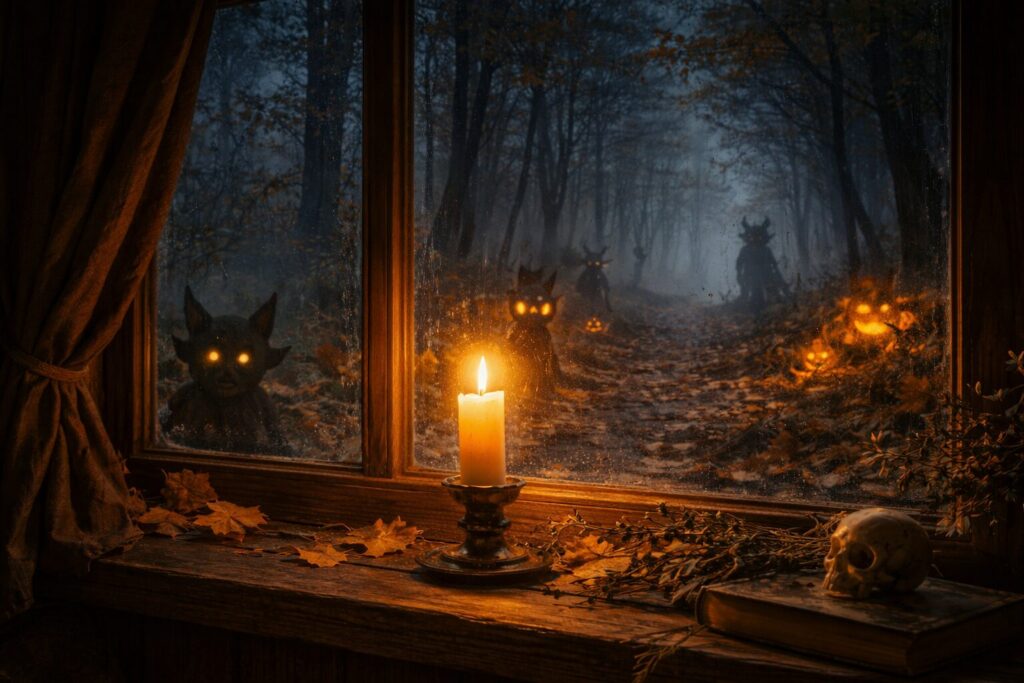
Samhain is a turning point. For some, it’s the Witches’ New Year. For others, it’s simply the deepest doorway in the autumn season — a time when endings feel clearer, memory runs closer to the surface, and the year begins to close itself.
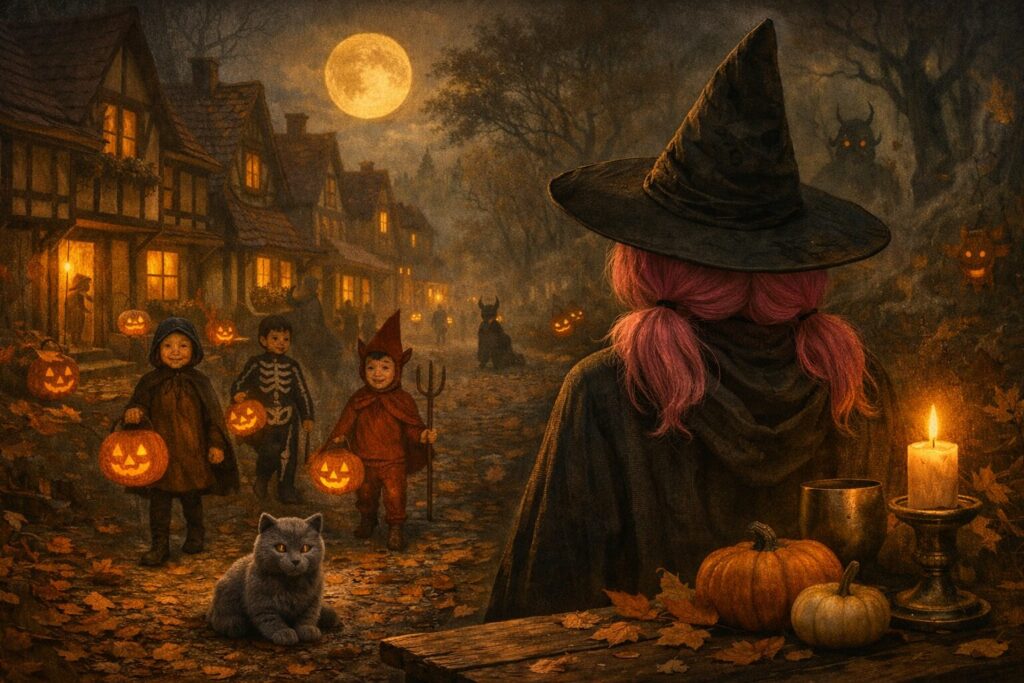
It’s also worth saying plainly: Halloween and Samhain aren’t the same thing, even though they’ve been mashed together for a long time. Halloween carries its own history and its own kind of magic — playful, communal, and full of folklore. We’re good with that. The costumes, the lanterns, the candy, the ridiculous fun — it’s part of how this season lives in the wider world. If anything, it keeps the doorway visible, even for people who don’t name it the way we do.
For those who observe Samhain as a sabbat, the focus tends to be different: discernment, release, protection, remembrance, and relationship — with ancestors worth honoring, with the dead who visit, with the land and spirits that stir in the season, and with the parts of ourselves that need an honest reckoning before the next cycle begins.
However you keep this season, keep it in a way that feels real. Light a candle. Share a meal. Tell a story. Clean your space. Leave an offering. Write down what you’re done carrying. Let the year close cleanly.
And if you’re celebrating Halloween too — enjoy it. Then, when the noise fades, listen for what remains.