ARCHONS & THE ELEMENTAL ARCHITECTURE OF MAGIC
A Cosmological Interpretation for Contemporary Witchcraft
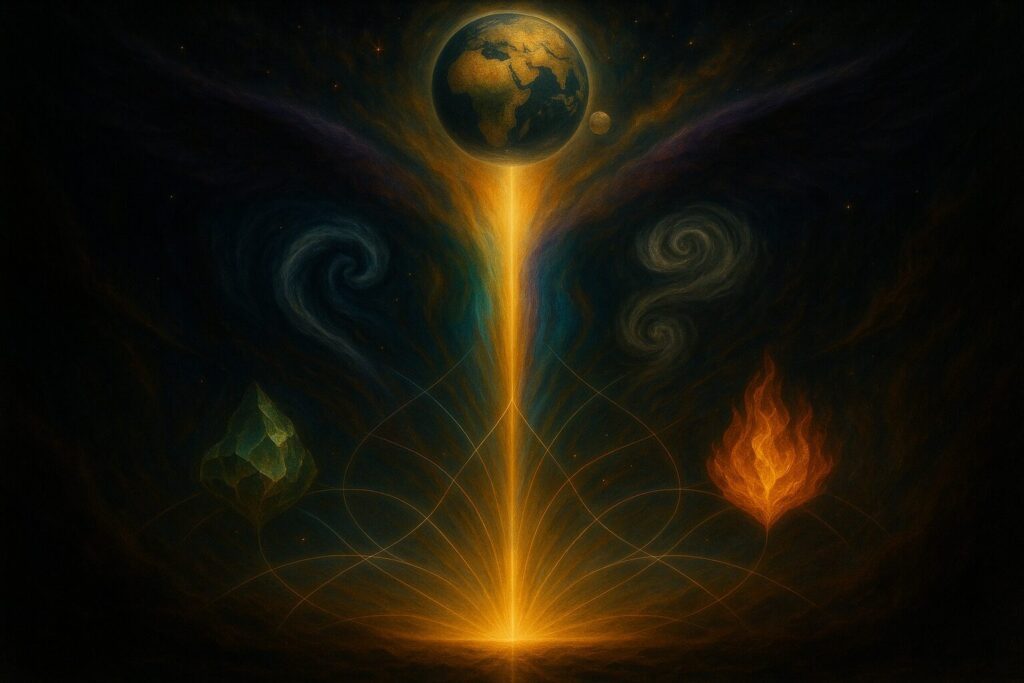
In many esoteric systems, the Elements are not simply materials or metaphors but the enduring behaviors of the cosmos—stable patterns through which reality expresses itself on both physical and psychic levels. Contemporary witches often work with these Elemental forces intuitively: the rising motion of flame, the yielding logic of water, the dispersive clarity of air, the steadying weight of earth. Yet behind these behaviors lies a deeper layer of order that ancient philosophers and mystics often implied but rarely named outright.
In this framework, that deeper layer belongs to the Archons.
Not gods, not angels, not archetypes, but primordial intelligences—structuring principles that exist outside myth rather than within it. While deities occupy story, symbol, and relationship, Archons occupy the realm of cosmology. They define the fundamental parameters through which the Elements can exist at all.
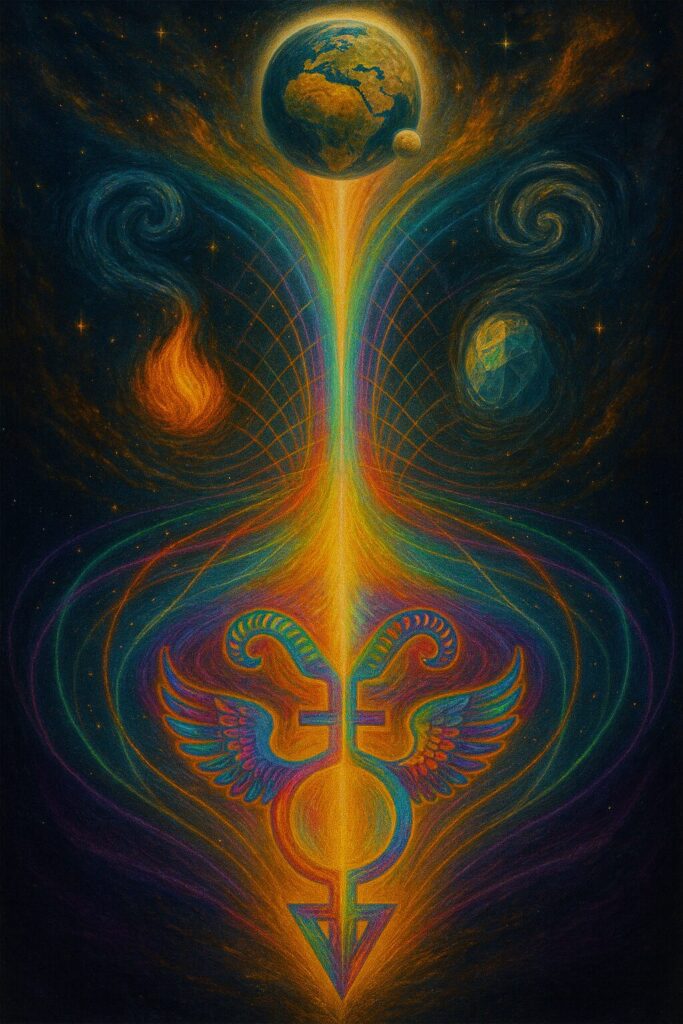
Spirit: The Emanation of the Finger of Light
Spirit is not a fifth substance stacked atop the four Elements, but the radiant field that emanates from the Finger of Light itself—the primordial vector through which Being becomes intelligible. Where the elemental Archons establish structure, Spirit grants coherence, proportion, and presence, binding their patterns into a single luminous order.
In this sense, Spirit behaves less like an element and more like a ratio—a harmonic or mathematical correspondence akin to the Platonic Forms. It is the hidden intelligence by which Fire’s ascent, Water’s depth, Air’s motion, and Earth’s solidity enter into elegant relationship. Spirit is the medium in which the witch, the world, and the deep intelligences of the Elements recognize their shared origin in a geometry older than myth.
Explore the Finger of Light →To acknowledge Archons is not to introduce a new pantheon into witchcraft, but rather to recognize that elemental magic depends upon an underlying architecture—an intelligible and stable pattern that makes the Craft possible. Witchcraft assumes a patterned universe; Archons are those patterns understood as intelligences.
Across cultures, practitioners have attempted to describe the great structuring intelligences behind nature and consciousness. Though the word “Archon” is specific to certain cosmologies, nearly every esoteric tradition recognizes beings or principles that shape the world at a foundational level. The following are not contradictions, but different cultural attempts to articulate the same underlying reality.
In Gnostic cosmologies, Aeons are emanations flowing from the divine fullness (Pleroma). They are not personalities so much as archetypal forces—Wisdom, Silence, Thought, Depth—that organize reality on a cosmic scale. Archons, in this context, act as structuring powers within the created world, expressing divine law through form. The overlap between Aeons and Archons is the shared theme of cosmic intelligence shaping the boundary between spirit and matter.
Neoplatonic systems describe reality as a descending chain of principles—Intellect, Soul, and the many Logoi—through which the One expresses itself as multiplicity. Hermetic writings adopt similar language, presenting the world as patterned by rational seeds or “Words” of power. These Logoi are the blueprints of phenomena, the laws behind elemental behavior, and closely parallel the idea of Archons as governing intelligences.
Tattvas are subtle elemental essences—pre-material vibrations from which the physical elements arise. Unlike the later Western elements, Tattvas operate on a plane of pure potentiality, shaping perception and consciousness as much as matter. In this sense, they function almost identically to Archonic principles: generative, pattern-forming, and foundational.
The Sefirot are not gods but emanations or modalities of divine energy. They structure the cosmos from its most abstract principles (Crown, Wisdom, Understanding) to its most grounded (Foundation, Kingdom). Each Sefirah is a mode of divine activity, echoing how Archons function as channels or architectures through which reality becomes intelligible.
In Western occultism, the elemental Kings—Paralda of Air, Djin of Fire, Nicksa of Water, and Ghob of Earth—govern vast elemental realms. The Watchtowers operate similarly in Wicca and ceremonial magic, marking the cardinal directions and guarding the liminal space of ritual. Though more approachable than cosmic Archons, these beings are masks of the same deep intelligences that structure the Elements themselves.
Daimones were intermediaries—neither gods nor mortals, but forces that wove meaning between realms. The Protogonoi (Chaos, Gaia, Eros, Aether, Nyx) were primordial conditions rather than personalities. These resemble Archons in their impersonal magnitude: not deities with stories, but structural powers that make existence possible.
Across cultures, similar concepts appear under many names: Intelligences, Emanations, Principles, Primordials, Deep Currents, Governors, The Mighty Ones. Their diversity indicates not contradiction but convergence—different vocabularies attempting to articulate the same foundational reality: that the cosmos is shaped by intelligible forces older than myth, and broader than any single tradition’s theology.

The existence of parallel concepts across cultures suggests that humanity has long intuited a level of order beneath mythic storytelling—a layer in which the cosmos reveals itself as coherent, intelligible, and upheld by principles rather than personalities. The Archon, understood in this way, functions as a bridge between cosmology and practice. Magic works not by suspending natural law but by cooperating with deeper, subtler forms of it. The witch performs ritual not to override the world’s structure but to move in harmony with it.
“Every act of will is an act upon the subtle structure of the universe.” -Aleister Crowley
This is why elemental operations—purification, grounding, clarity, inspiration, manifestation—retain their symbolic and practical potency across centuries. They are not arbitrary associations but reflections of a stable metaphysical architecture. When the witch calls the quarters or builds a spell around elemental balance, she brings her intention into consonance with these underlying intelligences. The rite becomes effective because it aligns with something ancient and structurally sound.
“Magic is the art of changing consciousness in accordance with cosmic law.” -Dion Fortune
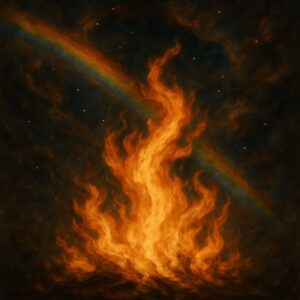
Physically, fire tends toward ignition, heat, and ascent. It erupts from stone, climbs the air, and vanishes into radiance. The same motion appears in the psyche as courage, anger, devotion, and the sharp, cleansing clarity that follows a hard decision. The Archon of Fire is this motion made intelligible: the cosmic habit by which what is cramped or hidden is urged upward into visibility.
In magic, Fire is engaged whenever a working calls for purification, courage, acceleration, or irreversible change. A candle on the altar is a small, obedient column of that stellar logic: a controlled flame that gathers attention and declares that from this point forward, something will be different. To work with Fire is to cooperate with the Archon of vertical transformation, trusting that what cannot endure the heat no longer belongs to the pattern of one’s life.
For the witch, the art lies in proportion. There is a difference between inviting Fire to refine and inviting it to consume. When intention is clear and properly scaled, the Archon of Fire answers cleanly—burning away what has gone dead, quickening what is ready to live, and carrying a signal upward into the subtle architecture of the world.
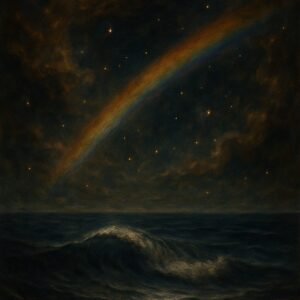
Water yields, receives, and remembers. It shapes itself to its vessel, seeks its own level, and bears the imprint of whatever passes through it. Psychologically, the same qualities appear as emotion, intuition, dreaming, and the slow, layered work of memory. The Archon of Water governs this family of behaviors: wherever there is depth, reflection, or fluid connection, this pattern is active.
Magical practice turns to Water for healing, reconciliation, divination, and all workings that depend on feeling rather than force. A bowl of water on the altar, a chalice raised in blessing, or a dark mirror used for scrying are all ways of cooperating with the Archon of Water. Feelings, like rivers, cannot be bullied into new courses; they respond instead to containment, gentle guidance, and time.
To “flow around” an obstacle, to “wash away” grief, or to “cool down” conflict is to think in Water’s terms. The witch who understands this does not demand instant stillness from a stormed heart, but offers it a channel and a destination. In doing so, they allow the Archon of Water to do what it has always done: move what is heavy toward a wider sea.
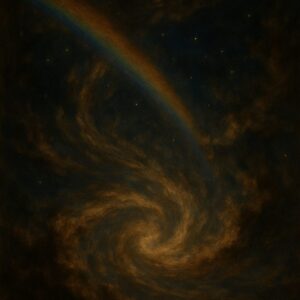
Air moves, circulates, and connects. It is invisible, known only by the shifting of clouds, the rustle of leaves, the feeling of breath. On the inner plane, Air expresses itself as thought, language, analysis, pattern-recognition—the whole shimmering web of ideas that surrounds a life. The Archon of Air is the intelligence of movement and meaning combined: the way information travels and reconfigures itself.
Witches engage Air whenever they cast with spoken charms, work with breath, or turn to divination. Tarot, runes, and other oracles rely on patterns of correspondence—systems in which symbols “move” among one another and carry messages. This is Air’s Archonic work at a subtle level: the maintenance of intelligibility itself.
A spell that seeks clarity, insight, or communication works best when it acknowledges that Air tends toward dispersal and circulation. The goal is not to freeze thought in place, but to invite a cooling breeze through confusion so that the pieces can settle into a new order. In that clearing wind, the witch participates in the Archon of Air’s oldest task: carrying meaning from one shore of awareness to another.
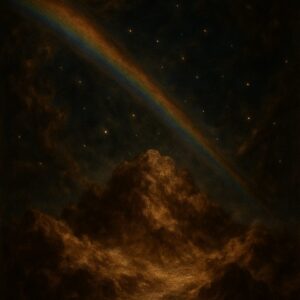
Earth is structure, gravity, and endurance. It accumulates, settles, and resists sudden change. Within the psyche, its qualities appear as stability, embodiment, boundaries, and the patient work of building a life that can actually be lived in. The Archon of Earth is the pattern by which things become solid and remain so.
In witchcraft, Earth is invoked through stones, salt, soil, bones, and through every act that anchors the unseen into the seen. Protective circles drawn on the floor, wards embedded in the threshold, talismans meant to last, and even the unglamorous rhythms of budgeting, meal planning, or tending the home all participate in Earth’s Archonic logic. They insist that magic must eventually take form or it remains only a mood.
To ask Earth for aid is to ask for weight and continuity: for a spell to “stick,” for a choice to become a habit, for a dream to acquire walls, roof, and keys. Seen in this light, the most ordinary forms of care become occult acts, extensions of the same pattern that holds mountains in place and keeps the world from drifting apart.
Across all four Elements, the Archons provide continuity between matter and meaning. They are the reason symbolic actions can have real effects: lighting a candle, pouring water, speaking a charm, or fixing a protective ward all touch patterns that are already active in the world. Magic, in this sense, is the art of recognizing and consciously engaging those patterns, allowing human intention to move in step with the deep architecture of the cosmos.
Understanding the Archons as the deep intelligences behind elemental behavior allows for a more nuanced view of magical practice. Each Element expresses itself in dual ways—through physical behavior and through psychological or spiritual resonance. The Archons provide the continuity between these realms, making it possible for symbolic actions to have real effects. Lighting a candle to strengthen will is effective because will and fire share the same Archonic logic. Pouring water to soothe emotion works because emotion follows the same patterns as water: yielding, flowing, reflective.
From this perspective, magic becomes a way of entering into dialogue with the universe’s underlying grammar. The practitioner is not manipulating external forces but participating knowingly in a patterned cosmos. Wiccan ritual, especially the calling of the Watchtowers, can be understood as a formal acknowledgment of these ancient intelligences—a way of situating the circle within the deep, pre-theistic architecture that makes sacred space possible.
In this model, the gods are not displaced but contextualized. They are mystic, relational, personal; they occupy the human-facing side of the sacred. The Archons occupy the cosmic-facing side: impersonal, structural, foundational. The two layers complement one another. Myth provides meaning; cosmology provides coherence. Witchcraft lives in the place where the two intersect.

If cosmology is the memory of the universe before story, then the Archons are the keepers of that memory. Their patterns shape the rising of flame, the dreaming of water, the speech of air, and the endurance of earth. Every magical act—every candle lit for clarity, every bowl of salt for grounding, every cup of water for healing—touches these ancient intelligences. To practice the Craft is to acknowledge that our small gestures participate in a vast architecture, one that whispers through the Elements and sustains the world beneath the world.
“From the Unknowable came order, and from order came the powers that uphold all things.” -Tripartite Tractate