
The Finger of Light
What happens when difference does not disappear? MCC’s cosmology follows that question from primordial potentiality through relationship, motion, worlds, and Spirit, toward the complex relationships through which magic becomes possible. The Finger of Light names the continuity of becoming: how difference can endure and give rise to something more.
We begin with 137 as a doorway into proportion, interaction, and stability. Mathematics and physics offer structures to think with; the sacred meanings we explore belong to MCC’s interpretation.

Section 2 · The Scientific Doorway
Why 1/137?
Before 137 becomes symbol, correspondence, or cosmology, it is worth asking what the number actually means in physics.
Physics describes the strength of electromagnetic interaction using a quantity called the fine-structure constant, written as α (alpha). It measures how strongly electrically charged particles couple to the electromagnetic field, including light.
One striking feature of α is that it is dimensionless. It carries no units such as meters, seconds, or kilograms. The physical quantities in its defining formula combine so that their units cancel, leaving a pure number. Changing our measuring system does not change that number.
In the low-energy limit, α is approximately 1/137.036. Its inverse, α−1, is therefore approximately 137.036. The familiar expressions 1/137 and 137 are rounded shorthand for these two related quantities.
This gives us a precise place to begin: a numerical proportion describing interaction. Before we give the number a sacred interpretation, it already has a physical meaning within the relationship between charge and the electromagnetic field.
A note on scale: In quantum electrodynamics, the effective electromagnetic coupling depends on the energy or momentum scale at which an interaction is probed. This is called the running of the coupling. The familiar value near 1/137 describes its low-energy limit.
Where MCC enters the conversation
For MCC, this physical relationship offers a symbolic point of departure: how does difference enter relationships that can sustain further becoming? That question will carry us through polarity, motion, structure, and the emergence of new capacities. Physics supplies a measurable example of interaction and proportion; the cosmological meaning we draw from it belongs to MCC’s interpretation.
Scientific references: NIST — CODATA 2022 recommended constants (PDF); Particle Data Group — electromagnetic coupling and its energy dependence, §10.2.2 (PDF).
Section 3 · Correspondence and Evidence
Pattern, Meaning, and Evidence
A recurring pattern can invite inquiry. Understanding its significance means asking both what the pattern shows and what we are bringing to it.
MCC’s cosmology grows from practice, myth, and reflection. Mathematics gives us another language for examining its relationships. A useful correspondence can clarify how difference, motion, coherence, and emergence belong together, or help us express something that experience has made difficult to ignore.
In the account ahead, Zero through Nine name distinctions and emerging capacities. Each number must do conceptual work: describe what has become possible and how it follows from the relationships already present. The sequence needs to make sense on those terms, without depending on a collection of matching numbers.
What correspondence offers
A correspondence helps us think by preserving a meaningful relationship between the things being compared.
- It makes a difficult idea easier to understand.
- It shows how parts relate, rather than merely repeating a number or image.
- It identifies where the comparison holds and where it reaches its limits.
- It opens questions that can be explored through reflection, practice, or research.
What evidence must address
Evidence bears on a particular claim. Finding the same number in two fields does not by itself establish a shared cause or explanation.
- The claim is clear enough for observations to support or challenge it.
- Matches and misses are both recorded.
- Chance, ordinary causes, shared influences, and selective attention are considered.
- Where the claim is testable, independent checks or new predictions can strengthen the case.
Three numerical echoes
One below a power of two
1, 3, 7, 15, 31, …For positive whole-number values of n, this rule produces numbers immediately below successive powers of two. One, three, and seven are its opening terms; the sequence continues beyond them.
The arithmetic gives us an exact relationship to a numerical boundary. Reading that boundary as an image of closure, incompleteness, or creative remainder is the symbolic step we bring to it.
Coherence across a whole
Among spheres of positive dimension, only those of dimensions one, three, and seven are parallelizable. This means they admit a smoothly varying, complete set of independent tangent directions at every point.
The structural question is interesting in its own right: what can be maintained coherently across an entire form? MCC can explore that question without assigning cosmic stages to the dimensions in the theorem.
Symmetry and classification
Three-dimensional crystallography distinguishes seven crystal systems through symmetry. A related classification groups them into six crystal families, placing the trigonal and hexagonal systems within one family.
Both counts are meaningful within their definitions. The useful lesson is that a structural number belongs to a particular question about relationships and form.
A correspondence earns its place by showing what relates, how it relates, and what that relationship helps us understand.
The digits of 137
The inverse fine-structure constant is approximately 137.036 in its low-energy limit. The digits 1, 3, and 7 belong to a rounded expression in base-ten notation; another number base would write the same quantity differently. Their appearance together can carry symbolic meaning for MCC, but it does not determine where the cosmology begins, require it to end at Seven, or establish its sacred claims.
The account begins with what cannot yet be counted as a world: Zero, primordial potentiality, and the Mystery of how difference comes to endure.
Mathematical and scientific references: Parallelizability of spheres; IUCr — crystallographic point groups and crystal systems; IUCr — crystal families and classification.
Section 4 · The Primordial Opening
Zero — Nyx
Primordial potentiality, before difference has become a world.
A creation account asks language to reach beyond the conditions that made language possible. We speak through distinctions: something and something else, here and there, before and after. At the opening of MCC’s cosmology, those distinctions have not yet become stable enough to sustain a world.
We call this Zero: primordial potentiality, approached through the sacred name Nyx. Here she names the underlying circumstance from which difference may arise. Night, deep water, and the unseen give us images for what our ordinary categories cannot hold.
Zero does not mean a measured quantity of nothing. It names what precedes formed worlds and what their dissolution may return to. Calling it potentiality leaves open the possibility of becoming without pretending that we know what this primordial condition ultimately is.
The Dream of Nyx
In mythic language, we may call this her dream. The dream expresses possibility before its forms are settled. It does not require Nyx to imagine a universe deliberately, choose its inhabitants, or plan the outcome of creation.
Night and sea offer different ways to approach this primordial depth. Within MCC’s syncretic reading, Nyx and Tiamat can name the same primordial presence through different cultural expressions. This is our theological correspondence; the myths retain their distinct histories and meanings.
Potentiality and Mystery
Potentiality describes the openness we give Zero within this account. Mystery names what remains unknown about that condition and its ultimate nature. We do not turn the unknown into another conscious being behind Nyx, or claim to have settled whether “something” and “nothing” adequately describe it.
Primordial darkness and Dark
The darkness associated with Zero precedes polarity. Dark, at Two, already stands in relationship with Light. These are related images with different roles: primordial Night names the condition before distinction; Dark participates in a distinction that has emerged.
One — Occurrence
One names an occurrence: an intensity, a disturbance, an instance that has not yet acquired the relationships through which it could sustain itself. It may be imagined as a rupture, almost a violence within the undifferentiated. “Accident” expresses the absence of a known intention behind it.
An isolated occurrence may subside into Zero, leaving no enduring difference, or open into Two. What proceeds is difference entering relationship. One therefore has no established world of its own; it marks the occurrence through which a world becomes possible.
Subsiding
Occurrence does not sustain a distinction.
Opening into relation
Difference becomes capable of relationship, and something can proceed.
This is conceptual notation. The arrows do not measure elapsed time, and Nyx need not spend an eternity making unsuccessful attempts. In the opening that proceeds, occurrence, difference, and relation are inseparable. Sustained motion and time arise with that relationship.
Primordial responsiveness
As difference opens into relationship, what occurs can affect what else occurs. MCC calls this primordial responsiveness. Myth may express it as Nyx first noticing difference, but this first “notice” requires neither reflective awareness nor a plan. It is the earliest responsiveness that later organization can express as intelligence, consciousness, and eventually Will.
Within the differentiated cosmos, MCC also understands Nyx as a remote divine presence capable of attention. Her later awareness retains a relationship with the primordial unseen. We leave her purposes largely unknown; recognizing a presence that can notice does not make the opening of creation a deliberate design.
The emergence of difference belongs to the Mystery; the account becomes more definite when relationship permits something to proceed.
We now examine the distinction within that opening: Two, where difference becomes apparent. Its capacity for relationship brings us directly toward Three, the Threshold, and the first continuity of becoming.
Section 5 · Difference and Relation
Two — Light and Dark
Difference, attraction, and the possibility of relationship.
Two names difference within the primordial opening. What occurs becomes distinguishable as this and that. We are examining the same opening through which relation and motion arise: Two identifies the poles; Three will name the generative relationship through which something more can proceed.
MCC uses Light and Dark as sacred language for this first polarity. They describe disclosure and retained possibility within differentiated reality. Their meanings here are cosmological, rather than descriptions of visible light and its absence.
Light
Light names the tendency toward expression: what acquires definition, becomes manifest, and can be distinguished. As the cosmos develops, this tendency finds fuller expression in form, intelligibility, and order.
- Manifestation
- Definition
- Intelligibility
Dark
Dark names what remains concealed, latent, unresolved, or unexhausted by its present expression. It includes the depth from which forms may emerge and the dissolution through which settled forms release their hold.
- Retained possibility
- Concealment
- Dissolution and return
Neither moral rank nor fixed gender
Light and Dark carry no automatic verdict of good or evil. Their familiar images already suggest why: illumination can guide or overwhelm, while concealment can shelter or deceive. Ethical judgment concerns what happens within developed relationships, where actions affect lives. Nor does gender define this polarity; neither pole belongs exclusively to men, women, or any other gender.
The Dark of Two is already distinct from primordial Night. It is possibility held within relationship, rather than the undifferentiated condition named by Zero. Both Light and Dark can participate in what follows; concealment does not make something incapable of influence.
Attraction and differentiation
Eros
Eros names the pull into relation: the tendency through which distinct conditions meet, join, exchange, and become capable of producing something together.
In MCC’s account, this is cosmic attraction. Love and desire are later, felt expressions of a relational tendency more fundamental than romance or conscious wanting.
Eris
Eris names the tendency through which difference is established, preserved, or renewed. Separation and disruption can keep a relationship from absorbing everything into sameness.
This includes the possibility of distinct participants, boundaries, and the breaking of an existing arrangement so that another relationship can become possible.
Eros and Eris operate across both Light and Dark. They describe how conditions relate, while Light and Dark describe disclosure and retained possibility. Concealed depth can gather and hold; disclosure can distinguish and separate. Neither relational tendency belongs to only one pole.
For something to emerge between distinct conditions, they must be able to meet without losing every difference between them.
Complete sameness would leave no distinction to relate; complete isolation would leave no exchange. Between those limits, attraction and differentiation can sustain a dynamic relationship. Their changing interaction makes room for persistence, disruption, and reorganization without requiring a fixed ratio or permanent equilibrium.
At this depth, these tendencies express primordial responsiveness. Attraction need not yet be a desire someone feels, and separation need not be a refusal someone chooses. Conscious intention develops through more complex forms of relationship later in the account.
The divine presences encountered through the names Eros and Eris can have agency, personality, and relationships beyond the functions described here. Their primordial currents can precede the conscious forms through which they are later known. This account examines their role in becoming without reducing either god to a single tendency.
Eros and Eris remain active throughout the cosmology. As relationships become more complex, attraction and differentiation appear within and between whole forms, generating further tensions and patterns. These are the emerged dualities we will examine at Eight.
Two identifies the difference that relationship must preserve. At Three, we examine what the relationship itself makes possible: an emergent capacity that neither pole contains in isolation, through which becoming can continue.
Section 6 · Relationship and Emergence
Three — Shadow, the Creative Remainder
Relationship becomes capable of carrying becoming forward.
Within the same primordial opening, Three names relationship as generative. Two distinguishes the poles; Three attends to what their relation makes possible. MCC calls this emergent condition Shadow.
Attraction and differentiation allow distinct conditions to meet without losing every difference between them. Their relationship can then produce consequences and capacities that neither possesses alone. What matters is the possibility of further becoming: an interaction can change the conditions from which another interaction proceeds.
Light
Disclosure and expression: what becomes manifest, acquires definition, and can be distinguished.
Dark
Retained possibility: what remains concealed, latent, or unexhausted by a particular expression.
Shadow
What becomes possible through their relationship: a condition capable of carrying consequence, transformation, and further becoming.
Shadow depends upon relationship. It is neither a third primordial substance waiting beside the poles nor simply a mixture of lighter and darker states. It names the productive condition of their meeting. Like Light and Dark at this depth, it carries no moral verdict.
We call it a creative remainder because an account of the poles taken separately leaves something unaccounted for: what they can do in relationship. “Remainder” is a philosophical term here, expressing a consequence that is not exhausted by its sources considered in isolation. It does not require a numerical residue, a rounding error, or a defect in creation.
Relationship reveals a dimension that examining either pole alone does not disclose.
Three therefore changes the kind of account we can give. We can describe distinct conditions, their relationship, and what that relationship makes possible. The third aspect need not be another isolated object; it can be a capacity that exists through connection itself.
Motion: change can continue
A relationship can alter its participants and the possibilities available to them. Motion here means continuing change and passage, before the account develops bodies travelling through established space. Difference gains a way to proceed through transformation.
Time: change acquires sequence
With continuing change, before and after acquire meaning. In MCC’s cosmology, time belongs to this developing order of relationships and consequences. It is not a clock already running while the primordial opening waits to happen.
Motion and time are therefore bound to this first relational opening. Occurrence, difference, and relation are distinctions within our explanation of it. We separate them to understand what each contributes, while recognizing that the opening itself is inseparable.
Mathematical correspondence: information in relationship
Information theory offers a precise comparison. Mutual information measures how much, on average, knowing one variable reduces uncertainty about another.
Here, H(B) is uncertainty about B, and H(B | A) is the uncertainty remaining when A is known.
Imagine two records, A and B, each showing heads or tails with equal probability. In one model they are generated independently; in another, B copies A.
| How A and B relate | What knowing A tells us about B |
|---|---|
| Independent records | No reduction in uncertainty: 0 bits of mutual information. |
| B copies A | B is completely determined: 1 bit of mutual information. |
The individual odds are unchanged, while the relationship differs. That is the useful analogy for Three: describing the parts separately need not describe their relationship. Mutual information measures statistical dependence; it is not a measurement of Shadow or magical power.
Mathematical reference: MIT OpenCourseWare — information, entropy, and mutual information (PDF).
As worlds and conscious beings develop, Shadow also finds expression in depth, partial disclosure, ambiguity, and perspective. These are later ways of encountering the complexity of relationship. At Three, the capacity itself does not depend on someone perceiving or intending it.
Whether a particular relationship produces lasting novelty depends on its conditions. Three names the capacity for emergence, through which difference can become the basis of further structure. The cosmology follows that possibility into the forms, lives, and increasingly complex relationships that come next.
Shadow names the emergent possibility. The Threshold names the opening through which it can proceed, and the Finger of Light names the continuity of becoming through that opening.
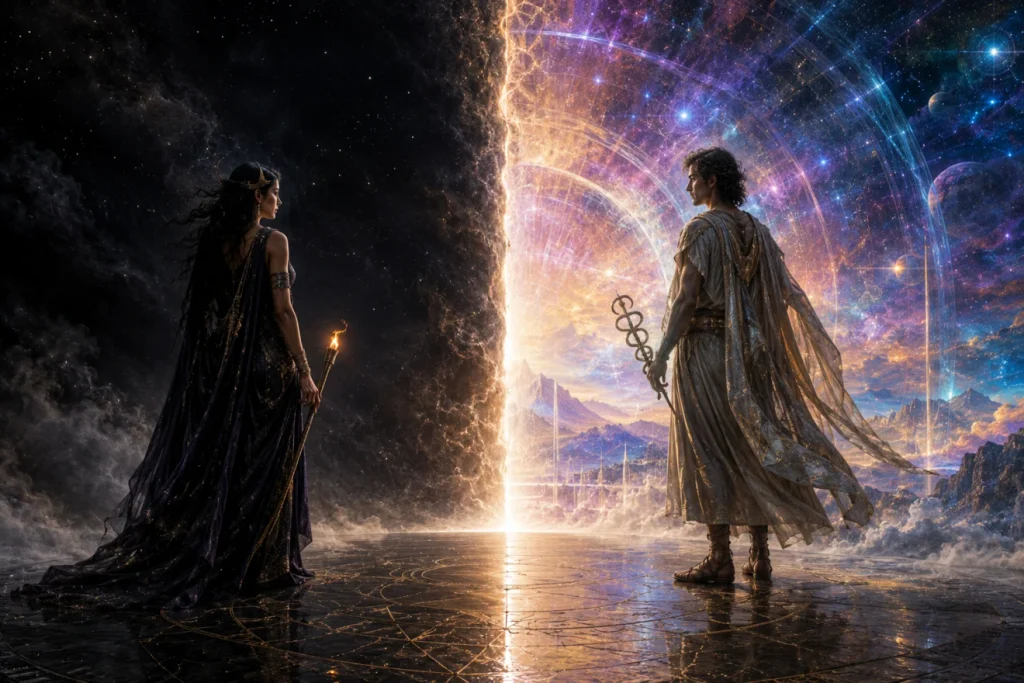
Section 7 · The Opening of Becoming
The Threshold and the Finger of Light
Through relationship, possibility gains a way to continue.
Shadow, the Threshold, and the Finger of Light describe three aspects of the same primordial opening. At Three, relationship permits something to proceed from difference: a creative capacity emerges, passage becomes possible, and becoming gains continuity.
Our distinctions between occurrence, difference, and relationship help us describe this opening. They do not place separate events on an earlier clock. Time and motion become meaningful within the emergence we are describing.
Shadow
The creative remainder: what relationship makes possible beyond an account of either pole considered alone. This capacity belongs to their relation.
The Threshold
The opening through which potential can become consequential. It names the possibility of passage and transformation within relationship.
The Finger
The continuing movement of becoming through that opening, carrying distinctions and consequences into further relationship, pattern, and form.
A threshold both distinguishes and connects. There must be a difference for passage to mean anything, and a relationship through which passage becomes possible. We sometimes picture this opening as a tear: a mythic image for the emergence of access, rather than a literal rip in an already existing fabric of space.
The Finger of Light
The continuity of becoming through the Threshold: the creative movement by which relationship can carry difference into further relationship, structure, and manifestation.
This is why we describe the Finger as a creative current, or sometimes an axis of becoming. It gives us an image for change that can carry consequences: what happens can affect what becomes possible next.
Continuity
Calling this current “stable” means that relationship can carry consequences onward. Its continuity can include transformation, growth, decay, and return. Coherence allows change to proceed without requiring sameness.
Direction
Direction means that change can develop tendencies and trajectories. Several paths may remain possible, and new relationships may alter which paths are accessible. Direction does not require a predetermined destination.
Motion is essential here. In this cosmology, it first names change within relationship, before familiar images of bodies crossing space apply. Time names the ordering through which one condition can follow from another. Both belong to the opening at Three: becoming moves, and its movement can acquire a history.
The word Light draws on the capacity for disclosure named at Two. Through the Finger, possibility can acquire expression and form. Dark’s retained potential and Shadow’s creative depth remain part of this relational cosmos; disclosure continues alongside what remains unseen. Mystery names the ultimate unknown that this account leaves open.
From the first opening to plural thresholds
Three names generative relationship and the possibility of passage. As complexity develops, relationships themselves enter into further relationships. At Nine, we use 3 × 3 as a symbolic shorthand for this expansion: thresholds become plural and interconnected, allowing influence to pass through a more complex field.
Within that field, Will can organize access and focus influence toward change. This developed capacity grows from the responsiveness already present here. It can engage capacities carried by places, objects, beings, and their relationships, while outcomes remain shaped by existing propensities and constraints. Nine gives fuller expression to possibilities rooted in the first opening.
Because change has continuity, what has happened can shape what may happen next. This brings us to Fate as patterned propensity: consequence takes form, while further relationship can still alter its course.
We now turn to Time and the Fates.Section 8 · Sequence, Cycle, and Consequence
Time, Fate, and the Triple Goddess
Becoming acquires a history, and possibility takes a course.
Time belongs to the same opening as relationship and motion at Three. We examine it more closely here because continuing change brings something consequential into the account: one condition can follow from another, and what has occurred can shape what follows.
The Finger of Light names the continuity of becoming through the Threshold. Time names the ordering of that movement. Before and after become meaningful within relationship; as patterns develop, duration, recurrence, growth, and ending can become meaningful too. This ordering requires no earlier clock against which creation waited to begin.
Time is the order of becoming; Fate is the pattern of propensity and constraint within it.
In this part of MCC’s cosmology, the Triple Goddess is encountered through the Moirai, the three Fates. Their traditional imagery of spinning, allotting, and cutting the thread of life gives us a way to consider beginning, measure, and ending across a wider field of becoming. The interpretation below belongs to our cosmology; the ancient image supplies its starting point.
Clotho
In MCC’s reading, she expresses a beginning that can take up a course. A possibility enters relationship and starts to acquire a history. Its continuation remains open to the conditions and encounters through which it develops.
Lachesis
She expresses the particular conditions of a course: its resources, relationships, opportunities, proportions, and limits. Becoming takes shape through what is available and what it encounters. Different conditions give different possibilities room to develop.
Atropos
She expresses the boundary of a particular course. An ending has consequence, even when its effects continue through other lives, forms, or relationships. Further becoming can carry an inheritance from what has ended.
The thread can therefore help us think about more than an individual human life. A forest, a relationship, a culture, or a working can have a course shaped by beginnings, conditions, and boundaries. Such threads also cross: the history of one becomes part of the circumstances of another.
A thread carries continuity with consequence: what has happened becomes part of the conditions of what can happen next.
Cycles carry history
The seasons offer a lived correspondence for arising, flourishing, decline, release, and renewal. Their recurring pattern need not assign each goddess a particular season. Return is not reversal: a returning spring meets changed soil, changed lives, and the consequences of earlier seasons. A cycle can come around again while becoming continues.
In MCC, propensity means a tendency within existing conditions: what is favored, resisted, accessible, or difficult. Fate concerns these patterned tendencies and constraints. A developing course has weight, but its future can still be affected by further relationship. This openness belongs to the model from the beginning.
Conditions have weight
History, accumulated pattern, material limits, and the actions of other beings shape what can happen. Some trajectories are strongly established. Desire alone does not make every outcome accessible, and some boundaries remain beyond a particular intervention.
Conditions can change
New encounters, choices, chance, and changes in the surrounding situation can strengthen one tendency or weaken another. An intervention may also alter conditions enough for a previously unavailable course to become possible.
Agency and responsiveness have earlier expressions within this cosmology. Nine concerns the developed capacity of Will to organize magical access within that already responsive field. Will can engage existing tendencies, redirect influence, or help open another course. Its reach depends on capacity, timing, relationships, and resistance; a working may also produce no meaningful change.
Divination approaches this same field from the side of perception: seeking to discern its pressures, directions, and possible crossings. A reading concerns a situation that continues to develop. What it reveals may help someone recognize a course or choose an intervention, while the consequences of that choice remain to unfold.
To understand how these courses become worlds, we turn next to the endurance of form: pattern acquiring structure, dimension, and resistance sufficient to sustain further relationships.
At Four, creation begins to build worlds.Section 9 · Structure Becomes Durable
Four — Worlds, Matter, and the Architecture of Existence
Relationship acquires enduring form.
At Three, relationship opens the possibility of continuing becoming. Four concerns what happens when relationships sustain recognizable forms. Patterns acquire enough continuity to become structures, and those structures become conditions within which further relationships can develop.
Matter, location, boundary, and environment belong to this part of the account. Here and there can have enduring significance; a form can resist some changes while permitting others. Durability also remains compatible with motion. A river’s waters move through a recognizable course, while that movement continues to shape the course itself.
At Four, relationship can hold a form, and that form can become a condition for further becoming.
Four concerns the endurance of particular forms and environments. Six will concern how differentiated parts become integrated into a coherent whole. A structure can hold together and participate in further relationships while that larger integration is still developing.
The four elements as qualities of form
MCC uses Earth, Water, Air, and Fire as a symbolic language for the qualities of structured existence. These elemental correspondences describe ways forms endure, interact, and change; they are not a chemical inventory of what the universe contains.
Earth
Form acquires weight, boundary, and persistence. Earth expresses the capacity to hold a pattern, support other structures, and resist changes that would dissolve its particular shape.
Water
Continuity can move through changing conditions. Water expresses flow, adaptation, and the capacity to carry relationships through a shifting form or environment.
Air
Forms participate in a surrounding field of interaction. Air expresses movement, exchange, and connection: the passage through which one condition can affect another across an interval.
Fire
Existing arrangements can be altered or broken open. Fire expresses transformation, intensity, and release, through which a form’s present organization can give way to different possibilities.
These qualities overlap within actual things and events. The river’s boundary, flowing water, exchanges with its surroundings, and transformations can all enter an elemental reading. The fourfold language helps us examine a world without dividing everything in it into four exclusive kinds.
Four names a capacity for worlds to have structure. It sets no fixed count of worlds or physical dimensions. Within MCC’s cosmology, this includes the material world and the enduring conditions through which otherworldly places and presences may be encountered.
The Three Worlds within a larger cosmos
MCC’s Three Worlds map serves ritual orientation and relationship with place, otherworld, and afterlife. Its threefold organization answers a different question from the number Four here: how we navigate and understand relationships within a cosmos capable of holding worlds. We use it as a practical and mythic map, allowing that reality may exceed the divisions through which we approach it.
The Protogenoi, or Primordial Powers, help give divine expression to these vast conditions. Their relevance extends across the earlier depths of the cosmology. At Four, we attend especially to powers encountered through world, earth, sea, sky, place, and the conditions that sustain existence.
Responsiveness takes form
A structure can receive influence, respond through its organization, and retain consequences. Four gives the responsiveness already present in the model enduring arrangements through which to express itself.
MCC may encounter primordial powers through modes of presence very different from familiar personality. Their responsiveness can be inseparable from the places, patterns, and immense conditions through which they are known.
Structure and response leave the question of experience open. Our numbered map distinguishes capacities; a divine presence may express several of them, and its primordial character need not confine it to one mode of awareness.
World, life, and divine presence
Gaia offers MCC a way to hold these relationships together. Four draws attention to world, body, environment, and the conditions that can sustain life. Five draws attention to Spirit, presence, and experience within relationship. In our encounter with her, these belong together: the numbered distinctions illuminate aspects of a divine reality that exceeds any one of them.
Form carries history
A structure can retain traces of what has happened through its shape, arrangement, and relationships. Earlier interactions help establish the conditions through which it will respond to later ones.
Form shapes possibility
Boundaries, materials, locations, and surrounding conditions support some interactions and resist others. These differences give propensities their particular weight within a structured world.
This becomes important to MCC’s account of magical action. When we speak of places and objects holding operative capacity, enduring form supplies part of the account: relationships and their effects can persist between workings, without constant conscious direction. What is retained may accumulate, dissipate, or be renewed according to its conditions. The developed Will considered at Nine concerns access to and direction of such capacities.
Four gives the elemental language its foundation in form, movement, and relationship. Five brings Spirit into focus: the inward dimension of presence, experience, and participation. This is the correspondence carried by the pentacle’s four elements together with Spirit.
At Five, we turn from the endurance of form to experience within it.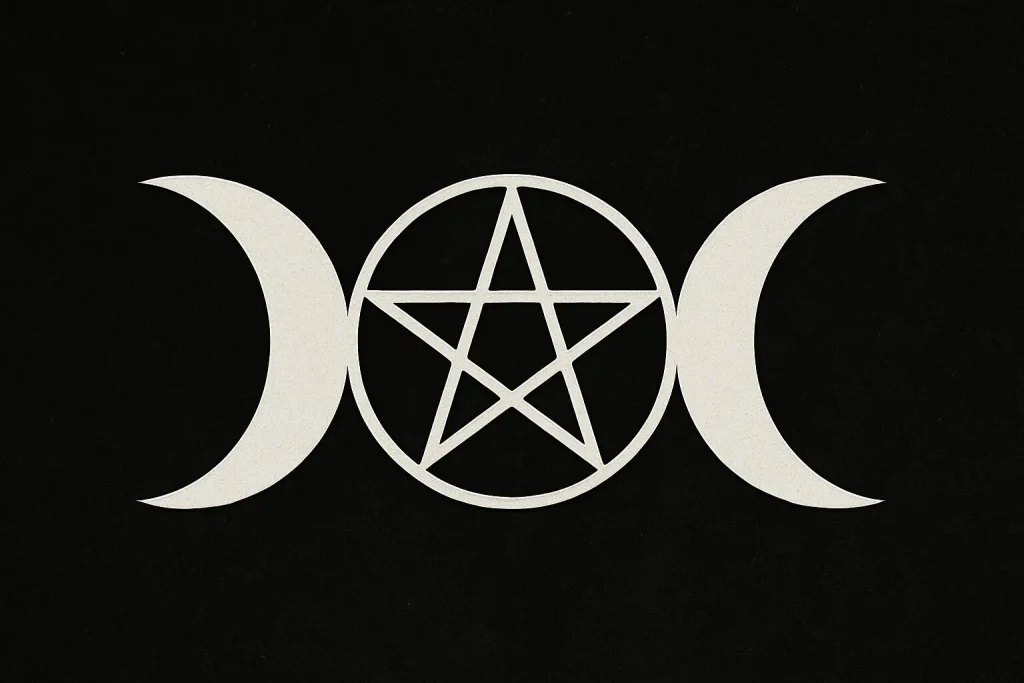
Section 10 · The Interior Opens
Five — Spirit, Interior Life, and Awakening
Becoming acquires an inward point of view.
Four considers how relationships sustain forms, worlds, and environments. Five brings Spirit into focus: existence experienced from within. A being can encounter conditions as significant to itself, develop preferences, participate in relationships, and act from an inward point of view.
This develops from the primordial responsiveness already present in MCC’s account. Five gathers that theme into questions of awareness, identity, intention, and agency. Their precise emergence remains part of the Mystery; complexity alone supplies no numerical test for when experience begins.
Spirit names the inward dimension of becoming: presence, experience, and participation in relationship.
Five is a further creative remainder in this account because our description of durable form at Four has not yet addressed what existence may be like from within. This inwardness can take forms very different from human self-reflection. Experience need not tell a story about itself or put its desires into words.
The capacities below help distinguish aspects of interior life. They can develop differently and overlap in different ways; they are not a checklist every being must satisfy.
Experience
Conditions have significance from a particular point of view. Comfort, disturbance, attraction, and aversion can become ways a being encounters its circumstances, rather than descriptions supplied only by an observer.
Continuity
Earlier encounters can be retained in ways that support recognition, attachment, and identity. A presence can change while carrying a history through which its relationships remain meaningful.
Agency
Needs, preferences, and intentions can help direct action. A being can seek, avoid, initiate, or choose within the possibilities available to it, affecting both its surroundings and other beings.
Relationship
Another presence can become someone encountered. Recognition, attachment, cooperation, conflict, and reciprocity become possible, even when the beings involved experience their relationship very differently.
The pentacle correspondence
Four elements + Spirit
MCC reads the pentacle’s five points through Earth, Water, Air, Fire, and Spirit. The elemental qualities considered at Four enter relationship with the inward dimension brought into focus at Five. Spirit participates with form, movement, exchange, and transformation; the figure holds them together as a magical correspondence.
Divine presence and agency
For MCC, a god is a concentrated center of agency, meaning, and relationship within reality. Five helps us articulate the inward agency of such a presence. Its domains, currents, and relationships may reach across several depths of the cosmology, while its divine identity exceeds any single function through which we describe it.
The language of awakening expresses this emergence into conscious relationship. It need not place every god’s first awareness at one cosmic moment. Human recognition is a relationship a divine presence can enter, rather than a condition we require for its existence.
This wider consideration of interiority also informs MCC’s approach to spirits associated with place or ancestry, fae and other nature beings, and embodied lives unlike our own. Familiar personality is only one way presence may become recognizable. Difference in awareness, scale, or motive calls for attention to the particular relationship.
Five and Nine · Agency and magical access
Desire, intention, choice, and action already belong here at Five. A being can affect its surroundings through its agency. The later place of Will at Nine does not postpone action until that point.
Nine concerns Will’s developed ability to organize magical access across an interconnected field of relationships and thresholds. The capacity to act from an inward point of view provides a basis for that more complex direction of influence.
Experience, care, and responsibility
Interior life changes the ethical significance of relationship. There can be someone for whom an encounter matters. The capacity to experience benefit or harm and the capacity to understand and direct one’s conduct are related, but distinct, considerations.
Experience gives care an object
A being’s welfare can matter even when it cannot explain its experience or understand another’s intentions. Recognition, protection, and consideration can extend beyond beings who think or communicate as humans do.
Agency brings responsibility
Where understanding and choice are possible, questions of intention, consent, obligation, and accountability arise. Responsibility must be considered in relation to a being’s capacities and the choices actually available to it.
Light and Dark remain cosmological relations, not moral rankings. Care, cruelty, cooperation, and exploitation concern what beings do within relationships. MCC considers motives, understanding, and consequences when judging conduct. Hunger, territoriality, or unfamiliarity alone cannot tell us everything about a presence’s intentions or character.
Five therefore opens the possibility of both deliberate care and deliberate harm. An inward life can recognize another’s needs, disregard them, or misunderstand them. The ethical questions belong to these encounters and choices, rather than to an assumed division of existence into inherently good and evil substances.
An inward life does not by itself guarantee coherence. Desire, identity, outward expression, and surrounding relationships can remain in tension. Six concerns the integration through which these dimensions can sustain a coherent whole.
At Six, we turn to integration and the meaning of completion.
Section 11 · The Layers Hold Together
Six — Integration, Grounding, and Completion
Difference can belong to a coherent whole without disappearing.
Four considers enduring form. Five brings interior life into focus. Six concerns integration: the ways differentiated capacities can sustain a coherent being, place, or system.
This returns to the question of stability at a greater complexity. A form can persist at Four; at Six, its different dimensions can support a recognizable whole. Where interiority is present, this includes the relationship between inward experience and outward expression.
Enduring form
Structures hold patterns and provide conditions for further relationships: body, place, boundary, and environment.
Interior life
Experience, presence, identity, and agency bring an inward dimension to participation in the world.
Integrated nature
Differentiated capacities sustain one another and participate in a coherent whole that can continue through change.
Six names a whole whose differentiated dimensions are coherent enough to sustain a recognizable nature.
Coherence preserves difference. A being’s identity, memories, desires, actions, and relationships can belong together while remaining distinguishable. Integration gives their differences a continuing relationship; it need not erase tension or make every part alike.
Body and Spirit
In embodied life, experience, physical conditions, memory, and action continually affect one another. MCC considers their integration through the particular life they sustain together, including its changing needs and limits.
Place and presence
A sacred place may be encountered through landscape, living communities, history, spirit, and ritual relationship. Its coherence belongs to the interaction of these dimensions, rather than to any one considered in isolation.
Six as grounding
Grounding gives capacities a sustainable way to participate. Intention finds expression through action; Spirit remains in relationship with its conditions; a practice acquires forms through which it can be maintained. Such coherence can support a working, while its effects still depend on the situation in which it acts.
Among conscious beings, integration can also support enduring trust, obligations, devotion, and shared practices. Coherent arrangements can sustain harmful conduct too. Completion describes an organization of relationships, not moral perfection or immunity to disruption.
Completion does not imply exhaustion
Several mathematical structures give us useful images for the distinction between a completed form and the possibilities that continue through or beyond it.
Six as a perfect number
Six is the first perfect number: its proper positive divisors—the positive divisors smaller than itself—are 1, 2, and 3, and their sum is Six.
MCC reads this as a correspondence for differentiated parts belonging to a completed whole. The arithmetic gives the image its precision; the cosmological meaning is our interpretation.
Euler’s formula and the completed turn
As the angle θ increases, eiθ traces the unit circle. From θ = 0 to θ = 2π, it completes one turn and returns to its starting point: ei2π = 1. If the angle keeps increasing, another turn follows.
For MCC, this offers an image of movement continuing through a completed form. Finishing a turn does not require movement to end.
Read the notation and the familiar identity
e is the exponential base, approximately 2.71828. i satisfies i² = −1. θ is an angle in radians; 2π radians is a full turn. Cosine and sine give the point’s horizontal and vertical coordinates.
At a half-turn, θ = π, the point is −1. Rearranging that result gives the familiar identity:
Here, these symbols retain their mathematical meanings. Their appearance together does not assign them the numbered roles of MCC’s cosmology.
π and the closed circle
For a Euclidean circle, π is the ratio of circumference to diameter. The circle is a closed geometric form, while π is irrational: its decimal expansion neither terminates nor settles into a repeating block.
Here, “continues” refers to the decimal expansion: π itself is a fixed, finite, precisely defined number. MCC takes the pairing as a symbolic image of a form whose completion does not bring every way of expressing its relationships to an end.
These correspondences have limits. The circular path repeats, and π’s digits express an exact numerical relationship. They illustrate continuation after completion; the emergence of new capacities and possibilities belongs to MCC’s cosmological account.
Mathematical references: NRICH: perfect numbers · MIT: complex numbers and exponentials · A proof of π’s irrationality
A whole can be complete in its organization while remaining open in its relationships. It can encounter other wholes, respond to changing conditions, and participate in consequences that extend beyond its present boundaries. Its coherence gives further becoming something to proceed from.
This is the distinction Seven develops. Completion establishes a coherent whole; further relationship can bring forth possibilities that its present organization has not exhausted.
The form is complete; becoming continues.Section 12 · Completion Opens into Becoming
Seven — The Prism of Plurality
A coherent whole can become the ground of something new.
Six names coherence: a being, place, world, or system can sustain a recognizable nature while its parts and relationships continue to change. That coherence gives further becoming something to work with. What holds together can develop, enter new relationships, and help make possible something that did not exist before.
MCC places this further emergence at Seven. A whole may be complete in its organization while remaining open in its possibilities. Changes within it, encounters beyond it, and the consequences of its own activity can bring new forms, relationships, and capacities into being.
From completion to emergence
Six describes the coherence of a whole. Seven describes the further becoming that coherence makes possible.
Relationship has been present since Three, and plurality has already appeared throughout the unfolding cosmos. Seven follows that generative principle through the lives of coherent wholes. A being can acquire a new capacity; an established form can support an unfamiliar expression; several distinct participants can become capable of something none could accomplish independently.
These numbered distinctions can operate together. A community, for example, may preserve the coherence of Six while generating the new possibilities described by Seven. Its continuity and its becoming belong to the same living history.
What coherence can make possible
The openness of Seven can appear across many kinds of whole. These examples describe places where emergence may continue, each shaped by its own conditions and relationships.
Beings
Selves develop through experience, growth, and encounter. New abilities and relationships can become part of a recognizable being without erasing its history.
Worlds
A world with an enduring character can support additional forms of life, places of meeting, and ways of participating in its unfolding reality.
Gods
MCC leaves room for new divine presences, new relationships with older gods, and distinct expressions of a god’s existing plurality.
Cultures
Languages, arts, customs, and collective memory make new ways of knowing and acting possible. What a community creates can continue beyond any one participant.
Practices
An established ritual can develop new applications, alliances, and meanings as it meets different places, practitioners, and circumstances.
Capacities
Organized relationships can enable actions unavailable to their participants separately. An emerging capacity can then become a condition for further emergence.
A whole can become part of another whole
A person participates in a community; a living organism participates in an ecosystem. Each retains its own organization while contributing to relationships at another scale.
A new capacity can open further possibilities
A shared language permits deliberation and promises. Those practices can support new forms of cooperation. What emerges changes what its participants can do next.
This is the creative remainder of completion. A description of what a whole presently is does not exhaust what may arise through its existence. Its capacities can enter relationships whose consequences become realities in their own right.
At Three, relationship opened a way for becoming to proceed. At Seven, coherent beings, places, and worlds can carry that openness into further forms of existence. The principle returns at a different scale: what emerges can itself participate in emergence.
Becoming brings new relationships with it
Whatever emerges enters a reality already populated by other forms, histories, and capacities. Its presence changes the conditions around it, while those conditions shape what it can become. The openness of Seven therefore leads us toward another question: how do emerged differences organize their interactions?
Attraction and separation now operate among complex wholes, each with its own character. Cooperation, tension, exchange, and resistance can form patterns that influence what happens next. Following those patterns brings us to Eight.
From emergence toward pattern and magical access
Eight explores emerged dualities: the dynamic relationships through which complex participants draw together, distinguish themselves, exchange influence, and respond to one another.
Nine then concerns the developed operative magical field, where connected thresholds offer access through which Will can focus magical influence. Its roots extend through the preceding account: responsive reality, enduring forms, interior life, and relationships capable of carrying influence.
Seven opens further possibilities. Eight develops their relational patterns. Nine considers how those patterns can support magical access and directed change.
What emerges brings difference into new relationships. Eight follows the patterns those relationships make possible.
Section 13 · Relation in Motion
Eight — Emerged Dualities and Pattern
What has emerged begins to shape what it encounters.
Seven opens coherent reality to further becoming. New forms, capacities, and relationships can arise, and each enters a world already shaped by other presences. Their encounters have consequences: they draw together, resist, exchange, separate, and alter the conditions of one another’s existence.
Eight names the patterns developing through these interactions. The differences first encountered at Two now appear among complex wholes. A being brings its history into relationship; a place brings its character; a community brings its accumulated customs, commitments, and tensions. Difference has acquired depth.
Emerged dualities
Eight describes how complex differences enter relationships that shape their continuing motion.
A duality here is a relation between distinguishable positions or tendencies. It can exist between beings, within a being, or across a larger pattern. The same participant may draw close in one relationship and establish distance in another. A world can contain many such tensions at once, with each participating in a wider plurality.
Attraction and distinction continue
The currents of joining and differentiation have accompanied becoming from its first opening. At Eight, they operate through the complexity that has emerged. MCC gives these currents mythic expression through the following divine names, while recognizing that each god exceeds any single function described here.
Eros
Attraction · Affinity · Joining
Eros expresses the drawing toward relation: the attraction through which contact, exchange, alliance, and union become possible. Love and desire are among its lived expressions, while its cosmological reach extends through the deeper tendency of things to enter relationship.
Eris
Distinction · Disruption · Separation
Eris expresses the persistence of difference: the boundary, interruption, divergence, and resistance through which participants remain distinguishable. Its disruption can unsettle an established arrangement and open space for another pattern to develop.
Both currents operate across Light and Dark. Attraction can sustain a relationship or bind it too tightly; separation can preserve integrity or sever a sustaining bond. Their consequences depend on the participants and conditions. Together, their tension helps make patterned plurality possible: connection continues while difference retains room to act.
How dualities become complex
The dualities encountered within an emerged world carry more than simple opposition. Each side can contain further relationships, competing needs, and changing possibilities. These examples show some of the forms that complexity can take.
Contact and boundary
A boundary gives an encounter shape. It can admit some exchanges, resist others, and change as the relationship develops. Openness and distinction can support one another.
Continuity and change
A being or tradition carries a recognizable history while responding to new conditions. What is preserved influences what can change, and change alters what preservation requires.
Giving and receiving
Exchange changes the conditions of those involved. Its effects may be unequal, delayed, or returned in another form. A relationship acquires a history through these responses.
Such patterns are moving relationships. Their participants need not exert equal influence, and a sustaining pattern need not hold them at an exact midpoint. Rhythm, adjustment, tension, and occasional disruption can all contribute to its continuity.
Feedback: when a response returns
Feedback occurs when the consequences of a change return through a chain of influence and affect the process that produced them. A relationship can therefore help strengthen, restrain, or reorganize its own developing pattern.
Reinforcing feedback
Positive feedback
A change produces responses that strengthen the original change. An escalating quarrel can work this way, as each retaliation encourages further retaliation.
Balancing feedback
Negative feedback
A response opposes the initial change. A thermostat reducing heat as a room warms illustrates this kind of regulation. The response helps restrain a departure from the intended condition.
“Positive” and “negative” describe the direction of feedback, not its moral value. Either attraction or separation can be reinforced or restrained. Actual behavior depends on the structure, strength, and timing of the responses; feedback can also contribute to oscillation or instability.
Technical background for these analogies: MIT OpenCourseWare, Linear Dynamics and Interacting Systems , An Introduction to Feedback , and Feedback: Applications and Consequences . Their application to this cosmology is MCC’s interpretation.
Pattern gives becoming a direction
Repeated relationships can make some developments easier and others more difficult. An established alliance supports certain actions; a conflict repeatedly renewed creates resistance; a practiced response becomes easier to repeat. History begins to exert influence through the pattern of the present.
This helps articulate the weight of Fate as propensity. Existing relationships shape which possibilities are accessible and what changing direction may require. Their patterns can endure, weaken, or be reorganized as conditions change. Openness remains part of the account throughout.
As relationships connect with other relationships, an influence may pass through several encounters, boundaries, and openings. This brings the plurality of Threshold into focus: access has paths, conditions, and consequences within a larger relational field.
Nine develops that field into the account of operative magical access. Primordial responsiveness has acquired increasingly organized forms of agency; developed Will can now be considered in its capacity to focus influence, work through available thresholds, and attempt to alter what follows.
Eight gives relationship a pattern. Nine asks how that pattern becomes accessible to Will.
Section 14 · Will, Access, and Possibility
Nine — The Operative Magical Field
Where plural thresholds give Will access to change.
Eight describes complex relationships developing patterns of exchange, resistance, and response. As those relationships connect with others, influence can pass through a larger field. An encounter changes the conditions of another encounter; a boundary opens onto further boundaries; an alliance creates possibilities beyond itself.
Nine brings these developments into an account of operative magical access. Within MCC’s cosmology, magic becomes fully articulated here as a capacity of relational reality. Developed Will can engage that capacity, focus an intervention, and attempt to alter what follows.
The operative magical field
Nine names a field of relationship through which magical capacity becomes accessible to directed Will.
The roots of this capacity extend through the preceding account: primordial responsiveness, creative relationship, enduring form, interior life, coherence, and emergence. Nine concerns their developed organization. Agency and magical influence already have histories; Will enters a reality that is active before any particular working begins.
We use field for this connected arrangement of relationships and possibilities for influence. Power can still be concentrated in particular beings, objects, and places. The account allows different currents to operate through different mechanisms; “field” does not identify them with a single measurable physical substance.
Capacity
What can carry or produce influence. A being, place, object, or relationship may retain operative capacity, including between workings and without anyone’s present attention or belief.
Access
A workable relationship to that capacity. Affiliation, correspondence, practice, place, or timing may make influence available. Access can be partial, conditional, strengthened, or lost.
Will
An agent’s organized direction toward change. Will brings intention into a working through attention, commitment, and action, using available access within the conditions of the field.
Three multiplied: thresholds in relation
At Three, relationship gives rise to the opening through which becoming proceeds. At Nine, openings themselves participate in further relationships: one threshold can lead to another, and one crossing can alter the conditions of passage elsewhere.
MCC reads Three multiplied by Three as an image of relationship becoming relational at another scale. The Threshold is now understood through its connected plurality.
| 3 | Relationship and opening Difference permits a creative relation through which becoming can proceed. |
|---|---|
| 6 | Coherence and completion Differentiated capacities sustain a recognizable whole without exhausting its possibilities. |
| 9 | Field and operative access Relationships among complex wholes support connected thresholds and directed magical influence. |
The arithmetic supplies a symbolic correspondence. It does not establish a numerical threshold at which complexity must become magical, or require reality to contain exactly nine gates, forces, or realms.
Will, attraction, and a focus for change
Primordial responsiveness acquires increasingly organized expression through the cosmology. At Nine, we consider its development into Will capable of engaging magical access. Such Will can be human, divine, or otherwise nonhuman; its forms need not mirror human self-reflection.
Eros remains important here. Attraction gives an intervention a relational direction: an affinity, alliance, correspondence, or desired connection through which influence may proceed. Will gathers and directs that possibility toward a change. Love, in this broad cosmological sense, concerns the drawing into relationship that underlies the working.
Eris remains equally present in the distinctions that give a working definition. Selection, separation, release, resistance, and boundary can all be necessary to its purpose. A focus for change emerges through relationship with difference, including the independent agency of whatever else participates.
The gods of passage
Ancient crossroads and messenger imagery gives MCC a language for this access. We understand gods of the threshold as presences whose agency concerns passage itself: how realms meet, what can cross, and how a crossing changes the relationships involved.
Hekate
Magic · Keys · Plural Access
Hekate gives this account a particularly direct magical expression. In MCC’s understanding, she can open, guard, close, or redirect access. Her presence at thresholds concerns both the possibility of passage and the conditions under which influence can act.
Hermes
Communication · Translation · Movement
Hermes expresses the passage of meaning, persons, and influence across differences. Communication itself requires a crossing. In MCC’s understanding, his agency includes carrying, connecting, negotiating, and changing the relations through which passage becomes possible.
Their functions overlap. Both can traverse thresholds and participate in changing the conditions of access. Within MCC’s reading, their ability to travel among realms follows from this affinity with passage itself. Nine brings these aspects of their agency into focus; their presence reaches throughout the cosmology.
The Triple Goddess and plural presence
Hekate’s triple form offers a powerful image of this plurality. MCC reads her triplicity through distinct faces, manifestations, and relationships: a divine presence can meet different thresholds without being exhausted by any single encounter. Some expressions may carry their own names; others may remain unnamed.
The connection with Three multiplied by Three is symbolic: the threshold becomes a plurality of related thresholds, and divine presence can meet that complexity. The Moirai remain the distinct Fates discussed earlier. Shared triplicity can reveal a correspondence without making different divine presences identical.
Historical points of contact: Hekate’s crossroads and triple imagery and Hermes as messenger and guide . Their interpretation within the Zero–Nine account is MCC’s.
Divination approaches this field through perception: it attempts to discern position, direction, relationship, propensity, and possible movement. A working approaches it through intervention. Insight can guide action, while gaining insight and changing external conditions remain distinguishable outcomes.
This is why divination is less like reading a predetermined answer and more like perceiving more of the geometry of the field. What can be perceived may include constraints, developing opportunities, and places where a different action could matter.
93 — Will, Love, and Relationship
Thelema offers a neighboring correspondence between Will and Love. Its historical use of 93 comes from Greek letter-values: the words Thelema, meaning Will, and Agape, meaning Love, each total ninety-three.
Θέλημα
Thelema · Will · 93
Ἀγάπη
Agape · Love · 93
How the Greek letter-values total 93
Greek isopsephy assigns numerical values to letters. Accents and breathing marks do not change these values.
Thelema: Θ + ε + λ + η + μ + α
Agape: Α + γ + α + π + η
That established association invites comparison with MCC’s interest in directed Will and relational attraction. Thelemic Agape and MCC’s account of Eros belong to their respective traditions; the correspondence opens a conversation between them.
MCC’s additional symbolic reading
- 9
- The operative field and its connected thresholds.
- 3
- Relationship and the opening through which becoming proceeds.
93 can poetically suggest the field acting through relationship.
This reading of the digits Nine and Three is MCC’s own exploration. The historical Thelemic basis of 93 is the shared numerical value of the two Greek words, rather than this separate interpretation of its digits.
Historical reference: O.T.O. U.S. Grand Lodge FAQ, “What does 93 mean?”
A Qabalistic correspondence: Nine and Yesod
In Hermetic Qabalah, Yesod is the ninth sephirah, its name commonly translated as Foundation. That provides another useful point of comparison for a number concerned with the basis on which influence can operate.
The comparison is selective. MCC’s connection between Nine, Will, and an operative relational field belongs to this cosmology; it does not make Yesod the traditional location of every aspect of Will or require MCC to adopt the tenfold sequence of the Tree of Life.
Historical reference: Book 4, Part II, glossary entry for Yesod .
Nine opens into continuing plurality
The numbered account reaches Nine with a cosmos capable of carrying influence through complex relationships, and with forms of Will able to engage that influence. Further worlds, beings, divine expressions, thresholds, and outcomes can continue to emerge within this openness.
Each additional development does not require another universal numbered stage. Nine gives the account an operative field; it leaves becoming room to continue. We can now return to the principle running through the whole sequence: relationship can give rise to more than its participants contain separately.
The thresholds are plural, and becoming remains open.
Section 15 · The Pattern Beneath the Numbers
The Creative Remainder
Reality does not merely combine. Relationship changes what becomes possible.
Looking back across the sequence, a recurring movement becomes visible. Difference permits relationship. Relationship permits organization. Organization can support capacities that were not present in the same way among its participants considered separately.
Once such a capacity appears, it does not sit outside the world that produced it. It becomes part of that world — something new that can enter relationships, encounter resistance, create consequences, and participate in whatever happens next.
MCC calls this generative opening the creative remainder. “Remainder” does not mean discarded residue. It names the more that becomes possible when reality enters relationship with itself.
What emerges through relationship can itself become a condition for further becoming.
Difference becomes creative
Shadow
Light and Dark are more than two conditions standing beside one another. Difference creates tension, contrast, boundary, attraction, and relation. Shadow names the first new capacity of that relation: not a substance added from outside, but something possible because the two can meet. The Threshold is that opening; the Finger of Light is its continuing movement.
Form develops an inward dimension
Spirit and interiority
Four gives durable worlds, bodies, boundaries, environments, and structures. Within formed existence, Five marks inward life: experience, memory, desire, attention, response, choice, and forms of conscious agency. MCC gathers this interior dimension under Spirit. Form is no longer described only from the outside; reality can also be encountered from within.
Completion opens into plurality
Further becoming
Six gathers form and interiority into coherent wholes. Yet a whole, once coherent, becomes something that can encounter other wholes. It can participate, reproduce, alter its environment, create histories, form communities, and generate consequences. Seven names this reopening into plurality. The form is complete; becoming continues.
Pattern becomes operatively accessible
The magical field
Eight describes interdependence: networks, correspondence, exchange, feedback, and patterns of relation among complex participants. Such patterns create thresholds — places where one part of the field can reach another. Nine names the operative magical field: not the beginning of magic, but the point at which developed Will can recognize available access and deliberately enter a connected pattern of possibility.
These arrows describe conceptual relationships, not a clock. At the primordial opening especially, occurrence, difference, Shadow, the Threshold, and the first movement of the Finger belong to one inseparable becoming. Time does not stand outside that opening measuring its steps.
The recurring pattern
Three is what relation makes possible.
Five is what formed existence can carry inwardly.
Seven is what completion releases into plurality.
Nine is what patterned relation makes accessible to Will.
Why call it a remainder?
Because after the participants are named, something about their relationship still matters. A bond can do what neither participant can do alone. An organized whole can sustain capacities that its components do not express separately. A network can create routes of access that no isolated point contains by itself.
The remainder is therefore not a leftover quantity. It is a way of naming generative relation: the capacity of an arrangement, encounter, or whole to open possibilities that then become part of reality in their own right.
Not a leftover
Nothing has been discarded. “Remainder” names what relationship makes possible beyond describing the participants separately.
Not proof by number
The numerical sequence gives MCC a symbolic map. The meaning rests in the concepts and relationships, not in numerical recurrence by itself.
Not a ladder
Later capacities do not replace earlier ones. Form, Spirit, coherence, plurality, pattern, and access remain active together.
This is why becoming remains central even after worlds, selves, coherent beings, networks, and magical practice enter the account. Stability can support movement. Boundaries can make exchange possible. A completed form can become a participant in another relationship. A magical act can alter conditions that later actions will inherit.
The Finger of Light names the continuity running through these openings: reality forming, relating, responding, reorganizing, and continuing beyond every temporary completion.
What holds can support what changes, and what changes can establish new ways of holding. Completion does not imply exhaustion.
We can now bring Zero through Nine into a single view. The full map does not show ten isolated ideas, but one connected movement: from primordial possibility and difference, through worlds and inward life, into coherence, plurality, interdependence, and the operative field of magic.
Section 16 · The Cosmology at a Glance
The Whole Cosmological Map
From primordial possibility to a relational cosmos capable of participating in its own continuing becoming.
Nyx · Undifferentiated Existence
Before meaningful distinction, MCC begins with existence as unresolved possibility. This is not absolute nothingness. Difference has not yet become established, and Mystery remains undivided within the primordial whole.
The First Formation
Something occurs. A potential takes temporary form — an event, distinction, or first appearance within undifferentiated possibility. But occurrence alone does not yet guarantee enduring creation; without productive relation, it may close again into possibility.
Light · Dark · Eros · Eris
Difference becomes meaningful. Light and Dark express disclosure and depth; Eros and Eris express attraction and separation. Tension, contrast, boundary, and relation become possible without requiring sameness.
Shadow
Relation produces more than opposition. Shadow names the ambiguity, depth, tension, partial revelation, and genuine novelty that become possible because difference can enter creative relationship.
2 → 3: difference enters relationship, and relationship opens a capacity neither pole possesses alone.
Threshold Opens ⇄ Finger Proceeds
Shadow holds difference open long enough for possibility to continue rather than simply resolve. The Threshold names that opening. Through it, the Finger of Light becomes a stable creative current carrying ordering, information, persistence, differentiation, and direction into what follows.
Worlds
Pattern becomes durable as dimension, form, matter, environment, element, place, boundary, and structure. Creation gains somewhere to persist and somewhere from which further relationships can occur.
Spirit · Interiority
Form acquires an inside. Experience, memory, desire, attention, identity, response, choice, and conscious agency become part of the account. MCC gathers this inward dimension of existence under Spirit.
4 → 5: formed existence becomes capable of being encountered not only from outside, but from within.
Completion · Coherence
Form and interiority become capable of belonging to one coherent nature. Inner and outer, structure and experience, body and Spirit can hold together as an organized whole.
Plurality · Further Becoming
A completed whole can now encounter other wholes. Beings, relationships, communities, gods, histories, cultures, consequences, and new possibilities arise through those encounters. The form is complete; becoming continues.
6 → 7: coherence creates participants, and participants reopen creation into plurality.
Patterned Relation
Plural participants form networks of correspondence, exchange, recurrence, feedback, affinity, resistance, and consequence. Relationships develop patterns, and patterns create pathways through which one part of the whole can affect another.
The Magical Field
Interdependence creates plural thresholds. Developed Will can recognize available access, enter a connected pattern deliberately, and influence its propensities. Nine is not where magic suddenly begins; it is where an already relational reality becomes operatively accessible.
8 → 9: patterned relationship creates routes of access, and Will becomes capable of deliberate participation.
Nine ends the numbered map. It does not end the cosmos.
Magical acts enter existing relationships and become conditions for what follows. New forms meet other forms. New thresholds appear. Consequences generate further consequences. The sequence opens outward rather than requiring a Ten.
These are relationships and resonances, not a claim that each deity belongs exclusively to one numbered stage. Divine presence crosses the map.
Nyx
The sacred face of primordial existence and Mystery: undifferentiated possibility before established relation.
The Moirai
Beginning, measure, boundary, consequence, sequence, and the conditions through which becoming acquires a course.
Gaia & Primordial Powers
Especially resonant with world, element, place, environment, embodiment, and durable cosmic structure.
Awakened Gods
Divine personhood becomes intelligible where interiority, agency, relationship, and coherent identity are possible.
Hekate & Hermes
Thresholds, crossings, mediation, movement, communication, access, and the passage between otherwise separated domains.
Zero holds possibility.
One permits occurrence.
Two establishes difference and relation.
Three opens emergence.
Four gives emergence a world.
Five gives the world an inside.
Six gathers inner and outer into coherence.
Seven gives the whole a future.
Eight reveals the patterns among what has become.
Nine makes those patterns available to deliberate participation.
Section 17 · Beyond the Edge of the Map
Mystery — What Knowing Cannot Exhaust
A map can be true without being total. To encounter something genuinely is not necessarily to possess all that it is.
A cosmological map creates a particular temptation. Once Zero through Nine have been named, their relationships described, and a coherent pattern drawn between them, the diagram can begin to look more complete than any diagram of reality has a right to be.
MCC does not understand the map that way. The numbered cosmology is an attempt to describe relationships within becoming. It is not a claim that reality has been captured, catalogued, or emptied of everything that exceeds the model.
Mystery is the depth of reality that can remain beyond any single act of knowing — even when the encounter itself is genuine.
This does not mean that everything is unknowable, nor that ignorance should be treated as sacred. We can learn real things about the world. We can describe patterns, test explanations, correct mistakes, deepen relationships, and become more precise.
Mystery begins with a simpler recognition: knowledge does not necessarily equal possession. Something may be known truly without being known completely.
Zero through Nine describe a pattern MCC finds meaningful in existence, emergence, Spirit, relationship, and magic. They are not a fence around reality. Whatever the map successfully explains remains part of a reality larger than the explanation itself.
Nyx
Undifferentiated primordial existence: possibility before meaningful distinction has become established.
Dark
The primordial tendency toward depth, concealment, inwardness, potential, and non-disclosure.
Shadow
Partial revelation: enough distinction for contour, ambiguity, relation, and something genuinely new to appear.
Mystery
The excess of reality over our present grasp. Mystery is not another numbered stage; it becomes especially meaningful wherever a knower encounters more than the knower can contain.
What is known
Encounter, evidence, experience, observation, memory, relationship, interpretation, and accumulated understanding can tell us something real.
What remains
Further context, interiority, causes, possibilities, relationships, meanings, and dimensions of the encountered reality may remain beyond present grasp.
This distinction matters because the cosmology does not place a conscious observer at the beginning of existence. Reality does not need someone watching it in order to possess complexity, depth, relation, or unrealized possibility.
Reality has depth
Worlds, structures, relations, and primordial processes can exceed a simple description before reflective consciousness enters the account. There can be more present than any later observer will immediately see.
Depth becomes Mystery to a knower
At Five, experience and awareness make another relation possible: something can now encounter reality, know it, question it, misunderstand it, and discover that genuine knowledge may still have an edge.
That edge can mean different things. Some mysteries are simply questions awaiting better information. Others seem to deepen as our understanding grows.
A gap that may close
What caused a sound? Who built an object? Which physical process is occurring? What happened in a forgotten event? Investigation may supply enough evidence that the mystery simply becomes an answer.
A depth that may continue opening
Consciousness, death, gods, Spirit, existence, other minds, magic, and the fact that anything exists at all may become clearer through study while still generating deeper questions about what they are and how they belong to reality.
Knowledge and Mystery are therefore not enemies. Solving a problem can remove ignorance. Genuine understanding can also reveal that the landscape was larger than we first realized.
One can genuinely encounter a god, spirit, person, place, or world without therefore possessing an exhaustive account of what that being is.
This matters especially in religion. If gods are real beings rather than objects constructed entirely inside human thought, then relationship with them should increase knowledge without requiring total ownership of their nature. A deity can become familiar without becoming small.
The same is true of other people. Another consciousness can be known deeply, loved intimately, and encountered for decades while still possessing an interiority that is not reducible to our idea of that person.
The Eros of Mystery
Mystery draws us closer. It invites study, devotion, experiment, conversation, pilgrimage, divination, prayer, curiosity, and the desire to understand: there is more here — approach.
The Eris of Mystery
Mystery also preserves difference. What we encounter resists being collapsed into our preferred explanation: you may enter relationship with this without making it identical to your understanding of it.
Mystery therefore echoes one of the oldest movements in the cosmology. Eros draws the knower toward relation. Eris preserves enough difference for the relation to remain real.
Learning does not necessarily destroy Mystery. Often it moves its edge. Discovering how something works can resolve one uncertainty while exposing deeper questions of origin, relation, meaning, or consequence. Study should make MCC less credulous, not less capable of wonder.
Shadow gives contour
Shadow is neither complete concealment nor complete disclosure. A shadow tells us something real: position, contour, relation, interruption, the presence of form. Yet the shadow is not the whole object. It becomes an image for knowledge that is genuine without pretending to be complete.
The Threshold gives access
The Threshold allows difference to persist into encounter. The Finger carries differentiation, order, and relation forward so that worlds, beings, patterns, and meanings can become distinct enough to be met at all.
The Finger does not abolish Mystery.
It gives Mystery edges.
Through those edges we can distinguish beings, worlds, relationships, histories, causes, symbols, structures, correspondences, and possibilities. We can learn. We can test. We can disagree. We can revise our conclusions. None of that requires reality to be exhausted by the description.
MCC does not use Mystery as an escape hatch whenever evidence becomes inconvenient. “We do not know” is a complete and honorable answer. Ordinary explanations should be investigated. Claims may be mistaken, symbolic, psychological, fraudulent, incomplete, or simply unresolved.
Mystery marks a boundary in understanding; it does not erase the boundary between evidence and imagination. Uncertainty is not proof of whichever explanation we happen to prefer.
That discipline matters especially in magic. Magical practice may place us in unusual relationships with intention, symbol, Spirit, place, consciousness, synchronicity, probability, threshold, and experience. An unanswered question does not prove a particular magical explanation.
Yet uncertainty does not make an experience meaningless. MCC is comfortable with the more demanding position: investigate what can be investigated, say clearly what is known, and remain capable of relationship where explanation is incomplete.
The cosmological map gives us structure. Mystery reminds us that structure is not possession. Whatever truth the map contains, the reality it points toward remains larger than the diagram.
Cosmology therefore needs more than numbers and equations. Human beings also carry difficult truths through image, story, deity, symbol, poetry, and myth.So how do we tell a creation story without mistaking the story for the whole of creation?
Section 18 · Four Languages, One Story
How Do We Tell a Creation Story?
No single language has to carry the entire weight of reality.
Cosmology sits at an unusual crossroads. Mathematics can describe pattern. Physics can investigate measurable nature. Myth can place us in relationship with realities that an equation was never intended to personify. Mystery reminds us that even a successful description can still have an edge.
MCC does not ask any one of these languages to swallow the others. We use them differently because they answer different kinds of questions. Where they illuminate one another, the comparison can be fruitful. Where they diverge, the distinction matters.
Mathematics can reveal structure.
Physics can test nature.
Myth can make sacred relationship speak.
Mystery keeps the account open.
Story lets them meet without pretending
that they are the same thing.
Pattern without theology
Number, proportion, geometry, symmetry, recurrence, topology, and relation can reveal structures that do not depend upon our religious interpretation of them. Mathematics gives us disciplined ways to notice pattern.
But a mathematical relationship does not announce its own sacred meaning. The pattern may be real while our interpretation of that pattern remains an act of theology, philosophy, symbolism, or imagination.
Nature under observation
Physics investigates measurable reality: matter, energy, spacetime, fields, interaction, symmetry, information, change, and the conditions under which organized structures can emerge.
Ideas such as emergence, coupling, symmetry-breaking, self-organization, and interdependence can provide useful parallels for MCC’s cosmology. But a parallel is not proof. The Finger of Light is not a hidden physics equation, and physics has not demonstrated the MCC sequence.
Structure enters relationship
Myth does something an equation is not intended to do. It gives human beings a language of image, presence, genealogy, desire, conflict, place, encounter, transformation, and sacred personality.
We can speak abstractly about attraction and separation; myth may encounter Eros and Eris. We can describe sequence, measure, and boundary; myth may know the Moirai. This does not require reducing gods to metaphors for abstract principles.
The edge remains visible
Mystery prevents a useful model from becoming a closed machine. Something can be genuinely encountered without being completely possessed by the explanation we give it.
That is not an excuse for credulity. Claims still deserve scrutiny. Evidence still matters. Mystery simply reminds us that the limits of a map and the limits of reality are not necessarily the same thing.
Similarity is not identity. A scientific idea can illuminate a religious intuition without proving it. A myth can carry sacred truth without functioning as a laboratory report. A numerical pattern can be suggestive without becoming evidence of divine design. And Mystery can remain without making every explanation equally plausible.
With those distinctions in place, the cosmology can do something different. It can be told rather than diagrammed. The numbered map becomes sequence, relationship becomes encounter, and abstract conditions become a sacred story through which the same ideas can be approached from another direction.
The Finger of Light
The following is an original MCC sacred telling of the cosmology developed on this page. It draws upon Greek divine names and imagery, but it is not presented as a surviving ancient Greek creation myth.
Before distinction, Nyx
Before there were worlds, there was Nyx.
Not darkness as the eye knows darkness, for there was not yet an eye to see it, nor a lamp whose absence might be noticed. Nyx was Night before opposition: existence unseparated, without here or there, self or other, revelation or concealment.
Everything that might become was held without yet being divided into the things it could become.
Something happened
Within possibility, something occurred.
A distinction flickered into being — not yet a world, not yet an enduring order, but an event within what had been undivided. For the first time, existence contained the difference between what had occurred and what had not.
Yet occurrence alone was fragile. A single appearance could vanish as readily as it had arisen. For becoming to continue, what appeared would have to encounter something other than itself.
Light and Dark · Eros and Eris
Difference deepened.
What could disclose itself became Light. What could remain inward, fertile, concealed, or unresolved became Dark.
Between what differed moved two ancient tendencies. Eros drew one thing toward another. Eris preserved the distance through which one thing could remain other than another.
Attraction and separation, approach and distinction, relation and boundary entered creation together.
Shadow
Had every difference resolved perfectly, perhaps creation might have folded back into stillness.
But relation left something more.
What Light could not wholly reveal and Dark could not wholly reclaim remained between them. What Eros could not completely unite and Eris could not completely divide persisted as ambiguity, contour, tension, possibility, and partial revelation.
Shadow was the first creative remainder.
The Threshold Opens · The Finger Proceeds
Within Shadow, the Threshold opened —
not a door in a wall, for walls had not yet been built,
but a passage in possibility itself. Difference had
learned how to remain open.
Through that opening proceeded the
Finger of Light: not a god and not
a physical flame, but the stable creative current through
which pattern could persist, information could carry
forward, and what had happened could shape what came next.
Where sequence acquired continuity, the
Moirai became encounterable:
Clotho drawing forth, Lachesis measuring,
Atropos establishing boundary.
Beginning, duration, consequence, and ending entered
the rhythm of becoming.
Worlds take form
Then pattern learned to hold.
Distance acquired dimension. Movement acquired pathways. Matter and energy took durable forms. Environments arose. Elements interacted. Boundaries could remain long enough to shape what happened within them.
Seas gathered beneath skies. Earth bore weight. Fire transformed. Storm crossed distance. Places developed character, and the primordial powers of world, element, motion, depth, and environment became increasingly distinct.
Here Gaia becomes especially encounterable: not simply as a label placed upon matter, but as divine presence within the depth, fertility, relation, and living reality of world.
Existence develops an inside
Structure became intricate enough for another opening.
Existence was no longer described only by what could be seen from outside. Experience appeared. Awareness could endure. Memory could carry a past inwardly. Desire could reach toward what was absent. Attention could choose. Presence could answer presence.
MCC gathers this inward dimension under Spirit.
Souls and spirits became possible. So did concentrated centers of agency, meaning, and relationship whose presence could become divine. Some would be ancient; others would arise within worlds, histories, peoples, places, and relationships still unfolding.
The cosmos could now be experienced from within.
Inner and outer learn to hold together
Form and interiority did not remain separate layers.
Body could bear memory. Place could bear presence. Identity could persist through change. Spirit could inhabit structure without being reducible to structure, while structure could shape the possibilities available to Spirit.
What had been capacities could become a coherent whole — a being, a place, a life, a world, a divine presence capable of continuing as itself.
The whole meets another whole
And because the whole was truly whole, it could meet another.
From meeting came consequence. From consequence came history. From history came kinship, conflict, ecosystem, community, culture, ritual, lineage, memory, devotion, love, rivalry, new gods, new spirits, new forms, and possibilities that no participant carried alone.
Creation passed beyond isolated completion and opened into plurality.
The form was complete. Becoming continued.
The cosmos becomes a web
As relationships multiplied, they did not remain random encounters.
Paths repeated. Affinities formed. Actions carried consequences through networks. Seasons returned. Memory altered future choice. Places answered the lives within them. Symbols gathered meaning through repetition. Communities shaped their members, and members reshaped their communities.
The cosmos became dense with patterned relationship: correspondence, exchange, feedback, attraction, resistance, resonance, consequence, and connection.
No participant stood entirely alone. Each existed within a field already shaped by others.
Will enters the pattern deliberately
And eventually some beings learned not merely to inhabit these relationships, but to recognize them.
A threshold could be noticed. A correspondence could be cultivated. A symbol could focus attention. A place could be approached differently from another. Intention could be disciplined into Will. Relationship could be entered with purpose.
Magic did not suddenly appear from nowhere. The possibilities of magic had been gathering throughout the whole movement of becoming.
At Nine, the relational cosmos becomes operatively accessible. Developed Will can enter an available pattern and attempt to influence what becomes more or less possible within it.
The witch therefore does not stand outside creation commanding it from beyond. The witch works from within the web.
And creation did not end at Nine.
Nine opened.
Every act enters a world already in relationship.
Every consequence becomes a condition for what follows.
Every completed thing may meet another.
Every threshold may lead into another pattern.
What becomes may always become part
of something becoming still.
The numbered cosmology and the sacred telling describe the same MCC framework in different registers. The map clarifies relationships; the story makes those relationships imaginable and encounterable. Neither should be used to erase the distinctions preserved by mathematics, science, history, theology, or Mystery.
Something important has also changed during the telling. At the beginning, divine names help us speak about primordial realities. By the time interiority, coherence, plurality, and relationship have emerged, divine beings can themselves become participants within the cosmos — capable of encounter, agency, relationship, history, affinity, and distinction.
The cosmology can describe conditions in which gods become encounterable. It cannot reduce a god to a number.The map gives us the pattern. Theology begins when we ask who is meeting us within it.
Section 20 · Participating in a Relational Cosmos
From Cosmology to Magic Will Within the Living Field
Magic does not enter the cosmos from outside it. It becomes possible because relationship already runs through it.
The Finger of Light is a cosmology page, not a spell manual. But once the map reaches Eight and Nine, magic can no longer remain only an implied possibility. The cosmology has finally described both a relational field and beings capable of entering that field deliberately.
That gives MCC a more precise answer to a practical question: what kind of universe would make magical practice meaningful in the first place?
Magic is intentional participation in a relational field through which developed Will engages available thresholds and attempts to alter the conditions of what may become.
That definition does not place magic outside nature, outside Spirit, or above the rest of creation. It begins with the opposite assumption: whatever magic is, it occurs inside the same cosmos described by the rest of the map.
Pattern creates pathways
By Eight, the cosmos is dense with interdependence. Beings, places, symbols, histories, environments, memories, actions, spirits, gods, bodies, and communities exist inside networks of correspondence, affinity, exchange, feedback, resistance, recurrence, and consequence.
Will enters deliberately
At Nine, developed Will can recognize, create, strengthen, or approach an available threshold within that field. Magical practice becomes deliberate participation: choosing where to enter, what relationships to engage, and what change to attempt.
Eight does not mean “magic.” Nine does not create magic. Eight describes the patterned relationships through which influence can travel. Nine describes conscious, intentional access to them.
Field
Existing relationships, histories, conditions, affinities, resistance, and possibilities.
Threshold
A point of connection through which one part of the field can reach another.
Will
Intention developed into sustained, directed, relational agency.
Intervention
A working changes, strengthens, weakens, invites, redirects, binds, opens, or releases.
Consequence
The altered conditions return to the field and become part of what happens next.
MCC does not imagine the Finger of Light as a cosmic battery from which witches withdraw a universal occult substance. The Finger names the continuing current by which differentiation, persistence, information, relationship, and becoming remain possible at all. Magical workings occur within the world that current has made possible; they need not all run on one kind of hidden “energy.”
Access can take many forms
A threshold is not necessarily a portal in the dramatic sense. It is any meaningful point through which a relationship can be entered, intensified, redirected, or made operative.
Material access
Objects, places, bodies, offerings, herbs, flame, water, written petitions, tools, and other physical anchors can locate a working within the material relationships already present.
Symbolic access
Names, images, correspondences, sigils, stories, gestures, numbers, colors, and ritual forms can concentrate meaning and connect attention to a particular pattern of relationship.
Relational access
Devotion, memory, ancestry, friendship, oath, exchange, place, repeated practice, and established spiritual relationships may provide routes already strengthened through history and participation.
Temporal & situational access
Timing, season, circumstance, readiness, repetition, opportunity, emotional state, and changing conditions can make some interventions more available than others.
Will is not simply wanting something very badly.
It is the developed capacity to
hold intention, choose a direction,
sustain relationship, and act through an available
threshold with purpose.
Notice the field
What is already present? Which relationships are strong, weak, open, conflicted, absent, or resistant?
Choose the change
Will gives intention shape by distinguishing a desired movement from the many other possibilities in play.
Carry it into action
A working becomes more than fantasy when intention is sustained through practice, relationship, decision, action, or repeated engagement.
The practitioner does not command an empty universe to become whatever the practitioner imagines. A working begins inside conditions already shaped by history, probability, bodies, environments, relationships, choices, other beings, material limits, and previous consequences. Magic attempts to change that landscape: strengthening one route, weakening another, establishing a connection, clearing interference, inviting assistance, shifting attention, altering the practitioner, or opening a threshold through which another outcome becomes more available.
This is why magical action can be meaningful without requiring omnipotence. A river may change a landscape without choosing every stone. A key may open a door without controlling the building. Influence can be real without being absolute.
Possibility is not availability
The fact that an outcome can be imagined does not mean the necessary route to it presently exists. Some possibilities are near; others require conditions not yet present; some may face overwhelming resistance.
Access is not control
A threshold permits participation, not ownership. Other beings retain agency. Structures resist change. Circumstances carry history. A working joins these conditions rather than erasing them.
Power is not isolation
Greater force does not necessarily compensate for poor relationship, mistimed action, weak access, contradictory conditions, or a working directed at the wrong part of the field.
Outcome is not mechanism
A successful working may justify attention to the result without automatically proving which proposed mechanism, spirit, correspondence, or theory caused it.
Ordinary action is not outside the magical field. An employment working does not make the application irrelevant. Healing magic does not make appropriate care irrelevant. Protection does not make locks, boundaries, preparation, or judgment irrelevant. Physical action may be one of the strongest available relationships through which an intended change can become actual.
Gods, spirits & presences
Where MCC recognizes genuine conscious presence, that presence is not merely a symbolic component inserted into a spell. Gods, spirits, ancestors, places, and other beings may possess their own agency, character, interests, willingness, relationships, and capacities.
Devotion & magic
Devotion may create or deepen relationships that later become relevant to magical practice, but devotion is not merely spell preparation. A prayer may matter because the practitioner changes, because another presence responds, because relationship deepens, or through combinations MCC cannot fully separate.
A magical act does not vanish when the ritual ends.
If it changes anything — a decision, relationship,
emotional state, opportunity, commitment, spiritual bond,
material condition, or probability — that change becomes
part of the conditions inherited by what happens next.
Magic participates in the Creative Remainder:
what changes can become a condition for further becoming.
This is the deeper connection between Nine and the rest of the cosmology. Magical action does not interrupt the sequence. It repeats its generative logic. A practitioner enters existing relationships, something changes through that encounter, and the changed field becomes capable of relationships and consequences that did not exist in exactly the same way before.
Magic does not solve Mystery.
Often it gives the practitioner another way
to enter relationship with it.
A striking divination, apparent synchronicity, answered prayer, spirit encounter, or successful working may deserve attention without telling us everything about the mechanism involved. MCC can compare results, refine technique, investigate ordinary causes, recognize failure, and become more discerning without pretending that consciousness, Spirit, divinity, or magic have already been completely explained.
Magic is therefore neither an exception to the cosmology nor a supernatural substance poured into it. It is one of the things a relational universe becomes capable of once conscious beings can recognize its patterns and deliberately enter them.
Eight gives us the field. Nine gives us access. Will gives the intervention direction. Consequence carries it forward.Magic is not an escape from becoming. It is intentional participation within it.
Section 21 · Keeping Different Kinds of Knowing in Conversation
Science, Symbol & Sacred Knowing
Different ways of knowing do different work. None becomes stronger by pretending to be another.
This page has moved freely among physics, mathematics, philosophy, mythology, theology, religious experience, and magical practice. MCC does that deliberately. We do not believe these ways of approaching reality must be sealed away from one another.
A scientific idea may illuminate a theological question. A mathematical pattern may inspire symbolic reflection. A ritual experience may lead someone to investigate history, psychology, religion, or nature more closely. A myth may express something about relationship that an equation was never intended to say.
The important distinction is not between serious knowledge and mere belief. It is between different kinds of claims and the different kinds of support appropriate to them.
We can take science seriously, practice magic seriously, encounter gods and spirits as real presences, and still be careful about what each kind of experience or evidence allows us to claim.
MCC does not regard magical belief as something awaiting scientific permission. Our practice begins from a religious and experiential conviction that magic belongs to reality and that relationship with gods, spirits, place, symbol, Will, and Mystery can matter in ways that are not exhausted by material description.
At the same time, calling that conviction sacred does not require us to pretend that a laboratory has demonstrated every theological or magical explanation we hold. Confidence and precision can coexist.
Empirical Knowledge
Claims about observable nature can be investigated through evidence, measurement, comparison, experimentation, replication, historical inquiry, or other methods suited to the question.
Mathematical Knowledge
Number, geometry, proportion, symmetry, relation, and formal structure can establish truths within mathematical systems. Those truths are real without automatically deciding their spiritual meaning.
Symbolic Knowledge
Symbols, correspondences, myths, metaphors, images, and ritual structures can reveal patterns of meaning and relationship that are not reducible to literal description.
Theological Knowledge
MCC makes religious claims about gods, Spirit, Mystery, the Finger, divine agency, sacred relationship, and the structure of becoming. We name those claims openly as theology rather than disguising them as laboratory findings.
Experiential Knowledge
Prayer, ritual, dreams, divination, synchronicity, presence, trance, devotion, magical results, and spiritual encounters can give a person genuine experiential knowledge: something happened to me; I encountered this.
Practical Magical Knowledge
Practitioners also learn through repeated work: which methods feel responsive, which relationships deepen, which conditions repeatedly matter, what fails, what succeeds, and how technique changes through experience over time.
MCC is comfortable saying:
we believe magic is real.
We believe magical practice can matter, relationships
with spiritual beings can be genuine, divination can
disclose meaningful information, and ritual can participate
in change.
We do not need to rename those convictions
“quantum physics” in order to take them seriously.
Comparison
A scientific or mathematical idea may give us a useful analogy for something already present in the cosmology.
Challenge
Evidence can correct assumptions, expose weak historical claims, or require us to revise how we understand an experience.
Expansion
Religious and magical experience can raise questions that invite further philosophical, historical, psychological, or scientific investigation.
Disciplined inquiry into measurable nature
Science is extraordinarily powerful because it builds methods for testing claims against observable reality. When MCC invokes physics, cosmology, biology, psychology, or another science, we want to represent those fields accurately rather than borrow their authority loosely.
Disciplined participation in sacred relationship
Magic asks another kind of practical question: how does a practitioner enter relationship with symbol, Spirit, place, deity, Will, timing, material conditions, and patterned possibility in order to participate deliberately in change?
These are not required to be enemies, and one does not have to consume the other. Science can investigate parts of magical experience without deciding in advance that the sacred meaning of those experiences is either proven or impossible. Magical practice can remain religious without claiming that every spiritual interpretation has already been experimentally established.
The fine-structure constant is a genuine subject of physics, and its inverse is famously close to 137. MCC’s fascination with that number—its dimensionless character, its appearance in physics, and the symbolic possibilities we notice around it—belongs to another layer of interpretation. The physics makes the number interesting; our cosmological reading makes it meaningful to us. The second claim does not need to masquerade as the first.
The same applies when we notice resonances with emergence, information, symmetry, entropy, resonance, dimensionality, self-organization, or the relationship between time and change. These scientific ideas may help us think. Sometimes the parallels are striking. But resemblance does not automatically establish identity.
Good magical thinking still requires discernment
Discernment does not weaken a magical worldview. It helps us tell the difference between what we experienced, what we believe about it, and what we can responsibly claim to others.
Begin with what actually happened
A candle behaved strangely. A dream repeated. A divination was striking. A working was followed by an unusual result. Start with the encounter before deciding exactly what caused it.
Let ordinary explanations remain available
A mundane cause does not insult magic. Physical, psychological, social, environmental, and magical relationships all belong to the same world and may operate together.
Do not mistake technical language for explanation
Words such as “quantum,” “frequency,” “energy,” or “dimension” have specific scientific meanings. They can also appear metaphorically in spiritual language, but the two uses should not be quietly treated as identical.
Patterns deserve attention, not automatic certainty
Repetition may become spiritually meaningful, especially within an established relationship. Its meaning still develops through context, discernment, history, practice, and further encounter.
Experience and interpretation are both important
“I encountered a presence” and “I know exactly what that presence was” are different claims. The first does not become worthless because the second remains open.
That phrase is sometimes used dismissively, but MCC does not mean it dismissively. Human beings know enormous parts of life through encounter: love, grief, beauty, consciousness, devotion, fear, relationship, memory, and presence are not meaningless merely because another person cannot reproduce the exact interior event on demand.
Spiritual and magical experiences belong in that difficult territory. They can be powerful, transformative, repeated, shared, surprising, and deeply persuasive to the person who undergoes them. Such experience deserves attention. What remains open is how far any one experience can establish a universal explanation of its cause.
Discernment protects magic
Careful thinking helps separate meaningful practice from exaggeration, misinformation, fraud, projection, poor historical claims, and explanations that collapse under the slightest examination. Magic does not benefit from being asked to defend every strange claim made in its name.
Wonder protects inquiry
Intellectual seriousness also requires us not to confuse “not presently explained” with “not worth encountering.” Curiosity keeps a worldview alive. Mystery reminds us that the limits of present explanation need not be the final limits of reality.
MCC therefore does not aim for a nervous compromise halfway between belief and disbelief. We are witches. We practice magic. We honor gods and spirits. We take sacred encounter seriously.
Our caution belongs somewhere else: in how precisely we describe what we know, how we know it, what remains an interpretation, and where Mystery still begins.
Science should be allowed to remain
science.
Mathematics should be allowed to remain
mathematics.
Myth should remain powerful enough to be
myth.
Magic should be taken seriously as
magic.
Religion should be allowed to speak honestly as
religion.
And Mystery should remain
larger than any one language used to approach it.
The map has shown how possibility differentiates,
takes form, develops interiority, becomes coherent,
enters relationship, forms patterns, and becomes
available to deliberate participation.
But becoming also includes release.
Forms loosen. Bodies die. Structures dissolve.
Relationships change. What was gathered does not
remain gathered forever.
Creation does not only emerge.
It releases, returns, and becomes again.
Section 22 · Dissolution Is Also Creative
The Open Cosmos — Release, Return & Becoming
What takes form can loosen. What loosens can enter relationship again.
A numbered cosmology can easily be mistaken for a ladder. Zero leads to One, One to Two, and eventually the reader arrives at Nine as though creation has finally reached the top.
That is not MCC’s model.
Zero through Nine describe capacities and relationships within becoming. They do not create permanent ranks, and Nine is not a final cosmic state. Worlds continue. Relationships change. Structures fail. Beings die. Communities transform. Magical acts create consequences. New conditions inherit what came before them.
Creation is not only the coming-into-form of things.
It is also the capacity of forms to
release what they have gathered and make
new relationship possible.
Gather
Possibility becomes specific enough to take form, relation, history, and presence.
Hold
Structure gives what has emerged enough coherence to endure and participate.
Loosen
Conditions change. Boundaries soften. A particular organization ceases to hold.
Re-enter
Matter, memory, Spirit, influence, meaning, and consequence enter other relationships.
Become
Those altered relationships help shape possibilities that did not exist before.
This is not a closed circle in which everything simply returns to where it began. Creation carries history. What has happened becomes part of the conditions from which later becoming proceeds.
Zero names primordial possibility before differentiated history. Once a world has existed, it cannot become historically identical to the condition before its existence. Relationships have occurred. Consequences have entered the field. Something has been changed simply by having happened. Dissolution can release a form without making its history unhappen.
Dark preserves depth
Dark has never meant evil or mere destruction. It names depth, inwardness, concealment, fertility, unrealized possibility, non-disclosure, and the capacity for established form to loosen without reality itself disappearing.
Shadow holds transition
Shadow reminds us that change rarely moves from one absolute state directly into another. Between disclosure and concealment, ending and beginning, identity and transformation lies a region where more than one condition can remain active.
The Finger carries change
The Finger is not only a current toward greater manifestation. It carries continuity through change. What has occurred can shape what follows even when the form through which it first acted no longer remains.
Without release, every successful form would have to remain forever. Nothing could decay, conclude, surrender, decompose, transform, forget, empty itself, or make room. Stability would cease to support life and become permanent confinement.
The reality of an ending therefore does not imply that what ended was a failure. Finite form may have integrity precisely because it has boundaries.
Atropos
The Moirai already gave MCC a sacred language for this. Atropos does not stand outside creation as an enemy of what Clotho began. The cut belongs to the thread. A finite course acquires meaning partly because it has a boundary. When that course reaches its limit, what it gathered may pass into consequence, inheritance, memory, transformation, Spirit, or other forms of relationship.
Death changes the form of relationship
Death makes these questions more than philosophical. MCC does not reduce a person to a body alone, nor do we treat the dead as though only memories of them can remain. At the same time, the exact conditions of existence beyond death belong to Mystery rather than to a diagram we claim to have completely solved.
The body releases
Embodied form genuinely changes at death. Matter re-enters other systems. The particular living organization of a body ends even though the materials through which it existed continue elsewhere.
History remains active
Love, harm, memory, descendants, promises, stories, possessions, communities, consequences, teachings, and unfinished relationships can continue altering the living long after a life has ended.
Spirit may continue
MCC holds that souls and spirits can persist and that genuine relationship with ancestors and the dead is possible. Afterlife, otherworlds, ancestral presence, and post-mortem consciousness belong within our sacred worldview even where their precise workings remain part of the Greater Mystery.
Return should not be used to make grief smaller. A relationship may continue in another form while an embodied presence is still genuinely gone. Transformation is not the same as replacement. MCC can affirm continuing Spirit and continuing relationship without pretending that death leaves nothing broken, absent, or mourned.
This is one reason ancestral practice matters. The dead need not be imagined as frozen copies of themselves, nor as erased from relationship. They may become different kinds of participants within the living field: remembered, honored, encountered, petitioned, grieved, celebrated, or carried forward through lineage and practice.
Endings alter relationship
At Eight, dissolution is visible as a change in the relational field. When a being dies, a community ends, a promise is broken, a ritual concludes, or a structure collapses, the network around it does not remain untouched. Relationships reorganize around the absence, inheritance, memory, consequence, and whatever continues.
Magic can participate in release
Magical practice is not only concerned with attraction, manifestation, or bringing things into form. Rites of release, banishing, uncrossing, mourning, ancestor work, funerary practice, psychopomp work, closure, protection, and transition all engage thresholds where one condition is ending and another is becoming possible.
In this sense, magical release is not the opposite of magical creation. Both participate in the same relational universe. Sometimes Will strengthens a pattern. Sometimes it opens one. Sometimes it establishes a bond. Sometimes it helps a bond conclude cleanly enough that something else can begin.
What ceases to be one particular thing does not therefore
cease every relationship it produced.
Creation does not merely preserve its forms.
It carries their consequences forward.
A leaf becomes soil without returning the forest to a time before leaves. A dead star may contribute material to later worlds without erasing the star that once existed. A vanished culture may continue through language, stories, ancestry, artifacts, habits, gods, symbols, and consequences. A ritual may end while the relationship established through it continues. A god or practice may pass through centuries of concealment and later enter new relationship under altered historical conditions.
This is why MCC does not imagine the cosmology as a perfectly repeating wheel. There may be cycles everywhere—seasons, lives, rituals, growth and decay, appearance and concealment— but repetition occurs inside history. What returns does not necessarily return unchanged.
Nor does Nine require a Ten. Once conscious participants can deliberately enter the relational field, every intervention produces consequences that return to that field. The sequence has become recursive. It opens into living history rather than requiring another numbered rung.
Creation is not an event that happened once
and then stopped.
It is reality’s continuing capacity to form,
experience, relate, remember, release,
recombine, and become.
Light and Dark therefore never resolve into a cosmic war with a final victor. Light makes disclosure, distinction, and manifestation possible. Dark preserves depth, concealment, fertility, release, and unrealized possibility. Shadow keeps difference relational rather than absolute. The Finger carries continuity through the movement.
Worlds form. Spirit experiences. Coherent beings emerge. Plurality multiplies. Relationships become patterned. Will participates. Consequences return to the field. Forms release.
And becoming continues.
Nothing in the map requires becoming to close.
The future remains relational,
contingent, sacred, and unfinished.
Section 23 · Where Cosmology Becomes Worldview
Beyond the Map
The numbered sequence ends. The relationships it describes do not.
The Finger of Light is MCC’s attempt to describe an
architecture of becoming: from primordial possibility,
through occurrence and difference, into Shadow,
worlds, Spirit, coherence, plurality, interdependence,
and finally the deliberate participation of Will.
Yet the map does not terminate at Nine.
Consequence returns to relationship.
Forms release.
New conditions emerge.
What has become enters what becomes next.
Beyond Nine there is no missing number we need to invent. The cosmology has reached the point where beings, relationships, histories, gods, spirits, places, communities, and magical acts can continually alter the field from within it. The numbered map becomes lived history.
Embrace the Magic
Step back from the numbered cosmology and explore MCC’s broader framework for Mystery, consciousness, sacred relationship, magical experience, and the ways witches encounter a world understood as more than merely inert matter.
Enter Embrace the MagicTypes of Magic
Move from cosmology into magical practice: the currents, methods, correspondences, relationships, specialties, and techniques through which witches work intentionally within the living field.
Explore Types of MagicPaganism
Place the cosmology inside the wider religious landscape: gods, devotion, nature, sacred relationship, ritual, plurality, living tradition, and the many ways Pagan life can be understood and practiced.
Explore PaganismOur Philosophical Roots
Follow the conceptual questions beneath the theology: relation, difference, becoming, threshold, emergence, Will, agency, plurality, responsibility, Mystery, and the traditions of thought that help MCC examine them.
Explore Our Philosophical RootsMCC does not treat this cosmology as a finished creed that future experience must be forced to obey. It is a serious theological model, but a living one. Practice may sharpen it. New relationships may complicate it. Better knowledge may require revision. Mystery may expose places where the language has reached its limit. A useful map should help us encounter reality, not prevent reality from surprising us.
We do not expect every Mystery to resolve.
We do expect relationship to continue.
The map gives us a way to see the pattern.
Practice gives us a way to enter it.
Mystery ensures there is always more to meet.